Munich, Murnau and the artists’ shared experiments
Wassily Kandinsky’s work in Munich and the Bavarian town of Murnau grew through training, travel, friendships and collective experiments. He moved from Moscow to Munich in 1896 to study art. More than a decade later, he and Gabriele Münter painted with Alexej von Jawlensky and Marianne von Werefkin around Murnau. Their landscapes retained streets, mountains, houses and people even as their colours became bolder and their forms more selective. The shared work did not make four interchangeable painters. It created a setting in which each could question how much a picture needed to describe the world in front of it. [1]; [5].
The painting above is Kandinsky’s Murnau – View from the Window of the Griesbräu, a 1908 oil on cardboard owned by the Lenbachhaus. It shows the street seen from the inn where the artists stayed: near buildings press close to the viewer, a pale road bends among coloured roofs, and the hills run across the back. The place remains legible, while violet, green, pink and orange carry much of the picture’s force. This is a good starting point for the Munich and Murnau years precisely because it is a dated, documented object, not an imagined moment when landscape suddenly became abstraction. [7].
Watch: Wassily Kandinsky
Five museum videos about Kandinsky’s art, sources of inspiration and the relationship between colour and music.
Vasily Kandinsky: Around the Circle
Curator Megan Fontanella introduces Kandinsky and the Guggenheim collection.
Watch on YouTubeAt a Glance
- Munich arrival:1896, after Kandinsky left an academic legal path in Moscow to study painting; the Centre Pompidou chronology places his academy entry in 1900.
- Phalanx:Art association and school established in 1901; Kandinsky met Gabriele Münter through its teaching context in 1902.
- Travel:Kandinsky and Münter worked across Europe and North Africa between 1903 and 1908, using small oil studies, prints, photographs and sketchbooks.
- Murnau campaign:The shared painting stays with Münter, Jawlensky and Werefkin began in 1908 and continued in varying combinations into 1910.
- Münter House:Münter bought her Murnau home in August 1909; she and Kandinsky stayed there for extended periods until 1914.
- Munich associations:The NKVM formed in 1909; the later Blue Rider exhibition and almanac grew from, and then diverged from, this network in 1911–12.
Contents
- Choosing Munich: learning and organising
- Journeys with Münter before Murnau
- Four artists at Murnau in 1908
- Colour, streets and churches as experiments
- The Münter House as a working place
- Reverse glass painting and local visual culture
- Munich’s NKVM and a widening network
- Reading the period through objects
- Frequently asked questions
- References
Choosing Munich: learning and organising
Kandinsky was nearly thirty when he made the move to Munich. His earlier law and economics work in Moscow meant that he was changing disciplines rather than following an art-school course begun in childhood. The Centre Pompidou places his formal entry into the Munich academy in 1900, four years after the move. That distinction keeps the early period from looking more settled than it was. The years involved practice, study and the practical problem of finding places to show new work. Munich’s schools and exhibition culture gave him possibilities, but he helped build his own platforms as well. [1].
In 1901 Kandinsky participated in the Phalanx association, which combined teaching and exhibitions. An association could put students and working artists in contact with a public without waiting for a conventional academy or official salon to endorse them. Gabriele Münter encountered Kandinsky in this setting in 1902. She was already making art and would develop a practice that included painting, drawing and photography. Their ensuing collaboration should be described as work by two artists with different decisions and eyes, not as the single story of a teacher who supplied a style to a pupil. Lenbachhaus’s reconstruction of their journeys is particularly useful because it compares objects and photographs made from shared motifs while preserving each artist’s separate viewpoint. [1]; [2].
The Phalanx years also make printmaking and small paintings visible. Early Kandinsky was not occupied only with a succession of large oils. The Centre Pompidou describes linocuts, woodcuts and compact travel views as substantial parts of his experiments. Cutting a block requires deciding which contours and spaces matter; a small outdoor painting requires selecting from a complicated scene quickly. Neither medium explains an entire later theory on its own. They do show that simplification, sequence and colour choices were material problems before Kandinsky began presenting abstraction as a major public claim. [1].
Journeys with Münter before Murnau
After Phalanx ended, Kandinsky and Münter travelled through the Netherlands, Italy, Tunisia, France and other places. Lenbachhaus traces their itinerant collaboration from 1902 to 1908, with small-format oil studies and photographs recording scenes from Kallmünz, Rotterdam, Tunis, Rapallo and Paris. The works do not all point in one direction. Some hold onto recognizable streets, harbours or figures, while others intensify a pattern or contrast. A photograph and an oil sketch of a shared place may use different crops and emphases. Comparing them teaches more about observation and choice than a claim that travel simply “influenced” an artist. [2]; [1].
Their roughly year-long stay in the Paris area in 1906–07 also matters as a period of encounter with contemporary French painting, but it did not turn them into copies of one French school. Both continued to work with landscape and small studies. The Lenbachhaus account stresses that they engaged closely with the same motifs while developing individual visual responses. That is a helpful corrective to a story in which Kandinsky alone absorbs every influence and Münter appears only in his biography. Her photographs and sketches are evidence of active looking, selection and experiment in their own right. [2].
Even the claim that 1908 was Kandinsky’s “first discovery” of Murnau needs qualification. The Lenbachhaus object essay for the 1908 Griesbräu view documents an earlier passage through the town on a 1904 bicycle journey. What changed in 1908 was the sustained joint painting stay, soon followed by repeated work there, not the first moment he saw the place. Jawlensky and Werefkin also knew the area before the four worked there together. Giving the dates their distinct meanings prevents a picturesque origin story from taking the place of a real working history. [7].
Four artists at Murnau in 1908
Kandinsky and Münter returned to Bavaria in 1908, and Jawlensky and Werefkin joined them for a concentrated stay in Murnau. The Lenbachhaus dates an important shared period to mid-August through September; the four stayed at the Griesbräu inn on the town’s main street. Murnau was connected to Munich by rail, so it could function both as a painting destination and as part of a larger urban network. It offered the town, the Alpine foothills and the Murnauer Moos, rather than one isolated scenic motif. The artists painted outdoors and examined each other’s responses to subjects seen in common. [5].
Their meeting is often called a decisive stylistic turn. The Lenbachhaus describes a move from post-Impressionist treatment toward expressive colour and greater abstraction of visible reality. Yet this was not a switch thrown on a single day, and it did not erase the four artists’ different aims. Kandinsky and Münter painted streets and landscape; Jawlensky’s forms and colour had their own bold economy; Werefkin used the figure in a symbolist language that retained human situations. Her work should not be judged as lagging because she did not follow Kandinsky toward non-objective painting. The collective strength lies partly in those differences. [5]; [3]; [10].
The Griesbräu painting makes the change concrete. It is an oil on cardboard, 49.8 × 70 cm, rather than a monumental canvas. Near houses occupy much of the field; the road and roofs guide the eye back to the hills. The brushstrokes are broad enough to make the surface evident, yet details still model the buildings. The museum calls attention to this remaining connection with Jugendstil and to the way later Murnau views condensed colour and form further. Describing the painting as “fully abstract” would miss its particular position in that sequence. [7].
Colour, streets and churches as experiments
Compare the 1908 window view with Kandinsky’s Murnau – Grüngasse of 1909. The latter is another oil on cardboard, 33 × 44.6 cm. Its street remains identifiable, while intensely coloured walls, road and shadows have stronger independence from ordinary local colour. The Lenbachhaus describes its hues as far from nature without making the street disappear. A viewer can ask how the picture balances the route through a town against the flat, powerful areas of paint. The question is about a specific work and its decisions, not about whether “abstraction” has finally arrived. [8].
In Murnau with Church I of 1910, the Lenbachhaus sees a further loosening of the object while a white church tower and clusters of houses remain faintly recognizable. The owner records it as an oil on cardboard, 64.7 × 50.2 cm. This image can be set beside a clearer town view without assuming a single painting had to be a preparatory step for the next. Kandinsky was testing what a place could become under changing colour, scale and arrangement. The church motif continued to matter even when the painted surface grew less like a map of the town. [9].
Other artists were carrying out parallel experiments in their own works. The Lenbachhaus’s essay on Jawlensky’s Murnau Landscape of 1909 describes angular surfaces and colour contrasts departing from natural appearance, and its essay on Summer Evening in Murnau connects his concise contours to Münter’s contemporary landscapes. Münter painted Jawlensky and Werefkin together in a 1908/09 work that survives in the collection. These objects help replace the vague phrase “Kandinsky and his circle” with an exchange among identifiable makers. Their images are cited here for their historical evidence; the page’s own reproduced image is Kandinsky’s separately licensed CC0 work. [10]; [13]; [10].
The term “Murnau style” can help identify a cluster of bright, condensed landscapes, but it hides variation if used as a stamp. The four artists did not paint every scene in the same way, and a summer outdoors could yield sketches, oils, photographs and studies with different functions. Some pieces look from a window, others follow a road or locate a building. Their dimensions and supports matter. A portable board painted before a motif is not experienced like a later large canvas in an exhibition, even when related colours or shapes appear in both. The object records give a reader a way to make such comparisons without inventing a single original scene for every work. [5].
The Münter House as a working place
On 21 August 1909 Münter bought a house in Murnau. The Lenbachhaus foundation account says she and Kandinsky stayed there for extended periods through 1914 and received artist friends. The house was hers, and it was a working and social setting rather than a romantic backdrop to one man’s paintings. Its later nickname, the Münter House, rightly keeps her ownership and artistic life visible. Alongside Munich studios and galleries, it became a place to paint, arrange collections, talk about work and plan publications. [6].
A reconstructed historic house cannot reproduce every day of a past collaboration. It can, however, show that paintings, prints, furniture and collected objects occupied the same domestic rooms. Münter and Kandinsky made and displayed work there; guests brought other ideas and images. The foundation dates an autumn 1911 gathering with Franz and Maria Franck-Marc and August and Elisabeth Macke to the preparation of the Blue Rider almanac. That is a specific documented bridge between the earlier landscape experiments and the later editorial venture. It does not make every 1909 Murnau street view a coded draft for the 1912 book. [6].
Münter’s role extends beyond hosting. She was a painter and photographer whose choices shaped what the Murnau years looked like to later viewers. The Lenbachhaus’s travel project includes her oil studies, photographs and sketchbooks; the collection includes her Murnau paintings and an image of Jawlensky with Werefkin. Her home later became a place where works were protected. Those later acts are important, but the immediate subject here is the art she made and the working relationships she built. [2]; [10]; [6].
Reverse glass painting and local visual culture
The artists also encountered Bavarian reverse glass painting around Murnau. In this technique a maker paints on the back of a glass sheet, requiring attention to the order of marks and leaving a distinct shiny surface when seen from the front. Lenbachhaus research points to the local painter Heinrich Rambold and the brewer Johann Krötz’s collection as important encounters for Münter, Kandinsky and Jawlensky. The story involves looking at existing local work, collecting and making their own pieces. It should not be compressed into a claim that one folk technique directly caused Kandinsky’s abstraction. [5].
Glass painting offered another way to think about outlines, flat colours and luminosity. It also carried religious and popular imagery, including saints and votive motifs, which the artists treated with interest rather than dismissing as inferior to gallery painting. The 1912 Blue Rider almanac reproduced reverse glass works, including examples from Krötz’s collection, so the local encounters entered a wider printed argument about who and what deserved attention. A reader should still distinguish a traditional maker’s object, a Kandinsky glass painting and an image selected for the book. They may be related by material and editorial choice without having the same author or original purpose. [5]; [1].
The collecting side has a history of its own. Lenbachhaus discusses both local reverse glass traditions and the circle’s broader acquisition and representation of art from outside Europe in the colonial period. The material can challenge academic rankings while also raising questions about access, context and attribution. Those questions become more urgent when an object is reproduced in a book under a different framework from the one in which it was made. Murnau was therefore not only a landscape laboratory; it was a place where the artists’ ideas about sources and artistic value were being formed and tested. [5].
Munich’s NKVM and a widening network
The New Artists’ Association Munich, or NKVM, was founded in early 1909 after the productive Murnau work. Lenbachhaus identifies Jawlensky, Werefkin, Kandinsky and Münter among its founders and locates important discussions in Jawlensky and Werefkin’s Munich-Schwabing apartment. The association provided a platform for exhibitions, sales and public statements. It linked the concentrated four-artist Murnau experience to a larger set of makers, including artists who did not share every theory or style. The city’s galleries and the Murnau painting environment were thus connected, not competing chapters of Kandinsky’s life. [4]; [3].
The association’s debates eventually became disagreements. Kandinsky and Franz Marc planned an almanac during 1911; after a Kandinsky work was rejected for the NKVM’s third show in December, they and Münter withdrew and quickly organised a separate Blue Rider exhibition. Jawlensky and Werefkin did not take that exact step at once, although their work later appeared in Blue Rider tours. A simple story of the four Murnau painters all becoming the new group together would flatten this sequence. The Der Blaue Reiter guide follows the exhibition and publication chronology in detail. [11]; [4].
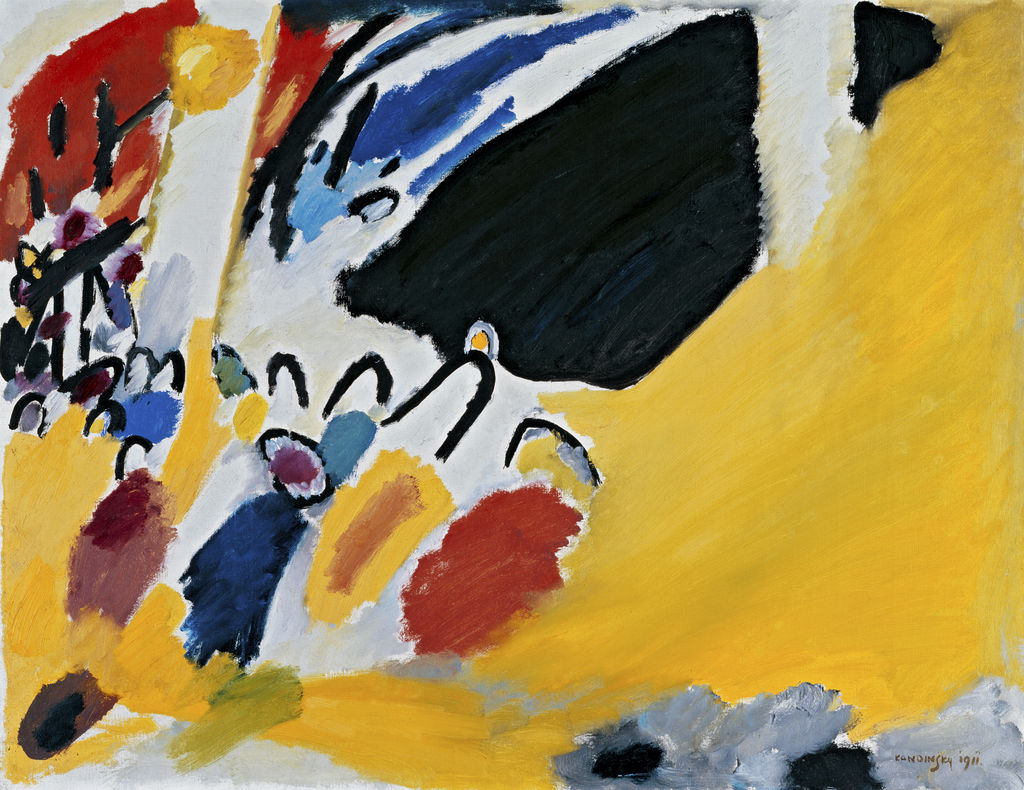
Munich also remained a site of concerts, writing and image circulation. Kandinsky’s response to a January 1911 Schoenberg concert is connected to the painting Impression III (Concert), while the almanac widened the project to music and other arts. These developments followed years of making and organising; they did not replace Murnau landscape work in one stroke. Kandinsky’s early book on art and spirituality and the music guide treat those specific exchanges. Here they show how the Munich and Murnau network gave artistic and practical form to ideas he was already testing with paint, print and glass. [4].
Reading the period through objects
One way to see the period clearly is to compare three owned, dated pictures rather than repeat a broad claim about a “breakthrough.” In 1908 the view from the Griesbräu window still builds a street, buildings and hills through broad strokes. The 1909 Grüngasse keeps a road but gives colour and dark shadows greater force. In 1910 Murnau with Church I makes its tower and houses harder to isolate in a moving field of colour. This sequence is an interpretive comparison, not proof that each canvas was conceived as a step toward the next. The Lenbachhaus records anchor the dates, media and subjects; close looking supplies the comparison. [7]; [8]; [9].
Then put a work by another painter beside them. Jawlensky’s Murnau Landscape makes angularity and opposed hues conspicuous; Münter’s portraits and place studies select different features; Werefkin’s painted figures keep psychological narrative in play. Their works prevent the whole setting from becoming the prologue to Kandinsky alone. The 1909 NKVM was a means to show such varied experiments together, and the later Blue Rider drew from—but did not simply duplicate—that association. [10]; [10]; [10].
The period ended through war and departure rather than through an artistic theory reaching a final stage. Kandinsky left Germany in 1914 as the First World War began. The works and materials that remained with Münter followed another path of preservation and later donation to Munich. Lenbachhaus dates her major gift to 1957; an older Centre Pompidou overview gives 1956, so the acquiring museum’s documented date is used here. The objects now allow readers to revisit the 1908–14 experiments in a richer sequence than the famous few reproductions once suggested. [12]; [6]; [1].
Kandinsky artworks directory
Frequently Asked Questions
He moved from Moscow to Munich in 1896 to study painting after an academic path in law and economics. The Centre Pompidou chronology places his academy entry in 1900, so the move and enrolment should not be treated as the same event. [1].
Kandinsky, Gabriele Münter, Alexej von Jawlensky and Marianne von Werefkin worked there together in 1908. They shared subjects and conversations but retained distinct artistic practices. Lenbachhaus dates a concentrated joint stay to late summer 1908. [5].
No. The Lenbachhaus documents a 1904 passage through Murnau. The important change in 1908 was the sustained joint painting stay with Münter, Jawlensky and Werefkin. [7].
Yes. She bought the house on 21 August 1909. She and Kandinsky spent extended periods there through 1914 and received other artists as guests. It remained important in Münter’s later life and is part of the foundation that preserves her work. [6].
No. The 1908 Griesbräu view still shows a street, houses and hills; the 1909 Grüngasse likewise keeps a recognizable place. Colour and form grow less dependent on natural appearance, and the 1910 Murnau with Church I presses further toward a loose field, but its tower and houses can still be identified. [7]; [9].
Discussion
Which Murnau landscape best shows a change in how Kandinsky used colour?
Name a dated work and a visible feature before interpreting its place in the period.
Reader Insights
Compare the 1908 Griesbräu view with a 1909 or 1910 Murnau work.
How did the four painters make distinct pictures of shared places?
Which object record distinguishes a painting from a later movement story?
Join the Conversation
Share a close observation anchored to a dated Murnau artwork.
References
- Centre Pompidou, Kandinsky monograph and chronology. Munich training, travel, media and later sequence. View source.
- Lenbachhaus, Under the Open Sky. Kandinsky and Münter’s shared travel and separate artistic perspectives. View source.
- Lenbachhaus, Soulmates. Jawlensky and Werefkin’s independent work, Murnau and NKVM roles. View source.
- Lenbachhaus, 2021 bilingual Blue Rider wall texts. Murnau, Munich salon, NKVM and 1911 events. View source.
- Lenbachhaus, 2021 bilingual research booklet. Murnau stay and reverse glass context. View source.
- Lenbachhaus, Gabriele Münter and Johannes Eichner Foundation. House purchase, guests and later history. View source.
- Lenbachhaus, 1908 Griesbräu view, GMS 34. Support image, medium, dimensions, CC0 and early Murnau chronology. View source.
- Lenbachhaus, 1909 Murnau – Grüngasse, GMS 42. Comparison landscape. View source.
- Lenbachhaus, 1910 Murnau with Church I, GMS 59. Later landscape and object interpretation. View source.
- Lenbachhaus, 1909 Jawlensky Murnau Landscape, Münter Jawlensky and Werefkin and Werefkin Washerwomen. Independent works; images not reused. View source 1 · View source 2 · View source 3.
- Lenbachhaus, Blue Rider history. Transition to exhibition and almanac. View source.
- Lenbachhaus collection. The acquiring museum dates Münter’s donation to 1957; the older Pompidou overview says 1956. View source.
- Lenbachhaus Summer Evening. View source.