


 by Tom Gurney
Tom Gurney BSc (Hons) is an art history expert with over 20 years experience
Email: tomgurney1@gmail.com / Phone: +44 7429 011000
Introduction
In a photograph of the 1906 German Centenary Exhibition in Berlin, Friedrich's paintings hang in two rows against pale walls. The Sea of Ice, The Stages of Life and Monk by the Sea can be recognised among them. Pictures separated by date, subject and ownership had been brought into a concentrated encounter. The concentrated display helped an audience recognise the range of a painter whose reputation had become marginal. [1]
Rediscovery describes a change in attention. Paintings survived in royal galleries, museums and family collections. In his response to the 1906 exhibition, Nationalgalerie director Hugo von Tschudi acknowledged that Friedrich was already represented in the museum. Bringing familiar works together with pictures from private owners enabled visitors to recognise the range of his achievement. [2]
At a Glance
- Berlin · Academy exhibition of 1810
- Nationalgalerie · Centenary exhibition of 1906
- Anniversary exhibitions · Hamburg, Berlin and Dresden, 2023–25
Contents
- Introduction
- The arguments of 1810
- Praise, resistance and continued visibility
- Berlin in 1906
- Political appropriation and later interpretation
- Encountering Friedrich abroad
- The anniversary exhibitions of 2023–25
- Andreas Aubert and the route back through Dahl
- Reading the same picture in two museum catalogues
- A collection takes shape in Paris
- An exhibition afterlife in photographs and records
The arguments of 1810
Friedrich's early reputation developed through exhibitions that unsettled viewers' expectations of landscape. The controversy surrounding Cross in the Mountains, shown in his Dresden apartment over Christmas 1808, was already under way when he sent two large canvases to Berlin in 1810. Basilius von Ramdohr's attack on the altarpiece in 1809 questioned the devotional claims of a landscape. The crucifix, mountain and trees had made the status of an entire genre a matter of public dispute. [3]
Monk by the Sea and Abbey in the Oakwood appeared together at the Berlin Academy exhibition in 1810. The first offers a small human presence against immense horizontal expanses. The companion gathers a funeral procession among bare oaks and ruined masonry. In the first, distance seems to extend almost beyond the picture's capacity to contain it. In the second, the arch of the ruin and the trees interrupt the sky. Their paired display gave viewers two markedly different experiences of scale, death and the limits of human understanding. [4]
The literary response to Monk has a history of its own. Clemens Brentano and Achim von Arnim prepared a manuscript in which an opening meditation was followed by conversations among imagined exhibition visitors. The Freies Deutsches Hochstift, which preserves the manuscript, identifies Brentano's writing and Arnim's continuation. Their dialogue let different voices try out ways of responding to the painting. Humour and irony formed part of the encounter. [5]
Heinrich von Kleist substantially shortened and revised their text for the Berliner Abendblätter on 13 October 1810. He retained much of the opening, removed the dialogue's critical and ironic elements and constructed a much more concentrated response. After Brentano objected, Kleist published an explanation accepting responsibility for the printed version. The text commonly associated with Kleist therefore emerged through an editorial exchange among three writers. [5]
Birgit Verwiebe's account of the painting distinguishes Brentano's treatment of longing and infinity from Kleist's apocalyptic emphasis. The printed response's disturbing image of exposed eyes gives literary form to an encounter with a picture that seems to deny shelter. That response became part of the painting's subsequent identity. Readers approaching the canvas through Kleist already possess a powerful language for its emptiness and vulnerability. The episode also preserves evidence of disagreement about how an unfamiliar painting should be described. [4]
Praise, resistance and continued visibility
Contemporary responses varied even within the reception of a single picture. Woman at a Window appeared at the Dresden Academy exhibition in 1822. A review in the Wiener Zeitschrift für Kunst, reproduced in Berlin's collection essay, admired the simple studio setting while objecting to Friedrich's habit of showing people from behind. The same painting inspired Friedrich de la Motte Fouqué to write a sonnet. Its silence could prompt irritation or poetic invention. [6]
Caroline stands at an opening through which we see masts, sky and trees. Her turned body conceals her expression. The 1822 review records the difficulty this withholding presented to an early audience, while Fouqué's sonnet demonstrates the possibilities it opened for another viewer. [6]
After Friedrich's death in 1840, the settings in which his work could be encountered remained uneven. Verwiebe documents the public display of Monk by the Sea, Abbey in the Oakwood and Morning in the Riesengebirge in the king's Vaterländische Galerie at Schloss Bellevue from 1844 to 1865. The paintings therefore had an audience during the decades usually associated with Friedrich's declining reputation. Access to three important pictures still supplied only a partial view of his career. [7]
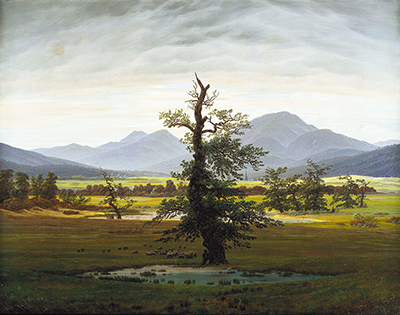
Institutional collecting preserved another part of the work. The Nationalgalerie's founding collection of 1861 included The Solitary Tree and Moonrise by the Sea. The museum's purpose-built home opened in 1876. These dates place Friedrich within the history of a national collection well before the centenary exhibition. The fuller account of the commission and the collector belongs to Friends, Patrons and Collectors. Here the consequence was that a pair of his landscapes had entered an enduring public institution. [8]
Other works remained with relatives. Berlin's Woman at a Window record traces its acquisition to Johanna Friedrich in Greifswald in July 1906. The painting's appearance in the centenary exhibition brought a work long held by the family into the same public conversation as established museum pictures. Acquisition records help explain why the revival could feel like a revelation even to visitors who had previously encountered Friedrich. [6]
Berlin in 1906
The centenary exhibition surveyed German art from 1775 to 1875. Its title referred to a century of art, and the event took place sixty-six years after Friedrich's death. It assembled thirty-six of his paintings and fifty-seven drawings. The paintings occupied two apse rooms in the Nationalgalerie, while the drawings were displayed in the nearby Neues Museum. The division also gave visitors access to two substantial aspects of his practice. [2]
The museum's exhibition history names Hugo von Tschudi, Alfred Lichtwark and Woldemar von Seidlitz as its curators, with Julius Meier-Graefe also involved. Andreas Aubert's research on Dahl had helped draw Lichtwark and Tschudi's attention to Friedrich. [1]
Peter Behrens designed the exhibition architecture, poster and catalogue cover. The surviving installation photograph lets us see how pale walls and a relatively restrained two-row arrangement gave individual landscapes space to register. The arrangement facilitated comparison across pictures of different sizes and subjects. [1]
The revival had already begun before the exhibition opened. Hamburg acquired The Sea of Ice in 1905. The painting's new institutional home and its appearance in Berlin belong to the same period of renewed attention. Its splintered, rising ice presents a demanding test of landscape painting's ability to organise a surface, with a wreck pressed into a comparatively small area among the floes. It offered the revived reputation a work of extraordinary visual severity. [9]
For Tschudi and his generation, Friedrich's command of light and atmosphere helped establish his place in a history leading towards modern painting. The Berlin exhibition texts connect this reassessment to a conception of art shaped by Impressionism. That interest directed attention to qualities that earlier discussions of religious meaning could leave less prominent. Their surfaces combined close observation and carefully managed colour with subjects open to interpretation. [2]
Political appropriation and later interpretation
Friedrich's recovered prominence made his work available to political appropriation. The Pommersches Landesmuseum documents the National Socialist use of his northern landscapes and a chauvinistic reinterpretation of his patriotism during the Napoleonic Wars. Its reception display includes the Greifswald mayor Friedrich Rickels's 1940 memorial speech. The occasion was the centenary of Friedrich's death, and the speaker's claim that National Socialist Germany understood the artist reveals the regime asserting possession of his legacy. [10]
The museum also records the difficulty this exploitation created for later viewers. The anniversary of 1974 brought exhibitions in Hamburg and Dresden with distinct concepts and mutual loans across divided Germany. Their cooperation and their differing presentations belong together in the reception history. The same paintings could be approached through competing scholarly and institutional priorities, while the act of lending allowed audiences to encounter a wider selection. [10]
The bicentenary exhibitions were supported by an expanding body of research. The Friedrich Centre's reception bibliography records the 1973 catalogue raisonné by Helmut Börsch-Supan and Karl Wilhelm Jähnig, Werner Hofmann's Hamburg exhibition catalogue of 1974 and Hans Joachim Neidhardt's Caspar David Friedrich und sein Kreis for Dresden. The Dresden title placed Friedrich among his circle, making artistic relationships part of the exhibition's declared subject. These publications provided durable records through which the displays could continue to be studied. [11]
The international audience was growing as well. Tate's archive records Caspar David Friedrich: Romantic Landscape Painting in Dresden from 6 September to 15 October 1972. Its files preserve the organisation of an exhibition through which British visitors could encounter works gathered for a limited period. The show preceded the German bicentenary and demonstrates that Friedrich's widening reputation involved several institutions and occasions. [12]
Encountering Friedrich abroad
Writing for the 1990 exhibition The Romantic Vision of Caspar David Friedrich, Robert Rosenblum recalled an American audience that had known the artist largely through slides and book illustrations. He described the importance of travelling to see the paintings themselves. The distinction concerns colour, scale and surface as well as access. A reproduction can establish the outline of Monk by the Sea, while the original makes the relationships between a dark strip of water and the shifting sky a much more sustained experience. [13]
That exhibition brought paintings and drawings from the Soviet Union to Chicago in 1990–91 and New York in 1991. Its catalogue joined Rosenblum's introduction with Boris Asvarishch's research on the Russian collections and Sabine Rewald's object entries. The publication made collection history, individual works and modern interpretation available within one volume. Visitors were encountering pictures whose preservation outside Germany formed an essential part of the artist's surviving achievement. [13]
The Louvre's purchase of L'Arbre aux corbeaux in 1975 offers another concrete point in this international history. Its acquisition record dates the purchase through the museum's committee, council and decree. A landscape by Friedrich had acquired a permanent home within a major French collection. The picture's earlier ownership and its specific imagery are treated on its own artwork page, while the acquisition here marks a widening institutional presence. [14]
At the Met, Moonwatchers in 2001 used a concentrated comparison. Dresden's Two Men Contemplating the Moon, Berlin's Man and Woman Contemplating the Moon and the Met's newly acquired version could be considered together. The exhibition presented a recurring subject through differences between pictures. Its discussion acknowledged Christian, mystical and political interpretations of the Dresden painting. Visitors could examine the arrangement of figures and trees while considering why the imagery had generated such divergent readings. [15]
The anniversary exhibitions of 2023–25
Hamburg's Art for a New Age, held from December 2023 to April 2024, included a separate section devoted to contemporary artists inspired by Friedrich. The exhibition's bilingual leaflet described around twenty such artists. Placing contemporary responses within the show made his afterlife part of the visitor's encounter with the historical work. It invited consideration of what later artists had selected from his ways of presenting nature and human presence. [16]
Berlin's Infinite Landscapes in April–August 2024 returned explicitly to the museum's role in the 1906 revival. It also incorporated research into Friedrich's working methods. Its account of recent conservation and technical examination connected interpretation with physical evidence from the pictures. The institutional history of displaying Friedrich and the material history of his canvases became related subjects within a single retrospective. [17]
Dresden's Where It All Started opened in August 2024 at the Albertinum and Kupferstich-Kabinett. The two venues brought painting and drawing into the city where Friedrich had worked for more than forty years. The exhibition's stated emphasis on his engagement with academic traditions and the surrounding countryside restored local practice to a reputation that had become international. [18]
The Met's The Soul of Nature, held from 8 February to 11 May 2025, extended that collaboration across the Atlantic. The museum identified it as the first comprehensive United States exhibition dedicated to Friedrich and distinguished it from the narrower presentations of 1990–91 and 2001. Paintings, finished drawings and working sketches brought several kinds of evidence before its audience. [19]
The recent retrospectives have made these encounters accessible beyond their closing dates. Digital labels, catalogues and collection records allow a reader to move between an exhibition's argument and the particular works on which it depends. Friedrich's reception continues through those comparisons, with each display opening the paintings to another audience.
Andreas Aubert and the route back through Dahl
The groundwork for Friedrich's large showing in Berlin was already being laid while his paintings were still scattered. Andreas Aubert encountered the artist in the course of investigating the Norwegian painter Johan Christian Dahl. The Berlin museum's digital exhibition traces publication to 1893 and the German appearance of the relevant chapter to 1895. It also identifies Aubert as a source of information for the museum directors Alfred Lichtwark and Hugo von Tschudi. The route to a canon of German painting thus passed through research on a Norwegian artist and through the translation of art history.[20]
There was a material reason why looking for Dahl could make Friedrich visible. The Dresden version of Two Men Contemplating the Moon had belonged to Dahl. Werner Busch draws attention to Wilhelm Wegener's 1859 account of Friedrich and to the small number of his paintings then in Dresden's picture gallery. He suggests that Dahl's part in placing the moon painting in the gallery may have been a deliberate effort to keep his friend's memory present. The suggestion describes a possible motive. The relationship and passage of the painting supply the historical evidence on which the suggestion rests.[21]
A museum object can preserve part of that chain without continuously receiving the attention that originally brought it there. The identity of the two moonwatchers, for example, remains an interpretive question. The ability to attach the composition to Dahl's ownership gives a different kind of historical knowledge. It identifies a painter who looked at the picture and whose activities made it possible for others to see it later. The biographical source that records the work also records a scarcity of Friedrich's paintings in the gallery. Early custody and later recognition are different measures of what survived.[21]
This sequence helps locate the event of 1906 more precisely. A public rediscovery on that scale required published scholarship, identifiable pictures, access to owners and people able to bring the material into an exhibition. The years of work by Aubert and the exchanges between historians and museum directors made a body of objects available for the kind of argument the exhibition could mount. The 1906 visitors saw a large assembly of works. The underlying knowledge had arrived in smaller units, often through a question about a particular artist or a particular painting.[20][21]
Reading the same picture in two museum catalogues
A gallery catalogue can preserve the language in which an institution wanted its visitors to see a painting. Birgit Verwiebe's study of the Nationalgalerie catalogues reproduces the pages of the 1861 Wagener catalogue with The Solitary Tree and Moonrise over the Sea. That catalogue belongs to the conversion of a private collection into the foundation of a public institution. The placement of the two paintings under Friedrich's name joins them to a new survey of contemporary art. Readers could find the works even when their interests were quite different from those of the person who had acquired them.[22]
Verwiebe contrasts such earlier practices with the emphasis on colour and form in the 1906 Centenary Exhibition. The catalogue discussion of The Solitary Tree takes the eye from the shaded ground and its water through the green middle distance and towards the cooler mountains and clouds. The sequence is easy to try against the painting. Read this way, it is a landscape in which slight changes of colour build intervals of space. The oak can carry much of the painting's identity while these intervals give an observer another way to spend time with the work.[22]
This reading does not require the catalogue to settle the significance of the tree or the relationship of the work to its pendant. Its historical interest lies in where it directs attention and which comparisons it makes easy. An observer comparing painted greens or the way clouds change tone can place Friedrich beside work from other moments of nineteenth-century landscape. A reader trying to recover the commission or the pairing will need to look for other kinds of description. The object provides grounds for both kinds of inquiry. The catalogue shows one of them acquiring unusual institutional authority at a particular date.[22]
Cataloguing could also produce very practical differences in access. Verwiebe notes that the 1907 catalogue retained an earlier structure to which additions had accumulated. Five paintings by Friedrich had to be looked up in three different places. The new 1908 catalogue reorganized the collection and included around 300 monochrome photographs across its entries. It is worth distinguishing the result in a reader's hands from an exhibition installation. Illustrations and a clear arrangement can bring objects into comparison, including after a visit. Black and white can communicate many features of a composition, while leaving a visitor to recover from the object itself the precise colours a catalogue might praise.[22]
A collection takes shape in Paris
In France, the purchase of L’Arbre aux corbeaux made a particularly visible point of entry. The Louvre's Côme Fabre describes the acquisition in 1975, associated with Michel Laclotte, as the beginning of the museum's collection of paintings from the German-speaking lands of the first half of the nineteenth century. The claim is about the formation of a painting collection. Drawings, visiting loans and other means of encountering Friedrich have their own histories. The purchase gave the Louvre an object around which it could develop longer-term comparisons and a continuing account of this period.[14][23]
A later acquisition suggests how such comparisons can change. In 2013 the Louvre bought Oehme's mining scene in the Ore Mountains, catalogued in French as Paysage des monts Métallifères au petit matin, avec deux ouvriers de la mine en prière, avant de descendre dans le puits. The long descriptive title gives a place, an hour, an occupation and an action. It leads a reader into a particular circumstance within a landscape. The familiar title L’Arbre aux corbeaux can give the immediate impression that one dominant natural form and its birds carry the picture. The differences between the records and the paintings make the two objects useful to one another inside a collection.[24]
The mining scene also shows why provenance matters to a history of reception. The Louvre record identifies stages in the work's earlier ownership and the dealer from whom it was acquired. For a spectator there is the question of what the picture presents. For a museum there is also the question of how it can establish the history of the object it is making available. Those enquiries operate at different levels. They come together when the museum gives the picture a title, an accession record and a place in the narrative of a collection. The form in which a later audience meets Friedrich depends partly on the answers an institution can give to all three questions.[23][24]
The Louvre has also interpreted L’Arbre aux corbeaux for an audience of children and families through its Mini-Louvre materials. In that context the bird, tree and branch provide starting points for looking. The same object can enter a curator's lecture through the history of museum acquisitions and enter an education resource through readily identifiable forms. These are two kinds of public access created by a single acquisition. They help explain why placing a picture within a museum's holdings has consequences long after the date on which it was bought.[23][25]
An exhibition afterlife in photographs and records
The Tate archive gives the London exhibition of 1972 several kinds of surviving record. The administrative files establish the exhibition and its organisation, while the photographic inventory lists installation views and images of works exhibited. The distinction matters if a later reader wants to know how pictures were encountered. A list of works can establish inclusion. An installation view can show scale relative to a wall or an adjacency that a list leaves unspecified. A photograph of an individual work can circulate after the temporary arrangement has been dismantled.[12][26]
The archival image of Friedrich's gallery at the 1906 exhibition serves a similar purpose for an earlier moment. Its modern presentation identifies a view designed by Peter Behrens, with paintings in two rows against light backgrounds. In the surviving view The Sea of Ice, The Stages of Life and The Monk by the Sea belong to one spatial arrangement. A visitor might have moved from the relative calm of a low horizontal field to the ice picture's crowded foreground, or turned towards the shore where the figures in The Stages of Life gather. The photograph makes such paths possible to imagine and gives evidence for the works' proximity. The movements of an individual visitor remain outside its record.[20]
These forms of evidence also change which questions a historian can ask. A modern reader can consult the floor plan for the relation between rooms, look to a photograph for the arrangement on a wall and consult a catalogue for a work's title at the time. Each kind of evidence has omissions. Taken together, they recover more about historical access to Friedrich's art than the exhibition title or the date of opening by itself. They explain how two audiences, each looking carefully at Friedrich, might have formed different pictures of the artist simply because different parts of his work were available for comparison.[20][22][26]

Frequently Asked Questions
Discussion
Which works did different exhibitions bring together?
Reader Insights
How did The Lonely Tree reach the Nationalgalerie?
Which works did different exhibitions bring together?
How did contemporary and later readers describe the paintings?
How did The Lonely Tree reach the Nationalgalerie?
Join the Conversation
Share what you noticed in Reception and Rediscovery.
References
- Staatliche Museen zu Berlin and anniversary museum partnership, Caspar David Friedrich at the German Centenary Exhibition of 1906, German digital exhibition with historic catalogue cover, floor plan and installation photograph.
- Alte Nationalgalerie, Infinite Landscapes, exhibition texts, 2024, section on the Jahrhundertausstellung and Tschudi's 1906 response.
- Gerd Spitzer, Sächsische Biografie, Caspar David Friedrich, German scholarly biography, Tetschen controversy.
- Birgit Verwiebe, Monk by the Sea, 2023 catalogue essay republished by the anniversary museum partnership, including the 1810 literary response.
- Freies Deutsches Hochstift, Brentano and Arnim's manuscript of Verschiedene Empfindungen vor Friedrichs Seelandschaft, German museum commentary on the surviving manuscript and Kleist's revisions.
- Birgit Verwiebe, Staatliche Museen zu Berlin, Frau am Fenster, A I 918, collection record, 1822 review and July 1906 acquisition.
- Birgit Verwiebe, 2024 catalogue essay on Friedrich, Berlin and the Nationalgalerie, German, Bellevue display of 1844–65.
- Anniversary museum partnership, Foundation of the Nationalgalerie in Berlin, 1861, German chronology entry.
- Hamburger Kunsthalle and anniversary museum partnership, The Sea of Ice, HK-1051, collection and catalogue essay, acquisition in 1905.
- Pommersches Landesmuseum, A History of Perception, museum reception display, including the 1940 Rickels speech and 1974 exhibitions.
- Caspar-David-Friedrich-Zentrum, Rezeption, German bibliography of the 1973 catalogue raisonné and 1974 Hamburg and Dresden exhibition catalogues.
- Tate Archive, Organisation Part 4, Caspar David Friedrich, 1972, TG 92/248/4, exhibition dates and organisational archive.
- Sabine Rewald, ed., Robert Rosenblum and Boris I. Asvarishch, The Romantic Vision of Caspar David Friedrich: Paintings and Drawings from the U.S.S.R., Metropolitan Museum of Art and Art Institute of Chicago, 1990, front matter and Rosenblum's introduction, pp. 3–11.
- Musée du Louvre, L'Arbre aux corbeaux, RF 1975 20, French collection record, acquisition dates.
- Metropolitan Museum of Art, Caspar David Friedrich: Moonwatchers, 2001 exhibition record and version comparisons.
- Hamburger Kunsthalle, Art for a New Age, bilingual exhibition leaflet, 2023–24, contemporary-art section.
- Alte Nationalgalerie, Caspar David Friedrich: Infinite Landscapes, 2024 exhibition record.
- Staatliche Kunstsammlungen Dresden and anniversary museum partnership, Anniversary Exhibitions, Where It All Started, 2024–25 venue dates and curatorial scope.
- Metropolitan Museum of Art, The Soul of Nature, exhibition announcement and account of earlier US exhibitions, December 2024, exhibition held February–May 2025.
- Staatliche Museen zu Berlin and anniversary museum partnership, Caspar David Friedrich and the German Centenary Exhibition of 1906, especially the account of Aubert and the installation documentation.
- Werner Busch, Caspar David Friedrichs Zwei Männer in Betrachtung des Mondes, in Atlas der Weltbilder, 2011, pp. 306–316.
- Birgit Verwiebe, Bestandskataloge, Galeriekataloge, Sammlungsführer, in Die Sammlung der Nationalgalerie zum langen 19. Jahrhundert, including the Wagener and Tschudi catalogues.
- Côme Fabre, Musée du Louvre, À l’est, du nouveau ! La collection de peintures allemandes du 19e siècle au Louvre, 2026 curator lecture description.
- Musée du Louvre, Paysage des monts Métallifères au petit matin, object and acquisition record.
- Musée du Louvre, Mini-Louvre education resource, p. 17, on L’Arbre aux corbeaux.
- Tate Archive, Tate Exhibitions photographic collection list, entry for the 1972 Friedrich exhibition.