 by Tom Gurney
Tom Gurney BSc (Hons) is an art history expert with over 20 years experience
Email: tomgurney1@gmail.com / Phone: +44 7429 011000
Introduction
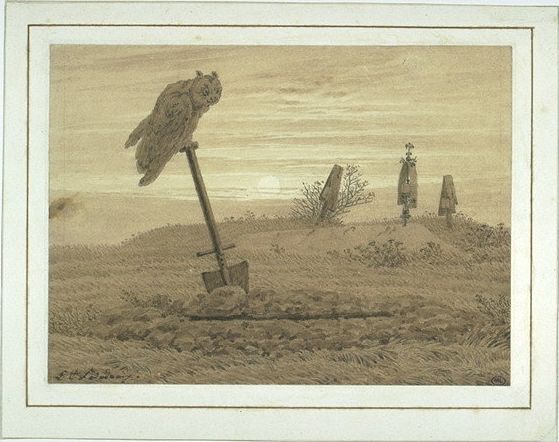
An owl grips the handle of a gravedigger’s shovel. The shaft leans towards the left, carrying the bird high above the narrow dark opening in the foreground. A pale moon hangs low enough to seem almost level with the grave markers on the hill. Caspar David Friedrich brought these details together in a drawing just fourteen centimetres high and nineteen wide. The Louvre dates the sheet to 1834 and catalogues it as Le cimetière sous la lune avec un hibou, RF 35803 recto. Friedrich gave it to the French sculptor Pierre-Jean David d’Angers, whose account of their meeting helps explain what we are looking at. [1][2]
At a Glance
- Date · 1834
- Medium · Brown ink and wash with pencil
- Collection · Musée du Louvre, Département des Arts graphiques
- Accession · RF 35803 recto
- Dimensions · 14 cm high × 19 cm wide
Contents
- Introduction
- The shovel and the open grave
- Drawing a moonlit scene in brown ink
- A gift to David d’Angers
- The owl, the vulture and the coffin
The shovel and the open grave
The owl is the easiest figure to make out. Its folded wings form an elongated shape that droops to the left, while its head turns towards the right. Its two small ear tufts interrupt the otherwise rounded outline of the head. The feet gather at one small point on the shovel handle. Once you find that point, the shaft carries the eye down to the crosspiece and the broad, dark blade, which disappears into a mound of earth. The gravedigger’s work is apparent from the tool and the broken ground. The position of the blade, close to the grave’s edge, gives the bird a perch precisely where a person might stand to look down. [1]

At first the grave can be difficult to make out. The disturbed earth spreads widely across the foreground, with clods and overlapping edges that take time to distinguish. The opening itself registers as a thin, nearly horizontal darkness. We are looking across the ground at a shallow angle, so much of the depth of the grave is hidden. Above it, the dark shaft holds its straight course through grass and soil marked by hundreds of short strokes. The blade’s geometric shape belongs to the same piece of work as the cut in the ground. The bird, perched above both, turns the trace of someone’s labour into the main incident of the drawing. [1]
Beyond the shovel, the land rises gently to three upright markers. The leftmost one leans amid a spray of twigs, the middle one has a small upright detail at its top, and the one farthest right stands a little apart. Their spacing gives the hill a shape and lets the pale sky show between them. The cemetery extends beyond the freshly opened grave. Past the markers there is little to interrupt the view. Horizontal bands of cloud stretch across the sky, and one of them passes across the pale disk. The moon is close to the centre of the composition, yet its outline is much softer than the silhouette of the owl. The eye may have to adjust to the middle tones of the sky before the moon becomes clear. [1]
Drawing a moonlit scene in brown ink
The Metropolitan Museum of Art describes the Louvre sheet as brown ink and wash with pencil on mounted wove paper. The Louvre indexes brown wash, brush and graphite. Ink wash uses diluted ink applied by brush. Here the broad, lightly toned bands suggest distance and give the sky a continuous surface, while much darker marks describe the shovel, the owl’s face and the edge of the grave. At the bottom, strokes gather into uneven groups that give the grass its direction. Near the horizon they become smaller and more widely spaced. That change in scale makes the hill seem to recede within a very short distance on the page. [1][2][3][4]
The most useful passage to compare with the moon is the face of the owl. Small, dark marks pick out the eyes, and overlapping strokes turn the head into a rounded form. The moon emerges through an almost opposite distribution of light and shade. Its pale area merges at intervals with the brighter bands around it, so the disk feels embedded in the sky. Along the upper edge of the grave, the dark line interrupts the earth even where surrounding marks partly break it up. The very dark brown lines and the lighter washes therefore ask the eye to do different kinds of work. You can follow the shovel in one glance, while the moon and the ground take longer to read. [1][2]
Friedrich had made his early reputation with finished works in ink wash, and the Met identifies a return to the medium in his last years. The gift shows that he was already using it for a finished picture of this kind in 1834, before the stroke he suffered the following year. The surface brings out how much can be done with slight changes of tone. The shovel and the nearest grave read as solid things occupying particular places. The sky, rendered in the same range of browns, gives the impression of air extending beyond the hill. The larger history of Friedrich’s drawings includes studies and exhibition pieces that put the same tools to very different uses. [1][3][5]
A gift to David d’Angers
In 1834 David d’Angers sought out Friedrich in Dresden. In the passage from his notebooks reproduced by the Louvre, the sculptor recalls asking Friedrich to sign a drawing he had given him. David identifies a grave, the shovel planted on its edge, an owl perched on the shovel and a moon illuminating the scene. He also recalls that Friedrich let a little ink fall on the drawing. The Louvre describes the sheet as one of the few that Friedrich signed. The signature is visible along the lower left of the picture. Read alongside the sheet, the account records the circumstances of the request and confirms the identity of the tool and its relation to the grave, details that the dark foreground can make surprisingly easy to miss. The Louvre received the work as a gift from Prouté in 1974. [1][2][6]
David called Friedrich’s work “the tragedy of the landscape.” Writing of this sheet and other moonlit scenes, he admired how simply Friedrich could convey sublime things. Here a few physical traces are enough to imply a human event. The turned earth and upright shovel point to someone who has dug a grave. The other markers imply earlier burials. The owl has settled on the tool during a moment when the work has stopped, and the moon illuminates the old graves and the new one alike. The scene leaves us in that interval. The action David remembered is held in the objects, down to the particular way the shovel is lodged in the ground. [1][2][6]
The owl, the vulture and the coffin
A sheet in the Klassik Stiftung Weimar, Eule am Grab, is dated 1834 and catalogued as KK 4713. It preserves the same arrangement of bird, shovel and grave, with the low moon between the shovel and the markers. In Weimar, the band of shadow across the grave is sharply defined, and the pale disk stands out against the clouds. In Paris, the twigs around the leaning marker and the broken ground beside the grave provide more points of interest between those principal forms. The Louvre describes the Weimar drawing as a less detailed treatment of the subject. Each sheet retains the owl’s compact head and folded wings, and in both the angle of the shovel links the perch to the foreground. [1][7]
The Albertina’s Landschaft mit Gräbern, inventory 24610, is a larger sheet measuring 23.8 by 28.6 centimetres. Its holding museum dates it to about 1835–37. The Met exhibited it as Cemetery Landscape with a Vulture and dated it to about 1834. The bird bends its head down towards the open grave, with a hooked beak in place of the owl’s round face and small tufts. There is more sky above it, and the low moon and the distant markers remain. In the Met’s reading, the vulture introduces the possibility of a scavenger feeding on a body, while the moon recalls songs of the period in which moonrise suggested the ascent of the soul. The difference in the birds’ posture makes the comparison particularly telling. The owl turns its face out across the scene. The vulture’s lowered head directs attention towards the opening and what might be placed there. [1][2][8]
In the Hamburger Kunsthalle’s Owl with a Coffin (1835–38), the bird is perched on a coffin resting across an excavated grave. The larger sheet includes two shovels, a rope for lowering the coffin and a moonlit coastal distance. It gives the burial a further stage, with the coffin in place and ready to be lowered. Friedrich had also depicted a funeral in the much earlier oil painting The Abbey in the Oakwood, where people carry a coffin towards the Gothic ruin. At the Louvre, the shaft of a single shovel leads from the excavated earth to a living bird. Follow it in either direction and the same small area of the paper joins the work of burial to a moment of stillness under the moon. [1][9][10]
Frequently Asked Questions
Discussion
Where does the wash make the strongest distinction between ground and sky?
Reader Insights
Where does the shovel lead your eye?
Where does the wash make the strongest distinction between ground and sky?
How are the distant markers arranged?
Where does the shovel lead your eye?
Join the Conversation
Share what you noticed in Cemetery in Moonlight with an Owl.
References
- Musée du Louvre, Le cimetière sous la lune avec un hibou, RF 35803 recto, French collection record and reproduction. View source.
- The Metropolitan Museum of Art, Caspar David Friedrich: The Soul of Nature, exhibition gallery texts, pp. 29–30. View source.
- The Metropolitan Museum of Art, Caspar David Friedrich: The Soul of Nature, “The Great Beyond” and selected works. View source.
- Getty Research Institute, Art & Architecture Thesaurus, “ink wash (technique),” 300404638. View source.
- Friedrich anniversary chronicle, 1834 visit and 26 June 1835 stroke. View source.
- Pierre-Jean David d’Angers, Les Carnets de David d’Angers, ed. André Bruel (Paris, Plon, 1958), vol. I, p. 329, excerpt reproduced under “Commentaire” in the Louvre’s French record. Read the excerpt.
- Klassik Stiftung Weimar, Eule am Grab, KK 4713, collection record and reproduction. View source.
- Albertina, Landschaft mit Gräbern, 24610, collection record and reproduction. View source.
- Markus Bertsch, Owl with a Coffin, Hamburger Kunsthalle 41119, Hamburg exhibition catalogue essay as reproduced in the Friedrich anniversary chronicle. View source.
- Staatliche Museen zu Berlin, Abtei im Eichwald, collection record and reproduction. View source.