 by Tom Gurney
Tom Gurney BSc (Hons) is an art history expert with over 20 years experience
Email: tomgurney1@gmail.com / Phone: +44 7429 011000
Introduction
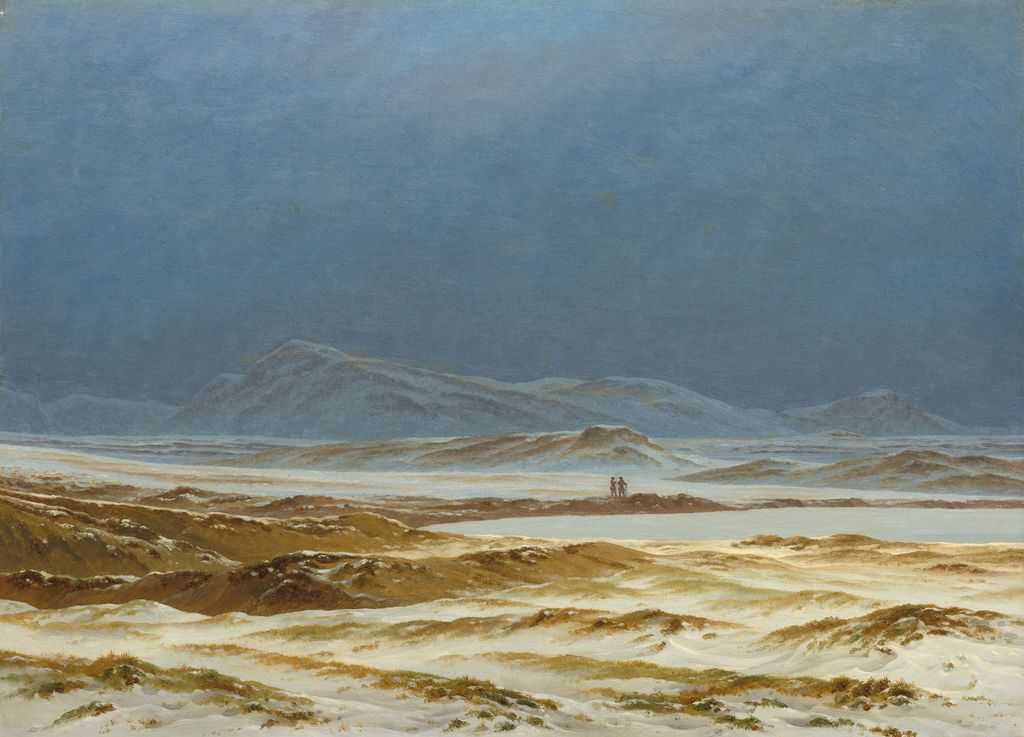
Just above the lower edge of Caspar David Friedrich’s Northern Landscape, Spring, short blades of grass stick up through the snow. They are easy to miss beneath the expanse of blue sky. Two people stand on a brown strip of land beyond a pale reach of ice, their bodies scarcely interrupting the horizontal bands of land and snow. Friedrich gives the first signs of spring as little room as he gives the people. The closer you look, the more there is going on in a landscape that at first seems almost still. [1][2]
At a Glance
- Artist — Caspar David Friedrich
- Titles — Northern Landscape, Spring in the National Gallery of Art, Nordische Frühlingslandschaft in the Hamburg exhibition catalogue
- Date and medium — About 1825, oil on canvas
- Dimensions — 35.3 cm high × 49.1 cm wide
- Collection — National Gallery of Art, Washington, DC, 2004.113.1, Patrons’ Permanent Fund [1][3]
Contents
- Introduction
- From the rough ground to the mountains
- What makes it spring?
- Two people on the far bank
- A northern setting and an early account
- From a Munich estate sale to Washington
- Annotated Details
- Image Details
From the rough ground to the mountains
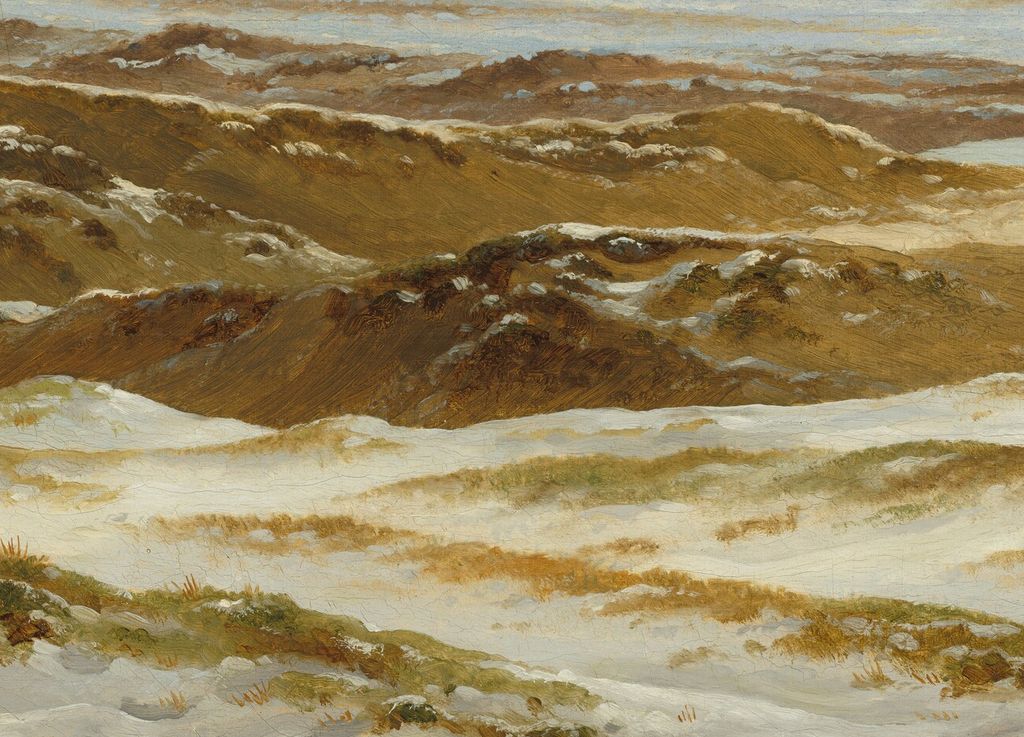
The foreground is a succession of low rises and hollows. At the left, brown banks overlap, with broken white edges where snow catches on the crests. Farther down, the relationship reverses. Snow covers much of the surface and uneven strips of earth interrupt it. Across the lower right, pale brushstrokes bend around the humps of ground. Friedrich lets their curves do much of the work of describing slope and depth. The small tufts at the bottom stand up against these broader strokes and bring the nearest ground into focus. [1]
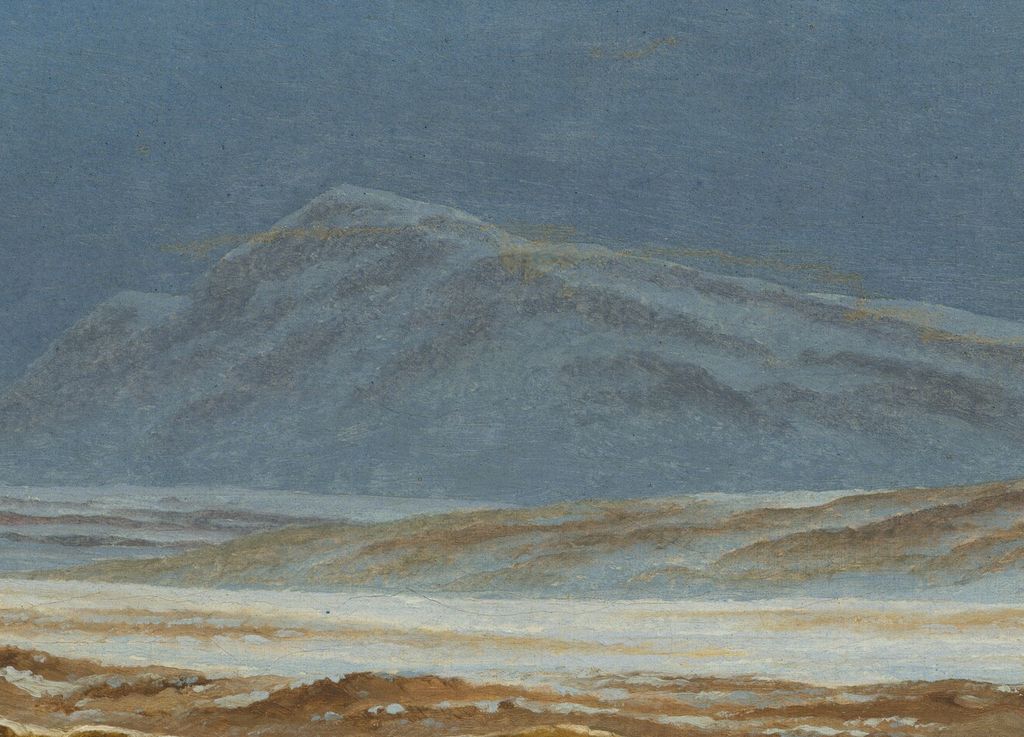
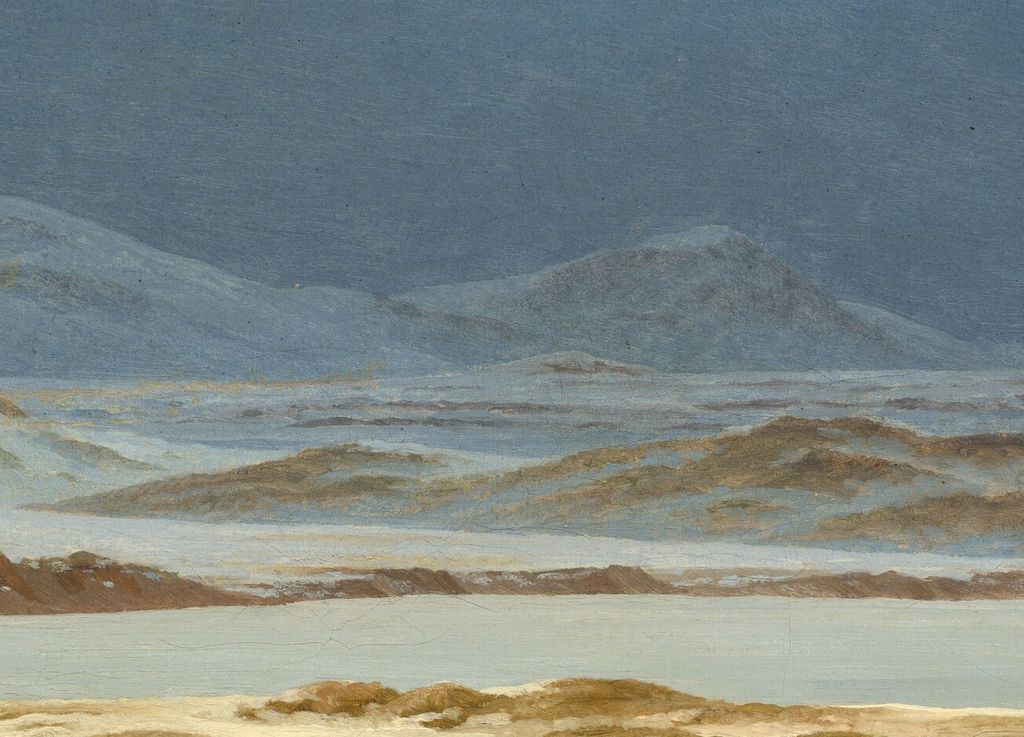
Beyond the foreground, a long strip of pale blue enters from the right. Its even surface is especially clear against the broken edges of the land around it. The National Gallery of Art describes it as a frozen lake or river. Across it, the two figures stand a little right of centre. The brown bank gives them a line to stand on, and the pale snow beyond it makes their upper bodies easier to pick out. Farther back the ridges stretch sideways and their edges begin to lose definition. A larger summit rises left of centre, while a separate, lower peak interrupts the skyline towards the right. [1]
The sky is darkest above the distant slopes and lightens subtly towards the upper edge. The hills and sky share enough blue for the mountain contours to seem partly absorbed by the air around them. The nearest earth, in shades of ochre and brown, has much sharper changes of colour. Friedrich builds the sense of distance out of that difference. The foreground comes close enough to inspect blade by blade, while the far slopes are legible mostly by their outlines. Within a canvas less than half a metre wide, the space between those kinds of looking is considerable. [1][3]
What makes it spring?
The shoots are most apparent near the bottom, where some cluster around low patches of vegetation and others stand singly on pale ground. There is green in some of the thicker growth, but much of the grass is brown or yellow. At a glance these colours belong to the exposed earth. The upward flicks of the brush give the plants away. The Met’s exhibition label singles out the small green shoots as the sign of the coming season, and the National Gallery notes the more brushy handling of the grass compared with the delicate mist. The change of season is conveyed by marks that ask for a closer view than the sweep of the landscape ordinarily invites. [1][2]

A little light in the sky adds to the sense of change. The National Gallery suggests it may be dawn. Johannes Grave draws attention to the way the blue lightens at the very top, where the prospect of sunlight is still just that. Even after the grass comes into view, the ice remains a long, uninterrupted surface and the distant slopes keep their wintry colour. The National Gallery reads the scene as carrying a suggestion of hope or rebirth. The picture gives that interpretation a concrete scale. The evidence for new growth fits into a few inches of foreground. [1][3]
Two people on the far bank
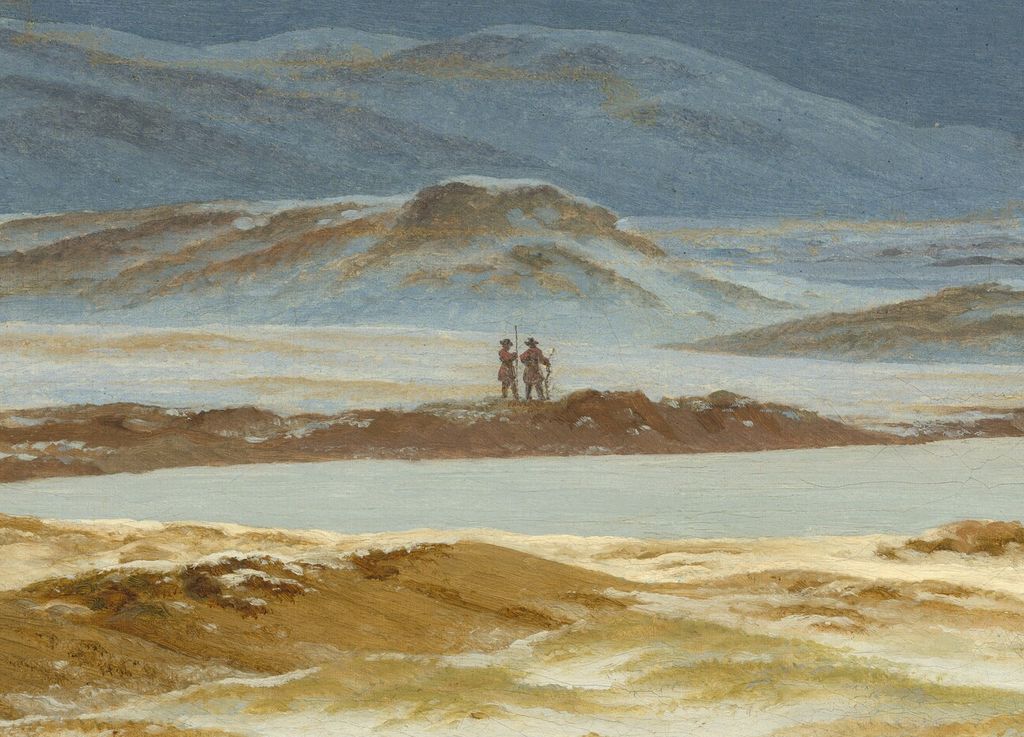
The figures’ clothes are close in colour to the earth beneath them, as the Met’s exhibition label observes. Grave identifies a bow and suggests that a second object may be a spear, details that support the familiar reading of the pair as hunters. Their position is easier to make out than their purpose. We can see how far they are from the nearest bank and how little of the terrain they occupy. Once they are visible, the low rise behind them seems larger and the nearly level strip of ice gains width. [1][2][3]
They also offer a way into an otherwise difficult scene to imagine crossing. Their feet are on exposed ground. Between their footing and ours lie the uneven banks and the frozen surface, and the painting offers no continuous track between them. Any activity the pair may be engaged in remains hard to read at this scale. Without a path leading towards them, the figures mark a distance the eye can cross in an instant and the body would have to negotiate in stages. [1]
A northern setting and an early account
The National Gallery describes Friedrich’s painted landscapes as studio inventions informed by close study outdoors. Grave proposes that the distant range in this picture draws on a sheet from the Karlsruhe Sketchbook of 1804. The view in the drawing probably comes from the vicinity of Dresden. The sketchbook contains landscape studies made principally around Dresden and the Elbe valley, according to the Klassik Stiftung Weimar. If the proposed source is right, a profile drawn from familiar country could serve in a much colder landscape imagined years later. The mountain outline and the weather would then have different origins within the same scene. [1][3][4]
There is a possible early description of the painting. In March 1823 Heinrich Hase published an account of winter landscapes he had seen in Friedrich’s studio. As quoted by Grave, Hase described a small picture with mountains receding in the mist of a cold evening, a frozen watercourse and heath-covered ravines. In his account, the wind had blown away enough snow for moss and sedge to show. That combination makes the connection with the Washington painting plausible. Hase also described a setting sun and said he saw no other living thing. The two people in the Washington picture complicate the match. [3][5]
Even Hase’s description of a small picture has been debated. Grave reports that Börsch-Supan thought the size of the Washington canvas counted against the identification. Doyle argued that it could reasonably seem small next to the much larger picture of the sea of ice that Hase discussed in the same article. The word tells us something about Hase’s impression in the studio. The passage Grave quotes gives no measurements to match against the canvas. [5]
The identification remains open. The 1973 catalogue by Helmut Börsch-Supan and Karl Wilhelm Jähnig treated Hase’s landscape as lost. Grave reports that Margaret M. Doyle considered whether the figures might have been added late, after Hase’s visit. That possibility would explain their absence from the published account, and the account alone cannot establish that sequence. Doyle used an approximate range of 1823–25 when she published the painting in 2006. The National Gallery of Art dates its canvas to about 1825. Hase’s description gives us an unusually close point of comparison for the snow and the mist, while the museum’s date remains approximate. [1][3][5][6]
From a Munich estate sale to Washington
The National Gallery’s published ownership history begins at a Munich estate sale in 2003, where the canvas was offered as the work of an anonymous artist. It entered a German private collection. Doyle’s account describes a dirty, unlined canvas with two tears. Once it had been cleaned and repaired, she reports, its condition proved excellent. Börsch-Supan, who had co-authored the catalogue of Friedrich’s paintings, authenticated it as Friedrich’s work. The doubts about which picture Hase saw concern the identity of a painting described in 1823. The modern attribution concerns the authorship of the surviving canvas. [1][5][6]
Sotheby’s offered the work in London on 15 June 2004 as lot 26. The National Gallery’s provenance next records French & Company, Inc., New York, and dates its own purchase to 20 October 2004. The acquisition brought the museum its first oil by Friedrich, following its acquisition of his drawing Moonrise on an Empty Shore in 1992. The painting later appeared in the Hamburger Kunsthalle’s Caspar David Friedrich: Art for a New Age exhibition and in the Met’s The Soul of Nature. The museum labels carry the spring title, which directs attention to a detail that a viewer absorbed by the mountains or looking for the two people might otherwise pass over. [1][2][6]
Annotated Details from Northern Landscape, Spring
Use the numbered details to trace the forms and light in this work.
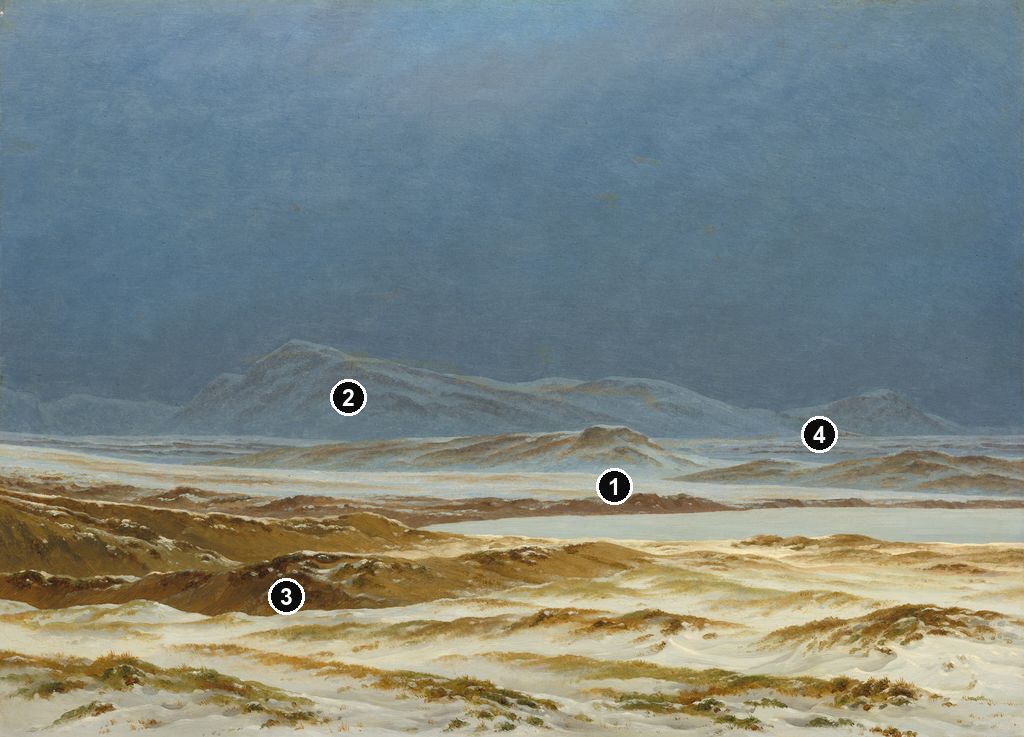
Details from NORTHERN LANDSCAPE, SPRING
The detail crops show parts of the work at a larger scale.
Two small figures
Two people stand on the thin tongue of land beside the water.
Low ridges across the horizon
Mist softens the edges of the bluish ridges.
Snow and exposed ground
Earth shows through the snow in strips that recede toward the water.
A pale opening beneath the sky
A light interval separates the lower slopes from the broad blue-grey sky.
Frequently Asked Questions
Discussion
What do the figures tell you about the scale of the place?
Reader Insights
Which marks first suggest that the snow is thinning?
What do the figures tell you about the scale of the place?
Where do the distant ridges merge into the sky?
Which marks first suggest that the snow is thinning?
Join the Conversation
Share what you noticed in Northern Landscape, Spring.
References
- National Gallery of Art, Washington, Northern Landscape, Spring, 2004.113.1. Collection record, reproduction, visual description, essay, provenance, exhibition history and bibliography.
- The Metropolitan Museum of Art, Caspar David Friedrich: The Soul of Nature, exhibition materials, object label for Northern Landscape, Spring, p. 19.
- Johannes Grave, Nordische Frühlingslandschaft, in Markus Bertsch and Johannes Grave, eds., Caspar David Friedrich. Kunst für eine neue Zeit, Hamburger Kunsthalle exhibition catalogue, 2023, p. 188. English edition of the entry.
- Klassik Stiftung Weimar, Karlsruher Skizzenbuch, catalogue record.
- Johannes Grave, Schiffbruch ohne Zuschauer, pp. 4–5 and notes 14–15. Transcribes Heinrich Hase, “Kunstnachrichten aus Dresden. Winterlandschaften,” Artistisches Notizenblatt, no. 6, 28 March 1823, pp. 21–22, at p. 21.
- Margaret M. Doyle, “A Friedrich for the National Gallery of Art, Washington”, The Burlington Magazine 148, no. 1235, February 2006, pp. 109–112. Opening passage in the publisher’s issue archive.