



 by Tom Gurney
Tom Gurney BSc (Hons) is an art history expert with over 20 years experience
Email: tomgurney1@gmail.com / Phone: +44 7429 011000
Introduction
In one painting by Caspar David Friedrich, a crucifix stands so high on a rocky summit that we see it from below and from behind. In another, mourners carry a coffin through the entrance to a ruined church. A later painting shows women following a country road at dawn, and we lose sight of the road before they reach their destination. Friedrich gives each scene a different relation between what the viewer can see and what the landscape invites us to imagine. He explained the firs and the rock in his altarpiece himself. The prospect of resurrection in the dawn painting depends on details that viewers have been putting together since the nineteenth century. [1][2][3][4]
At a Glance
- Altarpiece · Cross in the Mountains
- Burial scene · Abbey in the Oakwood
- Late works · Easter Morning and Cemetery in Moonlight with an Owl
Contents
- Introduction
- The cross above the viewer
- The procession through the ruin
- What the dawn allows us to infer
- Moonlight over a newly opened grave
- A cross for a particular person
- A gate between the viewer and the grave
- What changes between two winters
The cross above the viewer
Friedrich painted The Cross in the Mountains, also known as the Tetschen Altar, in 1807–08. The slope takes up most of the lower part of the canvas, and the evergreens interrupt the light behind it. Christ turns towards the sunset, so the figure on the cross receives the light from a direction we can follow without sharing his view. The rising edge of the rock gives us a sense of where the cross has been placed, though the distance between our vantage point and the summit remains hard to judge. The rays spread from below the skyline. We can locate their source by their direction and see what it illuminates. [1][2]
The carved and gilded frame sets out a second set of relationships. Friedrich designed it and Christian Gottlob Kühn carved it. The wheat and grapes beneath the painting refer to the Eucharist, and the palms in the upper frame evoke Christian martyrs, as Dresden curator Holger Birkholz explains. These emblems stay at the surface of the object, near enough to see in the relief of the carving. The figure of Christ occupies a place deep within the painted scene. If we look from the wheat and grapes up to the crucifix, we move between a familiar sign of Christ’s body and blood and the same body viewed at an unusual angle and distance. Birkholz proposes that the familiar emblems helped make the painting’s novel devotional form easier to approach. [1]
Friedrich displayed the work in his Dresden apartment at Christmas in 1808. The exhibition drew a public objection from Basilius von Ramdohr about the use of landscape for sacred art. Friedrich’s response gives unusually direct evidence of how he understood the picture. As Gerd Spitzer records, Friedrich associated the rocky summit with firmness of faith and the evergreens with hope in the crucified Christ. Both ideas have a physical basis in the painted terrain. The cross takes its footing from the rock, and the trees hold their dark foliage against the evening sky. Spitzer also records that the work was installed in a private room at Tetschen Castle. The frame gave viewers a way to approach the painting as a devotional object in a room where they could also inspect it as a landscape. [1][2][5]
The procession through the ruin
In The Abbey in the Oakwood of 1809–10, the dark ground reaches across a broad canvas. Bare oaks and the remains of a high Gothic window rise into a lighter band of sky. The lower doorway is the point towards which the figures move. The monks carrying the coffin are small enough to get lost among the gravestones at first, and the line of the procession brings them back into view. In Birgit Verwiebe’s account for the Alte Nationalgalerie, the monks are bringing the coffin into the ruin for a funeral Mass. She also picks out the two lights on the altar behind the crucifix and reads them as a sign of hope. Their position matters. The candles are close to the figures and the coffin, and much harder to see than the light above the trees. [3]
A surviving transcript of a letter, possibly addressed to Johannes Karl Ludwig Schulze, records Friedrich’s wish to depict the mystery of the grave and the future. The anniversary chronicle identifies the Abbey as the probable subject. Friedrich writes of what faith allows a person to apprehend and what remains beyond the limits of human knowledge. His description also gives close attention to the appearance of the terrain after sunset. Fog covers the ground and dissolves the lower outlines, while the higher parts of the ruin are still clear. In the painting, the unequal visibility of stones, people and branches lets a viewer experience some of that uncertainty at the level of looking. We can trace the route of the coffin towards the opening, even as the surrounding ground is difficult to make out. [3][6]
The position of the viewer changes between the two works. The Tetschen cross faces a light beyond the ridge, and the view stops at the slope. In the Abbey, the monks appear to have a route through the opening in the ruin, and the viewer can follow their progress in short stages. The crucifix is one object within the burial rite. The Gothic wall, modelled on the ruins at Eldena near Greifswald, brings an earlier building into that rite. Verwiebe explains that Friedrich opened up a window that had been blocked at Eldena and added a portal. In his painting the masonry has lost most of its enclosure, yet the doorway still marks the passage from the cemetery to the site of the service. [1][3]
A different ruined church frames Hutten’s Tomb, painted about 1823–24. Here a man stands close enough to examine a sarcophagus, and the viewer has reason to move in too. Johannes Grave identifies the name Hutten at the base of the armour and notes that earlier accounts record other inscriptions, including Jahn and Stein with the year 1813. He also proposes a reading of the headless figure holding a cross as an allegory of faith. In the Abbey the activity centres on a coffin that is still being carried. The stone tomb in the later painting gives historical memory a fixed place and connects the sixteenth-century humanist Ulrich von Hutten with figures associated with the Wars of Liberation. The cross-bearing sculpture and the inscriptions allow the same ruin to hold questions about religious inheritance and political remembrance. [3][7]
What the dawn allows us to infer
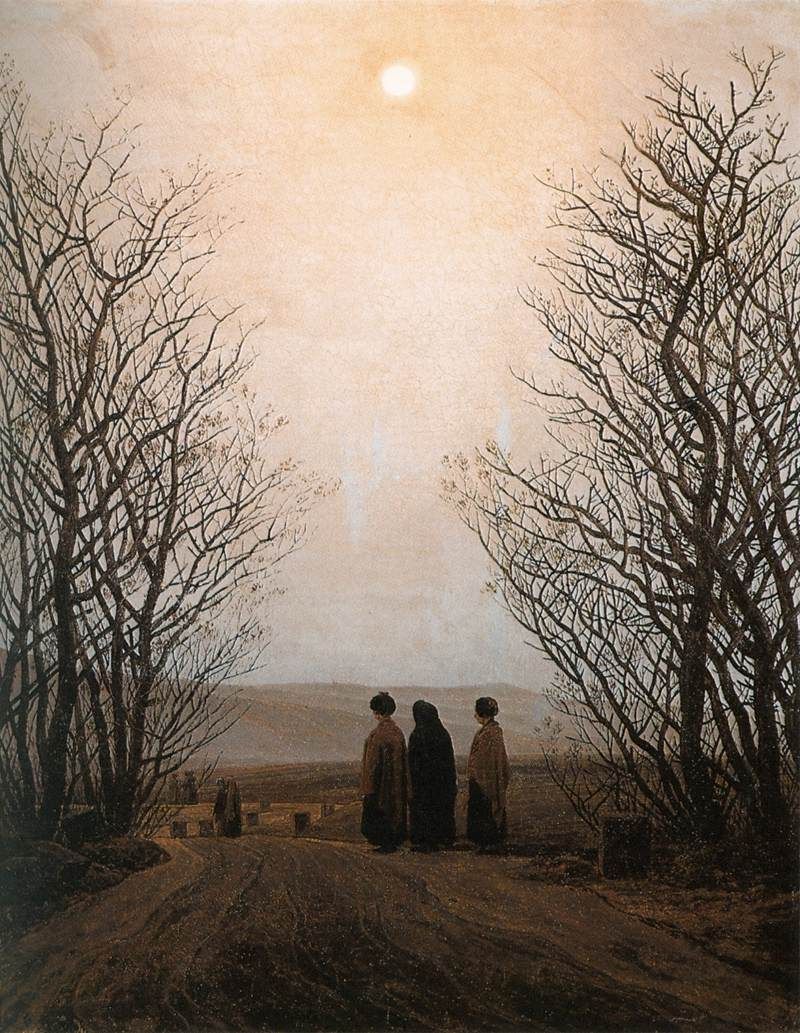
In Easter Morning, painted about 1828–35, three women gather near the edge of a road, with others farther along it. The nearest group is large enough to count easily, but the faces are turned away or seen at an angle. Bare branches enclose the view to either side. The road and the gaps between the groups give the scene a direction, while the bends make the destination impossible to see. Wilhelm Wegener, who owned the painting, wrote in 1859 that the women were heading for a cemetery. He noticed shoots on the trees and green growth that had survived the winter. His account joins the prospect of a visit to the dead with very small signs of life returning. [4]
Johannes Grave relates the traditional title and the nearest group of three to the women who visit Jesus’s tomb early in Mark’s Gospel. The clothes are those of Friedrich’s contemporaries, and the presence of several more women farther along the road keeps the picture grounded in an ordinary landscape. The connection to the Gospel rests on the approach, the hour and the number of women in the nearest group. Mar Borobia, writing for the Thyssen, also associates the receding night and the start of spring with the Resurrection. Her reading draws attention to two changes we can see at once. The moon is still high while dawn is already gathering, and the trees have only just begun to put forth new growth. Light and season give different measures of the same moment. [4][8]
The church ruin in the Abbey makes the destination visible before the monks reach it. In Easter Morning, the road offers the promise of arrival, and the bend postpones it for as long as we look. The picture shares that moment before arrival with the Gospel episode Grave invokes. We can recognise the analogy while the women are still on the road. The brightness just above the horizon reaches a place their journey has yet to take them. [3][4][8]
Friedrich had already made the start of spring barely perceptible in Northern Landscape, Spring of about 1825. The National Gallery of Art in Washington points to grass pushing through the snow and a faint change in the sky that may indicate dawn. The museum sees these as suggestions of hope and rebirth. The two people across the ice give the landscape scale, but no road connects them to the foreground. To find evidence of spring, we have to bring our attention back across that distance to a few strokes of grass near the lower edge. The painting makes the signs of change just as easy to pass over as the two people. The title and the vegetation establish a seasonal reading. The Easter title and the group of three give the Madrid painting grounds for a more specifically Christian one. [4][8][9]
Moonlight over a newly opened grave
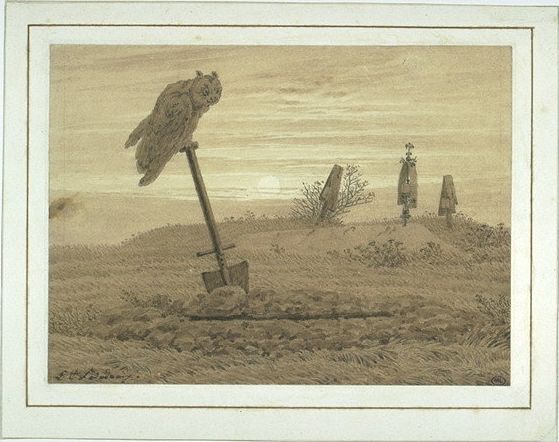
The 1834 drawing Cemetery in Moonlight with an Owl makes a place of burial immediately present once we recognise the tool in the foreground. An owl is perched on a shovel that a gravedigger has left at the edge of an open grave. The French sculptor Pierre-Jean David d’Angers, to whom Friedrich gave the sheet, identified the shovel and grave in his account of their meeting. He also recalled the moon illuminating the scene. Its pale disk is low among bands of wash, while the dark handle gives the owl and the disturbed earth a common axis. The shaft leads down from a living animal to the place prepared for a body. In the Abbey people carry the coffin into view. Here their work is apparent from the shape of the ground and the object left standing in it. [3][10][11]
The Louvre records a related sheet at the Albertina in which a vulture takes the owl’s place. In its exhibition account of the vulture sheet, the Metropolitan Museum of Art sees a tension between the physical prospect of decay and the suggestion of the soul’s ascent, drawing a comparison with songs of the period in which moonrise had that association. The bird in the Albertina sheet bends its head towards the grave. The Paris owl holds its head up and turns to the side. The replacement changes the relation between bird and grave even as much of the setting remains. The Met’s argument depends in part on the habits and posture of a vulture. David’s description of the Paris drawing brings us back to the simpler conjunction of a nocturnal bird, the traces of someone’s labour and the moon. [10][11]
The moon in Easter Morning belongs to the last part of a night that is visibly giving way to day. In the Louvre drawing it provides the light by which we make out the land beyond the grave. The cemetery continues up the rise, where the older markers stand apart from the freshly broken earth. The dark line of the shovel takes the eye down to the open grave, while the lighter bands of wash let it travel across the hillside to the older stones. The land ends a little beyond them, where it meets the pale bands of cloud. [4][10]
A cross for a particular person
In the Cross by the Baltic Sea exhibited by the Met in 2025, a cross and an anchor occupy a rocky coastal foreground. The label identifies the work as a commission from Louise Seidler for the portraitist Dorothea Stock after the deaths of her niece and nephew. Friedrich's letter to Seidler makes consolation conditional on the disposition of the person who looks. The work therefore gives us a specific occasion for considering how faith could enter a Friedrich landscape, alongside evidence that he expected the same object to meet different viewers differently.[12]
The anchor offers an immediate link to the coast. It belongs to the practical vocabulary of boats, which Friedrich knew from observing and drawing along the Baltic. Its great weight and its low place below the cross give the two objects a relation that can be understood before deciding how to read them. An anchor holds something in place. A cross above a rocky shore commands a look at a different height. The painting lets these functions become associated through their positions. The Met reads the cross as a guide and source of support, a reading with more direct documentary grounding here than in a landscape without a known recipient or an accompanying letter.[12]
The small coastal painting also changes what is available to a spectator after seeing the Tetschen Altarpiece. The mountain cross stands high and receives part of its meaning from the worked frame that surrounds it. The Baltic composition brings the cross into an encounter with an object whose work belongs to the sea. The practical anchor can be imagined in use while still being visible as a shape with religious associations. For a bereaved recipient, the painting could offer an occasion to hold a recognizable place, a sign of belief and the memory of a particular loss in view together.[1] [2] [12]
A gate between the viewer and the grave
The unfinished Cemetery in Dresden, dated about 1825, makes access to the grave a central problem. Carl August Böttiger visited Friedrich while the work was in progress and reported a commission from a Leipzig art lover. His account connects the fresh mound with the burial of a child and imagines the parents at the gate. The Dresden collection essay treats the memorial purpose as probable. The account helps recover a situation behind the work, while the unfinished canvas leaves open exactly how Friedrich would have completed it.[13]
The gate divides the picture into two fields that can be seen together. Ironwork and stone stand near the spectator. Beyond them the ground falls and rises in the cemetery and pale mist gathers in its low places. The eye can go through the opening, although the obstruction remains emphatic at the front. In Abbey in the Oakwood, the procession makes the viewer follow people moving towards a doorway. The Dresden cemetery gives us the doorway first and puts the fresh earth on its far side. The arrangement turns standing outside into part of the experience of mourning.[3] [13]
The objects above the gate connect that experience to a Christian history. The Dresden essay identifies the crown of thorns, lance and sponge as references to the Passion. These forms are located at a boundary, where the deepening blue makes it possible to see their silhouettes. The grave itself is marked by disturbed earth farther back. Look from the mound up to the gate and two kinds of evidence come together: the material sign of a recent burial and the emblems of an older sacred narrative. The painting supplies the relationship through the position of those forms, leaving the spectator to decide how much consolation it affords.[13]
What changes between two winters
The London Winter Landscape and its probable companion in Schwerin show how a religious reading can depend on a comparison. In Schwerin a man on crutches crosses snow among damaged or dying trees. In London a man rests near a rock, his crutches set aside, facing a crucifix amid firs. The National Gallery relates the scenes to despair and the hope offered by faith. The visual connection is particularly clear in the relation between each body and its immediate support. Crutches make the effort of crossing the land visible. The rock and evergreens give the resting figure a place to remain and direct his attention.[14]
The distant church in the London painting adds a second scale to the religious imagery. The crucifix belongs to the nearby space and the man can face it directly. The building is a much larger form and is harder for a spectator to make out through the mist. Its towers echo the firs, which makes it possible to move visually from the near site of prayer to a more uncertain architecture. A church in the distance can organize the view even where its walls offer almost no visible detail. That effect is quite different from the ruined walls of the Abbey, whose physical decay is unmistakable.[3] [14]
The companion reading leaves the two works with distinct moments of their own. Setting the crutches aside is visible, while what happens before or after that moment has to be inferred. The pairs of trees, the surfaces of snow and the degrees of visibility provide firmer points of comparison than any proposed sequence of events in the man's life. Through those changes Friedrich gives the notion of hope a place in the way the spectator moves between paintings and notices what the ground, sky and human posture have in common.[14]

Frequently Asked Questions
Discussion
How does Easter Morning treat the road and distant light?
Reader Insights
How does the ruined doorway frame the procession?
How does Easter Morning treat the road and distant light?
What can an inscription tell us that an anonymous grave cannot?
How does the ruined doorway frame the procession?
Join the Conversation
Share what you noticed in Faith, Mortality and Landscape.
References
- Staatliche Kunstsammlungen Dresden, Cross in the Mountains, Gal.-Nr. 2197 D. Albertinum multimedia guide, with commentary by Holger Birkholz.
- Gerd Spitzer, Das Kreuz im Gebirge (Tetschener Altar). German essay in the Friedrich anniversary chronicle.
- Birgit Verwiebe, Abtei im Eichwald, NG 8/85. Staatliche Museen zu Berlin collection record, with a transcription from Friedrich’s correspondence.
- Mar Borobia, Mañana de Pascua, 792 (1973.24). Museo Nacional Thyssen-Bornemisza Spanish collection entry and essay.
- Friedrich anniversary chronicle, Christmas 1808 display of Cross in the Mountains and the Ramdohr dispute.
- Friedrich anniversary chronicle, Transcript of a letter from Friedrich on the grave and the future, 1809–10. English translation of the excerpt, with a qualified identification of the painting.
- Johannes Grave, Hutten’s Tomb. Hamburger Kunsthalle catalogue essay in the Friedrich anniversary chronicle.
- Johannes Grave, Ostermorgen. German Hamburger Kunsthalle catalogue essay in the Friedrich anniversary chronicle.
- National Gallery of Art, Washington, Northern Landscape, Spring, 2004.113.1. Collection record and essay.
- Musée du Louvre, Le cimetière sous la lune avec un hibou, RF 35803 recto. French collection record, reproduction and excerpt from David d’Angers’s notebooks.
- Metropolitan Museum of Art, Caspar David Friedrich: The Soul of Nature. Exhibition gallery texts, pp. 29–30, on the Louvre and Albertina drawings.
- Metropolitan Museum of Art, The Soul of Nature exhibition labels, pp. 18–19, label for the private collection Cross by the Baltic Sea and Friedrich's letter to Louise Seidler.
- Staatliche Kunstsammlungen Dresden and anniversary museum partnership, Der Friedhof, Gal.-Nr. 2197 B, including Böttiger's studio account and the identification of the emblems on the gate.
- National Gallery, London, Winter Landscape, NG6517, including the discussion of the probable Schwerin pendant.