 by Tom Gurney
Tom Gurney BSc (Hons) is an art history expert with over 20 years experience
Email: tomgurney1@gmail.com / Phone: +44 7429 011000
Introduction
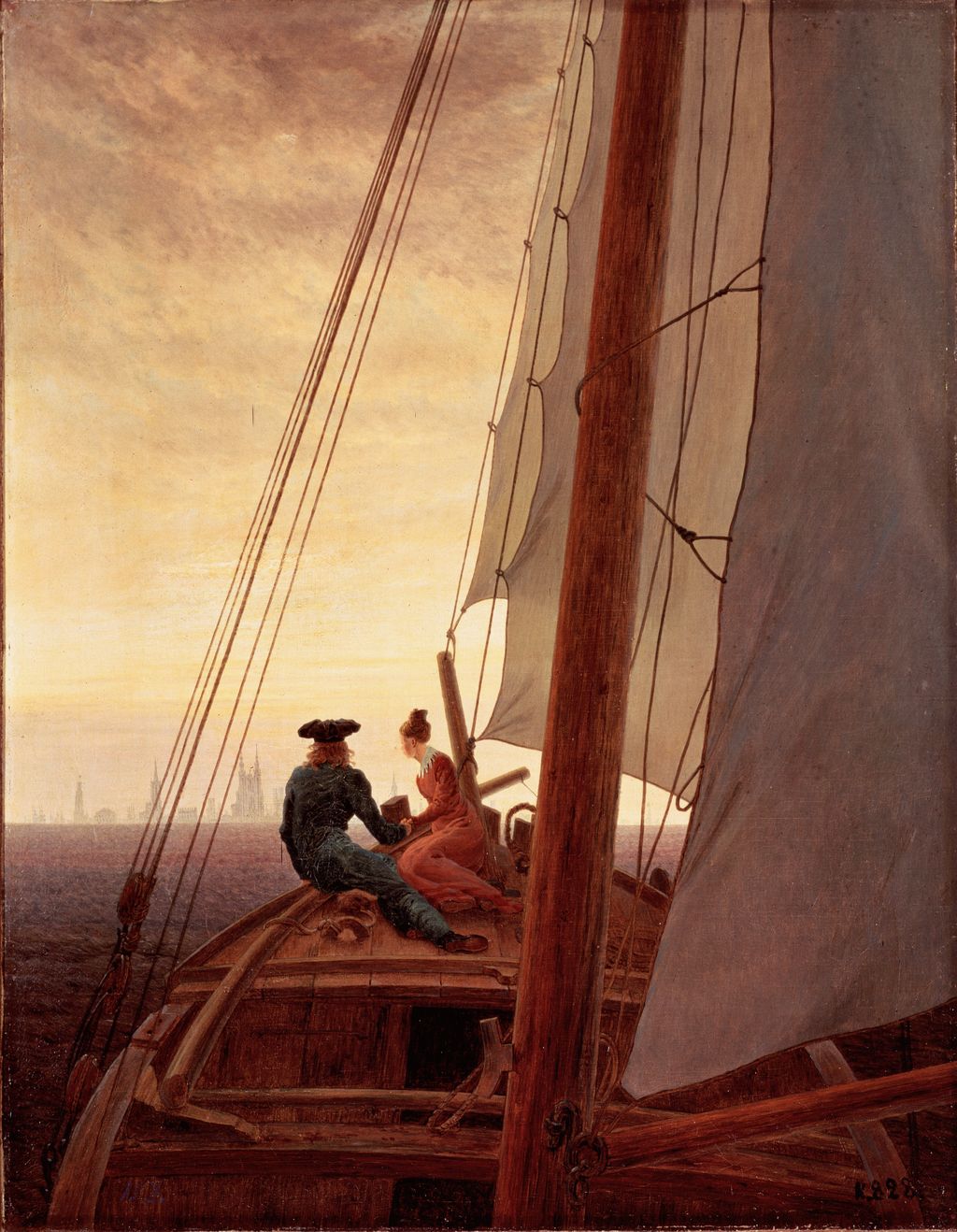
Two passengers sit hand in hand near the bow, looking towards a city that barely shows above the water. A mast rises close to us on the right and runs out through the top of the painting. On the left, taut ropes cut across a broad stretch of glowing sky. Caspar David Friedrich gives us a place on the deck of the same vessel. The city is already in view. Its towers are the only parts of it that the passengers can begin to make out. [1][2]
At a Glance
- Artist — Caspar David Friedrich
- German title — Auf dem Segler
- Russian title — На паруснике
- Date and medium — 1818–1820 in the Hermitage collection record, oil on canvas
- Dimensions — 71 cm high × 56 cm wide
- Collection — State Hermitage Museum, Saint Petersburg, ГЭ-9773 [1]
- Catalogue title and date variant — On the Sailboat, 1818–19 in the 1990 exhibition catalogue [2]
Contents
- Introduction
- A view from the deck
- The Baltic journey and the drawings
- Who is sailing and where are they going?
- A harbour seen from land
- From Friedrich’s studio to Peterhof
- Annotated Details
- Image Details
A view from the deck
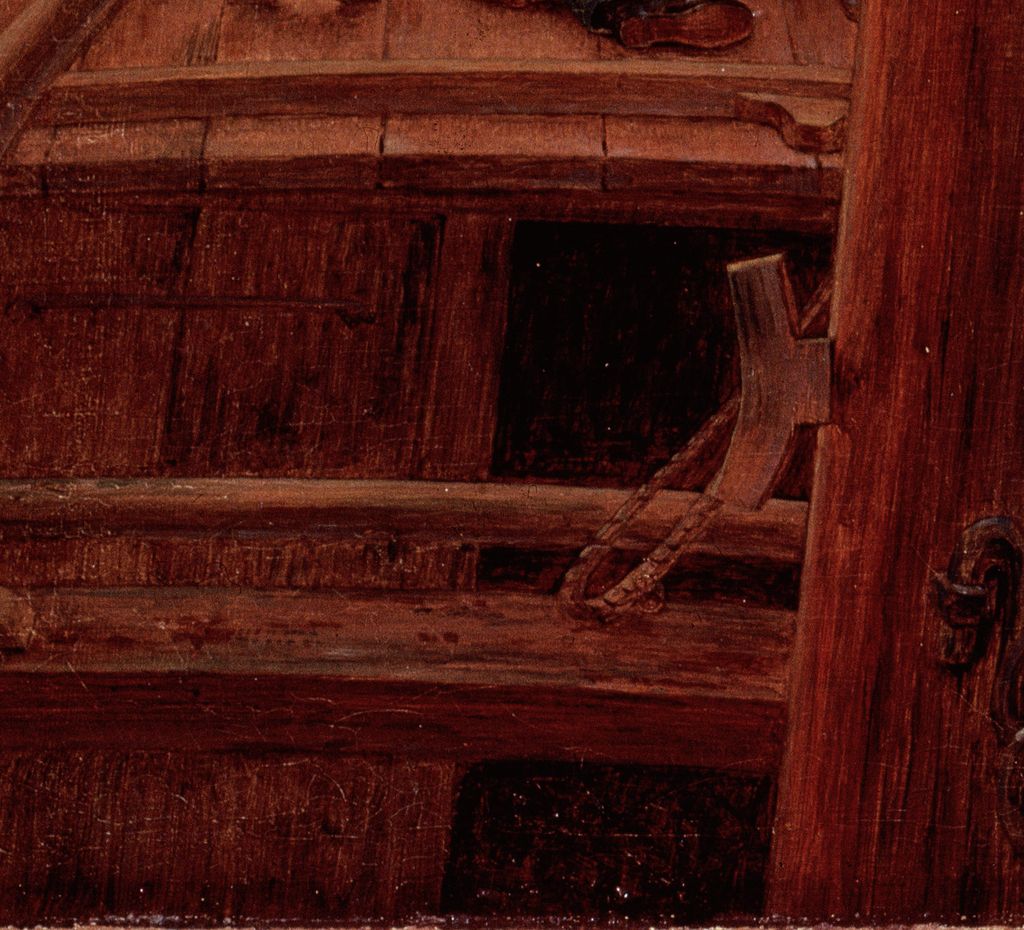
The lower edge of the canvas cuts through the boat. A dark rectangular opening interrupts the deck, and the boards, rails and crosspieces give the foreground a weight and solidity missing from the distance. Follow the left rail towards the bow and the space contracts until the figures occupy nearly all the visible deck in front of us. Friedrich gives the boat much of the lower part of the picture, but most of what we see of it is a narrow wedge. The view ahead opens above and to either side of that wedge. [1][2]
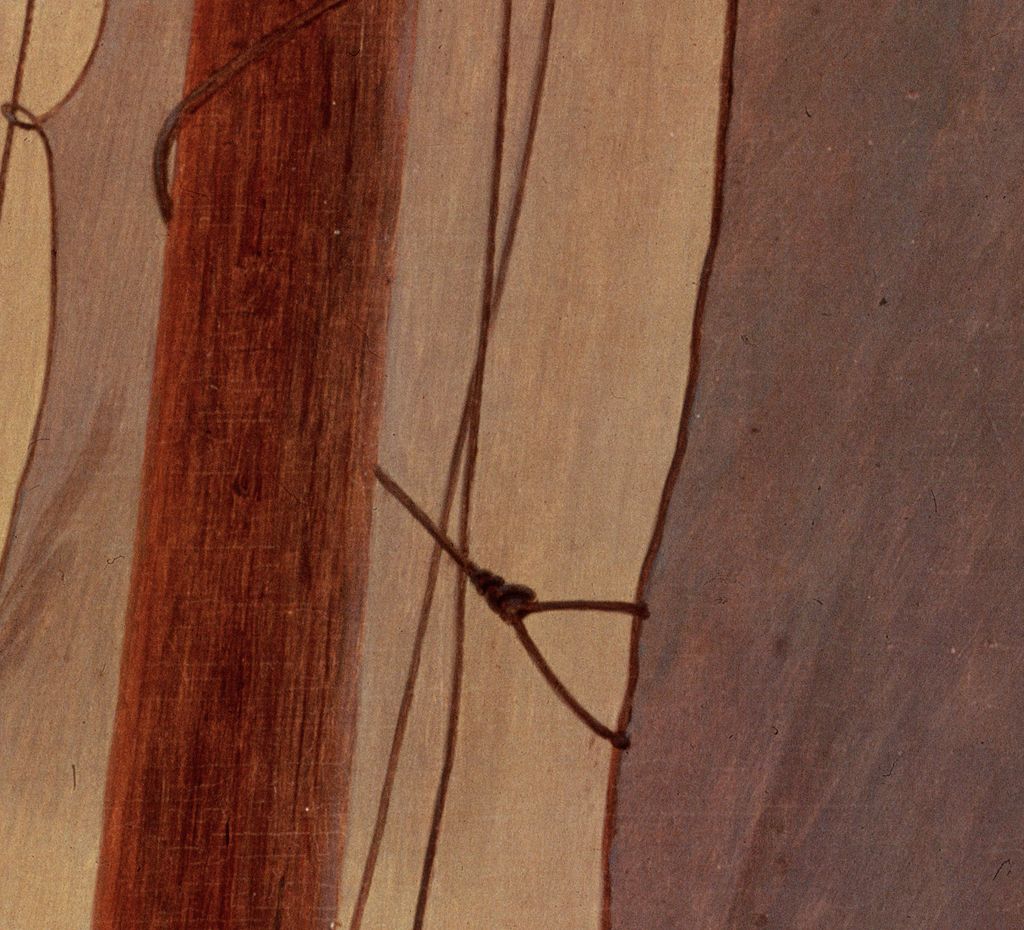
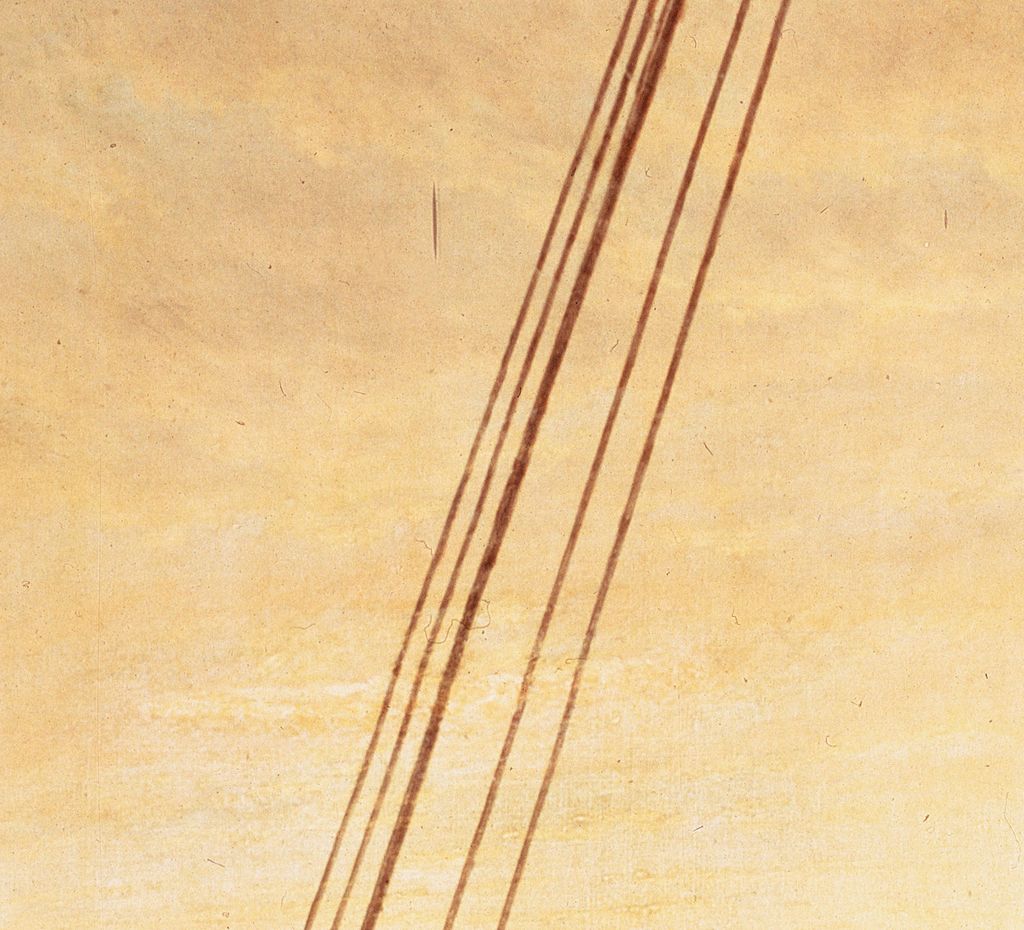
The ropes on the left run upwards in a close group, almost parallel across the light. Across the painting, narrower lines bend around the mast and meet the edges of the sails. The outer sail is so close that the frame cuts away most of its extent. Its shaded surface forms a broad shape along the right edge, while a smaller, lighter area of canvas beside the mast admits some of the brightness from beyond. The wind is visible in the taut lines and the curves of the cloth. The mast leans across the picture, while the far line of the water stays nearly level. That difference gives the deck its sense of movement without the need for heavy seas. [1][2]
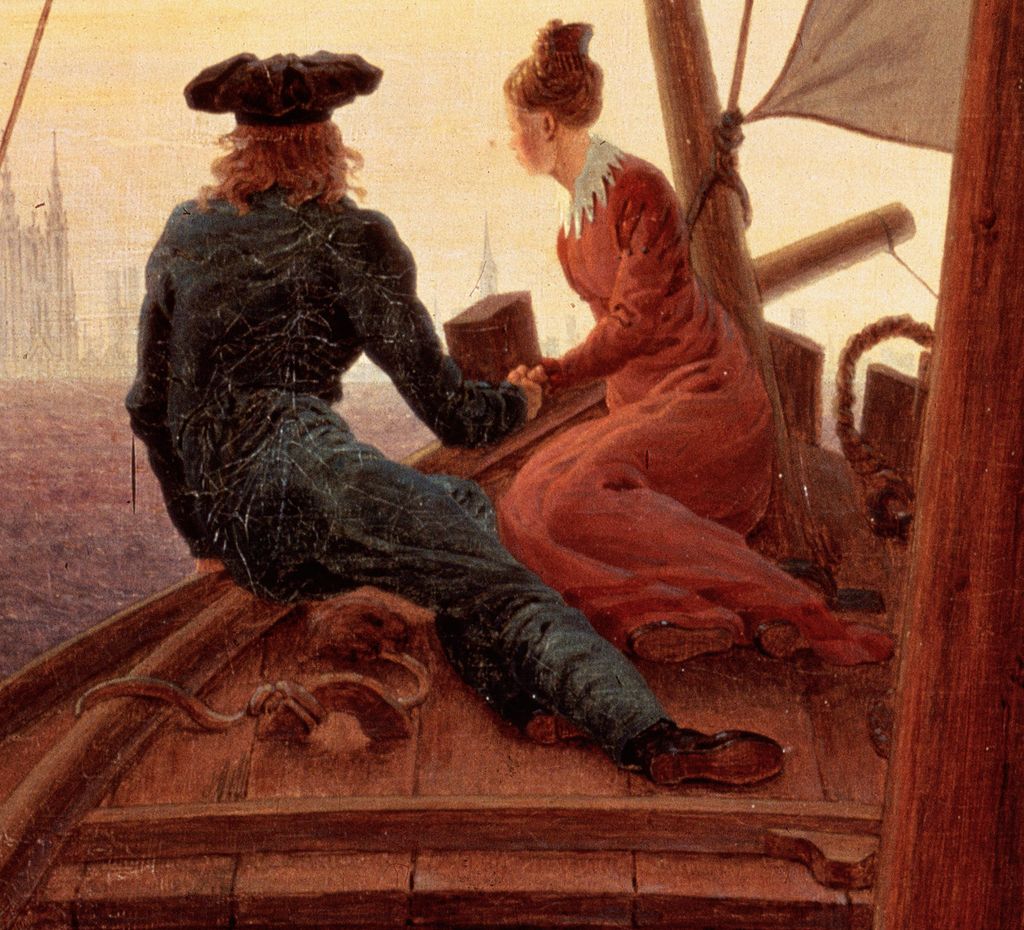
The man sits on the left in dark green, a broad hat shading his head. He angles his legs back into the foreground. The woman, in a muted rust-coloured dress, sits higher in the picture and turns slightly towards him. One arm from each figure reaches into the gap between them. Their hands meet just above the deck, below the brighter sky. The clasp is small enough to miss on a first look, especially beside the scale of the mast. Once seen, it changes the relationship between two people who might otherwise simply be sitting side by side. [1][2]
Our view of the passengers has the same limits as our view of the voyage. We can see the direction in which their bodies are turned and the gesture they share. Their expressions are largely hidden. The back-turned figure, often called a Rückenfigur, lets a painter give a landscape a human point of view while leaving room for the person looking at the painting to see it differently. Here there are two figures and a handclasp. We look past them to the city, but we see their gesture from a position they do not share. [1][2]
The Baltic journey and the drawings
Friedrich married Caroline Bommer on 21 January 1818. They set off for his native Greifswald before 13 June that year. In the 1990 exhibition catalogue, Sabine Rewald recounts how they travelled on with Friedrich’s brother Christian and his wife, visiting Wolgast, Stralsund and Rügen. It was a return to a familiar coast for Friedrich, and the surviving drawings put him at work during the journey. A pencil sheet in Oslo’s Nasjonalmuseet, dated 11 August 1818, records studies of sailing vessels on the passage from Wiek to Stralsund. Another sheet, dated 17 August, shows ship studies in Greifswald harbour. [2][3][4][5]
Oslo also holds a much larger pencil-and-wash sheet, dated about 1818 and catalogued as a study for Auf dem Segler. There is the same broad division of the view, with ropes rising on the left and sails occupying the right. A dark rectangular opening marks the deck and a long piece of timber extends past the mast. The sheet isolates those parts of the boat in a patch of drawing surrounded by paper. In the oil, the mast reaches through the frame and the timbers continue below it. Rewald draws attention to Friedrich’s handling of scale. By giving the passengers so little of the picture, he makes the spars and sails seem larger and puts the viewer closer to them. The painting also gives the boat a destination to look towards and makes the figures’ gesture legible within the rigging. [1][2][6]
A separate Oslo sketchbook page, catalogued to 1806, shows how early the view from aboard a sailboat had caught Friedrich’s attention. Its pencil lines follow a curve at the bow, a section of sail and the ropes descending towards the deck. A faint line of shore beyond the boat helps fix the viewpoint. This sketch predates the marriage by more than a decade. Beside the finished oil it shows that the experience of looking forward from a deck belonged to Friedrich’s work well before the 1818 trip. The larger study carries that point of view into the composition of the oil. [6][7]
Who is sailing and where are they going?
The Hermitage presents the hand-holding pair as a traditional allegorical likeness of Friedrich and Caroline. Their marriage and journey make that identification plausible. Rewald calls attention to a detail that limits a literal reading. The man’s hair extends below his hat, whereas Friedrich did not wear his hair long. Robert Rosenblum, writing in the same catalogue, finds some resemblance between the woman and images of Caroline but stresses how completely the man’s face is concealed. The couple can recall the newlyweds while keeping the freedom of figures invented for a landscape. [1][2]
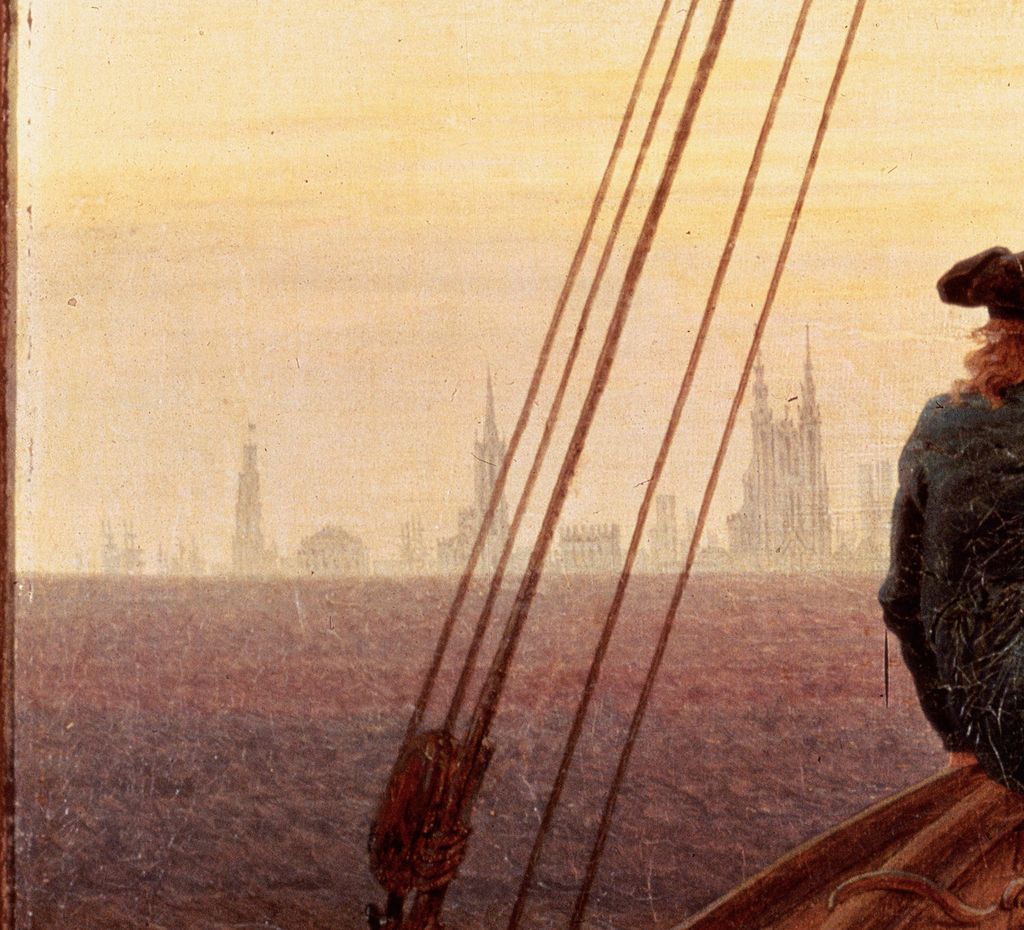
There is a similar distance between the itinerary and the painted destination. Rewald suggests that the expanse of water may recall the Greifswalder Bodden, the Baltic bay between the mainland and Rügen. She reads the skyline as a combination of features from Dresden, Greifswald and Stralsund. The painted city gives the eye a series of upright accents, from a few faint towers at the left to a denser cluster of pointed shapes further in. Its pale silhouette carries just enough detail to suggest buildings. A slight shift in the angle of a rope or the position of a passenger would hide some of the skyline from our view. Friedrich makes the glimpse of land feel both particular and fleeting. [1][2]
A view in the other direction appears in Chalk Cliffs on Rügen. There, the people are on land and the sails are far away. Johannes Grave’s anniversary essay proposes a drawing Friedrich made at Stralsund in August 1818 as the model for the more distant boat and traces the cliffs to two separate views that he combined. The same summer gave Friedrich material for different relations between land and sea. From the cliffs, the sails make it possible to judge how far out the water extends. On the ship, the shore itself becomes the measure of distance. [8]
The light allows for more than one reading of the voyage. The Hermitage describes a sunrise, which fits a picture about setting out and the promise of married life. Rosenblum notes that the glow has also been read as sunset. The sky is warm near the horizon and darker overhead, with no clear solar disc to settle the question by itself. In Rosenblum’s account the voyage can suggest a couple’s future on earth or a passage towards an afterlife. The cluster of spires gives the destination a possible religious charge. The joined hands make the ordinary experience of travelling together equally present. Both readings draw on the distance still to be crossed. [1][2]
A harbour seen from land
Friedrich’s Greifswald Harbor, painted around 1818–20 and now in Berlin’s Alte Nationalgalerie, gives an almost contemporary comparison. A large vessel occupies the centre of that composition. Its sails have been furled, and a rowing boat is bringing it to its anchorage. Birgit Verwiebe identifies the outlines of three local churches in the background, St Mary’s, St Nicholas’s and St James’s. The masts and church towers share the same evening sky. Looking from the edge of the harbour, we can see the ship as a whole and follow its manoeuvre in relation to smaller craft and the town. [9]

The canvas in Saint Petersburg gives the act of approaching a different scale. A single nearby mast takes up more space than any of the distant buildings. Much of the sail is still full, and the boat’s bow leads us towards a shore whose landmarks are harder to separate. In the Berlin painting the city helps locate the ship. In the sailing painting the ship gives us a place from which to see the city. The change in viewpoint explains why the two paintings can feel so different even though they share masts, spires and a sky bright near the horizon. [1][2][9]
From Friedrich’s studio to Peterhof
In 1820 the Russian grand duke Nikolai Pavlovich, the future Nicholas I, and his wife Alexandra Feodorovna visited Friedrich in Dresden. The Metropolitan Museum’s Moonwatchers catalogue records their studio purchase of On Board a Sailing Ship together with the painting it calls Sisters on the Harbor-View Terrace. The Hermitage counts the sailing picture among the couple’s first acquisitions. Its 2024 exhibition proposed that it may have been Nicholas’s gift to Alexandra. That possibility belongs to the history of the couple who owned it, alongside the painting’s possible allusion to the artist’s marriage. [1][10][11]
The painting later hung in the Cottage Palace in Alexandria Park at Peterhof, a private summer residence built for Alexandra in the English neo-Gothic style between 1826 and 1829. A mid-nineteenth-century watercolour by Eduard Hau records the arrangement of Alexandra’s sitting room. Peterhof’s catalogue identifies Friedrich’s canvas above the balcony door, near maritime paintings by Théodore Gudin and Ivan Aivazovsky. The watercolour shows how a small picture that puts us at sea could also belong to a room furnished with several different views of the water. The Hermitage’s collection record lists the painting as received from the Pavlovsk Palace Museum in 1963. The Met catalogues give 1945, and Peterhof’s catalogue records it as being at the Hermitage since 1946. [1][2][10][12][13]
Annotated Details from On Board a Sailing Ship
Explore five details in Friedrich’s On Board a Sailing Ship.
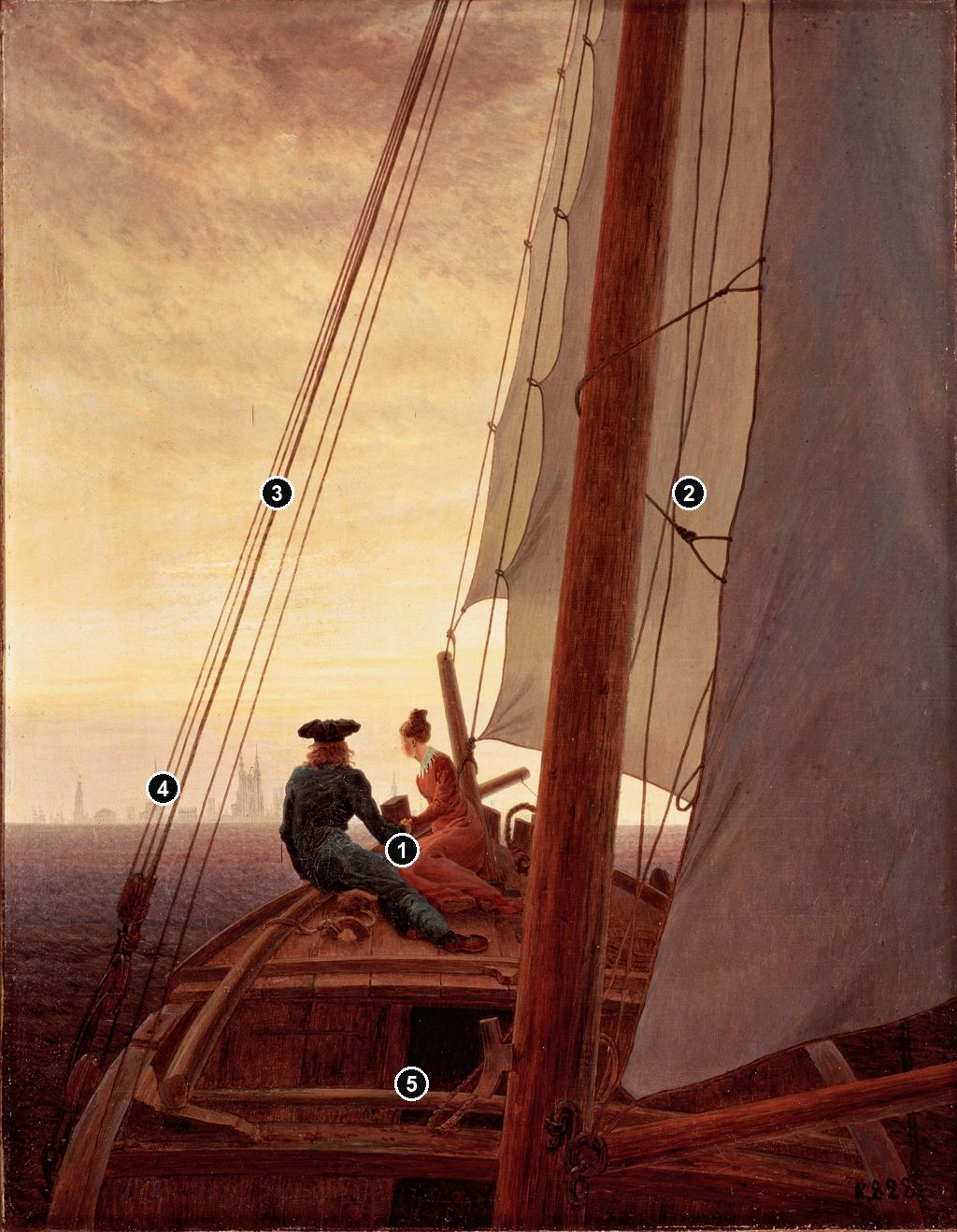
Details from ON BOARD A SAILING SHIP
The crops show how smaller parts of the painting relate to the whole.
The seated couple
The passengers sit near the bow. Their joined hands form a small connection between their two silhouettes.
Mast and pale sail
The mast cuts vertically through the view. The pale sail fills much of the right side.
Diagonal lines of rigging
Ropes angle across the open sky and draw the eye down toward the bow.
Distant skyline
Faint towers and spires appear at the horizon beyond the dark water.
The deck below the viewer
Curved boards, rail and an open hatch establish the viewpoint from inside the vessel.
Frequently Asked Questions
Discussion
How does the rigging guide your eye toward the shore?
Reader Insights
Where does the mast place you in relation to the passengers?
How does the rigging guide your eye toward the shore?
How might the later setting at Peterhof have shaped the way visitors saw the painting?
Where does the mast place you in relation to the passengers?
Join the Conversation
Share what you noticed in On Board a Sailing Ship.
References
- State Hermitage Museum, На паруснике, ГЭ-9773.
- Sabine Rewald, ed., The Romantic Vision of Caspar David Friedrich: Paintings and Drawings from the U.S.S.R., 1990, Robert Rosenblum’s introduction, p. 14, and the entry for On the Sailboat, p. 48 and fig. 34.
- Caspar David Friedrich: The Anniversary, biographical and works chronicle, entries for 21 January and before 13 June 1818.
- Nasjonalmuseet, sailing studies on the journey from Wiek to Stralsund, 11 August 1818, NG.K&H.B.16068-013.
- Nasjonalmuseet, ship studies in Greifswald harbour, 17 August 1818, NG.K&H.B.16068-015.
- Nasjonalmuseet, På seilbåten, c. 1818, NG.K&H.B.16028.
- Nasjonalmuseet, Fra seilbåten, 1806, NG.K&H.B.16069-006.
- Caspar David Friedrich: The Anniversary, Chalk Cliffs on Rügen.
- Birgit Verwiebe, Alte Nationalgalerie, Der Greifswalder Hafen, A II 356.
- Sabine Rewald, Caspar David Friedrich: Moonwatchers, 2001, p. 38.
- State Hermitage Museum, Landscape of the Soul: Caspar David Friedrich and Russia, 2024–25.
- Peterhof State Museum-Reserve, Cottage Palace.
- Peterhof State Museum-Reserve, catalogue commentary on Eduard Hau’s view of Alexandra Feodorovna’s sitting room, cat. 16.