 by Tom Gurney
Tom Gurney BSc (Hons) is an art history expert with over 20 years experience
Email: tomgurney1@gmail.com / Phone: +44 7429 011000
Introduction
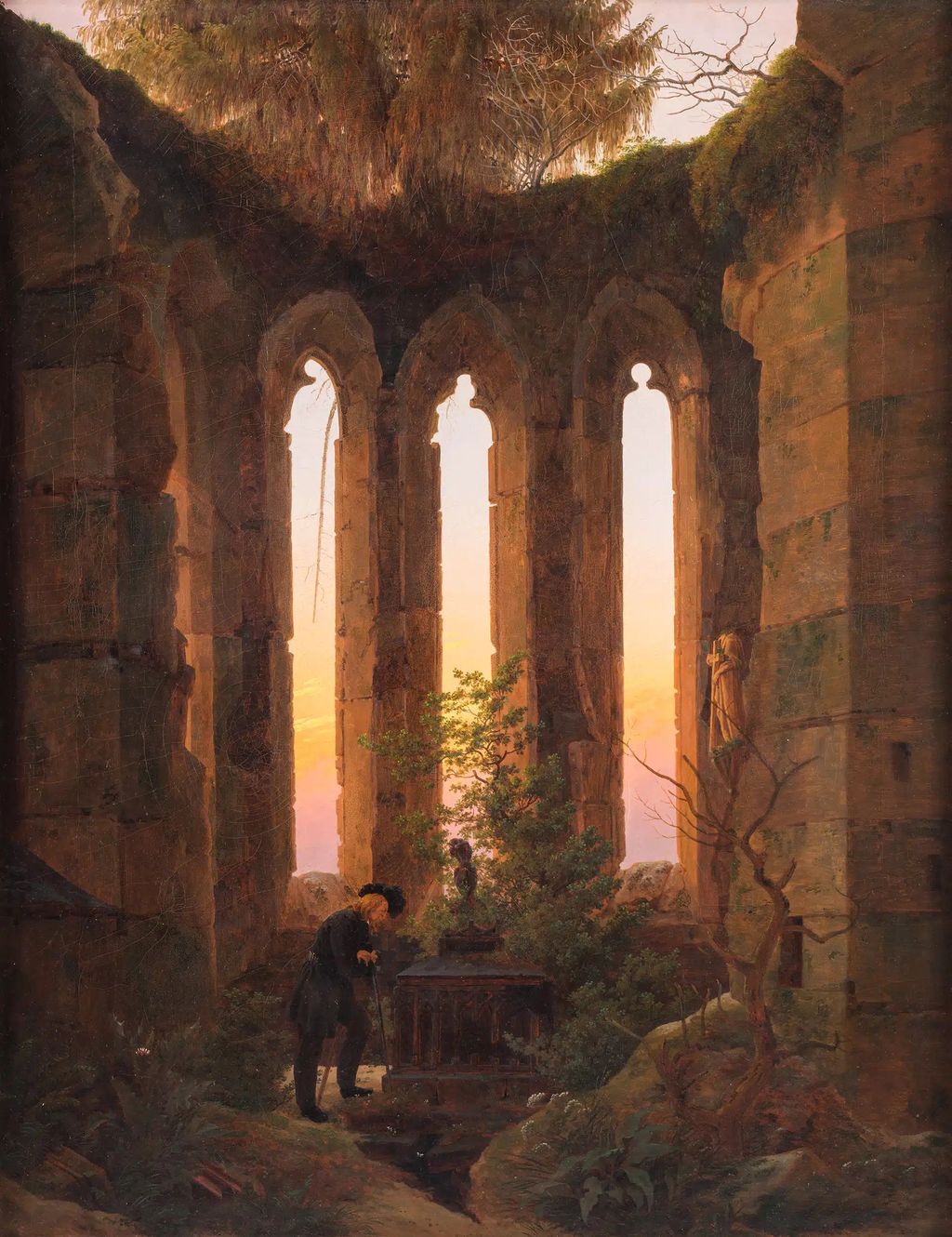
A man in a dark coat has stopped beside a stone tomb in Caspar David Friedrich’s Hutten’s Tomb. He bends towards the lid, where a knight’s helmet stands on a little base. Beyond him, three tall Gothic windows are filled with the light of sunset. The ruin is open to the sky, and the thin trees and bushes inside it come almost to the level of the helmet. The monument is Friedrich’s invention. On it he put the name of a man who died in 1523 and the names of people his first viewers might still have read about in the papers. [1] [2]
At a Glance
- Artist · Caspar David Friedrich
- German title · Huttens Grab
- Date · c. 1823–24
- Medium · Oil on linen canvas
- Dimensions · 93.5 × 73.4 cm (height × width)
- Collection · Klassik Stiftung Weimar
- Inventory number · G 690
Contents
- Introduction
- Inside the ruin
- The building Friedrich drew at Oybin
- Ulrich von Hutten and the painted memorial
- The names on the tomb
- What could still be hoped for
- Annotated Details
- Image Details
Inside the ruin
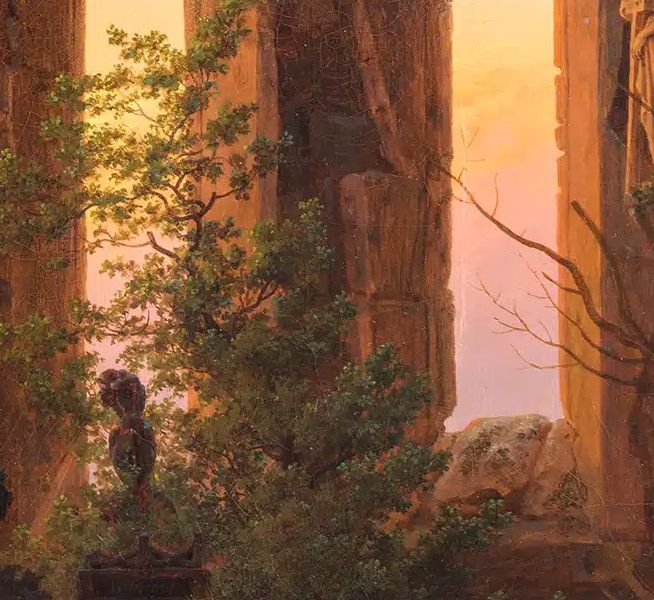
At first the sky is easier to make out than the tomb. Low down, the windows are pink and orange. Higher up, their openings turn pale and the damaged stonework cuts jagged shapes into the light. The three shafts of colour make the room feel taller, even though the line of the ruined wall dips above them. Through that gap at the top you can see branches as well as sky. The scale of the wall becomes apparent when your eye comes down to the man. Even standing upright, he would occupy only a small part of the space below the windows. [1]
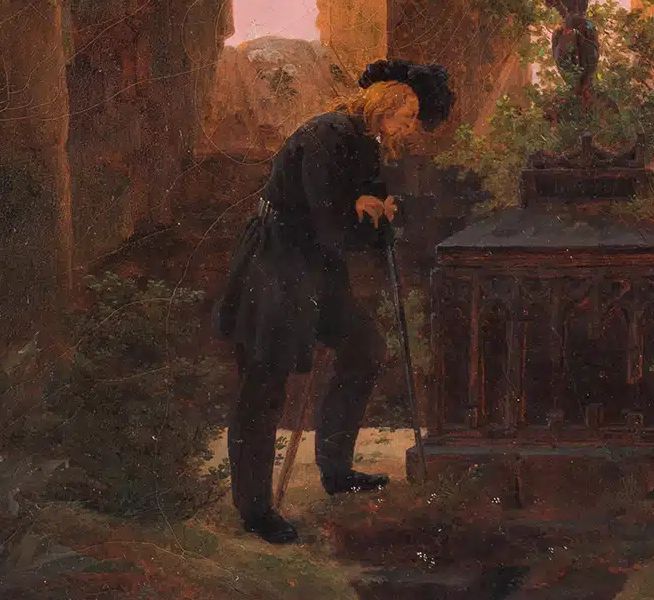
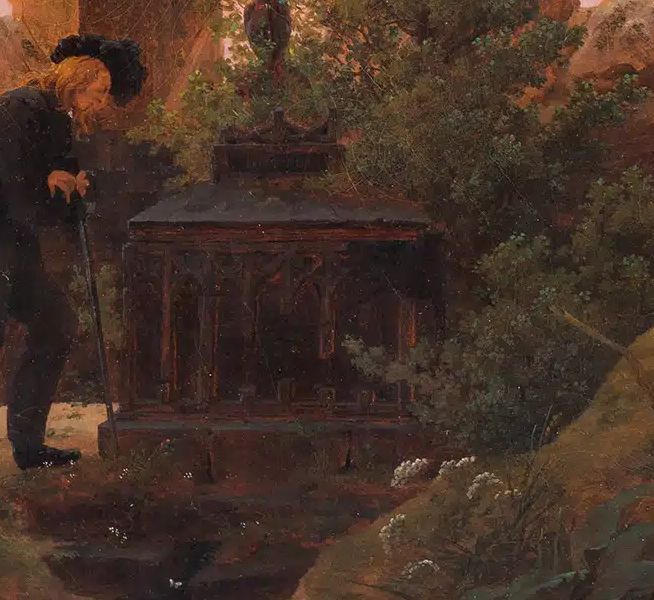
The tomb sits low in the picture, below the middle window. Its front has a row of narrow panels. In front of it the ground falls away into a dark cleft. The man stands on firmer ground at the left, with his face just far enough in profile to show the angle of his head. His attention is on the lid, where the helmet catches a little light. From where we stand, the row of panels is more exposed. There is room in the composition to follow his gaze up to the helmet, then come back down to the surface he stands beside. [1] [2]
At the right a headless figure holding a cross stands against the masonry. Weimar identifies it as Fides, the personification of Faith. Art historian Johannes Grave treats that identification as possible and suggests that the damaged figure might recall the destruction of religious images during the Reformation. The missing head makes the statue hard to read even at close quarters. The standing cross and the living visitor are easier to pick out. Between them, green growth reaches up in front of the windows, interrupting the bands of colour. [1] [2]
The building Friedrich drew at Oybin
Friedrich knew the architecture from a visit to the ruined monastery at Oybin near Zittau. He went there with the painter Georg Friedrich Kersting on 4 July 1810, on the way to the Giant Mountains. A watercolour over pencil from that visit survives in the Hamburger Kunsthalle. The study shows the east part of the former sacristy, a room once used for keeping vestments and other church furnishings. The identification is owed to Ludwig Hoch, whose research corrected the long-standing description of the sheet as a view of the choir. The watercolour also includes two small studies of pointed arches at the right edge and colour tests above them, marks of the work Friedrich did on site. [2] [4]
 Caspar David Friedrich.jpg)
In the painting he made the proportions of the architecture taller. Comparing it with the sheet shows how much of the original structure he kept, down to the varying silhouettes of the openings, and how far he could change the scale of a space while retaining its character. He had already adapted the same study for Ruins at Oybin, an oil painting of about 1812. There the central furnishing is an altar, with a crucifix on the left and a Madonna and Child on the right. The later picture puts a sarcophagus where an altar might stand. It keeps the room’s religious associations through the architecture and cross-bearing statue, and adds a visitor with a reason to stand before the stone. [1] [2] [4]
Another study came from much earlier in Friedrich’s career. Christina Grummt’s catalogue of his drawings traces the thistle at the left to Thistle and Two Tree Studies, a sheet with dates of 17 and 24 July 1799. On the page the thistle is a substantial study in its own right, its leaves defined in pen and wash over pencil. In the painting it is one of the details you discover after the architecture, when your eye has adjusted to the foreground. A field study of a plant and a watercolour of a ruined building, made eleven years apart, help give the invented scene the specificity of a place someone has visited. [1] [4] [5]
Friedrich had also given Gothic architecture a role in burial in Abbey in the Oakwood. In that painting a line of monks carries a coffin through the ruins of a church based on Eldena, near Greifswald. Their passage takes the eye from the cemetery into the church. The solitary visitor at Oybin has already arrived. His pause before the memorial gives the act of remembering the time that the earlier painting gives to a procession. [1] [4] [14]
Ulrich von Hutten and the painted memorial
The historical Ulrich von Hutten came from a Franconian knightly family. He studied at German and Italian universities, and Emperor Maximilian I crowned him poet laureate in 1517. Hutten became known for combative writing on religion and politics, including attacks on the papacy and the Roman Curia. Towards the end of his life the reformer Huldrych Zwingli helped him find refuge in Switzerland. Hutten died in 1523 on Ufenau, an island in Lake Zurich. His burial is associated with the island’s church of Saints Peter and Paul. The simple stone marking the site today was put up in 1959 after the discovery of a skeleton attributed to Hutten. Friedrich imagined a grander memorial at a different site. [1] [6] [7]
Around 1800, readers could see Hutten as a patriot and a champion of freedom as well as a figure of the Reformation. In Arminius he celebrated the defeat of Roman forces in the Teutoburg Forest. Centuries later, during the struggle against Napoleon, that story acquired new relevance as a precedent for resistance to an occupying army. Weimar draws attention to the two anniversaries that converged in 1823, three hundred years after Hutten’s death and ten years after the opening of the Wars of Liberation against Napoleon. Those anniversaries help explain how the name of a Renaissance writer came to sit above a set of early nineteenth-century names. [1] [2] [7]
The names on the tomb
The large name belongs to the base below the helmet, where HUTTEN is still legible at close range. The smaller lettering is on the face of the tomb. Grave’s 2023 catalogue essay gives the following historical readings. He reports that the front once read “Jahn 1813”, “Arndt 1813”, “Stein 1813”, “Görres 1821”, “D … 1821” and “F. Scharnhorst”. Weimar’s 100 Treasures entry agrees on the first four and gives “Scharnhorst” without an initial or date. The collection’s separate digital metadata lists Görres with 1813 and Scharnhorst with 1821, and omits Arndt. Those records differ, and the recorded fragment “D …” gives too little for a secure identification. [1] [2] [3] [8]
Friedrich Ludwig Jahn helped form the Lützow Free Corps and served with it during the war. Ernst Moritz Arndt wrote against Napoleonic rule and worked with Heinrich Friedrich Karl vom und zum Stein, the Prussian reformer who helped organize the allied administration of liberated territories. The shared date of 1813 brings a volunteer, a political writer and an administrator into the same account of the war. Weimar reads the visitor’s clothes as the uniform of a Lützow volunteer. Grave describes them more broadly as old German dress, a style with patriotic associations. Either reading gives the clothes a place in the story told by the lettering. The man’s own name remains unknown. [1] [2] [8] [9] [10]
The name Scharnhorst is generally associated with the Prussian military reformer Gerhard von Scharnhorst, who died from a wound he received in 1813. Grave’s transcription retains the initial “F.”, which differs from Gerhard’s. The association has a basis beyond the name itself. Friedrich had already dedicated a memorial design to Gerhard von Scharnhorst in 1814. As Holger Birkholz notes, the proposed monument was never built, and the painting offered Friedrich another way to commemorate him. [2] [8] [11]
Joseph Görres made his name through the Rheinischer Merkur, a newspaper that opposed Napoleon and later criticized the German authorities. The Prussian government suppressed it in 1816. His later pamphlet Germany and the Revolution brought him into further conflict with the authorities in 1819, the year of the Carlsbad Decrees restricting the press and universities. Birkholz points to a specific connection with 1821. In that year Friedrich’s friend, the Berlin publisher Georg Andreas Reimer, began issuing an edition of Hutten’s writings. Görres, Jahn, Arndt and Stein all subscribed to it. The edition shows that Hutten was a subject of active interest among the people named on the monument. The reason Friedrich paired Görres specifically with 1821 remains open. [1] [2] [8] [12] [13]
What could still be hoped for
By the time Friedrich exhibited the picture at the Dresden Academy in 1824, many of the hopes attached to the war had met with resistance from the governments of the German Confederation. Arndt had been suspended from his professorship at Bonn in 1820. Letters from Friedrich had been seized in searches of Reimer’s and Arndt’s papers the previous year. The letter found among Arndt’s papers accompanied an earlier design for a monument to the war’s heroes. The passage from war to Restoration gives the painted visitor’s posture particular force. His head is bowed over an object that recalls the public expectations of 1813, in a room with broken walls and no other visitors. [4] [8] [10] [13]
Weimar reads the flowers and new growth as signs of resurrection and the survival of hopes for freedom. Grave sees room for both defiance and disappointment. The orange light makes the windows brilliant but leaves the names almost lost in the dark of the stone. The brush growing at the base of the windows partly screens the helmet, even as its fresh leaves catch the light. The visitor’s bent figure can suggest grief or the close attention of somebody making an effort to read. The painting gives those readings much the same set of details to work with. [1] [2]
After Dresden, the work was shown in Hamburg and Berlin. According to Birkholz, the 1826 Berlin exhibition announced that the proceeds of a sale were intended for Greeks in need, during the Greek struggle for independence from Ottoman rule. That public offer gave Friedrich’s memorial a connection to a struggle taking place while the picture was on view. Weimar dates the probable acquisition by Grand Duke Carl August to 1826–28. Grave cites a photograph showing the painting in the grand ducal rooms around 1865. Its route to Weimar remains uncertain. [1] [2] [8]
Annotated Details from Hutten’s Tomb
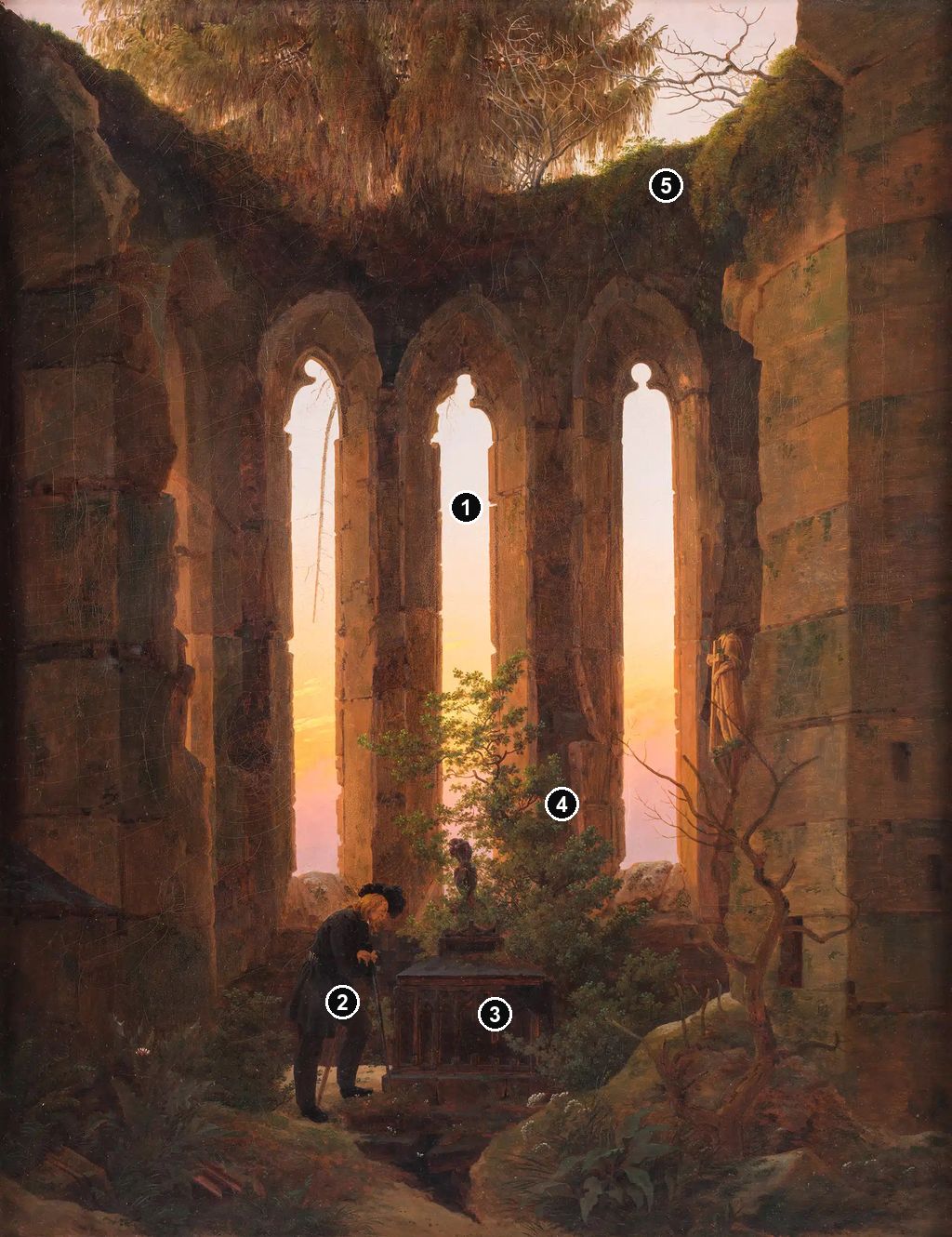
Explore five details in Friedrich’s Hutten’s Tomb.
Details from HUTTEN’S TOMB
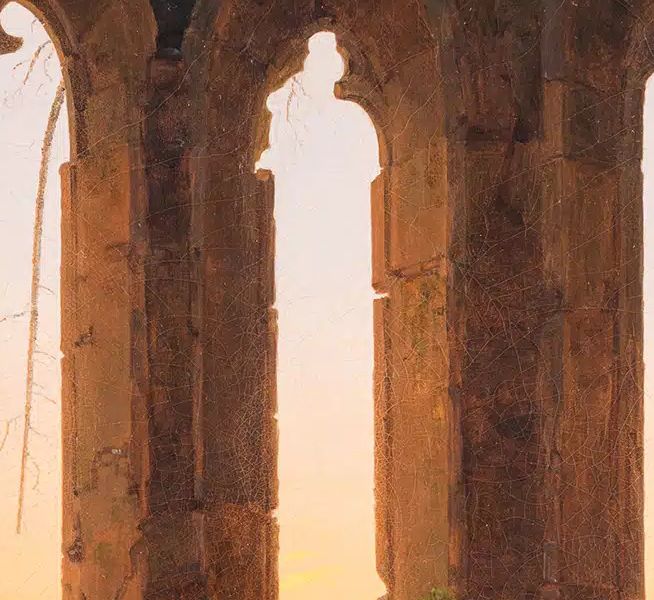
The crops show how smaller parts of the painting relate to the whole.
Three openings in the ruin
Light passes through three tall openings, leaving the heavy masonry in shadow.
The visitor
A solitary man bends toward the tomb. His dark clothes are set against the brighter opening behind him.
The memorial
The rectangular tomb occupies the lower centre. Its writing is difficult to distinguish at this scale.
Plants among the stones
Leaves rise between the tomb and the lit windows, partly obscuring the masonry.
Broken walls and open sky
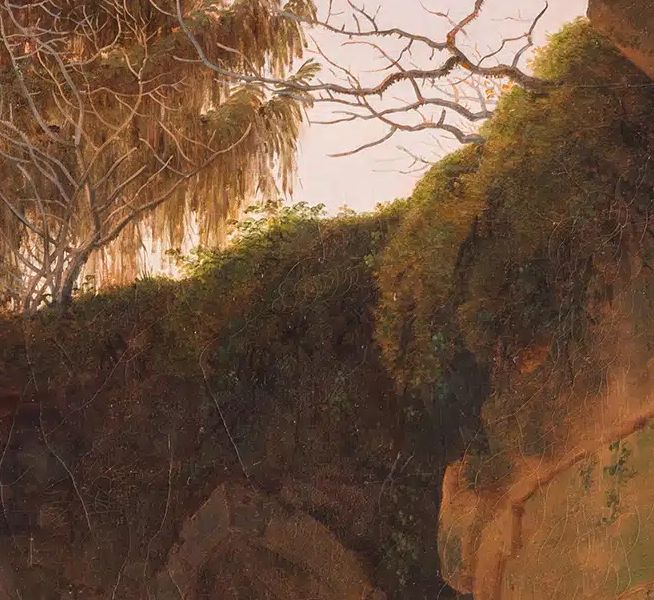
Broken stone and branches interrupt the light where the room opens to the sky.
Frequently Asked Questions
Discussion
What does the man’s posture tell us about his relationship to the tomb?
Reader Insights
How does light through the arches change the scale of the ruin?
What does the man’s posture tell us about his relationship to the tomb?
How do the inscriptions connect different periods of history?
How does light through the arches change the scale of the ruin?
Join the Conversation
Share what you noticed in Hutten’s Tomb.
References
- Klassik Stiftung Weimar, Huttens Grab, G 690, measurements, description and collection reproduction. 100 Treasures object entry
- Johannes Grave, “Huttens Grab,” in Markus Bertsch and Johannes Grave, eds., Caspar David Friedrich. Kunst für eine neue Zeit, 2023, p. 146. German anniversary chronicle
- Klassik Stiftung Weimar, Huttens Grab, G 690, digital object metadata. Goethe knowledge network object record
- Peter Prange, “Klosterruine auf dem Oybin,” Hamburger Kunsthalle, Kupferstichkabinett, inv. 41101, especially notes 2 and 5–7. German anniversary chronicle
- Christina Grummt, Caspar David Friedrich. Die Zeichnungen. Das gesamte Werk, 2011, no. 126, Distel und zwei Baumstudien. Publisher’s catalogue extract
- Hans Ulrich Bächtold, “Hutten, Ulrich von,” Historisches Lexikon der Schweiz. Historical Dictionary of Switzerland
- Barbara Basting, “Die zwei Gräber des Ulrich von Hutten,” Swiss National Museum, 7 October 2022. Museum research article
- Holger Birkholz, “»Solange wir Fürstenknechte bleiben«. Caspar David Friedrichs politische Haltung,” in Caspar David Friedrich. Wo alles begann, Staatliche Kunstsammlungen Dresden, 2024, pp. 248–253, especially pp. 250–253 and fig. 5. Exhibition catalogue extract
- Horst Ueberhorst, “Jahn, Friedrich Ludwig,” Neue Deutsche Biographie 10, 1974, pp. 301–303. Deutsche Biographie entry
- Hellmuth Rößler, “Arndt, Ernst Moritz,” Neue Deutsche Biographie 1, 1953, pp. 358–360. Deutsche Biographie entry
- Johannes Kunisch, “Scharnhorst, Gerhard Johann David von,” Neue Deutsche Biographie 22, 2005, pp. 574–575. Deutsche Biographie entry
- Otto Roegele, “Görres, Johann Joseph von,” Neue Deutsche Biographie 6, 1964, pp. 532–536. Deutsche Biographie entry
- German Bundestag, “The German unification and freedom movement (1800–1848),” section on political repression. Parliamentary history
- Alte Nationalgalerie, Abtei im Eichwald, NG 8/85, with an object essay by Birgit Verwiebe. Berlin collection record