 by Tom Gurney
Tom Gurney BSc (Hons) is an art history expert with over 20 years experience
Email: tomgurney1@gmail.com / Phone: +44 7429 011000
Introduction
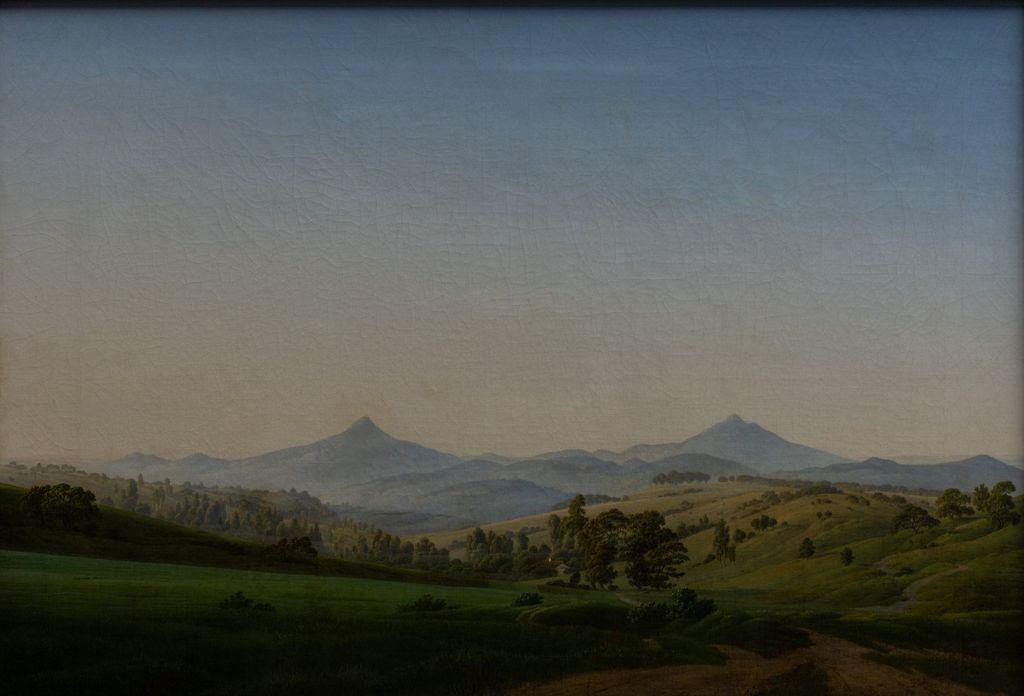
A track enters from the lower right of Caspar David Friedrich’s Bohemian Landscape with Milešovka Mountain. It dips among the low rises as the ground opens into a broad valley. Two mountains stand across the distance, their summits almost level with each other. Above them, a cloudless sky takes up most of the canvas. The path, the slope and the peaks give the eye three very different distances to travel in a picture that measures 70 centimetres high by 104 wide. Friedrich painted the scene in oil on canvas in 1808. It belongs to the Galerie Neue Meister at Dresden’s Albertinum, where it is catalogued as Böhmische Landschaft mit dem Milleschauer, Gal.-Nr. 2197 E. [1][2]
At a Glance
- Date · 1808
- Medium · Oil on canvas
- Collection · Galerie Neue Meister, Staatliche Kunstsammlungen Dresden
- Accession · Gal.-Nr. 2197 E
- Dimensions · 70 cm high × 104 cm wide
Contents
- Introduction
- Two mountains south of Teplice
- The path, the trees and the house
- The evening companion in Stuttgart
- From Tetschen Castle to two collections
- Annotated Details
- Image Details
Two mountains south of Teplice
The German name Milleschauer refers to Milešovka, the summit on the right. The peak on the left is Kletečná, known in German as Kletschen. Both are in the Central Bohemian Uplands, or České středohoří, south of Teplice in what is now the Czech Republic. Both have the pointed profiles characteristic of this part of the uplands, though Milešovka is the higher of the two. The Czech forestry survey gives its elevation as about 837 metres and Kletečná’s as 706 metres. On the canvas their summits sit at much the same height, and their broad outer flanks slope away towards opposite sides. The peaks are easy to read as a pair before we know either mountain’s name. [1][2][3]

Friedrich made a drawing of the mountains during a walking tour in 1807. The anniversary chronicle records a trip through northern Bohemia that September, and art historian Holger Birkholz cites the relevant sheet as number 527 in Christina Grummt’s catalogue of the drawings. Birkholz’s comparison shows that Friedrich adjusted the two profiles in the oil, bringing them closer in size and shape and arranging the range along the horizontal edge of the picture. The field drawing gives us more direct evidence of that change than a comparison of summit elevations. How high each peak appears depends on where someone is standing. Comparing Friedrich’s two versions shows the painter’s own change of emphasis, from the differences between the forms to the balance they create across the valley. [2][3][4]
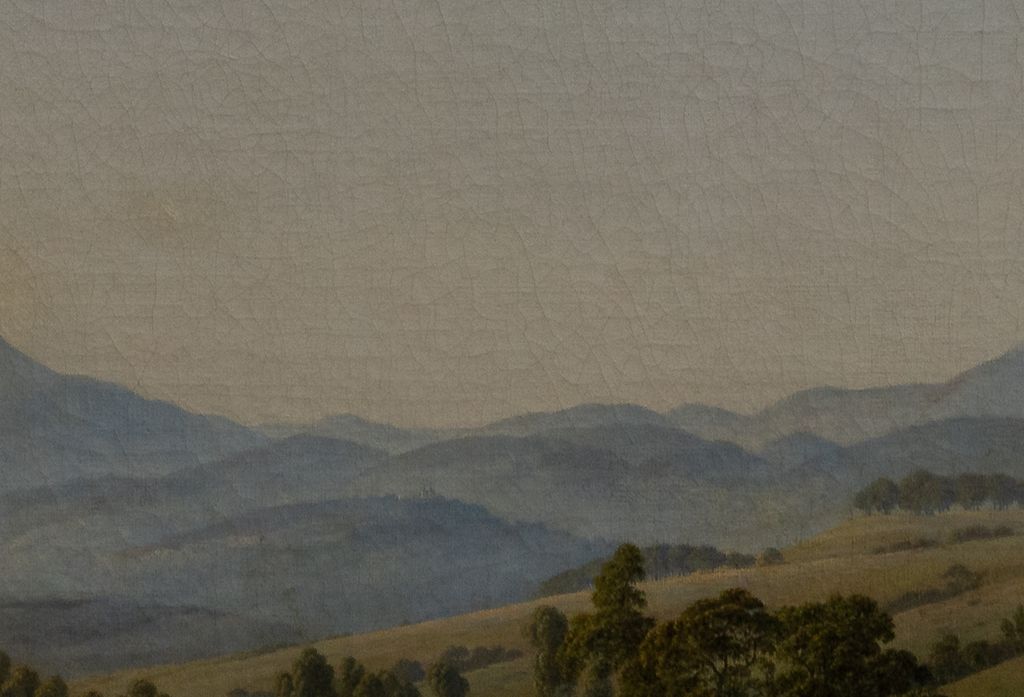
The balance is clearest if we follow the skyline in from the sides. Smaller rises lead towards the two peaks, and their inner slopes descend into a shallow interval. Under that interval, nearer hills overlap one another and conceal parts of the valley floor. The mountains frame the valley, leaving the centre of the skyline open. The low ridges between them soften the gap, while the sky above their crests is unbroken. Almost level summits allow that open field of colour to retain its breadth across the whole picture. [1][2]
The path, the trees and the house
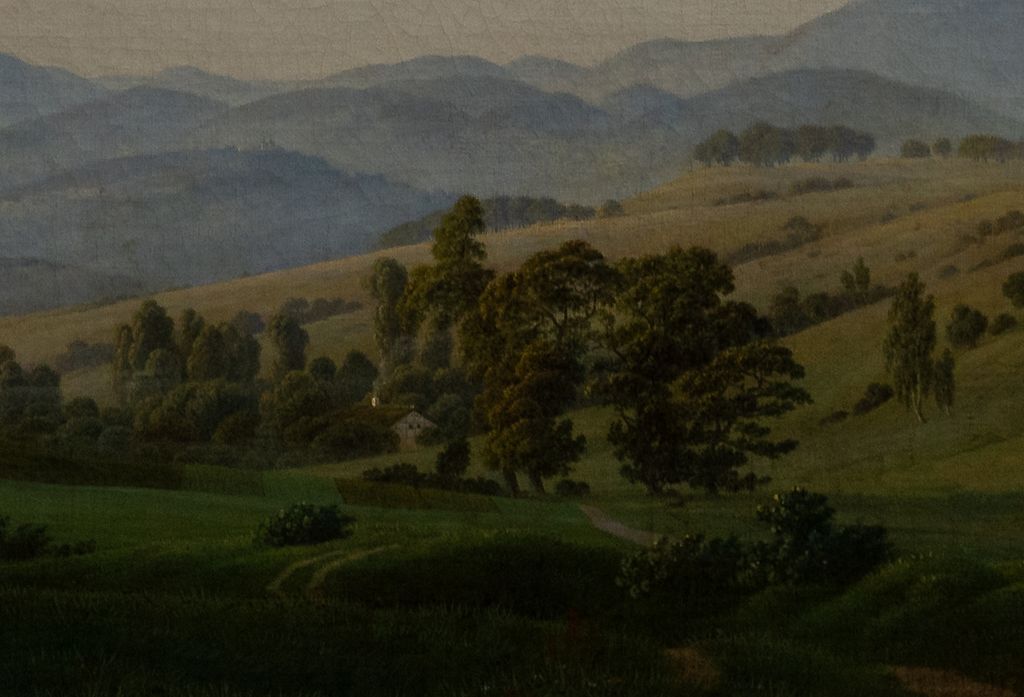
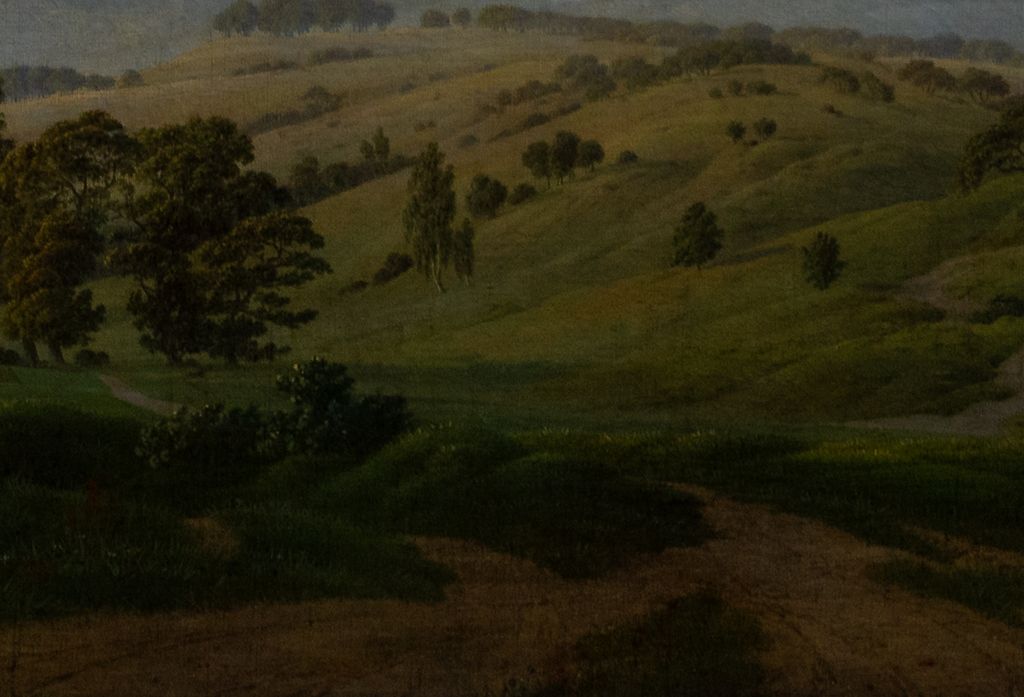
Friedrich distributes the strongest differences of colour and tone near the bottom of the canvas. The bare earth of the path stands out against shaded grass, and a run of lighter ground on the right makes the folds in the hillside easier to follow. The track briefly disappears behind a rise and comes into view again farther on. Gerd Spitzer, writing for Dresden’s collection, traces two possible movements for the eye from this area. We can go downhill towards the house among the trees or follow the rising ground to the right and imagine getting a better view from the hill. What looks at first like a broad panorama also gives us a choice of routes through its nearest terrain. [1][2]
The trees near the path came from a different place and an earlier visit. Friedrich drew groups of trees at Breesen while visiting his sister in May 1806. Birkholz identifies the relevant material as Studies of Groups of Trees, dated 24 and 26 May in the drawing catalogue. In the Dresden landscape, branches from adjacent trunks reach into one another above the route. Their dense leaves give this part of the middle ground an edge sharp enough to hold the eye against the pale ridges. Friedrich had already used one of the groups he studied in Breesen in the sepia Coastal Landscape with Cross and Statue, where it arches over a cross. Here the branches occupy a landscape with a track and a dwelling. The two works show how a relationship between trunks and branches could remain recognisable when the setting and its associations changed. This reuse of a single tree group gives a concrete example of Friedrich’s technique and studio practice. [2]
The house is easy to pass over on a first look. Its roof sits low among the trees and bushes, close to the axis between the peaks. The thin rise of chimney smoke helps locate it. Where the distant hills announce themselves in broad silhouettes, the presence of someone living in the valley registers through a detail small enough to disappear at a glance. In the sky, changes in colour are slow and continuous, deepening from a pale band near the horizon to blue overhead. The smoke shows a smaller movement of air within that much larger sweep. [1][2]
The evening companion in Stuttgart
The companion is Bohemian Landscape (Böhmische Landschaft), Staatsgalerie Stuttgart, inventory number 1380. Stuttgart dates its oil to about 1808 and gives its dimensions as 70 by 104.5 centimetres. The two works approach the same region at opposite ends of the day. In the Stuttgart evening scene, a large peak rises nearer the centre, with a smaller summit to its right, and the fading warmth is concentrated along the horizon and on the mountain. The trees are taller in the frame and darker against the open distance. In Dresden the morning light brings out more of the texture of the slopes, so the eye can pick its way among hollows, woods and patches of open grass. [1][2][5][6]
Both canvases carry the eye from close, dark ground to cool, distant mountains. The foreground trees change the pace of that journey. In the evening view, their slender trunks and reaching branches form an opening below the mountain. Stuttgart curator Christofer Conrad reads it as a gateway through which an imagined traveller would pass before tackling the climb. The Dresden track leaves room to imagine staying in the valley or turning up the gentler hill at the right. The two landscapes can suggest different journeys even at the same scale and with the same cloudless expanse above them. [1][5]
From Tetschen Castle to two collections
Birkholz identifies Count Franz Anton von Thun-Hohenstein and Theresia, Countess of Brühl, as the couple who bought both landscapes in 1808 for Tetschen Castle in Děčín. The castle’s 1814 inventory, transcribed in the Bulletin of the National Gallery in Prague, puts two mountain landscapes in consecutive entries. The entries give them separate numbers but share one brief description. The editors identify the two works as the Dresden and Stuttgart oils without assigning either landscape to a specific entry. This is evidence of their early history together, alongside another Friedrich painting in the same part of the inventory, The Cross in the Mountains, also known as the Tetschen Altar. [2][6]
Dresden’s collection bibliography records a photograph from 1904 that places the morning landscape at the left in the castle’s ladies’ salon. The canvas also appears in the catalogue of the 1906 exhibition of German art at Berlin’s Nationalgalerie. In 1921 Dresden acquired the morning painting and the Tetschen Altar from Count Franz von Thun und Hohenstein of Tetschen. The evening painting entered the Staatsgalerie Stuttgart in the same year. The records trace the move from a castle collection to two museums and give us one documented setting in which the morning landscape was seen before that division. [1][5][6]
The buyers’ relationship has prompted a reading of the morning canvas as a wedding picture. Birkholz draws attention to the echo between the trees that lean into one another and the two mountains that answer each other across the valley. The path and the inhabited house give this reading a domestic setting, and the painting’s gentle light allows the connections to emerge slowly. The purchase is documented, while the couple’s reason for choosing the pair remains open. The two sources of the composition are firmer ground for understanding how Friedrich made that echo possible. He could take a group of trees observed in Breesen and set it below two mountains drawn in Bohemia, then adjust the peaks until a likeness between the near and distant forms became visible. [1][2][6]
Annotated Details from Bohemian Landscape with Milešovka Mountain
Use the numbered details to trace how Friedrich arranged the forms and light in this painting.
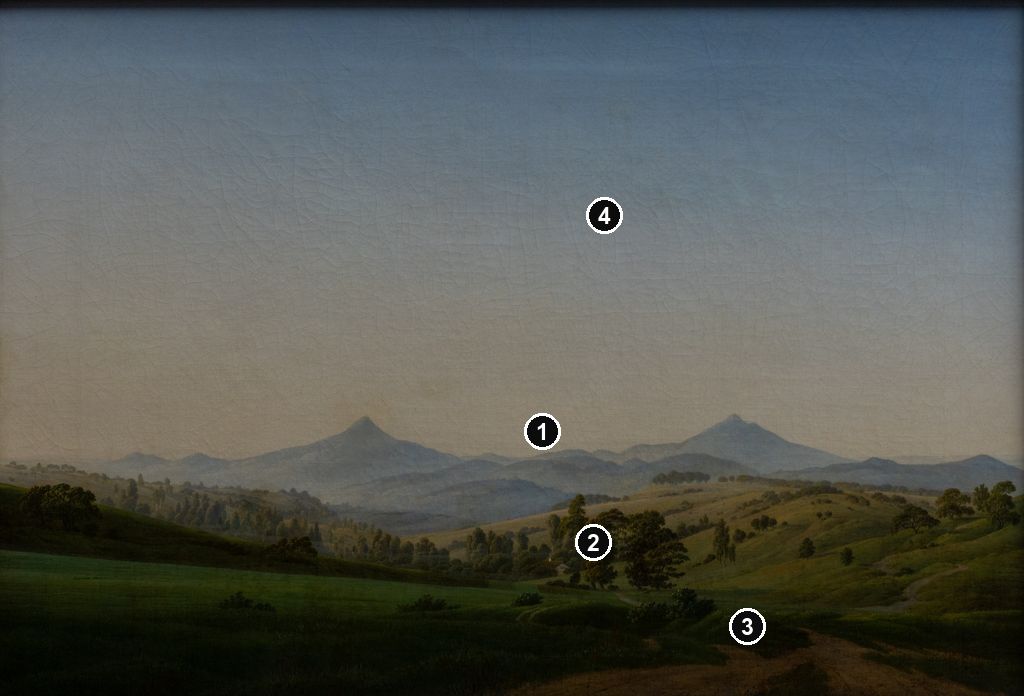
Details from BOHEMIAN LANDSCAPE WITH MILEŠOVKA MOUNTAIN
The detail crops show parts of the painting at a larger scale.
Milešovka and Kletečná
The two peaks rise on either side of the centre against a broad, pale sky.
The trees near the path
The nearer trees stand in a darker band of ground and frame a bend in the path.
A route through the hills
The pale foreground track curves uphill before disappearing among the darker slopes.
The long change in sky colour
The blue above softens into lighter tones toward the mountain ridge.

Frequently Asked Questions
Discussion
Where does the path disappear behind the hill?
Reader Insights
How do the two peaks balance one another?
Where does the path disappear behind the hill?
How does the blue change above the ridge?
How do the two peaks balance one another?
Join the Conversation
Share what you noticed in Bohemian Landscape with Milešovka Mountain.
References
- Staatliche Kunstsammlungen Dresden, Böhmische Landschaft mit dem Milleschauer, Albertinum, Gal.-Nr. 2197 E, with Gerd Spitzer’s 2018 object essay and the collection bibliography. View collection record.
- Holger Birkholz, “Bohemian Landscape with Milešovka Mountain,” 2023 Hamburg exhibition catalogue, p. 130, reproduced in the Friedrich anniversary chronicle. Read object essay.
- Forest Management Institute (ÚHÚL), Jablonec nad Nisou branch, PLO 5 – České středohoří, “Přírodní podmínky,” survey of the natural setting and elevations of the Central Bohemian Uplands. Read survey.
- Friedrich anniversary chronicle, biographical and works chronology, entry for the northern Bohemian tour of 8 September 1807. View chronology.
- Staatsgalerie Stuttgart, Bohemian Landscape, collection media guide, with text by Levi Blum and an account of Christofer Conrad’s reading. View collection guide.
- Martina Jandlová Sošková and František Šuman, “The Thun ‘Hochgräflichen Gallerie’: Tracing Works in the 1814 Inventory and their History after 1945,” Bulletin of the National Gallery in Prague XXIV (2014), fig. 9 and appendix, p. 92, entries 3–6. Read the inventory transcription.