 by Tom Gurney
Tom Gurney BSc (Hons) is an art history expert with over 20 years experience
Email: tomgurney1@gmail.com / Phone: +44 7429 011000
Introduction
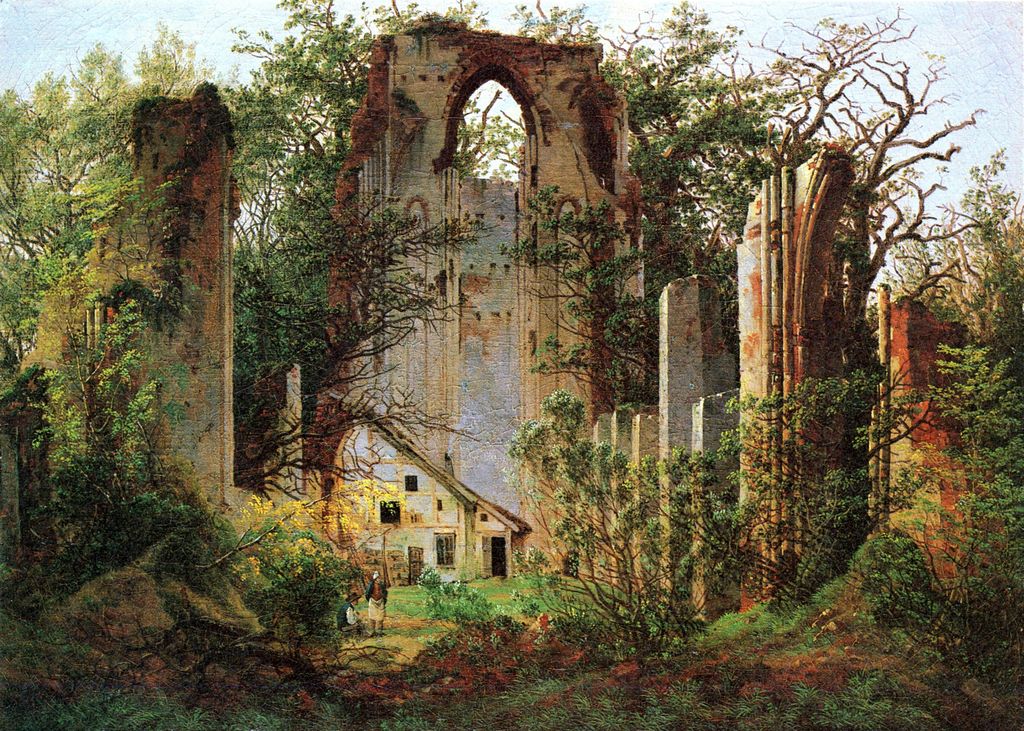
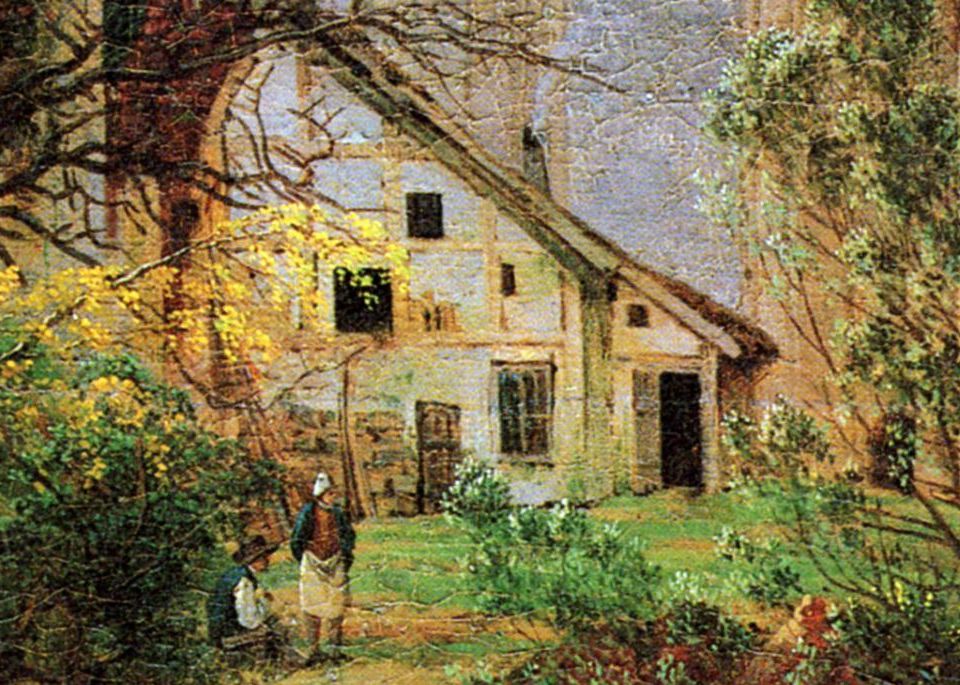
At the foot of a ruined Gothic window, Caspar David Friedrich painted a small cottage with a dark doorway. The window rises almost to the top of the picture. Most of it has been filled in with masonry, but daylight still comes through the pointed opening above. Two small figures appear on the path in front of the cottage. This is the Eldena that Friedrich knew near Greifswald, where a household had made use of a medieval church wall. By the time the painting entered the Nationalgalerie in Berlin, the cottage had been gone for almost a century. [1]
At a Glance
- Artist · Caspar David Friedrich
- German title · Klosterruine Eldena bei Greifswald
- Date · 1824–25
- Medium · Oil on canvas
- Dimensions · 35 × 49 cm (height × width)
- Collection · Alte Nationalgalerie, Staatliche Museen zu Berlin
- Inventory number · A II 574
Contents
- Introduction
- Looking towards the west wall
- From monastery to inhabited ruin
- What the drawings establish
- Eldena in the other paintings
- The small landscape at Dresden
- Annotated Details
- Image Details
Looking towards the west wall
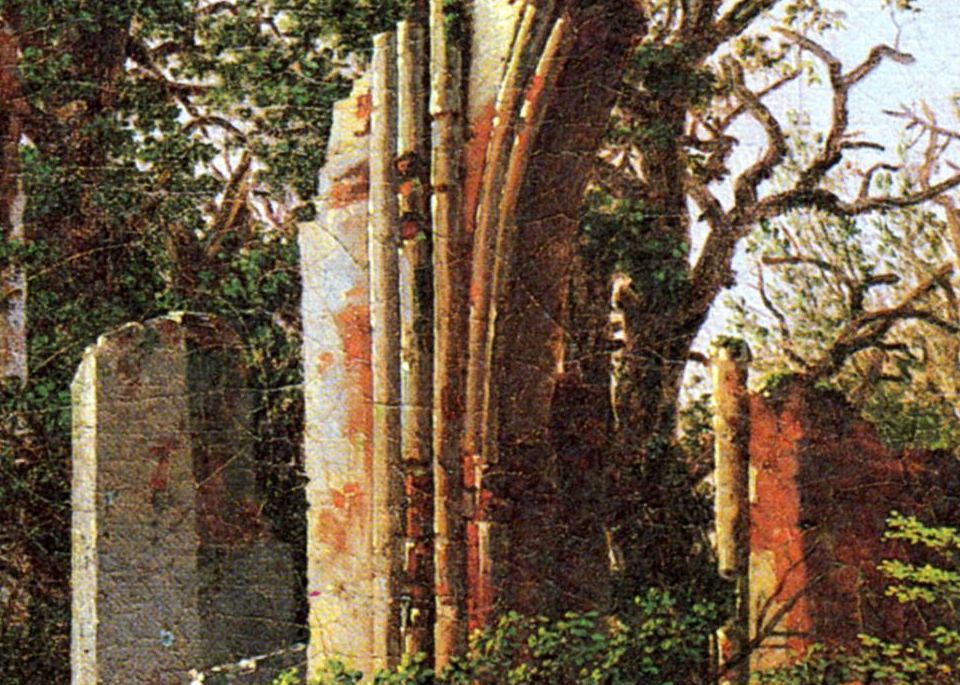
Friedrich puts us inside the former church, looking towards its west end. The wall stands almost straight across the picture. To the right, broken uprights recede towards it, from a tall fragment with several mouldings down to the low blocks beside the cottage. The light catches the edges of the mouldings and picks out the shape of an arch where it once sprang from its support. Across the picture, a rough tower of masonry at the left rises from darker ground. Between those side fragments and the west wall, trees and sky occupy much of the space once enclosed by the building. [1] [2]
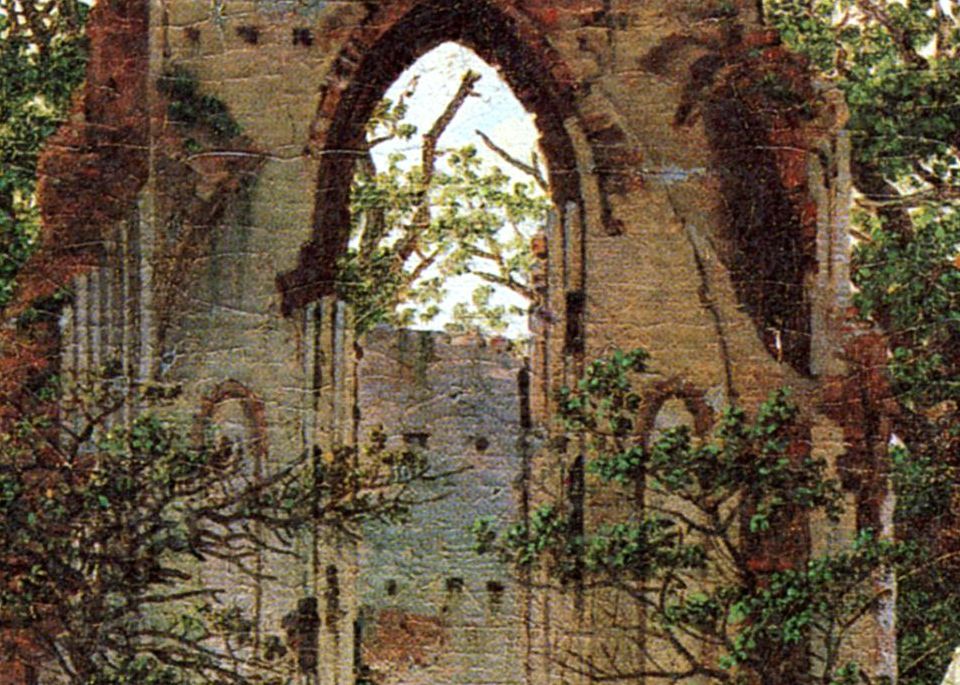
The window is easiest to read from the top. Dark reddish brick follows the curve of the arch, framing a bright patch of sky and a few leaves. The upright edges continue down alongside the pale infill, long after the opening has disappeared. A scattering of small dark marks breaks the surface below. Follow the same line down and it meets the cottage roof, which slopes across the verticals of the church. Below the roof, smaller rectangles do the work the great window once did. The cottage windows and door admit light to rooms people can still use. [1] [2]
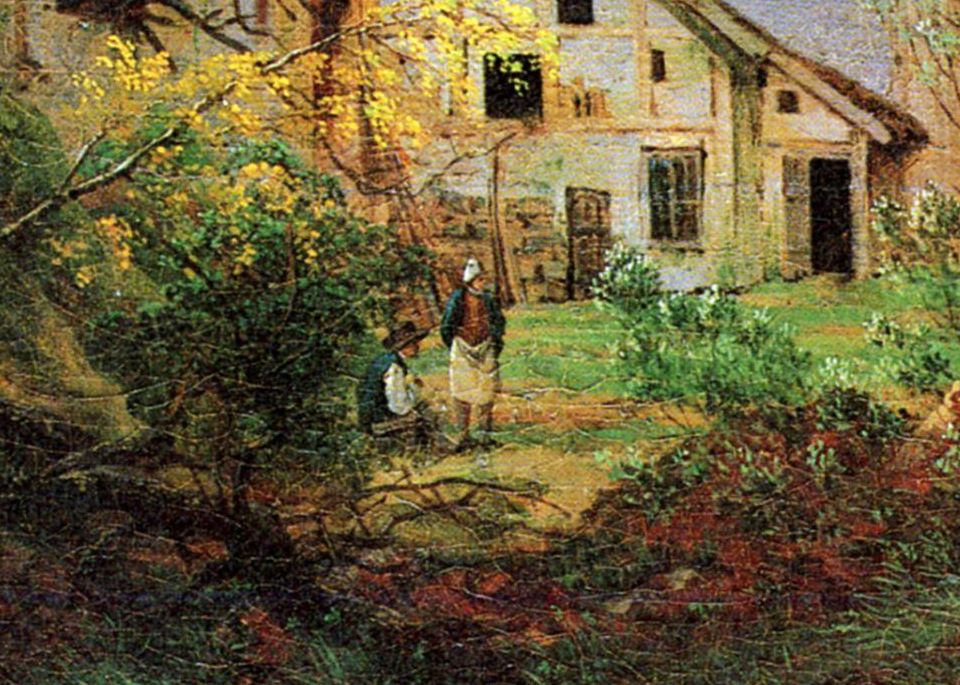
The two figures are easy to pass over. They occupy a strip of pale ground below and to the left of the cottage. The standing figure’s light apron picks up the colour of the cottage wall. The other figure is lower to the ground and partly against a dark bush. Their size makes the doorway look ordinary, which in turn makes the wall rising behind it seem taller. Their proximity to the house suggests the everyday life of the site. Who they were, and whether they lived in the cottage, remains open. [1] [2]
The foreground is mostly in shadow, but the greens lighten around the cottage and in the branches in front of the wall. At the right, bare limbs stand out against the sky above clusters of leaves lower down. At the left, thinner branches run across the pale face of the building. The old masonry can look almost continuous from a distance. Up close, twigs cross its edges and dark patches interrupt the brickwork. The painting gives us the solidity of a wall and the difficulty of seeing its whole outline through several layers of growth. [1] [2]
From monastery to inhabited ruin
Eldena began as a Cistercian monastery in 1199, at the mouth of the Ryck east of what became Greifswald. It was also known as Hilda and belonged to a network of foundations linked to the Danish monastery of Esrom. The early church was built from its eastern end, with work on the western façade extending into the early fifteenth century. The brick wall in Friedrich’s picture belongs to that later part of a building that had taken generations to complete. Its shape was one of the most conspicuous things left of the church. [3] [4]
The monastery was dissolved in the course of the Reformation in Pomerania. The former monastic property became a ducal estate and passed to the University of Greifswald in 1634, through a grant from Duke Bogislaw XIV. The surviving buildings served agricultural and domestic uses, and masonry was taken away for other building projects. The cottage under the window is one sign of that long period of reuse. Gerd-Helge Vogel, writing for the Nationalgalerie, identifies it as a day labourer’s dwelling and reads its modest size against the scale of what remained of the medieval church. [1] [3] [4] [5]
The cottage survived until 1828, when early conservation work was under way. Architectural historian Michael Lissok traces two small buildings that leaned against the west façade before the work, along with other traces of domestic use recorded in drawings of Eldena. The city’s account dates the first clearance and repairs and the laying out of a park to 1828–32, after Crown Prince Friedrich Wilhelm visited in 1827. Oaks were planted in the positions of missing nave piers. Today those trees help mark out the church on the ground. The shrubs in Friedrich’s painting belong to an earlier image of the place, and Vogel treats their profusion as part of the painter’s invention. [1] [3] [5]
Carl Gustav Carus drew Eldena on 13 August 1819 from the southwest. One of the cottages appears beside the ruin in his pencil sketch, which is now in Dresden. Carus went on to make a moonlit oil of the site. In that painting he gave the cottage a lit window and a smoking chimney. The sketch provides a second artist’s record of a dwelling by the church before the clearance. The oil shows how easily a detail of the site could take on a different character when the artist changed the time of day. [5]
What the drawings establish
Friedrich was back in the Greifswald area in 1801. A sheet dated 5 May of that year, now in the Staatsgalerie Stuttgart, shows the eastern parts of the ruin from the southwest. It establishes how early he took an interest in specific sections of the church. The drawing Berlin identifies as the basis of the 1824–25 oil is a different sheet, a study made from life around 1803 and now in the Hamburger Kunsthalle. Its subject is the interior view towards the west wall. Friedrich could return to that viewpoint on paper two decades later, when he made the painting. [1] [5] [6] [7]
The same study also furnished material for two sepia compositions called Winter, one dated 1803 and now in Berlin’s Kupferstichkabinett, the other dated around 1826 by the Nationalgalerie and now in Hamburg. The 1803 cycle links seasons to times of day and stages of human life. In its final sheet the ruin is seen by moonlight, with the sea beyond and an old man beside an open grave. The date of the Hamburg Winter is close to that of the oil. Friedrich could use his study of the west end for a nocturnal scene about old age and death, and for a daylight view where a small house draws the eye into the church. [1] [5] [6]
Two further works are easy to confuse with the oil in a list of titles. Berlin’s Kupferstichkabinett holds Klosterruine Eldena, a pencil drawing on wove paper dated around 1824, inventory SZ CD.Friedrich 27. Dresden’s Kupferstich-Kabinett holds Ruins of Eldena Abbey near Greifswald, Seen from the East, a watercolour over pencil with grey brushwork dated 17 March 1836, inventory C 1937-415. The Dresden sheet looks west from much the same direction as the oil. Its almost square format leaves a broad area of sky above the ruin, and the row of uprights to the right is easy to follow because their bases stand in the open. A fence appears on the left and the thatched roof is easier to see. The blocked window and cottage are still there, even though the dwelling had been taken down eight years before the date of the watercolour. Friedrich was still drawing on the earlier appearance of the site. [1] [5] [8] [9] [13]
Eldena in the other paintings
In Abbey in the Oakwood, painted in 1809–10, Friedrich used the same west window for a much larger canvas. He opened up the blocked arch and set an invented portal in front of the west wall. At ground level monks carry a coffin through a cemetery towards the ruin. The oaks frame the open tracery above them. Look back at the 1824–25 canvas and the position below the window is occupied by the cottage. Where the earlier painting guides a procession through the architecture, the later picture gives the space at the foot of the wall over to people in daylight and the approach to an ordinary door. [1] [10]

In Ruins of Eldena Abbey in the Giant Mountains, dated 1830–34 by the Pommersches Landesmuseum in Greifswald, Friedrich kept a low dwelling beside the ruin and opened the window again. The arch now frames distant land and sky. Behind the Pomeranian brickwork, the ground climbs towards peaks Friedrich had drawn on his journey to the Giant Mountains in 1810. Birte Frenssen identifies the Schneegruben and Reifträger and notes that Friedrich reversed the mountain outlines for the painting. The activity near the buildings is different, too. People are finishing the day’s work and a horse is led into shelter. Frenssen reads the evening scene in relation to the end of life. She also records that the oil went to Friedrich’s eldest brother Adolf in Greifswald and was never publicly exhibited during the artist’s lifetime. [11] [12]
The small landscape at Dresden
An anonymous reviewer of the Dresden art exhibition in 1825 singled out the lightness of the bushes around the ruins and found the small landscape pleasing. That notice, cited in the Nationalgalerie’s object essay, puts a first viewer’s attention on the vegetation. The reviewer identified the subject as the remains of Eldena Abbey in Western Pomerania. These two qualities can be seen together in the pale west wall. The blocked window and the house make it a particular ruin, while the branches that cross the old masonry govern how much of it we can see at any moment. [1]
The Nationalgalerie’s provenance begins with the Berlin publisher Georg Andreas Reimer, who is recorded as holding the painting from 1834. It appears in the records of his collection sale on 27 March 1842. The gallery bought it in 1927 from the Frankfurt dealer F. A. Prestel. By then, the west wall stood in a park laid out around the surviving medieval buildings. The picture preserves something harder to recover from the standing walls alone. Under the arch, at the end of what was once the nave, somebody had a door to go home through. [1] [3] [5]
Annotated Details from Ruins of Eldena Abbey
Use the numbered details to trace how Friedrich arranged the forms and light in this painting.
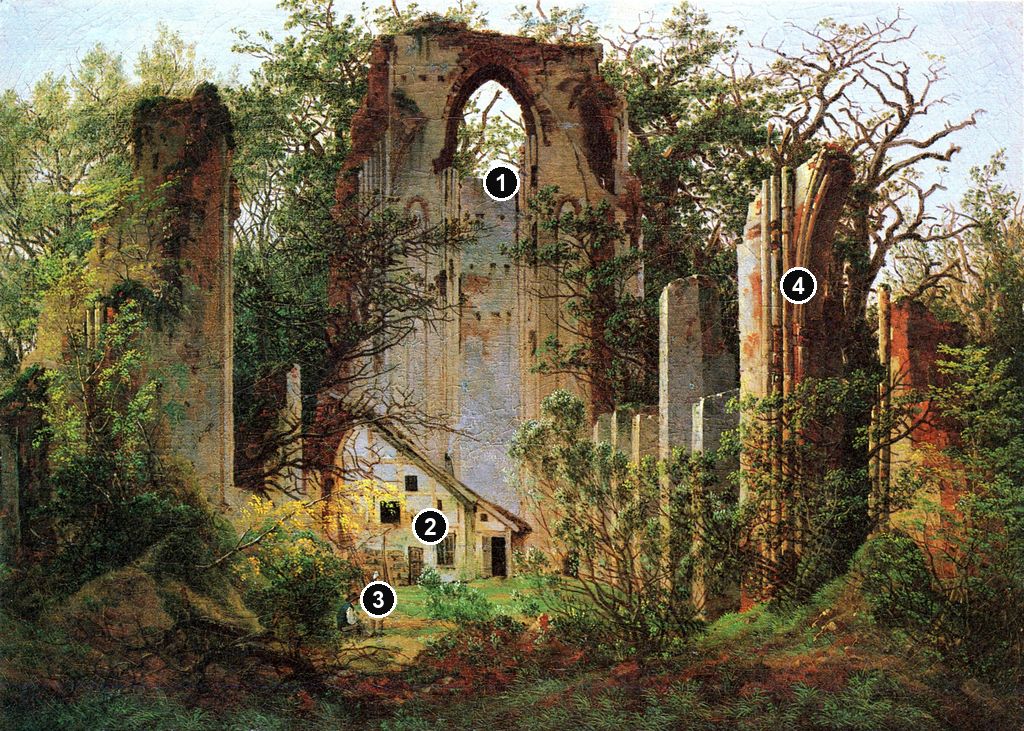
Details from RUINS OF ELDENA ABBEY
The detail crops show parts of the painting at a larger scale.
The blocked Gothic opening
An arch opens onto the sky above the pale wall that closes its lower part.
The cottage
A pale cottage sits against the abbey wall, dwarfed by the surviving opening.
Figures near the cottage
Small figures give a measure of the height of the ruined walls.
Brickwork and branches
On the right, shafts of masonry rise among bare, twisting branches.
Frequently Asked Questions
Discussion
How does the cottage change the scale of the ruin?
Reader Insights
Where does the wall close the pointed opening?
How does the cottage change the scale of the ruin?
Which details carry across Friedrich’s different views of Eldena?
Where does the wall close the pointed opening?
Join the Conversation
Share what you noticed in Ruins of Eldena Abbey.
References
- Alte Nationalgalerie, Klosterruine Eldena bei Greifswald, A II 574, with an object essay by Gerd-Helge Vogel and the 1825 review cited from Literarisches Conservationsblatt, p. 888. Berlin collection record
- Alte Nationalgalerie, Ruined Monastery of Eldena near Greifswald, full painting reproduction and collection description. Museum presentation on Google Arts & Culture
- Universitäts- und Hansestadt Greifswald, Klosterruine Eldena, 2018, site history, chronology and conservation. Municipal monument guide
- Landesamt für Kultur und Denkmalpflege Mecklenburg-Vorpommern, “Ein Relikt aus der Zeit der Zisterzienser: die ehemalige Klosterscheune in Greifswald-Eldena,” July 2009. State heritage essay
- Michael Lissok, “Die Klosterruine Eldena in Bilddokumenten und Werken der Bildenden Kunst des 19. Jahrhunderts,” Greifswalder Beiträge zur Stadtgeschichte, Denkmalpflege, Stadtsanierung, 2015, pp. 44–62, especially pp. 44–49. Municipal conservation journal
- Alte Nationalgalerie, Caspar David Friedrich. Unendliche Landschaften, 2024, sections on the 1803 cycle and the coast. Exhibition wall texts in German
- Sabine Rewald, ed., The Romantic Vision of Caspar David Friedrich: Paintings and Drawings from the USSR, Metropolitan Museum of Art, 1990, catalogue entry for The Ruins of Eldena Monastery, fig. 3.1. Met exhibition catalogue
- Staatliche Museen zu Berlin, Kupferstichkabinett, Klosterruine Eldena, c. 1824, SZ CD.Friedrich 27. Anniversary chronicle object record
- Staatliche Kunstsammlungen Dresden, Kupferstich-Kabinett, Ruins of Eldena Abbey near Greifswald, Seen from the East, 1836, C 1937-415. Anniversary chronicle object record
- Alte Nationalgalerie, Abtei im Eichwald, NG 8/85, with an object essay by Birgit Verwiebe. Berlin collection record
- Pommersches Landesmuseum, Ruine Eldena im Riesengebirge, c. 1830–34. Museum exhibit record
- Birte Frenssen, “Ruine Eldena im Riesengebirge,” with notes on the studies and the painting’s early ownership. German anniversary chronicle
- Antonio Esposito, “The Representation of Architectural Space for Caspar David Friedrich: The Case Study of Eldena Abbey,” Arts 14, no. 1 (2025), § 2.3 and fig. 23, with the Dresden watercolour and comparison of the nave supports. Research article in the German National Library