 by Tom Gurney
Tom Gurney BSc (Hons) is an art history expert with over 20 years experience
Email: tomgurney1@gmail.com / Phone: +44 7429 011000
Introduction
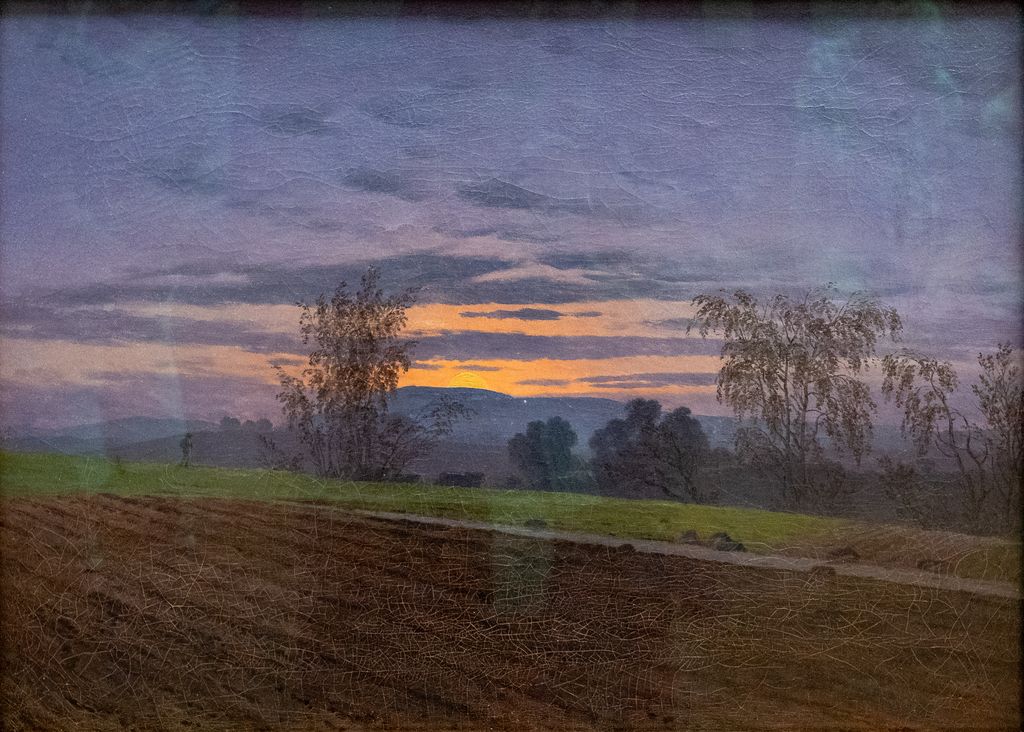
The last of the sun shows above a ridge in Caspar David Friedrich’s Ploughed Field. Below it, a strip of grass and a pale track cut across the picture at a slant. Everything below the track belongs to a piece of ground recently turned by a plough. The brown ridges are close enough to follow almost to the bottom edge, while a man with a stick on the far side of the grass is small enough to miss. Friedrich painted the scene around 1830, giving much of a small canvas to the traces of work still visible at dusk. [1][2]
At a Glance
- Artist — Caspar David Friedrich
- Titles — Ploughed Field in English and Sturzacker in German. The Alte Nationalgalerie uses Plowed Field. [1][2][3]
- Date and medium — Around 1830, oil on canvas. [1][3]
- Dimensions — 35 cm high × 47.7 cm wide. [1][3]
- Collection — Hamburger Kunsthalle, Hamburg, inv. HK-1053. Acquired in 1905. [1]
Contents
- Introduction
- The lines of the plough
- The ground falls away
- The colour of the last light
- The walker and the village
- The proposed Teplitz drawing
- Pasture and ploughed land
- From private collections to Berlin
- Annotated Details
- Image Details
The lines of the plough
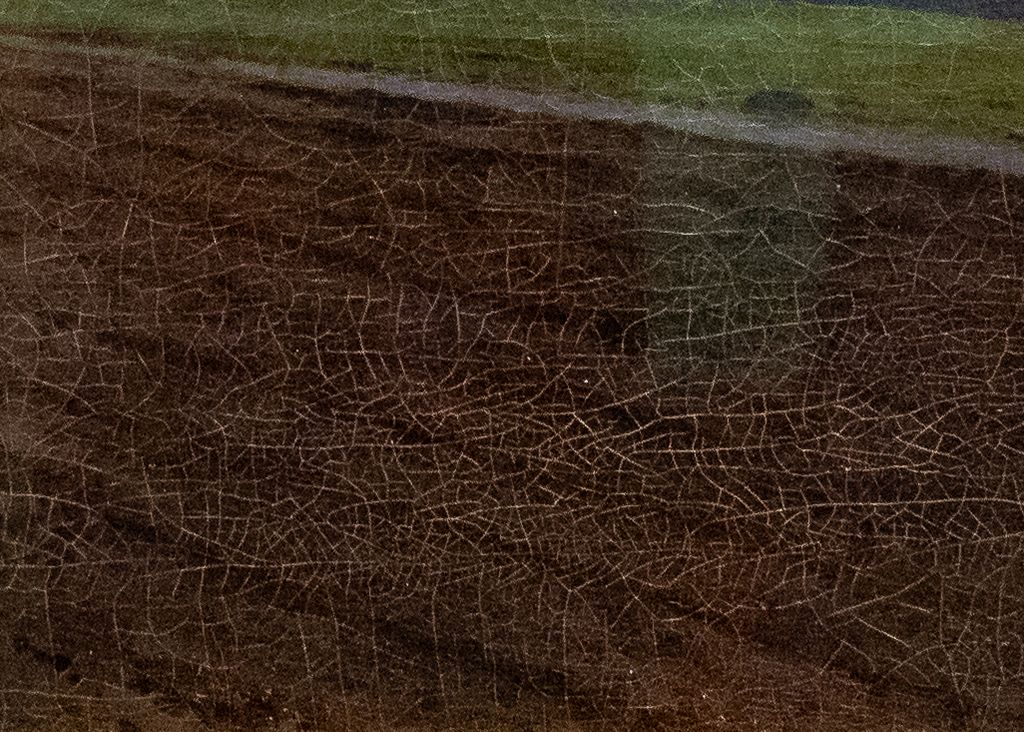
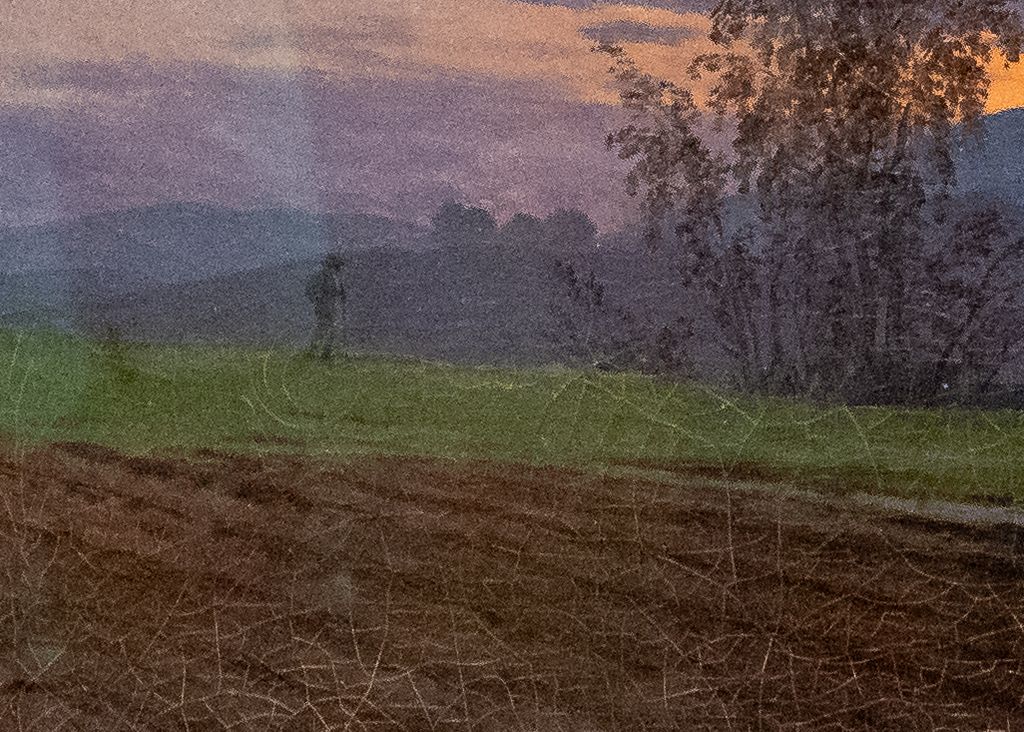
The German title Sturzacker refers to a freshly turned field. Across the foreground, dark troughs alternate with warmer brown ridges. Several of the broadest ridges can be traced from the bottom and right of the picture back towards the left, where the field meets the grass. Their intervals become harder to distinguish farther away. Up close there are irregular clods and breaks in the lines, enough to give the freshly exposed soil a roughness of its own. The surface cracking visible in the museum’s photograph runs in many directions across the soil and over other parts of the picture. The painted furrows are the much broader, roughly parallel bands. [1][2]
The edge of the field slopes down across the picture from left to right. The furrows take a steeper course across it, so their direction and the outline of the field can be followed separately. The soil takes up more of the picture on the left, where the boundary runs higher, and the grass tapers towards the right. A pale track comes into view along that boundary and can be followed towards the right edge. The track is narrow enough for the scattered dark stones along it to interrupt its outline. Those stones are easier to pick out than anything of comparable size beyond the grass. They give the eye a scale for the nearby ground before the view opens into the valley. [1][2]
The person and the field are the most direct signs that people use this land. The work itself survives in the even spacing of the rows, while their broken surfaces suggest the resistance of the soil. Friedrich gives the worked area the full width of the foreground. The only figure is already beyond it, travelling along the upper part of the meadow. That distance between the walker and the plough marks lets the two details carry different kinds of time. One records the repeated passage of the plough. The other suggests a few more steps before the light fails. [1][2]
The ground falls away
The strip of bright green grass is easiest to see beneath the walker at the left. Look just above it and the far side of the slope is already dim. Near the middle of the painting, the upper outlines of a few roofs peep over the grass. The lower parts of the buildings are hidden, which makes the drop beyond the field appreciable even though the descent itself is difficult to see. The farthest ridge is clearer against the strip of warm sky than the village is against the shadowed ground. Depth depends on what the nearer slope hides as much as on what is painted distinctly farther back. [1][2]
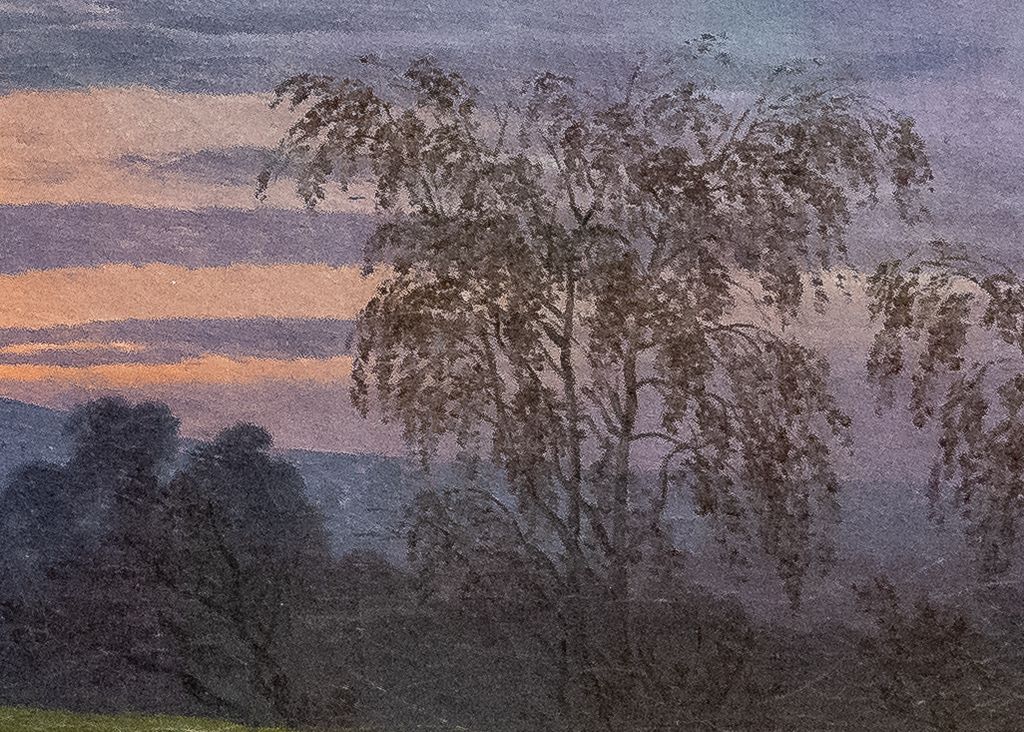
The trees give a series of intermediate distances between the grassy edge and the ridge. The tall tree left of centre has an uneven crown with small openings through which the sunset shows. At the right, the boughs of a larger spreading tree bend into fine hanging sprays. Kilian Heck, writing for the Hamburger Kunsthalle exhibition, tentatively identifies these trees as an aspen and a weeping birch. The middle trees are darker, rounder and more closely packed. From the first tall crown to the hanging branches on the right, Friedrich leaves enough open sky to show how the forms differ even as the lower trunks disappear into a common shadow. [1][2]
The colour of the last light
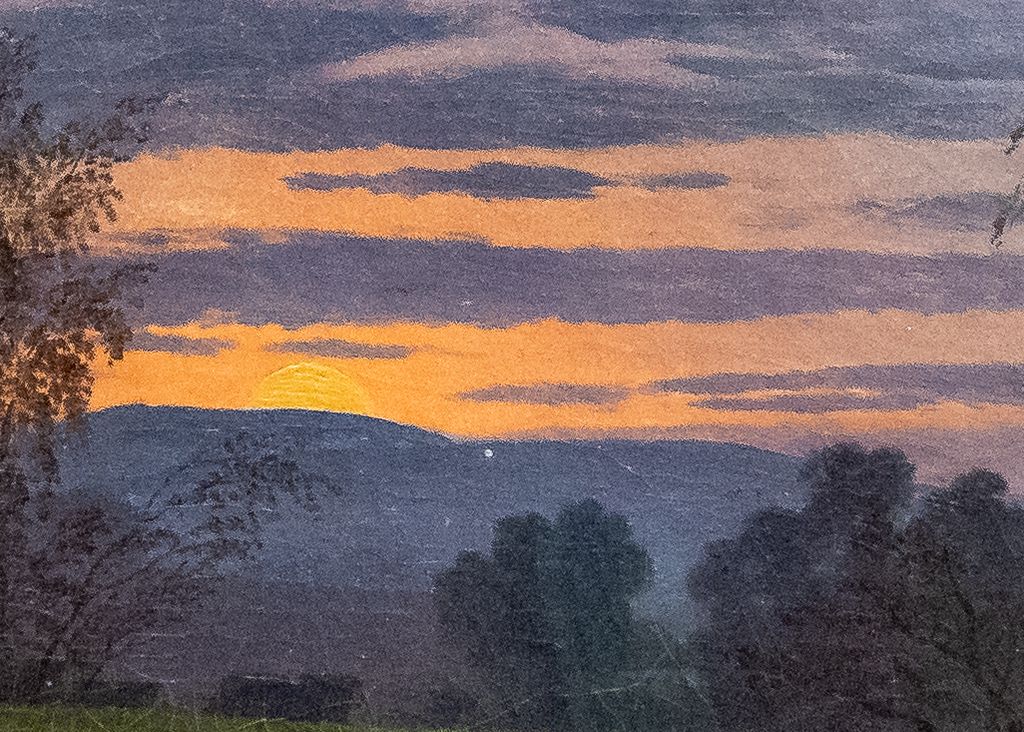
Near the ridge, a small arc of yellow sits within a much wider opening of gold and orange. Flat tongues of cloud extend into the warm colour, some with sharp outlines and others with edges that soften into the sky around them. The upper sky is much cooler and more muted. It contains broad areas of grey-violet as well as smaller blue-grey patches. Heck draws attention to the complementary pairs of yellow and violet, and blue and orange. Friedrich distributes them unevenly. The strongest warmth occupies a shallow band, so a small area of bright paint is enough to make the much larger sky feel as though it is darkening. [1][2]
The handling of the sky can be followed in the changing edges of the clouds and the gradual shifts of colour between them. Around the sun, the broken bands are legible at a glance. Higher up, the difference in tone between cloud and sky is slight. The same change in visibility takes place at ground level. Some leaf clusters stand out as tiny, separate touches against the yellow. Their branches lose definition farther down, where the trunks overlap the darker valley. The furrows remain legible through a different kind of contrast, between rust-brown crests and darker hollows. For all the strength of the sunset, the earth holds onto its own colours. [1][2]
The walker and the village
The figure’s stick and forward tilt make him readable as a walker even at this scale. The warm opening in the sky is nearer the middle of the painting, while he stands well to the left. The green bank beneath him gives way, farther across, to the barely visible roofs. Heck suggests the village may be his destination. The direction of the figure and the roofs make such a journey easy to imagine. Much of the way down is hidden from view, and Friedrich leaves the journey in progress. [1][2]
Helmut Börsch-Supan and Karl Wilhelm Jähnig read the apparent homecoming as a parable of death, an interpretation Heck cites in his catalogue essay. The sunset and the fading visibility of the village give that reading its force. The field also supplies a quite ordinary reason to be out at that hour, in a landscape where land has been worked and people live just over the slope. A viewer can register the change from day to night before even seeing the man. Finding him gives that change a human timescale. [1][2]
The proposed Teplitz drawing
Reinhard Zimmermann revisited a proposed link between the painting and a pencil drawing dated 3 September 1835 and drawn near Teplitz. Sigrid Hinz had cautiously suggested that Friedrich might have used the sheet for Ploughed Field. Börsch-Supan rejected the connection, and Zimmermann, able to look at the rediscovered drawing, found that neither its distant ridge nor the scattered stones made a close enough match. The sketch postdates Hamburg’s approximate dating of the canvas by about five years. The resemblance offers little ground for revising that chronology or assigning the oil painting to Teplitz. [1][4]
Pasture and ploughed land
In Meadows near Greifswald, another small Hamburg canvas, horses make the use of the pasture immediately apparent and the town’s towers are clear against a bright sky. In Ploughed Field the worked soil comes right up to the viewer and the buildings are almost lost. In The Grosse Gehege near Dresden, a stretch of land once used for grazing is seen at sunset. There, water carries the light into the foreground. Here, the dry ridges keep it at a distance. [1][5][6]

From private collections to Berlin
The Kunsthalle records Ploughed Field in the collection of the Berlin publisher Georg Andreas Reimer through 1843. Its ownership research leaves gaps both before and after the Reimer collection. The next named owner is Heinrich Friedrich, from whose collection the Kunsthalle bought the painting in 1905. By the following year the museum was lending it to the German Centenary Exhibition at Berlin’s Nationalgalerie. The period catalogue lists Sturzacker among the Hamburg works, alongside Meadows near Greifswald. [1][7][8]
The 1906 exhibition brought together paintings by Friedrich that had been dispersed among museums and private owners. Hamburg sent five, including The Sea of Ice and Mountain Landscape in Bohemia. In the Alte Nationalgalerie’s 2024 exhibition Infinite Landscapes, the list of works again marked out Ploughed Field as one of the pictures shown in 1906. Where the jagged wreck in The Sea of Ice commands attention at a distance, Ploughed Field asks visitors to come much closer. The walker and the roofs are details they may discover only after their eyes have adjusted to the dusk of a field less than half a metre wide. [1][3][8]
Annotated Details from Ploughed Field
Use the numbered details to trace the forms and light in this work.
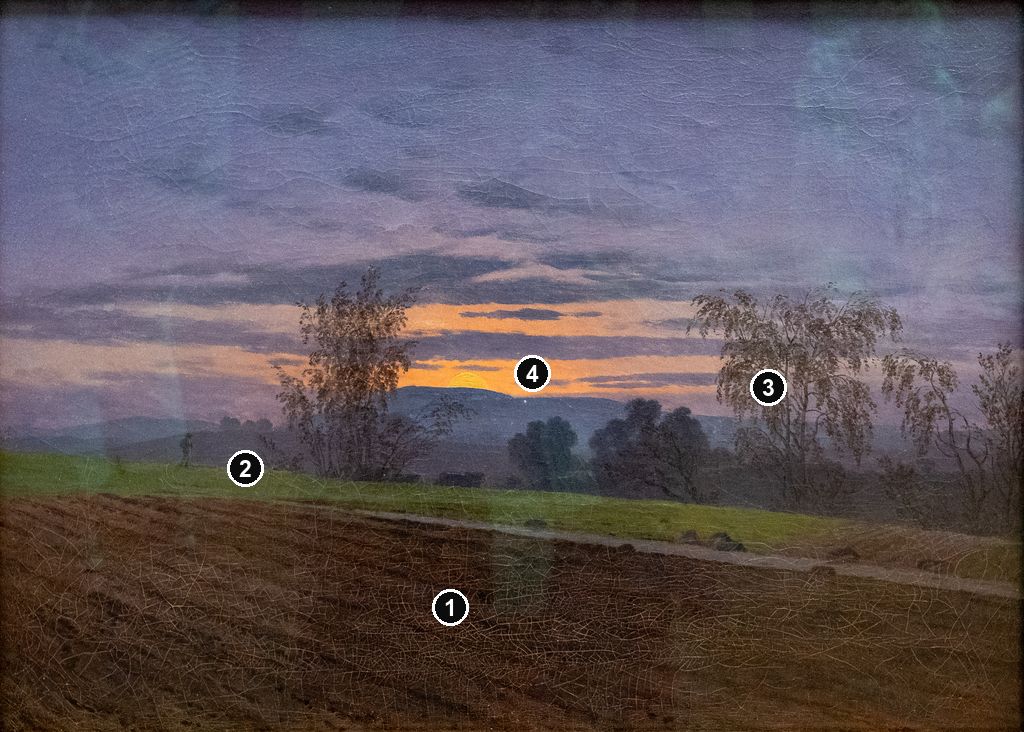
Details from PLOUGHED FIELD
The detail crops show parts of the work at a larger scale.
The furrows
The ridged field fills much of the foreground. The furrows carry the eye across its slope.
The green margin
A strip of green separates the worked earth from the distant trees.
Trees against the light
The thin crowns show patches of evening sky through their branches.
Low evening light
The orange light appears in narrow horizontal bands between dark clouds.
Frequently Asked Questions
Discussion
How much of the painting is devoted to the sky?
Reader Insights
Where do the furrows seem to turn?
How much of the painting is devoted to the sky?
How do the tree crowns interrupt the light?
Where do the furrows seem to turn?
Join the Conversation
Share what you noticed in Ploughed Field.
References
- Sturzacker, HK-1053, Hamburger Kunsthalle. Collection entry, object photograph and Ute Haug’s provenance research, updated 17 November 2021, consulted 11 November 2026.
- Kilian Heck, Sturzacker, Friedrich anniversary chronicle and English version, Ploughed Field. Hamburger Kunsthalle exhibition catalogue, 2023, p. 266, citing Börsch-Supan and Jähnig’s 1973 catalogue raisonné, p. 425, no. 390.
- Caspar David Friedrich. Infinite Landscapes, Alte Nationalgalerie works list. Entry 78.
- Reinhard Zimmermann, Meadow in Teplitz, Ketterer Kunst. Signed catalogue essay on the 1835 drawing and the proposed relationship to the Hamburg oil.
- Clara Blomeyer, Meadows near Greifswald, Friedrich anniversary chronicle. Hamburger Kunsthalle exhibition catalogue, 2023, pp. 268–71.
- Air and Light by Caspar David Friedrich, Staatliche Kunstsammlungen Dresden. Online study of the 1832 painting and the historical use of the Elbe floodplain.
- Ausstellung deutscher Kunst aus der Zeit von 1775–1875 in der Königlichen Nationalgalerie, 1906. Volume 1, index p. XLIV, under Friedrich.
- Caspar David Friedrich and the German Centenary Exhibition of 1906, anniversary project. Section 5, on the exhibition and the five loans from Hamburg.