


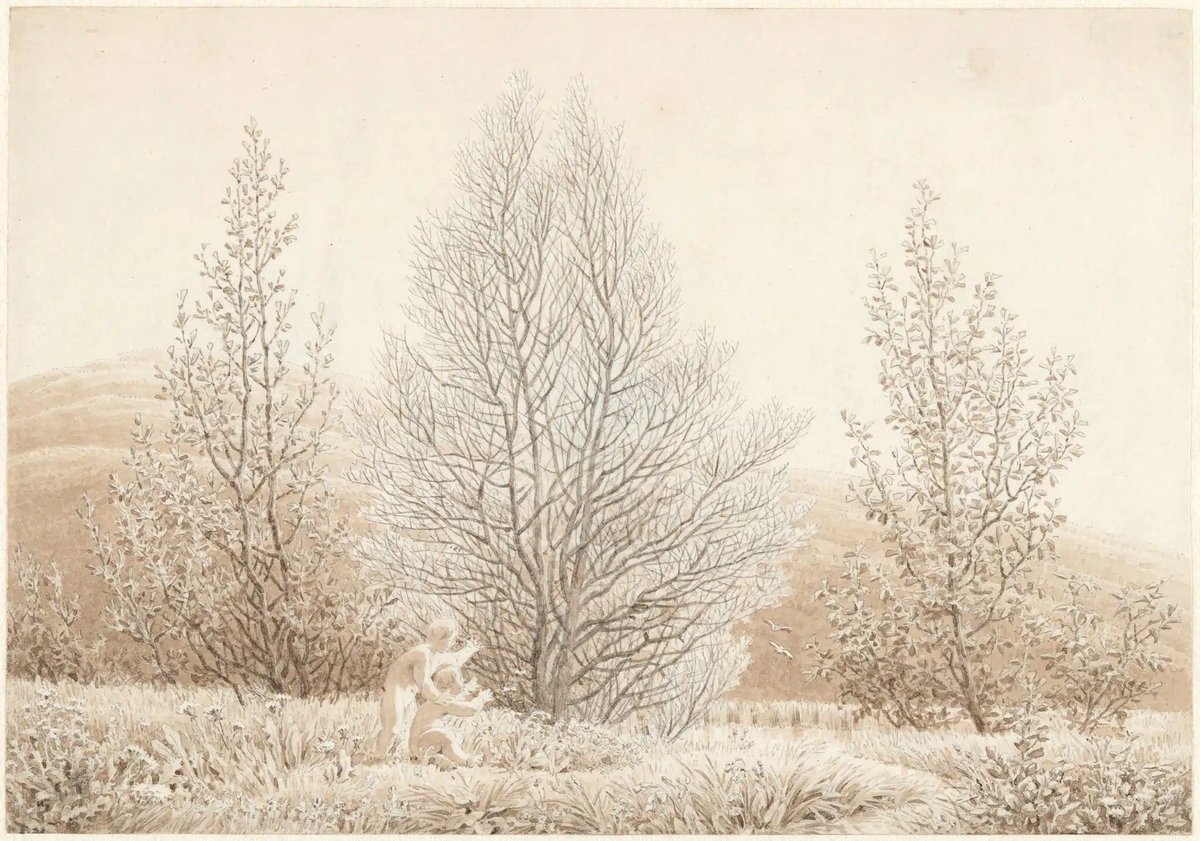
Spring, around 1826. Hamburger Kunsthalle, Kupferstichkabinett, 41121. Hamburger Kunsthalle / bpk, photograph by Christoph Irrgang. Public Domain Mark 1.0.
 by Tom Gurney
Tom Gurney BSc (Hons) is an art history expert with over 20 years experience
Email: tomgurney1@gmail.com / Phone: +44 7429 011000
Introduction
In Caspar David Friedrich’s Spring of 1803, children play in a meadow enclosed by low hills. In Winter, from the same set of sepia drawings, an old man sits beside an open grave, with the moon behind a ruined church. Friedrich brings a season, an hour and a stage of life together in each landscape. When he returned to the subject for an exhibition in 1826, he gave winter a place in a longer sequence. The graveyard was followed by a cave, and the cave by two angels. For a visitor who had followed the story as far as the grave, two pictures still lay ahead. [1] [2] [3]
At a Glance
- Drawing · Spring, from the Ages of Life sequence, around 1826
- Collection · Hamburger Kunsthalle, Kupferstichkabinett, 41121
- Other formats · Painted pendants and seasonal oils
Contents
- Introduction
- The four seasons of 1803
- Four hours in Hanover and two in Berlin
- Seven sheets at the Dresden Academy in 1826
- Runge's engraved hours and Friedrich's landscapes
- Two kinds of work at first light
- Spring that still looks like winter
The four seasons of 1803
The Berlin Kupferstichkabinett holds three sheets from Friedrich’s first four-part seasons cycle. They are Spring – Morning – Childhood, Autumn – Evening – Maturity and Winter – Night – Old Age and Death. Summer, the second sheet, remains missing. A photograph preserves its composition, with lovers in a leafy bower in a sunlit river valley. The other three sheets were long thought lost. They resurfaced in private hands and went on view at the Kupferstichkabinett in 2006 after treatment for wartime damage. In the surviving sheets Friedrich used a brush and brown sepia ink over a graphite drawing. [1] [4]
In Spring, the low rises and the foreground activity keep the eye close. The children have room to move about, and the enclosing land gives their play a visible boundary. In an 1803 diary passage that the Kupferstichkabinett associates with this sheet, Friedrich links the limited outlook with the children’s absorption in the present. A much deeper view opens in Autumn. Mountain slopes lead towards high peaks, and a cross on a rock introduces a small, distinct landmark into the great distances. In Winter, the open grave makes the foreground a place where the eye stops again. Beyond it the moon shows through the architecture and illuminates the sea. The change from sheet to sheet is a change in how far the figures and the viewer can look. [1] [4] [5]
Philipp Otto Runge was exploring the passage of time in his own Times of Day at about the same moment. The Hamburger Kunsthalle connects Friedrich’s interest in the subject to Runge, whom he met in Dresden in 1802. Runge also acquired two Friedrich landscapes with Rügen motifs depicting morning and evening. The 1803 sepias show how Friedrich could give the idea a particular shape. An ordinary feature of the terrain, such as the low rise in Spring, could help convey a stage of life without requiring a personification of the season to appear in the meadow. [4] [6]
References to a four-part cycle continued to appear after 1803. A report published in 1807 and Gotthilf Heinrich von Schubert’s discussion of the seasons in 1808 once led Helmut Börsch-Supan to propose another set of sepias from around 1807. Peter Prange’s account for the Hamburger Kunsthalle gives weight to Hein-Th. Schulze Altcappenberg’s case for reading both texts in connection with the 1803 sheets. Prange also describes physical evidence that a transfer drawing for Winter, with a darkened back and incised outlines, was used for the early composition and altered for the later one. A drawing could therefore preserve changes made across two periods. The evidence for an intervening four-sheet cycle remains disputed. [3]
There is a documented pair in oil from this early period. The Neue Pinakothek’s Summer (Landscape with Lovers), dated 1807, places its couple in a shaded bower looking out over a broad, sunny landscape. The museum identifies its companion as a winter landscape with a solitary monk, destroyed in the Munich Glaspalast fire of 1931. The canvas in Munich can help us picture how Friedrich used the lovers and the bower in his early seasonal work. The missing summer sepia and the destroyed winter oil are two separate losses. [1] [7]
Four hours in Hanover and two in Berlin
In the Four Times of Day at the Landesmuseum Hannover, a day passes across four small canvases of nearly the same size. A 2024 study by conservators and scientists from Hanover and the Prussian Palaces and Gardens Foundation dates the set to 1820–21 and traces it to Friedrich Wilhelm Körte, a literary historian in Halberstadt. The four paintings can be read from Morning through Midday and Afternoon to Evening. They are distinct from Friedrich’s earlier series of four small seascapes, now dispersed. Hanover also holds the morning scene from that group, Morning (Boats Setting Out). [8] [9]
In the Morning from Körte’s set, a fisherman is already at work. The sky casts a reddish reflection on the lake, and the hills descend into mist. At Midday a broad track runs into a pasture landscape where a shepherd watches his flock. Two groups of pines stand clear of the relatively open ground. In Afternoon, a wagon crosses farther back while the partially harvested field brings the signs of work close to the lower edge. The sky darkens across the picture. By Evening, pine trunks stand between the viewer and the sunset, and two walkers have stopped to look at the light through them. The Hanover museum draws attention to the relation between the descending mountain line in the first picture and the rising zone of trees in the last. The terrain helps carry the eye across the series as the light and occupations change. [8] [9] [10]
The hours also change what it means to be outside. The morning fisherman goes out onto open water, where the reflection spreads in front of him. The evening walkers stand among trunks that break the light into narrow intervals. Midday has the clearest route for someone on foot, and the half-cut field of Afternoon shows a task already under way. Hanover’s curators see an analogy with the span from birth to death. The different figures also make the progression intelligible as a single day of work, travel and rest. [9] [10]
The Berlin banker Joachim Heinrich Wilhelm Wagener asked for two landscapes, one for morning and one for evening. Friedrich wrote to him on 1 November 1822 that both were finished. In The Lonely Tree, a shepherd and flock occupy a wide meadow, and a single oak rises against the brightening sky. In Moonrise over the Sea, the view opens across water. Three people sit on a rock as sailing ships approach and the moon lights the horizon. Each painting has a strong foreground anchor, but the upright trunk pulls the eye up through the morning landscape while the seated group directs it out to sea. The commission gives the two hours a documented relationship. Seen together, the paintings also change the ground under the figures’ feet and the direction in which the viewer looks. [11] [12]
Seven sheets at the Dresden Academy in 1826
The Dresden Academy opened its annual exhibition on 3 August 1826. In the catalogue, entry 664 lists Friedrich’s seven sketches in sepia as one item. [13]
An anonymous writer in the Blätter für literarische Unterhaltung described them by number. The Hamburger Kunsthalle now catalogues seven corresponding sheets as The Ages of Life, dating them to around 1826. The review begins with a sunrise at sea, which the writer reads as the beginnings of creation. Spring comes second. Two children chase butterflies among budding trees. In summer, the third sheet, a couple meets in the shade. In autumn, the fourth, the view opens onto steep paths and a distant city. The writer saw the pair parting where the paths diverge. Winter comes fifth. A full moon shines into the graveyard by the ruined abbey, and the reviewer describes the two aged travellers making a grave in which to rest together. [3] [14] [15]
The sixth sheet takes the viewer underground to human remains among stalactites. The seventh, Angels in Adoration, shows two winged figures kneeling among clouds and looking towards the light. The sequence begins before its first human figures appear and continues after their burial. Sea, graveyard and cave give successive forms to the earth in the reviewer’s account, from unformed matter to the rocky chamber holding the dead. The last sheet removes the ground entirely. The reviewer thought the pictures stirred the imagination more than they satisfied the eye and left open whether Friedrich had intended this particular reading. Carl August Böttiger likewise admired the ideas and wished Friedrich had exhibited more fully worked pieces. He singled out the cave and described two human skeletons. The anonymous writer had described one, likening the stone formation around it to the skeleton of the earth. [3] [6] [14] [15]
Looking back to 1803 makes the changes within the four central sheets easier to see. In the earlier spring, five children occupy the meadow. In the later version, the two small butterfly catchers stand below three upright trees whose trunks dominate the scene. The old man of the first Winter has a companion in the second. With two people at the grave, winter can carry forward the encounter in summer and the separation that the Dresden reviewer saw in autumn. Putting the two winters beside each other also makes the old ending visible inside the new sequence. The moon and ruin persist, but a scene that once closed the series now leads into the cave. [1] [3] [14] [15]
The 1826 account establishes the seven subjects that visitors saw. Whether every sheet now in Hamburg was the one on the wall is a separate question. In 1834 the sculptor David d’Angers recorded seeing several newly completed drawings of seasons and ages in Friedrich’s studio. He described one child and blossoming trees in spring, where the Hamburg sheet has two children and trees without blossom. Börsch-Supan suggested that four of the originals shown in 1826 might have been lost and replaced in the surviving set by drawings from a later version. Prange notes that the paper is the same across all seven Hamburg sheets and cites Eckhard Schaar’s argument that their differing condition may help explain apparent differences in handling. The Hamburg group is conventionally dated around 1826, and the later studio account leaves room for Friedrich to have revisited some of the subjects. [3] [15]
In the Leipzig oil The Stages of Life, which the Museum der bildenden Künste Leipzig dates to around 1834, Friedrich brought different ages together on one shore. The sepias spread that experience across several sheets. In 1803, the moon gave the final scene its light. In the seven-sheet sequence, the graveyard still has its moon, and the angels look towards a light that belongs to neither an hour nor a season. [1] [3] [15] [16]
Runge's engraved hours and Friedrich's landscapes
The Met holds a set of large engravings after Runge's Times of the Day dated 1807. In the museum's records, Morning, Day, Evening and Night all belong to the same project, with the same three engravers named alongside Runge. The impression of Morning is more than three quarters of a metre high. The size matters for comparison with Friedrich. Runge could place small figures and recurring plant forms within elaborate borders, giving those features room to make connections between the edges and the centres of the compositions. A viewer reading the engravings in succession could compare the organization of the whole sheet as well as the principal figures.[17]
Compare the Morning and Night engravings with the first and last of Friedrich's 1803 sepias. A Runge print gives its central scene a border populated by related forms. The eye can cross from a figure or plant within the image to another element in the surrounding design. In Friedrich's Spring, much of what connects a person with the season lies in the small amount of land available for the children to move through. In his Winter, the distance between the grave and the moonlit view gives the spectator a different route. The sequence makes a change in the position and reach of the eye part of the change of season.[1] [2] [5] [17]
There is also a difference in how the subjects could circulate. A printed series can exist in more than one set of impressions, and the Met catalogues its set as the second state. A group of original ink drawings has an individual history as physical sheets. When one of Friedrich's sepias is missing and the others bear damage, photographs and descriptions supply evidence that cannot restore the original object or its appearance at the moment of exhibition. The different survival histories affect how easily a later viewer can put four images together and how much weight a single surviving impression or photograph is asked to bear.[1] [4] [17]
Two kinds of work at first light
Coastal Landscape in Morning Light, held in Lübeck and dated about 1817 by the Met, extends the comparison between the morning oils. The Met connects its fishing gear and working boats to details Friedrich collected on the Baltic coast in 1815. Several figures attend to the work at hand as the coloured light develops around them. An hour of the day can be clear to a spectator even while the people absorbed in it seem to have no reason to stop and take notice of the sky. The pace of a task supplies its own measure of time alongside the changing light.[18]
The morning in Körte's four pictures also includes a fisherman, but the figure's boat has a different relation to the land. Mist and lake provide a wide interval around it. In the coastal oil, people and equipment give several indications of what can be done at this place. In the Hanover oil, a single boat provides much of what the spectator can infer about the use of the water. These are two ways of making human occupation visible at the opening of a day. The one takes its bearings from the small actions available on a working shore. The other lets the setting's expanse set the scale of one person's activity.[9] [18]
The comparison adds something to the familiar reading of the four Hanover pictures as a passage through life. When Morning is seen with Midday and Afternoon, the tasks and routes change. The act of working from a boat has a relation to the shepherd's watch and the passage of a wagon. When the same Morning is seen beside the Lübeck canvas, it becomes easier to recognize which parts of fishing Friedrich concentrated in this one image and which kinds of activity he gave space to elsewhere. A fixed place in a series makes the Hanover picture legible in one way. Comparison with a separate picture of the hour makes it legible in another.[9] [10] [18]
Spring that still looks like winter
The National Gallery of Art's Northern Landscape, Spring, painted around 1825, gives the season a very different appearance from the 1803 sepia. Snow still lies in the hollows and the land remains brown across much of the canvas. The Met's exhibition label calls attention to new shoots in the foreground. The distant figures are so small and close to the colour of the ground that they can take longer to find than the patches of snow. The features that suggest a change of season and those that make the expanse feel wintry are present at once.[18] [19]
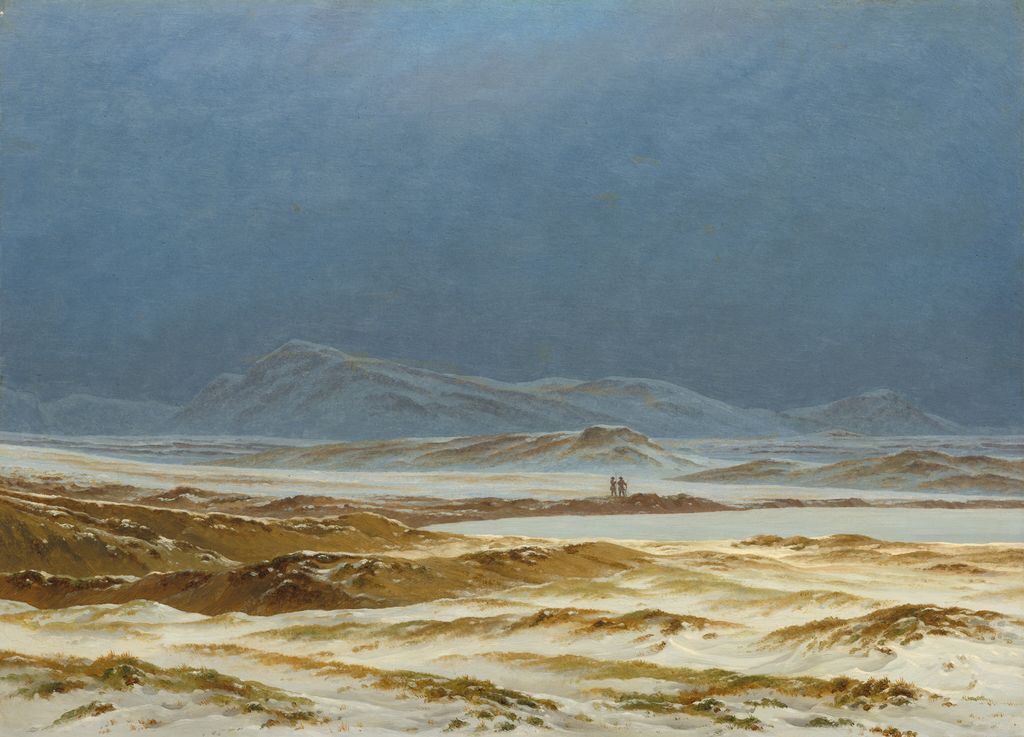
The contrast with the sepia matters because the early Spring gives the children room to occupy the lower part of the image. A spectator can read the suggestion of youth through what they do. The painted northern landscape makes human age much harder to judge. Its spring is discernible through the relation of snow, soil and small points of growth. The label therefore provides a reason to look near at a canvas that at first encourages a much longer view. A person reading from the season named in the title has to discover a visual change that occupies comparatively little of the scene.[1] [2] [18] [19]
In Spruce Thicket in the Snow (From the Dresden Heath I), around 1828, small blades of grass are visible through the thin snow. The Munich collection record draws attention to that detail within a close view of young conifers. Here the same coexistence of growth and snow does not need to be read across a broad expanse. It belongs to the immediate vicinity of branches and ground, without the distinct scale supplied by people out in a landscape. The pairing with Bushes in the Snow was already public when both works were exhibited in 1828, and the Met's exhibition texts identify the named place in the catalogue as the Dresden Heath.[18] [20]
The close view helps separate signs of season from the need to give a season one fixed meaning. Grass visible through snow does not by itself determine the month. It does let a viewer see that growth and cold belong to the same piece of ground. In the 1803 cycle a viewer encounters spring and winter in different sheets. In the later paintings the conditions associated with two seasons can press against each other within a few inches of a single canvas. A sequence makes change visible through comparison between scenes. A painting like Northern Landscape, Spring can make it visible through the very unequal space left to the signs of what is changing.[1] [18] [19] [20]


Frequently Asked Questions
Discussion
What changes between the oak meadow and the moonlit coast?
Reader Insights
How are figures and landscape brought together in Spring?
What changes between the oak meadow and the moonlit coast?
How does the sequence extend the passage through the seasons?
How are figures and landscape brought together in Spring?
Join the Conversation
Share what you noticed in Seasons, Times of Day and Ages of Life.
References
- Staatliche Museen zu Berlin, Caspar David Friedrich: Infinite Landscapes, English gallery texts, “The Seasons Cycle of 1803.”
- Staatliche Museen zu Berlin, Kupferstichkabinett, Spring – Morning – Childhood, KdZ 29941.
- Peter Prange, Hamburger Kunsthalle and the Friedrich anniversary project, Spring (The Ages of Life, Sheet 2), inv. 41121, catalogue essay.
- Staatliche Museen zu Berlin, Kupferstichkabinett, Caspar David Friedrich. Jahreszeiten. An der Wiege der Romantik, exhibition announcement, including Friedrich’s 1803 diary passage.
- Staatliche Museen zu Berlin, Caspar David Friedrich: Infinite Landscapes, exhibition checklist, nos. 31–33.
- Hamburger Kunsthalle, “Caspar David Friedrich. Die Lebensalter,” in William Blakes Universum, exhibition texts.
- Bayerische Staatsgemäldesammlungen, Neue Pinakothek, Der Sommer (Landschaft mit Liebespaar), inv. 9702.
- Mechthild Most, Eva Wenders de Calisse, Jens Bartoll and Kirsten Hinderer, Zur Maltechnik Caspar David Friedrichs, Stiftung Preußische Schlösser und Gärten Berlin-Brandenburg and Niedersächsisches Landesmuseum Hannover, 2024, pp. 3–5 and 8.
- Landesmuseum Hannover, Tageszeiten. Caspar David Friedrich in Hannover, illustrated exhibition notes, PNM 635 and 382–385.
- Landesmuseum Hannover, Tageszeiten. Caspar David Friedrich in Hannover, exhibition announcement, pp. 1–2.
- Staatliche Museen zu Berlin, Alte Nationalgalerie, Der einsame Baum, W.S. 52.
- Birgit Verwiebe, Staatliche Museen zu Berlin and the Friedrich anniversary project, Moonrise over the Sea, W.S. 53.
- Royal Saxon Academy of Arts, Dresden exhibition catalogue, 1826, p. 57, no. 664. Transcription linked to the SLUB Dresden scan.
- Anonymous, “Bemerkungen über die diesjährige dresdner Kunstausstellung”, Blätter für literarische Unterhaltung, 1826, p. 359. Transcription linked to the SLUB Dresden scan.
- Hamburger Kunsthalle and partner museums, Friedrich works chronicle, Die Lebensalter, sheets 1–7.
- Museum der bildenden Künste Leipzig, Caspar David Friedrich and the Düsseldorf Romanticists, Lebensstufen, c. 1834.
- Metropolitan Museum of Art, 1807 impressions of the four engravings after Runge, Morning, Day, Evening and Night.
- Metropolitan Museum of Art, The Soul of Nature exhibition labels, pp. 17–21, including the Lübeck morning, the Washington spring and the Dresden Heath paintings.
- National Gallery of Art, Washington, Northern Landscape, Spring, c. 1825, 2004.113.1.
- Bayerische Staatsgemäldesammlungen, Neue Pinakothek, Fichtendickicht im Schnee (Aus der Dresdner Heide I), ESK 1.