 by Tom Gurney
Tom Gurney BSc (Hons) is an art history expert with over 20 years experience
Email: tomgurney1@gmail.com / Phone: +44 7429 011000
Introduction
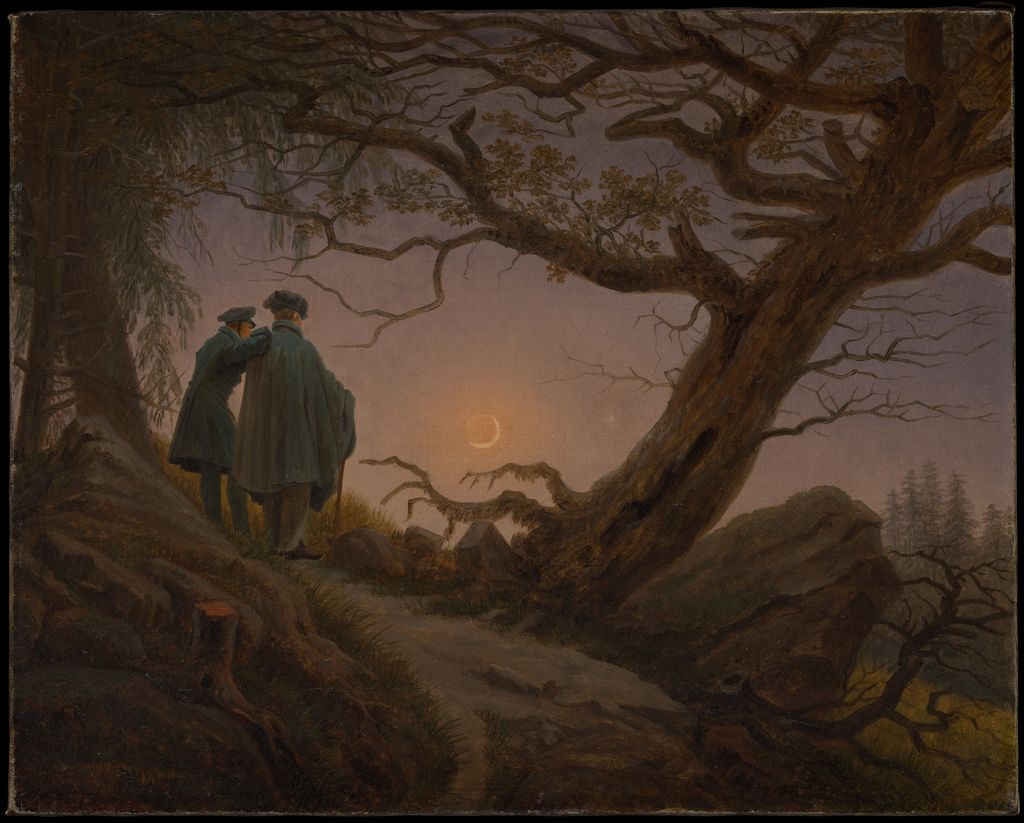
In Caspar David Friedrich’s Two Men Contemplating the Moon at the Metropolitan Museum of Art, a man in a dark coat leans towards his companion and rests an arm across his shoulder. Their backs are turned, but a sliver of the leaning man’s face catches enough light to show where he is looking. A thin crescent hangs low between them and the slanting trunk of an oak. Below it, the tree’s exposed roots curl up from the ground. The men have found a spot on a steep path where they can stop together, and Friedrich has left just enough light for us to see what made them pause. [1]
At a Glance
- Artist · Caspar David Friedrich
- Date · c. 1825–30
- Medium · Oil on canvas
- Dimensions · 34.9 × 43.8 cm (height × width)
- Collection · The Metropolitan Museum of Art, New York
- Accession · 2000.51, Wrightsman Fund, 2000
Contents
- Introduction
- The path to the moon
- The faint face of the moon
- Dresden, Berlin and New York
- Where the oak came from
- What the men may have meant to Friedrich
- How the painting came to New York
- Annotated Details
- Image Details
The path to the moon
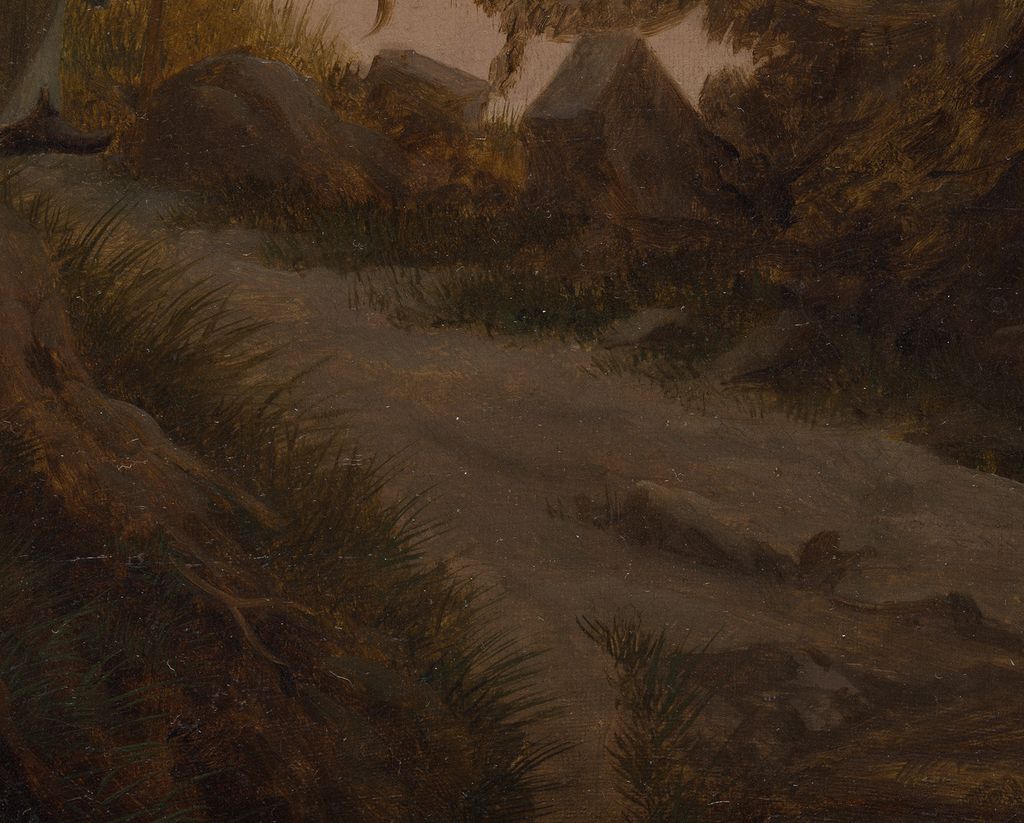
The path enters from the lower middle of the canvas and turns left as it climbs. There is a little light on its surface, enough to distinguish the worn track from the irregular banks at either side. Follow it up and it takes you to the men’s boots. The moon sits farther to the right. To see what the men see, your eye has to make the same turn their bodies suggest. Friedrich gives the two walkers a foreground substantial enough to stand on, then uses their attention to draw you across an interval of air. The hillside beyond that interval is scarcely described. [1]
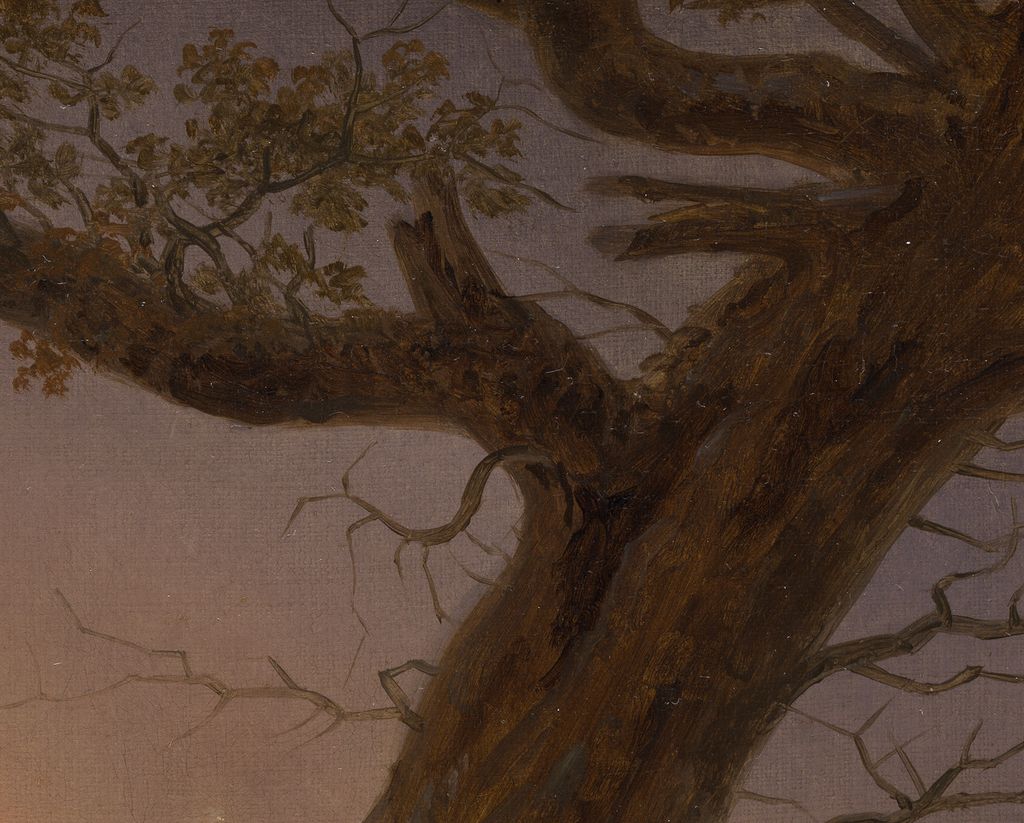
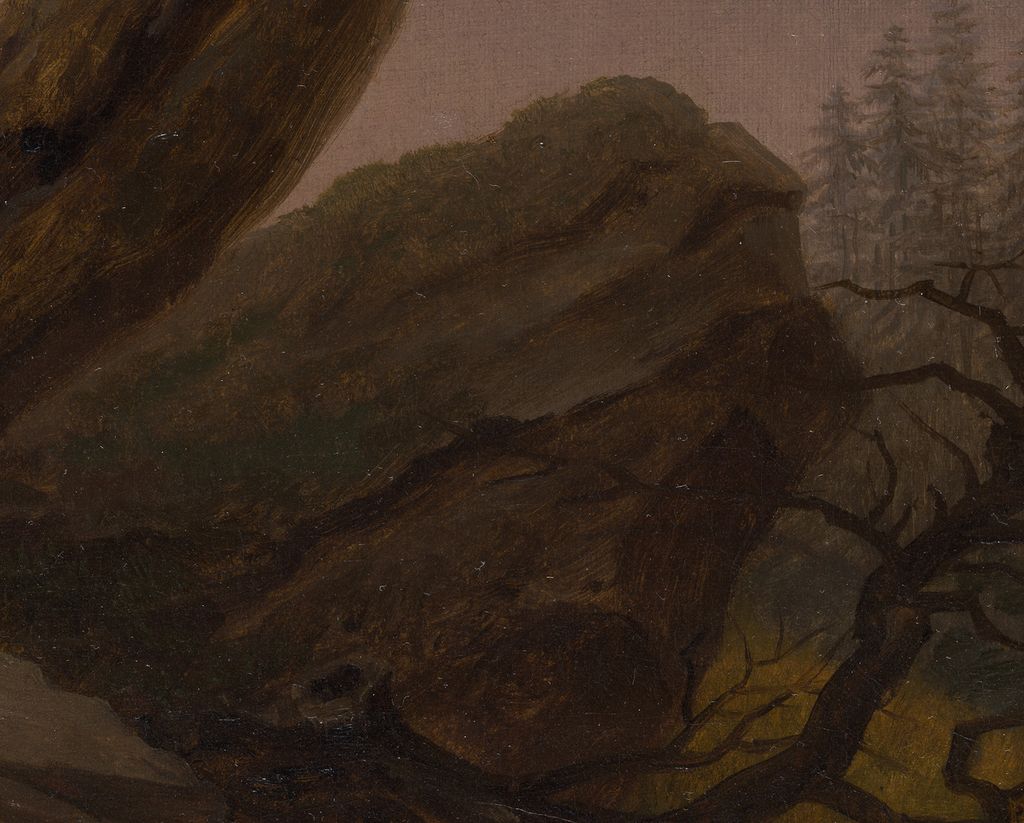
Look next at the oak, which rises from the roots near the centre and slants sharply to the right. One great limb stretches back across the painting above the men. Smaller branches hang into the pale sky, some still bearing scattered leaves. At the far left, the dark upright of the evergreen gives the men shelter and helps define the opening in which their hats are legible. At the right a slab of rock rises alongside the trunk, with a few distant conifers just visible behind it. The dark foreground has several depths of its own. Even the snapped wood down near the path takes a moment to come into focus. [1]
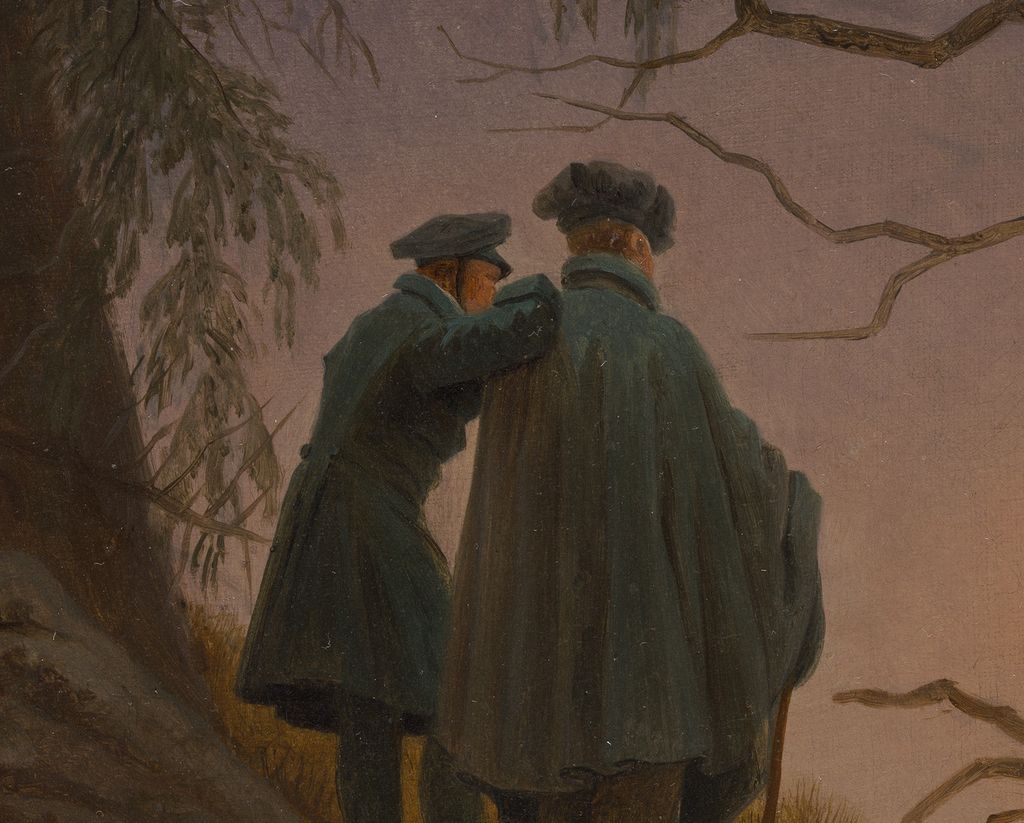
What the title calls contemplation has a very physical shape. The taller figure stands with his weight settled under a broad cape. The other bends at the waist, his coat following the angle of his body as he leans into him. Friedrich places their heads just far enough apart for the two caps to read separately. The touch at the shoulder joins the silhouettes. Figures seen from behind are often called Rückenfiguren. Here the device lets us follow two lines of sight and still leaves us slightly outside the encounter. We can see the moon over their shoulders and infer something of their ease with one another from the gesture. Their expressions remain largely private. [1]
The faint face of the moon
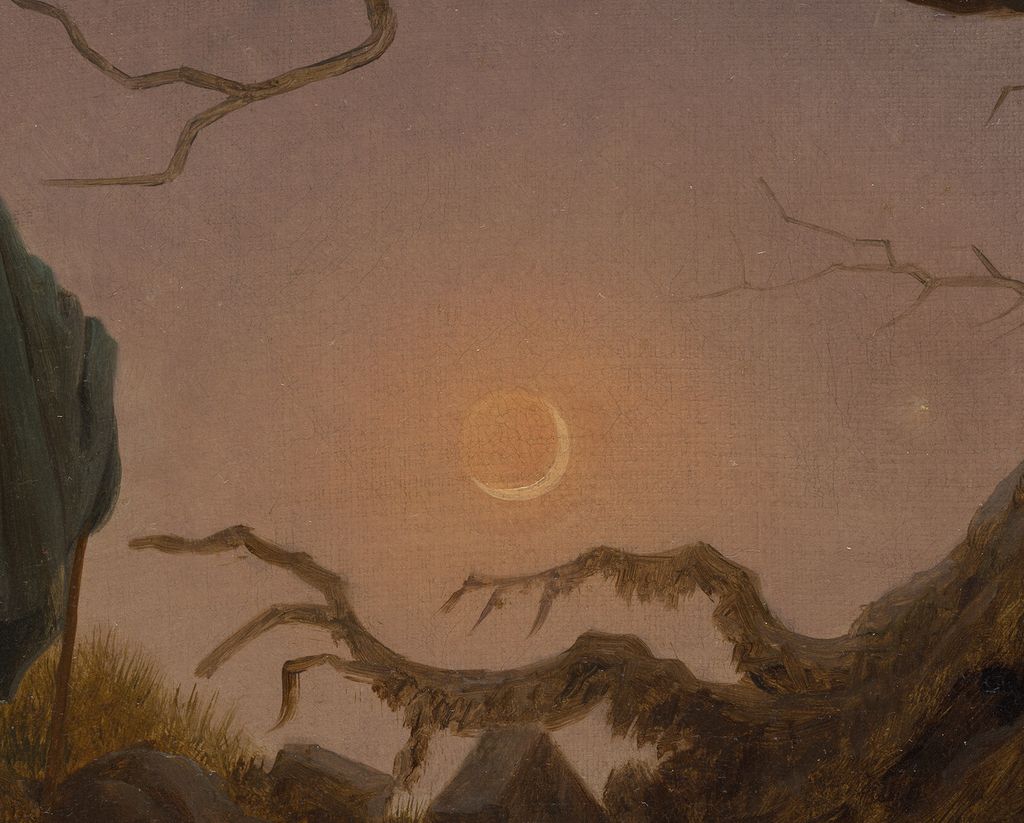
The brightest part of the moon is a narrow arc. Look just inside that arc and a fainter, round body comes into view. In her study of the Dresden painting, the Met curator Sabine Rewald identified this effect as earthshine, the sunlight reflected from Earth that gives the unlit portion of a crescent moon a dim glow. Rewald also identified the bright point to the right of the Dresden moon as Venus. In the New York picture a much fainter point sits above and to the right of the crescent. The Dresden analysis helps explain how carefully Friedrich looked at the sky, while the New York canvas lets the crescent emerge from a broader, pinkish glow. [1] [2] [3]
The crescent is thin enough that you may see the orange glow before you find the bright edge. The colour warms around the moon and cools as the sky opens to the right. The illumination on the path is broad and subdued, and the ground is still easy to read in patches. Friedrich was arranging the light across the whole surface as well as recording a recognisable phase of the moon. The result feels like the moment on a walk when you stop thinking about where to put your feet and discover how much you can still see. [1] [2]
Dresden, Berlin and New York
The earlier Two Men Contemplating the Moon belongs to the Galerie Neue Meister in Dresden, where it is dated 1819/20. Put the Dresden and New York images side by side and the family resemblance is clear. The two men stand together to the left of the moon in both, and the oak runs diagonally across the right half. Dresden’s rust-brown light sinks more deeply into the landscape, yet the streak of light along the climbing path stands out more sharply. The track in New York is quieter, and there is more of a sense of air between the boulder, the tree and the horizon. The men are still the first thing you see at the top of the path, but the space around them feels less close. [1] [2] [3]

Berlin’s Alte Nationalgalerie holds Man and Woman Contemplating the Moon, dated about 1824. The companion on the left wears a long dress, with a reddish sleeve visible where she reaches towards the man. The figures stand more upright and the eye is pulled to the oak, whose branches divide the lighter sky into smaller openings. The rock at right is especially imposing against that light. Eberhard Hanfstaengl, who acquired the picture for the Nationalgalerie, suggested that the couple represented Friedrich and his wife Caroline. It remains a proposal. The woman’s pose has a separate, material history. Berlin’s researchers identified a surviving tracing of a standing woman as the model for her outline. [2] [4] [5] [6]
New York brings back the two men and the broken branch that Berlin leaves out. The Met’s 2001 catalogue found that the New York painting also retained the lighter sky of the Berlin variant, with looser brushwork and less detailed forms than in either earlier canvas. Its infrared examination found no evidence of underdrawing in the New York picture. Berlin’s research, by comparison, documents Friedrich transferring figure outlines from tracing sheets with a stylus onto prepared canvas, including the standing woman in its version. The two findings show how differently Friedrich could work even when he kept much of a composition. You can see the difference in the edges. The woman’s dress and the Berlin oak read emphatically against the light. In New York, some smaller shapes around the exposed roots and near the men’s feet merge into the ground. [1] [2] [4] [6]
Where the oak came from
Friedrich’s tree was built from careful observations made years before any of the three paintings. A sheet of graphite studies in Dresden’s Kupferstich-Kabinett is dated 25 and 26 April 1809. It records two trees from Friedrich’s trip to Neubrandenburg. The lower study supplied the crooked, hollowed trunk, while the upper study supplied the long branch extending to the left. The Met catalogue traces the use of the sheet across all three moonwatching paintings. What had been separate drawings on a page became one oak, tall enough to fill a corner and broad enough to shelter the men on the other side of the canvas. [2]
The roots put the tree’s whole weight in view. If you follow the trunk down, it ends in a mass of exposed wood and earth, with thin branches and roots carrying the silhouette through the narrow space beneath the crescent. This is also where the two trees make a telling contrast. In the Dresden picture, the dead oak has been read alongside the evergreen as an image of mortality and enduring life, with the waxing moon suggesting salvation. The New York painting preserves the forms that allow such a reading. Its paler sky also gives the crooked branches an immediate visual purpose, tracing the opening the men are watching. [1] [3]
What the men may have meant to Friedrich
The taller man on the right has often been identified as Friedrich and his companion as the younger landscape painter August Heinrich. The identification comes from historical testimony about the Dresden composition and has been carried over to New York because Friedrich returned to the same pair. Heinrich died in 1822, several years before the Met’s approximate date for its painting. If the identification is right, the New York canvas returns to the likeness of a friend already lost. Friedrich’s precise intention in reviving the figures remains unknown. [1] [2] [7]
There is also a political edge to the story of the first painting. The writer Karl Förster visited Friedrich’s studio with the painter Peter Cornelius in 1820. In the account published from Förster’s papers in 1846, Friedrich says, ‘Die machen demagogische Umtriebe’ (‘They’re stirring up demagogic trouble’). Förster describes the remark as ironic. He leaves the two painted men unnamed, then goes on to describe a visit to Heinrich in Friedrich’s company that same day. The joke would have had a particular point at the time. The caps and cloaks recall the so-called Old German dress adopted by patriots and associated with opposition to the political Restoration. In the climate of repression that followed the Carlsbad Decrees of 1819, clothing of this kind attracted official suspicion. Förster was describing the Dresden composition. When Friedrich brought the men back in the later canvas, he kept the outline of the clothing that would have made the remark intelligible. [2] [3] [5] [8]
The Dresden painting itself passed between friends. In 1820 Friedrich gave it to the Norwegian painter Johan Christian Dahl in an exchange. Dahl gave Friedrich his view of the Plauenscher Grund in return. Three years later Dahl painted Two Men before a Waterfall at Sunset, which the Met reads as a tribute to Friedrich’s picture. Dahl’s two figures have their own place on a ledge, in a taller composition with moving water and a far-reaching view. The contrast is revealing. In the Met’s Two Men Contemplating the Moon, almost all of the action is in the approach to the viewing spot and in the slight bend of one man towards the other. Dahl kept the shared encounter and changed what there was to watch. [3] [9]
How the painting came to New York
The Met’s painting has a different history from the canvas Friedrich gave Dahl. According to the museum’s research, its first owner was Friedrich’s physician, Otto Friedrich Rosenberg. Rosenberg’s daughter Theophila Minna studied drawing with Friedrich. The exhibition catalogue relates that the doctor accepted the painting in place of a fee for medical care. It stayed with Rosenberg’s descendants for roughly 170 years before the Met acquired it in 2000 through the Wrightsman Fund. It was the museum’s first Friedrich painting. [1] [2] [10]
The acquisition made it possible to bring all three paintings together in the Met’s 2001 exhibition Moonwatchers. The two works named Two Men Contemplating the Moon had left Friedrich’s hands under different circumstances. One belonged to the exchange between painters and entered the Dresden gallery in 1840. The other passed through a household where Friedrich was both a patient and a drawing teacher. Seen together, the two canvases make a small change in the light easy to appreciate. In Dresden, the moon and its bright neighbour hold your eye in a pool of warmth. In New York, your eye can wander farther. There is a stretch of open sky between the crescent and the trunk, and through it you can see past the men into the distance. [1] [2] [3] [10]
Annotated Details from Two Men Contemplating the Moon
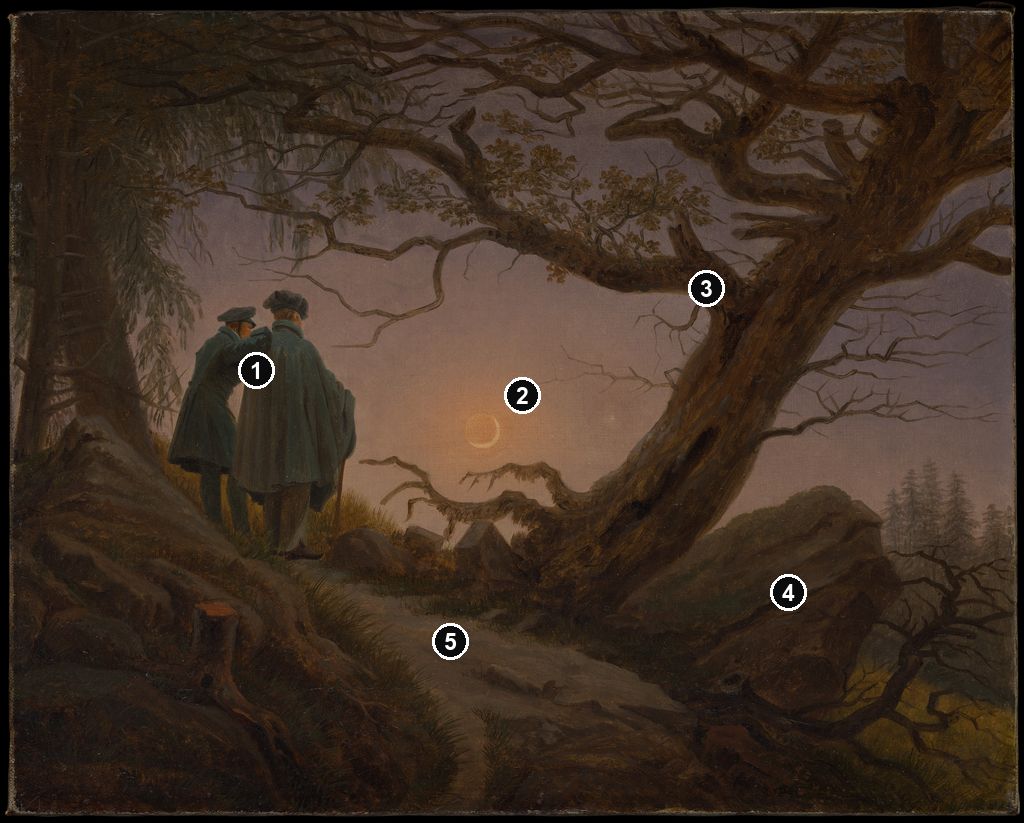
Follow five details in the Metropolitan Museum of Art’s version, from the path and the figures to the crescent and the oak.
Details from TWO MEN CONTEMPLATING THE MOON
The details below show how Friedrich arranged figures, trees and rocks around a small opening in the evening sky.
The two men
One figure leans toward the other, bringing the two silhouettes together against the lighter sky.
Crescent and faint lunar disk
A narrow bright crescent sits in the warm opening between the figures and the oak. The less luminous portion of the disk remains visible.
The leaning oak
The oak rises at a steep diagonal. Its branches spread above the men and stretch across the opening in the sky.
The rock below the oak
A large rock catches a little light below the trunk. Smaller forms along the slope lead the eye toward it.
The rising path
A strip of lighter earth climbs toward the figures and narrows as it passes behind the broken branches and roots.
Frequently Asked Questions
Discussion
What changes when a woman replaces one of the men in the Berlin painting?
Reader Insights
How does the sloping path draw you toward the two men?
What changes when a woman replaces one of the men in the Berlin painting?
Where does the faint part of the lunar disc become visible?
How does the sloping path draw you toward the two men?
Join the Conversation
Share what you noticed in Two Men Contemplating the Moon.
References
- The Metropolitan Museum of Art, Two Men Contemplating the Moon, 2000.51
- Sabine Rewald and Kasper Monrad, Caspar David Friedrich: Moonwatchers, Metropolitan Museum of Art, 2001, especially pp. 14–15 and catalogue entries 1–4, pp. 30–36
- Staatliche Kunstsammlungen Dresden and the Friedrich anniversary chronicle, Two Men Contemplating the Moon, Gal.-Nr. 2194, with an essay by Holger Birkholz
- Staatliche Museen zu Berlin, Mann und Frau in Betrachtung des Mondes, A II 887
- Birgit Verwiebe, Mann und Frau in Betrachtung des Mondes, Friedrich anniversary chronicle
- Alte Nationalgalerie, Caspar David Friedrich. Unendliche Landschaften, 2024 gallery texts, “Figurenumrisse”
- Alison Hokanson and Joanna Sheers Seidenstein, “Friedrich and the Soul of Nature,” Metropolitan Museum of Art catalogue excerpt
- Karl Förster, Biographische und literarische Skizzen aus dem Leben und der Zeit Karl Förster’s, edited by Luise Förster, Dresden, 1846, p. 157, digitised by the Bayerische Staatsbibliothek
- The Metropolitan Museum of Art, Johan Christian Dahl, Two Men before a Waterfall at Sunset, 2019.167.3
- The Metropolitan Museum of Art, Caspar David Friedrich: Moonwatchers, 2001 exhibition overview