


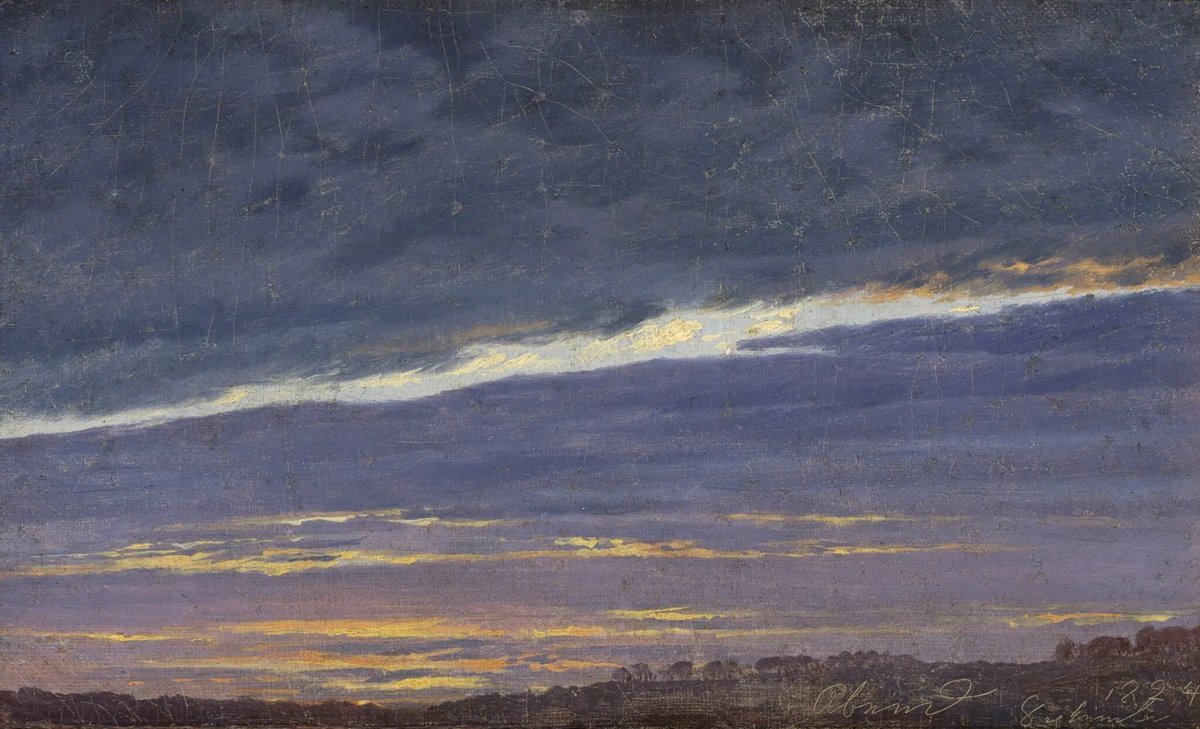
Cloudy Evening Sky photograph by Johannes Stoll / Belvedere, Vienna, CC BY-SA 4.0. Reproduction resized for this page.
 by Tom Gurney
Tom Gurney BSc (Hons) is an art history expert with over 20 years experience
Email: tomgurney1@gmail.com / Phone: +44 7429 011000
Introduction
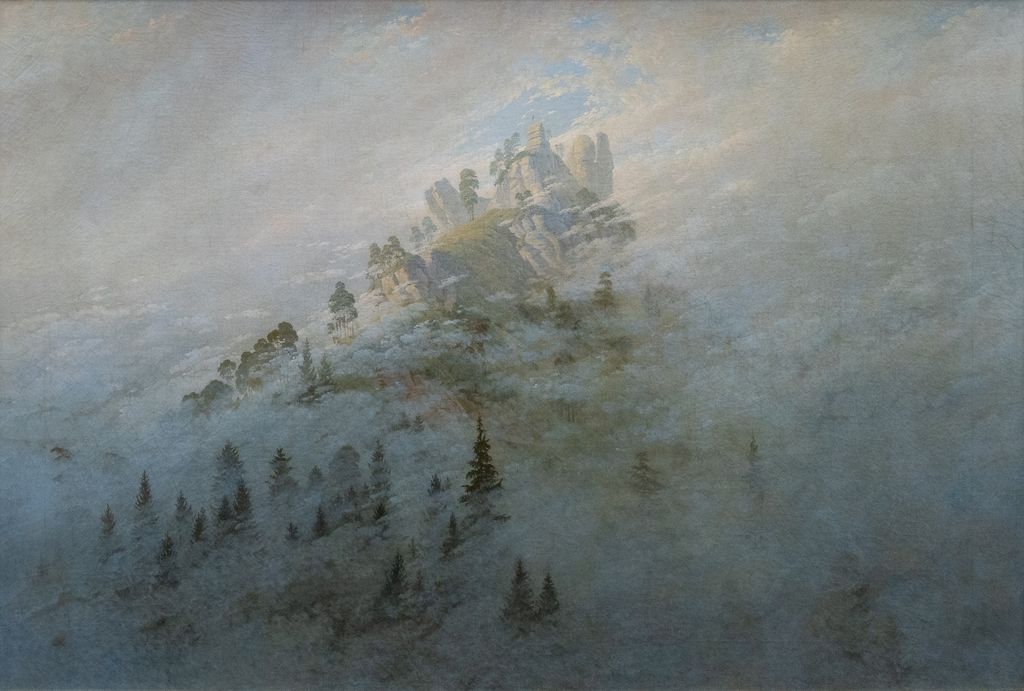
A few pink strokes in Caspar David Friedrich’s Evening catch the last light high above a violet plain. In Morning Mist in the Mountains, a line of rock disappears where the air around it brightens. Both paintings give a great deal of room to the sky, yet the two ask the eye to do different things. In the first, the ground is still legible as a narrow strip beneath layers of colour. In the second, the sky seems to begin somewhere on the mountain itself. Friedrich could make an immense distance felt in a picture small enough to hold in one hand, or make a mountain seem to hang in air by letting its lower slopes fade. [1] [2]
At a Glance
- Sky study · Cloudy Evening Sky, September 1824
- Collection · Belvedere, Vienna, 2379
- Comparison · Fog, evening light and moon-gazing landscapes
Contents
- Introduction
- Two skies from the autumn of 1824
- What a cloud name could tell a painter
- A mountainside with missing edges
- The moon in a narrow opening
- When moonlight makes a horizon
- A high horizon behind passing clouds
- What Goethe and Carus wanted from clouds
- A night rainbow and the problem of where the light comes from
Two skies from the autumn of 1824
Kunsthalle Mannheim’s Evening is only 27.5 centimetres wide. A group of trees is barely suggested on the sloping strip of land, and there is little to stop the eye once it rises above that line. Near the middle of the sky, yellow and orange make a broad patch of light. Higher up there is still blue, crossed by finer streaks of cloud. The sky appears to have more than one level. The pink strokes have enough colour to hold their place in front of the blue, while the bright area lower down opens up behind darker wisps. Markus Bertsch identifies the high, fine formations as cirrus. Friedrich scratched the words Abend Oktober 1824 into the wet paint with the end of a brush. [1] [3]
The Belvedere’s Cloudy Evening Sky in Vienna, inventory 2379, is 21.2 centimetres wide and carries an inscription for September of the same year. Here the light is confined to narrower spaces. A slot of blue shows between broad violet clouds. Lower down, pale, nearly horizontal bands leave a little room between the cloud bank and the thin strip of ground. Put the two sketches side by side and the scale of the clouds changes even though both grounds are reduced to a strip. Mannheim’s scattered strokes leave several ways for the eye to move across the sky. In Vienna, the weight of the upper clouds brings the eye down to the slim gap where the evening light remains. The blue above and the pale glow below make it possible to sense the thickness of the cloud bank in between. [1] [3] [4]
By the time Friedrich made the two sketches, his friend Johan Christian Dahl had returned from Italy with oil studies and moved into the building where Friedrich lived in Dresden. Bertsch suggests that the skies Dahl painted from his window could have encouraged Friedrich to try the method. One of Dahl’s surviving Cloud Study oils, jointly held by the Met and the Morgan Library & Museum, carries the date 9 May 1828. The month and year scratched into Friedrich’s sketches give them something of the character of entries in a record of the changing sky. Where the Mannheim study was painted remains an open question. The Met’s 2025 exhibition paired it with a view of sunset behind Dresden’s Hofkirche bearing the same October inscription. The curators thought the simpler Mannheim composition likely informed the skyline picture and left open whether either was painted in front of the view. [3] [5]
What a cloud name could tell a painter
Luke Howard’s essay on clouds, published in 1803, offered names for forms that might change in the course of a single sitting. His surviving studies, held by the Science Museum Group, also show the value of drawing to an observer interested in how one shape gives way to another. In 1816 Goethe approached Friedrich about making cloud paintings in the spirit of Howard’s classification. Friedrich had drawn clouds years earlier. His reservations about Goethe’s project come down to us in an October letter to Goethe from the painter Louise Seidler. She reported his reluctance to force free-moving clouds into prescribed classes. [4] [6]
Bertsch’s identification of cirrus in Evening helps explain why those pink streaks seem to sit high above the land. Their narrow, uneven forms are part of the evidence. In Cloudy Evening Sky the eye has more use for another kind of observation. The broad bank is easiest to make out where its dark underside meets the remaining light. Follow that lower edge sideways and it softens into the surrounding violet. The clearer edge where the blue shows through makes it easier to read the cloud as a mass hanging in front of open sky. [3] [4]
A mountainside with missing edges
In Morning Mist in the Mountains, painted about 1808 and held at the Heidecksburg in Rudolstadt, weather interrupts the outlines of things that would usually give a landscape its scale. Start with the low group of conifers. Some have dark, distinct crowns that disappear into the haze below. Above them, pale mist crosses the slope below the summit, where the warmer rock is easier to pick out. Near the edges of the painting, mist and cloud are almost continuous. The eye can piece together a mountainside from the remaining shapes, but the ground between them is hard to place. [2] [7]
Johannes Grave links the mountain’s profile to a small pencil outline on the reverse of Friedrich’s drawing of the Amselfall near Rathen. The drawing has been identified as the Honigstein massif, a reading Peter Prange considers possible. For the painter the outline could supply a recognisable summit. The oil shows how much can happen to that outline once its surroundings are withheld. A small cross appears above the highest rock, in a patch where the sky clears. In Grave’s reading, the time it takes the eye to discover the summit and its cross echoes the gradual clearing of the mist. [2] [8]
In the Städel Museum’s Mountains in the Rising Fog, painted around 1835, the low dark ridge in front runs across much of the picture. Beyond it, the fog fills a valley, and a more distant group of mountains rises out of the paler air. The Städel identifies the Rosenberg in Bohemian Switzerland as the source of the mountain motif. The visible foreground ridge gives the eye a place to start and a plane to look beyond. At Rudolstadt the eye climbs through openings in the mist to make out one mountain. In the later painting the fog marks the interval between hills, making the far mountains feel farther away precisely because so little terrain can be seen between them and the ridge. [2] [9]
The moon in a narrow opening
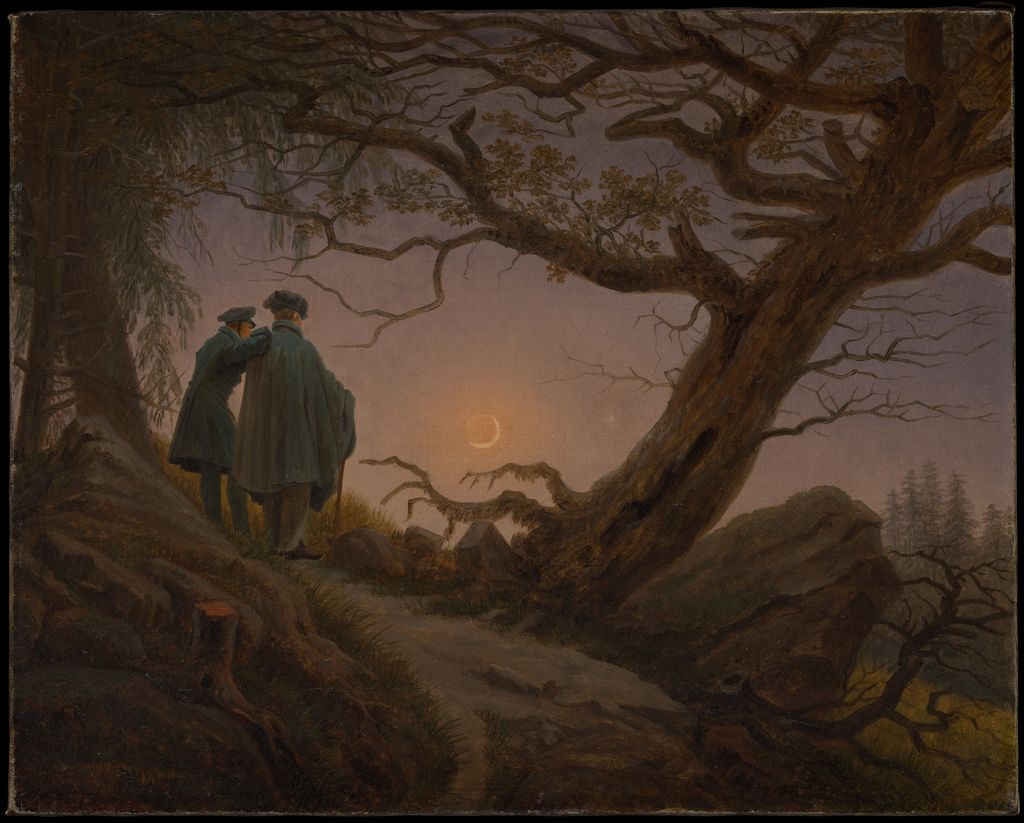
In Dresden’s Two Men Contemplating the Moon (1819/20, Galerie Neue Meister, Gal.-Nr. 2194), the dark tree and the steep ground close around a warm opening. The moon is small enough that the distinction between its bright crescent and the dim circle behind it rewards a closer look. In the Met’s Moonwatchers catalogue, Sabine Rewald explains the fainter part of the disc as earthshine, sunlight reflected from Earth onto the part of the moon in darkness. She identifies the point to the right in the Dresden picture as Venus. Naoki Sato, writing for the National Museum of Western Art in Tokyo, examines the earlier proposal of a lunar eclipse and also favours earthshine. The faint circle gives the crescent a sense of belonging to a whole body, even though only a narrow part of it shines strongly. [10] [11] [12]
Friedrich could change the feel of this sky while keeping the people and the tree in roughly the same arrangement. In Berlin’s Man and Woman Contemplating the Moon (about 1824, Alte Nationalgalerie, A II 887), the oak cuts across the pale opening and its smaller branches interrupt the light. In the Met’s later Two Men Contemplating the Moon (about 1825–30, 2000.51), the pinkish sky extends into the space to the right of the crescent, and faint trees beyond the rock make the depth of the view easier to sense. The warm light in Dresden is more concentrated near the men. Across the three paintings, the crescent is only a small mark. How far the light extends from it, and how much of that light the oak interrupts, determines whether the view feels enclosed or opens into the distance. [10] [11] [13] [14]
When moonlight makes a horizon
In Moonrise over the Sea, the 1822 painting in Berlin’s Alte Nationalgalerie (W.S. 53), the cloud bank partly hides a full moon. Its light appears along the horizon and on the water. The thin bright boundary is especially important at the sides, where the sea and sky are otherwise close in tone. The Met’s exhibition label draws attention to the shallow curve of the violet clouds, which gives the sky an arc above the straight line of the water. The larger sail cuts into the lighter sky. The smaller one sits against the cloud bank, where its outline is harder to make out. The two shapes give the eye intermediate distances to judge between the rock where the figures sit and the horizon. [5] [15]
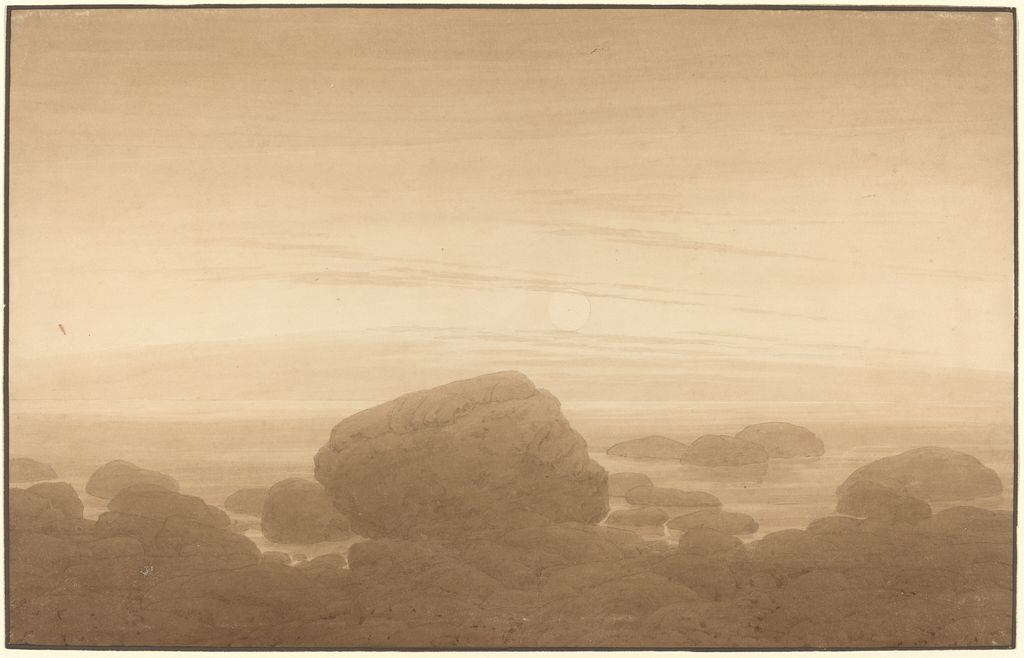
Compare the sea in Monk by the Sea (1808–10, Alte Nationalgalerie, NG 9/85). The dark water and the grey veils of cloud above it come close together in tone, while the brighter sky emerges much higher up. The light draws the eye away from the boundary between water and air. In Moonrise, light draws the eye along that boundary. A horizon can disappear in either mist or darkness, but here Friedrich makes moonlight restore the farthest line in the picture. The thin band of light carries across almost the whole width of the picture, though the visible rim of the moon occupies only a fraction of it. [5] [15] [16]
A high horizon behind passing clouds
In the Hamburger Kunsthalle's Drifting Clouds, painted about 1820, Friedrich gives the cloud banks room to move across the view of the ground. A scatter of rock and the meadow beyond it let the eye start in familiar terrain. Farther up, the banks of cloud pass in front of successive ridges. A break in the cloud can reveal a slope without revealing its connection to the next one. Following those breaks is an activity that takes time. The canvas stays still while the viewer begins to imagine what would become visible if one of the banks continued to move.[17]
The horizon is unusually high, leaving much of the small canvas available for the interplay of weather and ground. Markus Bertsch traces the arrangement to a drawing made on a Harz journey in June 1811. An inscription points to the Brocken, though the precise viewpoint remains disputed. The drawing marks the horizon with a continuous line and a written label. Such a line can be valuable in the studio even when the finished painting makes it difficult to follow. It supplies a stable reference for deciding how far a view extends behind the clouds.[17]
The difference between the drawing and the painting can be understood by looking for the missing intervals. Where the preparatory sheet sets a line across the distance, the painting asks viewers to infer the relation between fragments of terrain. That inference is easy near the meadow, where shapes can be read together, and becomes more tentative farther away. The clouds therefore do more than occupy a share of the picture. They determine how a viewer learns the shape of the land. The study's firm horizon and the painting's interrupted view work together across two stages of making.[17]
The little oil can look like a sketch made under passing weather. Its link to an earlier drawing provides a specific reason to be careful about that impression. Some of its sense of movement comes from decisions Friedrich could make over a longer period, such as where to let a ridge reappear. In the small dated Evening, the strokes of light are also essential, but few features of the ground come forward to interrupt them. Drifting Clouds asks a viewer to alternate between two different kinds of attention, one following the movement of the sky and another piecing together the ground through which it seems to pass.[3] [17]
What Goethe and Carus wanted from clouds
Goethe made a pen-and-ink sketch on 10 May 1816 that identifies three cloud forms drawn from Howard's classification. It survives through an illustration on a copperplate held by the University of London. The drawing makes concrete what an invitation to supply illustrations in that spirit could mean. A series could give a reader a set of distinguishable shapes to recognize in subsequent observations. The form of the drawing would help the names travel from one observer and language to another.[18]
Friedrich already had a practice of watching and drawing clouds. Werner Busch points to the Oslo sketchbook as evidence that the refusal reported by Louise Seidler concerned what he was being asked to do with his observations. In a landscape painting an individual cloud could be positioned so that its edge drew the eye towards a mountain, or so that the light it left behind mattered more than its outline. Such a cloud need not communicate its type as efficiently as an illustration designed to make the type clear. Friedrich's willingness to record a feature carefully and his reluctance to organize pictures around a classification are compatible.[4] [19]
Carl Gustav Carus had another use for Goethe's example. Oskar Bätschmann's study of the Nine Letters on Landscape Painting compares Carus's early treatment of clouds, attentive to how their movement affects the imagination, with his later enthusiasm for Howard's forms. This development belongs to a longer enquiry about the place of scientific knowledge in landscape painting. An artist who knew what changes to expect in the sky could still be moved by what happened there. For Carus the knowledge could become a resource for art. For Friedrich, the invitation to make a particular set of illustrations raised a different question about the purpose of a picture.[20]
Dahl's Cloud Study of 1834 in Berlin gives that distinction a visual counterpart. The oil is painted on paper mounted on cardboard. The museum places it among the small-scale atmospheric studies Dahl developed after his Italian journey, and suggests Carus may have alerted him to Goethe's cloud research. Look at a small field of sky like this one from the ground upward and the surroundings furnish a quick sense of position. Shift attention to the brushwork and changes of light across the clouds become an event that holds attention on its own. The object shows how a study could serve an artistic interest in changing weather without taking the form of an illustrated list.[21]
A night rainbow and the problem of where the light comes from
In Mountain Landscape with Rainbow, a pale arc reaches across a dark sky. The curve brings opposite sides of the painting into relation across the mountain. The museum catalogue identifies a drawing of the Rosenberg from May 1808 as a source for the profile and notes that Friedrich wanted to increase the mountain's height. That connection is particularly interesting beside the late Mountains in the Rising Fog. The distant peak can participate in quite different atmospheric arrangements. In the later oil, the fog opens a long interval between ridges. In the rainbow painting, the peak and the arc share a conspicuous central organization.[9] [22]
Markus Bertsch considers a moonbow a possibility. Under that reading the paleness of the arc belongs to a rare optical circumstance, while the strength of the illumination near the figure raises another question. The catalogue draws attention to the difficulty of reconciling that foreground brightness with the indicated light in the sky. Looking at the work with the problem in mind makes it possible to follow the apparent light twice. One look follows the arc and the brighter area in the clouds. The other starts with the illuminated figure and examines how much of the surrounding ground shares that illumination. The two routes do not obviously converge on a single visible source.[22]
The figure gives the bright foreground a scale and a direction. The curve farther off provides a relation that extends across the picture and exceeds anything the person could touch or cross. An effect that might be fleeting outdoors thus becomes a large structural feature. The question of its meteorological plausibility remains interesting because it gives a way to distinguish two things happening at once in the picture. Friedrich suggests an identifiable kind of atmospheric event and gives its curve a clarity capable of governing the whole composition.[22]
The distinction becomes especially vivid beside the crescent in the moonwatchers. There, a very small configuration of light rewards scrutiny, including the possibility of identifying earthshine. Here, the phenomenon is hard to miss even when the nature of the light remains uncertain. Weather can make Friedrich's landscapes demand attention at opposite scales. Sometimes a point of light asks the eye to reconsider the sky around it. Sometimes a feature extending across nearly the whole picture makes the viewer look again at a tiny patch of light near a person's feet.[11] [12] [22]
Frequently Asked Questions
Discussion
Which contours remain visible in Morning Mist?
Reader Insights
Where does the band of light open beneath the clouds?
Which contours remain visible in Morning Mist?
How is the moon placed in relation to the watchers?
Where does the band of light open beneath the clouds?
Join the Conversation
Share what you noticed in Moonlight, Weather and the Sky.
References
- Kunsthalle Mannheim, Abend (Evening)
- Johannes Grave, Morning Mist in the Mountains, Friedrich anniversary catalogue
- Markus Bertsch, Evening, Friedrich anniversary catalogue
- Markus Bertsch, Abendlicher Wolkenhimmel (Cloudy Evening Sky), Friedrich anniversary catalogue, Belvedere 2379
- The Metropolitan Museum of Art, Caspar David Friedrich: The Soul of Nature, exhibition labels, pp. 15–16
- Science Museum Group, Luke Howard’s Cloud Studies, 1803–11
- Thüringer Landesmuseum Heidecksburg, gallery collection, Morgennebel im Gebirge
- Peter Prange, Amselfall bei Rathen, Friedrich anniversary catalogue, Hamburger Kunsthalle 41093
- Städel Museum, Mountains in the Rising Fog, inventory 1821
- Holger Birkholz, Two Men Contemplating the Moon, Friedrich anniversary catalogue, Galerie Neue Meister 2194
- Sabine Rewald, with Kasper Monrad, Caspar David Friedrich: Moonwatchers, The Metropolitan Museum of Art, 2001, pp. 14–15 and catalogue entries 1–3
- Naoki Sato, “A Lunar Eclipse? Regarding C. D. Friedrich’s Depictions of Crescent Moons,” Journal of the National Museum of Western Art, Tokyo 11 (2007), pp. 37–50
- Birgit Verwiebe, Mann und Frau in Betrachtung des Mondes, Friedrich anniversary catalogue, Alte Nationalgalerie A II 887
- The Metropolitan Museum of Art, Two Men Contemplating the Moon, 2000.51
- Birgit Verwiebe, Moonrise over the Sea, Friedrich anniversary catalogue, Alte Nationalgalerie W.S. 53
- Birgit Verwiebe, Monk by the Sea, Friedrich anniversary catalogue, Alte Nationalgalerie NG 9/85
- Markus Bertsch, Drifting Clouds, Hamburger Kunsthalle exhibition catalogue, 2023, p. 256.
- University of London, Copper Plate of Illustrations Executed by Goethe, including the cloud sketch of 10 May 1816.
- Werner Busch, Afterword to Carl Gustav Carus, Neun Briefe über Landschaftsmalerei, 2021, on Friedrich's drawings and the cloud controversy.
- Oskar Bätschmann, Introduction to Carl Gustav Carus, Nine Letters on Landscape Painting, 2002, p. 36.
- Birgit Verwiebe, Alte Nationalgalerie, Johan Christian Dahl, Wolkenstudie, 1834, A II 91.
- Markus Bertsch, Mountain Landscape with Rainbow, Hamburger Kunsthalle exhibition catalogue, 2023, p. 134.