 by Tom Gurney
Tom Gurney BSc (Hons) is an art history expert with over 20 years experience
Email: tomgurney1@gmail.com / Phone: +44 7429 011000
Introduction
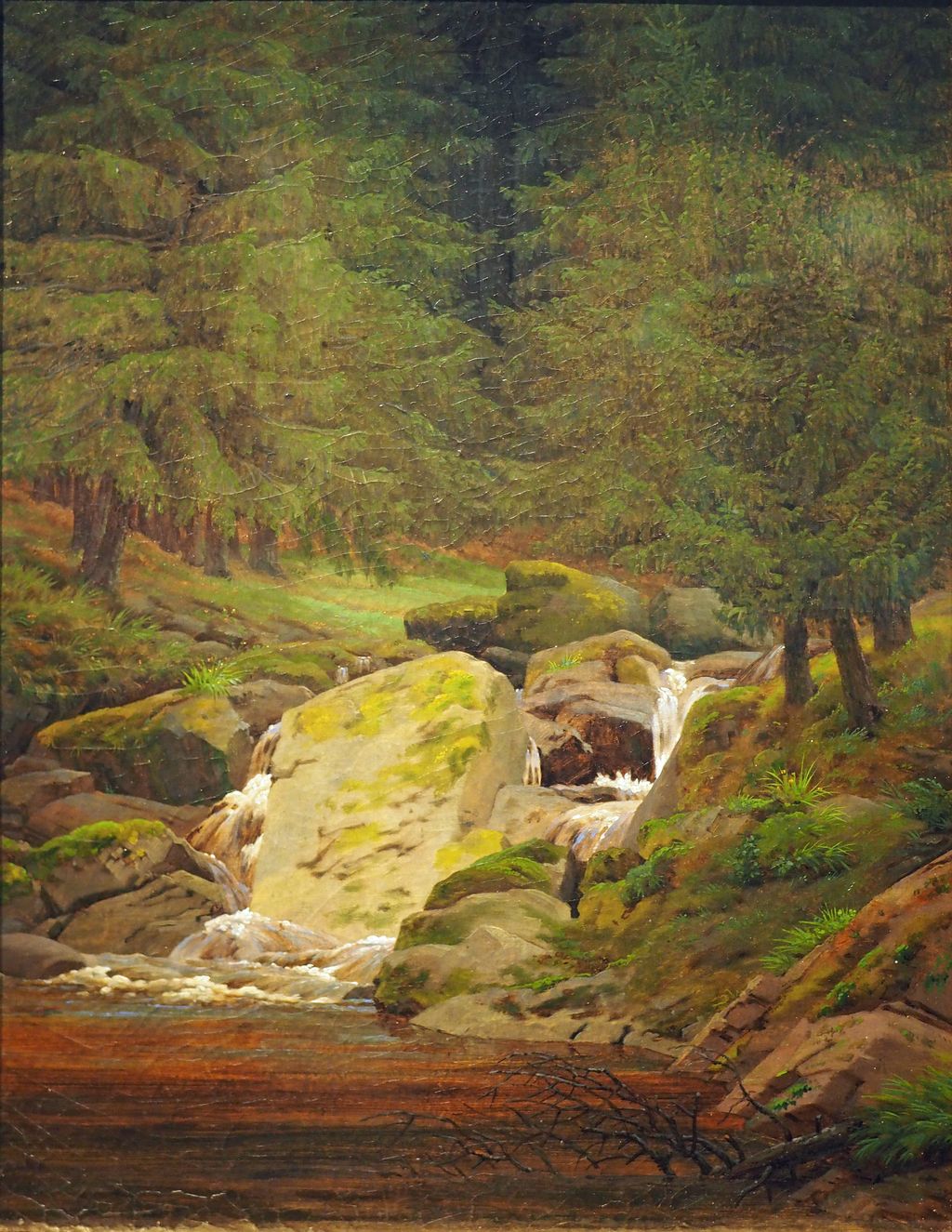
A thin fall of white water emerges between two boulders on the right of Caspar David Friedrich’s Pine Forest with Waterfall. Lower down, the current spills past a broad slab of stone, breaks into foam and spreads across a pool that fills the bottom of the canvas. The trees crowd the upper half of the painting so closely that their crowns leave no opening onto the sky. To see where the light comes from, it helps to look down into the water. [1][2]
At a Glance
- Artist — Caspar David Friedrich
- Titles — Pine Forest with Waterfall in English, Tannenwald mit Wasserfall in German. The Alte Nationalgalerie uses Fir Forest with Waterfall. [1][2][3]
- Date and medium — 1828, oil on canvas
- Dimensions — 44.2 cm high × 34.8 cm wide
- Collection — Hamburger Kunsthalle, Hamburg, inv. HK-5599. The museum credits the acquisition to support from the Campe’sche Historische Kunststiftung. [1][3]
Contents
- Introduction
- From the falls to the pool
- The rock and the forest
- A possible showing in Dresden in 1828
- The Dahl inscriptions
- Annotated Details
- Image Details
From the falls to the pool
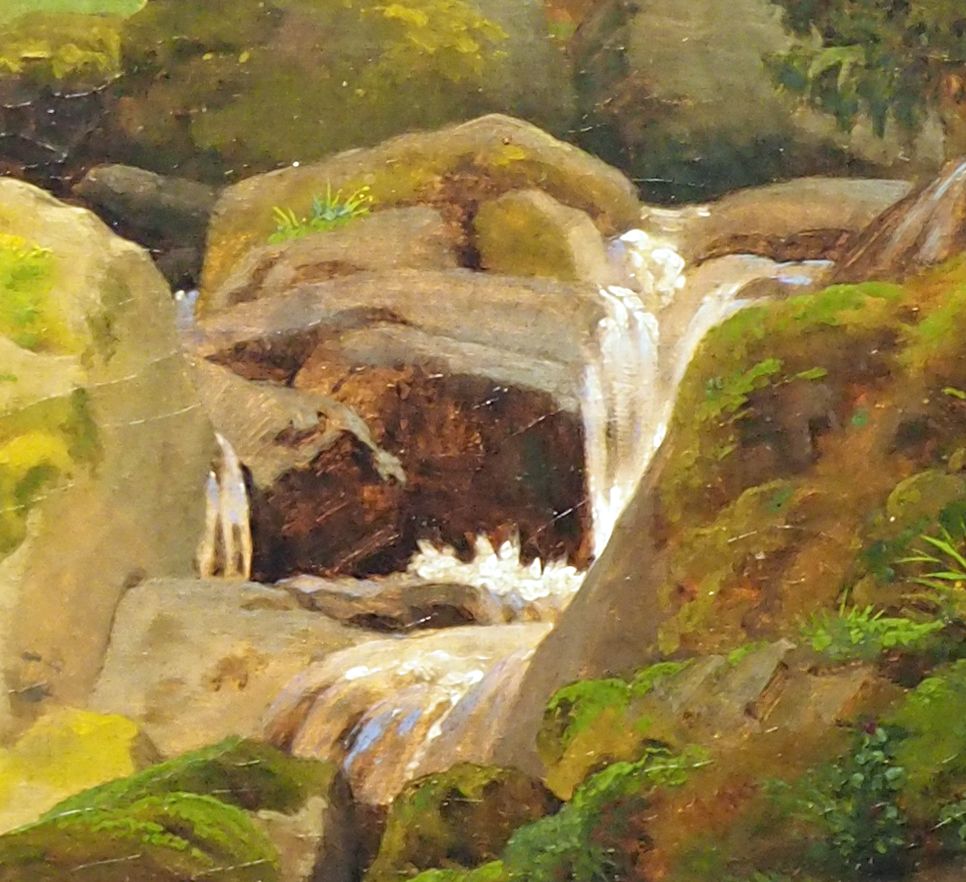
At the back of the stream, the water appears in glimpses. A narrow streak beside the trees on the right leads to a brighter fall between the rocks. Below it, a broader sloping surface catches the light as the water tumbles over a second ledge. To the left, another run slips down the flank of the large central boulder. The rock’s pale face looks almost flat from where we stand. Its edges tell us more about the depth of the scene, as the water vanishes behind them and emerges at different heights. The stream’s descent is easier to read from those small interruptions than from any continuous outline of its course. [1][2][4]
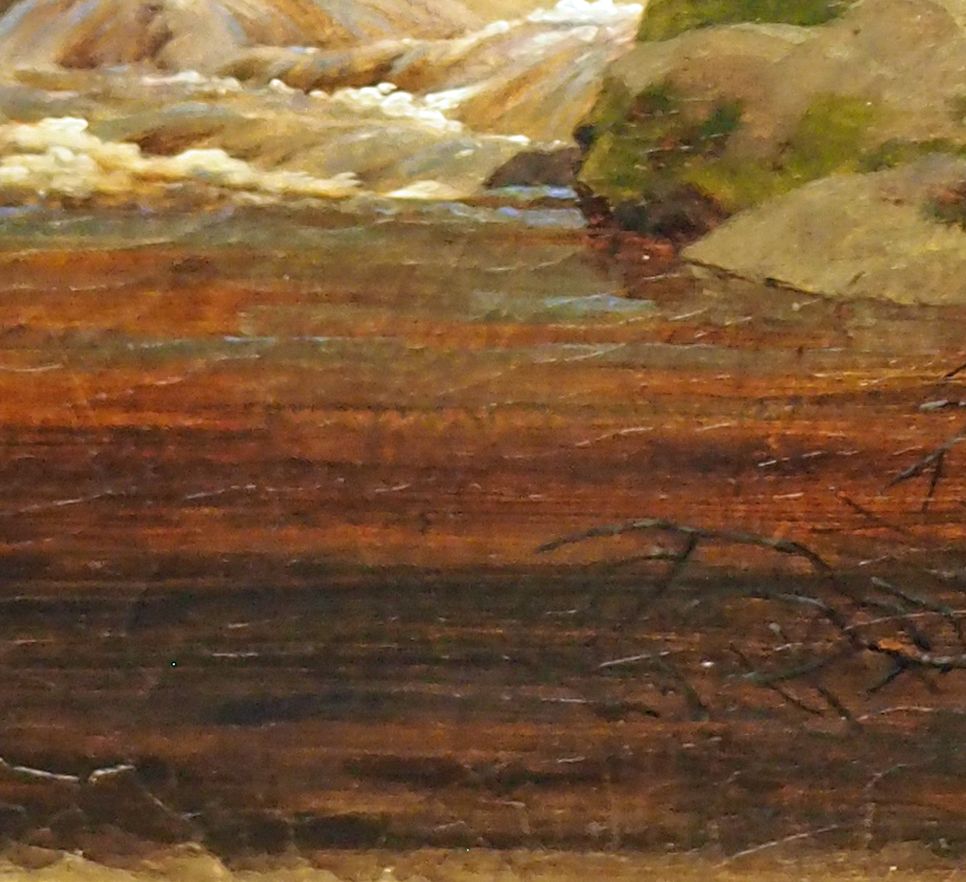
At the boulder’s foot, pale ridges of foam extend leftwards across the painting. They mark the transition from falling water to the broad pool. Near the rapids, the light strokes bend and bunch up around the stones. Farther forward, thin bands of colour lie nearly parallel to the lower edge of the canvas. A cool blue line runs below the foam, followed by warmer red-brown bands and much darker water at the bottom. The rust colours bring the earth under the trees to mind. The blue seems to belong to open air somewhere outside the view. Katharina Hoins reads it as a reflection of sky that would come into sight if the viewer turned away from the forest. [1][2][4]
A bare branch reaches out from the near bank on the right. Its fine, irregular forks cross those bands of water, so their dark outlines are clearest where the pool catches the brown light. The branch also gives us a sense of how close the water comes. A large boulder higher up hides the course of the stream, while a few slender twigs in the foreground can be followed almost to their tips. The painting is only 44.2 centimetres high. Friedrich makes the short distance from the foam to the bottom of the picture feel substantial by letting us register those changes in direction, colour and detail. [1][2]
The rock and the forest
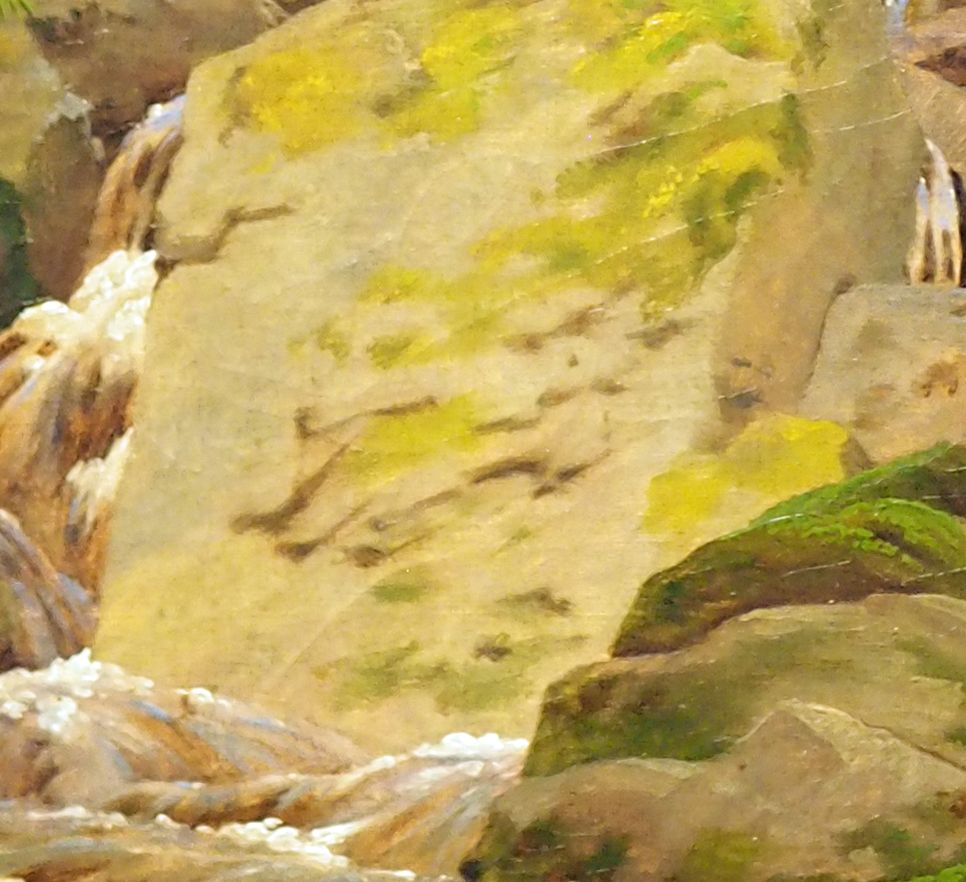
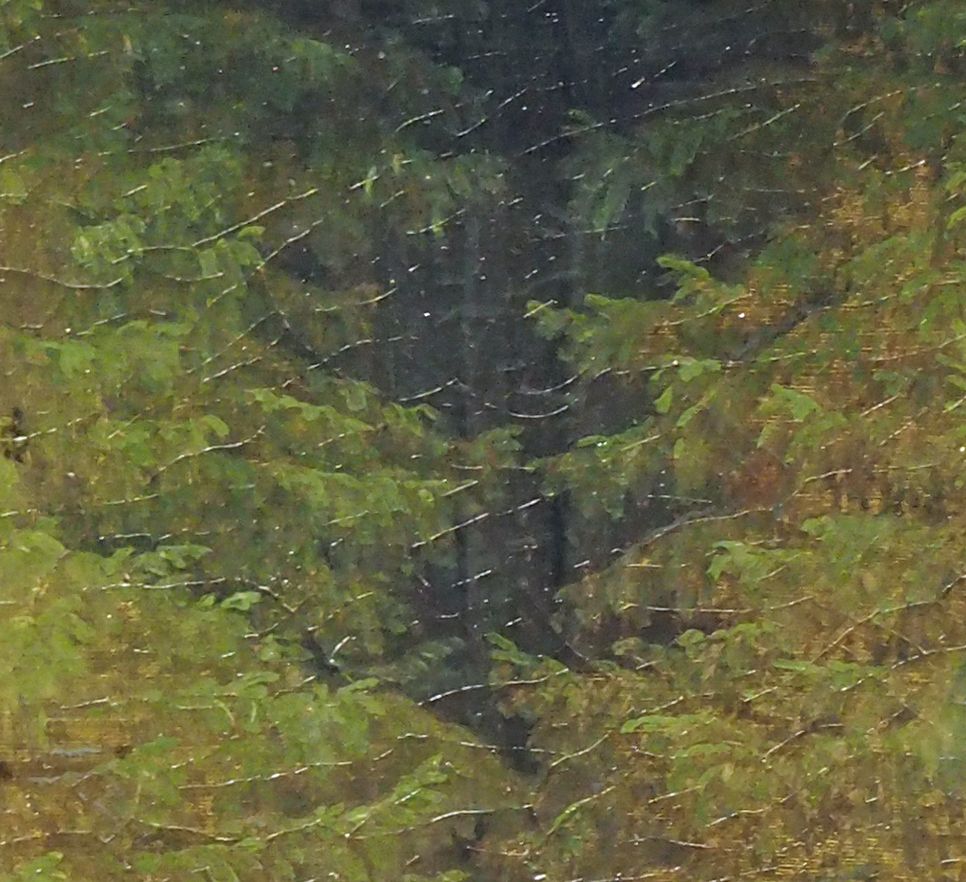
The broad face of the boulder catches the strongest light on any solid surface. Its upper edge carries yellow-green moss, with darker patches below and short marks across the exposed stone. Hoins points out the mosses, lichens, grasses and small yellow and orange flowers growing among the rocks. There are bright clusters of pointed leaves on both sides of the stream. Their size becomes apparent when the eye moves back to the great mass of conifers. Branches overlap in tiers until individual trees become hard to distinguish, especially where the foliage converges over a dark gap near the centre. Beneath the boughs at the left, a narrow stretch of lighter forest floor allows a few trunks to be seen in succession. [1][2][4]
Hoins distinguishes spreading fir branches from the upright spruce trunks deeper in the forest. The modern English title uses pine forest in a broad sense. The trees give the upper part of the painting its vertical order. The pool below has its own order, built from horizontal strokes. Between them the rocks tip and jut at angles, and the stream takes a different direction at each drop. Those changes concentrate the action in a relatively small part of the canvas. The stillest-looking surface, the pool, is also where the colours of the landscape travel farthest. [1][2][3]
The new growth on the rocks has encouraged a reading of the picture as an image of spring and renewal. Other details have prompted a different emphasis. Hoins compares the central slab to a sarcophagus or a massive grave marker, and cites the art historian Helmut Börsch-Supan’s interpretation of the withered branch as a reminder of mortality. The small flowers draw the eye up among the wet stones, while the branch stretches into the quiet pool. The associations with renewal and mortality arise at different stages of following the stream. [1][2]
A possible showing in Dresden in 1828
The catalogue of the Dresden Academy exhibition that opened on 3 August 1828 lists two oil paintings by Professor Friedrich in succession. Entry 619 is Ein Fichtenwald im Winter (A Spruce Forest in Winter), identified with Hamburg’s Early Snow. Entry 620 is Ein Wasserfall (A Waterfall). Hoins considers the Hamburg waterfall painting the probable match for the second entry. The printed title is short and the catalogue gives neither dimensions nor a description. The listing supplies a plausible early exhibition for this canvas, and its place next to the winter picture has helped sustain the idea that the two were conceived together. [1][2][5][6]
The two paintings are both small and upright. In Early Snow, a pale track curves past a bank into the dark woods, and the light at the top makes the crowns of the trees visible. In Pine Forest with Waterfall, the course of the water leads out of the woods and the blue appears near the bottom. The route through each painting gives the viewer a different relationship to the forest. In the winter scene, the ruts carry the eye into the shade. In the waterfall painting, the current comes towards the viewer and the trees close off the distance. [1][2][3][6]
Börsch-Supan proposed that the winter scene might be the waterfall’s companion. Their similar sizes, forest settings and contrasting seasons make the proposal plausible. The catalogue records the order in which the pictures were listed. The winter painting followed a different path through private collections. It belonged to the Berlin publisher Georg Andreas Reimer and was sold from his collection in 1842. Wilhelm Wegener later owned Early Snow and Friedrich’s Easter Morning, and described those works as a pair in 1859. As Johannes Grave observes, Friedrich’s original intentions remain open. The possible relationship between the two Hamburg forest pictures can be explored through their composition, while the 1859 account tells us how Wegener understood the pictures he owned. [1][5][6][7]
The Dahl inscriptions
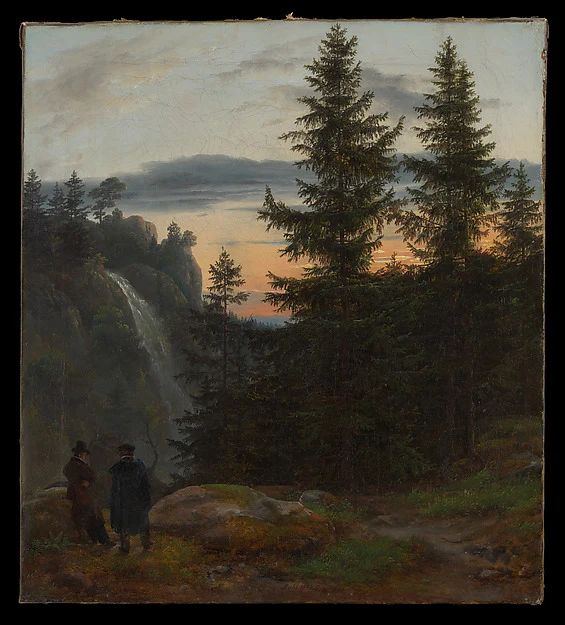
The Norwegian painter Johan Christian Dahl lived in the same Dresden house as Friedrich from 1823. Both had studied at the Copenhagen academy. They worked in separate studios in the house on the Elbe, where they also taught pupils. Dahl had already painted Two Men before a Waterfall at Sunset in 1823. The Metropolitan Museum of Art describes it as an homage to Friedrich’s Two Men Contemplating the Moon. Dahl sets the two figures above the falls and gives them a view into the evening light. Friedrich’s Hamburg picture brings the viewer down to the pool and gives the whole canvas over to the trees, rock and stream. The friendship makes Dahl an especially interesting possible owner of a landscape in which Friedrich approached a subject both artists painted. [1][8][9]
The Hamburger Kunsthalle’s provenance research records Dahl’s ownership as probable. Börsch-Supan reported in a 1999 assessment that he had previously seen the name Dahl written twice on the back of the painting. Those two marks appeared to have been removed, but he could still make out an inscription reading Dahl, Dresden on the frame. He understood the writing as a possible sign of ownership and considered whether the picture might once have been taken for a work by Dahl. He ruled out Dahl as the painter. The catalogue raisonné he compiled with Karl Wilhelm Jähnig gives Dahl as a probable owner for a time and records that the work is absent from Dahl’s lists of paintings. [1]
The Kunsthalle traces the canvas to Galerie Weber in Munich in 1972, where Börsch-Supan reported seeing it. The museum records later appearances at auctions in London in 1989 and 1997, both without a sale, before its purchase through Galerie Römer in Zurich. The provenance dates the purchase to October 1999, while the collection credit gives 2000. The record leaves a long gap between the possible Dahl ownership in Dresden and the sighting in Munich. [1]
Annotated Details from Pine Forest with Waterfall
Use the numbered details to trace the forms and light in this work.
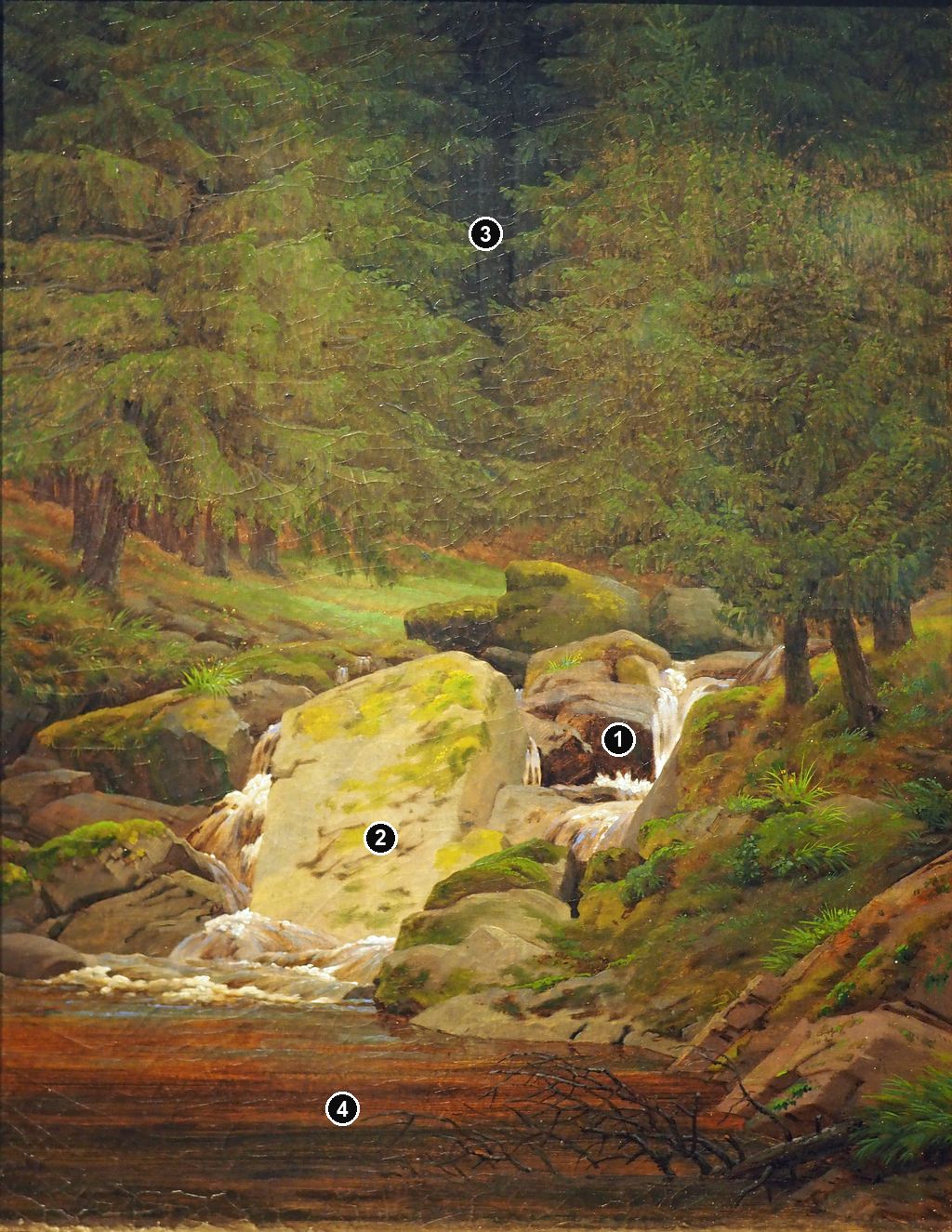
Details from PINE FOREST WITH WATERFALL
The detail crops show parts of the work at a larger scale.
The two streams
Water catches the light in narrow channels on either side of the large boulder.
The illuminated boulder
The light face of a boulder divides the rushing water.
The shadowed trees
Dark trunks and closely packed branches close off the upper view.
The foreground pool
Lower down, reddish and brown horizontal strokes trace the quieter surface.
Frequently Asked Questions
Discussion
How does the pale boulder divide the stream?
Reader Insights
Where does the water first become visible?
How does the pale boulder divide the stream?
What happens to the view above the waterfall?
Where does the water first become visible?
Join the Conversation
Share what you noticed in Pine Forest with Waterfall.
References
- Tannenwald mit Wasserfall, HK-5599, Hamburger Kunsthalle. Collection record, Katharina Hoins’s object essay and Ute Haug’s provenance research, last updated 23 January 2023, consulted 11 November 2026.
- Katharina Hoins, Tannenwald mit Wasserfall, Friedrich anniversary chronicle and English version, Pine Forest with Waterfall. Hamburger Kunsthalle exhibition catalogue essay, p. 178.
- Caspar David Friedrich. Infinite Landscapes, Alte Nationalgalerie works list. Entries 15–16.
- Nina Amstutz, Evergreens by the Waterfall, detail. Figure 109 in Caspar David Friedrich: Nature and the Self, Yale University Press, 2020.
- Dresden Academy exhibition catalogue, 1828, p. 55. Entries 619–620.
- Clara Blomeyer, Frühschnee, Friedrich anniversary chronicle. Hamburger Kunsthalle exhibition catalogue essay, p. 180.
- Johannes Grave, Ostermorgen, Friedrich anniversary chronicle. Hamburger Kunsthalle exhibition catalogue essay and reference to Wilhelm Wegener’s 1859 account.
- Staatliche Kunstsammlungen Dresden, 2015 annual report. Report on Dahl and Friedrich. Romantic Landscapes, p. 14.
- Johan Christian Dahl, Two Men before a Waterfall at Sunset, Metropolitan Museum of Art. Collection record, inv. 2019.167.3.