 by Tom Gurney
Tom Gurney BSc (Hons) is an art history expert with over 20 years experience
Email: tomgurney1@gmail.com / Phone: +44 7429 011000
Introduction
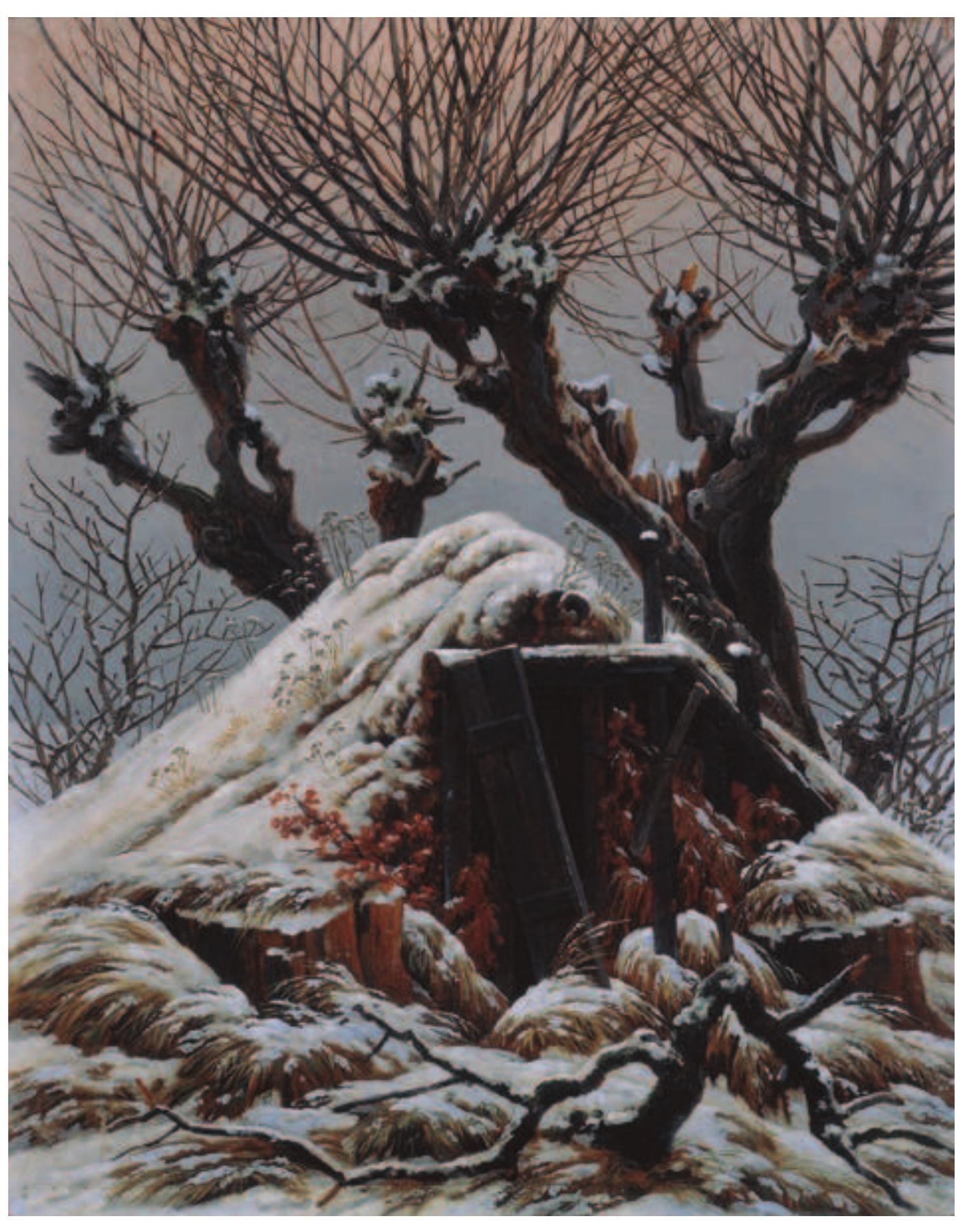
A low wooden doorway opens beneath a mound of snow. Above it, bare willow shoots spread from thick, knotted trunks and run out of the picture at the top. The doorway is the darkest part of Caspar David Friedrich’s Cabin in the Snow. The willows rise from behind it to fill most of the canvas. The eye moves between a building that seems to be sinking into the ground and trees whose fine branches are still reaching upward. Friedrich exhibited this small oil in Dresden in 1827, where a reviewer likened it to an episode in the songs of Ossian. [1][2][3][4]
At a Glance
- Artist — Caspar David Friedrich
- Titles — Cabin in the Snow in English, Verschneite Hütte in German
- Date and medium — 1827, oil on canvas
- Dimensions — 31 cm high × 25 cm wide
- Collection — Alte Nationalgalerie, Staatliche Museen zu Berlin, NG 9/60 [1][2]
Contents
- Introduction
- The doorway beneath the snow
- Shelter, decay and new shoots
- At the Dresden Academy in 1827
- Why the reviewer thought of Ossian
- Small winter oils
- Annotated Details
- Image Details
The doorway beneath the snow
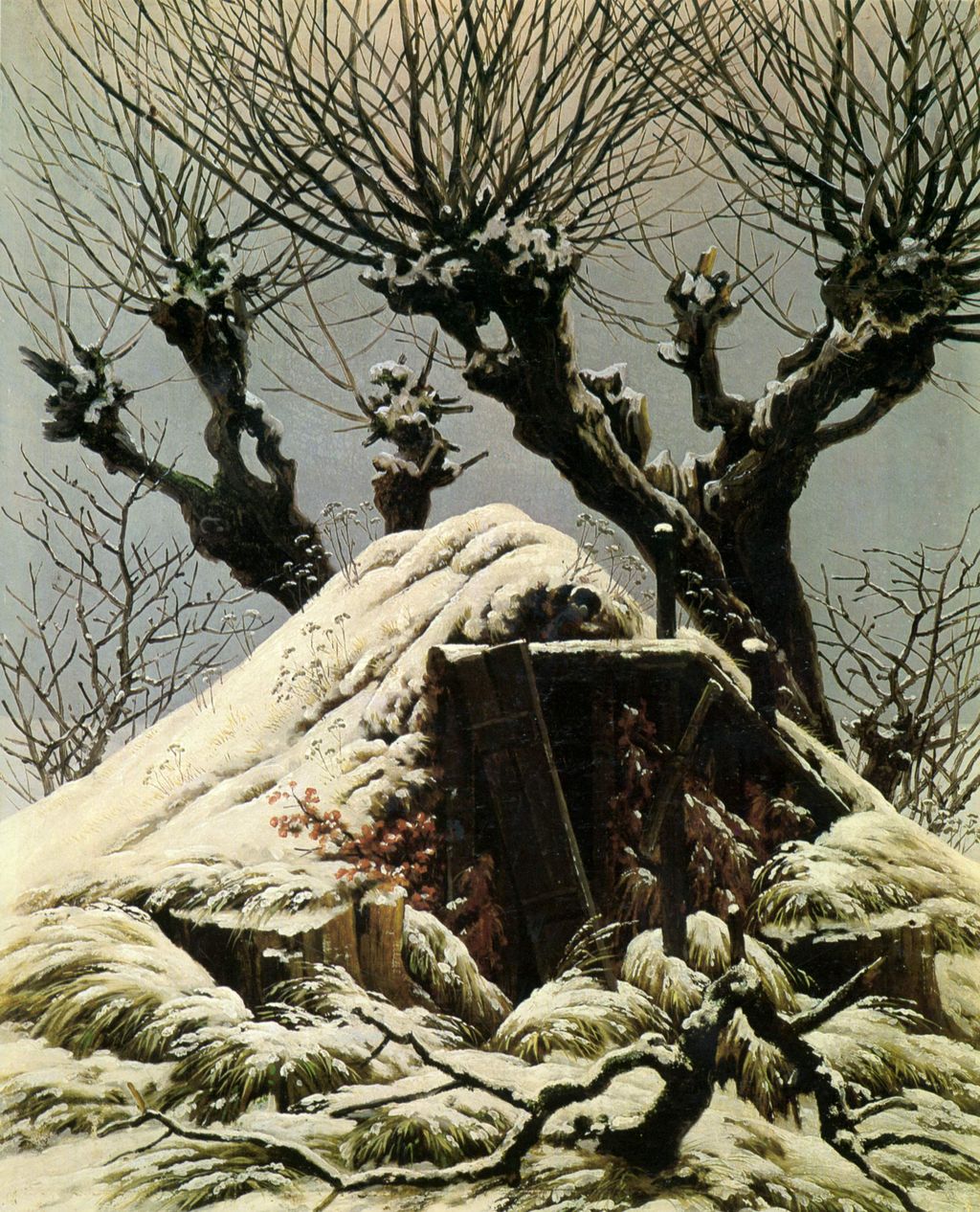
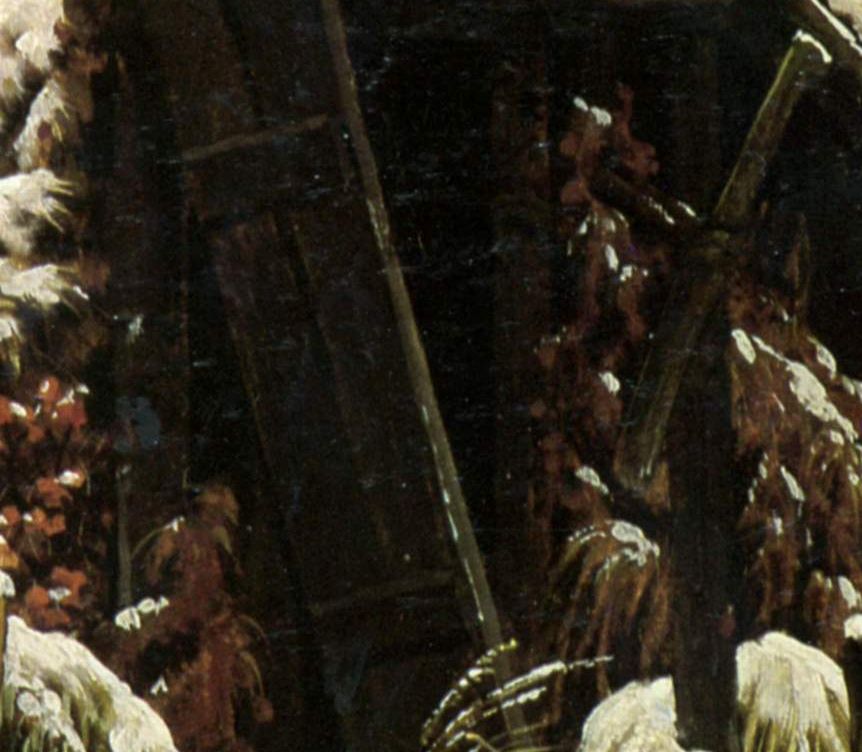
The cabin is easiest to find by looking for the nearly straight line across the snow just right of centre. It marks the top of the entrance. Below it, an angled door hangs partly across the opening and a slender diagonal timber cuts across the dark area on the right. There is a glimpse of rusty vegetation around the opening, where the wood and the surrounding ground come together. The dark interior makes the doorframe stand out, even as the snow makes it difficult to say where the rest of the cabin ends. Its upper surface has much the same rounded profile as the low banks in front of it. [1][8]
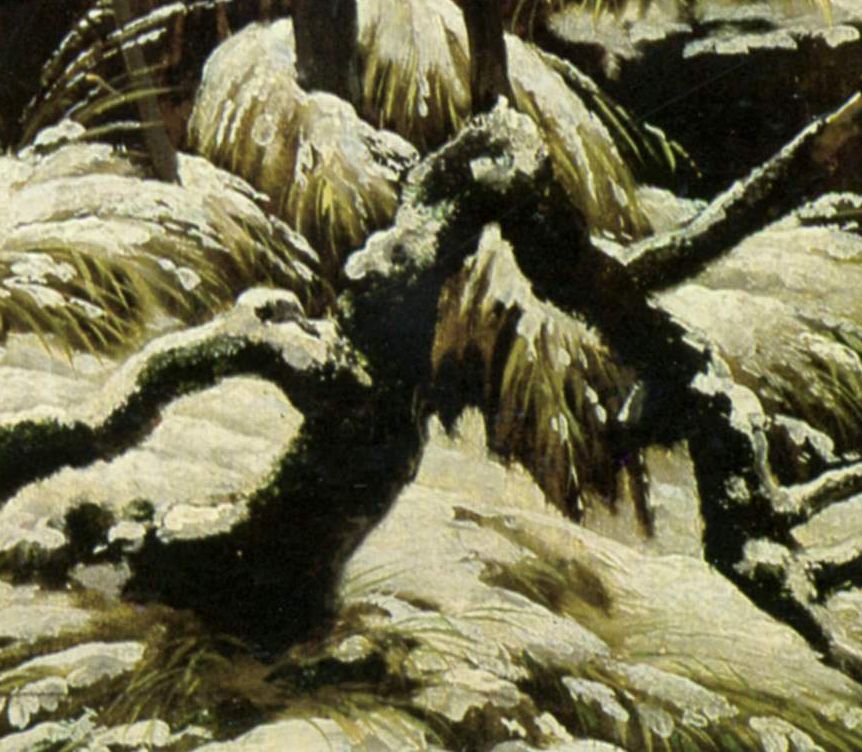
Snow has collected along the upper faces of the boards, across the mound and around the feet of the trees. In the foreground it sits unevenly on tufts of bent grass, leaving straw-coloured ends and patches of brown ground exposed. A crooked fallen branch extends across the bottom from a thick, dark section on the right into narrow twigs on the left. The thin lines lie almost flat against the snow. Higher up, the willow shoots take a similar spread of fine lines and lift it into the sky. This is one way Friedrich makes the two ends of the upright canvas belong together. The difference in scale becomes apparent when the eye follows the branch on the ground and then tries to trace the network overhead. [1][8]
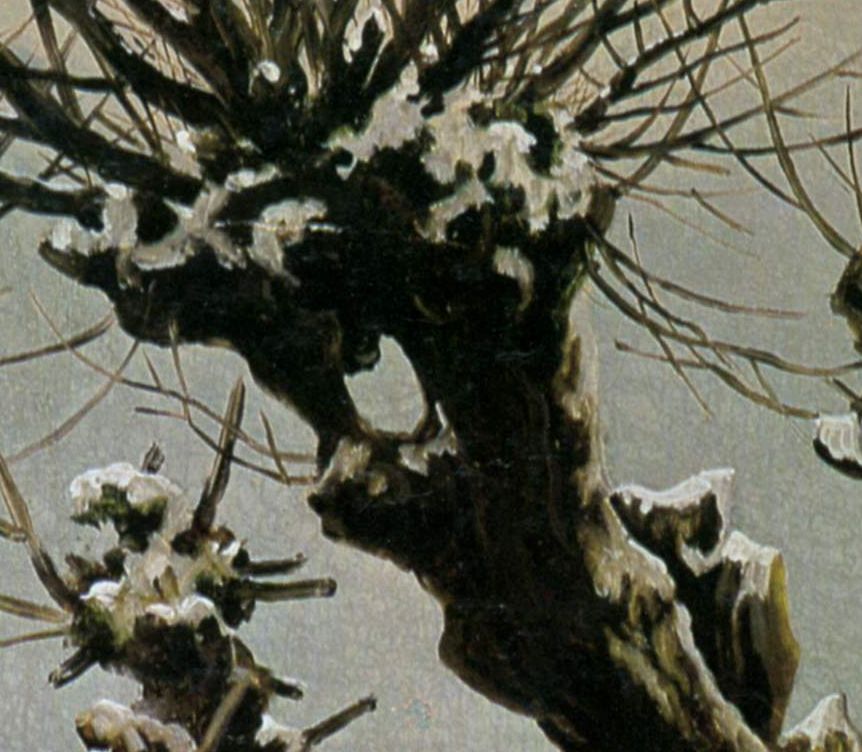
The two broadest tree forms stand behind the roof, their trunks diverging as they rise. Smaller shapes appear in the gaps, some rising only a short distance above the snow. The shapes of the crowns suggest pollarded willows, with slender shoots gathered around the thick heads left by repeated cutting. A dark limb that looks solid at its base breaks into an almost transparent mesh against the grey sky. Friedrich gives the branches enough room to show how they spread, while letting some run beyond the frame. We see where the cabin disappears into the snow but have to imagine the full extent of the trees. [1][8]
Shelter, decay and new shoots
In the Nationalgalerie’s object essay, Gerd-Helge Vogel suggests that the earth shelter may have housed workers temporarily during the fruit harvest. On that reading, the low profile and rough entrance belong to a modest building with a seasonal use. A viewer can pick out signs of labour in the doorway and the cut heads of the willows, although the scene itself is empty of people and animals. Snow has settled over the places where a person might once have stood or passed, and the tilted door now seems to offer little shelter from the weather. [1][8]
Vogel also sees a resemblance to an old grave. The dark gap enters a mound whose outline has begun to merge with the surrounding ground. The dry grass and broken wood suggest things that have reached the end of their use or growth. The shoots overhead give the scene a different measure of time. Vogel reads the strong young willow growth as a sign of the coming spring. The same trunk can carry an old break, a clump of snow and a fan of fine shoots. Winter makes all three visible at once, before any leaves cover the joins. [1][8]
At the Dresden Academy in 1827
The printed catalogue places three works by Friedrich in the third room to the right of the entrance. On page 57, no. 603 is his moonlit Baltic shore, Ostseestrand. Next comes no. 604, Eine Hütte (A Hut), followed by no. 605, Ein Gewölbe (A Vault). The short title in the list gives the object simply as a hut. The review in the Leipzig journal Blätter für literarische Unterhaltung supplies the snow and the state of the building in its description of a decaying hut. The three entries appear in the same order in the review’s account of Friedrich’s paintings. [1][3][4]
Catherine L. Clinger treats the two small works as pendants in her study of Friedrich’s interest in subterranean spaces. In her comparison, the Berlin picture puts the viewer outdoors facing an opening into darkness. A Vault begins inside a dark enclosure and looks through an opening towards light, where a young fir grows. Both paintings bring the viewer close to a threshold. Each then gives that threshold a different relation to the visible world. Clinger proposes a mining interpretation of the hut, a different account of the structure from the seasonal shelter Vogel envisages. The visual comparison shows why the opening matters to both readings. Friedrich brings us near enough to see the boards and the edge of the snow while leaving the space beyond the threshold dark. [1][5]
Why the reviewer thought of Ossian
On page 916 the anonymous reviewer moves from the Norwegian landscapes of Johan Christian Dahl to those of his colleague Friedrich. The writer compares Dahl to the English poet Edward Young and uses Ossian to describe Friedrich. For the Baltic shore, the account dwells on pale moonlight at the horizon and enormous dark anchors between rocks in the foreground. The reviewer finds a kind of sublimity in Friedrich’s open spaces and spare indications, crediting the harmony of his colour with giving the imagination room to work. In this view, the spectator has to supply something of the poetry. [4]
The reviewer then says that the decaying hut and dark vault are composed in the same spirit and recall short episodes in Ossian’s songs. The comparison is to short episodes in general, and it comes from a writer who uses literary analogies for several other painters in the room. Ossian was the bard to whom James Macpherson attributed the poems he published as translations from Gaelic, including Fingal in 1762 and Temora in 1763. The connection with the cabin belongs to the painting’s early reception. Read alongside the review’s remarks on the Baltic scene, it conveys how little Friedrich needed to show to make a viewer imagine what might lie beyond the picture. The door offers just enough of an opening to provoke that impulse. [4][6]
Small winter oils
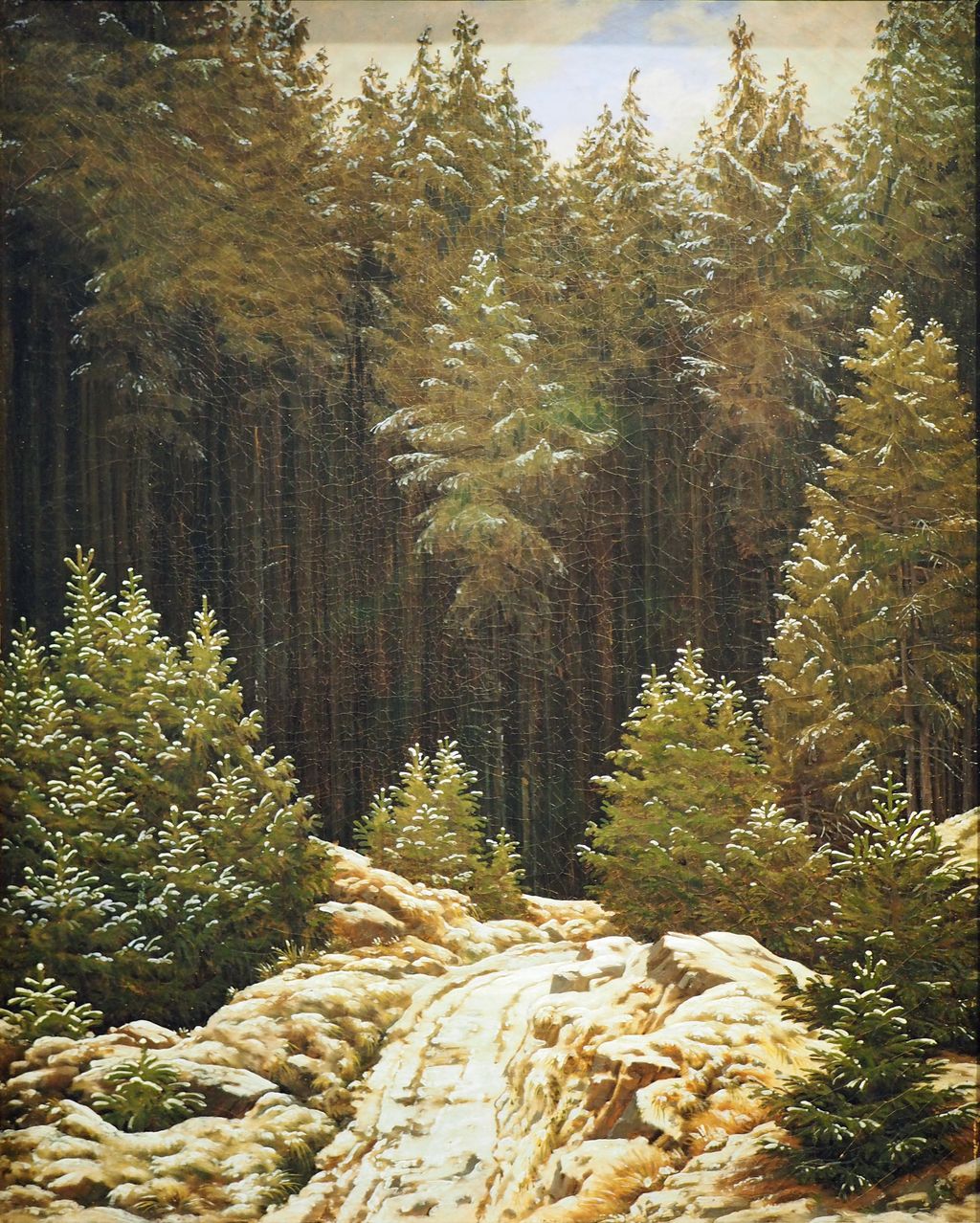
Vogel situates Cabin in the Snow among several small winter paintings Friedrich made between 1826 and 1828. The Munich Spruce Thicket in the Snow, dated around 1828 by the Bayerische Staatsgemäldesammlungen, is only a few millimetres larger in each direction. There, three taller young spruces rise above a cluster of smaller trees. Their needles hold scattered snow, while fine blades of grass still show through below. The near view and upright format let the spectator study individual stems against a grey sky, as in the Berlin canvas. In Munich the three evergreens order the whole view. In Berlin the angular timber and low dark doorway give the willow branches a human scale. We can imagine the size of a person who might duck under the lintel, then see how much of the frame the trees occupy above it. [1][7]
Friedrich’s choice of a small canvas changes the way the subject can be seen. From a short distance the trees and the roof read as a pair of large shapes, one dark and branching, the other pale and low. A closer look yields the worn boards, the small streaks of exposed grass and the snow caught on the willow heads. A few of those willow shoots pass across the pale opening between the crowns, where they are easiest to follow. The closer view turns what first looked like a dense screen of branches into a series of distinct growths, each rising from its own place on the trunk. [1][8]
Berlin’s collection record starts the ownership history with the 1827 purchase by Prince Johann Georg of Saxony. Later entries place the painting with the Rusch dealership in Dresden in 1924 and with Hugo Salm in 1928. The State of Berlin bought the picture from Hertha Schoene in 1960. [1]
Annotated Details from Cabin in the Snow
Use the numbered details to trace the forms and light in this work.
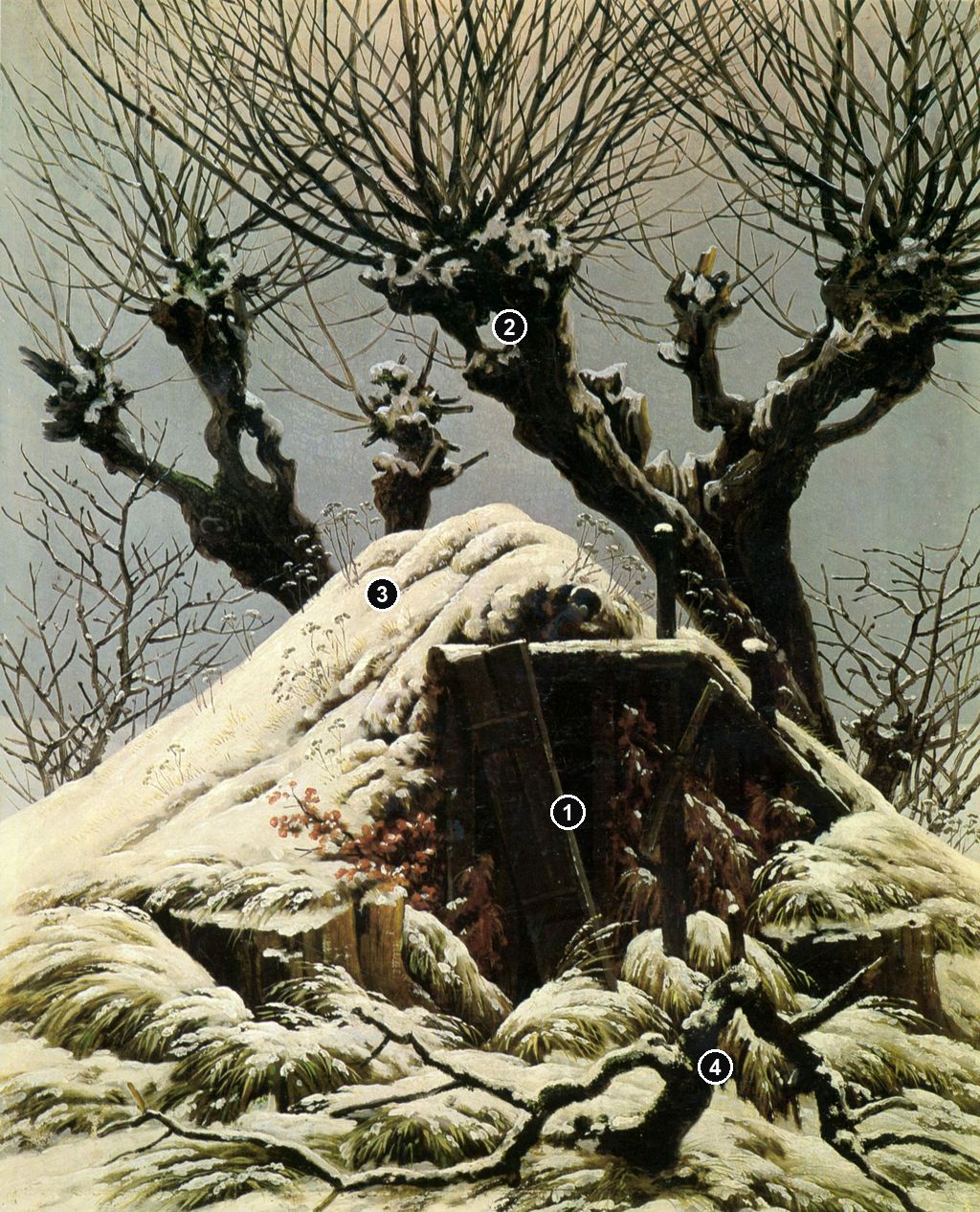
Details from CABIN IN THE SNOW
The detail crops show parts of the work at a larger scale.
The entrance
The dark opening cuts into a broad slope of snow.
Pollarded trees
Pruned trunks send thin shoots upward across the pale sky.
Snow over the structure
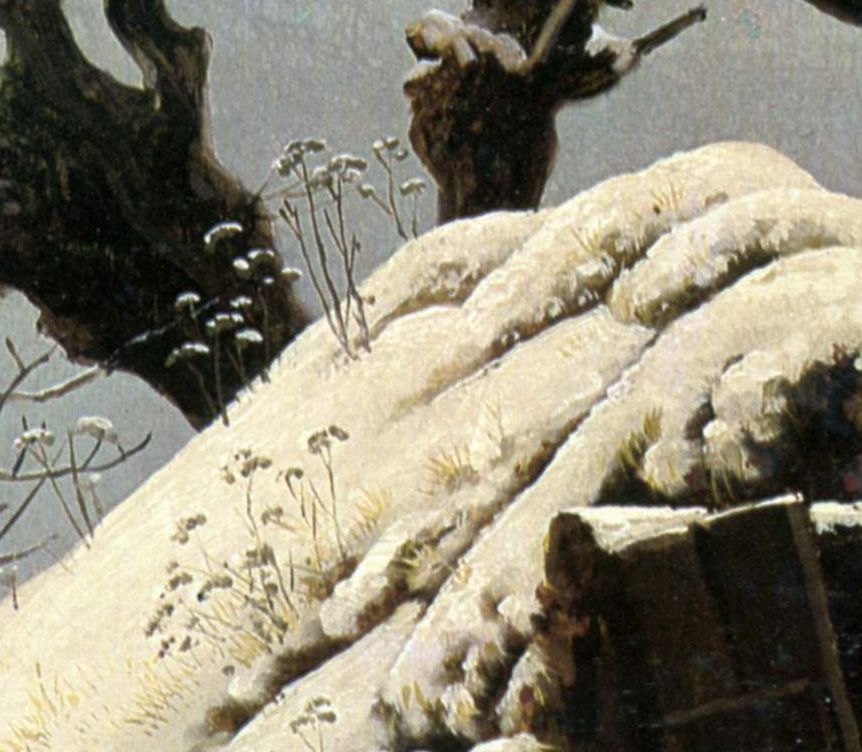
Snow follows the irregular contour of the roof and surrounding ground.
The broken foreground branch
A fallen branch crosses the textured snow in front of the cabin.
Frequently Asked Questions
Discussion
How do the branches change the sense of space?
Reader Insights
Which lines make the entrance recognizable?
How do the branches change the sense of space?
Where does the structure merge with the ground?
Which lines make the entrance recognizable?
Join the Conversation
Share what you noticed in Cabin in the Snow.
References
- Gerd-Helge Vogel, Verschneite Hütte, NG 9/60, Staatliche Museen zu Berlin. Holding record, object essay and provenance.
- Cabin in the Snow, Caspar David Friedrich anniversary chronicle. English title and object identification.
- Dresden Academy exhibition catalogue, 1827, p. 57. Entries 603–605 in the third room to the right of the entrance.
- Anonymous, Ueber die diesjährige Kunstausstellung in Dresden, Blätter für literarische Unterhaltung, 1827, p. 916. Contemporary review with the Ossian comparison.
- Catherine L. Clinger, Caspar David Friedrich and the Catachthonic Cultures of Romantic Science and Technology. Doctoral thesis, 2007, especially pp. 43–46 and fig. 2.4.
- National Portrait Gallery, James Macpherson. Publication history of Macpherson’s Ossian poems.
- Fichtendickicht im Schnee (Aus der Dresdner Heide I), ESK 1, Bayerische Staatsgemäldesammlungen. Collection record and account of the composition.
- The Hut in the Snow, figure in Nina Amstutz, Caspar David Friedrich and the Anatomy of Nature. Published reproduction used for close looking. Journal record.