


 by Tom Gurney
Tom Gurney BSc (Hons) is an art history expert with over 20 years experience
Email: tomgurney1@gmail.com / Phone: +44 7429 011000
Introduction
In June 1821 the Russian poet Vasily Zhukovsky wrote to Grand Duchess Alexandra Feodorovna about a painting he had seen in Caspar David Friedrich’s Dresden studio. Friedrich had only begun it, but Zhukovsky could already describe the moon emerging above clouds, two women watching from the shore and two men who had ventured closer to the water. He had asked the price and thought the picture might accompany one Alexandra already owned. The finished Moonrise by the Sea hung in her rooms at Ropsha, near Saint Petersburg. The letter follows the painting from the point of view of the visitor who recommended it. The Hermitage record follows it from the palace into the museum. [1][2]
Other pictures took different routes out of the studio. The Norwegian painter Johan Christian Dahl received his Friedrich in an exchange between friends. The Berlin banker Joachim Heinrich Wilhelm Wagener specified the subjects of two paintings before Friedrich made them. In Prussia the royal family acquired two works that were already on view at an academy exhibition. [3][4][5][6]
At a Glance
- Artist friends · Georg Friedrich Kersting and Johan Christian Dahl
- Prussian purchase · Monk by the Sea and Abbey in the Oakwood, 1810
- Wagener commission · The Lonely Tree and Moonrise over the Sea, 1822
Contents
- Introduction
- Goethe and the Weimar prize
- Georg Friedrich Kersting on the road and in the studio
- The Prussian court buys two paintings
- Johan Christian Dahl and the exchange of 1820
- Wagener’s morning and evening landscapes
- Georg Andreas Reimer’s collection
- Alexandra Feodorovna and Vasily Zhukovsky
- A physician's household and the later moonwatchers
- A publisher who lent, showed and sold pictures
- A sketchbook that survived through Kersting's family
Goethe and the Weimar prize
In August 1805 Friedrich wrote to Johann Wolfgang von Goethe in response to a call for drawings to be exhibited at Weimar. He sent two landscapes and asked twenty-five thalers for each if a buyer came forward. One was Wallfahrt bei Sonnenuntergang, or Pilgrimage at Sunset, drawn in grey-brown wash over graphite. The other was Herbstabend am See, or Autumn Evening by the Lake. By December he was writing to Goethe again, this time to thank the Weimar Friends of the Arts for awarding him half their prize and to ask if Goethe would keep the two drawings. [7][8][9]
Friedrich’s letters show how much the award changed the terms on which he offered the drawings. In August he had named a price. By December, Goethe’s keeping the sheets would itself have been a mark of esteem. Friedrich continued sending paintings and drawings to Weimar in the years that followed, and the ducal court bought some of them. The prize was the beginning of a relationship with Weimar that gave his work an audience beyond Dresden. [7][9]
Georg Friedrich Kersting on the road and in the studio
In 1810 Friedrich and Georg Friedrich Kersting travelled on foot through the Riesengebirge, the mountain range along today’s Polish and Czech border. Friedrich’s dated drawings help establish the route. The catalogue of the 1990 Hermitage loans places the painters at Oybin by 4 July and at the source of the Elbe on 10 July. Kersting made his own record of the trip. A sheet in Berlin, drawn in graphite and watercolour on blue paper, depicts Friedrich on the journey. The travel studies also had a much longer working life. Berlin’s catalogue traces the low mountain profiles in Wagener’s The Lonely Tree, painted in 1822, back to drawings Friedrich made on that outing. [1][6][10]
Kersting pictured his companion indoors the following year. His 1811 portrait in the Hamburger Kunsthalle shows Friedrich seated at the easel, his working arm supported by a mahlstick. The Dresden Academy exhibited it with Kersting’s painting of Gerhard von Kügelgen in his studio. Kügelgen’s room contains a number of objects associated with his work, while Friedrich has little around him beyond what he needs to paint. The pairing made the two interiors a public comparison of artists and working habits, with Kersting choosing what each room would disclose. [11][12]
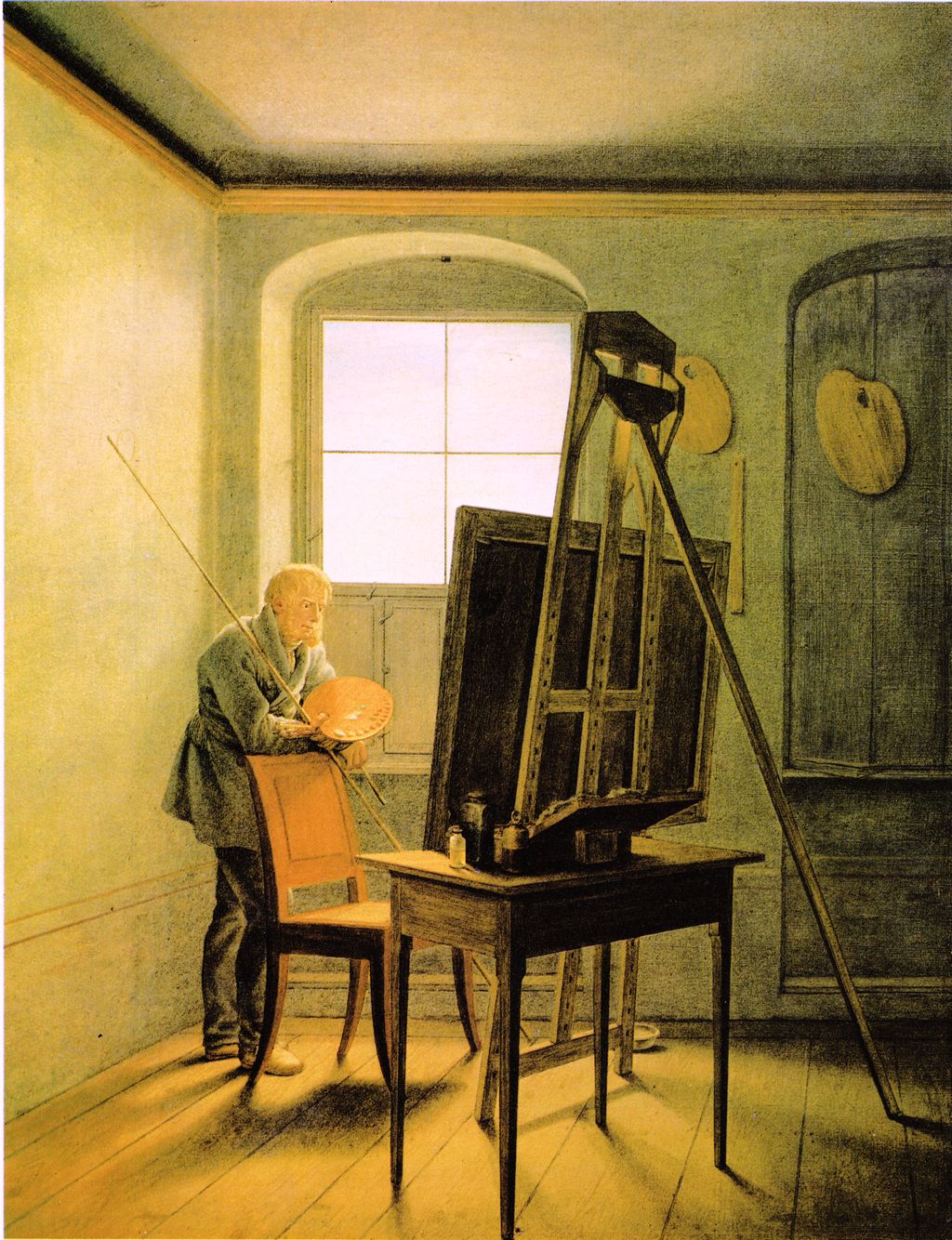
Kersting varied the arrangement in the version now in the Alte Nationalgalerie, which the museum dates to around 1812. Friedrich stands back with his palette and looks at the canvas. Kersting gives us the back of the easel and withholds the painted surface. The two portraits show a friend close enough to observe the painter at work and an artist who could choose how to represent that work. The Berlin canvas also has a later family history. It came to the Nationalgalerie from Johanna Friedrich, a descendant of the sitter, in 1906. The museum records that transaction separately from the early date of the portrait. [13]
The Prussian court buys two paintings
The theologian Friedrich Schleiermacher visited Friedrich in Dresden in 1810 and saw The Monk by the Sea and The Abbey in the Oakwood. Birgit Verwiebe’s account for the Alte Nationalgalerie credits him with persuading Friedrich to send both pictures to the Berlin Academy exhibition that year. A visitor to the exhibition could move from a single figure on a low strip of shore to a procession passing among graves, oaks and the remains of a Gothic church. The academy gave the pair a public audience before it entered royal ownership. [5][14][15]
The Alte Nationalgalerie’s object records register the purchase under Crown Prince Friedrich Wilhelm in 1810. Verwiebe describes the young prince, later Friedrich Wilhelm IV, as encouraging his father, King Friedrich Wilhelm III, to make the acquisition. Both accounts place the crown prince at the centre of the decision. Schleiermacher’s documented role came earlier, when he saw the pair in Dresden and helped bring it to Berlin. [5][14][15]
Friedrich Wilhelm III also acquired Morning in the Riesengebirge, painted in 1810–11. Its cross above the mountain ridges offered the court a third substantial example of Friedrich’s landscape painting and returned to terrain he had explored with Kersting. From 1844 to 1865, all three pictures were publicly accessible in the royal Patriotic Gallery at Bellevue Palace. By then Friedrich had died. Their display at Bellevue was a later consequence of the purchases made during his lifetime. [5][16]
Johan Christian Dahl and the exchange of 1820
Dahl arrived in Dresden in September 1818. Friedrich showed him around the city, and by December Dahl recorded spending a morning in conversation with him about art. In 1820 the friendship took a tangible form. Dahl gave Friedrich his landscape River in the Plauenscher Grund, now in Bergen. Friedrich gave Dahl Two Men Contemplating the Moon, now at the Albertinum in Dresden. The exchange links Dahl to this particular small canvas, the one catalogued as Gal.-Nr. 2194. Friedrich also made variants, and the Metropolitan Museum of Art holds a later version of the composition. [3][17]
The gift gave Dahl a painting he could live with and answer in his own work. In Two Men before a Waterfall at Sunset of 1823, two figures stand near a cascade. The Metropolitan Museum identifies the right-hand figure’s cape and beret with Friedrich and reads the work as a tribute to the earlier moonlit landscape. The setting and light belong to Dahl’s picture, but the motif of two men stopping together before a landscape recalls the canvas he received. The documented exchange gives the resemblance a history without requiring the figures in Friedrich’s painting to be portraits of the two artists. [3][17]
Dahl kept the painting until Friedrich’s death and sold it to the Dresden Gemäldegalerie in 1840. It was that collection’s first acquisition of a painting by Friedrich. Dahl’s role changed with the transfer. He had first accepted the canvas as a fellow artist and kept it for two decades. He then placed it with a collection in the city where they had met. [3]
Wagener’s morning and evening landscapes
Joachim Heinrich Wilhelm Wagener, a Berlin banker and collector, asked Friedrich for two paintings, one of morning and one of evening. The Alte Nationalgalerie records an early August 1822 visit by Wagener to the artist in Dresden and cites Friedrich’s letter of 1 November 1822 reporting the completion of both canvases. The paintings were still in Dresden in April 1823, when they appeared in a special exhibition at the Academy on the occasion of King Max I of Bavaria’s visit. The letter dates completion, while the exhibition gives a later point before the pictures could have reached Wagener. The museum cites the letter in the Wagener papers at the Central Archive of the Staatliche Museen zu Berlin. [4][10]
For the morning picture, The Lonely Tree, Friedrich set a large oak near the centre of an open meadow. A shepherd and flock are already out under the tree. In the evening picture, Moonrise over the Sea, three people sit on a rock facing the water and the approaching sails. The canvases are the same size, with a strong upright near the centre of the first and an unobstructed view across the water in the second. Wagener’s brief supplies the temporal order. Friedrich decided what would mark the hours and where the viewer would stand in relation to each scene. [4][10]
Wagener displayed the pair in his private gallery. After his death in 1861 the paintings entered the founding collection of Berlin’s Nationalgalerie through his bequest. Their current inventory numbers, W.S. 52 and W.S. 53, still place them next to one another. The separate chain of custody for the 1810 royal purchases explains why works now seen in the same museum can have very different histories. [4][5][10][14][15]
Georg Andreas Reimer’s collection
The Berlin publisher Georg Andreas Reimer came from Greifswald, like Friedrich, and was his friend as well as a collector. Verwiebe records thirty-one Friedrich works in Reimer’s estate in 1842. He lent pictures to academy exhibitions, showed some at a benefit exhibition in his own home in 1829 and handled sales of works by Friedrich and other artists to the Russian court. One picture from his collection, Ploughed Field, eventually reached the Hamburger Kunsthalle. Its provenance records the painting in the Reimer collection through 1843 and traces the Kunsthalle’s 1905 purchase to a later owner, Heinrich Friedrich. [5][20]
Alexandra Feodorovna and Vasily Zhukovsky
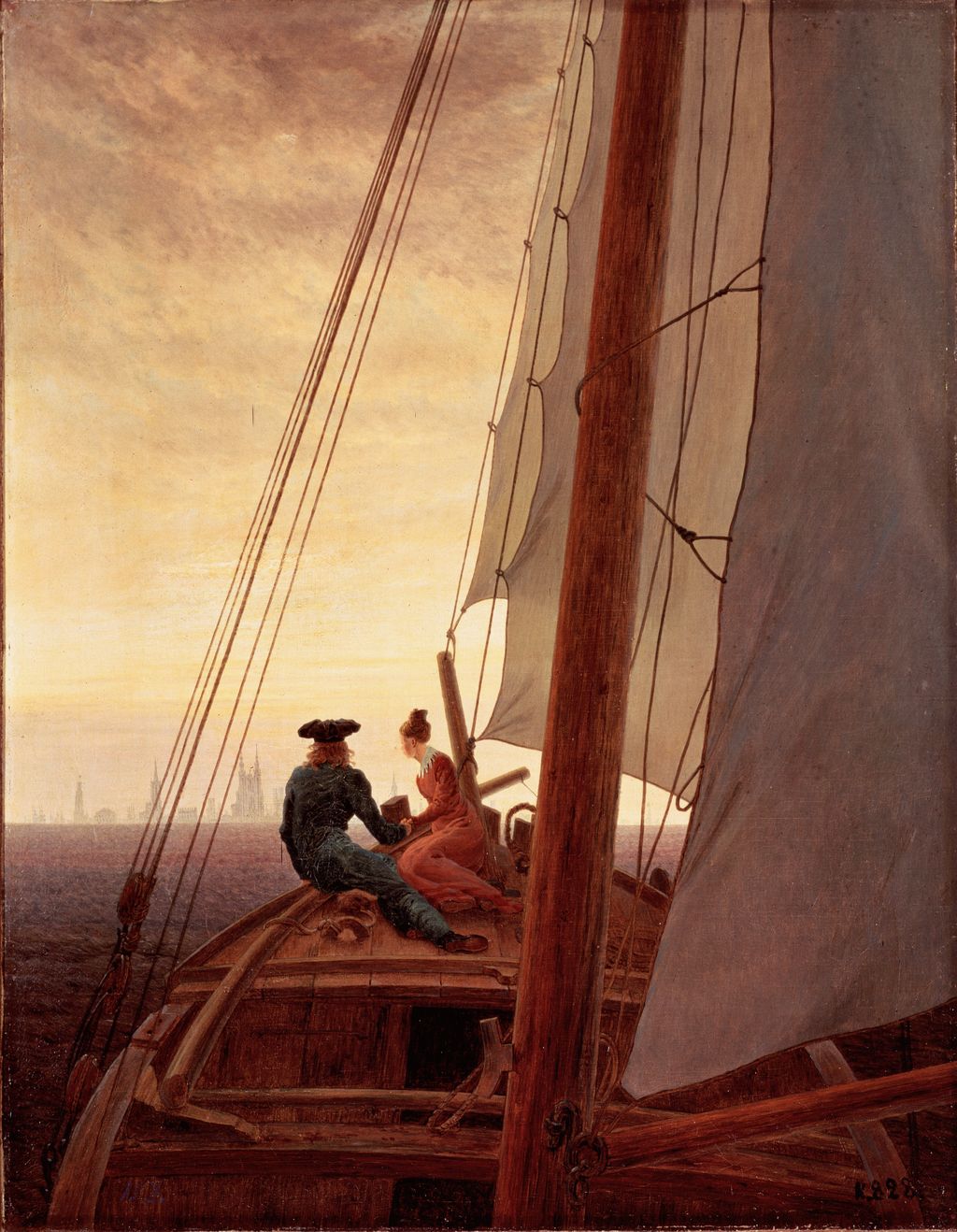
The connection between Prussian and Russian collecting ran through the royal family. Alexandra Feodorovna was born Princess Charlotte of Prussia, daughter of Friedrich Wilhelm III and sister of the crown prince associated with the 1810 purchase. In 1820 she and her husband, Grand Duke Nikolai Pavlovich, the future Nicholas I, visited Friedrich in Dresden. The 1990 catalogue traces On the Sailboat from its purchase during that visit to the English cottage in Alexandria Park at Peterhof. The Hermitage now holds the canvas. The catalogue records the purchase of Sisters on the Harbor-View Terrace, or Harbor by Night, on the same visit and gives both paintings the same route from Peterhof to the Hermitage in 1945. The visit provides a firmer basis for linking the paintings to the court than proposals about why the subjects appealed to the couple. [1][5][18][19]
Zhukovsky taught Alexandra Russian. He saw Friedrich’s work in Berlin in 1820 and met the artist in 1821. His June letter to Alexandra records the position of the shore figures, the dispersing clouds and his impression of the painting’s potential as a companion to one she owned. He even interprets the distant sail as bringing people home. That is a response from a contemporary viewer who saw the work under way. The finished painting still gives the two women and two men different positions on the shore and includes two anchors, where the letter mentions one. The suggested homecoming remains Zhukovsky’s reading of the scene. [1][2][18]
Alexandra’s Moonrise by the Sea of 1821 is the large canvas from Ropsha, with four figures and two foreground anchors. Wagener’s evening canvas of 1822 is smaller, has three figures and was painted with a morning landscape in mind. The similar titles can hide the different circumstances. Zhukovsky proposed the earlier picture after a studio visit, and the 1990 catalogue records its later display with a mountain landscape at Ropsha. Wagener commissioned the later picture as one half of a pair from the outset. [1][2][4]
Zhukovsky also collected Friedrich’s work for himself. Fofanov reports that inventories drawn up by the time the poet left Russia in 1841 listed more than fifty drawings and at least nine paintings by Friedrich in his private collection. Fofanov also records that much of the private collection subsequently disappeared from view. The inventory shows how much Friedrich the poet chose to live with himself, beyond the pictures he recommended to the court. [18]
A physician's household and the later moonwatchers
The Metropolitan Museum's version of Two Men Contemplating the Moon passed first to the physician Otto Friedrich Rosenberg. Sabine Rewald's catalogue identifies the painting as payment for Rosenberg's medical care and documents a second connection to the household. His daughter Theophila Minna took drawing lessons from Friedrich and went on to make portraits and landscapes. The two relationships mattered in different ways. The lessons passed skills between households, while the transfer of a painting helped settle an obligation and gave the family an object that stayed with descendants for roughly 170 years.[21] [22]
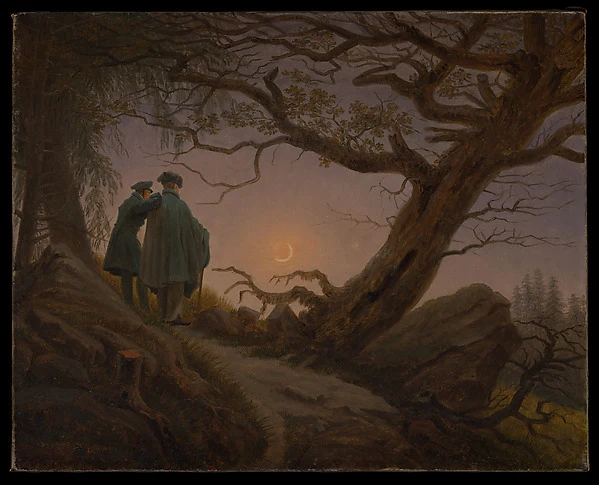
Putting that history beside the Dresden version makes two kinds of exchange visible within closely related paintings. The Dresden canvas passed through Dahl's hands before the Dresden gallery acquired it in 1840. Its relation to Dahl's own pictures can be studied through his treatment of pairs of observers and through the fact that he knew the painting at first hand. The later version remained in the physician's family. An ownership history can therefore explain why one version had a demonstrable place in the working life of a fellow artist while another became available to a broad museum audience much later.[3] [17] [21] [22]
The comparison also shows why the word collector needs some care here. Rosenberg's acquisition belongs to a history of professional care and household relationships. Wagener commissioned two landscapes with specified times of day and eventually bequeathed a collection that became the basis of a public gallery. Neither transfer needs an identical motive to be important. Each produced a durable record of where a Friedrich could be found, and each affected which other works would eventually be seen beside it. Provenance makes those different routes into public view legible.[4] [5] [21]
A publisher who lent, showed and sold pictures
Reimer's work on behalf of Friedrich can be followed beyond the total in the estate. Birgit Verwiebe records loans from his collection at the Berlin academy exhibitions of 1824 and 1834. She also identifies an exhibition for the benefit of Greeks in his own home in 1829. An academy loan put pictures into a public institutional setting on a particular occasion. The exhibition at home used the premises of a private collector for a public cause. In both cases the owner could make a picture available without selling it, and could bring it to the attention of people outside Friedrich's Dresden circle.[5]
Reimer's connection to the Russian court adds a further kind of movement. Verwiebe identifies him as someone who sold works by Friedrich and other artists to the court. The owner's roles could thus overlap across separate transactions. He could keep a group of paintings in Berlin, lend works from it and help others reach a distant buyer. The group of thirty-one Friedrich works recorded in the 1842 estate captures only one point in that activity. The exhibition records tell us where the pictures had been visible at earlier points, and the Russian sales account for another part of their distribution.[5]
Those movements help explain why a Berlin collection mattered to the reputation of an artist working mainly in Dresden. Someone attending an academy exhibition could encounter Friedrich through a lender with a sustained interest in his work, even though the encounter lasted only as long as the show. A buyer at court could gain access through a publisher who already knew both the artist and the market. Over time some of the works Reimer owned entered the Nationalgalerie. The long public history of those objects began with a series of decisions made while they were still in private hands.[5]
A sketchbook that survived through Kersting's family
The Karlsruhe Sketchbook gives Kersting's relationship with Friedrich a different material trace. The Klassik Stiftung Weimar identifies the volume as coming from Kersting's estate. It contains drawings made chiefly in the Elbe valley around Dresden between April and June 1804, including studies of trees and boats. The name Karlsruhe refers to an earlier place of keeping. It does not locate the observations on the pages. This is a useful distinction whenever a notebook takes its familiar title from the place in which it survived.[23] [24]
Unlike a commissioned painting, the book preserves drawings alongside one another in a working sequence. A reader who turns from a tree study to a boat can see how a draughtsman attended to different things over a short span. That continuity is difficult to recover from individual drawings dispersed among collections. The survival of a book through another artist's estate therefore preserves evidence about how Friedrich worked as well as evidence about his friendship. The provenance identifies a chain of custody without settling how or when Friedrich passed the book to Kersting.[23] [24]
The joint acquisition announced in 2024 brought together institutions in Berlin, Dresden and Weimar, alongside the Ernst von Siemens Kunststiftung and other support. The institutional record and the notebook belong to two different moments in the preservation of a private object. Kersting's estate is an early point in its history. The joint acquisition made it possible to present a volume that had stayed together to new audiences. Looking at the sketchbook through both moments extends the history of Friedrich's friendships beyond the well-known paintings of artists at work.[23] [24]


Frequently Asked Questions
Discussion
How does the light change between Wagener’s two paintings?
Reader Insights
What does Kersting choose to show of the studio?
How does the light change between Wagener’s two paintings?
Which purchases brought the works into public view?
What does Kersting choose to show of the studio?
Join the Conversation
Share what you noticed in Friends, Patrons and Collectors.
References
- Sabine Rewald, ed., The Romantic Vision of Caspar David Friedrich, Metropolitan Museum of Art, 1990, pp. 19–24 and 48–60.
- State Hermitage Museum, Moonrise by the Sea, ГЭ-6396.
- Holger Birkholz, Two Men Contemplating the Moon, Dresden Gal.-Nr. 2194, Friedrich anniversary chronicle.
- Alte Nationalgalerie, Moonrise over the Sea, W.S. 53, including the Wagener correspondence reference.
- Birgit Verwiebe, “Caspar David Friedrich and Berlin”, Alte Nationalgalerie exhibition catalogue, 2024.
- Kupferstichkabinett, Berlin, Georg Friedrich Kersting, Caspar David Friedrich auf der Reise im Riesengebirge.
- Klassik Stiftung Weimar, Caspar David Friedrich, Goethe and Romanticism in Weimar.
- Klassik Stiftung Weimar, Wallfahrt bei Sonnenuntergang, KK 514.
- Johannes Grave, Petra Kuhlmann-Hodick and Johannes Rößler, eds., Caspar David Friedrich. Sämtliche Briefe und Schriften, 2024, letters 7–8 and figs. 8–9.
- Alte Nationalgalerie, The Lonely Tree, W.S. 52.
- Sabine Rewald, Rooms with a View, Metropolitan Museum of Art, 2011, pp. 10–11.
- Staatliche Kunsthalle Karlsruhe, Kersting, Gerhard von Kügelgen in his Studio.
- Alte Nationalgalerie, Kersting, Caspar David Friedrich in his Studio, A I 931.
- Alte Nationalgalerie, The Monk by the Sea, NG 9/85.
- Alte Nationalgalerie, The Abbey in the Oakwood, NG 8/85.
- Alte Nationalgalerie, The Riesengebirge, with discussion of the early Morning in the Riesengebirge.
- Metropolitan Museum of Art, Johan Christian Dahl, Two Men before a Waterfall at Sunset, 2019.167.3.
- Sergei Fofanov, “Faith, Hope and Love of Caspar David Friedrich in Russia”, Tretyakov Gallery.
- State Hermitage Museum, On the Sailboat, ГЭ-9773.
- Hamburger Kunsthalle, Ploughed Field, HK-1053, with provenance research by Ute Haug.
- Sabine Rewald, Caspar David Friedrich: Moonwatchers, Metropolitan Museum of Art, 2001, catalogue entry 3, pp. 33–34, on Otto Friedrich and Theophila Minna Rosenberg.
- Metropolitan Museum of Art, Two Men Contemplating the Moon, 2000.51, object and provenance record.
- Klassik Stiftung Weimar, Karlsruher Skizzenbuch, volume contents and Kersting provenance.
- Klassik Stiftung Weimar, Das Karlsruher Skizzenbuch von Caspar David Friedrich bleibt in Deutschland, joint acquisition announcement, 2024.