


 by Tom Gurney
Tom Gurney BSc (Hons) is an art history expert with over 20 years experience
Email: tomgurney1@gmail.com / Phone: +44 7429 011000
Introduction
Two landscape artists drew the same rock arch near Dresden around 1803–04. Johann Moritz Gottfried Jentzsch brought his travellers close enough for us to see how they negotiate a plank bridge. Caspar David Friedrich placed his figures so far away that their size registers before their gestures. The passage through the rocks was a known destination. Each drawing offers a different account of what it was like to go there. Friedrich’s treatment makes the scale of the rocks the first thing we have to reckon with. His later paintings would bring that same attention to the experience of looking into debates about religion, the standing of landscape painting and what a picture can ask of its audience. [1][2]
At a Glance
- Weimar · Prize awarded for two sepia drawings in 1805
- Dresden · The Tetschen Altar exhibited in 1808
- Berlin · Academy exhibition of 1810
Contents
- Introduction
- A landscape that asks something of the viewer
- Goethe’s award and the Weimar drawings
- A landscape in an altarpiece frame
- Berlin in 1810 and the argument in print
- Dahl and Richter on shared ground
- A sheet of meadow plants in Goethe's collection
- What a window can promise or withhold
- Two sizes of maritime Romanticism
A landscape that asks something of the viewer
Around 1800, when Friedrich was starting his career in Dresden, the German-speaking lands were divided among numerous territories and courts. Weimar’s art competitions, Dresden’s collections and Berlin’s academy exhibitions gave artists distinct settings in which to make their work public. Romantic ideas also circulated through literature. The Deutsches Historisches Museum identifies Friedrich Schlegel as an early writer to use the term and places Clemens Brentano and Achim von Arnim among the writers who developed the movement. Interest in feeling, imagination and the medieval past took different forms in their work. In painting, a ruined abbey could make the past physically present in a landscape, while a stretch of open water could make distance itself the subject of a picture. [3][4][5]
The drawings of the Uttewalder Grund show how much depended on choices made in front of a familiar subject. In Jentzsch’s sheet, a man examines the rock formations through spectacles while other travellers help each other across. The Met identifies the spot as an attraction that several artists sketched. Jentzsch gives the viewer an account of how visitors approached it. In Friedrich’s unfinished wash, now at the Museum Folkwang in Essen, two distant figures are visible beyond the narrow passage. The Met’s exhibition label describes them as emerging from darkness into bright air. Their distance makes it possible to see the walls as a measure of human scale, and their position beyond the opening leaves the viewer facing the shadowed passage they have already crossed. [1][2]
Friedrich could also work with established ways of suggesting recession. In the early etching Footpath with a Bridge, bands of light and dark mark successive distances, and the bridge and traveller suggest a route through the scene. In his 1807 View of the Elbe Valley, the Met points out that a rocky projection cuts off the view down to the river. The high vantage point lets us see far, while the ground immediately below remains hidden. This is an everyday feature of looking from a height, yet leaving that gap in the composition changes the work of looking. The viewer has to imagine the continuity of the terrain. [1]
Goethe’s award and the Weimar drawings
Friedrich’s early reputation rested on finished ink washes. At exhibitions in Dresden and Weimar, a large drawing could be studied as an independent work. Diluted brown ink gave him a range from the light of the paper to deep shadow, and subtle differences within that range could hold a viewer’s attention across a wide stretch of sky or water. The Met connects the critical interest in these drawings with their command of the medium and a taste for mystery and mood. Some of Friedrich’s largest early washes developed from work on Rügen, where he had sketched the island’s coast in 1801 and 1802. Those studies gave him a vocabulary of rock, shore and distant water that he could arrange for a viewer who had never visited the island. [4]
In 1805 Friedrich sent Goethe two sepia drawings, Pilgrimage at Sunset and Autumn Evening by the Lake. The anniversary chronicle judges that Friedrich probably sent them for display at the Weimar annual exhibition outside the formal competition. Goethe awarded him half the prize money, ninety thalers. The distinction matters because the award shows that an exhibition and its organisers could make room for a landscape on the strength of the work itself. Goethe was a central figure in Weimar’s classical culture. His decision helped bring a young landscape artist’s drawings to wider attention. The Klassik Stiftung Weimar treats this relationship as part of the city’s own Romantic history. [5][6][7]
The two Weimar sheets are both about sixty-two centimetres wide, with grey-brown wash over graphite. Both take evening as a condition of seeing, though Pilgrimage includes a group of people and a cross, and Autumn Evening takes its title from a time of day and a place beside water. It is the kind of pairing that makes clear why a finished landscape drawing could stand on its own in an exhibition. The medium could describe what people did outdoors and register the subtler ways in which the hour changed their surroundings. In Friedrich’s coastal washes that followed, the extent of the water and the quality of light take up much of the surface. [4][7]
A landscape in an altarpiece frame
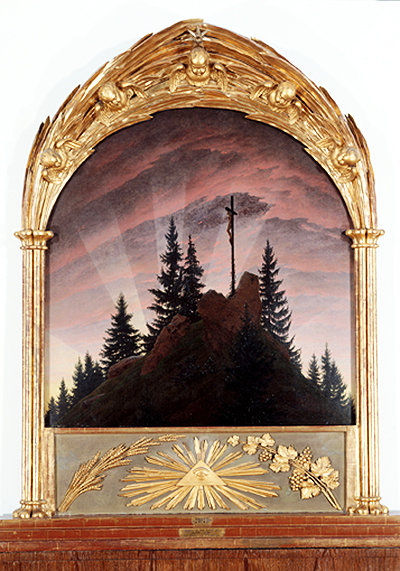
Over Christmas 1808 Friedrich showed The Tetschen Altar in his Dresden apartment. The painted cross stands among evergreens near the top of a steep outcrop. The view rises straight towards that silhouette and the streaks of light behind it. The gilded frame, carved by Christian Gottlob Kühn to Friedrich’s design, identifies the object with a tradition of religious display. The painting gives much of its surface to the slope, the trees and the sky. Their arrangement gives the cross its position and scale, and the sharp rise makes the viewer look up at it. [8][9]
Basilius von Ramdohr’s published attack made the setting and form of the work a matter of public argument. Could landscape painting take on the devotional work of an altarpiece? The objection concerned the standing of a whole category of painting. The frame made that question harder to set aside, since it addressed the person standing before the object as someone who might use it for devotion. Friedrich answered by offering an interpretation of particular motifs. As Gerd Spitzer records, Friedrich assigned steadfastness in faith to the rock and Christian hope to the evergreens. The exchange shows an artist defending the idea that the terrain and vegetation could carry meanings integral to the picture. [8][9]
The apartment display also made the painting’s encounter with an audience unusually direct. Visitors were looking at a work presented by the artist himself, in a room that acquired a devotional association from the object set up in it. The episode makes sense alongside the Met’s account of a broader Romantic inquiry into the religious significance of nature. The picture gives that inquiry a concrete form. One can take in the sky and trees as parts of an observed world and then ask what looking at those parts might contribute to the experience of standing in front of an altarpiece. [4][8][9]
Berlin in 1810 and the argument in print
Friedrich showed The Monk by the Sea and The Abbey in the Oakwood together at the Berlin Academy exhibition in 1810. Birgit Verwiebe records that the theologian Friedrich Schleiermacher encouraged the exhibition and that Friedrich gained membership of the Berlin Academy that year. The companion pictures offered distinct arrangements on canvases of similar size. In the Abbey, tree trunks and the remains of a Gothic wall stand between the viewer and the pale sky. In the Monk, shore and sea stretch almost continuously across the width, and the sky takes up most of the canvas. Each painting makes the amount of space available to a human figure immediately apparent. [10][11]
The exhibition brought the seascape into contact with writers whose own work was part of German Romanticism. Heinrich von Kleist, editor of the Berliner Abendblätter, asked Brentano and Arnim for a response. Their surviving manuscript gives several imagined visitors a turn at describing or judging what they see. The Freies Deutsches Hochstift, which holds the manuscript, notes that Kleist retained much of the introduction and removed most of the dialogue and its irony. His version appeared on 13 October 1810. A painting capable of provoking competing voices in the gallery thus became the occasion for an unusually concentrated first-person account in a newspaper. [3][12][13]
The printed piece begins by imagining what it takes to look out from an actual shore, including the wind and the sound of the water. It then describes a desire the picture awakens and leaves unfulfilled. In the essay’s terms, the spectator takes the monk’s place, and the painting itself becomes the dune. The passage is a record of how one writer construed the act of standing in front of the canvas. It gives the work’s extreme spareness a consequence beyond its appearance. The spectator’s effort to look across that space becomes part of what the picture is about. The different forms of the manuscript and the published essay show how much room there was for disagreement even among the writers closest to the event. [10][12][13]
Dahl and Richter on shared ground
In Dresden, the Norwegian painter Johan Christian Dahl brought another approach to subjects that mattered to Friedrich. The painters exchanged works in 1820, and Dahl received the 1819–20 Dresden version of Two Men Contemplating the Moon. The Met reads Dahl’s Two Men before a Waterfall at Sunset, painted in 1823, as an homage to that picture. The cape and beret of the man on the right recall Friedrich’s figures. Dahl likewise gives two companions a sight to share. He puts the falling water close at hand and gives it a course down through the rocks. The crescent in Friedrich’s painting asks the eye to travel into the distance, while the waterfall lets it follow a moving element through the landscape. The resemblance shows how readily a structure for shared attention could be taken up by a painter with a different sense of incident and terrain. [14][15]
A more public comparison arose around the Watzmann, an Alpine peak painted by Ludwig Richter and then by Friedrich in his Watzmann of 1824–25. Richter worked on his version in Rome from studies and impressions gathered while travelling through the Alps. The Neue Pinakothek identifies the example of Joseph Anton Koch as important to its composition. A shelter, a little chapel and grazing land make it possible to picture a life in Richter’s mountain country. Friedrich, who had never been to the Alps, drew on a watercolour made at the site by his pupil Johann August Heinrich and on rock studies from his own travels in the Harz. His mountain rises behind successive masses of rock and mist into bright snow. The two pictures share a named peak, while their foregrounds lead viewers to imagine quite different ways of being in its vicinity. [16][17]
Richter’s picture appeared at the Dresden Academy exhibition in 1824. Birgit Verwiebe suggests that Friedrich painted his version in response, and a review from the 1825 Dresden exhibition gives a contemporary account of its effect. The reviewer follows the painting from the plants among the lower rocks through mist to the snow, then expresses a wish to see even an eagle or a chamois in the heights. That wish recalls the response to The Monk by the Sea. Both pictures give the eye recognizable things to follow and eventually bring it to an expanse where a viewer searches for a further sign of life. Friedrich’s particular contribution to Romantic landscape lay in how deliberately he could set up that search, whether the point of departure was a local rock arch, a Baltic shore or an Alpine summit drawn by someone else. [10][13][17]
A sheet of meadow plants in Goethe's collection
During preparations for the 2024 Weimar exhibition, curator Christoph Orth identified a drawing of meadow plants in the holdings that came from Goethe. The sheet is dated 1 January 1807. Orth connects grasses on the right with a study dated June 1799 and compares the handling of the pencil with two Dresden drawings dated just before and after the Weimar sheet. The handwriting and watermark supply additional evidence for the attribution. It is a case in which the history of a collection and the evidence within a drawing can bring a lesser-known part of Friedrich's work into the discussion of Romanticism.[18]
The drawing also makes the early sympathy between Goethe and Friedrich more tangible. A person looking closely at the edges of the leaves can see that precise observation remains important even when the plants have been assembled on paper from work made at different times. The marks preserve differences among forms that a generalized impression of a meadow might flatten. Goethe's interest in botany gives a possible context for his interest in such an object. Orth leaves open how the sheet reached him. An anecdote published in 1818 about Goethe obtaining a Friedrich drawing from an album offers a possibility, with no secure identification of the sheet.[18]
For the history of Romanticism this is a different encounter from the prize awarded in 1805. The competition shows a landscape draughtsman entering a public system of judgment. The drawing in Goethe's holdings gives evidence of another kind of proximity, one in which a small natural form and the skill needed to draw it could matter. It becomes possible to take seriously both Goethe's admiration for Friedrich's precision and the differences that emerged over the purpose of landscape painting. Their association survives in particular objects and occasions whose significance changes as the evidence for them becomes more exact.[5] [6] [18]
What a window can promise or withhold
Carl Gustav Carus met Friedrich in 1817 and took advice from him on oil painting. The National Gallery connects Friedrich's influence with Carus's interest in ruins and in landscapes at evening or in winter. Carus also pursued medicine and natural science, and his Nine Letters on Landscape Painting document a developing interest in what knowledge of the earth could contribute to the painter. These activities give the friendship a context beyond the repetition of similar motifs. A fellow painter could take up a question Friedrich posed and arrive at a different account of why it mattered.[19]
Carus's A View of the Sky from a Prison Window, painted in 1823, comes very close in date to Friedrich's Woman at a Window. In Friedrich's painting the spectator sees a person with access to an opening and tries to infer what she sees. In Carus's work the eye comes up against bars. The light beyond them supplies an indication of outside space, although it offers very little terrain to enter in imagination. The chain and the stone sill make the location inside the room harder to disregard. The two works use a shared device to place the spectator in noticeably different circumstances.[20] [21]
In the Carus canvas, tiny details help define those circumstances. Straw on the sill and a web beyond the bars can be noticed at different distances from the window, while the sky has few familiar measures of depth. The National Gallery raises a possible connection with the performance of Beethoven's Fidelio in Dresden in 1823. The parallel can direct attention to captivity and release. It remains an interpretation alongside the independently visible evidence of confinement. The contrast between limited access to the outside and a concentrated view of it is available even to a viewer who has never heard the opera.[20]
That is one reason to compare works by closely connected artists at the scale of an individual object. The window has a history in earlier painting and in Romantic interiors. Knowing that history can help a spectator recognize a device. Comparing two uses makes it possible to see what an artist has to decide once the device is available. A standing figure, a bar across a patch of sky or the presence of a chain can redirect the relation between interior and landscape. Friedrich's circle explored that relation through specific changes in who could look and how far the view could go.[19] [20] [21]
Two sizes of maritime Romanticism
The Museum der bildenden Künste Leipzig compared Friedrich's Rocky Reef off the Seacoast with Andreas Achenbach's Storm at Sea off the Norwegian Coast in an exhibition on the relationship between Saxon and Düsseldorf painting. Friedrich's reef is painted on a canvas only 31 centimetres wide. Achenbach's storm spreads across 272 centimetres. Those dimensions affect the viewer before any interpretation of a rock or wave begins. In Karlsruhe the reef can suggest a landscape much larger than the field the eye can take in at close range. In the Städel painting the size of the surface gives the breaking water and threatened vessel room to occupy a large part of a spectator's view.[22] [23] [24]
The difference in scale accompanies a difference in how each picture organizes danger. In Friedrich's work the comparison between the shore and the rocks beyond it gives the eye an impression of a formidable coast. It takes time to find measures for the apparent size of the landforms. In the Achenbach a ship supplies an immediate measure and a question about what is about to happen. The breaking waves and cliffs matter partly because of their relation to the vessel's possible movement. Lighting helps direct that attention. The viewer can see what is at stake in the contact between water and rock through the position of something that could be damaged there.[22] [23] [24]
The Städel records that Achenbach painted his Norwegian storm before he visited Norway. The setting's force therefore depended on the painter's ability to stage the coast convincingly with the materials he already had. Friedrich also used observation and recombination to give imagined landscapes physical conviction. The comparison brings out a shared problem of making a place plausible on canvas. It also shows how differently the answer could be organized around a timed event, a material surface and the distance of a spectator.[4] [22] [24]
The Städel acquired the storm in 1837, the year Achenbach painted it. That transaction gives a concrete instance of the changing audience described by the Leipzig exhibition. At a time when Friedrich's standing had diminished, an institution could respond immediately to a large, detailed maritime drama by a younger artist. The comparison helps explain what was changing in exhibition culture without requiring Romantic landscape to have ended on one particular date. Both works ask spectators to attend to the strength of nature. They give spectators very different things to watch while doing so.[22] [24]

Frequently Asked Questions
Discussion
What changes when you look from the altarpiece to Monk by the Sea?
Reader Insights
How does the cross stand out above the rocky summit?
What changes when you look from the altarpiece to Monk by the Sea?
What did the paintings ask of their first viewers?
How does the cross stand out above the rocky summit?
Join the Conversation
Share what you noticed in Friedrich and German Romanticism.
References
- The Metropolitan Museum of Art, Caspar David Friedrich: The Soul of Nature, gallery texts, pp. 2–3, Uttewalder Grund drawings, Footpath with a Bridge and View of the Elbe Valley. View source.
- The Metropolitan Museum of Art, Johann Moritz Gottfried Jentzsch, Travelers at the Rock Arch in the Uttewalder Grund, 2004.82. View source.
- Olivia Fuhrich, “Romantik,” Deutsches Historisches Museum, Lebendiges Museum Online. View source.
- The Metropolitan Museum of Art, Caspar David Friedrich: The Soul of Nature, “Introduction,” “Forging His Path,” “Breakthrough” and “Nature and Faith.” View source.
- Klassik Stiftung Weimar, Caspar David Friedrich, Goethe and Romanticism in Weimar. View source.
- Friedrich anniversary chronicle, “Friedrich sends two sepia drawings to Goethe – and, contrary to expectations, receives 90 thalers in prize money,” 1805. View source.
- Friedrich anniversary chronicle, Klassik Stiftung Weimar collection entries for Wallfahrt bei Sonnenuntergang, KK 514 and Herbstabend am See, KK 515.
- Friedrich anniversary chronicle, Dresden apartment display of Cross in the Mountains, Christmas 1808. View source.
- Gerd Spitzer, “Das Kreuz im Gebirge (Tetschener Altar),” Gal.-Nr. 2197 D, Friedrich anniversary chronicle. View source.
- Birgit Verwiebe, “Monk by the Sea,” NG 9/85, Hamburg exhibition catalogue essay reproduced in the Friedrich anniversary chronicle. View source.
- Staatliche Museen zu Berlin, Abtei im Eichwald, NG 8/85, collection record and reproduction. View source.
- Freies Deutsches Hochstift, Brentano and Arnim’s Verschiedene Empfindungen vor Friedrichs Seelandschaft, manuscript account. View source.
- Heinrich von Kleist, “Empfindungen vor Friedrichs Seelandschaft,” Berliner Abendblätter, 13 October 1810, text as reprinted in Heinrich von Kleist’s politische Schriften und andere Nachträge zu seinen Werken. Read the text.
- Friedrich anniversary chronicle, Two Men Contemplating the Moon, Dresden version. View source.
- The Metropolitan Museum of Art, Johan Christian Dahl, Two Men before a Waterfall at Sunset, 2019.167.3. View source.
- Bayerische Staatsgemäldesammlungen, Ludwig Richter, Der Watzmann, 8983. View source.
- Birgit Verwiebe, “Der Watzmann,” F.V. 317, Friedrich anniversary chronicle, including the 1825 review from the Literarisches Conversations-Blatt, p. 888. View source.
- Christoph Orth and Johanna Kiesler, Klassik Stiftung Weimar, Caspar David Friedrichs Wiesenblumenstück, research on the drawing's attribution, studies and Goethe provenance.
- National Gallery, London, Carl Gustav Carus, artist biography and account of the landscape letters.
- National Gallery, London, A View of the Sky from a Prison Window, NG6704, 1823.
- Birgit Verwiebe, Alte Nationalgalerie, Frau am Fenster, A I 918, 1822.
- Museum der bildenden Künste Leipzig, Caspar David Friedrich and the Düsseldorf Romanticists, exhibition account.
- Staatliche Kunsthalle Karlsruhe, Felsenriff am Meeresstrand, 2261, 1824.
- Städel Museum, Storm at Sea off the Norwegian Coast, 875, 1837.