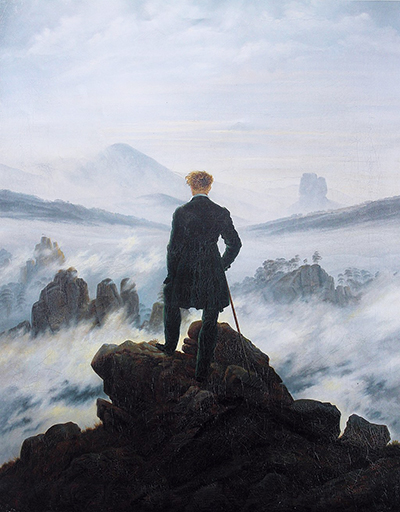
 by Tom Gurney
Tom Gurney BSc (Hons) is an art history expert with over 20 years experience
Email: tomgurney1@gmail.com / Phone: +44 7429 011000
Introduction
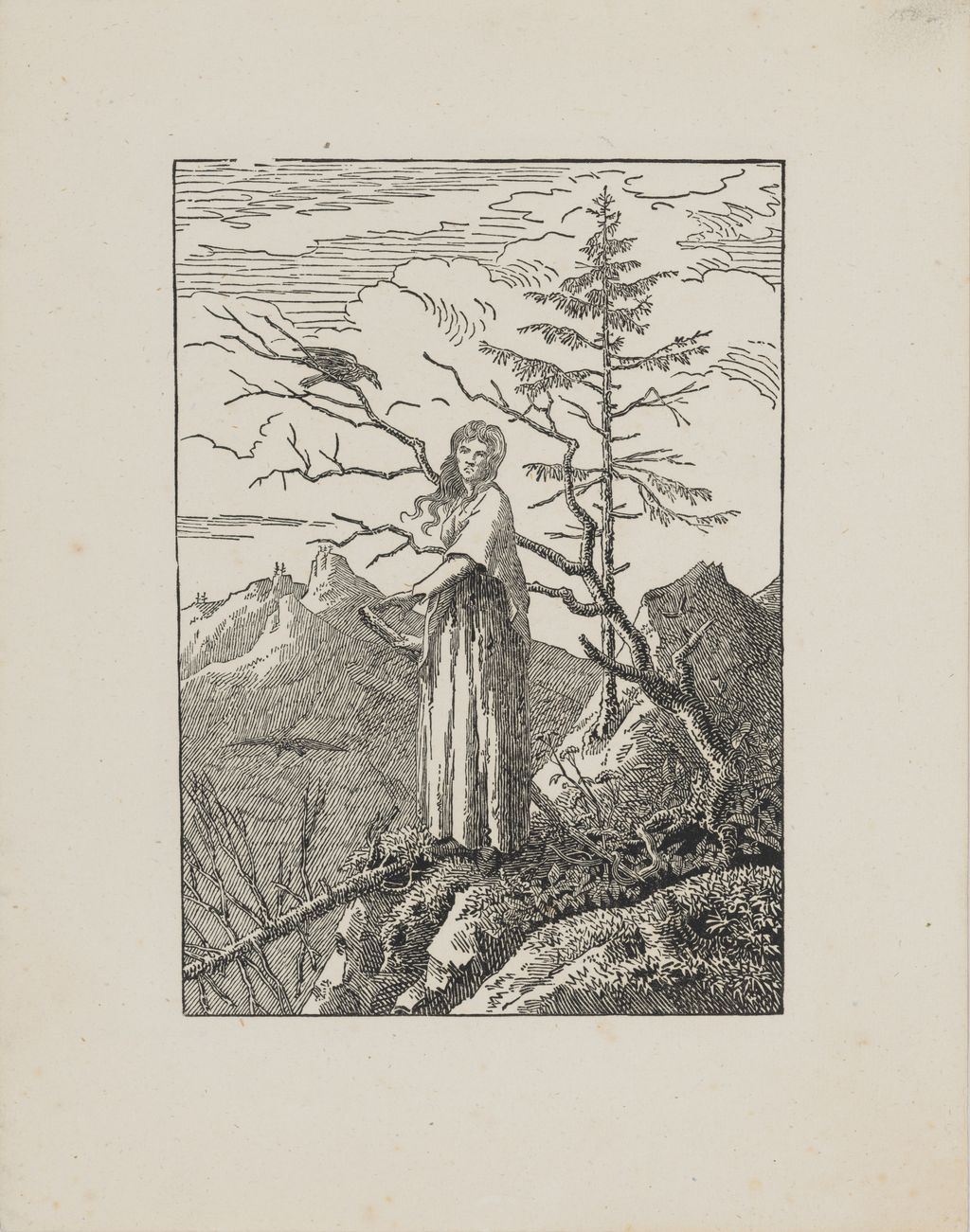
A woman stands on a rocky ledge, her long hair blown across one shoulder. A raven bends forward on a bare branch above her. Another flies below, where the ground falls away. Its position makes the drop suddenly apparent. The woman’s skirt reaches down to the ledge, while the bird below is suspended against a mountainside some distance behind her. Caspar David Friedrich designed the scene and his brother Christian Friedrich cut it in wood. In the Metropolitan Museum of Art’s impression, catalogued as Woman with a Raven at a Precipice and dated 1803, the printed image is just 17 centimetres high. [1][2]
At a Glance
- Date · 1803
- Medium · Woodcut on wove paper
- Collection · The Metropolitan Museum of Art
- Accession · 27.11.3
- Dimensions · 17 cm high × 11.9 cm wide
Contents
- Introduction
- A narrow foothold
- From drawing to printing block
- The sheets in New York, Amsterdam and Vienna
- Three woodcuts in Dresden and New York
- Annotated Details
- Image Details
A narrow foothold
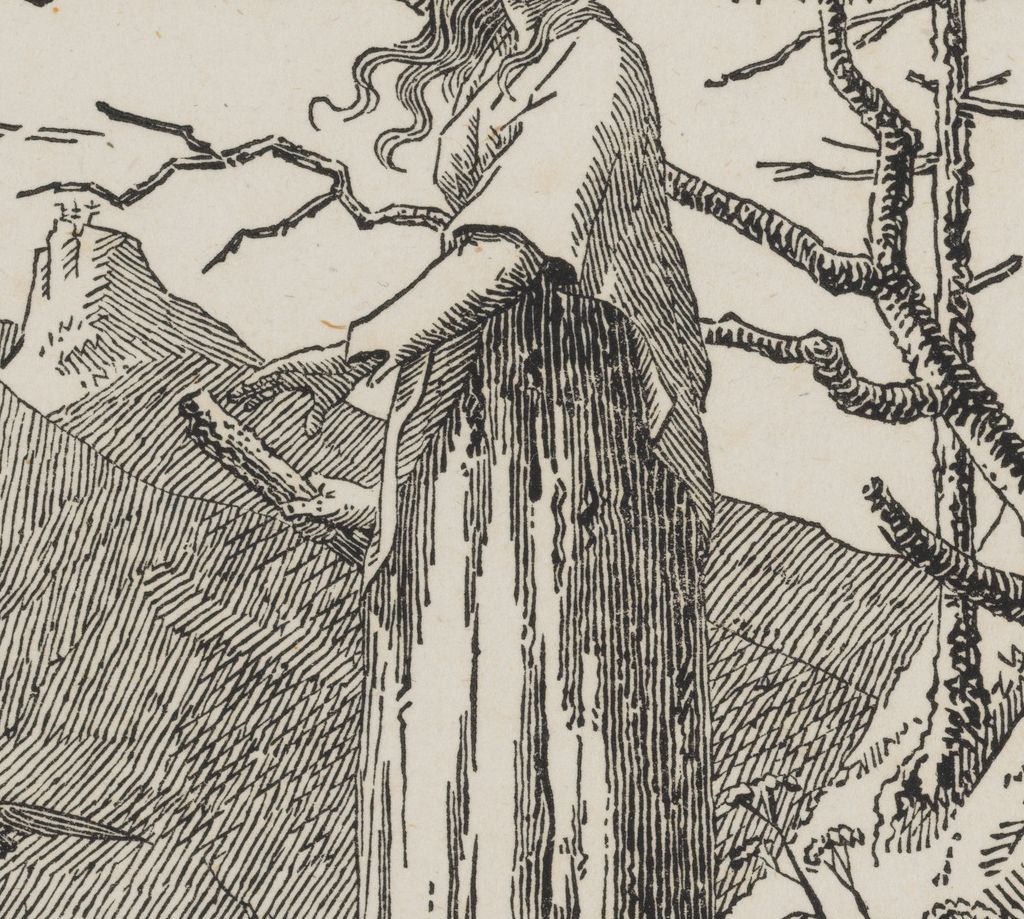
The woman stands nearly at the centre of the image, with her face turned far enough for us to see her expression. Her shoulders and hands are angled towards the left, where she holds on to a broken piece of wood. Down by her feet, a bare limb crosses the steep foreground and passes through the left border. The angle of the limb carries the eye off the ledge, while the upright folds of the dress keep bringing it back to the place where she stands. That patch of ground is crowded with marks, but the surface opens abruptly on either side of it. [1][2]
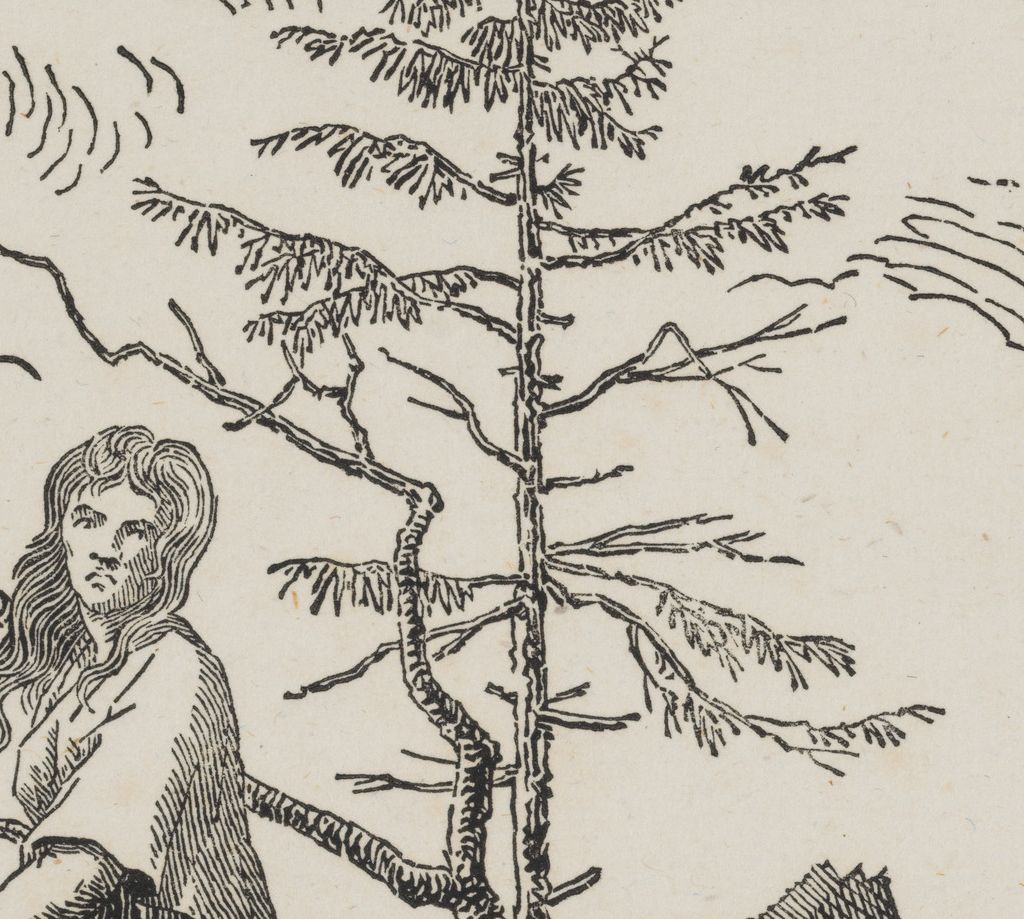
Two trees complicate the silhouette. The bare tree rises from the right and reaches across the scene in sharp bends. A slender conifer behind it carries its tip almost to the upper border. Its needles grow in small, regularly spaced groups that look delicate beside the bare limbs. The trees share the woman’s precarious ground and nearly surround her head with their branches. Yet the open patches of sky around her face give it some room. Look at the curves of her hair against the sky and then at the angular twig above them. The difference is small at the scale of the whole sheet, but it makes the movement of the hair especially clear. [1]
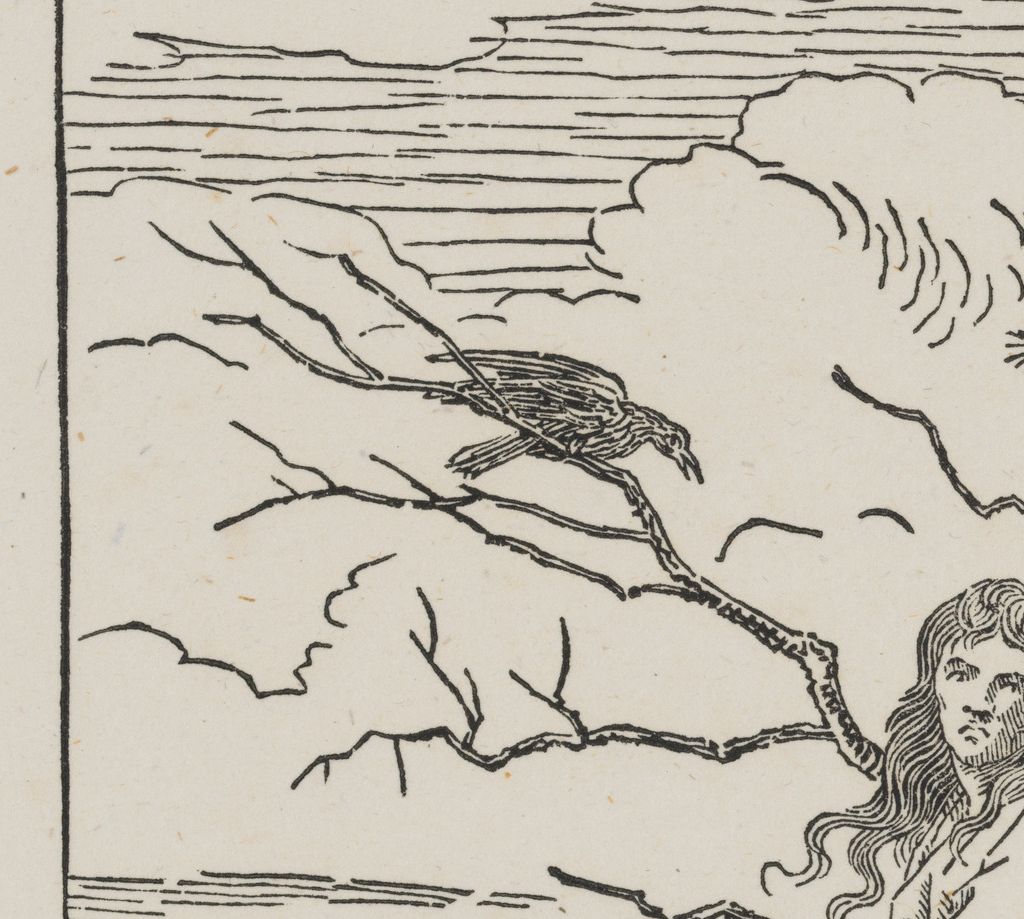
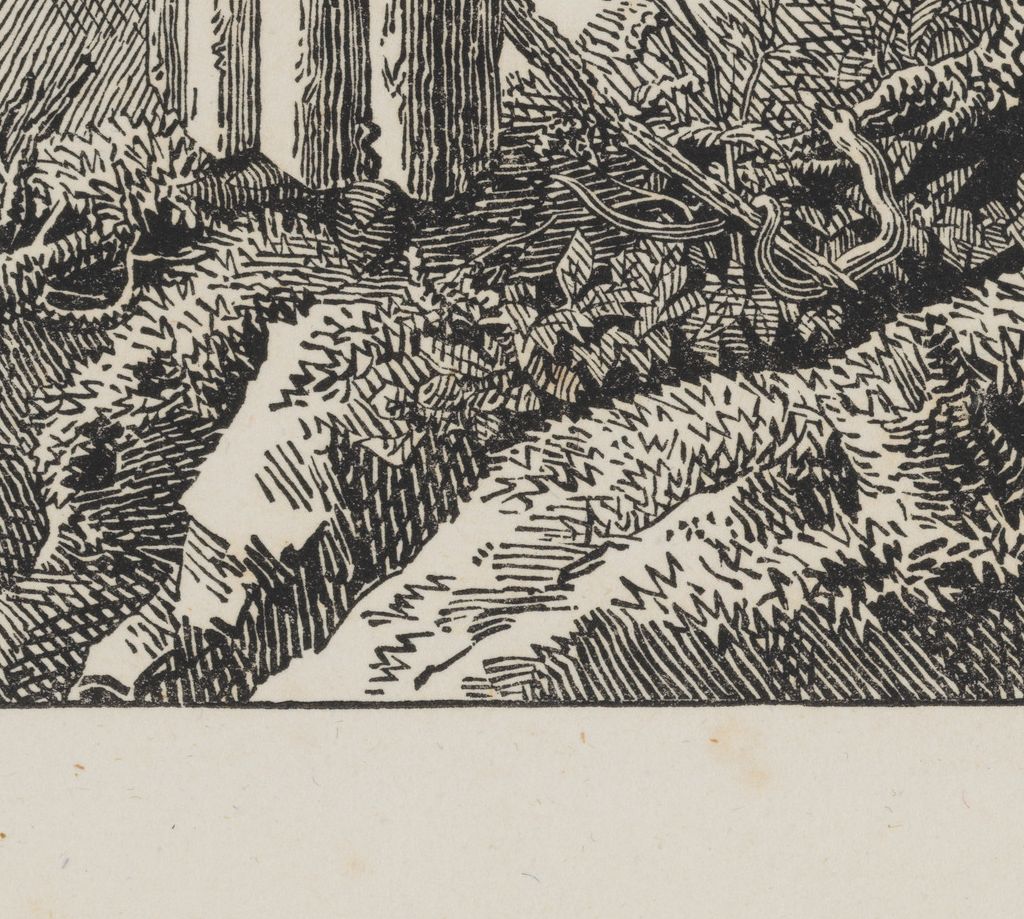
The raven on the branch is easy to pick out against the sky. The one in flight is harder to see because its outspread wings cross the fine lines of the opposite slope. Lower still, the Rijksmuseum identifies a snake on the ground. Its course through the roots and debris is easy to overlook amid the curls and short strokes around it. These details take time to find. The drop and the figure register quickly. Finding the second bird and the snake takes the eye from the distant mountainside back to the ground immediately around her feet. [1][2]
From drawing to printing block
In an essay published in 1976, art historian Helmut Börsch-Supan linked the woodcut to a drawing by Caspar David Friedrich dated 29 December 1801. In the drawing a distressed woman stands before an open chest. The relationship is easier to see if one starts with the woman’s expression and the open space in front of her. In the print that space belongs to a mountain landscape. Börsch-Supan recounts Werner Hofmann’s objection to reading the chest as coffin-like and treating it as equivalent to the abyss. For Börsch-Supan, the fact that the brothers’ other woodcuts also had related drawings with different settings strengthened the case for taking the earlier drawing’s expressive content seriously. The chest and the precipice can be compared as settings for distress, while the evidence for the drawing’s role comes from the comparison of motifs. [1][3]
The surviving printing block is in the Hamburger Kunsthalle’s Kupferstichkabinett. The Friedrich anniversary chronicle dates it to 1801–03 and gives its dimensions as 120 × 173 millimetres. The block record, DP 78, cross-references Hamburg’s paper impression 37223, which has its own entry and a date of about 1804. In relief printing, the parts of the block left standing take the ink and transfer it to paper. Cutting away the wood between closely spaced lines leaves those lines standing separately. The fine branches and hatching on the Met’s sheet show just how closely the raised shapes could be spaced. [1][4][5][6]
Christian’s cutting gives each part of the scene its own kind of shading. On the mountain to the left, long diagonal strokes cluster on the slopes and loosen where a ridge catches the light. Around the woman’s shoes, short strokes are packed tightly between small pale shapes, making the ground look rough. In the sky, long horizontal lines stop at the cloud edges. There the untouched paper can appear to billow, even though it has the same tone as the blank margin. The broad light folds of the skirt work in a similar way. Their narrow dark edges suggest the weight of the cloth and carry the eye down to the ledge. [1][6]
The sheets in New York, Amsterdam and Vienna
The Met describes its impression, 27.11.3, as a woodcut on wove paper. Its image is 17 × 11.9 centimetres and the sheet is 24.4 × 19.2 centimetres, both measured height before width. In the full view of the paper, the margins give the image room on every side. That view makes a difference to the experience of the picture. The printed border closes sharply around the rock and sky, even where a branch or slope appears to continue beyond it. The sheet remains substantially larger than the world enclosed by that narrow black line. [1]
Other impressions carry their own measurements and catalogue dates. The Rijksmuseum’s woodcut RP-P-1981-194 has a 16.8 × 11.9 centimetre image on a 24.5 × 19.2 centimetre sheet, and the museum dates it to 1801–03. The Albertina dates its woodcut DG1923/362 to about 1802. Its paper measures 22.5 × 18.8 centimetres, and the catalogue gives 17.2 × 12.1 centimetres in the field labelled Platte. That field belongs to Vienna’s impression record. Hamburg’s dimensions for DP 78 describe the surviving block. The different date labels likewise belong with their individual records. They place the collaboration in the first years of the century, while the precise sequence in which these sheets were pulled remains open. [1][2][4][5][7]
The Albertina records an inscription at the lower right of its sheet that names the Dresden landscape painter as draughtsman and refers to the cutting. On the reverse are marks associated with the Royal Museums’ print collection and the collector Karl Ferdinand Friedrich von Nagler. The Rijksmuseum records a Stuttgart print collection stamp and a stamp indicating that a duplicate was disposed of. Those marks belong to the individual sheets and tell a different part of their history from the design that they share. The Met’s sheet entered its collection through the Harris Brisbane Dick Fund in 1927. [1][2][7]
Three woodcuts in Dresden and New York
At the Dresden Academy exhibition of 1804, catalogue numbers 240–242 were listed together as three woodcuts designed by C. D. Friedrich and cut by J. C. Friedrich. The entry gives the two jobs separately and groups the prints under a single description, without individual titles. The raven, spiderweb and sleeping boy designs are the three works usually associated with the entry. The Met showed its impressions of those three woodcuts together in its 2025 exhibition Caspar David Friedrich: The Soul of Nature, where it presented the images as evocations of feeling through the relationship between figures and their surroundings. [3][8][9][10]
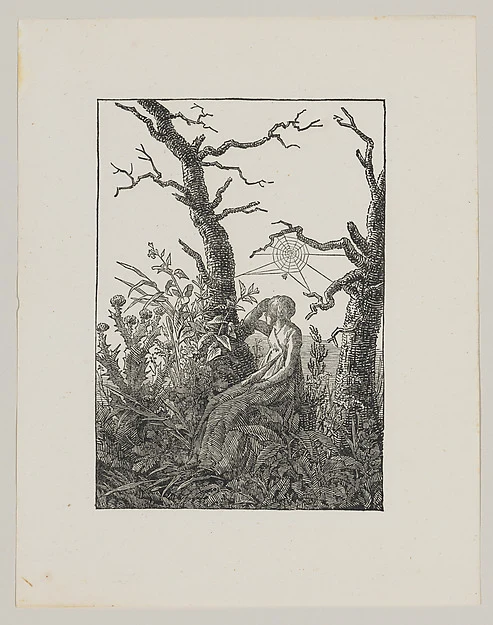
In Woman with a Spiderweb, the seated woman appears among bare trunks and the tiny web asks for close attention. The Met points out the butterfly near the web and its reappearance in Boy Sleeping on a Grave, where the museum reads it as a sign of the soul’s release at death. The grave physically supports the boy. In the raven print, the woman has only a small part of the rocky slope under her feet, and the bird in flight makes the gap beside her perceptible. Together the sheets show how a change in posture and setting could give a small creature a very different place in the scene. The precarious footing also makes an instructive comparison with the traveller in Footpath with a Bridge, an etching that Friedrich made himself. There the bridge carries the figure across the gap. Here Christian’s cut lines lead us to the edge and the bird’s flight carries us across. Both works show how much Friedrich could ask of a small figure in a print. [1][9][11][12][13]
Annotated Details from Woman with a Raven on a Precipice
Use the numbered details to trace the forms and light in this work.
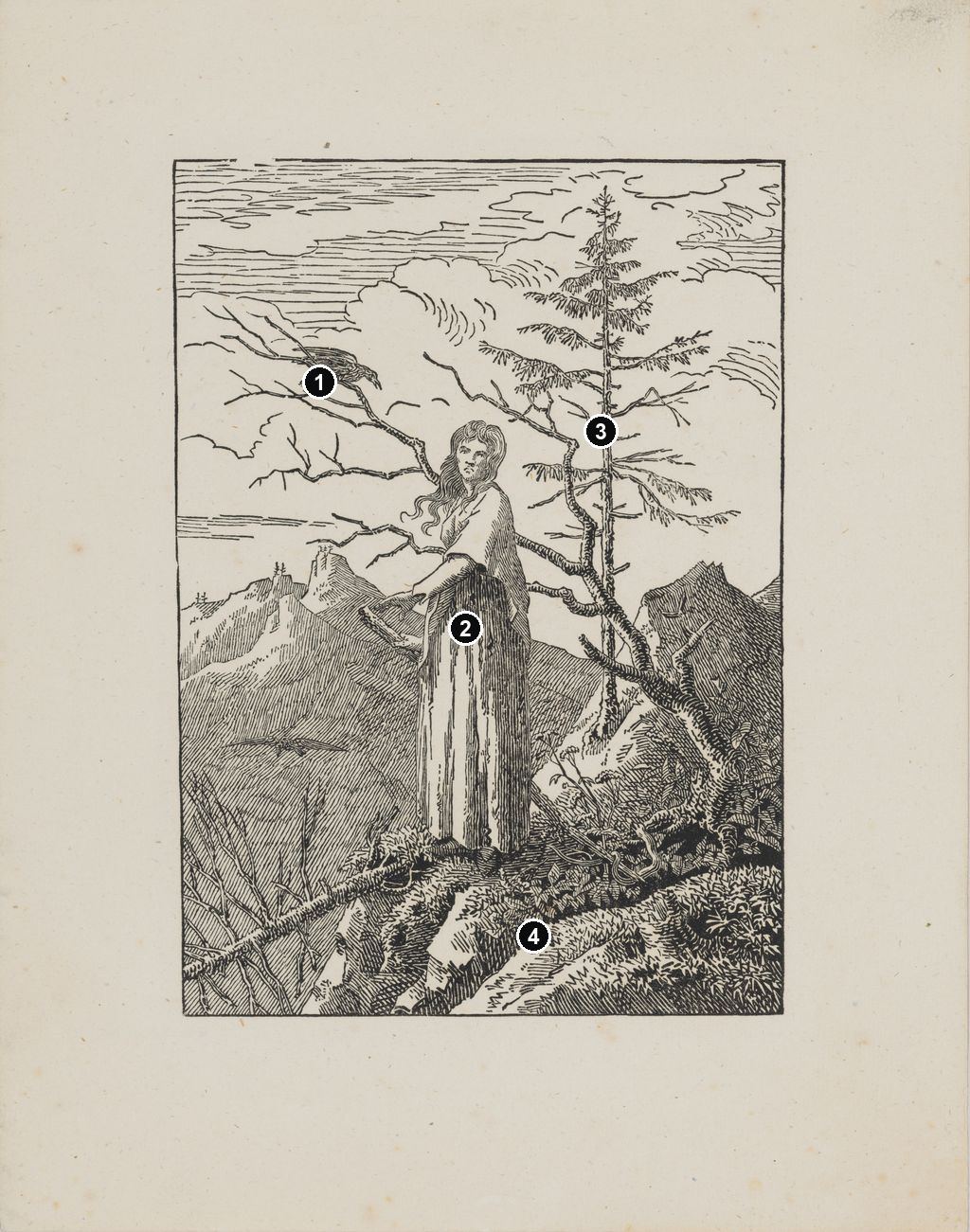
Details from WOMAN WITH A RAVEN ON A PRECIPICE
The detail crops show parts of the work at a larger scale.
The raven
A dark bird sits on a bare branch above and to the left of the woman.
The figure
The woman turns her head and brings one hand near her face.
A tree above the rocks
The fine lines of an evergreen contrast with the bare branches around it.
The precipice
Dense cutting describes rock, roots and the steep drop below the figure.
Frequently Asked Questions
Discussion
How does the branch lead you to the bird?
Reader Insights
Where do the cuts become densest?
How does the branch lead you to the bird?
What does the woman’s position reveal about the steep ground?
Where do the cuts become densest?
Join the Conversation
Share what you noticed in Woman with a Raven on a Precipice.
References
- The Metropolitan Museum of Art, Woman with a Raven at a Precipice, 27.11.3, collection record and full-sheet reproduction. View source.
- Rijksmuseum, Vrouw staand aan de rand van de afgrond en raaf, RP-P-1981-194. View source.
- Helmut Börsch-Supan, “Zur Deutung der Kunst Caspar David Friedrichs,” Münchner Jahrbuch der bildenden Kunst 27 (1976), pp. 206–207. View source.
- Hamburger Kunsthalle, Kupferstichkabinett, Die Frau mit dem Raben am Abgrund, printing block DP 78, Friedrich anniversary chronicle. View source.
- Hamburger Kunsthalle, Kupferstichkabinett, Die Frau mit dem Raben am Abgrund, impression 37223, Friedrich anniversary chronicle. View source.
- Wendy Thompson, “The Printed Image in the West: Woodcut,” The Metropolitan Museum of Art. View source.
- Albertina, Die Frau mit dem Raben am Abgrund, DG1923/362. View source.
- Churfürstlich Sächsische Akademie der Künste, 1804 Dresden exhibition catalogue, printed p. 20, nos. 240–242. View source.
- The Metropolitan Museum of Art, Caspar David Friedrich: The Soul of Nature, exhibition labels for the three woodcuts. View source.
- The Metropolitan Museum of Art, Caspar David Friedrich: The Soul of Nature, exhibition overview. View source.
- The Metropolitan Museum of Art, Woman with a Spiderweb, 27.11.2. View source.
- The Metropolitan Museum of Art, Boy Sleeping on a Grave, 27.35. View source.
- The Metropolitan Museum of Art, Footpath with a Bridge, 27.36.2. View source.