 by Tom Gurney
Tom Gurney BSc (Hons) is an art history expert with over 20 years experience
Email: tomgurney1@gmail.com / Phone: +44 7429 011000
Introduction
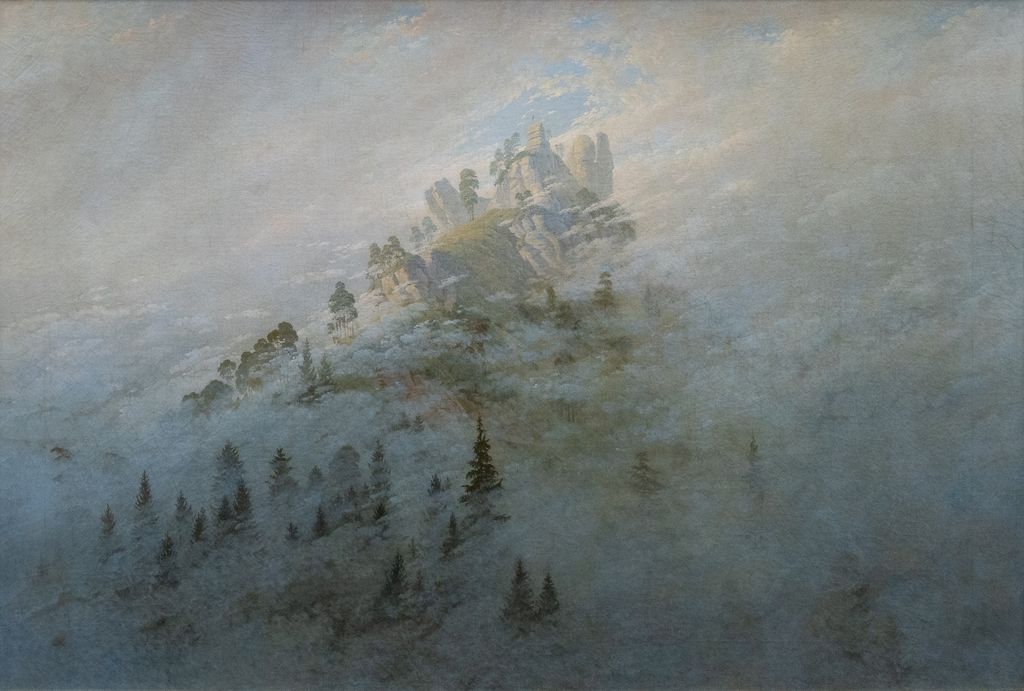
A cluster of treetops rises out of blue-green mist. Above them, the side of a mountain comes into view a little at a time, first as a change in colour and then as a broken line of rock. The highest crag is almost lost in the brightness around it. Look just above its tip and a tiny cross comes into view. In Morning Mist in the Mountains, Caspar David Friedrich makes a whole mountain difficult to see, then asks us to look for something much smaller. [1][2]
At a Glance
- Artist — Caspar David Friedrich
- Titles — Morning Mist in the Mountains in English, Morgennebel im Gebirge in German
- Date and medium — About 1808, oil on canvas
- Dimensions — 71 cm high × 104 cm wide
- Collection — Thüringer Landesmuseum Heidecksburg, Rudolstadt, inv. TLMH M 529 [1][2][3]
Contents
- Introduction
- How the mountain comes into view
- A cross in the opening
- From a sketch near Rathen
- An early description and a late attribution
- Morning in the Riesengebirge and the later rising mist
- Annotated Details
- Image Details
How the mountain comes into view
The clearest trees are low in the picture, between the left edge and the centre. Several dark conifers are visible far enough down to make out their tapering branches. Others are little more than tips. One taller tree near the middle stands above the surrounding cluster, with an outline sharp enough to see where the branches step outward. Its base disappears into the same blue-green that hides the ground around it. The differences between these trees give us a sense of depth even where the slope they grow on is hard to see. [1]
Follow the mountain upward from the left and a second set of marks comes into focus. Small trees and patches of exposed stone interrupt the incline. The warmer colour of the rock, ranging from muted pink to yellow-brown, helps it emerge from the cooler haze. Near the top the line breaks into separate crags. A paler band runs across the rock below them, leaving enough of the face visible for the eye to join the forms across it. On the right, the outline drops away quickly. The left side provides a series of points to follow upward, while the descent on the right soon has to be inferred. [1][3]
Out toward the corners, it gets harder to tell where the mist around the mountain ends and the clouds in the sky begin. The haze has colour and variation of its own. The blue-green at the bottom lightens toward the right, while pale streaks near the summit pass in front of the darker rock. Across the upper part of the picture the eye meets much larger areas of light with very few edges to hold it. There is no long, level horizon to separate the sky from the land. The changing sharpness of the trees and rocks does much of that work. [1][3]
Werner Busch, writing for the 2014 Dresden exhibition on Friedrich and Johan Christian Dahl, draws attention to the curious impression that such a heavy mountain might be floating. The effect is particularly striking if you look at the upper rocks first and then try to trace their connection to the ground. Busch points to the French painter Pierre-Henri de Valenciennes, whose treatise described the natural phenomenon of a summit clearing above a valley still covered in mist. Friedrich concentrates the whole picture on this uneven clearing. The mountain has just enough substance to make the disappearance of its base surprising. [1][4]
A cross in the opening
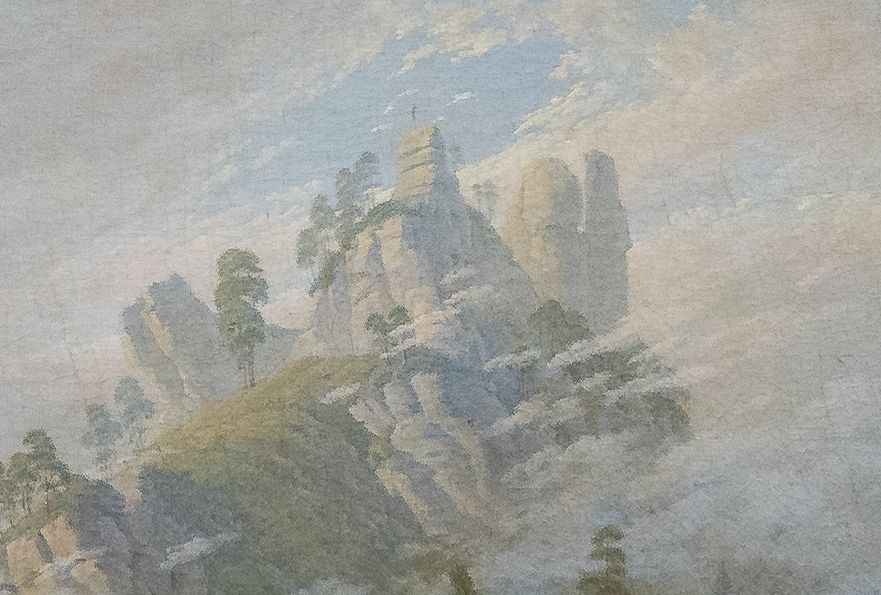
The cross stands on the highest point, where a patch of blue appears between the clouds. Even there it can be difficult to distinguish from the broken profile of the rock. Birgit Verwiebe reproduces a detail in which the upright and crosspiece become easier to see. In the full composition they occupy a fraction of the space given to the surrounding cloud. Their position matters as much as their size. Where the rock and the light sky meet, a fine mark can register after the eye has already taken in the much larger shapes. [1][2]
In a remark on landscape quoted by Verwiebe, Friedrich associates mist with an increase in apparent scale and with the anticipation stirred by a veiled distance. His painting gives that anticipation a particular direction. The eye can start with the trees, find another length of the slope, and follow the opening to the summit. The mountain appears to be clearing as we look, even though the marks on the canvas stay where they are. Johannes Grave links the time it takes to see the mountain to the time implied by the title. The first signs of change are already present in the painted scene. [2][3]
The Metropolitan Museum of Art read the tiny cross as suggesting that a viewer has to seek out signs of the divine. Lutz Unbehaun, writing for the Heidecksburg collection, gives the patch of clear blue a more specific Christian meaning, connecting the opening of the sky to Christ. Both readings depend on where Friedrich put the cross. It is small enough to escape an initial glance and stands just where the view clears. There are no climbers on the slope whose gestures direct us to it. A change in the weather supplies the opening through which we see it. [1][5]
From a sketch near Rathen
One proposed source survives on the back of a pencil drawing in the Hamburger Kunsthalle. The sheet, titled Amselfall bei Rathen, shows a rocky gorge and waterfall on the front. On the back, a few lines have been identified as a view of the nearby Honigstein massif in Saxon Switzerland. Grave connects that outline to several finished drawings and then to the Rudolstadt painting. For Grave, the subject of the painting is the mountain with its characteristic crown of rock. [3][6]
Peter Prange, writing about the sheet itself, treats the identification of its reverse as possible. He notes that the characteristic crown of Honigstein is clearer in other views. He also reopens the question of the sheet’s date on the basis of the paper and its proposed membership in one of Friedrich’s sketchbooks. The drawing helps explain the kind of observation behind the painted profile, while its date and the precise relationship to the oil remain open. Even with Honigstein as a likely source, the Heidecksburg catalogue treats the painted mountain as a composition built from observed forms. The summit gives those forms a point of concentration and the mist makes the shape impossible to trace all the way around. [1][3][6]
An early description and a late attribution
The painting is unsigned. In its catalogue, the Heidecksburg draws attention to a report published in Prometheus in 1808. A visitor to Friedrich’s studio described a mountain wrapped in cloud, with a cross on the highest rock standing out against clear blue air. The combination of rock, cross and clear sky makes this an unusually specific clue to the Rudolstadt painting. The Heidecksburg dates the oil to 1808, while the Met’s 2025 exhibition label allowed for a probable date of 1807–08. [1][5]
The Met records that the princely family of Schwarzburg-Rudolstadt acquired the canvas. By the time it attracted fresh attention in the Heidecksburg’s storeroom in 1941, it had been inventoried as a local landscape associated with the Schwarzatal. The museum’s collection entry describes an initial attribution based on style, supported by conservation examination after the Second World War. Its account of the old title is revealing. For someone cataloguing the picture as a local view, the hazy peak could recall familiar terrain even with much of its shape obscured. The studio report brings the barely visible feature at the top back into the history of the work. [1][5][7]
Morning in the Riesengebirge and the later rising mist
Friedrich returned to the combination of a summit cross and morning fog in Morning in the Riesengebirge, catalogued by the Prussian Palaces and Gardens Foundation as Morgen im Riesengebirge (Kreuz auf dem Felsen), 1810, inv. GK I 6911. In that canvas the cross stands on a crag to the right and the land continues beyond it in successive ridges. A woman in white holds the cross with one hand and helps a man up with the other. The ridges stretch the view sideways and into the distance, while the figures give the climb a visible endpoint. In the Rudolstadt picture, the treetops and summit belong to the same mass, and the scale of the cross makes finding it part of looking at the mountain. [1][8][9]

The Städel Museum’s Mountains in the Rising Fog, around 1835, is another distinct canvas, inv. 1821. Its catalogue connects the distant mountains to the Rosenberg in Bohemian Switzerland. The low ridge in front and the pale bands across the valley give the eye several levels to cross before it arrives at the mountains. The Rudolstadt painting gives the largest share of its space to the air around one slope. Look again from the lower treetops to the highest crag and the extent of that choice is plain. There is enough detail to follow the mountain up, while the mist keeps the land around it out of reach. [1][10]
Annotated Details from Morning Mist in the Mountains
Use the numbered details to trace how Friedrich arranged the forms and light in this painting.
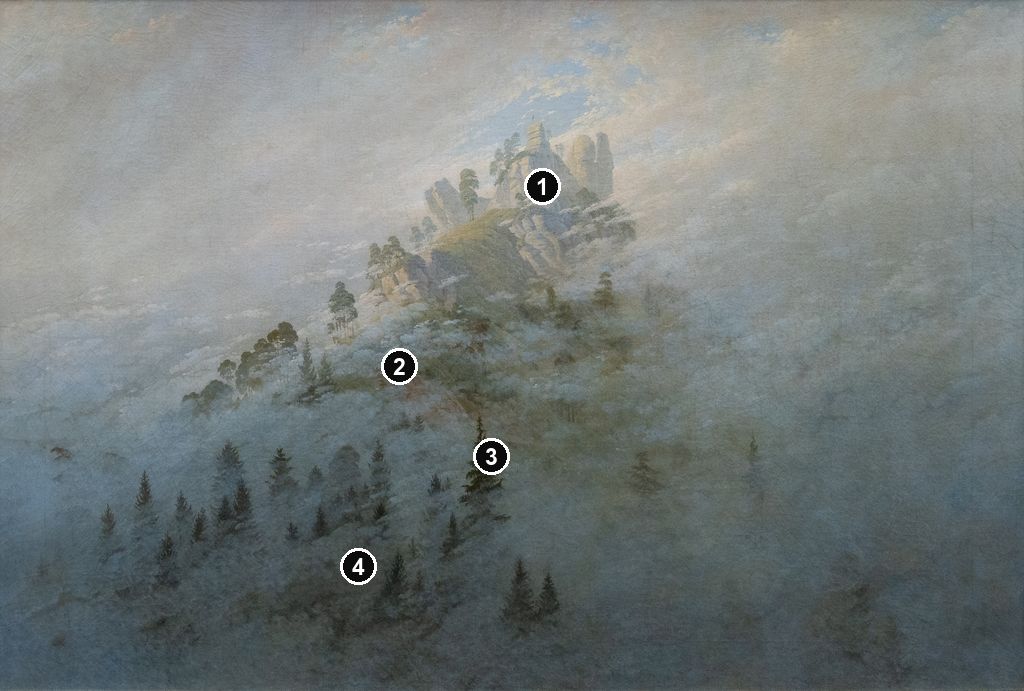
Details from MORNING MIST IN THE MOUNTAINS
The detail crops show parts of the painting at a larger scale.
Rock towers
The sharpest outlines appear near the top, where rock towers emerge into clearer air.
The dissolving ridge
Rock and foliage soften along the left side of the slope as they enter the mist.
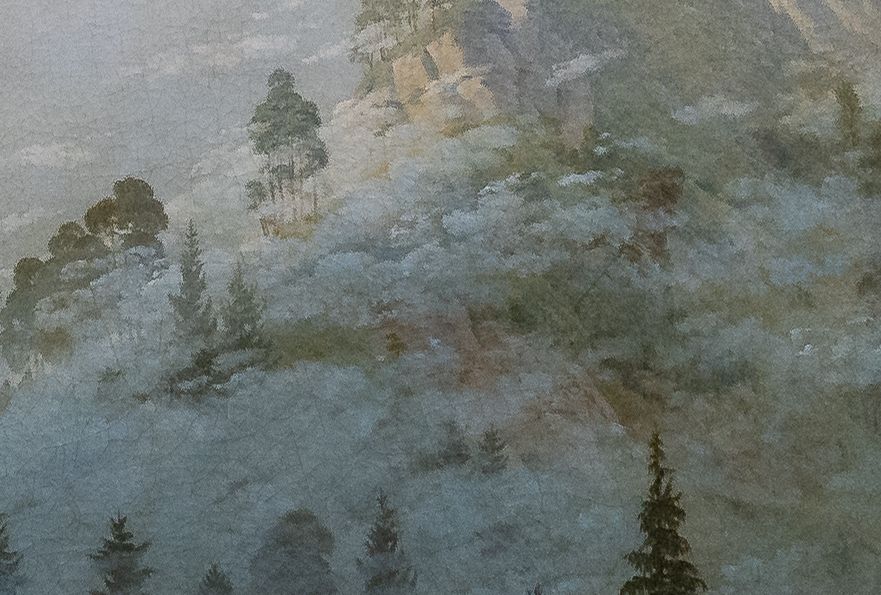
A dark fir
One slender fir remains distinct against the paler slope.
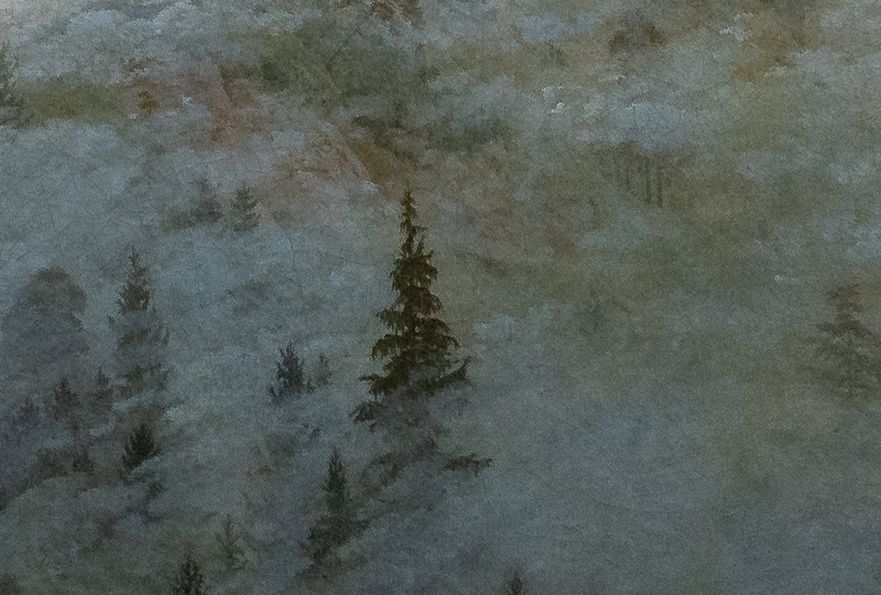
Trees lower on the slope
Trees at the lower left register as smaller, less distinct accents in the haze.
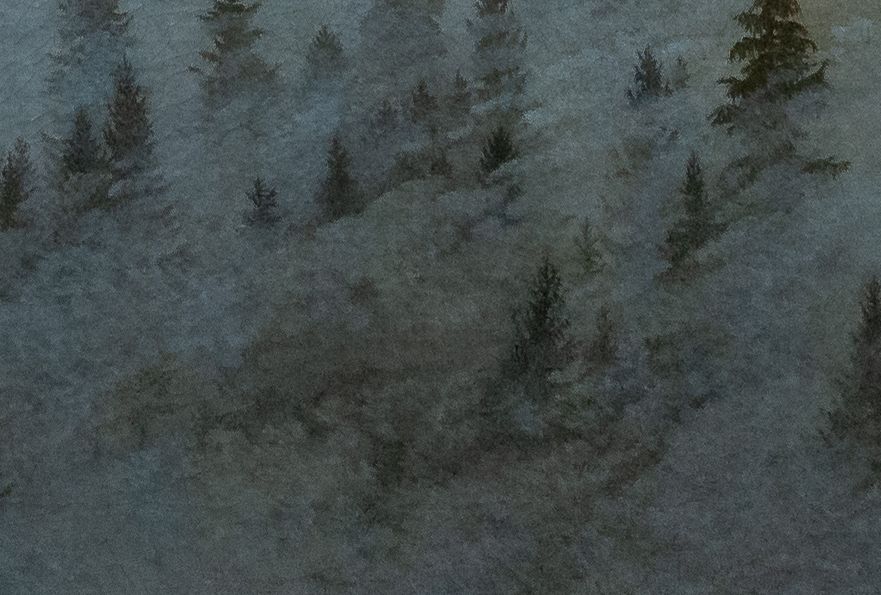
Frequently Asked Questions
Discussion
Where do the trees begin to disappear into mist?
Reader Insights
Which edges come into focus as you look longer?
Where do the trees begin to disappear into mist?
What changes when the cross is more prominent in another mountain painting?
Which edges come into focus as you look longer?
Join the Conversation
Share what you noticed in Morning Mist in the Mountains.
References
- Lutz Unbehaun, Thüringer Landesmuseum Heidecksburg, Morgennebel im Gebirge, TLMH M 529.
- Birgit Verwiebe, “An der Grenze der Sichtbarkeit. Verborgene Wesen und Gestalten in Bildern Caspar David Friedrichs,” Jahrbuch der Berliner Museen 65 (2024), pp. 72–73 and figs. 1–2.
- Johannes Grave, Morning Mist in the Mountains, Friedrich anniversary catalogue.
- Werner Busch, “Friedrich und Dahl. Thematische Verwandtschaft und bildnerische Differenz,” in Dahl und Friedrich: Romantische Landschaften (2014), p. 21.
- The Metropolitan Museum of Art, Caspar David Friedrich: The Soul of Nature, exhibition labels, p. 8.
- Peter Prange, Amselfall bei Rathen, Hamburger Kunsthalle inv. 41093, Friedrich anniversary catalogue.
- Thüringer Landesmuseum Heidecksburg, collection history and loan announcement.
- Jessica Korschanowski, Stiftung Preußische Schlösser und Gärten Berlin-Brandenburg, Morgen im Riesengebirge (Kreuz auf dem Felsen), GK I 6911.
- Stiftung Preußische Schlösser und Gärten Berlin-Brandenburg, Friedrich anniversary collection overview.
- Städel Museum, Mountains in the Rising Fog, inv. 1821.