 by Tom Gurney
Tom Gurney BSc (Hons) is an art history expert with over 20 years experience
Email: tomgurney1@gmail.com / Phone: +44 7429 011000
Introduction
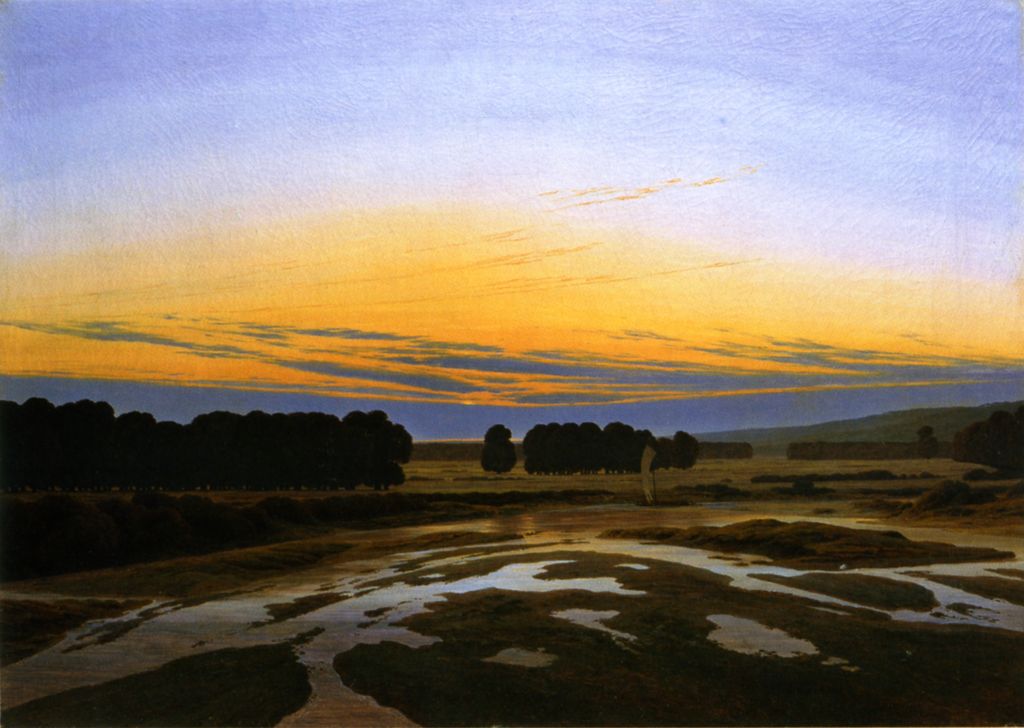
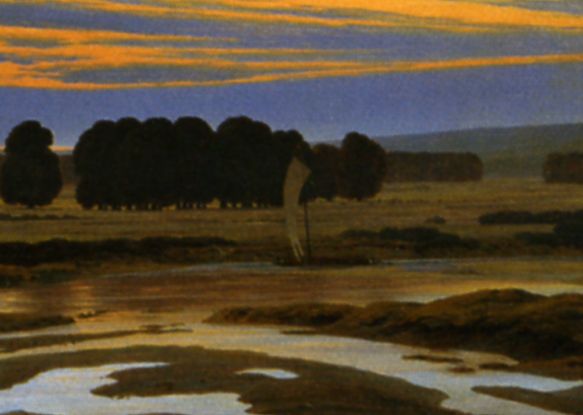
Thin channels of water catch the last light of the evening in Caspar David Friedrich’s The Grosse Gehege near Dresden. The nearest strips of ground seem to rise towards us, even as our view drops across them to the low tree line. A small sail appears just right of centre. The moment we recognise it as a working boat, a view that might have seemed immense enough to show the curve of the earth becomes a stretch of river that someone has to navigate. Friedrich painted this oil on canvas in 1832. It measures 73.5 by 103 centimetres and belongs to the Galerie Neue Meister at Dresden’s Albertinum, where it is catalogued as Das Große Gehege bei Dresden, Gal.-Nr. 2197 A. [1][2]
At a Glance
- Date · 1832
- Medium · Oil on canvas
- Collection · Galerie Neue Meister, Staatliche Kunstsammlungen Dresden
- Accession · Gal.-Nr. 2197 A
- Dimensions · 73.5 cm high × 103 cm wide
Contents
- Introduction
- The land inside the Elbe bend
- A low horizon and a foreground that rises
- What the drawings supplied
- A working boat at dusk
- The scale of the evening
- Annotated Details
- Image Details
The land inside the Elbe bend
The title refers to the Große Ostragehege, low ground on the Elbe downstream and northwest of Dresden’s historic centre. The name preserves a history that the canvas barely hints at. A court farm was established at Ostra in 1568 on ground that lay between the Elbe and the Weißeritz and was vulnerable to flooding. The Saxon court later used the area for a pheasantry and game park, and Dresden’s planning history traces the name of the enclosure to the fencing of the game park in 1696. The court’s park plans also brought formally planted avenues out from the city into the surrounding land. That history makes the regularity of the painted trees intelligible within a scene otherwise governed by the uneven spread of water. [1][3]
An 1813 map reproduced by the Dresden museum shows the broader extent of the old riverbanks and the route of the linden avenue known as Pieschener Allee. Carl August Richter’s 1824 circular panorama from the Frauenkirche gives a different sort of evidence. It sets the enclosure inside the bend and shows its proximity to a city whose towers are absent from Friedrich’s canvas. The panorama has a named point of observation, high above Dresden. In the painting we get a wide sweep of country and an elevated view of the flooded surface, with few clues about where we ourselves could be standing. The comparisons explain both the character of the place and the difficulty of turning the canvas back into a view on a map. [2][3]
The view across the river from Pieschen still gives a sense of how the avenue sits in the floodplain. Albertinum curator Holger Birkholz uses that position in the museum’s digital study to compare the breadth of the actual landscape with the compressed breadth of the painting. He also points out that the setting sun, from the area under discussion, would lie farther west towards Radebeul than Friedrich places it. Later engineering complicates any comparison with the scene today. In the 1890s the mouth of the Weißeritz was moved, a harbour was built and a flood channel was cut at Friedrichstadt. Even a photograph from the approximate area therefore records a landscape whose watercourses have been substantially reshaped since Friedrich’s time. [2][3]
A low horizon and a foreground that rises
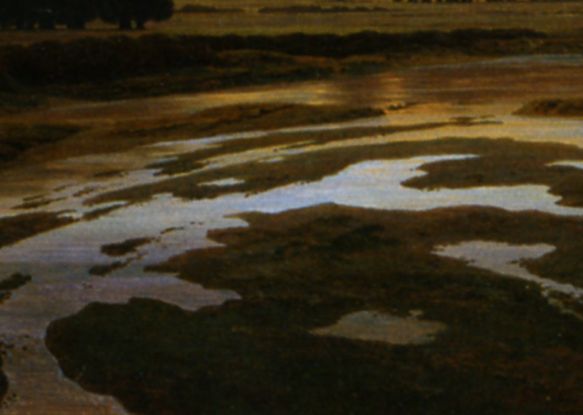
Look first at the bottom edge. Dark stretches of ground run out of the frame, giving the impression that the same shallow pattern continues below us. The water forms long, tapering shapes, broad near the lower edge and slender where it threads between higher patches. A band of water coming in from the left leads inward before the pale shapes spread again to the right. Some of those shapes could be read as holes or gaps in a single surface. Then the colour of the sky appears in them and they become glimpses of the same evening light at different depths in the picture. [1][2]
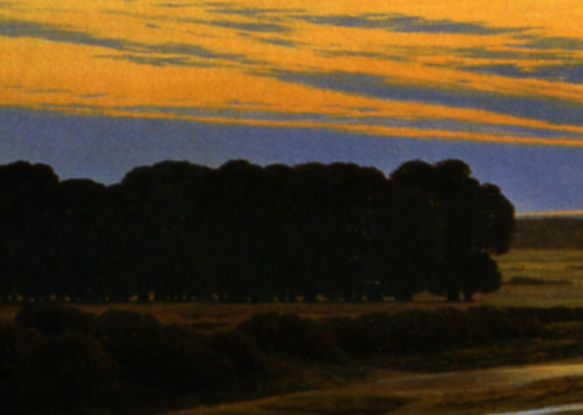
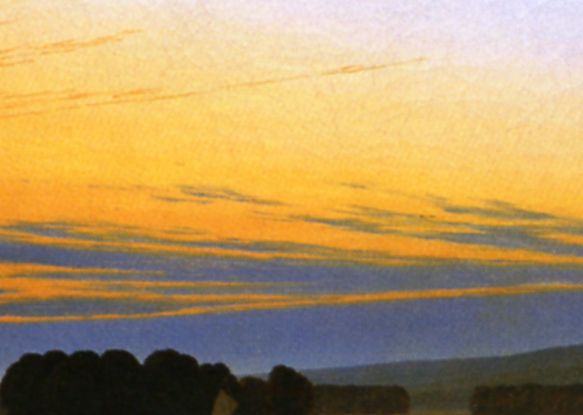
The tree line helps us tell near from far. At the left, the crowns form a dark, close-set rank. Farther across, gaps break the trees into distinct groups, and behind them the low rise on the right is cool enough in colour to seem farther away. Across this narrow interval Friedrich shifts from trees large enough to distinguish to a hillside whose outline carries more weight than any feature on it. Above it, long ribbons of cloud sweep in from the sides and thin near the middle. The viewer’s eye can move straight across the trees, follow the river into the distance or lift along the cloud bands. Each route gives a different sense of the space. [1][2]
The apparent curvature belongs to several parts of the picture. The horizontal belt of land is narrow, but the edges of the water sweep towards it from below and the clouds arch above it. The Dresden digital story relates the shapes in the land and water to paired hyperbolic arcs. In his account of Werner Hofmann’s reading, Björn Billing describes the foreground as appearing to bulge towards the viewer while the sky bows away. This is easiest to see by looking at the painting from far enough back to take in both zones at once. The edges of the ground seem to expand out of the picture even as the middle distance draws the eye in. A wide-angle image offers a modern analogy for that sensation. The visible evidence for it is in the painted relationships between the banks, clouds and low horizon. [1][2][4]
What the drawings supplied
Friedrich made the studies associated with the painting in 1804, twenty-eight years before the date on the museum record for the finished canvas. The institutions that acquired his Karlsruhe Sketchbook identify it as a source for The Grosse Gehege. Dresden’s digital comparison highlights sketches of tree rows, a barge and a low hill and places the motifs against the corresponding parts of the oil. The trees offer a particularly clear way of seeing what was portable. A drawn row preserves differences in height and intervals between crowns. In the painting those features can organise distance within an invented arrangement of land, water and sky, regardless of where a particular set of trees first caught Friedrich’s eye. [1][2][5]
The evidence for the vessel is more specific. In her study of Friedrich’s ships and boats, Sabine Cibura identifies a detailed 1804 drawing of an Elbe barge under sail, catalogued as Grummt 400 verso, as a model for the painted vessel and credits Mayumi Ohara with making the connection. The drawing records a timber load and gives close attention to a kind of square sail that Friedrich studied in several positions. At the scale of the painting, the sail still has a shape particular enough for the museum to recognise the vessel as a Kaffenkahn, a cargo barge common on the Elbe. The comparison lets us see why a type of boat studied in detail could remain legible in a passage where the banks and trees take up so much more space. [2][6]
A working boat at dusk
Around 1830, Carl Heinrich Beichling and Curt Victor Grohlig depicted the Dresden landing place known as the Packhof. Their etching, reproduced in the museum’s digital study, puts a barge at the bank among buildings, people and other craft, with the enclosure in the distance. Friedrich knew the same kind of traffic from the landing in front of his home at An der Elbe 33. Such boats carried timber from Saxon Switzerland and vegetables from Bohemia. He gives the boat in his canvas very little space, but the familiar rig is enough to put the reach of river within that network of work and trade. The adjoining planted avenues register another kind of human presence, even with the city itself beyond the edges of the picture. [2][6]

An early print gave the image a different emphasis through its title. The Hamburger Kunsthalle holds Philipp Veith’s Evening on the Elbe, after Friedrich, in an impression catalogued to 1833–36. Its date range belongs to the print, and the Kunsthalle’s account explains that the Saxon Art Association’s annual portfolios could be reprinted for later members. The print title directs attention to a passing hour and to the river as a whole, whereas the collection title of the oil names one reach of the landscape. Dresden acquired the canvas from Ella von Nostitz und Jänckendorf in 1909. [1][7]
The scale of the evening
In the Dresden collection essay, Gerd Spitzer reads the scene as a series of transitions. The last of the day’s light hangs above the darkening earth, late summer approaches autumn, and the boat’s progress seems to slow among the shallow patches. The reading depends on what we can see at different speeds. A sweep of gold over the sky gives the hour almost immediately. The suggestion of a season takes longer to gather from the muted green and brown of the ground. Longer still is the search for the boat and for a stretch of clear water through which it might continue. [1]
The difficulty of fixing our viewpoint has also given the picture a place in modern arguments about how we see the Earth. Bruno Latour discussed it in Facing Gaia (2017), where its unstable perspective served his argument about the limits of a view that claims to take in the world as a whole. Billing connects that reading with the way the foreground changes scale depending on where we look. Seen alone, the network of water and ground could suggest a view from much higher up. Look back at the boat and the trees, and the sizes become ordinary again. The canvas lets both impressions persist in the same view. [2][4][8]
Annotated Details from The Grosse Gehege near Dresden
Use the numbered details to trace how Friedrich arranged the forms and light in this painting.
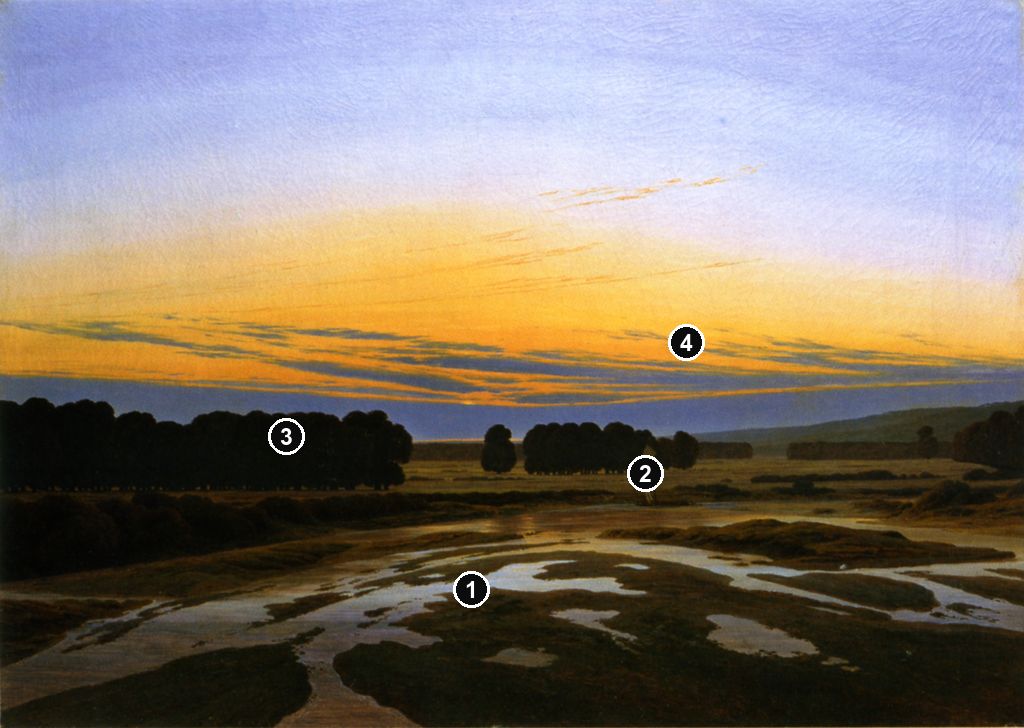
Details from THE GROSSE GEHEGE NEAR DRESDEN
The detail crops show parts of the painting at a larger scale.
Water in the floodplain
Shallow pools reflect the bright sky and break up the darker ground.
The vessel
A small sail rises just above the low ground. Its scale is easy to miss against the wide sky.
Trees on the horizon
The nearly continuous bank of trees gives way to smaller groups near the middle.
Bands of sunset colour
Long, low clouds interrupt the yellow light above the distant land.
Frequently Asked Questions
Discussion
When did you first notice the sail in the distance?
Reader Insights
How do the pools lead your eye across the foreground?
When did you first notice the sail in the distance?
How does the view of the ground differ from the view of the horizon?
How do the pools lead your eye across the foreground?
Join the Conversation
Share what you noticed in The Grosse Gehege near Dresden.
References
- Staatliche Kunstsammlungen Dresden, Das Große Gehege bei Dresden, Albertinum, Gal.-Nr. 2197 A, with an object essay by Gerd Spitzer. View source.
- Staatliche Kunstsammlungen Dresden and anniversary partners, Air and Light by Caspar David Friedrich, including the historical views, drawings comparison and Holger Birkholz’s account. View source.
- City of Dresden, Geschichte und örtliche Situation, planning history of the Ostragehege. View source.
- Björn Billing, “Zooming Out to the Anthropocene,” pp. 30–32, including the discussion of Werner Hofmann’s analysis and figure 1.5. View source.
- Stiftung Preußischer Kulturbesitz, acquisition account for the Karlsruhe Sketchbook, 12 July 2024. View source.
- Sabine Cibura, Die Schiffe und Boote im Werk von Caspar David Friedrich, 2019, pp. 102–103. View source.
- Hamburger Kunsthalle, Philipp Veith after Caspar David Friedrich, Abend an der Elbe, inv. 72037, German catalogue entry in the anniversary chronicle. View source.
- Bruno Latour, Facing Gaia. Eight Lectures on the New Climatic Regime, 2017, translated by Catherine Porter. View source.