


 by Tom Gurney
Tom Gurney BSc (Hons) is an art history expert with over 20 years experience
Email: tomgurney1@gmail.com / Phone: +44 7429 011000
Introduction
A row of church towers on the Baltic plain, a memorial spring outside Copenhagen and a pair of windows overlooking the Elbe mark three places where Caspar David Friedrich learned to look at landscape. He grew up in Greifswald, trained at the Royal Danish Academy of Fine Arts from 1794 to 1798 and settled in Dresden in the autumn of 1798. The order is simple, but the work runs back and forth between those places. A view drawn on a visit home could become a painting years later. A river seen every day from a Dresden studio could furnish material for a picture of polar ice. The works show what Friedrich kept of a place, even when he changed nearly everything around it. [1][2][3]
At a Glance
- Greifswald · Birthplace and early drawing instruction
- Copenhagen · Academy training from 1794 to 1798
- Dresden · Home from 1798
Contents
- Introduction
- Greifswald and the country around it
- Copenhagen at Charlottenborg and beyond
- Dresden’s galleries, exhibitions and riverbank
- Two kinds of drawing on one Copenhagen sheet
- A familiar town approached over imagined water
- Two ruins assembled from journeys
Greifswald and the country around it
Friedrich was born in Greifswald on 5 September 1774, when the town belonged to Swedish Pomerania. His father made soap and candles. The local university provided the setting for his first instruction in drawing through Johann Gottfried Quistorp, its drawing master and an architect. Friedrich began lessons with him around 1790. Quistorp taught him to draw outdoors and to make architectural drawings, and helped him on his way to the academy in Copenhagen. The two kinds of work gave a young draughtsman different tasks. A building called for attention to the way its parts fitted together. In the open country, the first question could be where to stand to see those parts at all. [1][3][4]
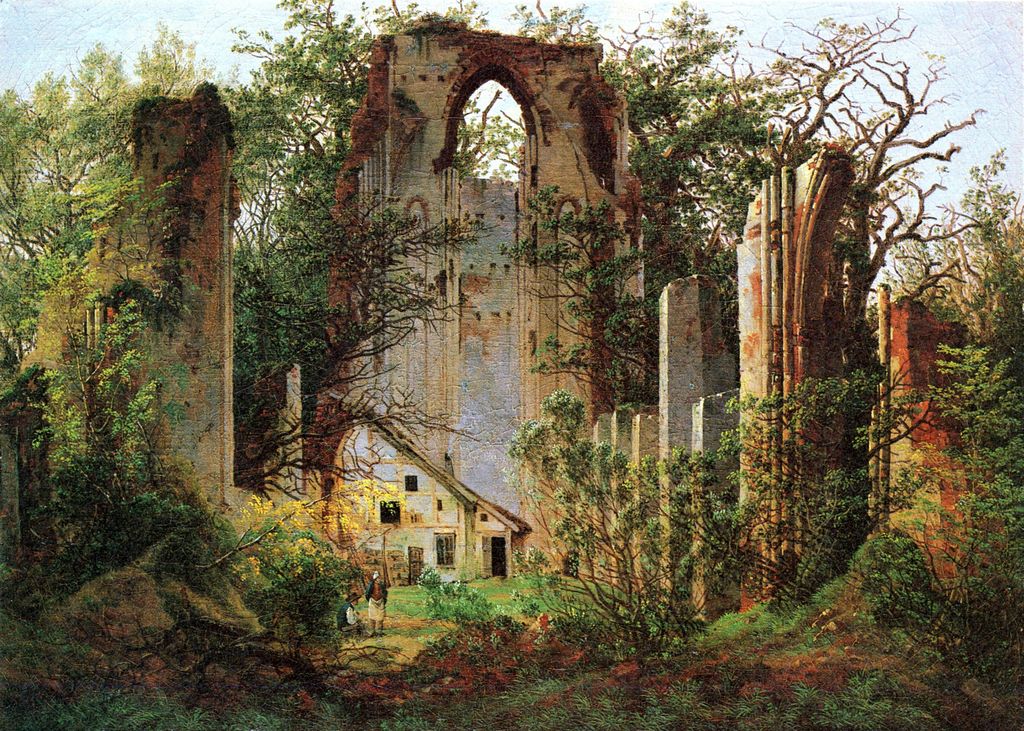
The ruined Cistercian abbey at Eldena, a few kilometres from town, brought those tasks together. Its surviving walls offered elevations and apertures that could be drawn precisely, but the effect of those forms depended on whether Friedrich faced the building from outside or looked across the former church interior. The Nationalgalerie’s essay on the 1824/25 painting of the ruins places his early interest in the site tentatively in the years of Quistorp’s instruction. The connection becomes firmer with a study from about 1803. It supplied the later painting’s view of the west wall from inside the church. The blocked window gives the wall a recognisable profile, and the apparent weight of the ruin comes partly from seeing that wall across the space it once enclosed. [5]
The town itself presented a different problem. Friedrich’s Meadows near Greifswald of 1821/22 has a wide belt of pasture with three horses and a city reduced to a thin line in the distance. An upright steeple or a difference in the height of a roof is enough to make a building legible at that scale. The Hamburger Kunsthalle connects the skyline to a drawing from the west, probably made around 1806, that Friedrich divided into squares to help transfer the outlines. The museum identifies the same source in Greifswald in the Moonlight. Friedrich kept the low outline that identifies the town, even as he changed the light and the country in front of it. In the meadow painting he replaced the drawing’s cow with a grazing horse and added two more in motion. [6]
Friedrich could make the buildings barely discernible without making them interchangeable. From the meadows he gave the intervening ground room to stretch, and the towers break the horizon like a series of fine marks. In the watercolour View of Greifswald, the town sits off to the left and the masts of a sailing vessel on the right carry some of the visual weight the towers bear in the oil. The river Ryck supplies the foreground, and its blue is graded to give a sense of distance across the water. The comparison shows how much the approach to Greifswald mattered. A city encountered across pasture and a city approached from its river called for different ways of organising the view. [6]
Dresden remained Friedrich’s base after 1798, but the north continued to be part of his working life. He was in Greifswald in May 1801, when the painter Philipp Otto Runge visited him, and made drawing trips to the Baltic island of Rügen that year and again in 1802. Finished wash drawings based on the island’s coast then reached audiences in Dresden and Weimar. Those journeys explain why a Baltic subject in the exhibition room need not be a record of a recent excursion. A sketch made near home could wait years, as at Eldena, or become one of a group of finished works made for viewers who had never seen the place. [2][3][5]
Copenhagen at Charlottenborg and beyond
Quistorp’s pupil entered a different kind of school in 1794. The Royal Danish Academy occupied Charlottenborg Palace on Kongens Nytorv. Its former ceremonial hall housed casts of antique statues and busts for students to study. Friedrich began in freehand drawing, progressed to work from plaster casts and entered the class drawing from the living model on 2 January 1798. A cast offered a fixed pose, so that the student could return to a difficult contour or check a proportion. The model made the same demands for precision while bringing the problem of drawing a living body into the room. These were four years of formal training whose stages can be traced independently of Friedrich’s later career in oil painting. [1][4][7]
The academy also put Friedrich within reach of artists who gave landscape different kinds of attention. Nicolai Abraham Abildgaard, a history painter who taught at the academy, also designed objects and monuments. Jens Juel was a portraitist as well as a painter of landscapes. Both are relevant to a small 1797 watercolour in the Hamburger Kunsthalle, Emiliekilde near Copenhagen. Count Ernst Schimmelmann had the spring built in the grounds of Sølyst north of Copenhagen as a memorial to his first wife, Emilia. Abildgaard designed it, and Juel painted it in 1784. Comparing the two works offers a more specific account of Friedrich’s exposure to Danish art than a list of professors. Both depict the same monument, but the painters differ in where they position the viewer and how much they make of the surrounding grounds. [4][8][9]
Juel presents the monument almost frontally. Friedrich approaches from the side, where the masonry takes up less of the view and the slope and vegetation command more of it. Friedrich’s sheet has sometimes been judged by how accurately they present the structure. In the Hamburg catalogue essay, Peter Prange argues that the omission of the park’s orderly character matters in its own right. The fence appears to be deteriorating and the vegetation looks unmanaged. Friedrich’s watercolour lets the viewer discover the monument among those details. Even in a small work made during his training, moving the vantage point could change which part of the scene held attention. [8]
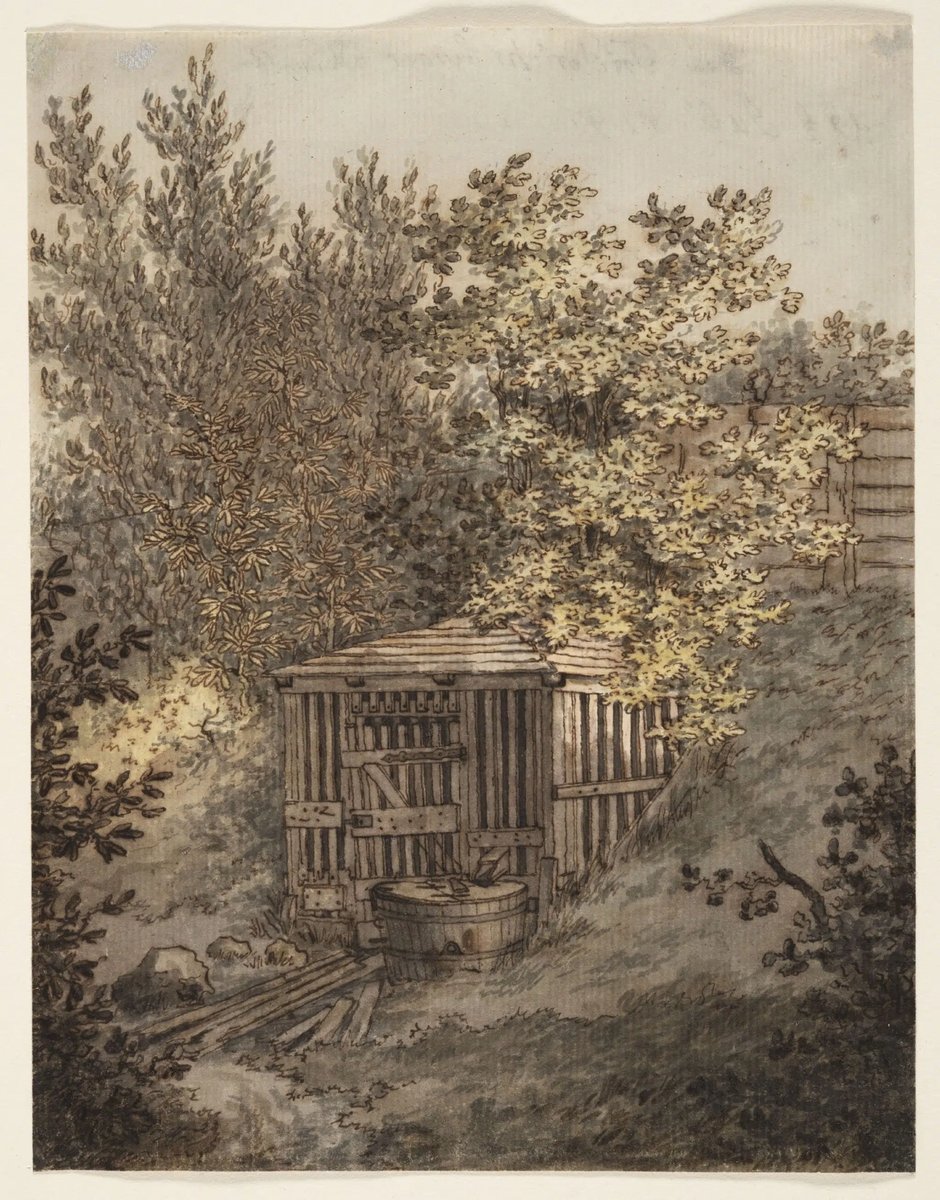
He also made two views of the Frederiksberg spring on 9 and 12 July 1797. One survives in the Dresden Kupferstich-Kabinett, drawn in brown ink and watercolour with traces of pencil. It belongs to the same summer as the Emiliekilde sheet, whose grey wash and dark pen lines describe a different spring. The group gives a view of his drawing practice beyond the prescribed sequence of the academy. The kind of close attention he applied to a cast or an architectural detail could be applied outdoors to the relationship between built stone, steep ground and foliage. The place where the eye rests depended as much on the approach to the spring as on the design of the structure. [4][8][10]
Copenhagen remained part of his professional world through people who also crossed the Baltic. The Danish artist Johan Ludvig Lund, a friend from his student years, arrived in Dresden in 1799. Johan Christian Dahl came to Dresden in 1818 after studying at the Copenhagen academy in a later generation. Friedrich and Dahl soon knew one another as working landscape painters. By 1823 they lived in the same building on the Elbe. The Danish years therefore belong to the history of Dresden’s artistic community as well as to Friedrich’s own education. [3][11]
Dresden’s galleries, exhibitions and riverbank
Dresden offered Friedrich both an audience and pictures to study. He first showed work in the academy’s annual exhibition in March 1799. Around 1800 he drew small figures from Netherlandish paintings in the Dresden Picture Gallery and copied a group of rocks from a landscape by Nicolaes Berchem. One drawing shows him isolating the figures that give a landscape its scale and human activity, and the other shows him attending to a rocky form within an older painting. The gallery could serve as a place to study what other painters had made of the same sorts of elements he went out to draw in Saxony. [2][3]
The rooms where Friedrich worked could also become exhibition spaces. At Christmas 1808 he showed Cross in the Mountains in his Dresden lodgings. The painting, known as the Tetschen Altar, placed an outdoor scene with a crucifix inside an elaborate altarpiece frame. The studio display gave visitors a chance to see that combination in the room where Friedrich worked. Later, the academy made Friedrich a member in 1816 and appointed him professor on 17 January 1824. He did not receive charge of the landscape class. The Staatliche Kunstsammlungen Dresden documents a setting for teaching that the academy title alone would miss. Friedrich and Dahl both received pupils in their own studios at An der Elbe 33. [1][3][4][11][12][13]
Friedrich had already drawn the Elbe from two studio windows around 1805–06. Both sepias are in the Belvedere in Vienna. The left window shows an oblique view towards the Augustusbrücke. In the sheet for the right window, the view turns away from the bridge. Each opening makes a small picture of the same stretch of river within the larger drawing. In Georg Friedrich Kersting’s 1811 portrait of Friedrich at work, the window admits light to the spare studio beside the painter and his easel. Taken together, the drawings and the portrait show how little separated the place where Friedrich worked from a subject that kept returning to his pictures. [14]
The river is just outside the room in Woman at a Window of 1822. Friedrich and his family had moved to An der Elbe 33 in 1820. In the painting his wife Caroline stands at the open studio window, where a mast and the tops of poplars suggest the water and the opposite bank. Floorboards and shutters make the interior measurable by comparison, while the narrow opening leaves the distance to the far shore harder to judge. Friedrich showed the painting at the Dresden Academy that year. Anyone familiar with the river traffic could bring a fuller view of the Elbe to the fragment he allowed into the frame. [3][15]
Other Dresden works make the same river almost unrecognisable. During the severe winter of 1820/21, the Elbe froze, and Friedrich made three surviving small oil studies of ice floes, probably on the spot. In The Sea of Ice of 1823/24, forms related to those observed fragments rise in slabs large enough to dwarf a ship. The local ice gave him angles and colours that could be examined at close range. The finished scene puts those forms on a scale the Dresden riverbank could never have supplied. [16]
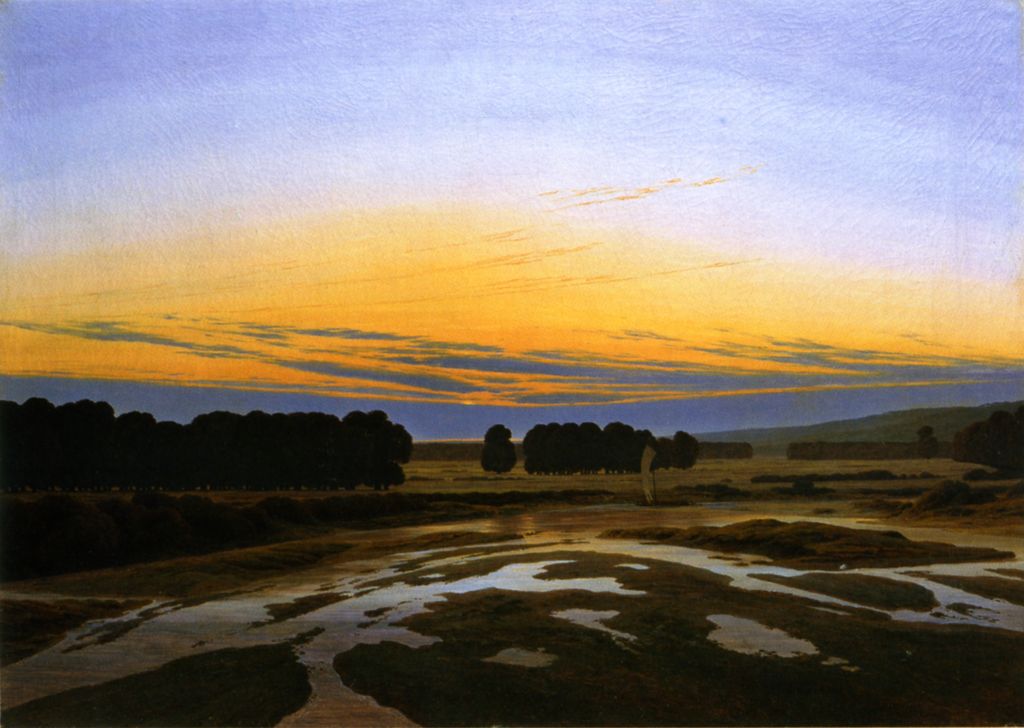
Friedrich could also paint the Elbe as a recognisably Saxon landscape while taking liberties with the view. In The Grosse Gehege near Dresden of 1832, a small barge crosses a bend downstream from the city. The square sail belongs to a kind of working vessel that landed near his house. The surrounding floodplain draws on local studies from 1804. The historical maps and views assembled by the Albertinum fix the enclosure west of the city, but the finished painting asks the eye to look down over the floodwater and out across an immense sky from a viewpoint that is hard to place. Friedrich even shifted the position of the sunset relative to the real view. [17]
Greifswald’s towers stay recognisable at a distance. Copenhagen’s monument becomes less imposing when approached from the side. In Dresden, a working sail identifies the river even when the reach of the landscape seems to exceed what a person could take in at once. Each work gives the viewer some feature of a place to hold on to. Which feature does that work, and what surrounds it, depends on where Friedrich wants the viewer to stand. His biography follows the journeys between those places and the wider course of his career. [3][6][8][17]
Two kinds of drawing on one Copenhagen sheet
A small sheet in the National Gallery of Denmark preserves a seated male model in pencil on one side and a landscape with a drawbridge and ruin in moonlight on the other. The museum dates both to Friedrich's years of training. The study of the model measures only nine by thirteen centimetres. A sheet of that size puts a premium on which lines the student chooses to keep. It can hold the general balance of a pose and some indications of volume without requiring the extended finish possible on a larger academy drawing.[18] [19]
Turn to the landscape side and the small scale presents a different problem. The drawbridge gives an approach to the ruin, and the moonlight distinguishes parts of the building from the surroundings. The eye needs to be able to separate the constructed object from the ground and water around it. On the model side the central relationship is between the body and the support on which it sits. The same material object thus preserves two different ways of deciding where contour and shadow should do the work of describing space.[18] [19]
The sheet adds physical evidence to the academy chronology. The sequence of classes records what Friedrich was permitted to study and when. The drawings show the variety of subjects he had in hand during those years. The dates are broad enough that they do not determine which side came first or the setting in which every stroke was made. Keeping those questions open still allows the paper to show something quite specific. Study of the figure and interest in the atmosphere of a ruin could coexist very early in his practice, before the large oils for which those ruins later became famous.[4] [18] [19]
A familiar town approached over imagined water
The version of Greifswald in Moonlight in Oslo brings the skyline into a setting the Met describes as topographically impossible. The profile is seen from a direction available from land, but Friedrich put water in front of it. The fishing details, drawn from observations along the coast, help give the invented approach a practical character. A person looking at the picture can recognize activity that belongs to the region and use it to imagine a route towards the town that the actual terrain would not provide.[6] [20] [21]

The church of St Nicholas gives the small picture a particularly exact point of contact with Greifswald. The steeple crosses the moon and helps locate the centre of the distant scene. The Met notes that Friedrich was baptized there and that the church was dedicated to the patron saint of sailors. Those circumstances make the choice of landmark intelligible within the painter's life and the coastal setting. The effect in the picture also depends on the line made by the steeple against a bright disc, a relation that is quite different from the place it takes among the thin shapes in the meadow view.[6] [21]
Seen with Meadows near Greifswald, the nocturne shows how one feature could be used to establish place under very different conditions. A pasture permits a broad foreground and moving animals close to the viewer. The water makes room for a marine foreground of boats and gear. In each work the town is distant enough that a few taller structures carry much of the information needed to recognize it. The land and the water offer different experiences of approaching the same outline. The familiar silhouette gives a viewer a way to notice those differences even without having been to Greifswald.[6] [20] [21]
Two ruins assembled from journeys
Friedrich's excursion to Oybin with Kersting in July 1810 took him to the remains of a Celestine monastery in Upper Lusatia. He drew a view into the sacristy chapel in pencil and watercolour. In the subsequent oil Ruins at Oybin, the narrow openings increase the impression of height. Markus Bertsch also identifies additions that give the chapel a more explicit religious use, including a crucifix, an altar and a sculpture of the Virgin and Child. The comparison with the study shows which parts of the place Friedrich had encountered and where he decided to intervene.[22]
The wall at Oybin could then be put to work again. In Hutten's Tomb the underlying architectural view survives within a composition centred on an imagined monument. A spectator who knows the study can trace the persistence of the chapel even when the picture's subject has changed. The journey supplied a set of relations among openings, masonry and ground. Those relations could give different subjects a believable location. They were valuable because they could be used in new settings as well as because they offered evidence of what Friedrich saw that summer.[22]
The late Ruins of Eldena Abbey in the Giant Mountains brings that practice back to Greifswald. The Pommersches Landesmuseum's Birte Frenssen identifies the Pomeranian ruin in front of a mountain skyline drawn on the 1810 journey and reversed in the oil. She also connects the man with his dog to a dated study made in September 1824 in the country between Dresden and Meissen. The western window of the abbey, partly blocked in Friedrich's time, is open in the painting. A viewer can look through a recognizable piece of his home region towards a range that belongs to a different journey.[23]
There is also a connection in the other direction. Frenssen records that the painting passed to Friedrich's older brother Adolf in Greifswald. A work made by bringing material from several places together returned to the place most immediately identifiable in its architecture. Oybin and Eldena show why it is useful to keep the provenance of a work, its sites and the dates of its studies in view at the same time. For Friedrich those histories can intersect in a single painting without all beginning in the same city.[22] [23]
Frequently Asked Questions
Discussion
How does Friedrich rearrange the site of Eldena Abbey?
Reader Insights
How is the Elbe valley arranged in The Grosse Gehege?
How does Friedrich rearrange the site of Eldena Abbey?
Where does his Copenhagen training show in the drawings?
How is the Elbe valley arranged in The Grosse Gehege?
Join the Conversation
Share what you noticed in Greifswald, Copenhagen and Dresden.
References
- Greifswald, Friedrich biography and local chronology
- The Metropolitan Museum of Art, Caspar David Friedrich: The Soul of Nature, exhibition sections
- Hamburger Kunsthalle, Staatliche Museen zu Berlin and Staatliche Kunstsammlungen Dresden, works and biography chronicle
- Institut für Sächsische Geschichte und Volkskunde, Sächsische Biografie, Caspar David Friedrich
- Staatliche Museen zu Berlin, Klosterruine Eldena bei Greifswald
- Hamburger Kunsthalle, Meadows near Greifswald
- Royal Danish Academy of Fine Arts, history of the Charlottenborg cast hall
- Peter Prange, Hamburger Kunsthalle, Emilias Kilde bei Kopenhagen
- Bakkehussamlingen, Nicolai Abildgaard
- Staatliche Kunstsammlungen Dresden, Frederiksberg Spring near Copenhagen
- Staatliche Kunstsammlungen Dresden, 2015 annual report, p. 14, Friedrich and Dahl in Dresden
- Städel Museum, Friedrich artist record
- Staatliche Kunstsammlungen Dresden, Das Kreuz im Gebirge (Tetschener Altar)
- The Metropolitan Museum of Art, Rooms with a View, catalogue entries 24, 42 and 43
- Birgit Verwiebe, Staatliche Museen zu Berlin, Frau am Fenster
- Hamburger Kunsthalle, The Sea of Ice
- Staatliche Kunstsammlungen Dresden, Air and Light by Caspar David Friedrich
- Statens Museum for Kunst, Siddende mandlig model, KKSgb6485 verso, dated 1795–98.
- Statens Museum for Kunst, Landskab med vippebro og ruin i måneskin, KKSgb6485, landscape on the other side of the Copenhagen sheet.
- Nasjonalmuseet, Loans inventory for 2024, Greifswald i måneskinn, NG.M.00387.
- Metropolitan Museum of Art, The Soul of Nature exhibition labels, Greifswald in Moonlight.
- Markus Bertsch, Ruins at Oybin, Hamburger Kunsthalle exhibition catalogue, 2023, p. 144.
- Birte Frenssen, Ruine Eldena im Riesengebirge, Pommersches Landesmuseum catalogue research.