


 by Tom Gurney
Tom Gurney BSc (Hons) is an art history expert with over 20 years experience
Email: tomgurney1@gmail.com / Phone: +44 7429 011000
Introduction
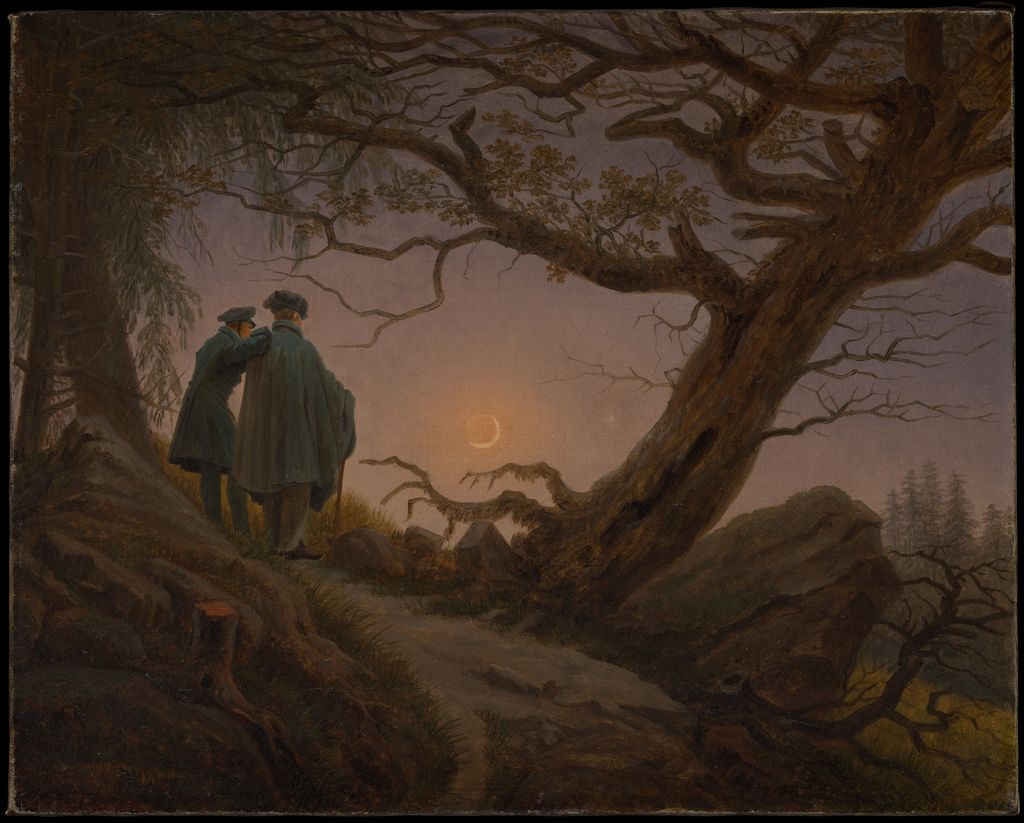
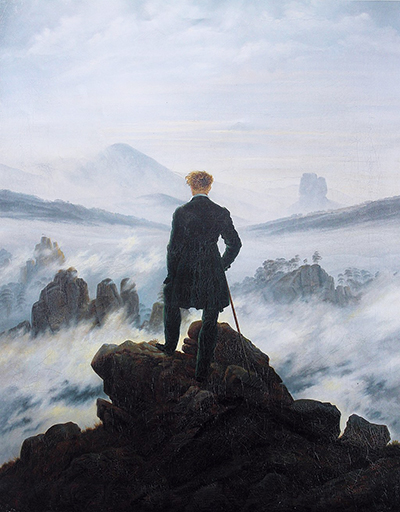
The man in Caspar David Friedrich’s Wanderer above the Sea of Fog has reached a place from which he can see across a mountain landscape. We see a dark coat where the middle of that landscape would be. In Two Men Contemplating the Moon, Friedrich sets the watchers to one side and leaves a small patch of sky open for the crescent they have stopped to watch. Both paintings use the Rückenfigur, the German term for a figure seen from behind. Where Friedrich places the body determines how far we can follow its gaze. [1] [2] [3]
Painters used rear-view figures before Friedrich to draw the viewer’s attention into a scene. As the art historians Alison Hokanson and Joanna Sheers Seidenstein point out, Friedrich made the figure itself a subject of attention. We can imagine standing where it stands, yet a large body in the middle of a painting can also come between us and the view. Looking at the figure and looking with it are two distinct experiences. We might pick out the crescent a figure has noticed or find our view stopped at the shoulder of someone who can see farther. [1]
At a Glance
- German term · Rückenfigur, a figure seen from behind
- Landscape examples · Wanderer above the Sea of Fog and Two Men Contemplating the Moon
- Interior example · Woman at a Window
Contents
- Introduction
- A figure in the way
- The distance across a room
- A view shared by two
- A shore without a destination for the eye
- What a turned body can tell us
- Three ways to look from the same cliff
- An almost reclining figure on Rügen
- The artist seen at work from behind
A figure in the way
In the Hamburger Kunsthalle’s Wanderer above the Sea of Fog, painted around 1817, the foreground rock rises to meet the man almost at the centre of the canvas. His boots and walking stick establish firm contact with that rock. The flanks of the more distant mountains angle towards the same middle, as Markus Bertsch observes, so the movement of the land brings the eye back to the person who interrupts it. We can look past him on both sides and see peaks standing clear of the fog. The contours that would join those peaks are largely hidden, some by mist and others by his body. [2]
The dark coat is easier to read than the ground immediately beyond it. Try tracing a route from the foothold to any one of the outcrops in the mist. The near ledge gives you an exact starting point, but the painting supplies very little continuous ground on which to make the journey. It gives the wanderer a place where he can stand and gives us several directions in which to look. The way from one to the other has to be imagined. [2]
Bertsch identifies a drawing of rocks at the Kaiserkrone as the source for the man’s perch and other studies as sources for formations elsewhere in the canvas. The painter assembled terrain from separate observations. The figure gives the resulting landscape the appearance of a prospect encountered from a single spot. We can infer that the man looks out over the fog, while the view affords no single destination for his eyes comparable to the moon in the nocturnal painting. A defined place to stand and an indefinite place to look are part of the same design. [2]
The distance across a room
Woman at a Window, painted in 1822, also puts a body in front of a view. Here the distance between our apparent position and the figure is described by floorboards. Their seams lead from the bottom of the canvas to the wall, and the verticals of the window concentrate the view at the far end of the room. Friedrich’s wife Caroline leans towards the opening. The slight shift of her body gives the straight lines of the room something to register against. Her position is exact enough that you can imagine the step it would take to stand beside her. [4]
That step would change the view substantially. From inside the room we see a slice of the far bank and a ship’s mast, with more sky showing above. The wall cuts off the view on either side and Caroline’s head and shoulders occupy part of the lower opening. The mast is enough to suggest a vessel whose hull is outside the visible strip. The wanderer’s coat obscures a portion of a panorama that continues on both sides of him. In the studio, the architecture has already narrowed the panorama before Caroline comes into it. Only in imagination can we shift sideways to find out how much more of the river she sees. [2] [4]
Akane Sugiyama traces this window motif back to Friedrich’s paired sepia views from his Dresden studio, made in 1805 or 1806. In the right-hand view he appears only in a fragmentary reflection in a mirror. Sugiyama reads the pair as an indirect way for Friedrich to represent himself through the studio and the scenes visible from it. The later oil makes the human presence much more conspicuous, filling part of the window with Caroline’s back. Seen alongside the earlier drawing, the painting makes clear how much the window can do on its own. It gives looking a place and a direction. Caroline adds the sense that someone already occupies that place and has a view of her own. [4] [5]
The Alte Nationalgalerie quotes an 1822 reviewer who praised the rendering of the studio and its outlook but objected to Friedrich’s habit of showing people from directly behind. To that reviewer the turned pose was conspicuous enough to spoil an otherwise persuasive view. Hokanson and Sheers Seidenstein see the window picture as suggesting distance from the natural world and a longing for it. There is room for that reading in the design. The floor and sill bring Caroline within reach of the spectator, while the portion of the outdoors visible past her remains small. [1] [4]
A view shared by two
In the Met’s Two Men Contemplating the Moon, the crescent is visible apart from the watchers. The pair stands well to its left. The dark ground climbs towards their feet, and the oak arches into the sky from the other side. The space between the caps and the trunk contains the little arc of light. The men’s orientation leads the eye to a point that the painting lets us find for ourselves. Their relative position matters as much as the direction of their gaze. One man leans on the other’s shoulder, making their contact legible even at the scale of a small painting. [3] [6]
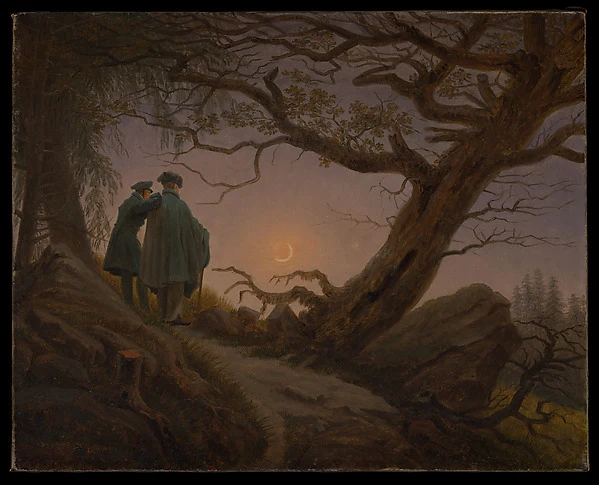
Compare the earlier Dresden canvas, dated 1819–20 by the Staatliche Kunstsammlungen Dresden, with the Berlin variant Man and Woman Contemplating the Moon, about 1824. In Dresden the two men give the group an inclined outline, with a sloping upper body beside a more upright one. In Berlin the woman’s skirt lengthens the silhouette down to the path and the pair stands more nearly upright. The moon remains apart from the figures. Friedrich could change the sense of how two people stood together while leaving the location of their shared attention substantially intact. Hokanson’s reading of companionship is particularly persuasive at this level, where the relation between the bodies is visible even though their faces are turned away. [6] [7] [8] [9]
The names that have been attached to these figures carry different degrees of certainty. Berlin identifies the woman in the studio as Caroline. Its former director Eberhard Hanfstaengl proposed that the Berlin moonwatchers were Friedrich and Caroline. Sabine Rewald discusses the identifications of Friedrich and the younger painter August Heinrich in connection with the Dresden composition, while Hokanson and Sheers Seidenstein treat Friedrich’s own presence as a possibility. Bertsch finds no reliable indication of the wanderer’s identity. The position of a head and the cut of a coat can make a figure distinctive without supplying the evidence that would establish a likeness. [1] [2] [4] [6] [8]
A shore without a destination for the eye
Friedrich gives the figure in Monk by the Sea of 1808–10 very little of the canvas. The head rises only a short way into the dark band of sea and the body is silhouetted against the pale shore. Much of the surface is sky. The figure faces into the scene at an angle, and from so far away it is difficult to infer a precise direction of gaze. The title supplies a role for this lone figure. Friedrich, in a description of the painting cited by Birgit Verwiebe, calls him a man in black walking along the shore and follows the description with a meditation on what lies beyond human understanding. [10]
The shore and horizon extend laterally across the picture. There is no diagonal path like the one that leads towards the moonwatchers and no near wall like Caroline’s to establish a series of distances between viewer, figure and far shore. The small body does give the shore a human scale at one point. Once the eye leaves the figure for the sea, there is little of known size by which to judge how far the water extends. In the mountain painting, several emergent peaks help us read layers of distance despite the missing ground. The shore in Monk by the Sea gives way to water and air with few such bearings. [2] [6] [10]
An early viewer described the curious consequence of that arrangement. In October 1810 Heinrich von Kleist published his response to the painting, reworking a text by Clemens Brentano and Achim von Arnim. He wrote that he became the Capuchin and the picture became the dune, yet the sea he longed to look out upon seemed entirely absent. In his account, the identification and the frustration happen together. The lone figure can suggest how it feels to be there even when the painted expanse gives the viewer almost no means of imagining a passage into it. [10] [11] [12]
What a turned body can tell us
One way to see what Friedrich has done is to imagine each scene with the figure removed. The window would still frame a view, and the sea would still extend across the canvas. In the moonlit pictures, the oak would still frame the crescent, but there would be little reason to give such a small light the attention we do. The presence of the two men changes the relative importance of things already in the landscape. Even before we find the moon, we have seen two people stop to look. Friedrich leaves us close enough to read those relations and far enough away to wonder what the act of looking is like for the person in the painting. [1] [4] [9] [10]
Three ways to look from the same cliff
The three visitors in Chalk Cliffs on Rügen have reached the same opening between the trees. Their bodies suggest different accounts of what is worth looking at there. The woman on the left gestures downwards. The man in the middle puts his hands low and approaches the edge with his head near the ground. The man on the right stands back from that part of the opening, his body upright and his attention apparently farther out to sea. Johannes Grave reads this separation of views as one of the painting's central decisions. The spectator can take up more than one of the directions indicated by the three people.[13]
The distance between the bent man's head and the grass is easy to see. The depth below the grass is harder to read because the body approaches a point at which the foreground breaks off. Following his posture directs the eye towards an uncertain space very close to the painted group. Following the upright man's orientation can send it out across broad changes of colour on the water. There is no reason to suppose that either direction gives the spectator exactly what the corresponding person sees. The near grass and the outward view are both available in a way that their neighbours in the painting seem to experience separately.[13]
The distribution of the figures also makes a difference to the way the opening is framed. If all three were upright, their silhouettes could form an approximate barrier along the edge. The bent body occupies a lower band, leaving the distance above it open. The red clothing to the left places a strong accent near one side, while the darker figure at right is closer to the bordering tree. The eye can therefore move between different depths without having to negotiate a single dominant body at the centre. This is a different arrangement from Wanderer above the Sea of Fog, where the central figure is the most conspicuous feature between us and the distance.[2] [13]
Proposals that the cliff visitors represent Friedrich and members of his family have persisted, and the journey after his marriage gives the suggestions a biographical context. Grave notes the limits of trying to identify the people by their appearance. The angle of view gives little or no face, including in the woman's lost profile. Clothing and gesture carry some information. They can also be seen as choices about the kinds of encounter the picture puts side by side. One can recognize a difference in attention among the visitors with considerably more confidence than one can attach an individual name to each.[13]
An almost reclining figure on Rügen
The standing posture of the Wanderer has become so familiar that it can obscure how extensively Friedrich varied the position of a person seen from behind. In the surviving Woman on the Beach of Rügen at Winterthur, the figure is low and almost reclining. She shares the shore with an orderly succession of boats. Grave compares the painting with a lost work, formerly in Gotha, in which a woman waved a handkerchief towards a distant vessel. Photographs preserve evidence of the latter picture. The two works present different kinds of relation to activity at sea even though their general situation and format were closely related.[14]
A person waving gives a visible sign that can be followed across the picture. The spectator can ask which boat the woman means to reach and whether anyone on it might respond. In the surviving work the reclining posture allows the boats to remain a succession of forms moving through the landscape. The woman's body follows a lower direction, closer to the shore. Her position is compatible with watching what happens, and the visible boats do not depend on a sign from her for the coherence of their movement. The difference affects how much narrative a turned figure introduces.[14]
The picture is also an example of how a body can become part of the arrangement of a landscape without losing the feeling of a person at ease. Boats, shore and the long strip of distant cliffs establish directions that are readily visible even before the spectator works out what any individual is doing. The reclining woman sits within those directions. She gives scale to the shore and encourages a look out from it, while her pose has enough weight and extension to remain a feature of the shore itself. The sight of a body in this position changes where the viewer imagines the ground continuing at the lower edge.[14]
The comparison with the cliff painting is instructive. There, three people near a break in the terrain appear to allocate their attention differently. Here one person and several vessels give attention a slower route along the shore and out across the water. Neither a crowd nor a conspicuous destination is necessary for a figure to make looking into a subject. A small change of posture can alter whether the landscape seems to offer an invitation, a practical problem or an occasion to stay where one is.[13] [14]
The artist seen at work from behind
In May 1814 Friedrich included a pen sketch in a letter to the painter Louise Seidler. The Dresden Kupferstich-Kabinett identifies it as a self-portrait from behind, showing Friedrich drawing in the Plauenscher Grund. The date, recipient and circumstance make it a useful counterpoint to conjectural identifications in the oils. Here the context supplies a person even though the drawing uses an angle that withholds the face. It also supplies an activity. The turned figure is someone occupied in making a record of the place.[15]
The written message and the sketch can do different things together. A letter can tell its recipient who is speaking and give an occasion to the exchange. The drawing can show the relation between a person's posture and the work being undertaken outdoors. A picture hanging by itself needs other evidence to recover those circumstances. In the letter the turned body can be personal without relying on likeness in the ordinary sense. Its place in an exchange between two painters lets the gesture of drawing carry meaning that a spectator of an unsigned landscape would have more difficulty assigning.[15]
There is a complementary record by Dahl. His 27 March 1824 sheet from Oslo includes a standing figure identified as Friedrich and a second reclining figure. The Met exhibited it under a title identifying the latter as a draughtsman, while the Norwegian loan inventory records a title that describes a man fishing. The shared inventory number secures the identity of the sheet across these labels. The difference in wording shows how strongly a small bodily arrangement can suggest a task while still leaving room for observers to read the visible evidence differently.[16] [17]
Seen beside Friedrich's letter, Dahl's sheet gives the reversed view another relation to authorship. In one case Friedrich chooses to place his own back in the drawing and can use the accompanying words to establish the circumstance. In the other he is the subject of a colleague's observation. A drawn back can therefore record a particular person and a working relationship as readily as it can invite an anonymous spectator into a landscape. The question is what information survives around the visible pose. A date, inscription or recipient can establish things that the angle of the head alone leaves undecided.[15] [16] [17]

Frequently Asked Questions
Discussion
What can we see around the woman’s silhouette?
Reader Insights
How does the pair stand in relation to the moon?
What can we see around the woman’s silhouette?
Where does the painter place us in relation to the wanderer?
How does the pair stand in relation to the moon?
Join the Conversation
Share what you noticed in The Rückenfigur.
References
- Alison Hokanson and Joanna Sheers Seidenstein, “Friedrich and the Soul of Nature,” Metropolitan Museum of Art catalogue excerpt
- Markus Bertsch, Wanderer above the Sea of Fog, Hamburger Kunsthalle and Friedrich anniversary chronicle, HK-5161
- Metropolitan Museum of Art, Two Men Contemplating the Moon, 2000.51
- Birgit Verwiebe, Frau am Fenster, Alte Nationalgalerie, Staatliche Museen zu Berlin
- Akane Sugiyama, “Woher stammen die Fenster?”, Tokyo University of the Arts research repository, Aspects of Problems in Western Art History 20 (2022), pp. 37–49
- Sabine Rewald, with Kasper Monrad, Caspar David Friedrich: Moonwatchers, Metropolitan Museum of Art, 2001, catalogue entries 1–3, pp. 30–33
- Staatliche Kunstsammlungen Dresden, Zwei Männer in Betrachtung des Mondes, Gal.-Nr. 2194
- Birgit Verwiebe, Mann und Frau in Betrachtung des Mondes, Alte Nationalgalerie and Friedrich anniversary chronicle, A II 887
- Alison Hokanson and Joanna Sheers Seidenstein, “Alone Together,” Metropolitan Museum of Art audio guide
- Birgit Verwiebe, Monk by the Sea, Alte Nationalgalerie and Friedrich anniversary chronicle, NG 9/85
- Heinrich von Kleist, “Empfindungen vor Friedrichs Seelandschaft,” Berliner Abendblätter, 13 October 1810, Bibliotheca Augustana
- Freies Deutsches Hochstift, Brentano and Arnim’s manuscript on Friedrich’s seascape and Kleist’s revision
- Johannes Grave, Chalk Cliffs on Rügen, Hamburger Kunsthalle exhibition catalogue, 2023, p. 204.
- Johannes Grave, Woman on the Beach of Rügen, Hamburger Kunsthalle exhibition catalogue, on the surviving and lost canvases.
- Kupferstich-Kabinett, Staatliche Kunstsammlungen Dresden, Letter to Luise Seidler with a Self-Portrait Seen from Behind, 12 May 1814, C 1925-12.
- Metropolitan Museum of Art, The Soul of Nature exhibition objects, Dahl's Studies of a Standing Man (Caspar David Friedrich) and a Reclining Draftsman.
- Nasjonalmuseet, 2025 loans inventory, Dahl's Caspar David Friedrich; fiskende mann, NG.K&H.B.02726.