 by Tom Gurney
Tom Gurney BSc (Hons) is an art history expert with over 20 years experience
Email: tomgurney1@gmail.com / Phone: +44 7429 011000
Introduction
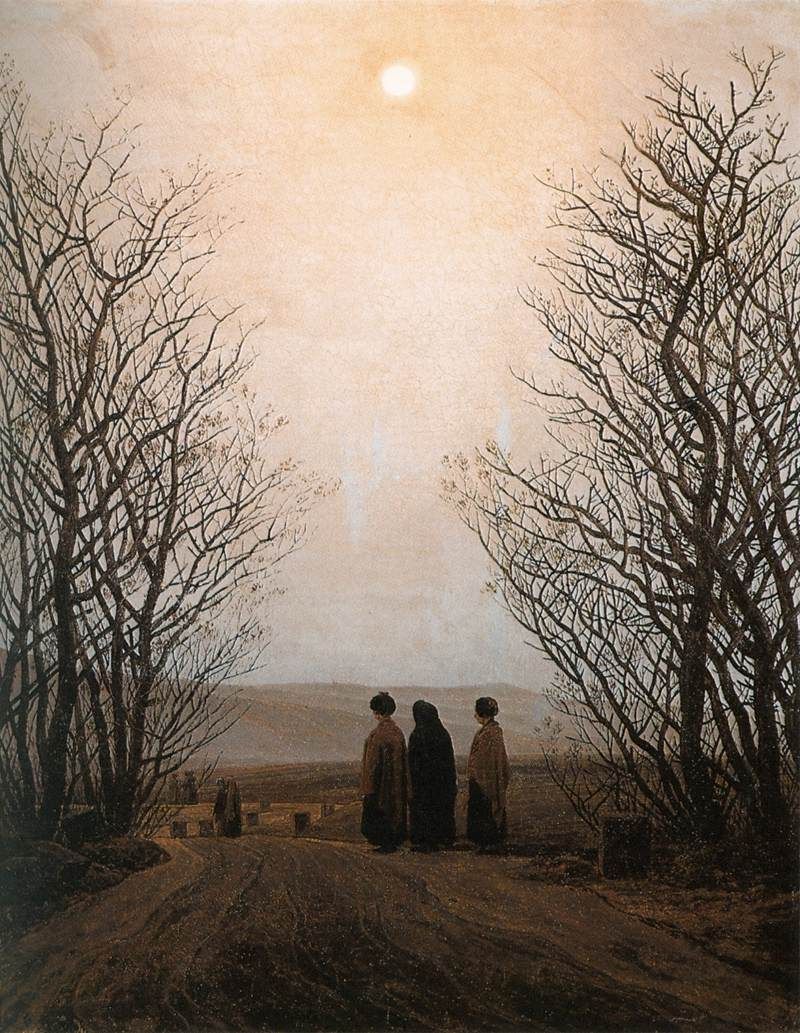
Three women stand at the right-hand verge of a broad dirt road. Ahead of them, smaller groups are already farther down the slope. Overhead a round moon is still visible, even as a cold light begins to reach the horizon. In Caspar David Friedrich’s Easter Morning, the eye can follow the road a little way into the fields before a bend takes it out of sight. Where the women are going has mattered to readers of the painting since at least 1859, when its owner Wilhelm Wegener described them as heading to a cemetery. [1][2]
At a Glance
- Artist — Caspar David Friedrich
- Titles — Easter Morning in English, Ostermorgen in German, Mañana de Pascua in Spanish
- Date and medium — About 1828–35, oil on canvas
- Dimensions — 43.7 cm high × 34.4 cm wide
- Collection — Museo Nacional Thyssen-Bornemisza, Madrid, inv. 792 (1973.24) [1][3]
Contents
- Introduction
- The road between the trees
- The moon and the first light
- The Dresden drawing and A Walk at Dusk
- The pairing with Early Snow
- Annotated Details
- Image Details
The road between the trees
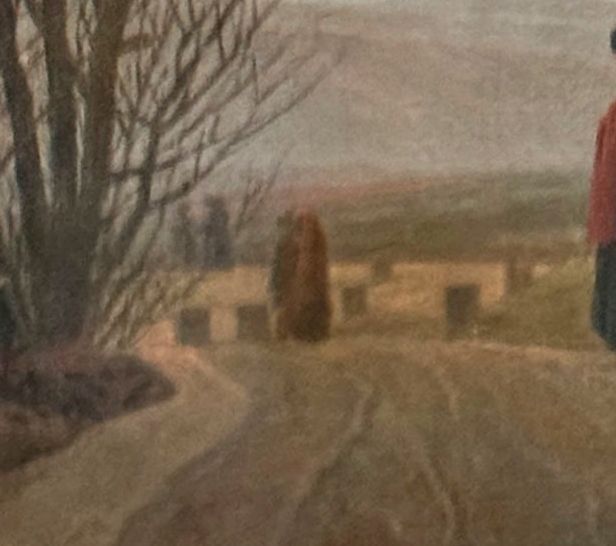
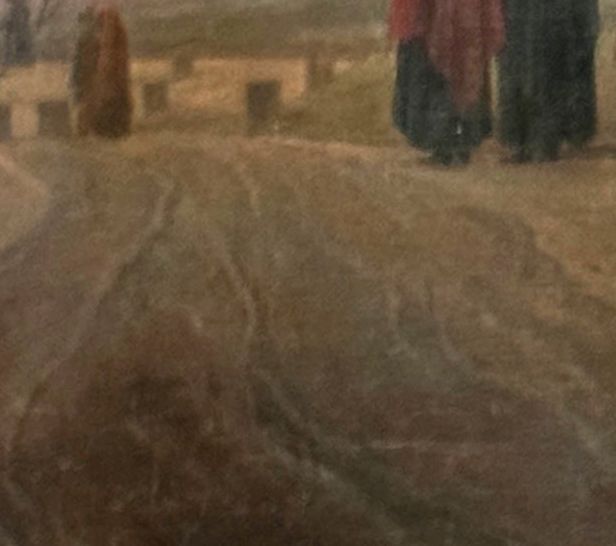
The road fills much of the lower edge. Faint lines in its brown surface carry the eye past small banks of earth and up to the point where the near stretch drops away. From Friedrich’s elevated viewpoint, the fall in the ground explains why the next walkers seem so far below the women in front. Beyond them the turns compress into small patches of light and dark. We can follow the direction of travel even where we begin to lose the surface of the road. [1]
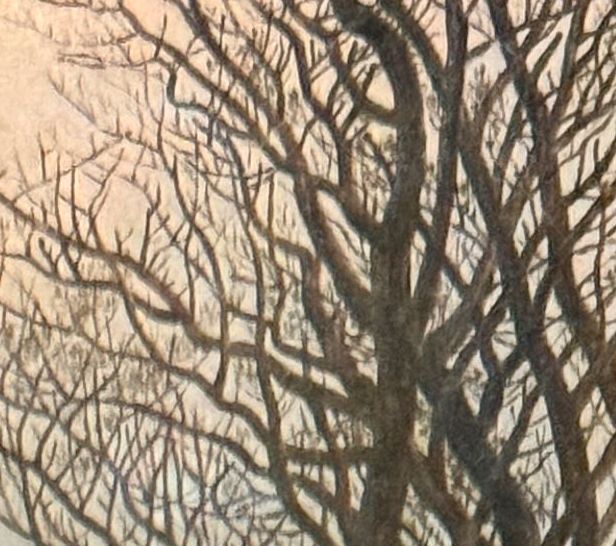
Tall trees rise on both sides. Their trunks lean inward and the branches thin into an irregular network against the sky. The branches are dark and clearly defined at the edges, where there are several trunks to look through. Toward the centre they give way to a broad opening. Beyond the nearest trees the fields stretch in low bands, and the line between the far ground and the sky is much softer than the outlines of the trees. The upright canvas lets us see these two kinds of space at once. The road leads back through the opening at ground level while the branches carry the eye almost to the top. [1][3]
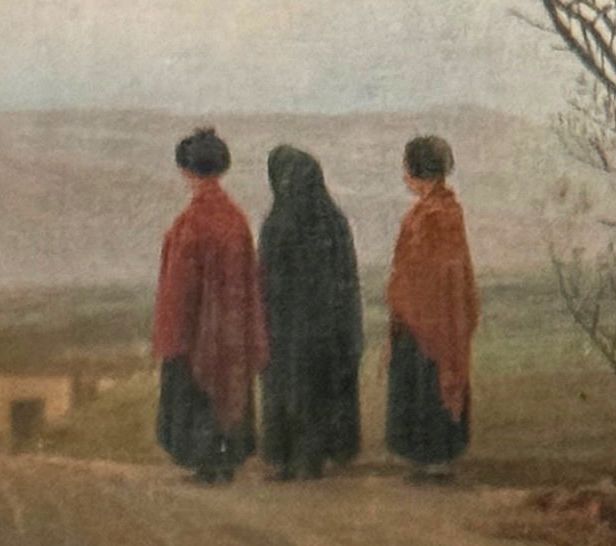
The first three women stand a little to the right of the moon’s vertical axis, leaving a clear strip of road to their left. Their garments are closely grouped, with two muted brown outer forms around a darker central figure. The heads are small and distinct, and the bodies are turned away or partly away. The far groups are much harder to read. Johannes Grave, writing for the Friedrich anniversary catalogue, identifies at least eight women altogether. Their shrinking scale makes the depth of the road more tangible than any one line drawn into the ground could. [1][3]
Mar Borobia’s Thyssen catalogue entry describes the nearest women as having paused at the verge. Wegener understood the figures as walking. The different descriptions catch something about their place on the slope. The women in front form a compact group with the quiet bearing of people standing still, while the figures farther along the road give the picture the direction of a procession. Friedrich leaves space between the groups. The eye can move from the first to the second and then farther down the road, picking up a sense of movement through changes in position and scale. [1][2][3]
The moon and the first light
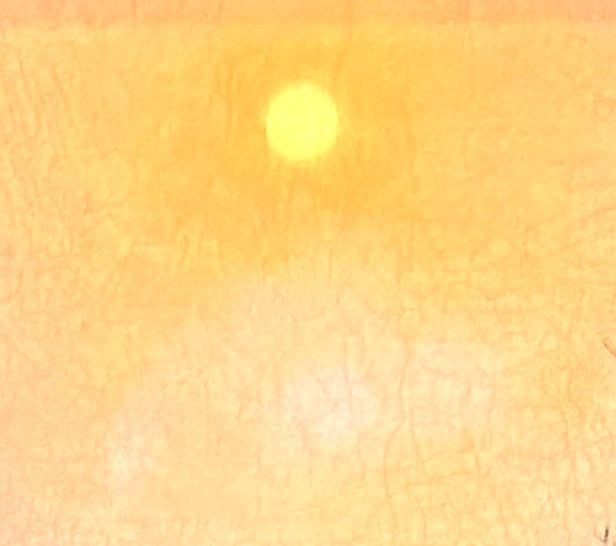
The moon is the sharpest point of light. Its pale disc sits high in a warmer patch of sky, while the illumination near the horizon is cooler and more diffuse. The road and trunks remain dark enough for the branches and the figures to read largely as silhouettes. Wegener’s 1859 account dwells on the fact that the moon is still high but casts no shadows. His description picks out the moment when it is possible to see both the lingering moon and the early signs of day. The effect depends on their coexistence. The light at the horizon has begun to change before the light above has disappeared. [1][2]
Wegener also noticed buds on the trees and green shoots that had survived winter. In the German passage reproduced by Börsch-Supan, he identifies one woman as being in mourning and likens the natural changes to a morning of resurrection. The two observations belong together in his account. The prospect of new growth accompanies a visit that he associates with bereavement. The Spanish catalogue records traces of snow on the ground and on the conifers. These details take longer to notice than the moon or the three women. Even at the bend, the earth still looks cold, and the silhouettes along the sides remain almost entirely bare. The ground and the sky therefore suggest change at different speeds. Dawn is beginning overhead while the evidence of spring is still scattered through the scene. [1][2][3]
Borobia reads the turn from night to day and the start of spring in relation to death, the hope of life after death and the Resurrection. Grave takes the traditional title and the nearest group of three as grounds for a more particular connection. In Mark 16:1–8, three women come to Jesus’s tomb early in the morning and find it empty. The clothes in the painting belong to Friedrich’s own time, and the road carries several more women through the same landscape. The resemblance is strongest at the moment of approach. The bend withholds the destination, so the three women can suggest the Gospel episode while remaining people on an early morning walk. [1][3]
The Dresden drawing and A Walk at Dusk
A sheet in the Dresden Kupferstich-Kabinett brings the arrangement of the figures into focus. The museum dates C 1925-13 to about 1835 and records it as work in black with a brush on tracing paper. Its title refers to figures from Ostermontag and Spaziergang in der Abenddämmerung. The first of those labels, literally Easter Monday, belongs to Dresden’s title for the sheet. The Madrid painting is catalogued as Mañana de Pascua. [1][4]
The sheet includes the three nearest women low on the right as well as the smaller figures. Their sizes and distances from one another correspond to the arrangement in the painting, even on a sheet without the road or trees. Borobia points out that the figures appear in reverse in the oil. The comparison shows how precisely Friedrich could handle the relationship between a group close to us and others much farther away. It also raises a question about the sequence of work. Grave notes that sheets like this could have been traced from a painting’s underdrawing or after the oil was finished. They may have helped Friedrich assemble figures for later use. The reversal is a visible relationship between the works, and the order in which they were made remains open. [1][3][4]
The same sheet includes the bowed man in the Getty’s A Walk at Dusk, an oil dated about 1830–35. There he stands before a megalithic tomb, with its broad capstone in full view. A slender moon hangs over the meadow, and the bare branches open onto distant trees and mist. Putting the two paintings side by side brings out how differently Friedrich uses the figures’ attention. The man at dusk has reached a place where he can stop and look down. In Easter Morning, the smaller figures still have road ahead of them, and we have to imagine what waits beyond the turn. [1][4][5]
The pairing with Early Snow
In 1859 Wegener also described Easter Morning and Early Snow as a pair. Both belonged to him by the middle of the nineteenth century. The two tall canvases are almost the same size, and in each one a road leads into the picture between trees. In Early Snow, now in the Hamburger Kunsthalle, the road enters a dense stand of conifers. A snow-covered spruce stands near the centre and the trees admit only a little sky above. With the pictures together, a viewer could compare that central mass of branches with the way the trees open around the road and sky in Easter Morning. The winter road is empty. The spring road has people spaced along it, so its turns are marked by figures as well as by changes in the ground. [1][3][6]
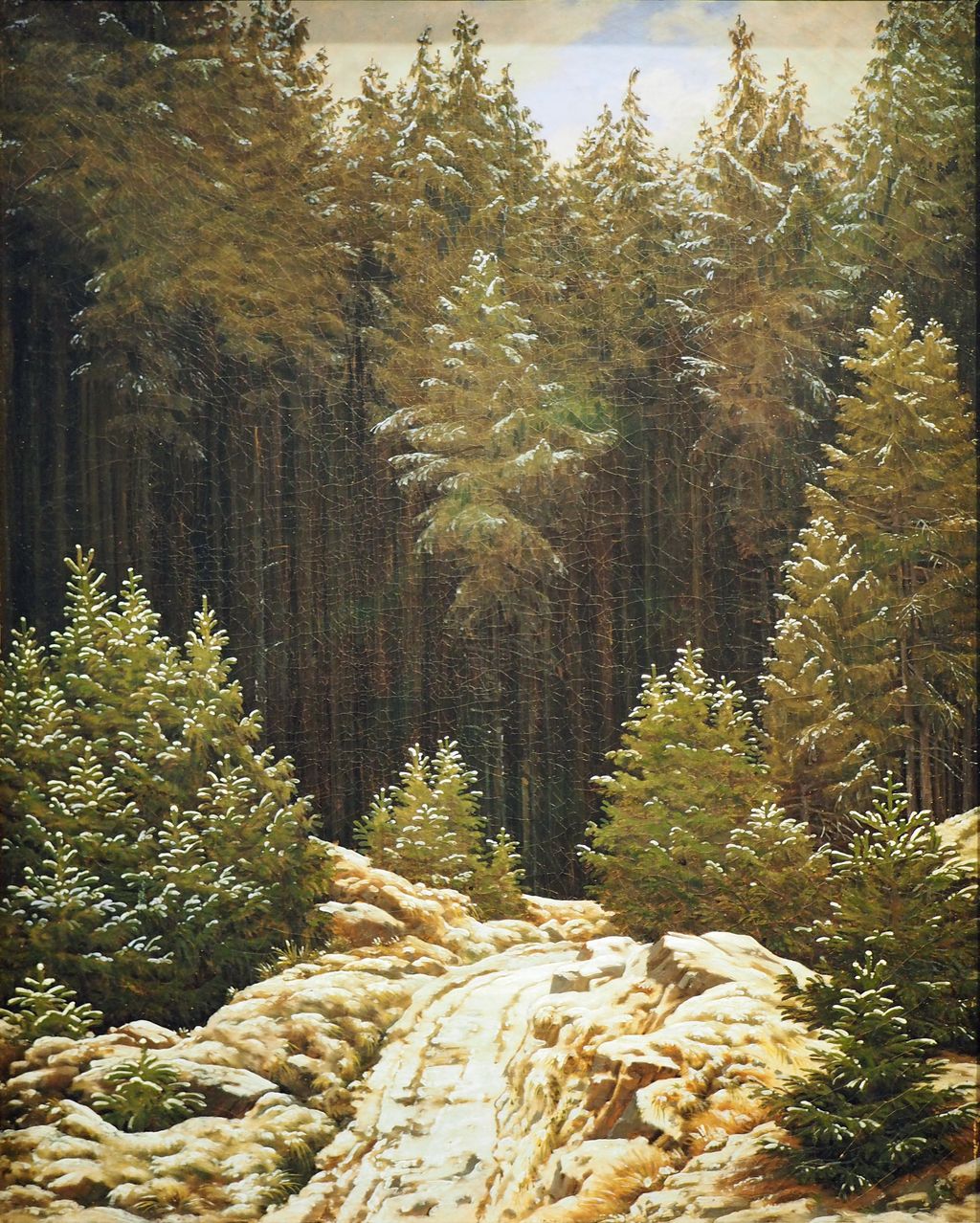
Grave leaves the question of Friedrich’s original intention open. As he explains, Helmut Börsch-Supan dated the Hamburg painting considerably earlier and pointed to its presence in Georg Andreas Reimer’s Berlin collection until 1842. He proposed Pine Forest with Waterfall as its companion. Grave gives weight to the especially close formats of Early Snow and Easter Morning and to the similarity of the two roads. Wegener’s account securely places the pairing in the history of his collection. An original pendant arrangement remains a possibility. [3][6]
Wegener’s name is easy to confuse with that of Joachim Heinrich Wilhelm Wagener, the Berlin banker who commissioned The Solitary Tree and Moonrise over the Sea. For Easter Morning, Wegener supplies both a record of ownership and a description of how he understood the scene. Borobia records that Baron Hans Heinrich Thyssen-Bornemisza acquired the picture on the British art market in 1973. It then spent about a year on deposit at London’s National Gallery, where it was cleaned. [1][2][7]
Annotated Details from Easter Morning
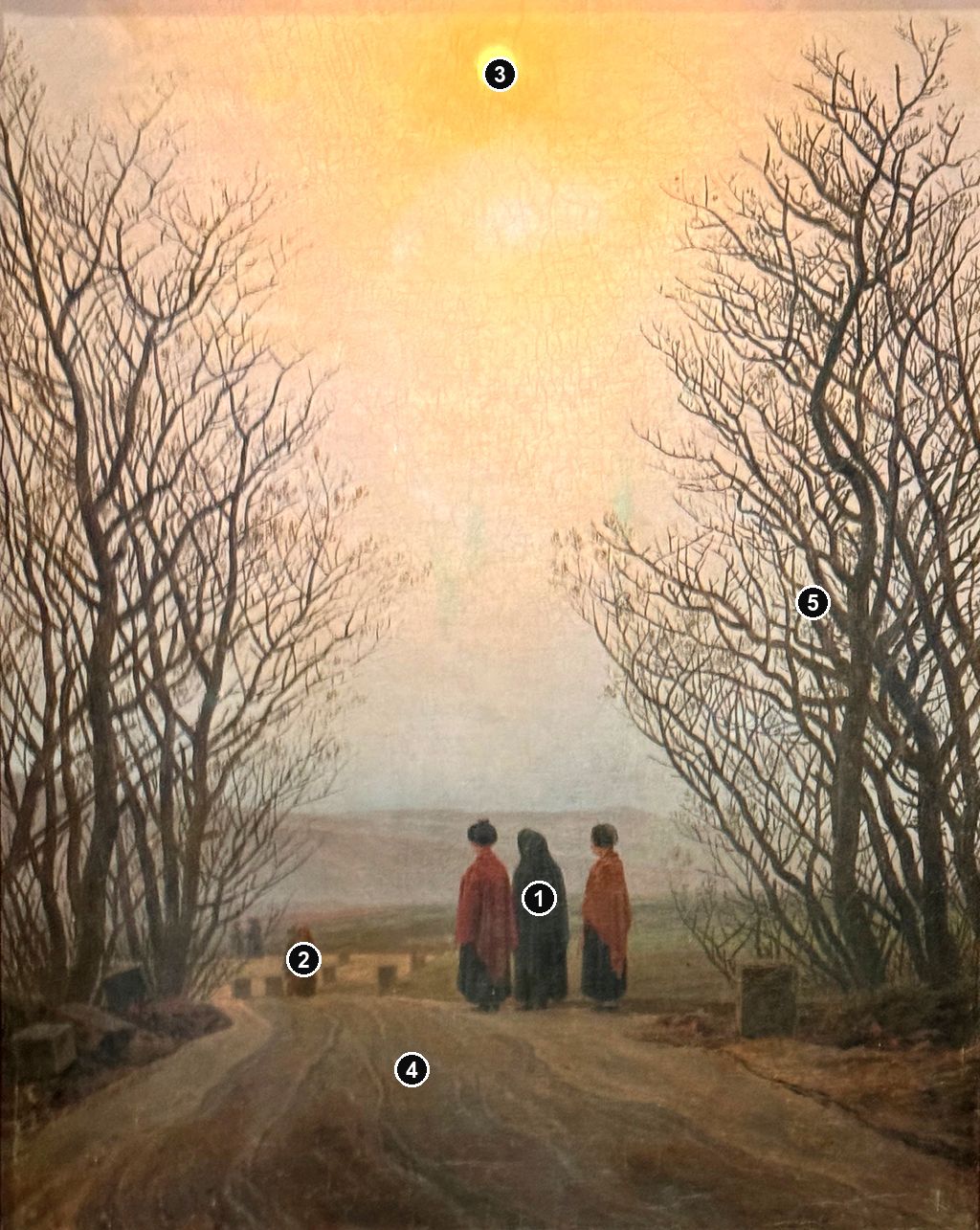
Use the numbered details to trace the forms and light in this work.
Details from EASTER MORNING
The detail crops show parts of the work at a larger scale.
The nearest women
Three women stand together on the right side of the road, with their silhouettes visible against the morning light.
Figures further down the road
A smaller group appears on the left, in the space beyond the nearest figures.
The moon above the road
The moon remains visible near the top of the open sky.
The road into the distance
The road curves between the trees and narrows towards the open fields.
The bare branches
Thin bare branches spread from the right and frame the open sky.
Detail images based on a photograph by Dguendel, CC BY 4.0. The frame was cropped out and the reproduction resized.
Frequently Asked Questions
Discussion
What can the related drawing tell us about the placement of the women?
Reader Insights
Where does the road lead your eye when the figures pause?
What can the related drawing tell us about the placement of the women?
How does the light change the way you read the bare trees?
Where does the road lead your eye when the figures pause?
Join the Conversation
Share what you noticed in Easter Morning.
References
- Mar Borobia, Mañana de Pascua, Museo Nacional Thyssen-Bornemisza. Spanish collection entry and catalogue essay.
- Wilhelm Wegener’s 1859 description, reproduced in Helmut Börsch-Supan, Caspar David Friedrich’s Landscapes with Self-Portraits. Original German passage and English translation on p. 629 of the 1972 article.
- Johannes Grave, Ostermorgen, Friedrich anniversary chronicle. German catalogue essay from the Hamburger Kunsthalle exhibition catalogue.
- Kupferstich-Kabinett, Staatliche Kunstsammlungen Dresden, C 1925-13. German collection record.
- A Walk at Dusk, 93.PA.14, Getty Research Institute. Collection authority record.
- Clara Blomeyer, Frühschnee, Friedrich anniversary chronicle. German catalogue essay and Hamburger Kunsthalle object data.
- Der einsame Baum, W.S. 52, Staatliche Museen zu Berlin. Collection record and Wagener commission.