 by Tom Gurney
Tom Gurney BSc (Hons) is an art history expert with over 20 years experience
Email: tomgurney1@gmail.com / Phone: +44 7429 011000
Introduction
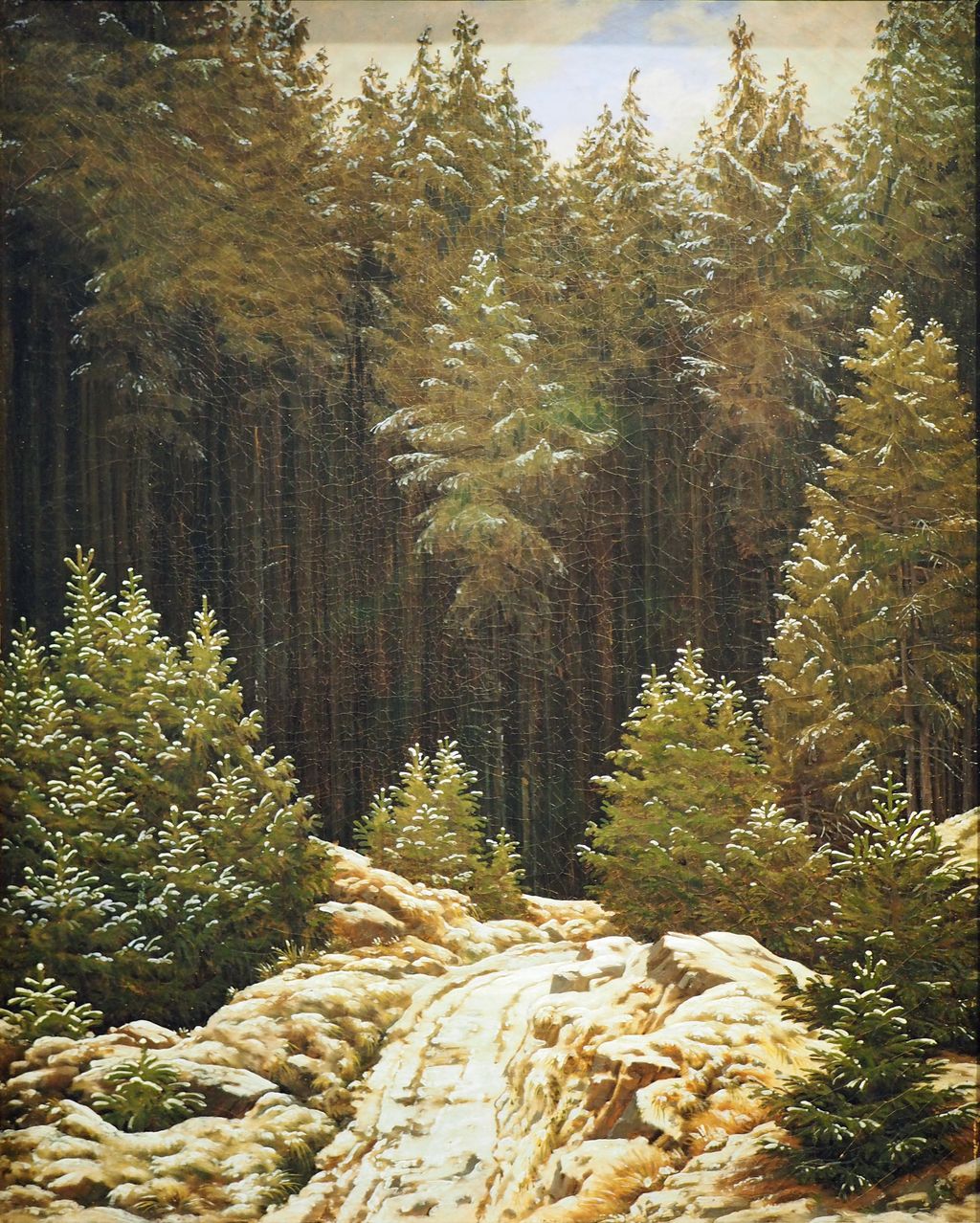
Two shallow ruts curve between snowy banks and disappear among the trees in Caspar David Friedrich’s Early Snow. Above the bend, a spruce spreads its branches against the almost black interior of the woods. A little light reaches the tops of the trees, and snow marks out their uneven edges against the sky. The track is wide enough at the bottom of the painting to imagine stepping onto it. A short way in, the woods conceal where it goes. [1][2]
At a Glance
- Artist — Caspar David Friedrich
- Titles — Early Snow in English, Frühschnee in German
- Date and medium — About 1827, oil on canvas
- Dimensions — 43.8 cm high × 34.5 cm wide
- Collection — Hamburger Kunsthalle, Hamburg, inv. HK-1057, acquired in 1906 [1][2][3]
Contents
- Introduction
- The track into the woods
- Fir, spruce and a light cover of snow
- From the Dresden exhibition to Hamburg
- The soldier in the earlier forest
- The pair in Wilhelm Wegener’s collection
- Annotated Details
- Image Details
The track into the woods
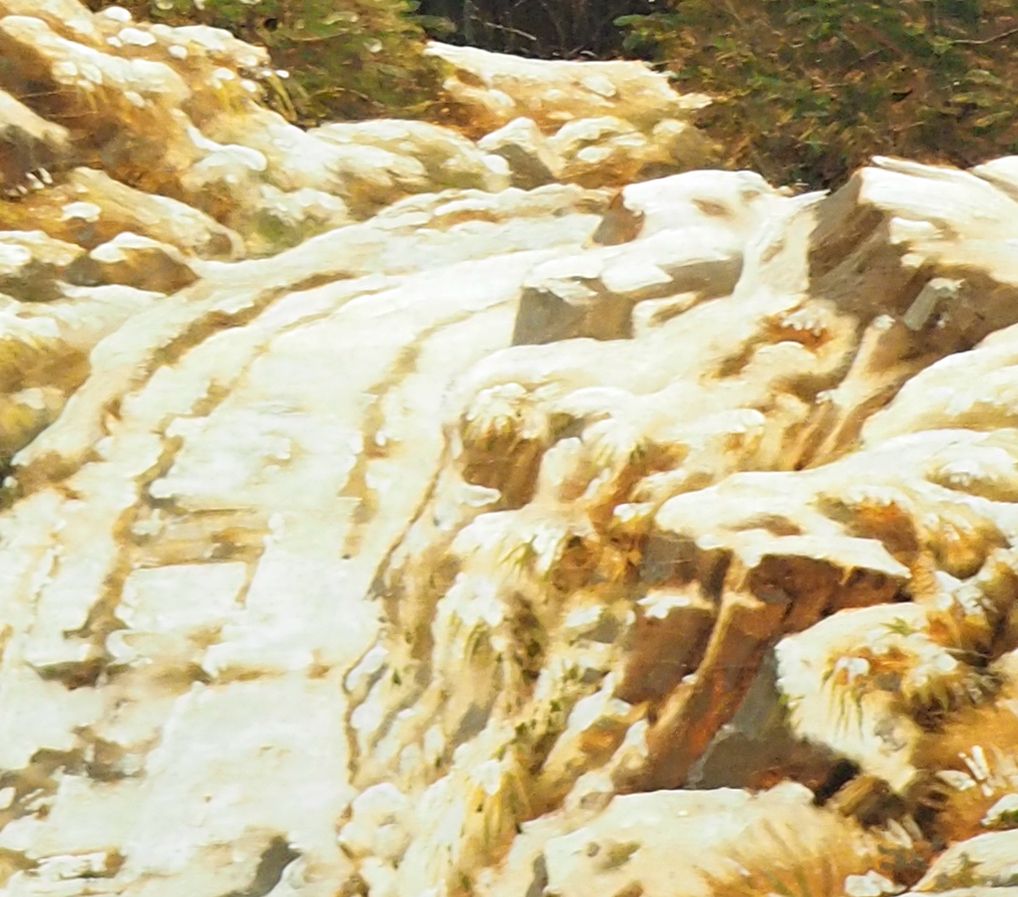
Friedrich gives the nearest part of the track much of the lower edge of the canvas. Its two grooves are separated by a low strip, and the pale surface is broken by darker, angular patches. The track turns to the right around a raised bank. Clumps of grass show through the snow on either side, especially where the right bank drops towards the track. Some of the stones are pale on top and dark on the side. These small changes of tone give the rise and fall of the ground a shape we can read before we begin to look between the trees. [1][2]
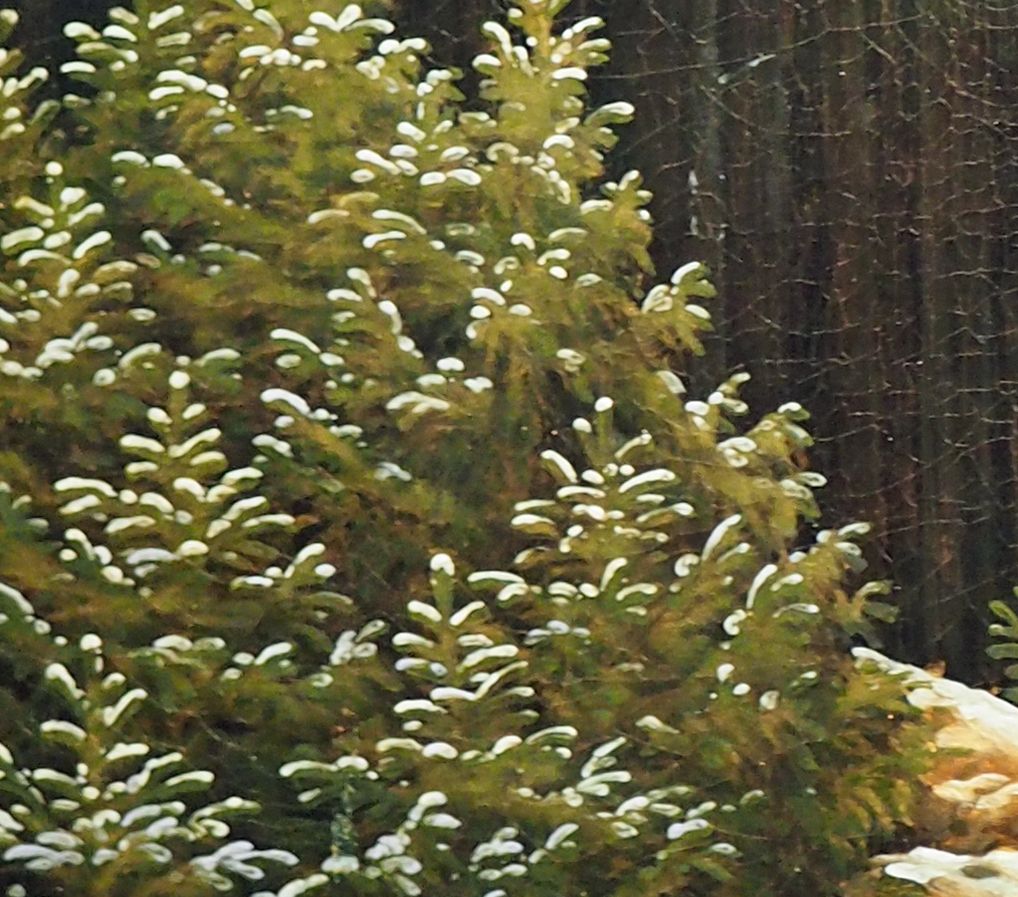
Young conifers gather along the banks. At the left, the branches overlap in a dense group, and at the right some of the tallest trees run out of the frame. Close to the bend, a smaller cluster stands against the shadows with clear space above its tips. Farther back the trees are so close together that their trunks almost merge. Where the pale track disappears, it becomes difficult to judge the distance from one trunk to the next. In the foreground we can distinguish stones from grass even where both are coated in white. In the wood, we can pick out upright lines but can only guess how far they extend. [1][2]
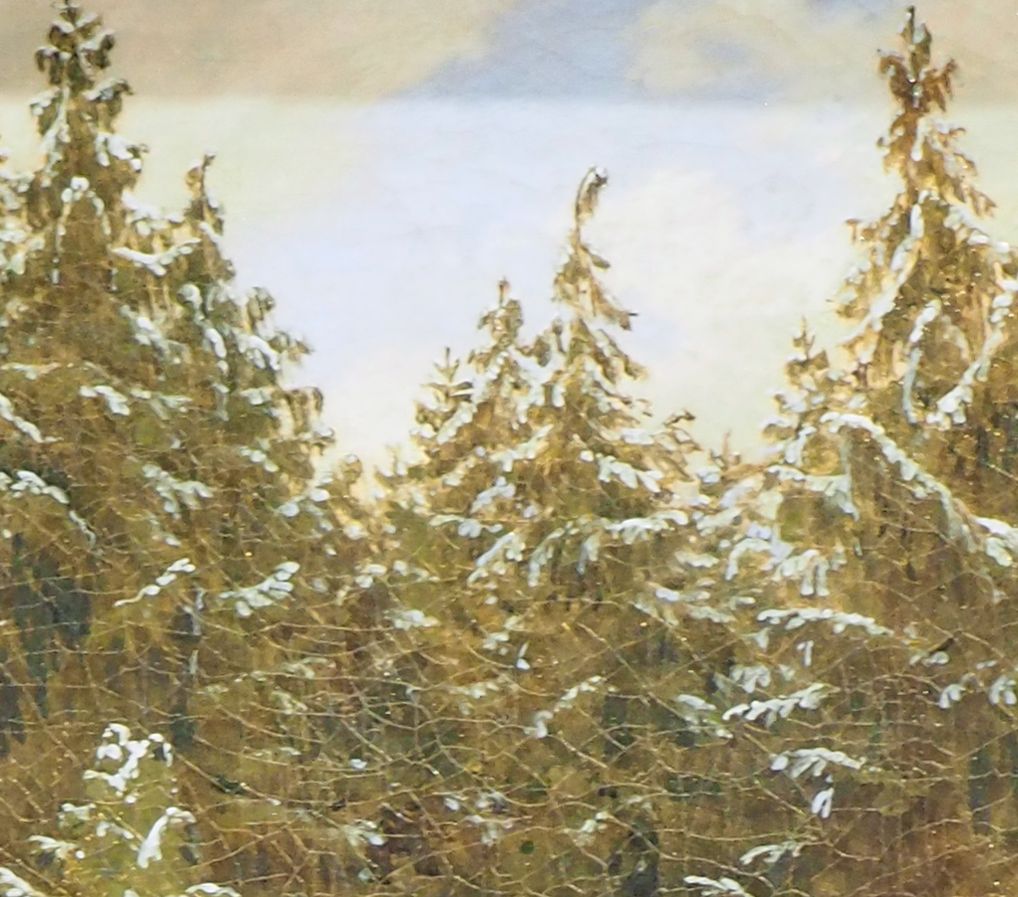
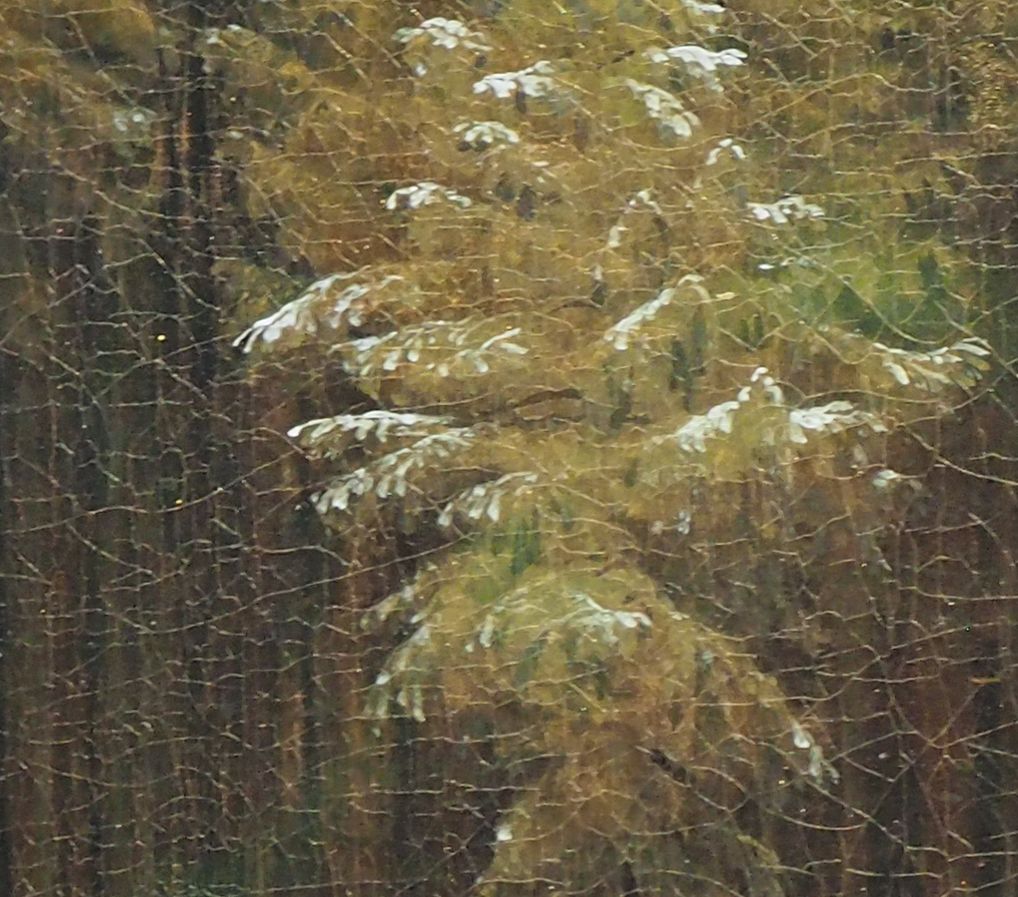
The opening at the top is irregular. One tall tree cuts into it from the right, while a crowded run of pointed crowns rises into the lighter sky towards the middle. A cooler patch of blue shows through the cloud. From the nearest banks to the highest branches, Friedrich lets the eye climb through a succession of small white marks. The bright snow also makes the trees below those marks seem darker. At the centre of the painting the two effects are especially close together, where pale dashes pick out the branches of the spruce and its lower trunk fades into the shade behind it. [1][2]
Fir, spruce and a light cover of snow
Clara Blomeyer, writing in the Hamburger Kunsthalle catalogue, identifies the trees along the track as firs and the dense stand beyond them as spruces. She singles out the spruce on the vertical centreline. Look along its branches and the snow breaks up into short, crooked strokes, separated by lengths of dark green. The small conifers near the bottom carry rounder, more compact dabs at their tips. On the ground the white paint spreads across the rock and the track in broader patches. Snow makes it easier to tell one set of branches from another while also showing how much foliage and rough ground are still exposed. The present title draws attention to that light cover. [1][2]
Blomeyer also points to an association that Friedrich himself made in connection with another painting. In explaining The Cross in the Mountains, also known as the Tetschen Altarpiece, he compared evergreen firs to the enduring hope of believers in Christ. The trees in Early Snow have prompted a related reading. Blomeyer reports that the art historian Helmut Börsch-Supan saw the spruces here as an image of Christians hoping for resurrection. The artist’s explanation concerned an altarpiece with a visible cross. In the Hamburg picture, the religious reading rests on what a viewer makes of the living trees in winter and the way Friedrich places them before us. [1][2]
From the Dresden exhibition to Hamburg
In the printed catalogue of the Dresden Academy exhibition that opened on 3 August 1828, entry 619 lists an oil by Professor Friedrich called Ein Fichtenwald im Winter, or A Spruce Forest in Winter. Blomeyer notes that the Artistisches Notizenblatt used the spruce title in connection with the painting’s first showing. The Hamburger Kunsthalle dates the canvas to about 1827. The exhibition gives a firm date by which it had been painted and a record of the name under which the public encountered it. [1][2][4]
By 1834 the painting was in the collection of the Berlin publisher Georg Andreas Reimer. The Kunsthalle’s bibliography also records it in that year’s Berlin Academy exhibition catalogue. When the painting was sold from Reimer’s collection after his death in 1842, it appeared as Tannenwald im Winter, or Fir Forest in Winter. Reimer owned dozens of works by Friedrich and showed several at Berlin’s academy exhibitions. The 1842 sale took place two years after Friedrich’s death. Those early names direct attention to different trees within the same scene. Frühschnee brings forward an element that both names take for granted. Under that title, it is easy to look first at how the snow lies, from the open stretches on the track to the much smaller deposits high up among the needles. The Kunsthalle acquired the canvas in 1906 from the Wegener estate for 300 marks. [1][2][5]
The soldier in the earlier forest
In Hunter in the Forest, also called The Chasseur in the Woods, Friedrich had already painted snow and young firs in front of a dense stand of tall spruces. That canvas, dated about 1813, is larger than Early Snow. The soldier is seen from behind at the edge of a small opening. His blue cape, helmet and sabre make him easy to find against the trees, even though he looks small beside them. A raven sits on a stump in the foreground. The soldier faces the dark interior, where Markus Bertsch observes that there is no path to show him a way forward. [2][6]

A Berlin reviewer described the man as a French chasseur when the painting was exhibited in 1814. Bertsch notes that the uniform leaves his nationality open, while the Napoleonic Wars gave contemporary viewers grounds for a political reading. In Early Snow, the woods fill much of the canvas again, but the soldier and raven have disappeared and a discernible track enters the composition. Our eye meets the bend without following anyone’s gaze. The dark trunks can still make the woods feel forbidding. By the time we encounter the deepest shadows, our eye has already followed the ruts into the scene. [2][6]
The pair in Wilhelm Wegener’s collection
By the middle of the nineteenth century Wilhelm Wegener owned both Early Snow and Easter Morning. He described them as a pair in 1859. The Madrid canvas is just one millimetre smaller in each dimension, and both paintings let a road take the eye into a landscape framed by trees. In Easter Morning the road can be followed through several groups of women before it turns out of view, and the trees open onto fields and a brightening sky. In the Hamburg picture the taller evergreens admit only a small patch of sky. Snow and branches give the empty track its depth, where the receding figures help give the Madrid road its scale. [2][7][8]
Johannes Grave leaves Friedrich’s original intention open. He points to the closeness of the canvases in size and the way their roads correspond. He also sets out Börsch-Supan’s argument that the Hamburg picture was painted considerably earlier than Easter Morning, belonged to Reimer until 1842 and may have been intended to accompany Pine Forest with Waterfall. That forest picture is also in the Hamburger Kunsthalle and is slightly larger than Early Snow. The Dresden exhibition catalogue lists an oil by Friedrich called A Waterfall immediately after the winter forest. Katharina Hoins identifies it tentatively with Pine Forest with Waterfall. If the identification is correct, the catalogue puts the two pictures in the same exhibition. The pictures also share a compositional feature. In the waterfall painting a pale boulder interrupts the view into the woods, and the water flows around it towards us. It gives the eye another route through the trees, much as the ruts guide us around the bank in the winter scene. The proposed original pairing depends on how the pictures’ dates, dimensions and subjects are weighed. Wegener’s account establishes that he saw Early Snow and Easter Morning as companions in his own collection. [3][4][7][9]
Annotated Details from Early Snow
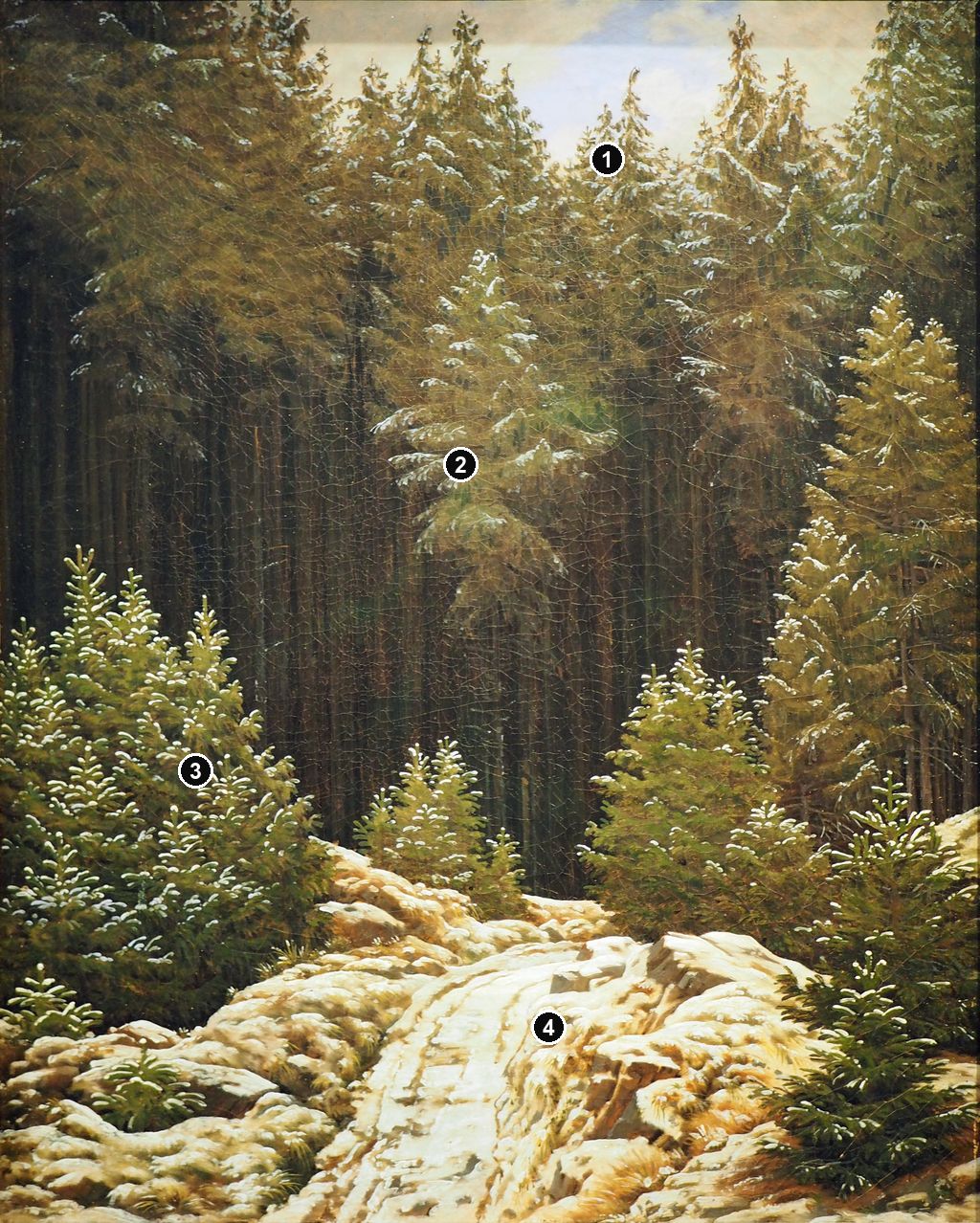
Use the numbered details to trace how Friedrich arranged the forms and light in this painting.
Details from EARLY SNOW
The detail crops show parts of the painting at a larger scale.
A break in the canopy
A small patch of pale sky remains visible above the dense forest.
Snow on the central branches
Bright flecks on the branches bring a nearer conifer forward against the dark trunks.
Young trees beside the track
Shorter trees with snow on their tips flank the entrance to the forest.
Snow and rock on the path
A bright, uneven track turns between trees. Ochre rock shows through the snow.
Frequently Asked Questions
Discussion
How does snow make some branches stand out?
Reader Insights
Where does the track disappear among the trees?
How does snow make some branches stand out?
How does an empty path change the scene compared with The Chasseur in the Woods?
Where does the track disappear among the trees?
Join the Conversation
Share what you noticed in Early Snow.
References
- Frühschnee, HK-1057, Hamburger Kunsthalle. Collection record, with provenance by Ute Haug.
- Clara Blomeyer, Frühschnee, Friedrich anniversary chronicle and English catalogue version, Early Snow. Hamburger Kunsthalle exhibition catalogue essay, p. 180.
- Caspar David Friedrich. Infinite Landscapes, Alte Nationalgalerie works list. Entries 15–16.
- Dresden Academy exhibition catalogue, 1828, p. 55. Entries 619–620.
- Birgit Verwiebe, Caspar David Friedrich and Berlin. Alte Nationalgalerie exhibition catalogue essay.
- Markus Bertsch, Der Chasseur im Walde, Friedrich anniversary chronicle. Hamburger Kunsthalle exhibition catalogue essay, p. 174.
- Johannes Grave, Ostermorgen, Friedrich anniversary chronicle. Hamburger Kunsthalle exhibition catalogue essay and reference to Wilhelm Wegener’s 1859 account.
- Mar Borobia, Mañana de Pascua, Museo Nacional Thyssen-Bornemisza. Collection record and catalogue essay.
- Katharina Hoins, Tannenwald mit Wasserfall, Friedrich anniversary chronicle. Hamburger Kunsthalle exhibition catalogue essay.