


 by Tom Gurney
Tom Gurney BSc (Hons) is an art history expert with over 20 years experience
Email: tomgurney1@gmail.com / Phone: +44 7429 011000
Introduction
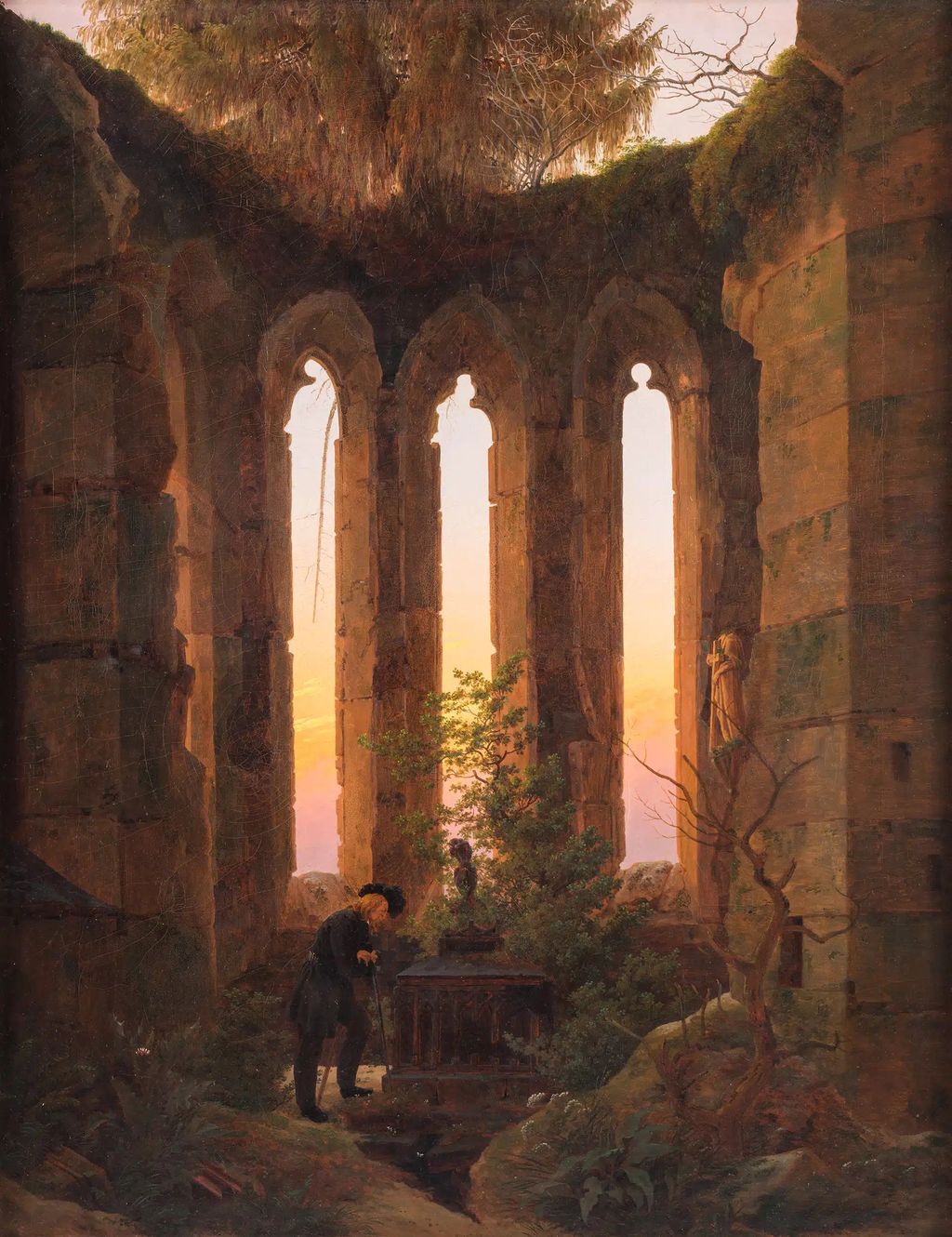
In March 1814 Caspar David Friedrich asked the writer Ernst Moritz Arndt for an inscription of about twenty words. He was painting an imaginary town with a monument in its square, and he wanted to dedicate the monument to the Prussian general Gerhard von Scharnhorst. A decade later, a name generally understood to refer to Scharnhorst appeared in much smaller lettering on a tomb in a ruined church. The setting had changed from a civic square to a place where one visitor bends over a stone. The two works belong to different moments in the history of the war. In 1814 Friedrich was asking who would get to honour the dead. By the time he painted Hutten’s Tomb, some of the people he wanted to remember had themselves come under government scrutiny. [1][2][3]
At a Glance
- Letter to Arndt · 12 March 1814
- Memorial painting · Hutten’s Tomb, 1823
- Historical setting · Napoleonic wars and their aftermath
Contents
- Introduction
- Saxony and the Wars of Liberation
- An ancient name among new graves
- A soldier at the edge of the woods
- How a landscape could hold names
- An anniversary under the Restoration
- From a Harz cave to an imagined burial ground
- What an exhibition could make legible
- A church furnishing after the occupation
Saxony and the Wars of Liberation
In 1806, several German princes left the Holy Roman Empire to join Napoleon’s Confederation of the Rhine. The emperor Francis II laid down the imperial crown that August. Saxony fought alongside Prussia at Jena and Auerstedt in October. After their defeat, Saxony made peace with France, joined the Confederation and became a kingdom in December. Friedrich lived in its capital, Dresden, but had been born in Greifswald, then part of Swedish Pomerania. The war put his adopted home and the Swedish crown on opposing sides. Gerd Spitzer records that Friedrich initially intended The Cross in the Mountains of 1807–08 for Gustav IV Adolf of Sweden, an opponent of Napoleon. The painting went to the Thun-Hohenstein family at Tetschen. Friedrich’s own explanation of the rock and evergreens concerned Christian faith and hope, while the intended dedication gives the work a connection with the conflict. [2][4][5][6]
Napoleon’s army suffered a disastrous retreat from Russia in 1812. In 1813 Prussia allied with Russia and declared war on France. Austria and Sweden were among the powers that joined the coalition. The fighting against Napoleon in the German lands became known as the Wars of Liberation, or Befreiungskriege. The name reflects the cause of those who sought to end French rule. Saxony’s king remained Napoleon’s ally, and troops from several German states fought on the French side at Leipzig. Some Saxon troops went over to the coalition. Napoleon won at Dresden in August, but the coalition defeated him at Leipzig in October and the Confederation of the Rhine broke apart. The coalition entered Paris in 1814, and Napoleon’s return from exile ended in defeat at Waterloo in 1815. [4][7][8]
An ancient name among new graves
Friedrich had already imagined a burial ground for the war’s dead before the coalition of 1813 took shape. He painted Tombs of Those Fallen in the War of Independence, also known as Tombs of the Ancient Heroes, in 1812. The view is almost entirely rock and grass. Two soldiers stand in the shadow of a cave, and a pale obelisk rises just to their left. In front of them lie darker, older monuments. One broken stone carries the name ARMINIUS, the leader of the Cherusci who defeated Roman forces in the Teutoburg Forest in 9 CE. Friedrich used the German form HERMAN in a preparatory study and switched to the Latin form in the painting. [2][9]
Markus Bertsch draws attention to a small snake near the damaged tomb, painted in the colours of the French tricolour. He reads the pairing as a comparison between Roman power and the French occupation, with Arminius’s victory offering a precedent for resistance. The obelisk praises a young saviour of the fatherland, and another grave refers to freedom and justice. The bright stone gives the newest-looking monument an immediate claim on the eye, while Arminius’s name takes closer looking. Holger Birkholz leaves open whether the inscriptions were meant to commemorate people already fallen or to anticipate honours for those who would fight. An audience at the Berlin Academy exhibition in 1812 would have seen these graves before the events at Dresden and Leipzig gave the words a new set of associations. [2][9]
A soldier at the edge of the woods
Friedrich spent part of 1813 at Krippen in the Elbe Sandstone Mountains, away from Dresden while Napoleon’s army occupied the city. His watercolour of a quarry near the village is dated 19 July. On a pencil study dated the following day, he added an appeal to German men to take up arms. The appeal sits above a group of conifers with smaller deciduous trees in front. The two sheets show the painter studying the terrain during the war, and the second shows him giving a group of trees a political association in his own words. [2][5][10][11]
In The Chasseur in the Woods, dated around 1813 by the anniversary chronicle and 1813–14 by the Met, a man in a blue cloak and helmet stands with his back to us. A sword hangs at his side. Young conifers edge the snowy opening, with a raven perched on a stump. Beyond the soldier the mature trees stand so close that his view into the woods, like ours, narrows to a few spaces between trunks. The picture gives him room to stop and look, but gives him no clear way through the trees. [10][12]
A reviewer of the autumn 1814 Berlin Academy exhibition in the Vossische Zeitung called the soldier a French chasseur. The review made nationality explicit within months of Napoleon’s first abdication. Bertsch also cites the first owner, Prince Malte von Putbus, who understood the bird as sounding a death song and imagined that the rider had lost his horse. The painting shows the raven and the man on foot. The horse and the events that may have brought the man there belong to the owner’s account. Bertsch finds the French reading plausible in the climate of 1813–14 and points out that the uniform leaves nationality open. Michael Thimann considers both the political allegory and a reading centred on the isolation of a soldier facing death. The deep shadow and the small, exposed figure give both interpretations something to work with. [10][13]
The patriotic exhibition held at Dresden in spring 1814 gave Friedrich’s paintings a setting in which viewers could bring the recent conflict to bear. It opened under the Russian governor-general Nikolai Repnin-Volkonsky on 24 March. Tombs of Those Fallen in the War of Independence is documented there. The anniversary chronicle also places the Chasseur at Dresden, while Thimann treats that showing as probable. The Berlin review establishes that the soldier painting was on view there later that year. Friedrich returned to a similar arrangement of dark conifers and snow in Early Snow around 1827. The later painting leaves the opening empty of both soldier and raven. The familiar spacing of trees makes it easier to see how much the earlier picture’s wartime reading depends on the two small presences at the forest’s edge. [5][10][13][14][15]
How a landscape could hold names
Friedrich’s friend Georg Friedrich Kersting joined the Lützow Free Corps in 1813. In 1815 he painted two pictures in memory of three friends who died during the war. In On Outpost Duty, Theodor Körner, Karl Friedrich Friesen and Heinrich Hartmann wear the Iron Cross and take up positions among oaks. In its companion, The Wreath Maker, their names are cut into three trunks behind a woman braiding oak leaves. The viewer can move from the three men in one picture to the places their names occupy in the other. Kersting’s pair shows how a landscape could become a memorial through the placement of a few words. Friedrich had also thought carefully about how much lettering his design for Scharnhorst’s monument could accommodate. His March 1814 letter tells Arndt that the available space was the reason for keeping the inscription short. In the same letter he objects that a people denied a voice cannot honour itself. [1][16]
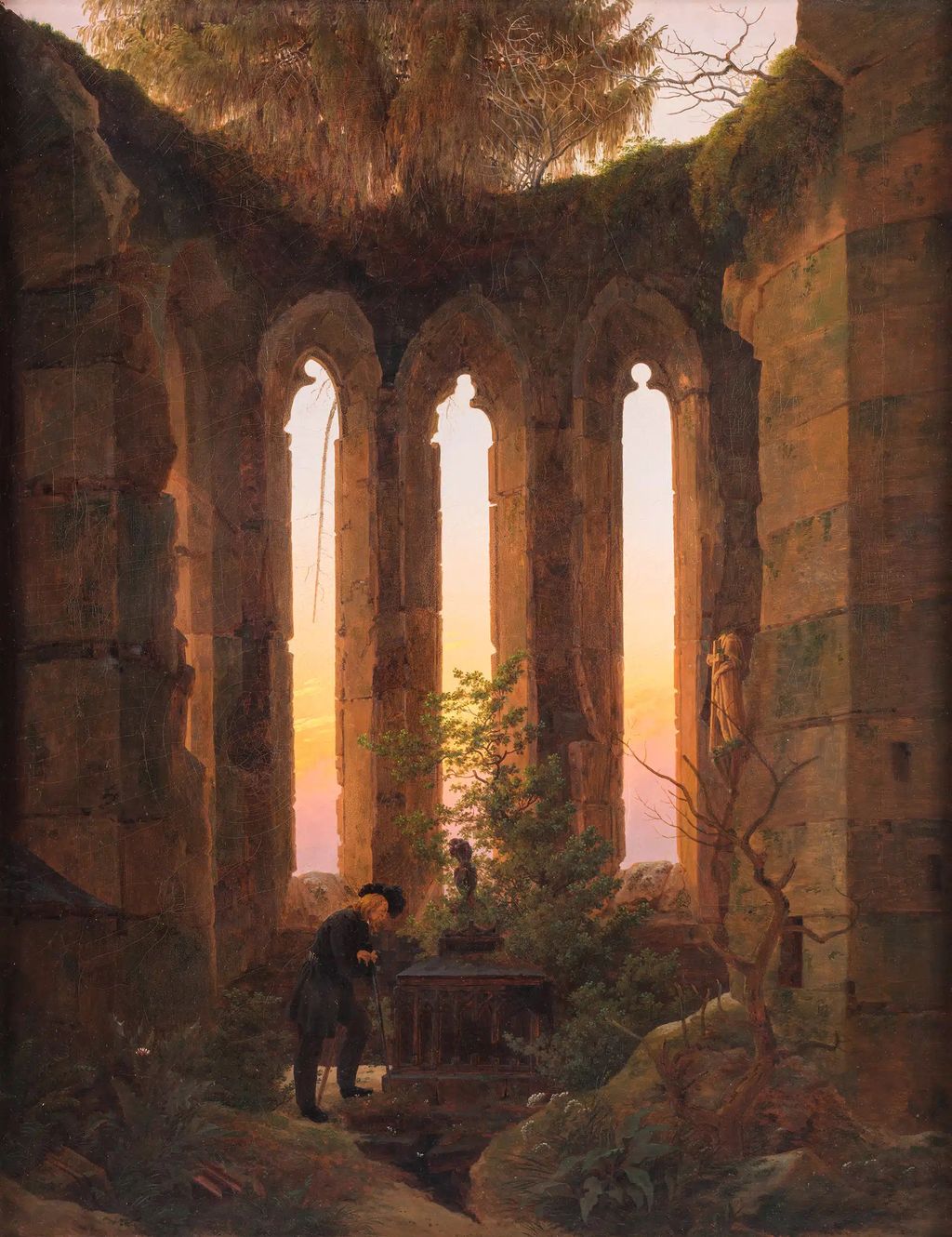
After the Congress of Vienna, the German Confederation preserved the authority of individual states. National and constitutional hopes persisted, but the authorities tightened controls on political opposition. The Carlsbad Decrees of 1819 restricted the press and placed universities under surveillance. That July, searches of the papers of Arndt and the publisher Georg Andreas Reimer turned up letters from Friedrich, including the request for the Scharnhorst inscription. Arndt was questioned about it in 1821. In the same year Reimer began publishing a collected edition of the writings of Ulrich von Hutten. Jahn, Arndt, Stein and Görres subscribed. Birkholz traces the edition’s troubles with the censors and its end in 1825 with the fifth volume. By then all four surnames had a place on Friedrich’s painted tomb. [2][17][18]
An anniversary under the Restoration
The year 1823 marked three centuries since Hutten died in Switzerland and ten years since the opening of the Wars of Liberation. Around 1800 the Renaissance humanist had been read as a patriot and a figure of the Reformation. His dialogue Arminius celebrated the ancient victory over Rome, so the connection to 1813 had a literary as well as a political history. Friedrich placed his invented monument inside the ruined monastery at Oybin, using a watercolour he had made there in 1810. Birkholz notes that the site also hosted a commemoration of the Reformation in 1817. The ruin carried memories of its own before the painter installed the tomb in it. [2][3][19][20][21]
The inscription HUTTEN is visible on the base beneath the helmet. Johannes Grave’s catalogue essay records the smaller lettering once decipherable on the face of the tomb as “Jahn 1813”, “Arndt 1813”, “Stein 1813”, “Görres 1821”, “D … 1821” and “F. Scharnhorst”. Weimar’s 100 Treasures account gives “Scharnhorst” without the initial, and the collection’s separate digital record omits Arndt and assigns different dates to Görres and Scharnhorst. The fragment beginning with D remains unidentified. The earlier letter supplies a specific reason for connecting Scharnhorst with the general, even though the recorded initial differs. Reimer’s edition gives 1821 an association with Hutten in Friedrich’s own circle. The precise reason for setting that date beside Görres remains open. [1][2][3][19][22]
The Klassik Stiftung Weimar identifies the man’s clothing as the uniform of a Lützow volunteer and reads the growth inside the ruin as an expression of continuing hopes for freedom. Grave describes the clothes more broadly as old German dress and finds room for disappointment as well as defiance. Above the man’s head, the windows take in the last light. The smaller names sit so low in the shadow that they demand the sort of attention the visitor is giving the monument. Friedrich showed the painting in Dresden in 1824. At the Berlin exhibition two years later, the catalogue announced that the proceeds of a sale were intended for Greeks in need during their struggle for independence from Ottoman rule. Birkholz records the notice. Visitors who stood before a memorial to the war of 1813 could now read an appeal connected to a war still in progress. [2][3][19]
From a Harz cave to an imagined burial ground
The cave in the Hamburg painting had a history before it became a place to set monuments. Markus Bertsch traces it to studies Friedrich made during his Harz journey in June 1811 at the Hartenberg near Wernigerode. The stones in front of the cave required their own preparation. A construction drawing sets out three views of the tomb with the partly open lid that eventually occupied the right foreground. That sheet shows a painter working through how an invented object would sit on the ground and how its opening would look at an angle.[9]
The choice of angle affects the way the tomb addresses a spectator. A flat face would allow an inscription to be read directly. At an angle, the lid and adjoining surfaces have enough depth to make the object feel heavy and awkward to approach. The partly open lid makes the possibility of an interior evident while the exterior still occupies most of what we see. These are consequences of placing a constructed object in a space the artist had investigated through drawings of actual rock. Looking closely at the preparation shows how Friedrich could give a memorial physical presence without relying on a real grave already associated with the person commemorated.[9]
This distinction also helps when comparing the painting with Karl Friedrich Schinkel's roughly contemporary design for a monument to Arminius. Schinkel proposed an object that might be built. His design remained unrealized. Friedrich's cave picture already gave its invented monuments a place where a spectator could encounter them in paint. A monument proposal asks how an ancient name can become the subject of a public structure. The painting lets the name be discovered among objects of different ages and degrees of legibility. The two uses of Arminius show how a contemporary analogy with resistance to Rome could generate quite different experiences of looking.[9] [23] [24]
The soldiers' size matters to that difference. Within the cavern scene, a person is small in relation to both the rock and some of the markers. The eye reaches the pale obelisk easily, whereas some details of the men and the older graves require a slower inspection. The painting gives each viewer the chance to find the historical reference within a particular distribution of light and scale. A temporary public exhibition could bring many viewers to that discovery even though the burial ground itself existed only as a picture.[9]
What an exhibition could make legible
The name patriotic exhibition helps recover the circumstances of a first encounter with these pictures. It also raises the question of whose politics the event represented. In the 1814 Dresden exhibition, Friedrich's work shared a venue with that of Ferdinand Hartmann and Gerhard von Kügelgen. Holger Birkholz records a contemporary review that grouped works at the exhibition as patriotic. The group was presented in a city governed at the time by the Russian administration after the defeat of Napoleon's army. Saxony's recent position on the French side and its subsequent occupation make the local situation more complex than a picture of one unified public celebrating the same victory.[2] [7] [25]
Tadeusz J. Żuchowski compares the helmeted figures in three works associated with this exhibition context, including the lone man in the forest and the two men in the Hamburg painting. He points out that the garments provide recognizable similarities across the group while leaving the nationality of the wearer difficult to determine. The Prussian newspaper that called the forest figure French is strong evidence for a reading made in 1814. Its description can be put beside the appearance of the figure and the political circumstances of publication. Those are three distinct sources of meaning for an image that contains no explicit statement of nationality.[10] [26]
Żuchowski also considers what the soldier can see in comparison with what a spectator can see. In the forest picture the man approaches a dark wall of trees, so the part of the landscape available to him seems sharply restricted. A viewer outside the frame can take in the whole arrangement, including the forms and intervals that make the encounter difficult for the figure. This line of interpretation can coexist with the early patriotic response. It gives a reason for the painting to remain effective when the man's identity is left uncertain. The forest, the figure's exposure and the limits of his view are visible before the spectator decides how much weight to give a particular uniform.[10] [26]
A church furnishing after the occupation
Friedrich also worked on a practical design problem in the years after the fighting. Peter Prange connects his designs for the choir furnishings of St Mary's in Stralsund with the restoration of a church partly damaged during the French occupation. Restoration began in 1814, and Friedrich worked on designs around 1817–18. Prange discusses the precision of the drawings and their relation to a study for a chair-sledge made in a similarly careful manner. The comparison is useful because it brings the drawings back to things that would have to take up space and accommodate bodies.[27]
The rebuilding of a church and the imagining of a tomb offer two different ways to think about the material aftermath of war. A church furnishing belongs to a place with an existing architectural order. A design for seating or panelling has to respond to surfaces and passages that other people already use. In the memorial landscapes, Friedrich could put a tomb where it would produce a particularly striking encounter with a cave or ruined wall. In the Stralsund work he was contributing to plans for a place people could enter after damage. The surviving designs widen the record of what he did with architecture in the wake of occupation.[2] [27]
The dating of the choir work also gives a useful point between the 1814 exhibition and the later Hutten's Tomb. During those years a damaged site could be repaired, a war could be commemorated and political expectations could change. A viewer who knows the outcome at Leipzig still needs different kinds of evidence to understand those consequences. The drawings for a church, the letter about a monument and the inscriptions in a painted ruin register three practical settings in which the aftermath of the war became visible.[1] [2] [3] [27]

Frequently Asked Questions
Discussion
What does the scale of the forest do to the soldier?
Reader Insights
Where are the names placed around the tomb?
What does the scale of the forest do to the soldier?
Which claims can be tied to a letter or exhibition record?
Where are the names placed around the tomb?
Join the Conversation
Share what you noticed in Friedrich in the Napoleonic Era.
References
- Caspar David Friedrich, letter to Ernst Moritz Arndt, Dresden, 12 March 1814, no. 25, in Sämtliche Briefe und Schriften, ed. Johannes Grave, Petra Kuhlmann-Hodick and Johannes Rößler, 2024, p. 59. Publisher’s edition preview
- Holger Birkholz, “»Solange wir Fürstenknechte bleiben«. Caspar David Friedrichs politische Haltung,” in Caspar David Friedrich. Wo alles begann, Staatliche Kunstsammlungen Dresden, 2024, pp. 248–253. Exhibition catalogue extract
- Johannes Grave, “Huttens Grab,” in Caspar David Friedrich. Kunst für eine neue Zeit, Hamburger Kunsthalle, 2023, p. 146. German anniversary chronicle
- Deutsches Historisches Museum, “Befreiungskriege gegen Napoleon.” Museum chronology of the Rhine Confederation and the war. See also the Saxon State Archives, papers of Elector and King Friedrich August
- Institut für Sächsische Geschichte und Volkskunde, “Friedrich, Caspar David,” Sächsische Biografie, especially pp. 8–10. Biographical entry
- Gerd Spitzer, “Das Kreuz im Gebirge (Tetschener Altar),” Galerie Neue Meister, Gal.-Nr. 2197 D. German anniversary chronicle
- Deutsches Historisches Museum, “Völkerschlacht bei Leipzig.” Museum account of the 1813 campaign
- Hamburger Kunsthalle, Kunst um 1800, pp. 38–39. Museum booklet
- Markus Bertsch, “Tombs of Those Fallen in the War of Independence (Tombs of the Ancient Heroes),” Hamburger Kunsthalle, HK-1048, in Caspar David Friedrich. Kunst für eine neue Zeit, 2023, pp. 168–171. Object essay
- Markus Bertsch, “Der Chasseur im Walde,” in Caspar David Friedrich. Kunst für eine neue Zeit, 2023, p. 174, including notes 4–8. German anniversary chronicle
- Kupferstichkabinett, Staatliche Museen zu Berlin, Steinbruch bei Krippen, SZ CD.Friedrich 18. Object entry
- Metropolitan Museum of Art, Caspar David Friedrich: The Soul of Nature, “Nature’s Cycles.” Exhibition labels and works
- Michael Thimann, “Bilder aus eiserner Zeit. Napoleon und die Kunst der Befreiungskriege,” in Bénédicte Savoy, ed., Napoleon und Europa. Traum und Trauma, 2010, pp. 117–135, especially pp. 130–132. Catalogue essay
- Anniversary chronicle, “Friedrich’s Tombs of Those Fallen in the War of Independence and The Chasseur in the Forest are shown at the exhibition of patriotic art.” 1814 Dresden entry
- Hamburger Kunsthalle, Early Snow, HK-1057. Anniversary chronicle object essay
- Birgit Verwiebe, Georg Friedrich Kersting’s Theodor Körner, Friedrich Friesen und Heinrich Hartmann auf Vorposten and Die Kranzwinderin, Alte Nationalgalerie, A II 327 and A II 328. On Outpost Duty and The Wreath Maker
- German Bundestag, “The German unification and freedom movement (1800–1848).” Parliamentary history
- Werner Busch, “Schleiermacher als Inspiration für Caspar David Friedrich,” in Religion als Bild – Bild als Religion, 2012, p. 292. Research essay
- Klassik Stiftung Weimar, Huttens Grab, G 690. 100 Treasures object entry
- Barbara Basting, “Die zwei Gräber des Ulrich von Hutten,” Swiss National Museum. Museum research article
- Peter Prange, “Klosterruine auf dem Oybin,” Hamburger Kunsthalle, inv. 41101. German anniversary chronicle
- Klassik Stiftung Weimar, Huttens Grab, G 690, inscription metadata. Goethe knowledge network object record
- Karl Friedrich Schinkel, Design for a Monument to Arminius, c. 1814, reproduced by German History in Documents and Images.
- Deutsches Historisches Museum, German historical myths, exhibition materials on the analogy between Arminius and the struggle against Napoleon.
- Holger Birkholz, English catalogue excerpt on Friedrich's political position, Staatliche Kunstsammlungen Dresden, on the artists and review of the Dresden exhibition.
- Tadeusz J. Żuchowski, The Paintings by Caspar David Friedrich with the Figure of the so-called Chasseur, Artibus et Historiae 83 (2021), pp. 361–385, published abstract.
- Peter Prange, Stuhlschlitten, Hamburger Kunsthalle catalogue research, on the Stralsund choir designs and restoration.