


 by Tom Gurney
Tom Gurney BSc (Hons) is an art history expert with over 20 years experience
Email: tomgurney1@gmail.com / Phone: +44 7429 011000
Introduction
In Caspar David Friedrich’s Monk by the Sea, the water stretches past a solitary figure towards an empty horizon. Under the paint, three carefully drawn sailing ships occupy that same stretch of sea. Friedrich worked out their hulls and rigging on the canvas and left all three out when he painted the water. The horizon looks so spare because he chose which details to leave behind, even after taking the trouble to draw them. [1]
The ships offer a way into Friedrich’s technique. On walks he recorded trees, rocks and distant ridges in pencil, sometimes adding written colour notes. In the studio he could bring studies made years apart into the same picture, alter the profile of a mountain or transfer the outline of a figure to a primed canvas. His command of drawing served several purposes over the life of a picture, from remembering a particular shape to deciding how much of it the finished painting needed. [1][2][3]
At a Glance
- Fieldwork · Pencil studies, colour notes and oil studies
- Studio · Composite designs, transferred outlines and revised paintings
- Conservation examples · Monk by the Sea and Abbey in the Oakwood
Contents
- Introduction
- What Friedrich brought back from a walk
- How Friedrich combined trees and mountains
- How a figure moved from paper to canvas
- Painting over a drawing
- The drawn ships and the painted abbey
- An evening observed in oil
- What unfinished paintings show at the surface
- Looking for blue and yellow below the visible colour
- The same picture under two kinds of light
- What the paper contributes to a wash drawing
What Friedrich brought back from a walk
Friedrich repeatedly drew along the Baltic coast and in the countryside and mountains within reach of Dresden. Some sheets preserve highly specific encounters. A page now in Dresden’s Kupferstich-Kabinett, Study of Two Trees, carries two studies made on successive days in April 1809. Friedrich dated each one and named Neubrandenburg beside the first, which he identified as an oak. The upright tree and its far-reaching branch sit above a second study in which a damaged trunk and roots stretch across the paper. The two dates let us see the page accumulating observations over time. [3][4]
Pencil could describe the angle where a branch forked or the edge where a rock face broke off. Colour presented a different problem. Friedrich sometimes wrote colour notes on his studies, using words to help recall what the pencil marks could only partly convey. A written observation could accompany an outline back to Dresden, where Friedrich might have to decide how that colour would work beside a different sky or foreground. The pencil fixed the contour while leaving the later treatment of light and colour open. [2][3]
Drawing also gave Friedrich a medium in which to finish pictures for exhibition. The Metropolitan Museum of Art’s Eastern Coast of Rügen with Shepherd (1805–6), almost a metre wide, uses pen and brown ink, brushed wash and opaque white watercolour over graphite. The combination gives him both delicate lines and areas of sustained tone. The white watercolour also gives him a way to place light marks over darker passages, in addition to any light supplied by the paper itself. The scale and range of marks show how far he could develop observations made on sketching trips within a finished work on paper. [3][5]
How Friedrich combined trees and mountains
In Bohemian Landscape with Milešovka Mountain (1808), a pair of intertwined trees draws the eye along a path that briefly vanishes behind a rise. Beyond them, two mountains frame a low stretch of countryside, with a smoking chimney near the central axis. Friedrich had drawn the trees in 1806 while visiting his sister in Breesen. He recorded the mountains on a walking tour in the Central Bohemian Uplands the following year. The canvas gives these observations a shared foreground, horizon and atmosphere. [6]
Friedrich kept enough of the mountain forms for them to be identified as Milešovka on the right and Kletečná on the left. A comparison with the 1807 drawing shows him bringing the peaks closer in size and shape. The mountain range follows the horizontal edge of the canvas, while the trees pull the eye back towards the centre. Above them, the blue deepens gradually and without the interruption of a cloud. That broad change in tone makes the distant hills seem to recede while the path and intertwined branches concentrate detail near the foot of the picture. [6]
The trees had already supplied a motif for an ink-wash drawing, Coastal Landscape with Cross and Statue, in which branches arch over a cross. In the oil painting they frame a path, and their closeness finds a larger echo in the two summits. The comparison shows how much Friedrich could keep of a form and still change the part it played. The distinctiveness of the observed branches helped the painted scene feel particular even when the hills beyond came from another journey. [6]
How a figure moved from paper to canvas
Friedrich sometimes used a tracing sheet to bring a figure into a composition. The Alte Nationalgalerie’s research found that he used a stylus to transfer outlines onto the primed canvas. Some surviving sheets retain marks on the reverse from the operation. Infrared images also made it possible to compare the sheets with the drawings beneath the paint and establish the direction of transfer, from paper to canvas. One surviving example, the pen-and-ink tracing Standing Woman Facing Right, Partially Visible from the Rear, was used for Berlin’s Man and Woman Contemplating the Moon (around 1824). [7][8][9]
An outline on its own records the turn of a body without committing it to a setting. In the moonlit painting the woman stands close to a companion and faces into a sky seen through branches. Her contour joins a design made up of other shapes, including the slant of the tree and the uneven edge of the ground. Paint gives her a value and colour relative to the dark foreground and the light beyond. Those relationships arise on the canvas, even when the figure’s outline comes from a sheet. [7][9]
Two tracing sheets supplied the three seated figures in Berlin’s Moonrise over the Sea (1822). The exhibition checklist identifies one sheet as a man seen partly from behind and leaning forward to the left. In the oil, the shared direction of the figures’ attention brings the separately drawn poses together. Friedrich could retain the exact inclination of a back or head and decide in the composition how near the other figures should be and how much of the sea would open out in front of them. [7][8][10]
Painting over a drawing
An underdrawing is the design laid out on the ground, the preparatory coating on the canvas. Some of its lines can be recovered by infrared reflectography, which registers certain materials, particularly carbon-based marks, beneath paint. It gives conservators a way to compare stages that once lay on top of each other. X-radiographs of Monk by the Sea and Abbey in the Oakwood supplied a different kind of evidence. They indicated that Friedrich used commercially primed canvas for the two paintings and that he planned them as companions. [1]
In both paintings a thin underpainting followed the drawing. The conservators describe one thin paint layer above it in the Abbey. In the Monk, they found a dark blue layer and a second application of lighter blue, pink and white in the central sky. Both paintings contain smalt, a blue pigment made from ground coloured glass. In a very thin film the paint settled in tiny depressions in the textured priming. Under magnification the colour breaks up into minute points, while at ordinary viewing distance it can read as an even transition with very little visible brushwork. [1]
A more local application of smalt appears in the National Gallery’s Winter Landscape, probably painted in 1811. The London study describes the mist as stippled with the point of a brush. The tiny marks produce a veil through which the distant church remains just legible. Infrared examination shows how fully Friedrich had worked out that building below the paint. Faint ruled lines establish its structure and darker lines reinforce the design. The finished church seems to emerge from the haze, although Friedrich had already set down its architecture with care. [11][12]
The repeated compositions of moon watchers offer another comparison. Berlin can connect the outline of the woman in its painting to a specific transfer sheet. For the Metropolitan Museum’s later Two Men Contemplating the Moon (ca. 1825–30), the Met’s 2001 exhibition reported that infrared examination found no guiding underdrawing. The two results concern different canvases. A composition Friedrich returned to could give him room to change both the figures and the way he arrived at the painted image. [7][13][14]
The drawn ships and the painted abbey
The underdrawing of Monk by the Sea preserves choices at several levels. In places along the dunes, the conservators identified both a faint outline and a more emphatic one. They also found fishing nets and three ships, including one at the right edge that became visible in infrared after old overpaint was removed. One ship to the left of the monk is drawn at an angle with sails set, as if leaning into the wind. The rigging and position would have given the viewer clues to the ship’s direction and distance. In the finished painting, the relationship between the shore and horizon rests largely on broad bands of colour and the scale of the monk. [1]
Infrared images of Abbey in the Oakwood answer a different question. There, Friedrich closely followed the drawn design. The images clarify a row of columns receding through the ruined church and the figure of Christ on the cross within the portal. Some parts of that structure are now hard to distinguish in visible light because the surface has aged and paint has been lost. A faint passage in the Abbey may therefore preserve part of an executed design, whereas the ghostly ships in the Monk record a stage of drawing that Friedrich chose to leave behind. [1]
The pair had also accumulated discoloured varnish, retouching and overpaint during its treatment history. The Nationalgalerie’s conservation project, carried out from 2013 to 2016, sought to stabilise the surviving paint and make the compositions legible again. It could also recover evidence about the paintings’ early appearance. The team found traces of an early egg-white varnish but could not determine whether Friedrich applied it in Dresden or someone else applied it in Berlin. Even a layer that can be identified in a sample may leave a question about where it entered the painting’s history. [1][15]
An evening observed in oil
In the small Evening of 1824, now in the Kunsthalle Mannheim, Friedrich used oil to study the changing colours of the sky. Pink clouds lie against the blue above, and the transitions between colours register how the sunset illuminates different parts of the cloud formation. At the lower right Friedrich wrote the month and year into the wet paint with the handle of his brush. The inscription and the clouds belong to the same working surface, with the movement of the handle leaving its own mark in the still-soft paint. [2]
Markus Bertsch’s catalogue essay identifies three surviving oil sketches by Friedrich, all devoted to the sky. It suggests a possible stimulus in Johan Christian Dahl, who moved into Friedrich’s Dresden building in 1823 and made oil sketches from his window. The technique offered a way to respond in colour as cloud and light shifted, the very information that a pencil sketch might record in words for later use. The few surviving studies give us a direct example of Friedrich working through such transitions in paint. [2]
The small sky study and the large Monk by the Sea put different demands on the brush. In Evening, colour records the transitions within a particular sunset. In the Monk, the layered central sky becomes part of a composition worked out across a primed canvas, with a horizon stripped of its drawn ships. Read alongside the tracing sheets and the Bohemian landscape, the two skies show how Friedrich could use a medium to catch something momentary or use it to bring observations and revisions from several stages of work into one picture. [1][2][6][7]
What unfinished paintings show at the surface
In the Berlin pair, infrared examination makes it possible to see marks below a finished surface. An unfinished painting can answer a related question by leaving parts of a working sequence visible without that instrument. The Met's 2025 exhibition placed Neubrandenburg on Fire and an unfinished Riesengebirge Landscape from Oslo within the late work. The two pictures expose very different kinds of preliminary information. One makes available the organization of a town whose towers need to stand against the sky. The other exposes lines in terrain and weather, features a viewer might ordinarily think of as less amenable to advance planning.[16]
In Neubrandenburg on Fire, the outlines of buildings remain precise even though the surrounding painting is incomplete. The distinction between a building and the air around it could be established in line while the effects of smoke, cloud and light were still to be realized in paint. Under the skyline, areas of applied colour give a sense of the different degree of completion reached in the road and fields. A viewer can consider the relation of those working states within one canvas. It gives a more exact impression of the division of labour between drawing and painting than the statement that Friedrich planned the composition carefully.[16]
In the Oslo landscape, visible lines occur in the clouds and mountains as well as in the trees and rocky foreground. The hills and clouds create different kinds of edges in nature. A distant contour can read as a ridge even when part of it is obscured. A cloud can change shape while a painter is observing it. On a canvas both forms can begin as an indication of where a boundary or change should occur. How sharply the edge is made to register in colour can then be decided in a subsequent operation. The unfinished state lets a viewer consider that interval between fixing an approximate position and determining how a feature ought to appear in the completed atmosphere.[16]
The two objects also help explain why the survival of an outline is uneven evidence. When a dark architectural contour is clearly visible, it is tempting to treat it as a finished decision. An equally intentional line in a cloud might have been softened or submerged had work continued. The underdrawing can be used to recover the painter's plan at one stage, while the handling of a finished surface helps tell us what he allowed that plan to become. Neither painting supplies a complete timetable for his studio. Each gives a visible instance of operations that other pictures often leave concealed.
Looking for blue and yellow below the visible colour
A blue sky can look consistent to a spectator even if the colour was made with different materials in different paintings. Matthias Alfeld, Kristina Mösl and Ina Reiche tested that question by using X-ray fluorescence imaging on four canvases in the Alte Nationalgalerie. The examination mapped elemental signals across selected passages. It helped distinguish choices that might be difficult to recover through ordinary visual comparison, especially where pigments have aged or several colours contribute to an effect. The group of four covers part of Friedrich's career and gives evidence of specific changes within that group.[17]
The investigators identified evidence of smalt and iron-based yellows in earlier works, and cobalt blue and chromium-based yellows in later examples. Both the names of the materials and the locations of the signals matter. Smalt is a blue glass containing cobalt. The presence of cobalt by itself therefore calls for more interpretation than an automatic attribution to the pigment called cobalt blue. The investigators' attention to elemental associations helps separate materials that share part of their chemistry. The result is a history of practical choices within the range of colours a spectator might call blue.[17]
Paint made with different pigments can vary in handling, opacity and behaviour over time. For the art historian, this makes the appearance of a twilight or moonlight picture a question about both visible colour and what it consists of. A pale area may do several things in a scene. It can suggest the direction of light, make a dark shape legible and tie neighbouring hues together. Identifying a pigment helps document the physical means of making those relationships. The identification alone leaves open which relationship Friedrich considered most important in a given passage.[17]
The researchers also detected a cadmium-related signal in a painting dated 1817 and considered historical retouching a probable explanation. That is a case where the presence of a material and the date attached to the object tell different histories. A picture can acquire paint in a later restoration, and the signal must be considered against location and conservation evidence before it becomes part of an account of the painter's palette. This is one reason an unexpected result should be kept visible as a finding with a stated limit. It can support further investigation without becoming a claim that Friedrich adopted a pigment at a particular moment.[17]
This chemical evidence and the visible lines in the unfinished pictures tell complementary stories. A material map can recover differences that are hard to see across finished fields of colour. An unfinished canvas can let a spectator distinguish a line from a field that has scarcely begun to be painted. Each type of evidence isolates a stage or material that ordinary viewing tends to gather into the appearance of a single picture. Bringing them into conversation makes it easier to see how a clear-looking landscape can involve a complex distribution of labour across the canvas.
The same picture under two kinds of light
In a transparency, the position of the light is part of how the image works. The large double-sided Friedrich transparency in Kassel makes that especially apparent. Hessen Kassel Heritage describes a painted landscape whose distant forms emerge when the object is lit from behind in a dark setting. The change concerns the visibility of features inside the picture. An apparent veil can recede, and a city and surrounding hills can come into view. An ordinary photograph taken under one condition can record an appearance of the work, while leaving the other available appearance outside the frame.[18]
A painter using an opaque canvas can place a bright field next to a dark one and rely on reflected light to make both visible. The Kassel object additionally makes use of light passing through the support. How much light reaches the spectator depends on the arrangement of the work and on what lies between the source and the eye. Painting the two faces means that the two treatments of the surface can take part in one act of viewing. A faint form can matter more under backlighting than under the ordinary light used to view a painting hung on a wall.[18]
The display was therefore part of the research problem. The Kassel presentation drew on work with a historian of physics and with the Dresden Academy of Fine Arts, where a study investigated ways to reconstruct the procedure. The institution posed questions about historical lighting and the possible transition between visible states. Those questions concern how the object could have been used in a room as much as how the marks were applied to its support. A modern reconstruction can test an arrangement and show its effects. It leaves room for uncertainty about the exact operation and timing of a historical presentation.[18]
The Morgan's Moonlit Landscape achieves a concentrated variation on transmitted light. Its moon is a separate insert in a watercolour, made to transmit light when illuminated from behind. A painter could give that small area a physical property that the surrounding paper did not share. The moon's different material construction changes the way it can appear relative to the rest of the landscape. This is a different solution from the large painted support in Kassel, where more of the scene participates in the change. The surviving objects demonstrate the range of problems Friedrich could address under the broad name of transparency.[18][19]
What the paper contributes to a wash drawing
Conservation of three early sepias has also shown how the material behaviour of two brown washes can differ. The technical study describes the relatively cool, dark tone and visible pigment particles found in Spring and Winter, alongside other physical differences between the sheets. As wash dries, material can accumulate at the edge of a wet area. A painter can use such a line as a boundary, or adjust the application so that attention stays with the variation of tone within the area. A monochrome picture can register these differences in technique with considerable clarity.[20]
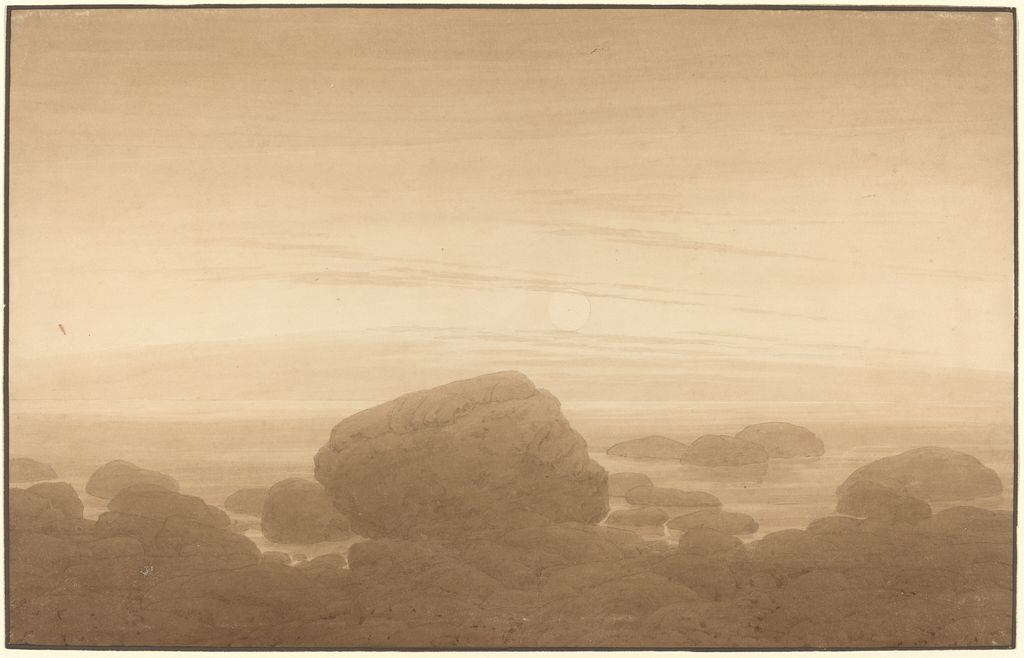
Such evidence is a reason to take the medium description on a museum label as the start of looking. In a wash drawing, the paper can supply a light value where little colour is laid down. Dense areas can mark changes of distance or structure without needing a different hue. A sharp edge can guide attention to a particular feature, and an extended area of tone can be organized through small changes that a viewer sees only after the main shapes are clear. The few apparent ingredients allow for a range of visual decisions, many made while water and pigment are still moving across the sheet.[20]
A late drawing at Dresden gives the questions about wash a different setting. Stony Beach at Moonrise (Stony Beach with Setting Sun) uses brown ink over graphite and returns to an earlier study of a Rügen beach. The layout of stones belongs to a highly particular observation. The means of recording it again in a finished sheet allow a viewer to see the local terrain within the large light of an ambiguous hour. An object can be recognizable in its shape and position while the atmosphere around it remains hard to identify. The wash helps make those two degrees of certainty available within a single image.[21]
Seen across the early sepias and the late beach, work on paper gave Friedrich ways to carry an observation forward without keeping every feature of the original drawing at the same level of emphasis. Graphite could fix the placement of stones. Brown wash could help redistribute visual attention across the sky and shore. The medium provided a way to test which relationships should be sharp and which should be left open. That is the same kind of decision that becomes visible through the unfinished oils, even though the support and working materials are different.[16][20][21]
Frequently Asked Questions
Discussion
How do the drawn ships change your reading of Monk by the Sea?
Reader Insights
Which study gives you the clearest view of a form Friedrich reused?
How do the drawn ships change your reading of Monk by the Sea?
What does the small oil study Evening show about the way Friedrich observed light?
Which study gives you the clearest view of a form Friedrich reused?
Join the Conversation
Share what you noticed in Technique and Studio Practice.
References
- Kristina Mösl and Francesca Schneider, “Romantic Icons: A Technical Study of the Underdrawing for Caspar David Friedrich’s Monk by the Sea and Abbey in the Oakwood”, in Studying the European Visual Arts 1800–1850, pp. 125–133.
- Markus Bertsch, “Evening”, Friedrich anniversary chronicle, from the 2023 Hamburger Kunsthalle exhibition catalogue.
- The Metropolitan Museum of Art, Caspar David Friedrich: The Soul of Nature, exhibition texts.
- The Metropolitan Museum of Art, Caspar David Friedrich: Moonwatchers, catalogue entry 4, Study of Two Trees.
- The Metropolitan Museum of Art, Eastern Coast of Rügen with Shepherd, object 2002.260.
- Holger Birkholz, “Bohemian Landscape with Milešovka Mountain”, Friedrich anniversary chronicle, from the 2023 Hamburger Kunsthalle exhibition catalogue.
- Alte Nationalgalerie, Caspar David Friedrich: Infinite Landscapes, exhibition texts, “Figure Outlines” and “Caspar David Friedrich’s Painting Technique.”
- Alte Nationalgalerie, Caspar David Friedrich: Infinite Landscapes, exhibition checklist, entries 91 and 94.
- Staatliche Museen zu Berlin, Man and Woman Contemplating the Moon, A II 887.
- Friedrich anniversary chronicle, Moonrise over the Sea, W.S. 53.
- The National Gallery, London, Winter Landscape, NG6517.
- John Leighton, Anthony Reeve and Aviva Burnstock, “A ‘Winter Landscape’ by Caspar David Friedrich”, National Gallery Technical Bulletin 13 (1989), pp. 44–60.
- The Metropolitan Museum of Art, Two Men Contemplating the Moon, 2000.51.
- The Metropolitan Museum of Art, Caspar David Friedrich: Moonwatchers, 2001 exhibition account, “Two Men Contemplating the Moon: Third Version.”
- Alte Nationalgalerie, Caspar David Friedrich Project, technical analysis, conservation and restoration.
- Metropolitan Museum of Art, The Soul of Nature exhibition texts and object labels, pp. 25–26, on the two unfinished oils.
- Matthias Alfeld, Kristina Mösl and Ina Reiche, Sunset and moonshine, X-Ray Spectrometry 50 (2021), pp. 341–350.
- Hessen Kassel Heritage, The transparent moonlight by Caspar David Friedrich, 2024 research exhibition.
- Morgan Library & Museum, Moonlit Landscape, Thaw Collection 1996.15.
- Three Early Sepia Drawings by Caspar David Friedrich: Art-technological Investigation and Retouching, technical study in Gerhard Banik, Wege in die Konservierungswissenschaft 2000–2008.
- Morgan Library & Museum, Stony Beach at Moonrise (Stony Beach with Setting Sun), Dresden sheet and curator commentary.