


 by Tom Gurney
Tom Gurney BSc (Hons) is an art history expert with over 20 years experience
Published on November 19, 2026 / Updated on November 19, 2026
Email: tomgurney1@gmail.com / Phone: +44 7429 011000
Rembrandt’s Life and Career, 1606–1669
Rembrandt's career began in Leiden, where he first put his name and dates on small history paintings, and ended in Amsterdam, where he was still painting large figures and self-portraits in his sixties. Between 1606 and 1669, the surviving evidence ranges from a teenager's university registration to an inventory drawn up for his creditors. It also includes things he made for audiences with very different expectations: a surgeon's group portrait, sheets of etchings that could travel without him, and a scene from ancient history ordered for Amsterdam's town hall. [2] [3] [11] [29] [33]
This timeline puts those records and works beside one another. A heading gives the year or span that can be established, while individual entries distinguish the date on an object from a museum's estimate, and an event from the later document that describes it. Use the biography for the continuous account, or follow the artwork and period links below to examine individual paintings, prints and documents. [4] [18] [34] [38]
At a Glance
- Date span1606–1669
- PlacesLeiden and Amsterdam
- Entries24 dated sections
- EvidenceArchives, museum records, paintings and prints
1606 · Birth in Leiden
The date traditionally given for Rembrandt Harmensz van Rijn's birth is 15 July 1606. It comes from the Leiden historian Jan Jansz Orlers, who included a short account of the painter in the second edition of his description of the city, published in 1641. Orlers was writing during Rembrandt's lifetime and in his native city. His notice is still several decades later than the birth it records. No baptismal record independently supplies the day, and a responsible chronology therefore gives the customary date together with its source. The year 1606 is used in most modern institutional accounts. [2] [5] [39]
Rembrandt's father, Harmen Gerritsz van Rijn, was a miller. His mother, Neeltgen Willemsdr van Zuijtbrouck, came from a baker's family. Harmensz in the painter's name means son of Harmen. These particulars place the child in a family with trades, property and relations within the city. They explain a little of the context in which he received schooling and entered an apprenticeship, and much less about the subjects or appearance of paintings he would produce twenty years later. The documented birth story and the later career can be set together without treating one as a forecast of the other. [2] [5] [11]
The language of the records also matters. A city historian identifying a native painter uses a different kind of evidence from a church officer recording a baptism or a clerk listing a burial. Orlers's entry is an early public account of a successful artist. It supplies details that would otherwise be lost and gives us a view of what Leiden considered worth recording about him in 1641. [5] [39]
1620–22 · Registration at Leiden University
In May 1620, Rembrandt's name was entered in Leiden University's matriculation records. He was still thirteen under the conventional birth date, with his fourteenth birthday due that summer. The surviving registration is a considerably firmer chronological reference than a reconstruction of his weekly studies. It establishes an administrative act. It leaves open how regularly he attended, what he heard, and when artistic training occupied most of his working time. Leiden University Libraries has also identified a separate registration in 1622. That second entry makes it difficult to draw a clean line in 1620 between formal schooling and painting. [3] [4] [5]
Orlers provides the account of the young Rembrandt choosing painting. His narrative connects schooling with a turn to apprenticeship, a sequence that makes good sense in a civic history. The university documents give the investigator a narrower but more precise kind of fact. The two sources can be read together: the young man had a documented institutional affiliation, and an author writing while he was alive understood painting to have drawn him away from the academic path. The chronology of his days in a classroom or a studio remains less exact. [3] [4] [11] [39]
These early records are often asked to do too much. Rembrandt's later use of the Bible, ancient history and classical subjects cannot tell us which lectures he attended. His pictures also came from a professional culture of pictures, prints, stories and conversation. A registration provides a starting point for asking about that education. It gives neither a reading list nor a hidden explanation for the art. The fuller account of the evidence is in Early Life. [3] [4] [9]
Early 1620s · Apprenticeship with Van Swanenburgh and Lastman
Orlers says that Rembrandt spent about three years with the Leiden painter Jacob Isaacsz van Swanenburgh and about six months with Pieter Lastman in Amsterdam. Those are useful durations, while the start and finish of either apprenticeship are harder to pin to a particular month. The second university entry makes some overlap in the chronology plausible. The association with Amsterdam also puts working contacts in that city several years before Rembrandt's substantial move into its portrait market. Travelling there to study and establishing a business there were distinct stages. [3] [4] [5] [11] [39]
Van Swanenburgh had worked in Italy and painted subjects that could demand complicated illumination. Lastman was known for histories with recognisable episodes, expressive gestures and carefully differentiated figures. It is tempting to assign every dark passage to one teacher and every narrative device to another. The existing evidence supports the broader point that Rembrandt encountered differing approaches to ambitious subjects early. A painting could use costume and architecture to establish a story, put a turning point in a hand or a glance, or direct attention by making one part of a crowded room abruptly brighter than the others. [5] [9] [11]
An apprenticeship also meant working inside someone else's system. Preparing materials, observing an experienced painter and studying existing compositions belonged to practical training. Rembrandt would later have to decide which of those habits to teach and how to organise a studio in which pupils could work alongside commissions. At this end of the timeline, the documented names of the masters are more secure than a list of exercises he performed for them. That difference is worth remembering when judging how confidently a particular feature of an early painting can be linked to a teacher. [5] [9] [10] [39]
1625–26 · The first dated histories
The signed and dated Stoning of Saint Stephen belongs to 1625. In the Lyon painting, Stephen is down on his knees, while men around him gather the weapons of the execution. Figure placement makes the action readable in more than one direction. The lowered body gives the foreground its subject, while heads and arms at varying heights bring the crowd into view as a group of participants with unequal roles. Identifications of particular faces have been proposed. The inscription on the painting is stronger evidence for its year than a resemblance is for the name of any man in the crowd. [6] [9]
The following year gives two further points of comparison. In Balaam and the Ass, Balaam's violence towards the animal is interrupted by an angel whose presence the donkey has perceived before its rider. The animal and rider respond to different parts of the same situation. In The Baptism of the Eunuch, bodies and gestures gather around a different kind of turning point, with the physical act of baptism giving the surrounding party something to witness. Both pictures rely on a readable story. The painter varies the amount of space he gives its witnesses and the way he makes the principal event arrest the eye. [7] [8] [9]
These small works show how quickly Rembrandt took on the task of making a large subject legible at an intimate scale. They also establish a chronological practice. A securely dated early painting gives curators a point against which to compare signatures, supports and handling elsewhere. Resemblance can draw another object into the discussion, while the evidence for its date or maker has to be weighed separately. [6] [7] [8]
About 1627–31 · Lievens, Huygens and the first pupils
Rembrandt and Jan Lievens developed reputations in Leiden at much the same time. Constantijn Huygens, who served the court of the Prince of Orange, considered both young painters worthy of extended attention. His autobiographical account is particularly useful because he looked for achievements in distinct pictures and distinguished the painters' strengths. In Rembrandt's treatment of Judas returning the silver, Huygens singled out the figure's expression of remorse. His response shows that a compact history could command the attention of a court official through the handling of a single body and face. [9] [11]
The precise relationship between their studios remains open. The artists studied many of the same problems, worked in proximity and can be compared through related subjects and experimental heads. A single jointly run room would make a tidy explanation, but the circumstances of their independent practices and occasional proximity are better evidence than any precise reconstruction of their working arrangements. Lievens developed a career of his own. Comparing their independent choices about scale, lighting and gesture makes more sense of Huygens's interest than treating either painter as a step in the other's development. [9] [11]
By the end of the Leiden period Rembrandt was also instructing younger artists. Gerrit Dou and Isaac de Jouderville are associated with this early phase. Documentary evidence of an annual payment by De Jouderville has a different value from attribution arguments about particular pictures. It shows that teaching could bring money to an already practising artist. It also shows why studio resemblance later became a normal condition of Rembrandt scholarship. Pupils entered a system in which close observation and repeated practice could produce convincing similarities. The existence of those similarities is something to explain before they can be used as evidence of a single hand. [9] [10] [11]
1631–32 · Amsterdam and the surgeons' commission
Rembrandt's connection with Hendrick van Uylenburgh can be placed in 1631, when the Amsterdam dealer and the painter were already financially involved. Accounts differ slightly in how they date the painter's move: the Rembrandt House Museum uses 1631, while the National Gallery of Art describes the residential move as occurring about 1632. The difference is intelligible in a working life that involved making arrangements, taking commissions and obtaining a place to live. The date range captures the transition from the Leiden practice to regular activity in Amsterdam. [2] [11] [40]
The commission that gives the transition an unmistakable public result is The Anatomy Lesson of Dr Nicolaes Tulp, dated 1632. The surgeons had an established reason to commission a group portrait. Rembrandt had to give the participants the distinction that paying members expected and create an event a viewer could follow. Tulp demonstrates the structures of the forearm, and the surrounding men's faces and lines of sight make several kinds of looking available within one picture. Some follow the demonstration, while others acknowledge a world beyond the immediate action. In a room full of heads, the cadaver also creates a long pale diagonal that changes the distribution of light. [12]
The anatomy lesson happened in the institutional world of the Surgeons' Guild. The picture is a commissioned arrangement, with its own requirements of likeness, visibility and dramatic clarity. Reading it as if it were a camera's record of the demonstration would flatten the painter's part in organising it. Reading it only as an exercise in light would obscure the relationships that made this particular grouping of men and this particular subject possible. The year 1632 joins the two accounts: a new portrait painter's opportunity and a guild's decision to represent its work. [11] [12]
1633–34 · Saskia and the expansion of the portrait practice
A silverpoint drawing traditionally associated with Rembrandt's betrothal to Saskia and the records surrounding their marriage are different kinds of witnesses. A portrait inscription actively shapes the memory of a meeting. Banns belong to a process that required the parties to announce their intention and identify themselves. Reading the papers together with the portrait helps place the relationship in time without asking the drawing to act as a formal register. Saskia came from a prominent Frisian family and was related to Hendrick van Uylenburgh, whose business was already important to Rembrandt's work. [11] [14] [15]
The marriage took place on 22 June 1634 in Sint Annaparochie. That date can be used with greater precision than many dates for the paintings that followed. Pictures linked with Saskia include informal studies, portraits and costumed figures. In Flora, dated 1634, flowers and an elaborate costume identify a role. A likeness and the identity performed in a picture can coexist, and the name of a sitter does not account for the painted figure's purpose. The distinction becomes especially important when later owners or artists gave titles to images for which little contemporary naming survives. [14] [15] [16] [40]
In the same period the Amsterdam portrait practice brought other sorts of assignments into the studio. Clients might appear alone, as members of a couple, or in a scene that presented work or status to a visitor. The more varied the practice became, the less useful a single picture is as a model for all the rest. A marriage can be dated on a particular June day. The development of relationships among painter, dealer, sitter and workshop is better understood as a set of overlapping changes. [9] [11] [14]
1635–38 · Amsterdam addresses and court pictures
The early married household had a succession of addresses before the couple bought a property. Rembrandt House Museum's chronology places Rembrandt and Saskia on the Nieuwe Doelenstraat in 1635 and at the house called the Suyckerbackerij on the Binnen Amstel in 1637. Their first child, Rombartus, died in infancy. Two daughters named Cornelia also died young, one in 1638 and the other in 1640. The documents that follow these moves and losses supply a scale closer to the everyday existence of the people than the dates of famous paintings alone. [2] [21] [40]
Rembrandt's link with the court of Frederik Hendrik gave him a sustained assignment in religious history. The paintings known as the Passion series were delivered across several years. A series established common requirements, including pictures that could be understood together as episodes, while each episode put a different burden on bodies, movement and light. The letters concerning the court pictures are unusually valuable because they connect artwork with requests, timing and payment. They allow the historian to distinguish the year in which a transaction can be documented from the potentially longer span of invention and execution. [9] [11] [13]
Consider the scale of work involved in the second half of the decade. A history for a court setting asked for the shaping of a scene from a received narrative. A private portrait asked for a resemblance, an attitude and a presentation that could make sense in the owner's rooms. They were both paid work, and they could coexist with drawings and etchings in which Rembrandt explored an idea on his own initiative. Losing the distinction between the commissions makes the chronology look like a simple march through styles. In practice the painter continued to take on differing kinds of work simultaneously. [9] [11] [13]
1639–40 · A house and a public image
In 1639 Rembrandt bought the wide Amsterdam property now occupied by the Rembrandt House Museum. The purchase price was 13,000 guilders. It gave him rooms in which the activities of a household and an artist's business could exist close together, with space for work, storage and the things he collected. He also accepted a major obligation. The price is a fact about a transaction and an indication of the magnitude of the decision. It cannot show, on its own, how he expected to meet the obligation or what every later interruption to his payments meant. Those questions belong with the subsequent property and financial records. [2] [18] [29] [40]
A print from 1639 and the National Gallery's Self-Portrait at the Age of 34 of 1640 show another side of the same period. In both, a figure leans on a support at the lower edge. The forearm helps set up a relationship with the spectator: the body has turned, the face is available to look at, and the arm appears comfortably at rest. In the painting a restrained pose can do much of the work that expensive-looking clothing might otherwise have to do. The image is carefully made and refers to prestigious portraiture of the past. [2] [17]
One source records a cost and the acquisition of an address. Another records a choice about how to appear. Seen together, they let us consider the painter's standing at the end of the 1630s through more than a shorthand notion of success. The property made possible particular kinds of work. The pictures display a kind of standing that the man who owned the house wished to claim through his art. [17] [18]
1641 · Titus is born and Orlers publishes
Titus, the fourth child of Rembrandt and Saskia, was born in September 1641. He was the only one of their children to survive childhood. Later family documents show him as a person with an interest in property, a party to business arrangements and eventually a husband. In 1641 the relevant event is a birth into an existing household, with earlier loss already part of its history. The boy's later appearances in art and archive can be traced from here without reading every child Rembrandt painted as Titus. Named and conjectural portraits require separate kinds of argument. [2] [21] [32] [40]
The same year brings the second edition of Orlers's history of Leiden. His account gives family information, a birth date and a sequence of teachers. Its appearance shows that the early story of the Amsterdam painter could already be told in print in the city where he grew up. It appeared while the events it describes were within living memory. It is still a retrospective account with a purpose of its own, designed for a description of Leiden rather than drawn up to answer present-day questions about authorship or enrolment. [5] [39]
In a short life chronology it is easy to place the Orlers account at the beginning and forget its own date. Keeping 1641 visible means that a visitor can ask two questions together: what the text says about 1606, and why a notice about the painter existed at all by 1641. This is one of the cases in which the document's publication deserves an entry alongside the events that it helps to date. [5] [39]
1642 · The militia portrait and Saskia's death
The Night Watch was completed in 1642 for the setting of Amsterdam's civic guard. The commission had to bring together the company's officers and members in a large room where other companies were represented. Captain Frans Banninck Cocq and Lieutenant Willem van Ruytenburch occupy the principal positions. Light picks out the lieutenant's clothing and passes unevenly across faces, weapons and other figures. The design gives the viewer more than one action to follow and makes room for people who appear partly hidden behind others. It makes a company's arrival or mobilisation an organising event in a civic portrait. [19] [20]
Technical examination gives access to an earlier stage within the making of the same picture. The Rijksmuseum detected traces of a preparatory sketch beneath its visible surface and has used imaging to show changes between early design and finished paint. The physical evidence matters because a date such as 1642 tends to present a work as one event. The canvas records several decisions, some superseded while it was still in the studio and some affected by its subsequent history. Completion, alterations made during execution and changes after delivery belong to different places in the painting's chronology. [19] [20]
Saskia died in the same year and was buried in Amsterdam's Oude Kerk. Her will and the records associated with her death have a bearing on how property would pass to Titus and how Rembrandt could continue to administer it. The coincidence of the death and the picture's date is striking. Their documentary connection is the household of the painter who made the picture. An account of his grief must leave open the relation between personal feeling and individual artistic decisions, for which these records offer little direct evidence. [11] [21]
1643 · Three trees and a passing storm
The Three Trees is dated 1643. Three trees rise on a bank at the right, silhouetted with unusual insistence against sky and light. Down towards the left the world continues on a small scale, with fields, water and distant activity. The printed marks that give weight to the trees are part of the same field as lighter passages where paper contributes most of what the eye sees. The effect depends on placing marks of strongly different densities next to one another. It is possible to follow the onset or passing of weather across the image without finding a single instant equally described in every part of it. [22]
Etching made this kind of orchestration repeatable. Working on a copperplate and printing from it were separate stages and could have different histories. A well-inked impression, wear on a plate, the character of a sheet of paper and the wiping of the surface could all affect what the black and white looked like in an individual print. A museum date for the design and the date an impression entered a collection are therefore different kinds of date. The edition history of an object may extend well beyond the day or year Rembrandt did the work for which its design is known. [22] [24]
The print belongs just after the great militia canvas. Their proximity is a reminder of what a calendar ordered solely around large commissions would lose. From one year to the next Rembrandt could direct a spectator through a room filled with bodies or across a broad sheet of land. The areas of strongest contrast do substantial work in both, and the size, materials and requirements of the two objects give that contrast different jobs. [19] [22]
Watch: Rembrandt’s life and work
Explore Rembrandt’s early career, etchings and paintings, and see his work alongside that of other Baroque artists.
Rembrandt | A Life of Art
Curators introduce Rembrandt’s early career and trace how he developed his handling of light and shade.
Watch on YouTube1647 · Jan Six at the window
An etched portrait of Jan Six dated 1647 shows him at a window, looking down into a book or papers. Six belonged to a wealthy Amsterdam family and had literary as well as commercial and civic interests. The portrait can describe him through activity and the conditions of seeing it. Light at the opening makes the reading legible while the interior stays comparatively dense. Objects in the room register through degrees of darkness. Six's absorption gives the spectator a relationship to the figure that would have been very different if he had turned his head straight out of the image. [2] [23]
This printed likeness can be compared with the later painted portrait of Jan Six, dated 1654. In that picture the attention given to the coat, gloves and emerging hands suggests an encounter with a person about to move. A sitter known on more than one occasion is an unusual opportunity to ask which elements of likeness the artist decides to carry from one medium and purpose to another. Neither picture supplies the whole character of its subject. Each gives him a credible occupation, with the distribution of light and visible detail helping to establish the kind of access the viewer has to him. [23] [41]
Dated pictures and prints can tell us that a relationship between an artist and a patron or sitter continued over a number of years. Financial documents may bring another part of that relationship into view. A loan creates obligations that a portrait by itself cannot substantiate. The more time there is between the sources, the more reason there is to distinguish the date of each encounter or transaction from a general statement about the warmth of a friendship. [2] [23] [32] [41]
Late 1640s · The Hundred Guilder Print and the dispute with Geertje
The large etching commonly called the Hundred Guilder Print is generally placed around the late 1640s. Its conventional name comes from its reputation in the market and cannot be read as a date or as a verified price for each impression. Around Christ Rembrandt has organised several episodes associated with a chapter in Matthew. The figures have different degrees of urgency: some approach or wait close by, while others shift weight or hold themselves apart. Changes in the density of the printed lines make one side of the composition feel different from the other, without making the figures cease to belong to a single gathering. [24]
Geertje Dirckx entered Rembrandt's household after Saskia's death and helped care for Titus. In 1649 the end of her relationship with Rembrandt appears in the legal record. It brought a dispute over obligations and support, with different parties advancing different accounts. Further proceedings resulted in Geertje's confinement in a house of correction in Gouda. Archive-based research helps to identify the people who brought information and the institutions able to act upon it. The papers have a vocabulary of complaint, petition and discipline that shapes what they tell us. [11] [25] [40]
The two entries share a portion of the calendar. They have importantly different evidentiary limits. The size, technique and visible arrangement of a print are open to examination in surviving impressions. The relationship that came under public scrutiny is available in part through records produced for litigation or administration, with views of the household voiced under specific pressures. Such papers are strong evidence that disputes occurred and that named people acted. They provide a more selective account of day-to-day life before and during the dispute. [24] [25]
1652–53 · A city fire and a plate reused
In 1652 the old town hall in Amsterdam burned. The Rembrandt House Museum lists a drawing by Rembrandt showing its ruins. The survival of both the subject and the observer's sheet is valuable for the timeline. A dated event in the city gives a point of reference for a drawing that belongs to it. The view also reminds us that the artist's visual record of Amsterdam consisted of more than commissioned images of officials. Civic buildings, their disappearance and changes visible from the street could become subjects in their own right. Within a decade, the municipality would commission Rembrandt to paint for the replacement town hall. [40] [42]
Around 1653 Rembrandt made The Flight into Egypt on an existing plate by Hercules Segers. Its previous composition was a landscape containing Tobias and the angel. Reworking the copper allowed substantial parts of the landscape to continue in a picture with a different journey. The final design had a material past, not merely a visual precedent. When a reworked impression is set beside one made before the change, parts of the countryside can remain recognisable even where the central figures give the whole place a new narrative identity. [43]
Putting the two objects beside one another makes a useful distinction between ways time can become visible in a work. The drawing has a date after which its principal subject existed in that condition. The print incorporates traces of work by another artist from an earlier period. Both reward comparison with related evidence. The image alone cannot yield the date of the fire or identify which marks survived from Segers without reference to other records and impressions. [42] [43]
1654 · Hendrickje, Cornelia and prints of the Passion
In 1654 the Amsterdam Reformed Church council summoned Hendrickje Stoffels and censured her over her relationship with Rembrandt. Their daughter Cornelia was baptised on 30 October. The church documents identify Hendrickje and establish the pressure she experienced in a public body separate from the painter's practice. The child born in this period is the Cornelia who survived Rembrandt. Earlier daughters of Rembrandt and Saskia also bore the name and died in infancy, a distinction it is easy to lose when several events are compressed into a table of births. [11] [26] [40]
In the Descent from the Cross by Torchlight, a plate dated 1654, the eye follows the lowered body through a night scene. Artificial light illuminates some hands, clothing and parts of the group, while darkness allows other areas to be understood only in relation to the torch. The waiting stretcher makes the next act visible early. The print belongs alongside several similarly scaled late religious prints, although a family of experiments in lighting is easier to establish than a formal edition issued together in an agreed order. Surviving impressions in different states show that presentation on paper could change after the year on the plate. [44]
The National Gallery's A Woman Bathing in a Stream is also dated 1654. It has often been associated with Hendrickje, and the museum keeps the proposal open in its title. The date belongs securely with the work. The guess at a person's identity belongs with the history of its interpretation. That difference is especially visible in a year that also gives us records in which Hendrickje's own name appears. An entry can therefore put the painting beside the documentary sequence without using it as a certified likeness. [26] [27]
1655 · A workshop scene in two versions
Two surviving paintings of Joseph accused by Potiphar's wife carry the episode into the bedroom after the attempted seduction. In the Washington example, the picture is currently catalogued as the work of Rembrandt's workshop and dated 1655. A second version in Berlin complicates any simple story of a finished original and a mechanical copy. What remains striking in both is the judicial character of the encounter: a woman offers evidence, a husband must decide how to read it, and Joseph is present as the person whose conduct is being judged. The painters have to give the fabric and bed a place in the argument as well as a place in the room. [28]
The catalogue weighs the place of the Washington picture in Rembrandt's workshop against the possibility of his more direct involvement. The difficulty is typical of the middle years of the career. A pupil or assistant could have practised the visual language of a particular master long enough to use much of it fluently. Repetition in a workshop could involve redesign, adaptation or different execution within a relatively stable scene. The degree of difference between two surviving versions is evidence for those questions, while the fact of a shared composition leaves room for several working relationships. [10] [28]
In a dated chronology the case should be retained precisely because it makes the standard of evidence visible. The workshop was an actual component of Rembrandt's work during the years at the Breestraat. A timeline that gives only the dates of accepted autograph works risks making those people disappear. A timeline that quietly promotes every workshop painting into the master's personal catalogue creates a different distortion. [18] [28]
1656 · Cession of goods and another anatomy lesson
In 1656 Rembrandt petitioned for cession of his goods. The proceeding brought creditors, claims and the artist's possessions into a formal process. An inventory was drawn up in July and followed the order of rooms in the house. It records art, books, objects used or kept in the studio and domestic belongings. Items that an artist might have encountered separately over many years came together in one document because they were now being listed in connection with debts. The list covers what the officials encountered and described at that point. A complete history of the collection would also have to account for what entered or left it at other times. [18] [29] [32]
The year also belongs to The Anatomy Lesson of Dr Deijman. Where the Tulp canvas sets the demonstration obliquely across a group, the Deijman design puts the dead man's foreshortened body in the centre of the spectator's path. The surgeon's position and parts of the larger group have to be reconstructed from the evidence that survived a later fire. The surviving fragment is a record of Rembrandt's 1656 work and of later damage. A drawing preserves information about the composition beyond the visible canvas. Comparison allows us to discuss the two anatomy paintings without silently restoring what the fragment has lost. [12] [30] [45]
Legal proceedings and a civic commission in the same year establish the painter's position more precisely than the word decline. Financial difficulty placed his property and independence under pressure. It also coexisted with a public assignment entrusted to him by a guild. The legal calendar measures what was happening to his capacity to hold property. The commission shows what he was still being asked to paint. [29] [30] [32]
1657–59 · Sales, the move and a dated self-portrait
The dispersal of the Breestraat household and the property itself followed the cession over several years. The house was sold in 1658, a distinct event from inventorying the possessions in 1656. By the next phase of the chronology Rembrandt was living on the Rozengracht in the Jordaan. The move altered the premises in which the household lived and the painter worked. The earlier building today allows a visitor to see rooms in which the artist's work was once conducted. Its present arrangement is a reconstruction informed by the documents, rather than a studio left in place when he moved. [2] [18] [29] [32] [40]
The signed and dated 1659 Self-Portrait in Washington shows a painter who was continuing to make substantial choices about his own representation. A dark costume gives weight to his body without demanding the degree of attention given to the face. The turned head and the disposition of light let the beholder see the expression and the physical work of painting it. The documented loss of property is relevant to when this canvas was made. Converting the expression directly into a statement about financial despair would require an account of the artist's intention that neither the canvas nor the documents provide. [29] [31]
The distance from the 1640 self-portrait is nineteen years. Both works impose a shape on the painter's appearance and draw on portrait conventions. Age is plainly important to the Washington painting, but changes in pose, costume and the relative emphasis of surface are acts of presentation as well. A chronology helps compare the works over an interval whose dates are known. It should allow observations about the paintings to stand beside, and sometimes independently of, what can be said about the painter's circumstances. [17] [31]
1660 · The Rozengracht household and its new firm
Hendrickje Stoffels and Titus entered into a partnership dealing in art in 1660. In the usual account of the arrangement, Rembrandt supplied work to the business while the partners handled its commercial side. The household was taking a formal step in response to an unsettled set of obligations. It is significant that the two named partners were people whose position is often described entirely through their relationship to the painter. The paperwork shows them acting as commercial parties in their own right. [2] [11] [32] [40]
The legally documented firm also gives the later address a role beyond that of a refuge after a sale. It was an address from which the family could sustain a business and Rembrandt could work. The former arrangement had combined ownership of a relatively large property, a collection, and a studio that had received pupils. A rented home offered a different basis for continued production. The records can identify parties and responsibilities. They reveal less about the precise course of negotiations with every patron or about the proportion of support that came from any one line of work. [11] [18] [32]
The chronology gives some perspective on what changed in 1660. Selling belongings and losing the former house did not clear every debt. Establishing a household business was one means of continuing under those conditions. Within the next two years Rembrandt's work was again on a civic scale, for the town hall and for the Drapers' Guild. Those commissions matter as individual opportunities rather than as proof that the earlier financial conditions had been reversed. [11] [32] [33] [34]
1661–62 · The new town hall and the Drapers' Guild
Rembrandt's canvas of The Conspiracy of Claudius Civilis was made for the new town hall. In the surviving portion the Batavian leader brings his allies together around a table, and swords gather over the meal as part of an oath. Low light gives import to a handful of faces and gestures. The subject, drawn from an ancient account, had a civic application in Amsterdam. Its intended architectural setting was large. The surviving painting is the central section of the original composition, so its present proportions can give a misleading impression of the distance at which the scene was originally to be seen. [11] [33]
The canvas was taken down in 1662. Its removal is documented more firmly than an explanation of precisely why it came down. Bringing surviving compositional evidence into the discussion can help recover the relation between the figures and the space around them. An explanation that sees only a difficult artist and an uncomprehending committee fills the gap with a familiar plot. The task, the temporary installation and the fragment that survived give us a chronology without requiring that explanation. [11] [33]
The Rijksmuseum dates The Syndics to 1662. It shows officials of the Drapers' Guild around a table, with the book and the arrangement of the men establishing the setting for their work. The angle of the table and the gaze of several men connect their activity to a viewer who has just come into their presence. Compare the guild painting with the town hall picture to see how two different requests could both generate a group gathered round a central surface. In one, the business of officials remains recognisable and contemporary. In the other, the assembly turns on a collective gesture in a historical narrative. The group portrait survived in a form that gives a much fuller sense of its original arrangement. [33] [34]
1663–64 · Hendrickje's death and Amsterdam in the drawings
Hendrickje was buried in the Westerkerk in 1663. The burial is a record of a death in the household and of a woman whose name is already present in business and church papers. Its location can be set beside the place of burial of Titus and, later, of Rembrandt. The church serving the Rozengracht neighbourhood recurs in the final part of the family story. Her death also changes the set of people then available to a household with several obligations and with Cornelia still young. [26] [32] [38]
In 1664 Rembrandt made drawings of Elsje Christiaens after her execution. The subject and approximate time can be placed through the surviving documents of her case. The Metropolitan Museum's sheet shows her body displayed on a gibbet, with a hatchet placed alongside as part of that display. The artist had to choose a side and a distance from which to record a form that would be seen from outside and below. The result is a drawing of a particular public event. How the artist responded to what he saw remains open beyond the act of recording it and the manner in which he did so. [29] [35]
The evidence of this part of the chronology is often local at a scale a finished painting cannot match. An entry in a funeral record, an image of a body displayed to the public and the business documents of the household each concern particular people in a particular city. They also underscore the selectivity of the more celebrated paintings. The dates of extant canvases are one record of the late career. They are accompanied by papers and smaller images that register different circumstances and different commitments of attention. [29] [32] [35] [38]
About 1665–69 · The late double portrait and the Kenwood painter
The Rijksmuseum places The Jewish Bride, its double portrait usually understood as Isaac and Rebecca, around 1665–69. The later familiar title carries a history of interpretation. The subject can be considered through dress, gesture and related representations of the biblical story, while the identity of any individual sitters is a separate question. The paint on the clothes is substantial. Gesture depends on the placement and overlap of the hands, with the thickness and colour of the cloth making a contrasting kind of contact visible. Assigning an anniversary or a particular event to the couple would go further than the evidence permits. [36]
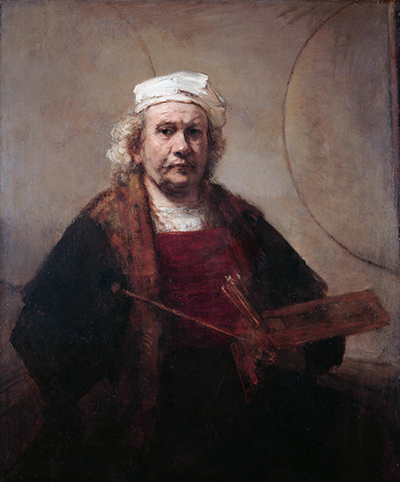
English Heritage dates the Kenwood Self-Portrait with Two Circles to about the middle of the 1660s. The man has a painter's implements, and the shapes behind him are visibly part of the design. Their precise meaning has been disputed. The result is less dependent on a solution to that puzzle than an anecdotal account might imply. Viewers can look at the distribution of work between the better defined face and the less elaborated tools, and at the way the broad movements on the wall affect the standing figure's scale. [1]
These are approximate entries because comparison and the surviving material evidence establish more than any single day or year can. The date range makes both paintings late, while its overlap with dated pictures can help a visitor see what kinds of handling and presentation were available to Rembrandt in his last years. It does not put the object with the broader range behind every other picture in the sequence. [1] [36] [37]
1668–69 · Titus, the last self-portraits and the burial
Titus married Magdalena van Loo in February 1668 and died later that year. The Amsterdam City Archives dates his burial in the Westerkerk to 7 September. The two events give a particularly short interval between a formal establishment of a household and its disruption. For Rembrandt, the death meant the loss of an adult son who had joined Hendrickje in the art business. The recognition of that commercial role helps make sense of why references to the family in the last years also appear in accounts of the painter's professional life. [2] [32] [38] [40]
The Mauritshuis has a self-portrait dated 1669. It is one of the dated works from the final year and gives us a more precise point of comparison with the portrait at Kenwood. The eyes and the mass of the head exert a different pull from the details of the costume. A self-portrait dated to the year of death can seem to invite a reading as a farewell. The date establishes proximity, and the image establishes a set of choices about how to represent a living face. The two facts remain valuable without an assumption that the painter meant to sum up his life. [1] [37]
Rembrandt died in Amsterdam on 4 October 1669 according to the family record kept by Nicolaes Sebastiaensz Vinck. The day was corrected in that account. The Westerkerk register independently establishes his burial on 8 October and gives the charge of fifteen guilders, the rate for a rented grave. The distinction between the two dates shows what the archive can do even at the end of a well-documented career. A family record supplies the accepted day of death. A record made in the ordinary operation of a church supplies the burial, its location and its cost. Neither establishes a cause of death. [2] [5] [38]
Rembrandt artworks
Different impressions of the same print can appear as separate records.
| Name | Date | Medium |
|---|---|---|
| The Night Watch | 1642 | Painting |
| The Return of the Prodigal Son | 1660s | Painting |
| The Anatomy Lesson of Dr Nicolaes Tulp | 1632 | Painting |
| The Jewish Bride | c. 1665–69 | Painting |
| Self-Portrait with Two Circles | c. 1665 | Painting |
| Christ in the Storm on the Sea of Galilee | 1633 | Painting |
| Bathsheba at Her Bath | 1654 | Painting |
| The Hundred Guilder Print | c. 1648–49 | |
| The Three Trees | 1643 | |
| Aristotle with a Bust of Homer | 1653 | Painting |
| The Abduction of Ganymede | 1635 | Painting |
| Ahasuerus and Haman at the Feast of Esther | 1660 | Painting |
| The Anatomy Lesson of Dr Jan Deijman | 1656 | Painting |
| Judith at the Banquet of Holofernes | 1634 | Painting |
| Artist in His Studio | c. 1628 | Painting |
| The Artist’s Mother, Head and Bust, Three-Quarters Right | 1628 | |
| The Artist’s Mother, Head Only, Full Face | 1628 | |
| Balaam and the Ass | 1626 | Painting |
| The Baptism of the Eunuch | 1626 | Painting |
| Beggar in a High Cap, Standing and Leaning on a Stick | c. 1629 | |
| Beggar with a Clenched Hand, Leaning on a Stick | c. 1629 | |
| Belshazzar’s Feast | c. 1636–38 | Painting |
| The Blinding of Samson | 1636 | Painting |
| Bust of a Bearded Young Man with a Skullcap | 1663 | Painting |
| Christ Presented to the People | 1655 | |
| The Circumcision | c. 1625 | |
| The Conspiracy of Claudius Civilis | c. 1661–62 | Painting |
| Danaë | Begun 1636 and later revised | Painting |
| The Descent from the Cross | 1632–33 | Painting |
| Descent from the Cross by Torchlight | 1654 | |
| The Descent from the Cross, Second Plate | 1633 | |
| Diana Bathing with Her Nymphs, with Actaeon and Callisto | 1634 | Painting |
| Ephraim Bueno, Jewish Physician | 1647 | |
| Portrait of Frederick Rihel on Horseback | c. 1663 | Painting |
| Flora | 1634 | Painting |
| The Goldweigher’s Field | 1651 | |
| Head of Christ | 1645–50 | Painting |
| The Holy Family with Angels | 1645 | Painting |
| Homer Dictating His Verses | 1663 | Painting |
| Jacob Blessing the Sons of Joseph | 1656 | Painting |
| Jacob Wrestling with the Angel | 1659–60 | Painting |
| Joseph and Potiphar’s Wife | 1655 | Painting |
| Juno | c. 1662–65 | Painting |
| Landscape with a Stone Bridge | c. 1638 | Painting |
| Head of an Old Man with Curly Hair | 1659 | Painting |
| A Man in Armour | Possibly 1655 | Painting |
| Minerva in Her Study | 1635 | Painting |
| Moses with the Tablets of the Law | 1659 | Painting |
| Old Man with a Gold Chain | c. 1631 | Painting |
| Peter and John at the Gate of the Temple | c. 1629 | |
| Philosopher in Meditation | 1632 | Painting |
| The Polish Rider | c. 1655 | Painting |
| Portrait of a Woman with a Lapdog | c. 1665 | Painting |
| Portrait of Gerard de Lairesse | 1665–67 | Painting |
| Portrait of Jan Six | c. 1654 | Painting |
| Portrait of Maerten Soolmans | 1634 | Painting |
| Portrait of a Woman, Probably Maria Trip | 1639 | Painting |
| Portrait of Oopjen Coppit | 1634 | Painting |
| Portrait of Titus | c. 1662 | Painting |
| Rembrandt and Saskia in the Parable of the Prodigal Son | c. 1635 | Painting |
| The Raising of Lazarus | c. 1630–32 | Painting |
| The Rest on the Flight into Egypt | c. 1626 | |
| Self-Portrait as the Apostle Paul | 1661 | Painting |
| Self-Portrait (Cologne) | c. 1668 | Painting |
| Rembrandt’s Self-Portrait, Frowning | 1630 | |
| Self-Portrait in a Cap, Wide-Eyed and Open-Mouthed | 1630 | |
| Self-Portrait in a Fur Cap | 1630 | |
| Self-Portrait in a Fur Cap, in an Oval Border | c. 1629 | |
| Self-Portrait in a Soft Hat and Embroidered Cloak | 1631 | |
| Self-Portrait, Bending Forward | c. 1628 | |
| Self-Portrait with a Broad Nose | c. 1628 | |
| Self-Portrait with Beret and Turned-Up Collar | 1659 | Painting |
| Self-Portrait with Plumed Cap and Lowered Sabre | 1634 | |
| The Shipbuilder and His Wife | 1633 | Painting |
| Simeon’s Hymn of Praise | c. 1640 | |
| Simeon in the Temple | c. 1669 | Painting |
| St Jerome Kneeling | c. 1628–29 | |
| Saint Matthew and the Angel | 1661 | Painting |
| The Stoning of Saint Stephen | 1625 | Painting |
| A Stout Man in a Large Cloak | c. 1629 | |
| The Supper at Emmaus | 1648 | Painting |
| Susanna and the Elders | 1647 | Painting |
| The Syndics of the Drapers’ Guild | 1662 | Painting |
| The Mill | 1645/1648 | Painting |
| The Woman Taken in Adultery | 1644 | Painting |
| Lucretia (1664) | 1664 | Painting |
| Lucretia (1666) | 1666 | Painting |
| Anatomische les van Dr. Jan Deijman (fragment) | 1656 | Painting |
| Isaac and Rebecca, Known as ‘The Jewish Bride’ | c. 1665 - c. 1669 | Painting |
| Johannes Wtenbogaert | 1633 | Painting |
| Man in Oriental Dress | 1635 | Painting |
| Musical Company | 1626 | Painting |
| Portrait of Ephraim Bueno | 1645 - 1647 | Painting |
| Portrait of Haesje Jacobsdr van Cleyburg | 1634 | Painting |
| Portrait of Oopjen Coppit | 1634 | Painting |
| Self-portrait | c. 1628 | Painting |
| Still Life with Peacocks | c. 1639 | Painting |
| Tobit and Anna with the Kid | 1626 | Painting |
| Young Woman in Fantasy Costume | 1633 | Painting |
| A Polish Nobleman | 1637 | Painting |
| A Woman Holding a Pink | 1656 | Painting |
| A Young Man Seated at a Table (possibly Govaert Flinck) | c. 1660 | Painting |
| Man with a Sheet of Music | 1633 | Painting |
| Philemon and Baucis | 1658 | Painting |
| Portrait of a Gentleman with a Tall Hat and Gloves | c. 1656/1658 | Painting |
| Portrait of a Lady with an Ostrich-Feather Fan | c. 1656/1658 | Painting |
| Portrait of a Man in a Tall Hat | c. 1663 | Painting |
| Saskia van Uylenburgh, the Wife of the Artist | probably begun 1634/1635 and completed 1638/1640 | Painting |
| The Circumcision | 1661 | Painting |
| Bellona | 1633 | Painting |
| Flora | ca. 1654 | Painting |
| Hendrickje Stoffels (1626–1663) | mid-1650s | Painting |
| Herman Doomer (ca. 1595–1650) | 1640 | Painting |
| Man in a Turban | 1632 | Painting |
| Man with a Magnifying Glass | early 1660s | Painting |
| Portrait of a Man | 1632 | Painting |
| Portrait of a Man Holding Gloves | 1648 | Painting |
| Portrait of a Man, probably a Member of the Van Beresteyn Family | 1632 | Painting |
| Portrait of a Woman | 1633 | Painting |
| Portrait of a Woman, probably a Member of the Van Beresteyn Family | 1632 | Painting |
| Portrait of a Young Woman with a Fan | 1633 | Painting |
| The Standard Bearer (probably Floris Soop, 1604–1657) | 1654 | Painting |
| The Toilet of Bathsheba | 1643 | Painting |
| Woman with a Pink | early 1660s | Painting |
| Lieven Willemsz van Coppenol (born about 1599, died 1671 or later) | Painting | |
| Portrait of a Man | ca. 1655–60 | Painting |
| Self-Portrait | 1660 | Painting |
| A Cap | c. 1629 - c. 1630 | Drawing |
| A Cow in a Shed | c. 1640 | Drawing |
| A Syndic of the Drapers’ Guild, Jacob van Loon, Seated | c. 1661 - c. 1662 | Drawing |
| Abraham Casting Out Hagar and Ishmael | c. 1650 | Drawing |
| Actor in the Role of Pantalone Engaged in Conservation | c. 1634 - c. 1636 | Drawing |
| Bedroom with Saskia in a Canopy Bed | c. 1638 | Drawing |
| Beheading of John the Baptist | c. 1640 - c. 1641 | Drawing |
| Boaz and Ruth | c. 1645 | Drawing |
| Boy Walking with a Stick | c. 1635 - c. 1640 | Drawing |
| Christ Appearing to Mary Magdalene as a Gardener (Noli me tangere) | c. 1645 | Drawing |
| Christ Healing a Leper | c. 1650 - c. 1655 | Drawing |
| Christ Washing the Disciples’ Feet | c. 1640 - c. 1650 | Drawing |
| Cottage with White Paling among Trees | c. 1648 | Drawing |
| Daniel in the Lions’ Den | c. 1650 | Drawing |
| David Hearing the News of Uriah’s Death | c. 1650 | Drawing |
| Five Studies of Haman’s Head | c. 1655 - c. 1660 | Drawing |
| Four Men Standing, Wearing Hats | c. 1650 | Drawing |
| Indian Archer | c. 1656 - c. 1658 | Drawing |
| Inn on the Amstelveenseweg | c. 1652 | Drawing |
| Jacob and his Sons | c. 1641 | Drawing |
| Jael Killing Sisera | c. 1658 - c. 1659 | Drawing |
| Jahangir | c. 1656 - c. 1658 | Drawing |
| Joseph in Prison Interpreting the Dreams of the Butler and the Baker | c. 1650 - c. 1655 | Drawing |
| Longhouse Farmstead with a Haystack in a Polder Landscape | c. 1652 | Drawing |
| Man Helping a Rider to Mount a Horse | c. 1640 - c. 1641 | Drawing |
| Nude Woman Lying on a Pillow | c. 1661 - c. 1662 | Drawing |
| Nude Woman Seated by a Stove | c. 1661 - c. 1662 | Drawing |
| One of the Three Kings Adoring the Virgin and Child | c. 1635 - c. 1640 | Drawing |
| Recumbent Lion | c. 1660 | Drawing |
| Saskia in Bed | c. 1635 | Drawing |
| Seated Actor in the Role of Capitano | c. 1634 - c. 1636 | Drawing |
| Self-portrait with Tousled Hair | c. 1628 - c. 1629 | Drawing |
| Shah Jahan | c. 1656 - c. 1658 | Drawing |
| Shah Jahan and his Son | c. 1656 - c. 1658 | Drawing |
| Small Study of the Head of the Sick Woman | c. 1647 - c. 1648 | Drawing |
| Standing Man with a Pouch | c. 1629 - c. 1630 | Drawing |
| Standing Man with a Stick, Facing Left | c. 1629 - c. 1630 | Drawing |
| Standing Man with a Stick, Facing Right | c. 1629 - c. 1630 | Drawing |
| Standing Man with Outstretched Arm | c. 1636 - c. 1641 | Drawing |
| Studies for the Sick Woman in the ‘Hundred Guilder Print’ | c. 1648 | Drawing |
| Studies of the Mourning Magdalen and the Virgin | c. 1635 - c. 1636 | Drawing |
| Study of a Man, Seen from Behind | c. 1629 - c. 1630 | Drawing |
| Study of a Woman’s Legs | c. 1628 - c. 1629 | Drawing |
| Susanna and the Elders | c. 1650 - c. 1655 | Drawing |
| The Actor Willem Bartholsz Ruyter as a Peasant | c. 1638 | Drawing |
| The Actor Willem Bartholsz Ruyter as King Ahasuerus on his Throne | c. 1635 - c. 1640 | Drawing |
| The Angel Appearing to Joseph in his Dream | c. 1650 | Drawing |
| The Annunciation to the Shepherds | c. 1650 | Drawing |
| The Entombment, over a Sketch of an Executioner | c. 1640 - c. 1641 | Drawing |
| The Pancake Woman | c. 1635 | Drawing |
| The Swijgh Utrecht Tower in Amsterdam | c. 1650 - c. 1655 | Drawing |
| Three Orientals Conversing | c. 1645 | Drawing |
| Three Scribes | c. 1628 - c. 1629 | Drawing |
| Three Women and a Child by a Door | c. 1645 | Drawing |
| Tobias and the Angel Taking Leave of Raguel | c. 1650 - c. 1655 | Drawing |
| Two Horses at a Halting-place | c. 1637 | Drawing |
| View of the Amstel from the Blauwbrug | c. 1645 - c. 1650 | Drawing |
| View of the Amstelveenseweg outside Amsterdam | c. 1660 - c. 1662 | Drawing |
| View of the Nieuwezijds Voorburgwal | c. 1647 | Drawing |
| Walking Man with a High Cap | c. 1655 - c. 1660 | Drawing |
| Winter View with a Waterway, Cottages and Two Boats | c. 1650 | Drawing |
| Woman with a Urinating Child | c. 1658 - c. 1660 | Drawing |
| Young Woman Seated by a Window (Saskia?) | c. 1638 | Drawing |
| A Landscape with Farm Buildings among Trees | c. 1650/1655 | Drawing |
| Beggar Man and Woman | c. 1630/1631 | Drawing |
| Beggar Woman Leaning on a Stick | 1628/1630 | Drawing |
| Bust of an Elderly Man in a Flat Cap | 1635/1637 | Drawing |
| Cottages and Barn beside a Road | c. 1650 | Drawing |
| Esther before Ahasuerus | 1655/1660 | Drawing |
| Figures on the Anthoniesdijk Entering Houtewael [verso] | c. 1650 | Drawing |
| God the Father Supported by Angels | 1655/1660 | Drawing |
| Head of an Old Man (recto) | c. 1631 | Drawing |
| Jan Cornelisz Sylvius, the Preacher | 1644/1645 | Drawing |
| Joseph Recounting His Dreams | early 1640s | Drawing |
| Seated Old Man | 1630 | Drawing |
| Self-Portrait | c. 1637 | Drawing |
| View of Diemen | c. 1655 | Drawing |
| View of Houtewael near the Sint Anthoniespoort [recto] | c. 1650 | Drawing |
| View over the Amstel from the Rampart | c. 1646/1650 | Drawing |
| Woman Seated on the Ground with Two Children | 1635/1640 | Drawing |
| Cottage among Trees | ca. 1650 | Drawing |
| Cottage near the Entrance to a Wood | 1644 | Drawing |
| Elsje Christiaens Hanging on a Gibbet | 1664 | Drawing |
| Group of Farm Buildings | ca. 1648–52 | Drawing |
| Houses by the Water | ca. 1652 | Drawing |
| Nathan Admonishing David | 1650–55 | Drawing |
| Old Man in Profile | 1620–69 | Drawing |
| Old Man Leaning on a Stick | 1632–35 | Drawing |
| Potiphar's Wife Accusing Joseph Before her Husband | 1620–69 | Drawing |
| Satire on Art Criticism | 1644 | Drawing |
| Seated Man Wearing a Flat Cap | 1635–40 | Drawing |
| St. Peter and St John Healing the Paralytic | 1606–69 | Drawing |
| Study Sheet with Three Women and a Boy | ca. 1638–39 | Drawing |
| The Last Supper, after Leonardo da Vinci | 1634–35 | Drawing |
| The Wedding Night of Tobias and Sarah | 1640–49 | Drawing |
| Two Cottages | ca. 1636 | Drawing |
| Two Studies of a Woman Reading | 1635–40 | Drawing |
| Woman Reading | 1606–69 | Drawing |
| The Annunciation to the Shepherds | c. 1655 | Drawing |
| Elsje Christiaens Hanging on a Gibbet | 1664 | Drawing |
| A blind hurdy-gurdy player and family receiving alms | 1648 | Print impression |
| A cavalry fight | 1629 | Print impression |
| A Polander with a Stick | c. 1631 | Print impression |
| A scholar in his study | c. 1652 | Print impression |
| A Scholar in his Study (‘Faust’) | c. 1652 | Print impression |
| A standing hurdy-gurdy player | c. 1631 | Print impression |
| Aanbidding der herders: nachtstuk | 1650 - 1654 | Print impression |
| Abraham Francen | c. 1657 | Print impression |
| Abraham Francen, apothecary | c. 1657 | Print impression |
| Arnout Tholinx | c. 1656 | Print impression |
| Bald headed man in profile right: the artist's father (?) | 1630 | Print impression |
| Bald man with open mouth, looking down: bust | c. 1631 | Print impression |
| Bald Old Man with a Short Beard | c. 1635 | Print impression |
| Bearded man with short wavy hair: bust | c. 1631 | Print impression |
| Bearded Old Man with High Forehead | c. 1629 | Print impression |
| Bedelaar met een houten been | 1628 - 1632 | Print impression |
| Bedelaar met een stok | 1631 | Print impression |
| Beggar in a high cap, standing and leaning on a stick | c. 1629 | Print impression |
| Beggar in a High Hat, Leaning on a Stick | c. 1629 | Print impression |
| Beggar leaning on a stick, facing left | c. 1630 | Print impression |
| Beggar Man and Woman | c. 1629 | Print impression |
| Beggar Man and Woman behind a Bank | c. 1630 | Print impression |
| Beggar seated warming his hands at a chafing dish | c. 1630 | Print impression |
| Beggar Warming his Hands | c. 1630 | Print impression |
| Beggar with a clenched hand, leaning on a stick | c. 1629 | Print impression |
| Beggar with a Cottage and Two Figures in the Background | c. 1629 | Print impression |
| Beggar with a Crippled Hand, Leaning on a Stick | c. 1629 | Print impression |
| Beggar with a Wooden Leg | c. 1630 | Print impression |
| Beggar Woman with a Gourd | c. 1629 | Print impression |
| Beggar, Seated in an Armchair | c. 1629 | Print impression |
| Bust of an old man with a fur cap and flowing beard, nearly full face | c. 1631 | Print impression |
| Bust of an old man with flowing beard and white sleeve | c. 1630 | Print impression |
| Christ and the woman of Samaria among ruins | 1634 | Print impression |
| Christ before Pilate: large plate | 1635 | Print impression |
| Christ Crucified between the Two Thieves | c. 1641 | Print impression |
| Christ Crucified between the two Thieves: 'The Three Crosses' | 1653 | Print impression |
| Christ crucified between the two thieves: an oval plate | c. 1641 | Print impression |
| Christ Disputing with the Doctors | 1630 | Print impression |
| Christ disputing with the Doctors: small plate | 1630 | Print impression |
| Christ Healing the Sick (‘Hundred Guilder Print’) | c. 1648 | Print impression |
| Christ Preaching | c. 1657 | Print impression |
| Christ preaching ('La Petite Tombe') | c. 1657 | Print impression |
| Christ Preaching, known as La petite tombe | c. 1657 | Print impression |
| Christ Presented to the People (Ecce Homo) | 1655 | Print impression |
| Christ presented to the people: oblong plate | 1655 | Print impression |
| Christus en de schriftgeleerden: kleine plaat | 1630 | Print impression |
| Clump of trees with a vista | 1652 | Print impression |
| Cottage and Boundary Post on the Spaarndammerdijk | c. 1650 | Print impression |
| Cottage and boundary post on the Spaarndammerdijk ('L'Obelisque') | c. 1650 | Print impression |
| Cottage and Farm Buildings with a Man Sketching | c. 1641 | Print impression |
| Cottage beside a canal with a view of Ouderkerk | c. 1641 | Print impression |
| Cottages beside a Canal: View of Ouderkerk aan de Amstel | c. 1641 | Print impression |
| David in gebed | 1652 | Print impression |
| Diana at the bath | c. 1631 | Print impression |
| Driekoningen: een nachtstuk | 1649 - 1653 | Print impression |
| Een student aan tafel bij kaarslicht | c. 1642 | Print impression |
| Farmhouse among Trees | 1652 | Print impression |
| Geleerde in zijn werkkamer (Faust) | 1650 - 1807 | Print impression |
| Girl with a basket | c. 1642 | Print impression |
| Goudsmid | 1655 | Print impression |
| Grotesque profile: man in a high cap | c. 1629 | Print impression |
| Head of a Man in a Fur Cap, Crying Out | c. 1629 | Print impression |
| Head of a man in a high cap | c. 1629 | Print impression |
| Head of a Man in a High Hat | c. 1629 | Print impression |
| Head of an Old Man in a High Fur Hat | c. 1629 | Print impression |
| Hieronymus geknield in gebed, de blik naar beneden gericht | 1635 | Print impression |
| Honderd Gulden prent | 1753 - 1810 | Print impression |
| Jacob's ladder | 1655 | Print impression |
| Jan Antonides van der Linden | 1665 | Print impression |
| Jan Asselijn, painter | 1645 - 1649 | Print impression |
| Jan Lutma, goldsmith | 1656 | Print impression |
| Jan Six | 1647 | Print impression |
| Johannes Lutma | 1656 | Print impression |
| Johannes Wtenbogaert | 1635 | Print impression |
| Jongeman, zittend en staand | 1644 - 1648 | Print impression |
| Jozef vertelt zijn dromen | 1638 | Print impression |
| Kruisiging: kleine plaat | 1633 - 1637 | Print impression |
| Landscape with a cow drinking | c. 1650 | Print impression |
| Landscape with a farm building and the 'house with the tower' | c. 1650 | Print impression |
| Landscape with a farmhouse along a road beside a canal | c. 1652 | Print impression |
| Landscape with a Fisherman (‘The Milkman’) | c. 1650 | Print impression |
| Landscape with sportsman and dogs | c. 1648 | Print impression |
| Landscape with Sportsman and Dogs (‘Het jagertje’) | c. 1648 | Print impression |
| Landschap met drinkende koe | 1648 - 1652 | Print impression |
| Lieven Willemsz van Coppenol | c. 1658 | Print impression |
| Lieven Willemsz. van Coppenol, writing master: the larger plate | c. 1658 | Print impression |
| Lieven Willemsz. van Coppenol, writing master: the smaller plate | c. 1658 | Print impression |
| Loflied van Simeon | 1637 - 1641 | Print impression |
| Male nude, seated and standing | c. 1646 | Print impression |
| Man Crying Out | c. 1629 | Print impression |
| Man drawing from a cast | c. 1641 | Print impression |
| Man Drawing from a Plaster Cast | c. 1641 | Print impression |
| Man in a Close Cap | 1630 | Print impression |
| Man in a Square Cap, in Profile to the Right | c. 1629 | Print impression |
| Man in cap bound around his chin | c. 1631 | Print impression |
| Man with square beard and curly hair: bust | c. 1631 | Print impression |
| Man, tekenend naar een gipsmodel | 1639 - 1643 | Print impression |
| Medea: or the marriage of Jason and Creusa | 1648 | Print impression |
| Naked woman on a mound | c. 1631 | Print impression |
| Old Bearded Man, with Mouth Half Open | c. 1629 | Print impression |
| Old beggar woman with a gourd | c. 1629 | Print impression |
| Old Man in a Fur Coat and Tall Hat | c. 1629 | Print impression |
| Old man in meditation, leaning on a book | c. 1645 | Print impression |
| Old Man Lost in Meditation, Leaning on a Book | c. 1645 | Print impression |
| Old Man Shading his Eyes with his Hand | c. 1639 | Print impression |
| Old Man with a Flowing Beard and White Sleeve | c. 1630 | Print impression |
| Old Man with a Fur Cap and Flowing Beard | c. 1631 | Print impression |
| Old Man, Seen from Behind | c. 1629 | Print impression |
| Old Woman Seated in a Cottage, with a String of Onions | c. 1629 | Print impression |
| Old woman seated in a cottage, with a string of onions on the wall | c. 1629 | Print impression |
| Old Woman Sleeping | c. 1636 | Print impression |
| Oude bedelares met kalebas | 1628 - 1632 | Print impression |
| Peasant family on the tramp | c. 1652 | Print impression |
| Pieter Haaringh: hands and hat | 1655 | Print impression |
| Polander leaning on a stick | c. 1631 | Print impression |
| Portrait of Abraham Francen | c. 1657 | Print impression |
| Portrait of Lieven Willemsz van Coppenol, known as ‘The Smaller Plate’ | c. 1658 | Print impression |
| Portret van de apotheker Abraham Francen | 1655 - 1807 | Print impression |
| Portret van de schrijfmeester Lieven Willemsz. van Coppenol: grote plaat | 1658 | Print impression |
| Portret van predikant Cornelis Claesz. Anslo | 1641 | Print impression |
| Portret van Rembrandt | 1638 | Print impression |
| Profile of a Man in a High Hat | c. 1629 | Print impression |
| Ragged Peasant with his Hands behind him | c. 1630 | Print impression |
| Ragged peasant with his hands behind him, holding a stick | c. 1630 | Print impression |
| Rembrandt’s Mother | 1628 | Print impression |
| Rest on the Flight into Egypt at Night | 1642 - 1646 | Print impression |
| Rest on the flight into Egypt: a night piece | c. 1644 | Print impression |
| Rondtrekkende boerenfamilie | 1650 - 1654 | Print impression |
| Saint Jerome Reading in an Italianate Landscape | c. 1653 | Print impression |
| Schatpenning | 1633 - 1637 | Print impression |
| Self-portrait Bare-headed | c. 1629 | Print impression |
| Self-portrait etching at a window | 1648 | Print impression |
| Self-portrait in a cap and dark cloak: bust | c. 1631 | Print impression |
| Self-portrait in a cap and scarf with the face dark: bust | 1633 | Print impression |
| Self-portrait in a Fur Cap | c. 1629 | Print impression |
| Self-portrait in a Soft Cap | c. 1634 | Print impression |
| Self-portrait in a soft hat and a patterned cloak | 1631 | Print impression |
| Self-portrait in a Soft Hat and Patterned Cloak | 1631 | Print impression |
| Self-portrait in a velvet cap with plume | 1638 | Print impression |
| Self-portrait leaning forward: bust | c. 1629 | Print impression |
| Self-portrait wearing a soft cap: full face, head only | c. 1634 | Print impression |
| Self-portrait with a Broad Nose | c. 1628 | Print impression |
| Self-portrait with bushy hair: bust | c. 1631 | Print impression |
| Self-portrait with cap pulled forward | c. 1630 | Print impression |
| Self-portrait with long bushy hair: head only | c. 1631 | Print impression |
| Self-portrait with Long, Bushy Hair | c. 1631 | Print impression |
| Self-portrait, Bending Forward | c. 1628 | Print impression |
| Self-portrait, frowning: bust | 1630 | Print impression |
| Self-portrait, Leaning Forward | c. 1629 | Print impression |
| Sheet of Slight Studies, One of Two Peasants | c. 1651 | Print impression |
| Sheet of studies of men's head: old man in fur coat and high cap | c. 1629 | Print impression |
| Sheet of studies of men's heads: man crying out, three quarters left: bust | c. 1629 | Print impression |
| Sheet of studies of men's heads: old bearded man nearly in profile to right: mouth half open | c. 1629 | Print impression |
| Sheet of studies of men's heads: old man seen from behind, profile right: half-figure | c. 1629 | Print impression |
| Sheet of Studies with a Tree and the Upper Part of Rembrandt’s Head in a Velvet Cap | c. 1644 | Print impression |
| Sheet of Studies, with a Self-portrait, a Beggar Couple, and Heads of an Old Man and Old Woman | 1632 | Print impression |
| Sheet of Studies, with a Woman Lying Ill in Bed | c. 1639 | Print impression |
| Sheet of studies, with a woman lying ill in bed: busts of two male figures | c. 1639 | Print impression |
| Sheet of studies: head of the artist | 1632 | Print impression |
| Sheet of studies: head of the artist, a beggar couple, heads of an old man and old woman, etc. | 1632 | Print impression |
| Sick woman with a large white headdress (Saskia) | c. 1645 | Print impression |
| Sick Woman with a White Headdress (Saskia) | c. 1645 | Print impression |
| Sleeping Puppy | c. 1640 | Print impression |
| Small Grey Landscape | c. 1640 | Print impression |
| St Jerome beside a pollard willow | 1648 | Print impression |
| St Jerome Kneeling | c. 1628 | Print impression |
| St Jerome kneeling in prayer, looking down | 1635 | Print impression |
| St Jerome reading in an Italian landscape | c. 1653 | Print impression |
| St Peter and St John at the gate of the temple: roughly etched | c. 1629 | Print impression |
| Star of the Kings | c. 1651 | Print impression |
| Straatmuzikanten | 1632 - 1637 | Print impression |
| Strolling Musicians | c. 1635 | Print impression |
| Study of the Head of a Woman | c. 1635 | Print impression |
| The Adoration of the Shepherds | c. 1657 | Print impression |
| The adoration of the shepherds: a night piece | c. 1657 | Print impression |
| The Adoration of the Shepherds: Nocturne | c. 1657 | Print impression |
| The Artist Drawing from a Model | c. 1639 | Print impression |
| The artist drawing from the model | c. 1639 | Print impression |
| The artist's mother seated at a table, looking right: three quarter length | c. 1631 | Print impression |
| The Baby Walker | c. 1646 | Print impression |
| The beheading of St John the Baptist | c. 1631 | Print impression |
| The Blindness of Tobit | c. 1629 | Print impression |
| The blindness of Tobit: a sketch | c. 1629 | Print impression |
| The circumcision | c. 1625 | Print impression |
| The circumcision: small plate | c. 1630 | Print impression |
| The Entombment | c. 1654 | Print impression |
| The Flight into Egypt | c. 1628 | Print impression |
| The Flight into Egypt, on a Plate by Segers | c. 1653 | Print impression |
| The flight into Egypt: a sketch: St Joseph | c. 1628 | Print impression |
| The flight into Egypt: altered plate from Seghers | c. 1653 | Print impression |
| The good Samaritan | 1633 | Print impression |
| The great Jewish bride | 1635 | Print impression |
| The Hundred Guilder Print | c. 1648 | Print impression |
| The Hundred Guilder Print: the ass, the camel and the wheelbarrow | c. 1648 | Print impression |
| The Hundred Guilder Print: the central piece with Christ preaching | c. 1648 | Print impression |
| The Hundred Guilder Print: the central piece with Christ preaching, the plate arched | c. 1648 | Print impression |
| The Hundred Guilder Print: the figures leaning on the wall in the centre left | c. 1648 | Print impression |
| The Hundred Guilder Print: the man seen on the back in the lower left corner | c. 1648 | Print impression |
| The Hurdy-gurdy Player | c. 1631 | Print impression |
| The monk in the cornfield | c. 1646 | Print impression |
| The Presentation in the Temple | c. 1654 | Print impression |
| The presentation in the temple in the dark manner | c. 1654 | Print impression |
| The presentation in the temple: oblong print | c. 1640 | Print impression |
| The Rest on the Flight into Egypt | c. 1644 | Print impression |
| The Skater | c. 1639 | Print impression |
| The sleeping herdsman | c. 1644 | Print impression |
| The small lion hunt (with two lions) | c. 1629 | Print impression |
| The Small Lion Hunt, with One Lion | c. 1629 | Print impression |
| The Spanish gypsy 'Preciosa' | c. 1642 | Print impression |
| The Star of the Kings: a night piece | c. 1651 | Print impression |
| The Three Crosses | 1653 | Print impression |
| The Tribute Money | c. 1634 | Print impression |
| The Triumph of Mordecai | c. 1641 | Print impression |
| The Virgin with the Instruments of the Passion | c. 1642 | Print impression |
| Thomas Haaringh | c. 1655 | Print impression |
| Thomas Haringh (‘Old Haring’) | c. 1655 | Print impression |
| Three heads of women, one lightly etched | c. 1637 | Print impression |
| Three oriental figures (Jacob and Laban?) | 1641 | Print impression |
| Three Studies of Old Men’s Heads | c. 1630 | Print impression |
| Titus | c. 1656 | Print impression |
| Two Beggars | c. 1629 | Print impression |
| Two tramps, a man and a woman | c. 1634 | Print impression |
| View of Amsterdam from the Kadijk | c. 1641 | Print impression |
| View of the Diemerdijk with a milkman and cottages | c. 1650 | Print impression |
| View of the Huis Te Vraag Inn on the Sloterweg | c. 1652 | Print impression |
| Vlucht naar Egypte: nachtstuk | 1651 | Print impression |
| Vrouw in een deuropening, pratend met een man met kinderen | 1641 | Print impression |
| Woman bathing her feet at a brook | 1658 | Print impression |
| Woman in a Fur-trimmed Cloak | 1631 | Print impression |
| Woman with a High Headdress | c. 1630 | Print impression |
| Woman with a high headdress wrapped around the chin: bust | c. 1630 | Print impression |
| Zelfportret met gepluimde fluwelen baret | 1638 | Print impression |
| A Bald Man in Profile (The Artist's Father?) | 1630 | Print impression |
| A Peasant Calling Out: "tis vinnich kout" (It's biting cold) | 1634 | Print impression |
| A Peasant in a High Cap, Standing Leaning on a Stick | 1639 | Print impression |
| A Peasant Replying: "Dats niet" (That's nothing) | 1634 | Print impression |
| Abraham and Isaac | 1645 | Print impression |
| Abraham Caressing Isaac | c. 1637 | Print impression |
| Abraham Casting Out Hagar and Ishmael | 1637 | Print impression |
| Abraham Entertaining the Angels | 1656 | Print impression |
| Abraham's Sacrifice | 1655 | Print impression |
| Adam and Eve | 1638 | Print impression |
| Bald Old Man with a Short Beard in Profile | c. 1635 | Print impression |
| Bearded Man in a Velvet Cap with a Jewel Clasp | 1637 | Print impression |
| Bearded Man, in a Furred Oriental Cap and Robe: the Artist's Father | 1631 | Print impression |
| Beggar Man and Beggar Woman Conversing | 1630 | Print impression |
| Beggar Seated on a Bank | 1630 | Print impression |
| Beggar with His Left Hand Extended | 1631 | Print impression |
| Beggar Woman Leaning on a Stick | 1646 | Print impression |
| Beggars Receiving Alms at the Door of a House | 1648 | Print impression |
| Bust of a Man Wearing a High Cap, Three-Quarters Right (The Artist's Father?) | 1630 | Print impression |
| Bust of an African Woman | c. 1630 | Print impression |
| Bust of an Old Bearded Man, Looking Down, Three Quarters Right | 1631 | Print impression |
| Canal with a Large Boat and Bridge | 1650 | Print impression |
| Canal with an Angler and Two Swans | 1650 | Print impression |
| Christ and the Woman of Samaria: an Arched Print | 1658 | Print impression |
| Christ Appearing to the Apostles | 1656 | Print impression |
| Christ at Emmaus: the Larger Plate | 1654 | Print impression |
| Christ at Emmaus: the Smaller Plate | 1634 | Print impression |
| Christ Carried to the Tomb | c. 1645 | Print impression |
| Christ Disputing with the Doctors: a Sketch | 1652 | Print impression |
| Christ Driving the Money Changers from the Temple | 1635 | Print impression |
| Christ Preaching (The Hundred Guilder Print) | c. 1649 | Print impression |
| Christ Returning from the Temple with His Parents | 1654 | Print impression |
| Christ Seated Disputing with the Doctors | 1654 | Print impression |
| Clement de Jonghe | 1651 | Print impression |
| Cornelis Claesz Anslo | 1641 | Print impression |
| Cottage beside a Canal | c. 1645 | Print impression |
| Cottage with a White Paling | 1648 | Print impression |
| Cottages and Farm Buildings with a Man Sketching | c. 1645 | Print impression |
| David and Goliath | 1655 | Print impression |
| David in Prayer | 1652 | Print impression |
| Death Appearing to a Wedded Couple from an Open Grave | 1639 | Print impression |
| Ephraim Bonus | 1647 | Print impression |
| Faust | c. 1652 | Print impression |
| Jacob Haaringh ('Young Haaringh') (Pieter Haaringh) | 1655 | Print impression |
| Jan Asselijn | c. 1647 | Print impression |
| Jan Cornelisz. Sylvius | 1633 | Print impression |
| Jan Lutma | 1656 | Print impression |
| Jan Uytenbogaert | 1635 | Print impression |
| Jews in the Synagogue | 1648 | Print impression |
| Joseph Telling His Dreams | 1638 | Print impression |
| Joseph's Coat Brought to Jacob | c. 1633 | Print impression |
| Landscape with a Cottage and a Large Tree | 1641 | Print impression |
| Landscape with a Cottage and Hay Barn: Oblong | 1641 | Print impression |
| Landscape with a Cow | c. 1650 | Print impression |
| Landscape with a Hay Barn and a Flock of Sheep | 1652 | Print impression |
| Landscape with a Milkman | c. 1650 | Print impression |
| Landscape with a Road beside a Canal | c. 1652 | Print impression |
| Landscape with a Square Tower | 1650 | Print impression |
| Landscape with a View toward Haarlem (The Goldweigher's Field) | 1651 | Print impression |
| Landscape with an Obelisk | c. 1650 | Print impression |
| Landscape with Sportsman and Dog | c. 1653 | Print impression |
| Landscape with Three Gabled Cottages beside a Road | 1650 | Print impression |
| Landscape with Trees, Farm Buildings and a Tower | c. 1651 | Print impression |
| Lieven Willemsz van Coppenol: the Larger Plate | 1658 | Print impression |
| Lieven Willemsz van Coppenol: the Smaller Plate | c. 1658 | Print impression |
| Man at a Desk Wearing a Cross and Chain | 1641 | Print impression |
| Man Crying Out, Three-Quarters Left | c. 1630/1631 | Print impression |
| Man in a Broad-Brimmed Hat | possibly 1638 | Print impression |
| Man in a Coat and Fur Cap Leaning against a Bank | c. 1630 | Print impression |
| Man in an Arbor | 1642 | Print impression |
| Nude Man Seated and Nude Man Standing, with a Woman and Baby in the Background | c. 1646 | Print impression |
| Nude Man Seated before a Curtain | 1646 | Print impression |
| Nude Man Seated on the Ground with One Leg Extended | 1646 | Print impression |
| Nude Seated on a Bench with a Pillow (Woman Bathing Her Feet at a Brook) | 1658 | Print impression |
| Old Bearded Man in a High Fur Cap, with Eyes Closed | c. 1635 | Print impression |
| Old Man Seen from Behind, Profile to Right | c. 1631 | Print impression |
| Old Man with a Divided Fur Cap | 1640 | Print impression |
| Old Man with Beard, Fur Cap, and Velvet Cloak | c. 1632 | Print impression |
| Peasant with His Hands behind His Back | 1631 | Print impression |
| Peter and John Healing the Cripple at the Gate of the Temple | 1659 | Print impression |
| Portrait of a Boy in Profile | 1641 | Print impression |
| Reclining Female Nude | 1658 | Print impression |
| Return of the Prodigal Son | 1636 | Print impression |
| Saint Francis beneath a Tree Praying | 1657 | Print impression |
| Saint Jerome beside a Pollard Willow | 1648 | Print impression |
| Saint Jerome in a Dark Chamber | 1642 | Print impression |
| Saint Jerome Reading in an Italian Landscape | c. 1653 | Print impression |
| Saint Peter in Penitence | 1645 | Print impression |
| Samuel Menasseh ben Israel | 1636 | Print impression |
| Saskia with Pearls in Her Hair | 1634 | Print impression |
| Self-Portrait (?) with Plumed Cap and Lowered Sabre | 1634 | Print impression |
| Self-Portrait in a Cap and Scarf with the Face Dark | 1633 | Print impression |
| Self-Portrait in a Cap, Open-Mouthed | 1630 | Print impression |
| Self-Portrait in a Cap: Laughing | 1630 | Print impression |
| Self-Portrait in a Flat Cap and Embroidered Dress | c. 1642 | Print impression |
| Self-Portrait in a Heavy Fur Cap | 1631 | Print impression |
| Self-Portrait Leaning on a Stone Sill | 1639 | Print impression |
| Self-Portrait with Raised Sabre | 1634 | Print impression |
| Self-Portrait with Saskia | 1636 | Print impression |
| Self-Portrait, Frowning | 1630 | Print impression |
| Sheet of Studies including a Woman Lying Ill in Bed | c. 1641/1642 | Print impression |
| Sheet of Studies including Head of the Artist, a Beggar Couple, Heads of an Old Man and Old Woman | c. 1632 | Print impression |
| Sheet of Studies with the Head of the Artist, a Beggar Man, and Woman and Child | 1651 | Print impression |
| Sheet with Two Studies: a Tree, and the Upper Part of a Head of the Artist Wearing a Velvet Cap | c. 1642 | Print impression |
| Six's Bridge | 1645 | Print impression |
| Small Gray Landscape: a House and Trees beside a Pool | c. 1640 | Print impression |
| Student at a Table by Candlelight | c. 1642 | Print impression |
| Studies of the Head of Saskia and Others | 1636 | Print impression |
| The Adoration of the Shepherds: with the Lamp | c. 1654 | Print impression |
| The Agony in the Garden | c. 1657 | Print impression |
| The Angel Appearing to the Shepherds | 1634 | Print impression |
| The Angel Departing from the Family of Tobias | 1641 | Print impression |
| The Artist's Mother in a Cloth Headdress, Looking Down | 1633 | Print impression |
| The Artist's Mother Seated at a Table, Looking Right | c. 1631 | Print impression |
| The Artist's Mother Seated, in an Oriental Headdress | 1631 | Print impression |
| The Artist's Mother with Her Hand on Her Chest | 1631 | Print impression |
| The Artist's Mother, Head and Bust | 1628 | Print impression |
| The Baptism of the Eunuch | 1641 | Print impression |
| The Bathers | 1651 | Print impression |
| The Blind Fiddler | 1631 | Print impression |
| The Blindness of Tobit: the Larger Plate | 1651 | Print impression |
| The Card Player | 1641 | Print impression |
| The Circumcision in the Stable | 1654 | Print impression |
| The Crucifixion: Small Plate | c. 1635 | Print impression |
| The Death of the Virgin | 1639 | Print impression |
| The Descent from the Cross by Torchlight | 1654 | Print impression |
| The Descent from the Cross: a Sketch | 1642 | Print impression |
| The Flight into Egypt: a Night Piece | 1651 | Print impression |
| The Flight into Egypt: Altered from Seghers | c. 1653 | Print impression |
| The Flight into Egypt: Crossing a Brook | 1654 | Print impression |
| The Flight into Egypt: Small | 1633 | Print impression |
| The Goldsmith | 1655 | Print impression |
| The Golf Player | 1654 | Print impression |
| The Hog | 1643 | Print impression |
| The Holy Family | c. 1632 | Print impression |
| The Image Seen by Nebuchadnezzar | 1655 | Print impression |
| The Large Lion Hunt | 1641 | Print impression |
| The Little Jewish Bride (Saskia as Saint Catherine) | 1638 | Print impression |
| The Omval | 1645 | Print impression |
| The Pancake Woman | 1635 | Print impression |
| The Persian | 1632 | Print impression |
| The Phoenix or the Statue Overthrown | 1658 | Print impression |
| The Presentation in the Temple with the Angel: Small Plate | 1630 | Print impression |
| The Quacksalver | 1635 | Print impression |
| The Raising of Lazarus: Small Plate | 1642 | Print impression |
| The Rest on the Flight: Lightly Etched | 1645 | Print impression |
| The Shepherd and His Family | 1644 | Print impression |
| The Ship of Fortune | 1633 | Print impression |
| The Stoning of Saint Stephen | 1635 | Print impression |
| The Three Trees | 1643 | Print impression |
| The Virgin and Child with the Cat and Snake | 1654 | Print impression |
| The Windmill | 1641 | Print impression |
| Thomas Haaringh (Old Haaringh) | c. 1655 | Print impression |
| Three Heads of Women, One Asleep | 1637 | Print impression |
| Turbaned Soldier on Horseback | c. 1632 | Print impression |
| View of Amsterdam from the Northwest | c. 1640 | Print impression |
| Virgin and Child in the Clouds | 1641 | Print impression |
| Woman at a Door Hatch Talking to a Man and Children (The Schoolmaster) | 1641 | Print impression |
| Woman at the Bath with a Hat beside Her | 1658 | Print impression |
| Woman Reading | 1634 | Print impression |
| Woman Sitting Half Dressed beside a Stove | 1658 | Print impression |
| Woman with the Arrow | 1661 | Print impression |
| Young Man in a Velvet Cap (Petrus Sylvius?) | 1637 | Print impression |
| Jan Uytenbogaert, "The Goldweigher" | Print impression | |
| A Man Making Water | 1630 | Print impression |
| A Peasant Calling Out: "T is vinnich kout" | 1634 | Print impression |
| A Peasant Replying: "Dats niet" | 1634 | Print impression |
| Bust of an Old Man with a Flowing Beard: the Head Bowed Forward: Left Shoulder Unshaded | 1630 | Print impression |
| Bust of an Old Man with Flowing Beard: the Head Inclined Three-Quarters Right | 1630 | Print impression |
| Canal with a Large Boat and a Bridge | 1650 | Print impression |
| Christ Before Pilate: the large plate | 1636 | Print impression |
| Christ between his Parents, Returning from the Temple | 1654 | Print impression |
| Christ Crucified Between Two Thieves; oval plate | ca. 1641 | Print impression |
| Christ Preaching, called La Petite Tombe | ca. 1657 | Print impression |
| Christ Presented to the People | 1655 | Print impression |
| Clement de Jonghe, Printseller | 1651 | Print impression |
| Cornelis Claesz Anslo, Mennonite Preacher | 1641 | Print impression |
| Cottage Beside a Canal with a View of Ouderkerk (counterproof) | ca. 1641 | Print impression |
| Cottages and a Hay Barn on the Diemerdijk with a Flock of Sheep | 1652 | Print impression |
| Descent from the Cross | 1633 | Print impression |
| Ephraim Bueno, Jewish Physician | 1647 | Print impression |
| Flight into Egypt: Altered from Tobias and the Angel by Hercules Segers | ca. 1653 | Print impression |
| Jan Asselijn, Painter (Krabbetje) | ca. 1647 | Print impression |
| Jan Cornelis Sylvius | 1633 | Print impression |
| Jan Cornelisz. Sylvius, preacher | 1646 | Print impression |
| Jews in a Synagogue | 1648 | Print impression |
| Landscape with a Cottage and a Haybarn | 1641 | Print impression |
| Landscape with a shepherd and a dog | ca. 1653 | Print impression |
| Lieven Willemsz van Coppenol with his Grandson | ca. 1658 | Print impression |
| Man at Desk, Wearing Cross and Chain | 1641 | Print impression |
| Man Crying Out, Three-Quarters Left: Bust | ca. 1629 | Print impression |
| Man in a Cloak and Fur Cap, Leaning against a Bank | ca. 1630 | Print impression |
| Nude Man Seated and Another Standing, with a Woman and a Baby Lightly Etched in Background | ca. 1646 | Print impression |
| Old Man with Divided Fur Cap | 1640 | Print impression |
| Panorama near Bloemendael Showing the Saxenburg Estate | 1651 | Print impression |
| Pieter Haaringh ('Young Haaringh') | 1655 | Print impression |
| Polander Standing with Arms Folded | 1630–40 | Print impression |
| Portrait of Lieven Willemsz van Coppenol, Writing Master (the larger plate) | 1658 | Print impression |
| Rembrandt with Raised Sabre | 1634 | Print impression |
| Rembrandt's Wife and Five Other Heads | 1636 | Print impression |
| Ruth and Naomi, or a scene from Cervantes's "La Gitanilla" | ca. 1642 | Print impression |
| Self-Portrait, Leaning on a Stone Wall | 1639 | Print impression |
| Sheet of Studies with a Woman Lying Ill in Bed, etc. | ca. 1641/42 | Print impression |
| Sheet with Two Studies: A Tree and the Upper Part of a Head of Rembrandt Wearing a Velvet Cap | ca. 1642 | Print impression |
| St. Jerome in a Dark Chamber | 1642 | Print impression |
| St. Jerome in Prayer | 1635 | Print impression |
| St. Jerome Reading | 1634 | Print impression |
| Studies of the Heads of Saskia and Others | 1636 | Print impression |
| Study from the Nude: Man Seated on Ground, with One Leg Extended | 1646 | Print impression |
| The Artist's Mother: Head and Bust Three Quarters Right | 1628 | Print impression |
| The Flute Player | 1642 | Print impression |
| The Fourth Oriental Head | ca. 1635 | Print impression |
| The Raising of Lazarus: The Larger Plate | ca. 1632 | Print impression |
| The Remonstrant Preacher Johannes Uytenbogaert | 1635 | Print impression |
| The Rest on the Flight into Egypt; lightly etched | 1645 | Print impression |
| The Star of Kings: A Night Piece | ca. 1651 | Print impression |
| The Stoning of St. Stephen | 1635 | Print impression |
| The Supper at Emmaus | 1654 | Print impression |
| The Synagogue | 1648 | Print impression |
| View of the Diemerdijk with a Milkman and Cottages ('Het Melkboertje') | ca. 1650 | Print impression |
| Young Man in a Velvet Cap (Ferdinand Bol) | 1637 | Print impression |
| Cornelis Claesz Anslo, Preacher | Print impression | |
| Ephraim Bonus, Jewish Physician | Print impression | |
| The Beheading of John the Baptist | Print impression | |
| The Presentation in the Temple: Oblong Plate | Print impression | |
| A Cavalry Fight | 1629 | Print impression |
| A scholar in his study | c. 1652 | Print impression |
| A standing hurdy-gurdy player | c. 1631 | Print impression |
| Abraham Francen, apothecary | c. 1657 | Print impression |
| Bald man with open mouth, looking down: bust | c. 1631 | Print impression |
| Bedelaar met een houten been | c. 1630 | Print impression |
| Bedelaar met een stok | 1631 | Print impression |
| Beggar in a high cap, standing and leaning on a stick | c. 1629 | Print impression |
| Beggar seated warming his hands at a chafing dish | c. 1630 | Print impression |
| Beggar with a clenched hand, leaning on a stick | c. 1629 | Print impression |
| Christ before Pilate: large plate | 1635 | Print impression |
| Christ crucified between the two thieves: an oval plate | c. 1641 | Print impression |
| Christ disputing with the doctors: small plate | 1819 | Print impression |
| Christ Healing the Sick (‘Hundred Guilder Print’) | c. 1648 | Print impression |
| Christ preaching ('La Petite Tombe') | c. 1657 | Print impression |
| Christ Presented to the People (Ecce Homo) | 1655 | Print impression |
| Christ presented to the people: oblong plate | 1655 | Print impression |
| Girl with a Basket | c. 1642 | Print impression |
| Grotesque profile: man in a high cap | c. 1629 | Print impression |
| Head of a man in a fur cap, crying out | c. 1629 | Print impression |
| Head of a man in a high cap | c. 1629 | Print impression |
| Jan Antonides van der Linden | 1665 | Print impression |
| Johannes Lutma | 1656 | Print impression |
| Landscape with a cow drinking | c. 1650 | Print impression |
| Landscape with a farm building and the 'house with the tower' | c. 1650 | Print impression |
| Landscape with sportsman and dogs | c. 1648 | Print impression |
| Lieven Willemsz van Coppenol | c. 1658 | Print impression |
| Lieven Willemsz. van Coppenol, writing master: the larger plate | c. 1658 | Print impression |
| Lieven Willemsz. van Coppenol, writing master: the smaller plate | c. 1658 | Print impression |
| Male nude, seated and standing | c. 1646 | Print impression |
| Man drawing from a cast | c. 1641 | Print impression |
| Medea: or the marriage of Jason and Creusa | 1648 | Print impression |
| Naked woman on a mound | c. 1631 | Print impression |
| Old man shading his eyes with his hand | c. 1639 | Print impression |
| Old woman sleeping | c. 1636 | Print impression |
| Peasant family on the tramp | c. 1652 | Print impression |
| Polander leaning on a stick | c. 1631 | Print impression |
| Ragged peasant with his hands behind him, holding a stick | c. 1630 | Print impression |
| Self-portrait in a cap and dark cloak: bust | c. 1631 | Print impression |
| Self-portrait in a soft hat and a patterned cloak | 1631 | Print impression |
| Self-portrait leaning forward: bust | c. 1629 | Print impression |
| Self-portrait wearing a soft cap: full face, head only | c. 1634 | Print impression |
| Self-portrait with cap pulled forward | c. 1630 | Print impression |
| Self-portrait with long bushy hair: head only | c. 1631 | Print impression |
| Self-portrait, frowning: bust | 1630 | Print impression |
| Sheet of studies of men's head: old man in fur coat and high cap | c. 1629 | Print impression |
| Sheet of studies of men's heads: man crying out, three quarters left: bust | c. 1629 | Print impression |
| Sheet of studies of men's heads: old man seen from behind, profile right: half-figure | c. 1629 | Print impression |
| Sheet of studies, with a woman lying ill in bed | c. 1639 | Print impression |
| Sick woman with a large white headdress (Saskia) | c. 1645 | Print impression |
| St Jerome Reading in an Italian Landscape | c. 1653 | Print impression |
| The Adoration of the Shepherds | c. 1657 | Print impression |
| The adoration of the shepherds: a night piece | c. 1657 | Print impression |
| The Adoration of the Shepherds: Nocturne | c. 1657 | Print impression |
| The artist drawing from the model | c. 1639 | Print impression |
| The beheading of St John the Baptist | c. 1631 | Print impression |
| The blindness of Tobit: a sketch | c. 1629 | Print impression |
| The circumcision: small plate | c. 1630 | Print impression |
| The Entombment | c. 1654 | Print impression |
| The flight into Egypt: a sketch: St Joseph | c. 1628 | Print impression |
| The flight into Egypt: altered plate from Seghers | c. 1653 | Print impression |
| The good Samaritan | 1633 | Print impression |
| The Hundred Guilder Print | c. 1648 | Print impression |
| The Hundred Guilder Print: the central piece with Christ preaching, the plate arched | c. 1648 | Print impression |
| The Hundred Guilder Print: the figures leaning on the wall in the centre left | 1753 - 1810 | Print impression |
| The Hundred Guilder Print: the man seen on the back in the lower left corner | 1753 - 1810 | Print impression |
| The Monk in the Cornfield | c. 1646 | Print impression |
| The presentation in the temple in the dark manner | c. 1654 | Print impression |
| The presentation in the temple: oblong print | c. 1640 | Print impression |
| The Rest on the Flight into Egypt | c. 1626 | Print impression |
| The rest on the flight into Egypt: a night piece | c. 1644 | Print impression |
| The sleeping herdsman | c. 1644 | Print impression |
| The Small Lion Hunt, with Two Lions | c. 1629 | Print impression |
| The Spanish Gypsy Preciosa | c. 1642 | Print impression |
| The Star of the Kings: a night piece | c. 1651 | Print impression |
| The strolling musicians | c. 1635 | Print impression |
| The Three Crosses | 1653 | Print impression |
| The tribute money | c. 1634 | Print impression |
| The triumph of Mordecai | c. 1641 | Print impression |
| Thomas Haaringh | c. 1655 | Print impression |
| Two Tramps, a Man and a Woman | c. 1634 | Print impression |
| View of Amsterdam from the Kadijk | c. 1641 | Print impression |
| View of the Diemerdijk with a milkman and cottages | c. 1650 | Print impression |
| Woman with a high headdress wrapped around the chin: bust | c. 1630 | Print impression |
| Zelfportret met gepluimde fluwelen baret | 1638 | Print impression |
| Abraham Entertaining the Angels | 1656 | Print impression |
| Abraham Francen | c. 1657 | Print impression |
| Bald Old Man with a Short Beard in Profile | c. 1635 | Print impression |
| Beggar Leaning on a Stick, Facing Left | c. 1630 | Print impression |
| Beggar Man and Woman behind a Bank | c. 1630 | Print impression |
| Beggar with a Wooden Leg | c. 1630 | Print impression |
| Beggars Receiving Alms at the Door of a House | 1648 | Print impression |
| Bust of a Man Wearing a High Cap, Three-Quarters Right (The Artist's Father?) | 1630 | Print impression |
| Bust of an Old Man with Flowing Beard and White Sleeve | c. 1630 | Print impression |
| Christ and the Woman of Samaria Among Ruins | 1634 | Print impression |
| Christ at Emmaus: the Larger Plate | 1654 | Print impression |
| Christ Crucified between the Two Thieves (The Three Crosses) | 1653 | Print impression |
| Christ Disputing with the Doctors: a Sketch | 1652 | Print impression |
| Christ Driving the Money Changers from the Temple | 1635 | Print impression |
| Christ Preaching (The Hundred Guilder Print) | c. 1643/1649 | Print impression |
| Clement de Jonghe | 1651 | Print impression |
| Clump of Trees with a Vista | 1652 | Print impression |
| Cornelis Claesz Anslo | 1641 | Print impression |
| Cottage with a White Paling | 1648 | Print impression |
| Diana at the Bath | c. 1631 | Print impression |
| Ephraim Bonus | 1647 | Print impression |
| Faust | c. 1652 | Print impression |
| Jacob Haaringh (Young Haaringh) (Pieter Haaringh) | 1655 | Print impression |
| Jacob's Ladder | 1655 | Print impression |
| Jan Asselijn | c. 1647 | Print impression |
| Jan Cornelisz. Sylvius | 1646 | Print impression |
| Jan Lutma | 1656 | Print impression |
| Jan Six | 1647 | Print impression |
| Jews in the Synagogue | 1648 | Print impression |
| Landscape with a Cottage and a Large Tree | 1641 | Print impression |
| Landscape with a Cottage and Hay Barn: Oblong | 1641 | Print impression |
| Landscape with a Hay Barn and a Flock of Sheep | 1652 | Print impression |
| Landscape with a Milkman | c. 1650 | Print impression |
| Landscape with a View toward Haarlem (The Goldweigher's Field) | 1651 | Print impression |
| Landscape with Trees, Farm Buildings and a Tower | c. 1651 | Print impression |
| Lieven Willemsz van Coppenol: the Larger Plate | 1658 | Print impression |
| Lieven Willemsz van Coppenol: the Smaller Plate | c. 1658 | Print impression |
| Nude Seated on a Bench with a Pillow (Woman Bathing Her Feet at a Brook) | 1658 | Print impression |
| Old Beggar Woman with a Gourd | c. 1630 | Print impression |
| Old Man in Meditation, Leaning on a Book | c. 1645 | Print impression |
| Old Man with Beard, Fur Cap, and Velvet Cloak | c. 1632 | Print impression |
| Peter and John Healing the Cripple at the Gate of the Temple | 1659 | Print impression |
| Reclining Female Nude | 1658 | Print impression |
| Return of the Prodigal Son | 1636 | Print impression |
| Saint Jerome in a Dark Chamber | 1642 | Print impression |
| Self-Portrait (?) with Plumed Cap and Lowered Sabre | 1634 | Print impression |
| Self-Portrait Etching at a Window | 1648 | Print impression |
| Self-Portrait in a Fur Cap | 1630 | Print impression |
| Self-Portrait in a Velvet Cap with Plume | 1638 | Print impression |
| Self-Portrait Leaning on a Stone Sill | 1639 | Print impression |
| Self-Portrait, Frowning | 1630 | Print impression |
| Sleeping Puppy | c. 1640 | Print impression |
| The Adoration of the Shepherds: with the Lamp | c. 1654 | Print impression |
| The Artist's Mother Seated at a Table, Looking Right | c. 1631 | Print impression |
| The Artist's Mother Seated, in an Oriental Headdress | 1631 | Print impression |
| The Artist's Mother with Her Hand on Her Chest | 1631 | Print impression |
| The Blind Fiddler | 1631 | Print impression |
| The Circumcision in the Stable | 1654 | Print impression |
| The Descent from the Cross: a Sketch | 1642 | Print impression |
| The Flight into Egypt | 1651 | Print impression |
| The Flight into Egypt: a Night Piece | 1651 | Print impression |
| The Great Jewish Bride | 1635 | Print impression |
| The Holy Family | c. 1632 | Print impression |
| The Raising of Lazarus: Small Plate | 1642 | Print impression |
| The Ship of Fortune | 1633 | Print impression |
| The Skater | c. 1639 | Print impression |
| The Small Lion Hunt (with One Lion) | c. 1629 | Print impression |
| The Stoning of Saint Stephen | 1635 | Print impression |
| The Three Trees | 1643 | Print impression |
| The Virgin and Child with the Cat and Snake | 1654 | Print impression |
| The Windmill | 1641 | Print impression |
| Three Heads of Women, One Lightly Etched | c. 1637 | Print impression |
| Three Oriental Figures (Jacob and Laban?) | 1641 | Print impression |
| Virgin and Child in the Clouds | 1641 | Print impression |
| Young Man in a Velvet Cap (Petrus Sylvius?) | 1637 | Print impression |
| A Peasant in a High Cap, Standing Leaning on a Stick | 1639 | Print impression |
| A Scholar in His Study ('Faust') | ca. 1652 | Print impression |
| Abraham and Isaac | 1645 | Print impression |
| Abraham Casting out Hagar and Ishmael | 1637 | Print impression |
| Abraham's Sacrifice | 1655 | Print impression |
| Bearded Man in a Velvet Cap with a Jewel Clasp | 1637 | Print impression |
| Beggar Man and Beggar Woman Conversing | 1630 | Print impression |
| Bust of an Old Bearded Man Looking Down, Three-Quarters Right | 1631 | Print impression |
| Canal with an Angler and Two Swans | 1650 | Print impression |
| Christ and the Woman of Samaria: an Arched Print | 1658 | Print impression |
| Christ Appearing to the Apostles | 1656 | Print impression |
| Christ at Emmaus: The Smaller Plate | 1634 | Print impression |
| Christ Carried to the Tomb | ca. 1645 | Print impression |
| Christ Presented to the People | 1655 | Print impression |
| Christ Returning from the Temple with His Parents | 1654 | Print impression |
| Christ Seated Disputing with the Doctors | 1654 | Print impression |
| Clement de Jonghe, printseller | 1651 | Print impression |
| Cottage and Boundary Post on the Spaarndammerdijk ('L'Obelisque') | ca. 1650 | Print impression |
| Cottage beside a Canal with a View of Ouderkerk | ca. 1641 | Print impression |
| Cottages and Farm Buildings with a Man Sketching | ca. 1645 | Print impression |
| David and Goliath | 1655 | Print impression |
| David in Prayer | 1652 | Print impression |
| Death Appearing to a Wedded Couple from an Open Grave | 1639 | Print impression |
| Descent from the Cross by Torchlight | 1654 | Print impression |
| Ephraim Bueno, Jewish Physician | 1647 | Print impression |
| Jan Asselijn, Painter (Krabbetje) | ca. 1646 | Print impression |
| Jan Lutma, goldsmith | 1656 | Print impression |
| Jan Uytenbogaert (The Gold Weigher) | 1639 | Print impression |
| Joseph Telling His Dreams | 1638 | Print impression |
| Joseph's Coat Brought to Jacob | ca. 1633 | Print impression |
| Landscape with a Farmhouse Along a Road Beside a Canal | ca. 1652 | Print impression |
| Landscape with a Square Tower | 1650 | Print impression |
| Landscape with Three Gabled Cottages Beside a Road | 1650 | Print impression |
| Man at a Desk Wearing a Cross and Chain | 1641 | Print impression |
| Man in a Coat and Fur Cap Leaning against a Bank | ca. 1630 | Print impression |
| Nude Man Seated before a Curtain | 1646 | Print impression |
| Old Man with a Divided Fur Cap | 1640 | Print impression |
| Portrait of a Boy, in Profile | 1641 | Print impression |
| Saint Francis beneath a Tree, Praying | 1657 | Print impression |
| Saskia with Pearls in Her Hair | 1634 | Print impression |
| Self-Portrait in a Flat Cap and Embroidered Dress | ca. 1642 | Print impression |
| Self-Portrait with Saskia | 1636 | Print impression |
| St. Jerome beside a Pollard Willow | 1648 | Print impression |
| Student at a Table by Candlelight | ca. 1642 | Print impression |
| Studies of the Head of Saskia and Others | 1636 | Print impression |
| The Agony in the Garden | ca. 1652 | Print impression |
| The Angel Appearing to the Shepherds | 1634 | Print impression |
| The Artist's Mother Seated at a Table Looking Right: Three-Quarter Length | ca. 1631 | Print impression |
| The Artist's Mother: Head and Bust, Three-Quarters Right | 1628 | Print impression |
| The Baptism of The Eunuch | 1641 | Print impression |
| The Blindness of Tobit | 1651 | Print impression |
| The Blindness of Tobit: The Larger Plate | 1651 | Print impression |
| The Circumcision | ca. 1625 | Print impression |
| The Crucifixion: Small Plate | ca. 1635 | Print impression |
| The Death of the Virgin | 1639 | Print impression |
| The Flight into Egypt: Crossing a Brook | 1654 | Print impression |
| The Goldsmith | 1655 | Print impression |
| The Golf-Player | 1654 | Print impression |
| The Image Seen by Nebuchadnezzar | 1655 | Print impression |
| The Old Bearded Man in a High Fur Cap, with Eyes Closed | ca. 1635 | Print impression |
| The Omval | 1645 | Print impression |
| The Pancake Woman | 1635 | Print impression |
| The Persian | 1632 | Print impression |
| The Raising of Lazarus: The Larger Plate | ca. 1632 | Print impression |
| The Stoning of St. Stephen | 1635 | Print impression |
| Thomas Haaringh (Old Haaringh) | ca. 1655 | Print impression |
| Turbaned Soldier on Horseback | ca. 1629 | Print impression |
| View of Amsterdam from the Northwest | ca. 1640 | Print impression |
| Woman at the Bath with a Hat beside Her | 1658 | Print impression |
| Woman Bathing Her Feet at a Brook | 1658 | Print impression |
| Woman Sitting Half-Dressed beside a Stove | 1658 | Print impression |
| Young Man in a Velvet Cap (Ferdinand Bol) | 1637 | Print impression |
| Jan Uytenbogaert | Print impression | |
| A cavalry fight | 1629 | Print impression |
| A scholar in his study | c. 1652 | Print impression |
| Abraham Francen, apothecary | c. 1657 | Print impression |
| Bald man with open mouth, looking down: bust | c. 1631 | Print impression |
| Bedelaar met een stok | 1631 | Print impression |
| Christ before Pilate: large plate | 1635 | Print impression |
| Christ preaching ('La Petite Tombe') | c. 1657 | Print impression |
| Christ presented to the people: oblong plate | 1655 | Print impression |
| Girl with a basket | c. 1642 | Print impression |
| Head of a man in a fur cap, crying out | c. 1629 | Print impression |
| Jan Antonides van der Linden | 1665 | Print impression |
| Landscape with a Cow Drinking | c. 1650 | Print impression |
| Landscape with a farm building and the 'house with the tower' | c. 1650 | Print impression |
| Landscape with sportsman and dogs | c. 1648 | Print impression |
| Lieven Willemsz. van Coppenol, writing master: the larger plate | c. 1658 | Print impression |
| Lieven Willemsz. van Coppenol, writing master: the smaller plate | c. 1658 | Print impression |
| Male nude, seated and standing | c. 1646 | Print impression |
| Man drawing from a cast | c. 1641 | Print impression |
| Medea: or the marriage of Jason and Creusa | 1648 | Print impression |
| Naked Woman on a Mound | c. 1631 | Print impression |
| Old man shading his eyes with his hand | c. 1639 | Print impression |
| Peasant family on the tramp | c. 1652 | Print impression |
| Polander leaning on a stick | c. 1631 | Print impression |
| Ragged peasant with his hands behind him, holding a stick | c. 1630 | Print impression |
| Self-portrait in a cap and dark cloak: bust | c. 1631 | Print impression |
| Self-portrait in a soft hat and a patterned cloak | 1631 | Print impression |
| Self-portrait with cap pulled forward | c. 1630 | Print impression |
| Self-portrait with long bushy hair: head only | c. 1631 | Print impression |
| Sheet of studies of men's heads: man crying out, three quarters left: bust | c. 1629 | Print impression |
| The Adoration of the Shepherds | c. 1657 | Print impression |
| The adoration of the shepherds: a night piece | c. 1657 | Print impression |
| The Adoration of the Shepherds: Nocturne | c. 1657 | Print impression |
| The artist drawing from the model | c. 1639 | Print impression |
| The beheading of St John the Baptist | c. 1631 | Print impression |
| The circumcision: small plate | c. 1630 | Print impression |
| The Entombment | c. 1654 | Print impression |
| The flight into Egypt: a sketch: St Joseph | c. 1628 | Print impression |
| The flight into Egypt: altered plate from Seghers | c. 1653 | Print impression |
| The good Samaritan | 1633 | Print impression |
| The Hundred Guilder Print | c. 1648 | Print impression |
| The presentation in the temple: oblong print | c. 1640 | Print impression |
| The rest on the flight into Egypt: a night piece | c. 1644 | Print impression |
| The Sleeping Herdsman | c. 1644 | Print impression |
| The Star of the Kings: a night piece | c. 1651 | Print impression |
| The strolling musicians | c. 1635 | Print impression |
| The Three Crosses | 1653 | Print impression |
| The tribute money | c. 1634 | Print impression |
| The triumph of Mordecai | c. 1641 | Print impression |
| View of Amsterdam from the Kadijk | c. 1641 | Print impression |
| View of the Diemerdijk with a milkman and cottages | c. 1650 | Print impression |
| Woman with a high headdress wrapped around the chin: bust | c. 1630 | Print impression |
| Abraham Francen | c. 1657 | Print impression |
| Beggar in a High Cap, Standing and Leaning on a Stick | c. 1630 | Print impression |
| Beggar Seated Warming His Hands at a Chafing Dish | c. 1630 | Print impression |
| Christ and the Woman of Samaria Among Ruins | 1634 | Print impression |
| Christ at Emmaus: the Larger Plate | 1654 | Print impression |
| Christ Crucified between the Two Thieves (The Three Crosses) | 1653 | Print impression |
| Christ Driving the Money Changers from the Temple | 1635 | Print impression |
| Clement de Jonghe | 1651 | Print impression |
| Diana at the Bath | c. 1631 | Print impression |
| Faust | c. 1652 | Print impression |
| Jacob Haaringh (Young Haaringh) (Pieter Haaringh) | 1655 | Print impression |
| Jacob's Ladder | 1655 | Print impression |
| Jan Asselijn | c. 1647 | Print impression |
| Jan Lutma | 1656 | Print impression |
| Jan Six | 1647 | Print impression |
| Landscape with a Cottage and a Large Tree | 1641 | Print impression |
| Landscape with a View toward Haarlem (The Goldweigher's Field) | 1651 | Print impression |
| Landscape with Trees, Farm Buildings and a Tower | c. 1651 | Print impression |
| Nude Seated on a Bench with a Pillow (Woman Bathing Her Feet at a Brook) | 1658 | Print impression |
| Old Woman Sleeping | c. 1635/1637 | Print impression |
| Self-Portrait (?) with Plumed Cap and Lowered Sabre | 1634 | Print impression |
| Self-Portrait Etching at a Window | 1648 | Print impression |
| Self-Portrait Wearing a Soft Cap: Full Face, Head Only | c. 1634 | Print impression |
| Sick Woman with a Large White Headdress (Saskia) | c. 1641/1642 | Print impression |
| The Adoration of the Shepherds: with the Lamp | c. 1654 | Print impression |
| The Blindness of Tobit: a Sketch | c. 1629 | Print impression |
| The Great Jewish Bride | 1635 | Print impression |
| The Presentation in the Temple in the Dark Manner | c. 1654 | Print impression |
| The Return of the Prodigal Son | 1636 | Print impression |
| The Small Lion Hunt (with Two Lions) | c. 1632 | Print impression |
| The Spanish Gypsy "Preciosa" | c. 1642 | Print impression |
| The Three Trees | 1643 | Print impression |
Frequently Asked Questions
Leiden historian Jan Jansz Orlers gives 15 July 1606 in a book published in 1641. No baptismal entry independently supplies the day. [2]
The first surviving matriculation entry is from May 1620. A separate entry records him again in 1622. [3]
The Stoning of Saint Stephen, now in Lyon, is signed and dated 1625. [6]
He bought the Amsterdam house in 1639 for 13,000 guilders. It became both a residence and a workplace. [2]
Rembrandt completed the civic guard portrait in 1642. The Rijksmuseum has detected stages of preparation beneath the finished surface. [19]
The art dealing partnership was formalised in 1660. Rembrandt continued to produce work while they handled the business. [2]
Nicolaes Sebastiaensz Vinck’s family record gives 4 October 1669 as the day of death. The Westerkerk register records burial on 8 October. [2]
References
- English Heritage, Rembrandt’s Self-Portrait with Two Circles, Kenwood
- Rembrandt House Museum, Rembrandt van Rijn: His Life, Work and House in Amsterdam
- Leiden University Libraries, Matriculation (1620)
- Leiden University Libraries, Rembrandt’s university registration in 1622
- Stephanie S. Dickey and Angela Jager, New Light on Family Ties: Rembrandt, Vinck, Van Swanenburgh
- Musée des Beaux-Arts de Lyon, The Stoning of Saint Stephen
- Paris Musées, Balaam and the Donkey, Musée Cognacq-Jay
- The Rembrandt Database, Museum Catharijneconvent documentation for The Baptism of the Eunuch
- Arthur K. Wheelock Jr., Rembrandt as Universal Artist, The Leiden Collection
- Rembrandt House Museum, Pupils of Rembrandt
- National Gallery of Art, Washington, biography of Rembrandt van Rijn
- Mauritshuis, The Anatomy Lesson of Dr Nicolaes Tulp, inv. 146
- Bavarian State Painting Collections, The Entombment and the Passion cycle
- Amsterdam City Archives, Rembrandt en Saskia, with the register of banns
- Irene Groeneweg, study of Saskia’s portrait inscription and the marriage registers, digitised by the RKD
- Metropolitan Museum of Art, Dutch and Flemish Paintings from the Hermitage, entry for Flora
- National Gallery, London, Self Portrait at the Age of 34, NG672
- Rembrandt House Museum, Stappen in de reconstructie van een leven, documentary research on the house and workshop
- Rijksmuseum, The Night Watch, SK-C-5
- Rijksmuseum, Preparatory Sketch Discovered Beneath The Night Watch
- Amsterdam City Archives, Saskia begraven, with the burial record and details of the will
- National Museum of Western Art, Tokyo, The Three Trees, impression G.2000-1754
- Rijksmuseum, Jan Six, impression RP-P-1961-1160
- Metropolitan Museum of Art, The Hundred Guilder Print, impression 371732
- Mark Ponte, He Too: Lievens, like Rembrandt, before the Chamber of Marital Affairs, Rembrandt House Museum
- Amsterdam City Archives, church council records concerning Hendrickje Stoffels
- National Gallery, London, A Woman Bathing in a Stream (Hendrickje Stoffels?), NG54
- Arthur K. Wheelock Jr., Rembrandt Workshop, Joseph Accused by Potiphar’s Wife, 1655, National Gallery of Art
- Amsterdam City Archives, Rembrandt sourcebook notes on the cession, inventory and Elsje Christiaens
- Norbert E. Middelkoop, For Memory and Decoration, with the Amsterdam Museum’s Deijman fragment and reconstruction
- National Gallery of Art, Washington, Rembrandt’s Self-Portrait of 1659
- Amsterdam City Archives, De geldzaken van Rembrandt, on the painter’s finances and the household firm
- Royal Swedish Academy of Fine Arts, The Batavian Oath of Allegiance to Claudius Civilis
- Rijksmuseum, The Sampling Officials of the Amsterdam Drapers’ Guild, Known as The Syndics, SK-C-6
- Metropolitan Museum of Art, Elsje Christiaens Hanging on a Gibbet
- Rijksmuseum, Isaac and Rebecca, Known as The Jewish Bride, SK-C-216
- Mauritshuis, Rembrandt’s Self-Portrait of 1669, inv. 840
- Amsterdam City Archives, Rembrandt’s death and the Westerkerk burial register
- Leiden University Libraries, Jan Jansz Orlers’s 1641 account of Rembrandt
- Rembrandt House Museum, Rembrandt’s life and work, illustrated chronology
- Rembrandt House Museum, Jan Six and Rembrandt’s etching
- Rembrandt House Museum, Rembrandt & Amsterdam, with the ruins of the old town hall
- Rijksmuseum, The Flight into Egypt on a plate by Hercules Segers, RP-P-OB-114
- National Gallery of Art, The Descent from the Cross by Torchlight, 1654
- Städel Museum, Rembrandt’s Amsterdam, on the Deijman fragment and preparatory drawing