


 by Tom Gurney
Tom Gurney BSc (Hons) is an art history expert with over 20 years experience
Published on / Updated on
Email: tomgurney1@gmail.com / Phone: +44 7429 011000
Elles: Toulouse-Lautrec's 1896 Portfolio: Introduction
A woman bends over a bath with a pitcher. Another lifts a hand mirror; another works through her hair. A tray arrives beside a bed. Across Elles, these modest actions become the occasions for strikingly different prints: crowded colour gives way to a few pale contours, and an upright body is followed by a figure stretched across a horizontal sheet.
Henri de Toulouse-Lautrec made the portfolio for the Paris publisher Gustave Pellet in 1896. Its ten image plates, title page and cover form a publication to be opened, handled and revisited. The sequence offers more than a collection of private interiors. It asks us to attend to activities that a more sensational account of prostitution might pass over. [1]
At a Glance
- ArtistHenri de Toulouse-Lautrec
- TitleElles, commonly rendered as Those Women
- PublicationGustave Pellet, Paris, 1896
- StructureTen image plates, a title page or frontispiece, and a portfolio cover
- MediumLithographs, with different inks and techniques across the sheets
- Edition100
- First image plateThe Seated Clowness, depicting Cha-U-Kao
- Exhibition advertisementPoster announcing display at La Plume, 31 rue Bonaparte, from 22 April 1896
The publication and component count follow Colta Ives's Met catalogue; Chicago identifies Cha-U-Kao as plate one. The exhibition date is printed on the surviving poster. [1] [2] [3]
This work across Henri de Toulouse-Lautrec’s career
Contents
- A Portfolio Has Several Kinds of Page
- The Woman Who Introduces the Suite
- The Opening Shift: Cha-U-Kao, Breakfast and Waking
- Water, Hair and the Work of Getting Ready
- Returning to the Bed
- Different Prints, Different Kinds of Attention
- Daily Life Within a Regulated World
- Pellet, Exhibition and the Problem of Reception
- Annotated details
A Portfolio Has Several Kinds of Page
The physical structure helps explain apparently conflicting descriptions of Elles. Ten refers to the principal image sequence. Twelve counts those ten sheets together with the title page and cover. A description of eleven colour lithographs may count the title image with the ten interior plates while leaving the wrapper separate. Naming the components is more useful than treating every number as a disagreement over the same thing. Ives distinguishes the ten lithographs, title page and portfolio cover explicitly. [1]
The cover and title page share a design, but they have different material jobs. A wrapper protects and contains the other sheets. A frontispiece introduces them from inside. Ives records one Met cover on Japan paper measuring 68.3 by 108.4 centimetres unfolded, and a separate, much narrower title-page impression on wove paper. The wrapper folded around the publication; the upright leaf could be looked at beside the other prints. These are different objects even when their images are immediately recognisable. [1]
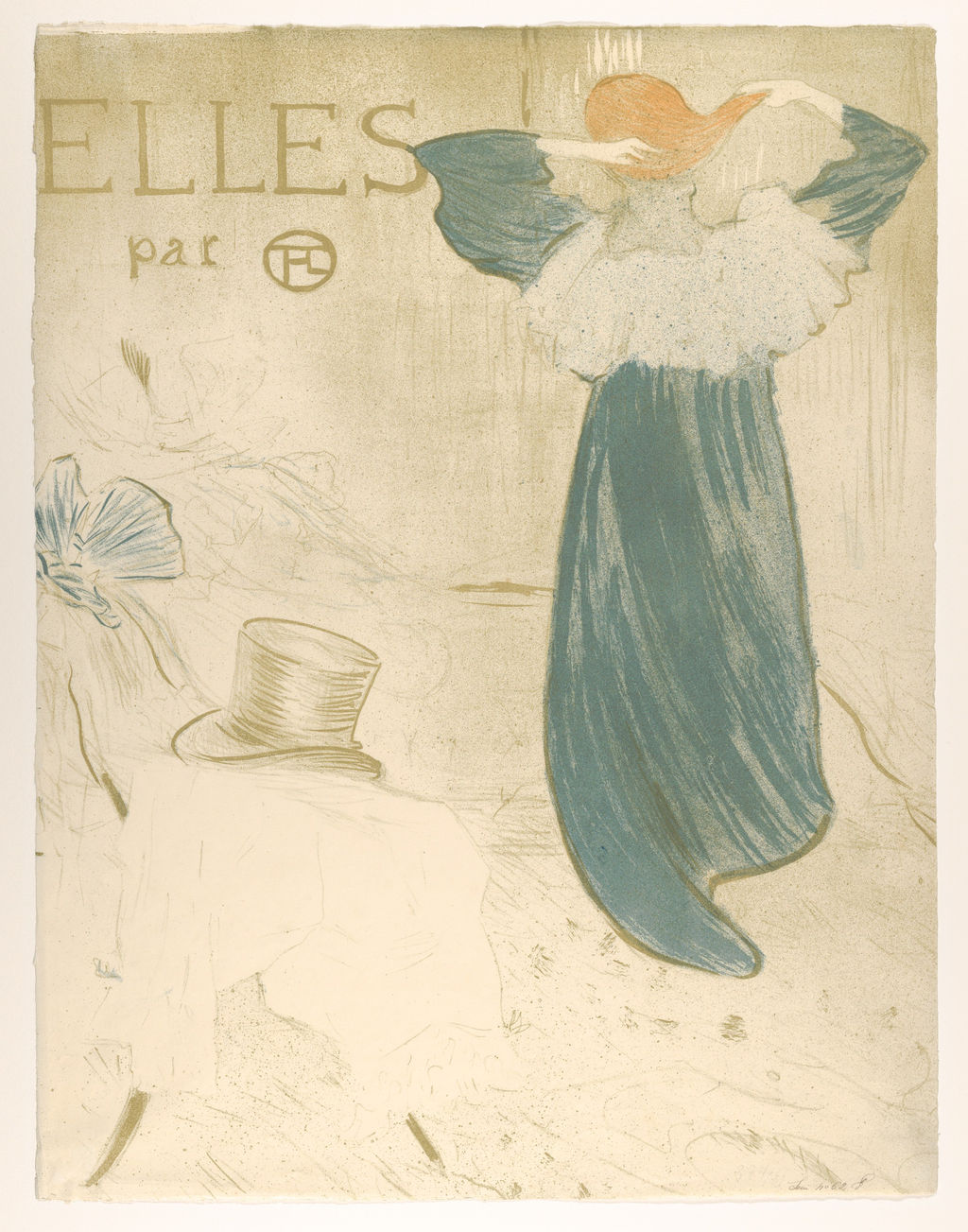
The Met's frequently reproduced sheet, accession 1984.1203.166(2), is a useful example. Its online heading calls it Elles (portfolio cover), while the detailed medium description identifies a frontispiece-edition impression, the second state of three. It is a crayon, brush and spatter lithograph printed in three colours on wove paper. Those particulars describe this sheet, rather than the large unfolded wrapper. [12]
The same design gained another function as an exhibition poster. The National Gallery of Art's example bears added wording naming Pellet, his address at 9 quai Voltaire, and the display at La Plume from 22 April 1896. Its catalogue identifies the third state of three. Lettering makes the picture announce an event and directs a viewer to a place. Inside the portfolio, the title introduces a sequence; on the poster, the image advertises an opportunity to see it. [3]
These distinctions also matter when encountering Elles in museums. A single framed sheet may be complete as an individual impression while representing only one component of the publication. Its original neighbours remain relevant. Looking at the suite involves imagining a change of sheet, format and visual density, as well as examining the image immediately before us.
The Woman Who Introduces the Suite
On the Met's frontispiece, the woman occupies the right half of the image with her back towards us. Her arms rise to either side of her head, drawing a long sweep of orange hair between her hands. The blue garment extends downwards into a curling hem. Around the pale frilled shoulders, little blue dots interrupt the paper; farther down, broad blue passages gather into the weight and folds of the robe. The upper gesture opens out while the lower silhouette narrows and turns.
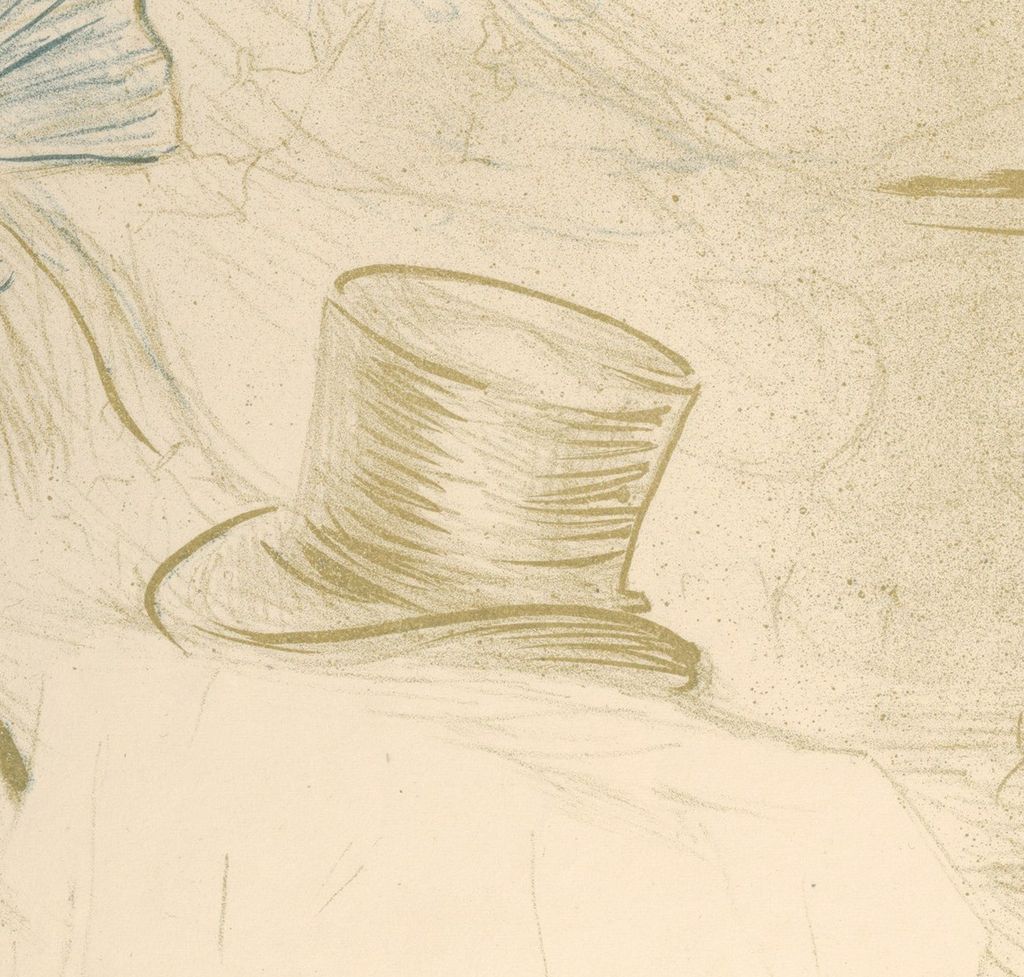
The title occupies the upper left. Its large letters share the space with the woman's lifted arms rather than sitting in an independent panel. Below, a top hat rests on a lightly drawn support. A frilled blue hat or bonnet appears farther back at the left, among loosely indicated furnishings. Dense colour belongs chiefly to hair and garment; furniture and floor remain much less substantial. The contrast makes the woman immediately legible while allowing a room to accumulate around her through scattered marks.
The Met interprets the top hat as belonging to an unseen male client and the woman's action as preparation for him. That reading connects a quiet grooming gesture to the commercial setting. The man is absent from the visible figure group but present through an object. His hat occupies the foreground, closer to the spectator than the woman herself. [12]
The gesture gains further meaning across the portfolio. Later sheets will make washing, combing and dressing subjects in their own right. The frontispiece introduces one such activity while leaving the occasion partly indirect. We can follow hands and hair before noticing the hat. It establishes a pattern in which the ordinary and the socially specific coexist within the same scene.
The woman's face remains concealed. Her gesture supplies the image's action without supplying a portrait through which to identify her. The elaborate blue curve can be enjoyed as a strong design, but that visual pleasure does not tell us her name or her account of the situation. The title, figure and accessories establish an encounter with a represented world; they leave much of its personal history unstated.
Annotated Details from Elles: Toulouse-Lautrec's 1896 Portfolio
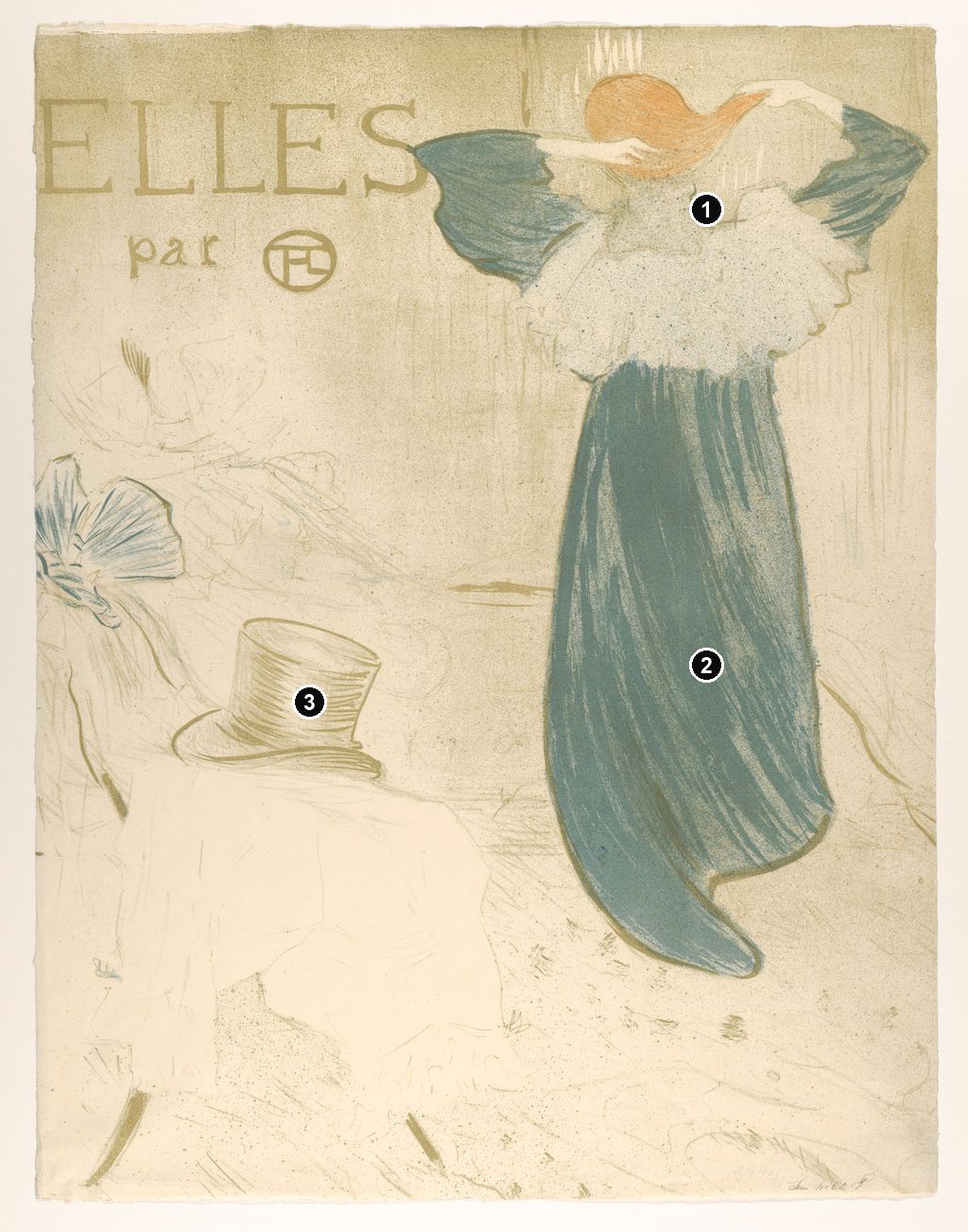
The numbered points identify visible features discussed in this article. Return from each detail to the whole composition. Elles frontispiece, 1896. Crayon, brush and spatter lithograph in three colours on wove paper, second state of three. Metropolitan Museum of Art, 1984.1203.166(2). This upright sheet introduces the portfolio; it is distinct from the unfolded wrapper and exhibition poster. Bequest of Scofield Thayer, 1982. Image source. CC0 / Public domain. Resized only; native appearance preserved.
Details from ELLES: TOULOUSE-LAUTREC'S 1896 PORTFOLIO
Compare the cropped details with the complete images above. Notice how their colours, shapes and positions contribute to the larger compositions.
The raised arms
The back-facing figure raises her arms to arrange her hair.
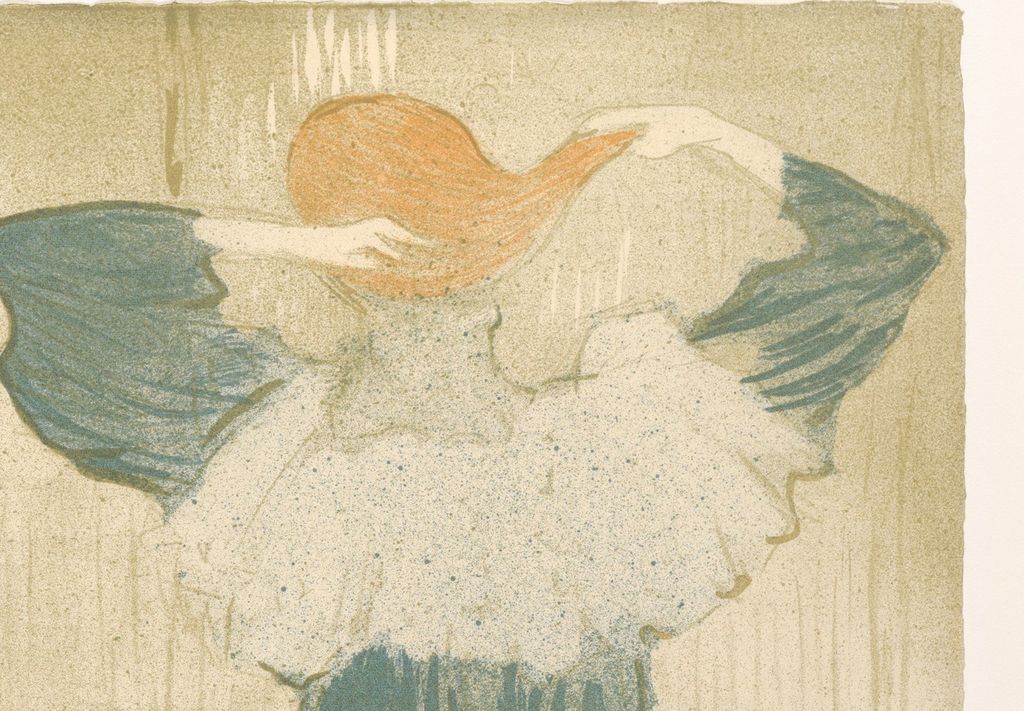
The striped skirt
The vertical stripes give the figure weight within a lightly indicated room.
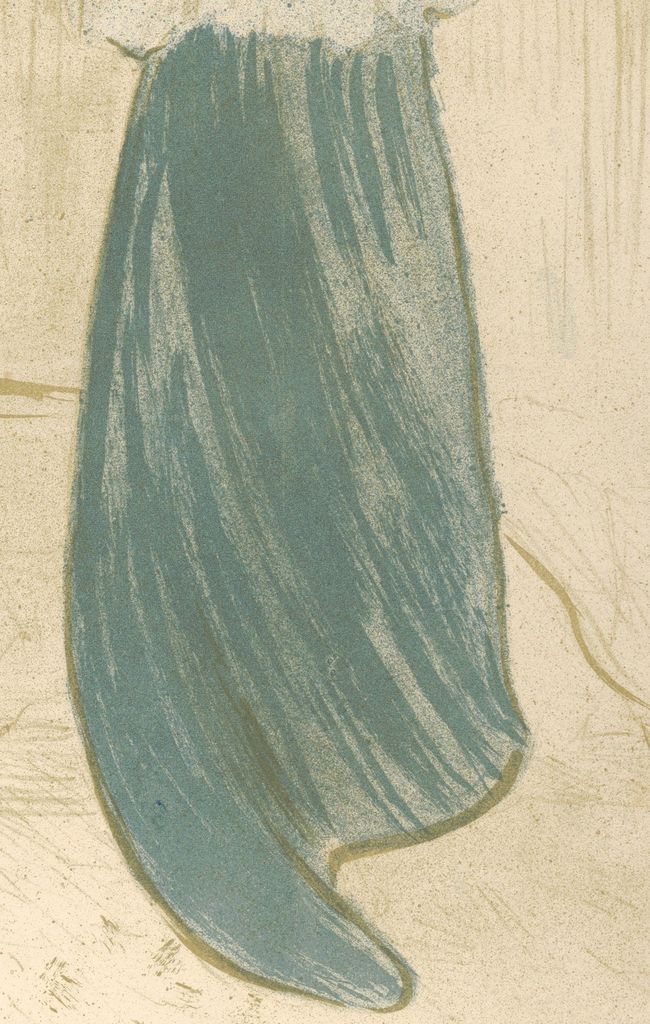
The top hat
The small top hat introduces a contrasting dark shape among the furnishings.
The Opening Shift: Cha-U-Kao, Breakfast and Waking
The first image plate is The Seated Clowness, also titled Seated Female Clown (Mademoiselle Cha-U-Kao). Chicago's record dates it to 1896, names Pellet as publisher and qualifies the printer as probably Auguste Clot. This is the seated print in Elles, distinct from Lautrec's 1895 painting of Cha-U-Kao and his standing lithograph of 1897. [2]
Its position broadens the opening beyond the bedroom. Cha-U-Kao sits on a red upholstered seat, her dark legs spreading towards the lower corners. A yellow ruff flares around her shoulders; her pale face and upper chest interrupt the strong dark costume. Smaller figures stand at the rear, and a deep vertical division separates their space from hers. The dense colour and recognisable performer give this first plate an emphatic presence. The individual Seated Clowness rewards a closer examination of that portrait; within Elles, its role is also to establish the sequence's range. [13]
Turning to Serving Breakfast produces a marked change. The standing woman carries a tray across a horizontal composition, with a second woman reclining behind her. The faces and the small objects on the tray catch attention within a very lightly articulated room. The Met's title identifies the pair as Madame Baron and Mademoiselle Popo; Ives describes its printing ink as sanguine, the red-brown tone associated with red chalk. This is a lithograph whose printed lines evoke drawing, rather than an original chalk drawing inserted among the prints. [1] [14]
Waking Up keeps the horizontal format but changes the bodily rhythm. A reclining woman stretches an arm above her head. Her dark hair and face occupy a relatively small area at the right; the bedding spreads towards the left through long, irregular lines. In the impression reproduced in the 1985 MoMA catalogue, the raised arm opens the space around the head while the sheets gather below. The catalogue places it directly after breakfast in the sequence. [13]
That order cautions against turning the portfolio into an illustrated timetable. Breakfast precedes waking in the catalogued sequence, and a performer in costume opens it. The sheets connect through bodily routines and different modes of presentation, without proving that we follow one woman through one day. The shift from Cha-U-Kao's saturated costume to the lighter breakfast and waking sheets can itself slow the viewer, making sparse marks demand the attention that strong colours initially commanded.
Water, Hair and the Work of Getting Ready
Filling a Tub, also called Woman at the Tub—The Tub, bends the figure into an almost enclosing curve. Her back arches over a low oval bath, and a pitcher extends down from her hand. The descending action gives the print its centre. A fireplace, framed images and adjoining furnishings surround her, while a pale mass of fabric enters from the right. Unlike the relatively open breakfast sheet, this print makes the room's different surfaces conspicuous. [13]
In the published impression reproduced by MoMA, a dark garment rises from the red floor. Pale ruffles or a collar break across the upper back, and cooler colour describes the bath and pitcher. The bent body joins these areas: head towards the tub, back lifted, garment descending to the floor. The image gives a practical task an unusually forceful silhouette. One can recognise pouring at once, then spend much longer tracing the shape through shoulder, back and hem.
The following Washing changes the viewpoint and the amount of colour. A woman seen from behind bends over a basin at the left, with a pale cloth gathered around her hips. Her bare back takes up much of the upright sheet. The shape is established with relatively few contours, and a bent arm carries the action towards the basin. The 2005 Chicago checklist describes its impression as printed from an olive-brown key stone and a blue colour stone. The means are economical, though the pose remains physically particular. [15]
Water connects these two sheets, but their compositions do different work. In The Tub, the whole clothed figure folds around a vessel on the floor. In Washing, the torso becomes a large pale surface beside a raised basin. The viewer's attention moves from an almost complete silhouette within a furnished room to a cropped body whose movement can be followed through shoulder and elbow. A repeated activity opens another problem of drawing.
Looking in a Mirror turns attention back towards the woman's own act of looking. She holds the small oval mirror away from her face, showing her profile and the open back of her garment. A dressing surface, objects and drapery occupy the room around her. The mirror is much smaller than the surrounding body and furnishings, yet it directs the scene: the hand positions it, the head turns towards it, and the woman's attention follows that route. [13]
This sheet introduces a useful difference between the spectator's view and the figure's. We see a body and an interior; she examines a small image held in her hand. Her self-directed attention complicates the idea that every grooming gesture is merely performed for an outside viewer. We can observe her looking without sharing exactly what she sees. The print makes that difference visible through the relation of head, wrist and oval glass.
In Combing Hair, the body turns away more completely. Both arms rise around a dark mass of loose hair. One hand works above the crown while the other gathers or separates strands closer to the neck. A dark band of clothing crosses beneath the pale shoulders. Around these concentrated shapes, the sheet's lower and lateral areas remain loosely described. The action draws the eye upwards, then returns it to the dark hair held between the arms. [13]
Placed together, mirror and hair sheets transform grooming into different relationships between hands and head. One gesture extends an object into space; the other brings the hands close around the body. Neither requires a dramatic incident. Their interest lies in the exact direction of attention and effort, and in how much the printed line can convey while leaving surrounding areas open.
Watch: Toulouse-Lautrec
Choose an artist introduction, a film about graphic design or a closer look at At the Moulin Rouge.
Returning to the Bed
The sequence returns to a horizontal format in Getting Up, also called Profile of a Woman in Bed. A woman rises beside a substantial grey headboard while another stands near her. Their pale garments are set against a yellow patterned wall and a red covering whose curves occupy much of the lower right. After the restrained mirror and hair sheets, these conspicuous patterns make the room more assertive. The figures remain light shapes within a setting that seems to move around them. [13]
The contrast between pale bodies and busy furnishings is especially clear at the meeting of a hand and the red bedclothes. A small gesture crosses a large coloured field. The design can be read through that difference of scale: a practical encounter between two figures gains emphasis from the surrounding fabric, without requiring a spoken exchange. The sheet does not identify a particular conversation or establish a familial relationship between the women.
Fastening a Corset, catalogued in French as Femme en corset—Conquête de passage, brings a man visibly into the scene. The woman stands with her back towards us and her arms bent behind her waist. Beyond her is a seated man wearing a top hat. A large pale chair back occupies the foreground, so that the eye has to move around one furnishing to reach the standing body and the figure farther back. The title and the man's presence place dressing within a more explicit commercial encounter than the earlier grooming sheets. [13]
The image also develops the frontispiece's indirect hint. There a hat stood in for an unseen man; here a wearer occupies the room. Yet the corset-fastening movement remains central. Lautrec gives the adjustment of clothing a substantial place in the encounter, rather than replacing it with a culminating sexual act. The suite's attention to preparation persists even where a customer is represented.
The final image, Lassitude, is also known as Woman Lying on Her Back or Collapsed on the Bed. A reclining body stretches across the horizontal sheet, surrounded by loosely indicated bedding. Ives records the Met impressions as printed in two colours; the Chicago checklist specifies sanguine drawing with an olive-green tint stone for its particular sheet. The stronger hues and patterned room of Getting Up have receded into a more subdued field. [1] [15]
The title can direct us towards weariness, but it does not give a medical finding or a personal testimony. Within the sequence, the reclining figure returns attention to an interval of reduced activity. Opening with Cha-U-Kao's emphatic seated costume and ending with a lightly articulated body on a bed creates a broad change of visual pressure. The viewer has passed through serving, stretching, pouring, washing, examining and dressing. Rest acquires its place among those activities rather than standing outside them.
Different Prints, Different Kinds of Attention
The variation across Elles is material as well as compositional. The 2005 checklist differentiates the crayon-and-scraper handling of Breakfast from the crayon, brush and spatter of The Tub. The latter Chicago impression uses an olive-green key stone with blue-grey, salmon-red, yellow and pale curry-brown colour stones. Its separate inks distribute attention across garment, vessels, floor and wall. Those precise colour names belong to that catalogue's examination of that impression. [15]
A key stone carries an important part of the image's drawing, while additional stones contribute colour. The balance between them can be studied through proofs. Wittrock's 1985 catalogue lists several trial impressions for The Tub, including the olive-green key stone alone and combinations of successive colour stones. One proof includes contours redrawn in crayon and an instruction concerning yellow. The printed result emerged through decisions and adjustments; its apparent ease does not imply that the complete image was resolved in one spontaneous action. [13]
The comparison between that key-stone proof and the published print is especially revealing. The same bent figure and oval bath are already recognisable without the full palette. In the coloured version, the floor, garment and patterned background become more forceful competitors for attention. Colour changes the relation between figure and room, rather than simply filling shapes that were finished in outline. The image has a different weight when its red floor and dark garment are present.
Elsewhere, a single ink can carry much of the expressive range. Breakfast uses sanguine; Ives describes Waking Up as printed in drab green. Their light and dark passages depend on the concentration of printed marks as well as on colour. A dark cluster at a face or head can hold attention while the rest of the sheet remains open. The term colour portfolio therefore accommodates considerable variety, including sheets whose effect approaches a lightly worked drawing. [1]
Paper participates throughout. On the Met frontispiece, the pale frill, arms and surrounding furnishings emerge through different densities of line, blue dots and relatively open surface. A reproduction can make the whole image seem like a gently coloured wash. Closer examination reveals decisions about where marks gather and where they disperse. Comparing such passages with the concentrated dark costume of The Seated Clowness makes the suite's range visible without imposing one technical formula on every leaf.
The printer's contribution remains part of this account. Chicago and MoMA qualify Auguste Clot's attribution with “probably” in their current records. That qualification deserves to survive beside Lautrec's authorship and Pellet's documented publishing role. Producing repeatable impressions required workshop expertise, while the proofs preserve evidence of the artist's changing decisions. [2] [16] For the wider range of his graphic production, Lautrec's prints and posters provide a route beyond this particular suite.
Daily Life Within a Regulated World
The routine activities are essential to Elles, but routine should not imply freedom from social constraint. The Art Institute's account of the maisons closes, or licensed brothels, describes police monitoring and the routine medical inspection of registered women. Washing, rest and dressing belonged within a world governed by commercial and official powers. The portfolio can direct attention towards women's ordinary activities without dissolving that historical setting. [17]
It is equally necessary to distinguish the suite's general subject from the identity of every depicted person. Cha-U-Kao is a named performer whose portrait opens the sequence. Her inclusion does not prove that she shared an occupation, address or living arrangement with the other women. The museum title naming Madame Baron and Mademoiselle Popo in Breakfast provides a particular identification; it is not a licence to name every similar-looking figure across the remaining sheets. [2] [14]
The title Elles also keeps this distinction active. The feminine plural gathers women into a collective subject, yet the prints differentiate bodies, gestures, clothes and settings. The reader moves between a named performer, a named pair and more generally titled figures. That unevenness of recorded identity belongs to the objects' history. It should remain visible instead of being replaced by an invented continuous cast.
There is room to recognise sympathetic attention in the choice of ordinary subjects. Serving another person, stretching, holding a mirror and combing hair receive sustained visual care. Sympathy, however, is a response to what has been represented. It cannot prove the sitters' consent to every later use of their images, explain their private feelings or turn the male artist into their rescuer. The portfolio reaches us through his compositions and a publisher's commercial decisions.
The comparison with In the Salon of the Rue des Moulins is useful at the level of form. There, a large group occupies one elaborate room. Here, distinct sheets distribute attention across different actions and degrees of activity. The sequence gives each action a fresh beginning, while encouraging the viewer to remember what came before. Its continuity is built through comparison across differences.
Pellet, Exhibition and the Problem of Reception
Pellet issued Elles in an edition of one hundred. Wittrock records paper specially made for the portfolio with a G. Pellet/T. Lautrec watermark. The material presentation placed the suite within the market for collectible original prints, and the exhibition poster made that market publicly visible. It named both publisher and viewing address, inviting an audience to encounter the sheets outside the private settings they depicted. [1] [13] [3]
An influential account of its reception links limited sales to frustrated erotic expectations. MoMA's label for its 2014–15 exhibition describes Pellet as a publisher specialising in erotica and interprets the suite's commercial failure through its emphasis on mundane intimacy. The Courtauld's 2019 catalogue entry is more tentative about the cause: the thwarting of expectations may help explain the disappointing result. Both accounts direct attention to the gap between a market for brothel imagery and the activities these prints actually foreground. [16] [18]
This interpretation of demand leaves the detailed sales history open. It should not become a claim that nobody bought or valued the suite. Nor does every document about weak sales of another Lautrec print establish the number of Elles portfolios sold. Phillip Dennis Cate reproduces a November 1898 letter to Pellet accounting for only three sales from two other groups of deposited impressions. The letter supports a restricted market for those named works; it does not count the buyers of this portfolio. [19]
Cate's broader account places Pellet among publishers promoting original colour lithography alongside works by Signac, Luce and Lunois. His comparisons of prices and edition sizes show Lautrec participating in a competitive, differentiated market. That is a more concrete setting than the legend of a wholly unrecognised artist. A publisher could invest in ambitious prints while finding their audience smaller than expected. [19]
The portfolio's continuing force is clearest when those publishing circumstances are brought back to the act of looking. A collector opening the wrapper encountered changes of orientation, colour and pictorial density. Today, prints often circulate separately as reproductions or museum exhibits, yet the contrasts remain available. After the yellow ruff of Cha-U-Kao, the pale breakfast scene asks for another pace; after the dark dress above the tub, the bare back at the basin asks for another kind of scrutiny. Elles makes these transitions consequential. The ordinary actions become compelling through the changing printed forms that carry them.
Toulouse-Lautrec artworks directory
Browse 84 identified works and publications in this researched selection. Dates and titles follow the individual records; this is not a complete catalogue of the surviving oeuvre. Print impressions remain attached to their designs. Some listed works do not have a dedicated article. The Drawings guide also contains nine illustrated studies consolidated from former articles.
Frequently Asked Questions
There are ten principal image plates, with a title page or frontispiece and a portfolio cover. Counting all components produces twelve; the ten image plates form the central sequence. [1]
The sequence brings together different figures and activities. It begins with Cha-U-Kao and places breakfast before Waking Up. Its connections do not establish a continuous single-day story about one person. [13]
Discussion
Look again at the images and ideas explored in Elles: Toulouse-Lautrec's 1896 Portfolio. These editorial prompts invite your observations.
Reader Insights
How does the change from Cha-U-Kao's strong yellow and black costume to the lightly drawn breakfast scene affect your pace of looking?
What changes between the bent, clothed figure in The Tub and the pale back in Washing? Consider the vessels, the direction of the arms and the amount of surrounding room.
Join the Conversation
Share a detail, comparison or question about Elles: Toulouse-Lautrec's 1896 Portfolio below.
References
- Colta Ives, Toulouse-Lautrec in The Metropolitan Museum of Art, Metropolitan Museum of Art, 1996, p. 52 and checklist pp. 68–69: suite structure, edition, individual titles, papers, inks and component dimensions. View source.
- Art Institute of Chicago, Seated Female Clown (Mademoiselle Cha-U-Kao), plate one from Elles, 1896, 1927.970, complete institutional API record: plate identity, publisher and qualified printer attribution. For the separate works, see Musée d’Orsay, Clownesse Cha-U-Kao, 1895, RF 2027 (in French), and MoMA, The Clowness at the Moulin Rouge, 1897, 156.1946. View source 1. View source 2. View source 3.
- National Gallery of Art, Poster for “Elles”, 1896, 1952.8.433, state designation and transcription of the announcement printed on the poster, including 22 April 1896 and the addresses (inscription in French). View source.
- Autoportrait, 1880 (in French). View source.
- ALBERTINA: Der Schimmel Gazelle,GE123DL. View source. (in German).
- Franka Blok, Portrait of Vincent van Gogh, 2024. View source.
- Art Institute of Chicago: Moulin Rouge, La Goulue. View source.
- Art Institute of Chicago: At the Moulin Rouge. View source.
- Jane Avril, 1893. View source.
- Au Salon de la rue des Moulins (in French). View source.
- Maurice Joyant (in French). View source.
- Metropolitan Museum of Art, Elles (portfolio cover), 1896, 1984.1203.166(2), frontispiece-edition impression, second state of three: materials and curatorial interpretation of the hat and grooming gesture. View source.
- Wolfgang Wittrock, “Catalogue of the Exhibition,” in Henri de Toulouse-Lautrec: Images of the 1890s, Museum of Modern Art, 1985, pp. 170–179, entries 139–158: suite components, ten image designs, reproductions, specially watermarked paper and The Tub trial proofs. The drawing, entry 146, is distinguished from the lithographs. View source.
- Metropolitan Museum of Art, Serving Breakfast (Madame Baron and Mademoiselle Popo), from “Elles”, 1896, 1984.1203.166(4), title, medium and object record. View source.
- Art Institute of Chicago, Toulouse-Lautrec and Montmartre, exhibition checklist, 2005, cats. 258 and 259a–l: cover/frontispiece distinction and object-specific technical descriptions of the Chicago suite. View source.
- Museum of Modern Art, Woman in Corset (Femme en corset) from Elles, 1896, 170.1946.11, publisher, probable printer, edition and gallery label from The Paris of Toulouse-Lautrec: Prints and Posters, 2014–15. View source.
- Art Institute of Chicago, Toulouse-Lautrec and Montmartre: “The Maisons Closes”, exhibition website, 2005: licensing, police monitoring and medical regulation. View source.
- Courtauld Gallery, Au lit (In Bed), D.1948.SC.154, entry from The Courtauld Collection: A Vision for Impressionism, 2019, paragraph on Elles and its reception. View source.
- Phillip Dennis Cate, “The Popularization of Lautrec,” in Henri de Toulouse-Lautrec: Images of the 1890s, Museum of Modern Art, 1985, pp. 88–89 and p. 92, note 21: Pellet's publishing, market comparisons and the November 1898 letter about other deposited prints. View source.
- Splash image, Elles frontispiece, 1896. Crayon, brush and spatter lithograph in three colours on wove paper, second state of three. Metropolitan Museum of Art, 1984.1203.166(2). This upright sheet introduces the portfolio; it is distinct from the unfolded wrapper and exhibition poster. Bequest of Scofield Thayer, 1982. Image source. CC0 / Public domain. Resized only; native appearance preserved.


 Henri de Toulouse-Lautrec.jpg)