


 by Tom Gurney
Tom Gurney BSc (Hons) is an art history expert with over 20 years experience
Published on / Updated on
Email: tomgurney1@gmail.com / Phone: +44 7429 011000
Toulouse-Lautrec and Montmartre: Introduction
A dancer watches another performer. A singer's cabaret produces a journal. A painting of a dance floor hangs above the bar in the very establishment it depicts. In Toulouse-Lautrec's Montmartre, places of entertainment were also places where images were commissioned, displayed and put into circulation. The district supplied subjects, but it also supplied working relationships: between artists and models, performers and proprietors, customers and the people whose labour made an evening possible. [1] [2]
Those relationships extended beyond the hill. A Montmartre singer could appear on a stage on the Champs-Élysées; an image made in Paris could enter a London publication; a poster intended to attract customers could be bought as art. Following those movements gives the familiar Moulin Rouge imagery a more precise setting. Montmartre was both a neighbourhood in which Lautrec worked and a public identity that entertainers, writers and image-makers helped construct. His biography follows the personal chronology; the places and exchanges here explain how that identity operated. [1] [2]
At a Glance
- Principal settingMontmartre and its southern entertainment districts, connected to theatres, galleries and publishers across Paris. [1]
- An early artistic meeting placeRené and Lili Grenier's apartment at 19 bis rue Fontaine, where Lautrec moved in 1884. [1]
- Different kinds of venueDance halls, cabarets, café-concerts, circuses and theatres offered distinct arrangements of performance and spectatorship. [1]
- A major commissionMoulin Rouge: La Goulue, 1891, the artist's first lithographic poster. [2]
- A historic address printed in an imageDivan Japonais advertises 75 rue des Martyrs. [3]
- Beyond nightlifeStudios, print workshops, journals, dealers and exhibitions were essential to the production and reception of the pictures. [1]
Contents
- Streets, studios and places to meet
- The cabaret as a workshop for words and images
- Dance halls and the people around the dance
- A café-concert assembled for publicity
- Entertainers as clients and makers of a reputation
- Social difference, staged roles and restricted rooms
- Printers, publishers and routes across the city
- How the images came to stand for Montmartre
Streets, studios and places to meet
The rue Fontaine introduces an important distinction between a famous district and the practical spaces within it. In 1884 Lautrec moved into the Greniers' apartment at 19 bis, close to the boulevard de Clichy. Phillip Dennis Cate places this move at the beginning of the artist's sustained participation in Montmartre's artistic community. Colta Ives describes the apartment as a gathering place for young artists and records that Degas also had premises in the building. A domestic address could therefore connect friendship, posing, discussion and access to an older artist's work. [1] [4]
Lautrec later maintained separate living and working accommodation. Cate records an apartment at 27 rue Caulaincourt in 1894 and a studio at 7 rue Tourlaque. These details give substance to the ordinary organisation behind the public career. A picture might begin with an encounter outside, continue through sittings or studies indoors, and require another workplace altogether before it could be printed. The district was a place of production as well as an evening destination. [1]
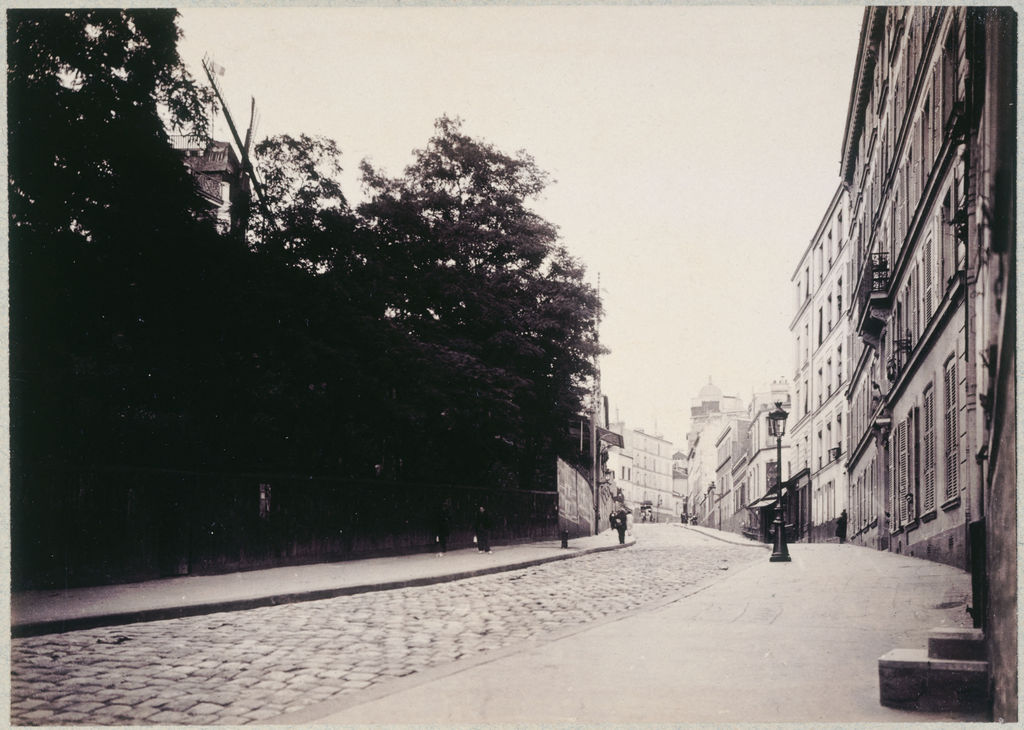
Its entertainment geography also had different levels. The Moulin de la Galette belonged to the rue Lepic landscape higher on the hill: a photograph dated around 1900 in the Musée Carnavalet records the mill seen from that street. The Moulin Rouge opened in 1889 on the boulevard de Clichy, at the foot of Montmartre. The National Gallery of Art describes this boulevard as a frontier between the less expensive district and more fashionable Paris. The two establishments' similar names can conceal a meaningful difference in position and clientele. They were distinct businesses, with different histories and ways of organising a crowd. [5] [6]
These addresses establish relationships without turning the paintings into a street plan. Lautrec often makes an interior recognisable through selected people, furnishings and gestures. A rail or table can tell us more about the experience of occupying a venue than a complete architectural view would. His rooms repeatedly ask where a spectator can stand, what that spectator can see, and who else is looking.
The cabaret as a workshop for words and images
The Chat Noir demonstrates how one address could acquire successive commercial identities. Rodolphe Salis opened it in 1881; in spring 1885 it moved from 84 boulevard Rochechouart to 12 rue de Laval, a street renamed rue Victor-Massé in 1887. Bruant established Le Mirliton in the former premises on the boulevard. Cate documents this succession alongside the journals associated with both establishments. A place of performance could also have a readership, allowing its songs and visual identity to travel beyond the room. [1]
Bruant's Le Mirliton joined the singer's role as entertainer to those of proprietor and publisher. His journal, first issued in autumn 1885, circulated his songs and employed artists including Steinlen and Lautrec. Lautrec's contributions began before his celebrated posters: a reproduction of his Élysée-Montmartre quadrille appeared in December 1886, followed by covers in 1887. These were photorelief illustrations, some with stencil colour, rather than the colour lithographs through which he later became famous. The connection between cabaret and printed page was already helping him reach an audience. [1]
The performances themselves depended on an understood relationship with customers. The Art Institute describes Bruant adopting a combative outsider persona, criticising upper-class society and commenting on current events. Yet Le Mirliton attracted people from different backgrounds, including affluent Parisians who came expecting to be ridiculed. The antagonism was part of what the establishment offered. Customers could purchase an encounter with a carefully performed version of social opposition; their presence did not imply that they shared the singer's adopted stance. [7]
The 1893 Bruant in His Cabaret advertisement makes this portability visible. The broad hat, black cloak and red scarf can identify the performer without showing the room in which he sings. The image carries the person and, through him, the establishment. A cabaret's identity could reside as strongly in a recurring silhouette or a journal cover as in its décor. [7]
Dance halls and the people around the dance
A dance hall brought the audience into a different relationship with the entertainment. In Moulin de la Galette, dated 1889, a wooden partition cuts between the dancers and the people nearest us. The Art Institute emphasises the contrast between activity beyond the barrier and stillness in front. Looking at the painting, the foreground faces and backs hold attention before the crowded floor becomes fully legible. Dancing is an available activity within a larger social room; watching and waiting have their own places. [8]
The barrier makes a useful starting point for understanding such spaces. It separates uses of the room while bringing them together in one view. Those close to us are not necessarily engaged in the same activity as the distant couples. Their clothing and poses alone cannot establish individual occupations, relationships or reasons for being there. What the picture does show is a difference between participation and observation, with the viewer placed outside the most active part of the scene.
At the Moulin Rouge, professional dancing became a powerful part of the establishment's attraction. Philadelphia's At the Moulin Rouge: The Dance, dated 1889–90, leaves a broad floor around a female dancer and Valentin le Désossé. The museum reports an inscription on the reverse, probably by Lautrec, describing Valentin's training of new dancers. What may initially seem a night of effortless pleasure therefore includes a possible moment of instruction. The surrounding company watches while a skilled performer demonstrates movement. [9]
The painting also became part of the venue's material environment. Its owners bought it and hung it above the bar. A customer could encounter an image of the dance floor while occupying the same business's social space. That relationship differs from a painting produced solely for a private collector or gallery exhibition. Here the establishment was both subject and purchaser, and the image helped furnish the experience for which its customers paid. [9]
Chicago's later At the Moulin Rouge, dated 1892–95, changes the balance. A table group occupies the foreground; the dance itself has disappeared. The Art Institute identifies dancers Jane Avril and La Macarona alongside photographer Paul Sescau, writer Édouard Dujardin and wine merchant Maurice Guibert. Lautrec and his physician cousin Gabriel Tapié de Céleyran appear at the back. The room brings together people with different kinds of work and connection to entertainment. Its social life cannot be divided cleanly into performers on one side and an unrelated public on the other. [10]
La Goulue adjusts her hair in the background rather than performing a spectacular kick. The distinction matters because a famous entertainer could be present without continuously delivering her stage persona. Lautrec's attention to people between acts also makes visible the time surrounding a performance: adjustment, conversation, sitting and looking. These are less easily condensed into an emblem of Paris, but they give the pictures much of their specificity. [10]

Henri de Toulouse-Lautrec, Moulin de la Galette, 1889. Oil on canvas, 88.5 ×101.3cm. Art Institute of Chicago, 1933.458. Art Institute of Chicago,1933.458. Image source. Public domain. Resized only; native appearance preserved.
A café-concert assembled for publicity
The Divan Japonais poster explicitly binds an image to an address: 75 rue des Martyrs. Ives describes a long, narrow café-concert with silks and fans on the walls and waitresses wearing kimonos. Its Japanese name and commercial décor offered customers a fashionable Parisian presentation of Japan. Those furnishings should be distinguished from the formal devices Ives connects to Japanese prints: tilted perspective, compressed space and broad colour shapes. The establishment's theme and the artist's Japonisme operated together without being the same thing. [4] [3]
The advertisement gives the largest presence to Jane Avril, seated in the audience beside Dujardin. Yvette Guilbert is much smaller and cropped at the neck on stage. The spectator supplies the commanding silhouette, while a singer can remain recognisable through her gloves. The arrangement promotes desirable company as well as an act. It asks a potential customer to imagine being in a room where an interesting audience is itself worth seeing. [3]
It does not document a single evening's attendance. Wolfgang Wittrock states that Guilbert had not appeared at the Divan Japonais since 1890, although the advertisement belongs to 1892–93. Her inclusion brings a recognisable performer into a designed publicity gathering. Reading the sheet as a literal record would confuse the persuasive work of advertising with the evidence of a dated programme. [3]
The business behind that confident image was unstable. Wittrock records Édouard Fournier's takeover from Jehan Sarrazin in late 1892 and repeated closures linked to reconstruction required by new fire regulations. Its periods of opening extended intermittently into early 1894, when Fournier sold it. The coherent printed interior outlasted these interruptions. Regulation and the practical condition of a building were part of entertainment history, even when neither appeared in the inviting advertisement. [3]
Watch: Toulouse-Lautrec
Choose an artist introduction, a film about graphic design or a closer look at At the Moulin Rouge.
Entertainers as clients and makers of a reputation
A successful performer brought professional judgement to an advertisement. Bruant's 1892 appearance at the elegant Ambassadeurs carried his Montmartre identity into the Champs-Élysées. Albi's museum explains that the wording about his cabaret referred to the recreation of Le Mirliton's décor on that stage. Bruant commissioned Lautrec and defended the resulting image against the venue director's preference for a conventional likeness. Montmartre could be exported through a performer, a reproduced setting and a poster, even when the actual engagement took place elsewhere. [2]
Jane Avril's 1893 poster provides another clear commission. The Met records that Avril requested it for her appearance at the Jardin de Paris. The performer who watches in Divan Japonais thus becomes an active purchaser of publicity for her own work. The distinction changes how the artist's circle should be understood. Friendship, repeated depiction and a commercial relationship could overlap, but an entertainer still had a career to manage and a particular engagement to promote. [11]
Guilbert's refusal of the separate 1894 poster project makes that judgement especially explicit. Albi's account records a commission for her Ambassadeurs appearances in the 1894–95 season and her rejection of the unflattering likeness. Their later work together included albums in 1894 and 1898. Her objection belongs to a negotiation over a professional image, followed by further collaboration. La Goulue likewise became a commissioning client when she requested decorative panels for her fairground booth in 1895. The subjects of the images could also direct their uses. [2]
Other forms of performance required different kinds of expertise. Loïe Fuller's act at the Folies Bergère combined music, coloured electric light and a silk gown manipulated with poles. The Met's account of Lautrec's 1893 lithograph identifies this technological and bodily construction behind the floating shape. A picture inspired by the act is evidence of artistic attention, without establishing a close personal friendship or a commission from Fuller. The credited publisher, André Marty, and printer, Ancourt, belong to this image's working history too. [12]
Circus and theatre supplied still other arrangements. In Equestrienne, dated 1887–88, a rider prepares for a trick involving a horse and a hoop; the Art Institute identifies the ringmaster as Monsieur Loyal. The visible feat requires trained coordination between people and animal. Theatre programmes involved work of another kind: Cate documents Lautrec's designs for André Antoine's Théâtre Libre and Lugné-Poe's Théâtre de l'Œuvre. A programme accompanied a named production and an evening's sequence, rather than simply announcing an entertainer's familiar appearance. These settings gave the artist different ways to connect a body, a performance and its public. [13] [1]

Moulin Rouge: La Goulue, 1891. Colour lithograph on tan wove paper. Art Institute of Chicago, 1954.1193. Foreground Valentin and a band of spectators frame the dancer. Image source. Public domain. Resized only; native appearance preserved.
Social difference, staged roles and restricted rooms
The pleasures offered by these venues had prices. In his historical comparison of entertainment costs, Cate gives Moulin de la Galette admission at fifty centimes for men and twenty-five for women, against an average evening's expenditure of three to five francs at café-concerts. His figures help distinguish audiences within the broad phrase “Parisian nightlife.” The opportunity to watch a poster in the street, purchase a print, buy drinks or spend an evening at a particular establishment involved different resources. Shared visibility did not mean equal access. [1]
The pictures nevertheless require care as evidence for those social differences. At the Café La Mie, about 1891, places a woman and a bowler-hatted man at a small table. Helen Burnham, curator at the Museum of Fine Arts, Boston, explains that Lautrec's friend and an unidentified woman from their circle were playing disreputable, drunken roles. The university resource Utpictura18 identifies the man as Maurice Guibert and relates the image to a photograph. Their appearance is a construction involving sitters and a role, rather than an unmediated sample of café society. A viewer cannot use the woman's dress or lowered head to recover an undocumented occupation or personal history. [14] [15]
Brothel interiors involved a different set of restrictions from those of a public entertainment venue. The Art Institute's exhibition account explains that licensed maisons closes were monitored by police and that registered women underwent routine medical inspections. That regulatory framework supplies a historical context which cannot be read directly from a facial expression. Nor should dancers, café customers and women represented in brothel scenes be treated as one interchangeable social group. A room's institutional purpose matters alongside the appearance of its occupants. [16]
The geography also reaches beyond Montmartre. Frey's account locates the rue des Moulins establishment near the Opéra. The Albi Salon painting, dated 1894, belongs to Lautrec's attention to prostitution in another part of Paris. The museum emphasises the individualised faces within the enclosing red seating. Their arrangement invites sustained attention to particular people, even as surviving identities and circumstances remain unevenly documented. Familiarity with a setting, whether real or claimed, does not give a picture transparent access to its occupants' thoughts. [17] [18]
Printers, publishers and routes across the city
The workshop is an essential part of this geography. A performance might supply a gesture, but a printed image required more than observation. Cate distinguishes the artist's drawing and correction of proofs from the printer's production of an edition. Ives identifies Père Cotelle at Ancourt's press in Lautrec's cover for L'Estampe originale. The image brings Jane Avril into a print workshop, connecting the world of performance with the skilled work through which images were multiplied. [1] [4]
Such connections did not keep the business within one neighbourhood. In 1892 Edmond Sagot offered Lautrec's posters from his shop at 18 rue Guénégaud on the Left Bank. Joyant organised the joint Lautrec–Charles Maurin exhibition of January–February 1893 at Boussod and Valadon, 18 boulevard Montmartre. Despite the boulevard's name, this gallery belonged to a wider Parisian commercial network, rather than the hill's studio streets. Gustave Pellet, publisher of Elles in 1896, operated at 9 quai Voltaire. The addresses reveal how images made from Montmartre subjects depended on outlets elsewhere. [1]
The publications also created relationships between artists. Cate documents Lautrec and Henri-Gabriel Ibels working on Le Café Concert, issued by Marty in 1893, and identifies shared commissions for theatre and journals. La Revue blanche published work by Lautrec alongside artists including Bonnard, Vuillard and Vallotton. These were overlapping ventures in which writers, editors, artists and dealers connected different audiences. Montmartre's celebrated individual personalities emerged through collaborative structures as well as through their own distinctive acts or styles. [1]
International publication made the chain longer. The correspondence discussed by Cate records Lautrec's work with the British publisher W. H. B. Sands on the 1898 Yvette Guilbert album. Henry Stern prepared stones and proofs, and the album was printed in London. Cate reproduces Stern's itemised bill for preparation, stones and packing. Those ordinary categories are a useful corrective to the apparent spontaneity of the finished marks: an image had to be prepared, approved, transported, printed and sold. Its recognisable Parisian subject could circulate through labour and decisions undertaken elsewhere. [1]
Posters entered a collecting market during the same years that they advertised performances. Sagot listed Jane Avril and Divan Japonais in June–July 1893; Cate records a two-franc price for Divan Japonais in 1894, or three francs fifty centimes mounted on linen. These are prices for a retained image, not admission charges. Mounted sheets, special papers and proofs without lettering addressed different kinds of purchaser. The public wall and the collector's room were connected destinations, with different expectations about how long and how closely someone would look. [1]
How the images came to stand for Montmartre
The strong association between Lautrec and the district can make this varied activity seem like a single continuous night's entertainment. The works themselves offer distinctions: the Galette barrier, the open floor around Valentin, a group gathered at a table, a singer reduced to gloves, a printer working at a press. Their settings organise people differently. The same performer may be a dancer, a customer, a client commissioning publicity or a recognisable presence enlisted in another establishment's advertisement.
The 2005 exhibition Toulouse-Lautrec and Montmartre restored some of that range by presenting paintings, photographs, journal illustrations and posters together. Its checklist includes works by Steinlen, Chéret, Anquetin, Van Gogh and other contemporaries as well as Lautrec. The district becomes more intelligible when it is seen through several makers and several kinds of evidence. A poster's confident promise and a photograph's record of a street answer different questions. [19]
The Palazzo Roverella's 2024 account similarly argues for an artist more complex than the familiar poster-maker and places his work among contemporaries and distinct cultural spaces. That wider view keeps Montmartre useful as a historical setting. It was a place where artistic work, leisure, publicity and commerce met, with unequal access and changing roles. Lautrec helped make it recognisable, while the conditions of his work carried its images far beyond the neighbourhood. [20]
Toulouse-Lautrec artworks directory
Browse 84 identified works and publications in this researched selection. Dates and titles follow the individual records; this is not a complete catalogue of the surviving oeuvre. Print impressions remain attached to their designs. Some listed works do not have a dedicated article. The Drawings guide also contains nine illustrated studies consolidated from former articles.
Frequently Asked Questions
Yes. He moved into the Greniers' apartment at 19 bis rue Fontaine in 1884. Cate later records his apartment at 27 rue Caulaincourt and studio at 7 rue Tourlaque in 1894. [1]
The poster assembles recognisable figures for publicity. Wittrock notes that the depicted singer, Yvette Guilbert, had not appeared at the venue since 1890. Her inclusion does not establish that she performed there with Avril and Dujardin in the audience in 1892–93. [3]
No. Printers, publishers and dealers connected Lautrec's subjects with businesses across Paris and abroad. Sagot's Left Bank shop and the London printing of the 1898 Guilbert album are documented examples. [1]
Discussion
Look again at the images and ideas explored in Toulouse-Lautrec and Montmartre. These editorial prompts invite your observations.
Reader Insights
What changes when you move from the open dance floor in The Dance to the table group in At the Moulin Rouge? Look for the space each picture leaves available to its audience.
In Divan Japonais, how does Avril's prominence as a spectator affect the promise made by the advertisement? Consider what remains recognisable in the much smaller singer above her.
Join the Conversation
Share a detail, comparison or question about Toulouse-Lautrec and Montmartre below.
References
- Phillip Dennis Cate, “The Popularization of Lautrec,” in Riva Castleman and Wolfgang Wittrock, eds., Henri de Toulouse-Lautrec: Images of the 1890s, Museum of Modern Art, 1985, pp. 77–92; especially pp. 77–79 on residences, cabarets and journals, pp. 82–89 on printers, dealers and publishers, and pp. 90–91 on prices and audiences. View source.
- Musée Toulouse-Lautrec, Albi, Toulouse-Lautrec et l'art de l'affiche, 2025 press dossier, pp. 5–8, 11 and 13, entertainment advertising, Bruant, Guilbert and chronology (in French). View source.
- Wolfgang Wittrock, “Catalogue of the Exhibition,” in Henri de Toulouse-Lautrec: Images of the 1890s, Museum of Modern Art, 1985, p. 232, cats. 259–261, Divan Japonais venue history and Guilbert's absence since 1890; Metropolitan Museum of Art, Divan Japonais, 1892–93, 58.621.17, identities, date and reproduced lettering. View source 1. View source 2.
- Colta Ives, Toulouse-Lautrec in The Metropolitan Museum of Art, 1996, pp. 26, 38, 41 and 43, the Greniers, Divan Japonais, Cotelle and Fuller. View source.
- Musée Carnavalet–Histoire de Paris, Le moulin de la galette, vu de la rue Lepic, Montmartre, photograph attributed to Emmanuel Pottier, circa 1900, PH24852 (in French). View source.
- National Gallery of Art, Picturing France, 1830–1900, teaching packet, p. 22, the Moulin Rouge's 1889 opening, boulevard de Clichy location and entertainment context. View source.
- Art Institute of Chicago, Aristide Bruant, in His Cabaret, 1893, accession 1949.1005, institutional API record, description of Bruant's persona, audience and recurring publicity image. View source 1. View source 2.
- Art Institute of Chicago, Moulin de la Galette, 1889, accession 1933.458, institutional API record, barrier and contrasting uses of the room. View source 1. View source 2.
- Philadelphia Museum of Art, At the Moulin Rouge: The Dance, 1889–90, collection interpretation, inscription, purchase and placement above the bar. View source.
- Art Institute of Chicago, At the Moulin Rouge, 1892–95, accession 1928.610, institutional API record, identities and social setting. View source 1. View source 2.
- Metropolitan Museum of Art, Jane Avril, 1893, 32.88.15, Avril's commission for the Jardin de Paris. View source.
- Metropolitan Museum of Art, Miss Loïe Fuller, 1893, 1970.534, performance technique, Folies Bergère, printer and publisher. View source.
- Art Institute of Chicago, Equestrienne (At the Cirque Fernando), 1887–88, accession 1925.523, institutional API record, description of the equestrian act and ringmaster. View source 1. View source 2.
- Helen Burnham, “Toulouse-Lautrec and the Stars of Paris,” curator interview, Museum of Fine Arts, Boston, 1 April 2019, answer on At the Café La Mie and its staged roles. View source.
- Utpictura18, Aix-Marseille Université, A la mie–Toulouse-Lautrec, notice 015774, photographic source and Maurice Guibert identification (text in French). View source. (in French).
- Art Institute of Chicago, Toulouse-Lautrec and Montmartre: exhibition themes, “The Maisons Closes,” account of licensing, police monitoring and medical inspections. View source.
- Julia Frey, “Henri de Toulouse-Lautrec: A Biography of the Artist,” in Henri de Toulouse-Lautrec: Images of the 1890s, Museum of Modern Art, 1985, p. 32, rue des Moulins location near the Opéra. View source.
- Musée Toulouse-Lautrec, Albi, Au Salon de la rue des Moulins, 1894, collection interpretation and individualised faces (in French). View source.
- Art Institute of Chicago, Toulouse-Lautrec and Montmartre, exhibition checklist, 2005, especially cats. 10/51, 13, 18, 32–33, 56, 66 and 89–90, range of media and participating artists. View source.
- Palazzo Roverella, “Inaugurata a Rovigo la mostra su Henri de Toulouse-Lautrec e la Parigi di fine secolo”, 23 February 2024, curatorial account of the artist's range and contemporary networks (in Italian). View source.
- Splash image, The Moulin de la Galette seen from rue Lepic, circa 1900. Albumen photograph attributed to Emmanuel Pottier. Musée Carnavalet–Histoire de Paris, PH24852. The mill rises behind trees beside the ascending street. Paris Musées / Musée Carnavalet–Histoire de Paris. Image source. CC0 / Public domain. Resized only; native appearance preserved. (in French).


 Henri de Toulouse-Lautrec.jpg)