


 by Tom Gurney
Tom Gurney BSc (Hons) is an art history expert with over 20 years experience
Email: tomgurney1@gmail.com / Phone: +44 7429 011000
Introduction
A girl in white kneels at a red prayer desk, reading from a small book. Behind her stand two adults in dark clothes. Across from them, an altar boy bows his head beside a candlelit altar. This is Pablo Picasso's First Communion, a large painting made in Barcelona in 1896, when the artist was only fourteen. The subject may look distant from the Picasso of Cubism, but it deserves to be seen as more than a surprising item from his childhood. In this room he worked out how to organise several figures, direct the light and make a ceremonial occasion convincing at public-exhibition scale. [1][2]
The painting is an oil on canvas, 165 × 117 centimetres, in the Museu Picasso de Barcelona. The museum identifies the kneeling child as Picasso's younger sister Lola Ruiz Picasso. It also identifies the adult man as Doctor Vilches, a friend of Picasso's father—not, as is sometimes repeated, Picasso's father himself. The work is both a family-linked image and a carefully staged exercise in the kind of painting that could be shown at an official art exhibition. [1]
At a Glance
- Made: Barcelona, 1896
- Artist’s age: Fourteen
- Scene: A girl at a prayer desk with adults and an altar boy
First Communion in Picasso's career
First Communion
1896Three Musicians
1921Guernica
1937Las Meninas series
1957The highlighted work is dated with the qualifications explained in the sources on this page. The other works are selective points of comparison, not the start or end of a style.
Contents
- What happens in First Communion?
- Who are the people in the painting?
- Why did Picasso paint it in Garnelo's studio?
- How do light and colour organise the scene?
- Did Picasso prepare studies for First Communion?
- Where was it first shown, and did it win a prize?
- What happened to the painting later?
- Why does First Communion matter today?
What happens in First Communion?
The title refers to a child's first reception of the Eucharist in the Catholic Church. Picasso shows the moment as solemn and quiet rather than bustling. Lola kneels at a prie-dieu, or prayer desk, her head lowered towards a missal. Her white dress and veil draw the eye immediately. The folds spread across the lower left of the canvas while the desk's red cushion anchors her in the space. Behind her, the two darkly dressed adults frame the occasion; at the right, a boy in white over red stands beside the altar. [1]
The figures do not simply line up for a group portrait. The three on Lola's side occupy different depths, one behind another, so that the eye moves from the girl to the adults and into the dimmer interior. The altar boy balances their weight on the other side. Above and beyond them are lit candles, flowers and the hangings and furnishings that turn the setting into a church interior. Picasso gives the scene enough objects to make its ritual legible, but keeps the figures still. We are invited to notice attention and posture rather than an unfolding action. [1]
There is no need to imagine that Picasso recorded a particular ceremony from life. The Museu Picasso says he painted the canvas in the studio of José Garnelo Alda, where liturgical props were available. The people are recognisable models, but the result is a constructed image of first communion, made for display. Nor does the title alone establish that this was the actual day on which Lola received the sacrament. The painting can be true to the social and religious world it depicts without being a documentary snapshot of one service. [1][2]
Who are the people in the painting?
The girl is Lola, born Dolores Ruiz Picasso, whom her brother drew and painted many times in his early years. The Barcelona museum identifies her in the finished canvas and has preserved studies in which Picasso worked out her kneeling figure. Looking at First Communion as one of the images of Lola gives her a more specific presence than the anonymous title might suggest. Yet the painting does not tell us exactly what she thought or felt while posing, and its ceremonial role should not be mistaken for a full account of her life. [1][3][4]
The man standing behind Lola is identified by the museum as Doctor Vilches, a friend of Picasso's father, José Ruiz. He acts as the child's godfather in the represented ceremony. The museum describes the woman beside him as the godmother, identified by the scholar Josep Palau i Fabre as Vilches's wife. That last identification rests on an attributed scholarly account rather than on a name written within the painting. The altar boy is identified as the Vilches couple's son. These relationships explain why the adult group feels like a circle of family acquaintances even though not every figure is a member of Picasso's immediate family. [1]
Picasso's father matters profoundly to the story, but in a different way. José Ruiz encouraged his son's training and, according to the museum, probably helped Garnelo choose a subject suited to the official exhibition for which the canvas was intended. That influence should not be converted into a claim that he posed as the dark-suited godfather. Such a confusion obscures the actual network of people around the teenage painter and collapses the roles of teacher, patron, parent and model into one. [1]
Lola's bright dress can also tempt a simple contrast: an innocent child against a dark adult world. The visual contrast is real, but the moral lesson is not supplied by the canvas. Her pose is intent rather than helpless, and the adults attend rather than loom over her. Picasso's arrangement permits readings of support, expectation and solemnity without settling what the sitters themselves experienced. That distinction matters when a real young person is placed at the centre of a ritual image.
Watch: Pablo Picasso
Explore Picasso through five videos from museums, broadcasters and art educators.
Picasso’s Guernica: Great Art Explained
Explore the composition and historical setting of Picasso’s best-known response to war.
Watch on YouTubeWhy did Picasso paint it in Garnelo's studio?
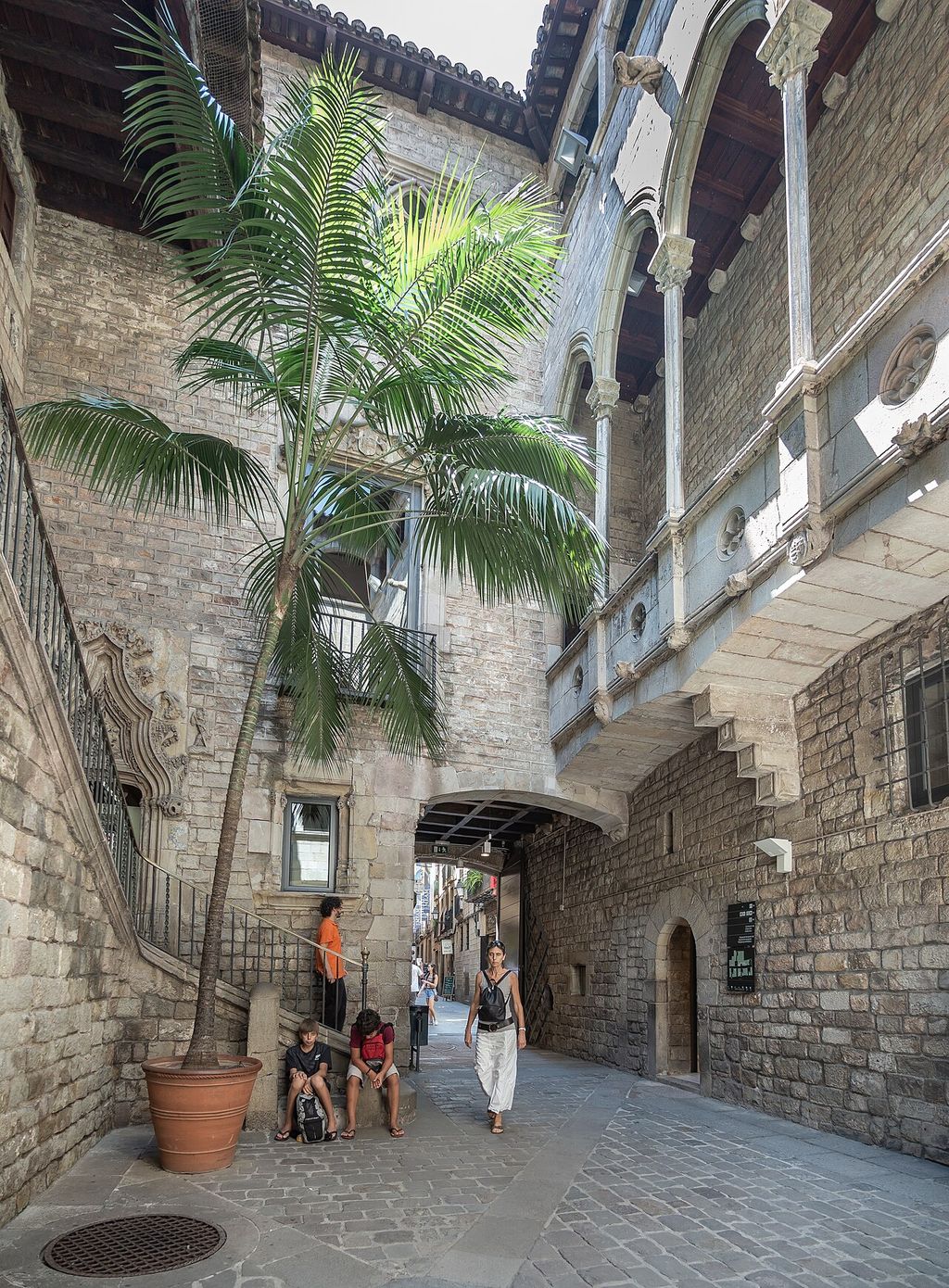
The Ruiz Picasso family had moved to Barcelona in 1895. Picasso was studying at La Llotja art school, and, on his father's advice, also worked in the studio of José Garnelo Alda. Garnelo was a teacher and a friend of José Ruiz; his own painting often dealt with religious or moralising subjects. The museum notes that he had painted a first-communion scene of a girl three years before Picasso's canvas. He could offer the young painter both an example of the subject and access to the material culture needed to represent it. [1][2]
The museum proposes that Garnelo and José Ruiz probably chose the theme with Barcelona's official art exhibition in mind. Religious scenes were familiar to juries and could win distinction. This is a plausible account of the commission-like setting in which the painting emerged, not a surviving declaration of Picasso's personal spiritual intention. We do not know that he chose the subject alone, and we do not need to imagine that he later rejected it simply because his art changed. At fourteen, learning how to complete a large multi-figure painting and place it before a public audience was an important artistic task in its own right. [1]
The studio setting also changes how we read the painting's apparent realism. Picasso was not simply copying a found scene. He had to select a moment in the ceremony, arrange people of different heights in a coherent space, and bring together garments, candles, flowers, textiles and furniture. A missal in Lola's hands makes her attention visible. The altar and the acolyte establish the direction of the action. The standing adults give the girl a social setting. These are choices about how to make a religious event readable on a canvas, not merely demonstrations that a gifted pupil could draw accurately. [1]
How do light and colour organise the scene?
Much of the church interior is dark. Against it, Lola's veil and dress seem luminous, and the altar cloth and the altar boy's white surplice repeat their brightness at the right. This distribution links the girl to the ritual space across the composition. The strong reds of her kneeler and the boy's cassock prevent the white from floating free of the room; the colour appears again in the warm wall tones. Small patches of flowers and patterned textiles keep the background from becoming a flat brown enclosure. [1]
The light appears to come from outside the painted field as well as from the visible candles. Its direction gives forms a sense of depth without making the scene an exercise in dramatic miracle lighting. The museum singles out Picasso's handling of translucent fabric: the girl's veil, the surplice and the altar covering let us feel different weights of cloth. In the veil, the effect is especially consequential because Lola's figure must remain visible through a layer that also marks the ceremony. [1]
There is a useful tension between the composition's order and its uneven attention. The adult faces recede into shadow, while Lola's clothing takes up a remarkable area of the foreground. The altar boy has a separate pocket of light and colour. The two sides do not mirror each other exactly; they answer each other through white fabric, red details and bowed heads. The girl and acolyte face different duties in the ritual, and the painting holds them in balance without confusing their roles.
Calling the work “academic” describes its training and exhibition context, but it does not finish the analysis. Picasso needed to make a scene that could be read clearly by a nineteenth-century audience, and he did so through scale, depth and costume. It is worth pausing over the decisions themselves: which figure advances into the foreground, which disappears into shade, which cloth catches light and which object tells us where we are. Later fame can make such choices seem unimportant because they are not visibly Cubist. In this painting, they are the subject of his experiment. [1]
Did Picasso prepare studies for First Communion?
Yes. The Museu Picasso holds a sketchbook with two studies of Lola kneeling and reading at the prayer desk, as well as other sketches and compositions involving the altar boy. Its collection also lists individual paper works related to First Communion. They do not reduce the painting to a single spontaneous act of precocious virtuosity: they show a young artist revisiting the relation between a figure and the space she must occupy. [1][5][6]
One museum sheet combines a study for the canvas with an image of Picasso's mother. It is important to keep the records distinct. A drawing's title can tell us that two motifs share a piece of paper; it does not mean that the mother appears in the finished church scene. Similarly, a preparatory sketch can illuminate a pose without proving that every detail of the final canvas was fixed from the outset. The surviving studies are evidence of work, revision and a household in which family members were frequent subjects. [7]
The studies also bring us back to Lola. In the finished picture her white dress may at first make her seem a type—the communicant in a conventional religious painting. In drawings, the museum can follow Picasso's particular attempt to place his sister at the kneeler with the book. That movement between a known sitter and an exhibition-ready subject is one of the painting's most interesting features. Lola is neither wholly an anonymous emblem nor simply a domestic portrait transplanted into a church. [1][3][5]
Where was it first shown, and did it win a prize?
Picasso worked on First Communion between January and March 1896, according to the museum's Barcelona chronology. It was then exhibited at the third Exposición General de Bellas Artes e Industrias Artísticas, held in the city's Palau de Belles Arts from 23 April to 29 June 1896. Picasso was still fourteen when the exhibition opened. This was a serious public occasion for a painter at the beginning of his career and for a canvas unusually large for his work up to that point. [1][2]
The important distinction is between exhibition and award. The museum's object record and chronology establish that First Communion was shown; they do not record a prize for it. Picasso's later Science and Charity, painted in 1897, was shown at a Madrid exhibition and received an honourable mention. The two paintings are often paired as his early large academic works, but they were made for different scenes and shown in different cities. Borrowing the Madrid recognition for the earlier Barcelona canvas would distort both histories. [1][2][8]
The pairing nevertheless helps us see what changed within a year. Science and Charity is a wider picture of illness, medical care and charitable nursing. It shifts from a church ceremony to a contemporary domestic drama and uses a different public language of social concern. José Ruiz again helped direct the subject. Together the paintings reveal a teenager learning how to work at an ambitious scale and address the tastes of official art institutions. They do not form a simple ladder from “traditional” to “modern”: each answered a particular brief and pictorial problem. [8]
What happened to the painting later?
Picasso gave First Communion to the Museu Picasso de Barcelona in 1970. The museum's collection record lists it under inventory number MPB 110.001. Its institutional home matters because Barcelona is the city where the canvas was made and shown, and the museum preserves many of the early drawings that allow it to be studied alongside the painting. Display locations can change, so a visitor should consult the museum's current object record before expecting to see it in a particular room. [1]
The painting has also required care as a physical object. The museum's 2019 annual report describes conservation treatment to stabilise the canvas and restore the coherence of a paint layer that had become visually disrupted. Its 2020 report describes further work on the frame, including cleaning and adaptations for protective glazing and backing. These records do not reveal every earlier event in the canvas's material life, but they remind us that a nineteenth-century painting is not a view into 1896 untouched by time. What viewers can now study depends partly on conservators' work. [9][10]
Why does First Communion matter today?
The easiest way to approach this painting is to ask whether a fourteen-year-old who could paint it was already destined to become the maker of Les Demoiselles d’Avignon. That question imposes a later career on an earlier work. First Communion is more revealing when we allow it to belong to Barcelona in 1896: to a family encouraging a talented son, to Garnelo's studio, to the official exhibition system, and to Lola and the Vilches family as people who helped the painter make a scene. [1][2]
The work does show unusual command of a large composition. It also shows a young artist operating within a convention, learning its demands and making its visual language his own. The white clothing and dark room, the staggered adults and the answering altar boy, the book and kneeler, all make a still occasion legible without turning it into a simple portrait of a single sitter. Those decisions are worth looking at even if one knows nothing of Picasso's later styles. They make First Communion an accomplished and historically specific beginning—not an early Cubist picture in disguise, and not merely a curiosity that greatness has left behind.
Discussion
Use the evidence and your own close looking to explain your view. These are editorial prompts, not reader comments.
Reader Insights
How do the prayer desk and altar connect the separate figures?
What skills does the 1896 composition show in a fourteen-year-old artist?
Why is it more than an amusing contrast with Picasso’s later work?
Join the Conversation
Which reading best fits the evidence?
References
Museu Picasso de Barcelona, First Communion, MPB 110.001; Catalan collection account and Spanish collection account.
Museu Picasso de Barcelona, Barcelona chronology (Catalan), entries for 1895–97.
Museu Picasso de Barcelona, Lola Ruiz Picasso exhibition and Spanish feature on the artist's sister.
Museu Picasso de Barcelona, Lola, the Artist's Sister, in the Studio in Riera de Sant Joan, on Lola as a frequent sitter during Picasso's training.
Museu Picasso de Barcelona, Study for First Communion and Other Sketches, MPB 111.450.
Museu Picasso de Barcelona, Study for First Communion and Figures, MPB 111.390R.
Museu Picasso de Barcelona, The Artist's Mother and Study for First Communion, MPB 111.454R.
Museu Picasso de Barcelona, Science and Charity, MPB 110.046; Catalan museum note pairing the paintings.
Fundació Museu Picasso de Barcelona, 2019 annual report (Catalan), conservation section.
Fundació Museu Picasso de Barcelona, 2020 annual report (Catalan), frame-conservation section.
Image Credits
- Edgardo W. Olivera from Montevideo, Uruguay. CC BY 2.0. Source: Wikimedia Commons. Resized to 1024px; no crop. Source record. Licence.
- Pilardenou999. CC BY-SA 4.0. Source: Wikimedia Commons (File:Llotja de Mar de Barcelona, Segon pis, Escoles i Tallers.jpg). 1024px proportional sRGB JPG derivative; no crop. Source record. Licence.

