


 by Tom Gurney
Tom Gurney BSc (Hons) is an art history expert with over 20 years experience
Email: tomgurney1@gmail.com / Phone: +44 7429 011000
Introduction
Pablo Picasso's The Blue Room shows a woman bending over a round metal tub in a modest Paris room. A bed fills much of the space behind her. A window, striped seat, flowers, pictures and a poster share the remaining walls and furniture. Blue is everywhere, but the room is not a single flat colour: yellow, green, white and red marks keep its objects distinct. The painting is intimate in size and subject, yet it has become one of the clearest ways to see Picasso changing direction in 1901.[1][2]
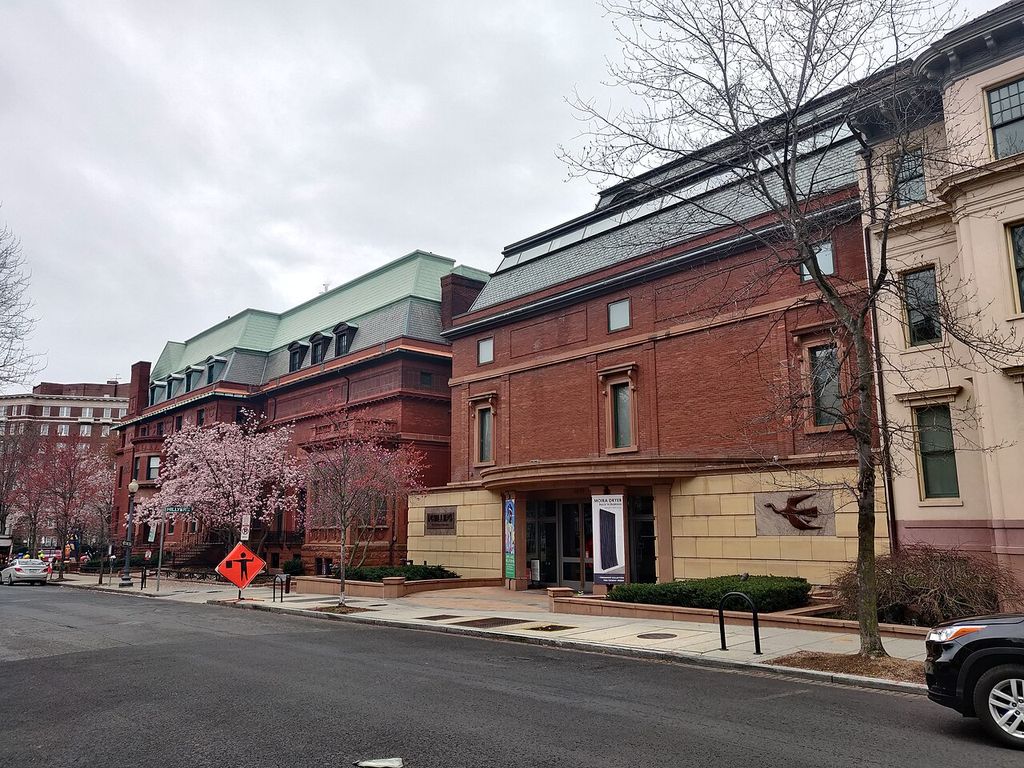
The particular canvas is in the Phillips Collection in Washington, DC, where it is object 1554. The museum records it as an oil painting measuring 50.48 by 61.60 centimetres and acquired in 1927. The artist was a young Spaniard working in Paris, not a French painter with a settled lifelong address there. The museum identifies the scene with his studio on the boulevard de Clichy in Montmartre. The Blue Room is an English name for a work also called La chambre bleue or Le Tub; those titles do not describe three separate Phillips paintings.[1][2][3]
At a Glance
- Date: Autumn 1901
- Scene: A woman bathing in a modest Paris room
- Collection: The Phillips Collection, Washington, DC; object 1554
The Blue Room in Picasso's career
First Communion
1896The Blue Room
1901Three Musicians
1921Las Meninas series
1957The highlighted work is dated with the qualifications explained in the sources on this page. The other works are selective points of comparison, not the start or end of a style.
Contents
- A room crowded with things to see
- Paris in 1901 and the beginning of blue
- The Toulouse-Lautrec poster and the flowers
- The portrait underneath the surface
- The painting in the Phillips Collection
A room crowded with things to see
The bather stands just left of centre, her back turned partly toward us. Her bent body creates a strong diagonal over the round tub. It gives the eye a path through the small interior, from her pale shoulder and arms toward the tub's darker rim. We can see the act of washing or bending to wash, but not a face from which to read a precise emotion. Nothing in the documented object record names the sitter or tells us that she felt contentment, shame or innocence.[1]
The bed is strikingly large relative to the figure. Its pale covers push across the picture, making the room feel occupied even where no person stands. A striped seat or sofa introduces warm red and green on the left, while a table and bouquet punctuate the right. The bright window interrupts the blues on the far left. Picasso gives the viewer several small places to look, but the arrangement remains close: there is no open corridor leading far beyond the bed. The room's compression is a visual fact; whether it feels homely or confining is a matter of response.[1][2]
The woman is not merely a pale shape pasted against a dark field. Blues appear in the room's walls, bed shadows, furniture and tub, shifting in tone and intensity. Her skin and the bedding register as lighter passages, while stronger outlines and red details hold some objects apart. The title directs us toward colour, but the colour works through contrasts. Looking only for “the Blue Period mood” can make us miss how actively Picasso distinguished the surfaces of a real room.[1][2]
Small pictures within the painting give it a second subject: the images an artist chooses to live with. On the wall above the bed is a version of Henri de Toulouse-Lautrec's 1895 poster May Milton, showing the Irish dancer. This is not a portrait of the woman bathing. The Phillips Collection and the Art Gallery of Ontario identify it as Picasso's reference to a French artist he admired. Lautrec died in September 1901, shortly before Picasso made this canvas, and the exhibition text understands its inclusion as a tribute.[1][2]
Another small image on the wall resembles a seascape. The technical study describes it as thought to represent one of Picasso's own paintings; “thought to” matters, because that is an identification by comparison, not a readable signature or accession number in this canvas. A bouquet on the side table recalls the floral still lifes he showed at Galerie Vollard earlier in 1901. The room can thus be read as a working artist's environment, holding examples of a predecessor's art and his own experiments. Its contents help date an evolving practice without requiring each miniature image to be matched to a surviving original.[2][4]
The painting is roughly wider than it is tall and small enough to be described as a room-sized glimpse rather than a grand public scene. Reproductions often enlarge it until the bather seems monumental. The actual dimensions restore an important relation between viewer and object: a relatively compact canvas contains a bed, bathing figure, windows, pictures and flowers. Picasso has packed a great deal of activity into that format. Its material is oil on canvas, not a watercolour or a print, and the later technical evidence concerns layers within this same physical support.[1][4]
Paris in 1901 and the beginning of blue
Picasso first visited Paris in 1900, then returned to Spain. The Museu Picasso in Barcelona records another Paris trip in June 1901 and an exhibition at Galerie Vollard from 25 June to 14 July, shared with Francisco Iturrino. It places the beginning of the Blue Period in the autumn. The Blue Room belongs to that pivotal later part of the year, after his brighter and more rapidly varied early Paris subjects. Describing it simply as a mature example of an already complete Blue Period conceals the change that the painting makes visible.[1][2][3]
The Phillips Collection calls it one of the earliest Blue Period works. The Art Gallery of Ontario and Phillips exhibition placed its creation around Picasso's twentieth birthday in October 1901. That is a reasoned chronology drawn from the artist's movements, related pictures and the May Milton reference; the canvas does not carry a day-and-month inscription cited by the museum. “Autumn 1901” communicates the evidence more accurately than a falsely precise date.[1][2]
The 1901 Paris studio was not an isolated origin point. Barcelona and Madrid had been part of Picasso's training and work, and he moved between Spain and France at this stage. The Barcelona museum's timeline is particularly useful here: it prevents the mistaken story that he had lived in Paris continuously up to 1900. Paris gave him fresh sights, artistic encounters and exhibition opportunities; it did not erase the Spanish and Catalan contexts from which he travelled.[3]
The death of his friend Carles Casagemas in February 1901 belongs to that year's history and to paintings Picasso made in response. Yet The Blue Room does not depict Casagemas, his death or an identifiable act of mourning. The change toward blue involved artistic sources, subjects, materials and circumstances as well as personal experience. The Musée d'Orsay's treatment of Picasso's Blue and Rose periods as a connected development similarly cautions against making one event explain every work in a three-year period.[2][3][5]
In this painting, the blue palette coexists with references to Toulouse-Lautrec and with flowers that recall Picasso's own Vollard display. The Art Gallery of Ontario describes it as a transitional work. That term is more exact than saying Picasso suddenly abandoned his earlier interests. A painter can develop a new dominant colour and still carry posters, café imagery, still lifes and interior design from recent work into the new canvas. The visible room is an inventory of those overlapping commitments.[2]
Watch: Pablo Picasso
Explore Picasso through five videos from museums, broadcasters and art educators.
Picasso’s Guernica: Great Art Explained
Explore the composition and historical setting of Picasso’s best-known response to war.
Watch on YouTubeThe Toulouse-Lautrec poster and the flowers
The May Milton poster is especially informative because it is recognisable despite being painted at a tiny scale on the wall. Toulouse-Lautrec had made it in 1895. Picasso's version borrows its figure and its blue, yellow and white accents, allowing another artist's graphic language to sit inside his own new arrangement. The poster does not simply prove “influence” in a vague sense. It shows Picasso placing a known image in a studio scene at a moment when he was deciding what kind of artist he could become.[1][2]
The 2021–22 AGO and Phillips exhibition proposed that its appearance honoured Lautrec after his death on 9 September 1901. That is a plausible curatorial reading strengthened by the chronology, not a written dedication by Picasso on the canvas. The same distinction applies to claims that the room is a manifesto of artistic succession. We can see the poster and compare its colours and subject; a claim about an exact private motive requires different evidence.[2]
The bouquet works in another register. It is a small object in the painted room, and at the same time it resembles the flower still lifes Picasso produced for the Vollard exhibition. The exhibition text explicitly points to that relationship. A vase can therefore carry a link between a lived setting and a painter's recent commercial and artistic work. It is not necessary to call the bouquet a coded symbol of optimism to notice that it interrupts the surrounding blue and connects this interior to other paintings.[2]
Together the wall images and flowers keep The Blue Room from being a generic scene of poverty or sadness. The bed and tub suggest everyday use; the poster and paintings suggest attention to images and to the history of art. This does not prove the composition is an exact topographical inventory of the studio on one particular morning. Picasso could observe a familiar place and reorganise its contents. The institution's studio identification anchors the setting, while the arrangement on canvas remains an artistic construction.[1][2]
The portrait underneath the surface
The visible bathing scene was painted over an earlier portrait of a man. This is not a second painting mounted behind the canvas. It is a composition underneath the oil paint we see today, on the same support. The distinction matters because the story is often told as a sudden 2014 discovery made by an X-ray. In fact, according to the AGO and Phillips exhibition, a conservator noted signs of two compositions in 1954. Later X-radiography confirmed evidence beneath the surface. More recent infrared and other studies made the man's image much clearer.[2][4][6]
The Phillips conservator Patricia Favero began a sustained investigation in 2007, drawing on earlier examinations. Collaborators at the National Gallery of Art, Winterthur and Cornell brought different methods to the canvas; the Phillips publicised the clearer image in 2014, and a detailed technical paper appeared in 2017. These dates refer to observation, investigation, public presentation and publication, respectively. They should not be collapsed into the claim that no one knew about an underlying picture until 2014.[4][6]
Filtered infrared reflectography reveals a man wearing formal clothes, slouched against a cushion or banquette with his head resting on his right hand. His fingers bear rings. The technical study describes a dark jacket, white bow tie and a red flower on the front of a white shirt. Such details were recovered by combining image methods and study of the paint, not by stripping away the bathing scene. The man remains unidentified. Suggestions that he must be Ambroise Vollard or another named figure are hypotheses, not established catalogue facts.[2][4]
Different tools answer different questions. X-radiography made a ghostly second composition apparent. Selected infrared wavelengths gave a more legible portrait beneath the surface blue; spectroscopy and X-ray fluorescence mapping helped researchers distinguish where pigments lay and how they were mixed. Small paint samples clarified the layering. It is therefore misleading either to say “an X-ray showed everything” or to imagine that modern technology recovered a perfect hidden picture in the original colours. The researchers themselves explain that no single technique fully reconstructs it.[2][4]
Their material findings do support a more specific account of how the canvas was reused. The earlier portrait appears to have been a finished, dry picture when Picasso painted The Blue Room directly over it. The study found no separate ground or dirt layer dividing the two compositions; it also found closely related pigment mixtures and fillers in both. This strengthens the attribution of the underlying painting to Picasso and suggests the two were made within months of each other. It does not tell us why he chose to paint over the man.[4]
Canvas was a useful material to a young artist, and economy may have been one consideration. The Phillips object record notes that Picasso reused canvases while short of money. But the absence of a letter or account about this precise decision means we should not say that he definitely disliked the portrait, or definitely covered it only because he could not afford a new canvas. A finished picture could be overpainted for several reasons. The material facts establish the sequence; motive remains open.[1][4]
The underpicture also complicates an easy narrative in which the bright early Picasso ends one day and the melancholy Blue Period begins the next. The portrait's formal Parisian sitter and colour connect with his summer 1901 work; the surface bather and blue interior take the image in another direction. Both layers occupy one support and probably a short span of time. The canvas is consequently evidence of an artist working through possibilities, rather than a tidy illustration of two completely separate phases.[2][4]
The painting in the Phillips Collection
The Phillips Collection records acquiring The Blue Room in 1927 and describes it as the first Picasso work to enter its collection. Duncan Phillips valued the colour and emotional force of Picasso's early painting. This institutional history explains why the work has become closely associated with the Washington museum. It does not supply a full chain of owners back to Picasso, and no such chain should be invented from the acquisition date alone.[1]
The canvas is also an example of why an artwork page benefits from both close looking and conservation. Without the object record, a viewer may misidentify the poster or treat a poster reproduction as the original painting. Without the technical work, the story of a hidden figure can become a headline detached from decades of research. Without the visible painting, the hidden portrait can take over the conversation, as though the bathing scene were merely a covering. It is the composition Picasso chose to present, and it warrants attention on its own terms.[1][2][4]
The strongest way to understand The Blue Room is to keep those levels together: a 1901 Paris interior, a carefully arranged bather and studio, a visible encounter with Toulouse-Lautrec and Picasso's own recent flower paintings, and a materially documented earlier portrait beneath. The sitter's identity and emotion are unknown; so is the hidden man's name and Picasso's exact motive for reusing the canvas. The Phillips Collection's object record[1] establishes the painting's identity, while the AGO and Phillips exhibition and the conservation study explain how much can—and cannot—be learned from its two painted layers.[1][2][4]
Discussion
Use the evidence and your own close looking to explain your view. These are editorial prompts, not reader comments.
Reader Insights
Which coloured objects keep the room from becoming a flat blue field?
How does technical study change what we know of the canvas’s earlier state?
Which details belong to the Phillips Collection’s particular painting?
Join the Conversation
Which reading best fits the evidence?
References
- The Phillips Collection, The Blue Room, object 1554.
- Art Gallery of Ontario and The Phillips Collection, Picasso: Painting the Blue Period exhibition text; French edition.
- Museu Picasso Barcelona, Picasso chronology, Spanish.
- Patricia A. Favero and colleagues, technical study of The Blue Room, Heritage Science 5:13 (2017).
- Musée d'Orsay, Picasso Bleu et Rose, French.
- The Phillips Collection, 2014 research update; multi-institutional study press release.
Image Credits
- Kurt Kaiser. CC0. Source: Wikimedia Commons. Resized to 1024px; no crop. Source record. Licence.
