


 by Tom Gurney
Tom Gurney BSc (Hons) is an art history expert with over 20 years experience
Email: tomgurney1@gmail.com / Phone: +44 7429 011000
Introduction
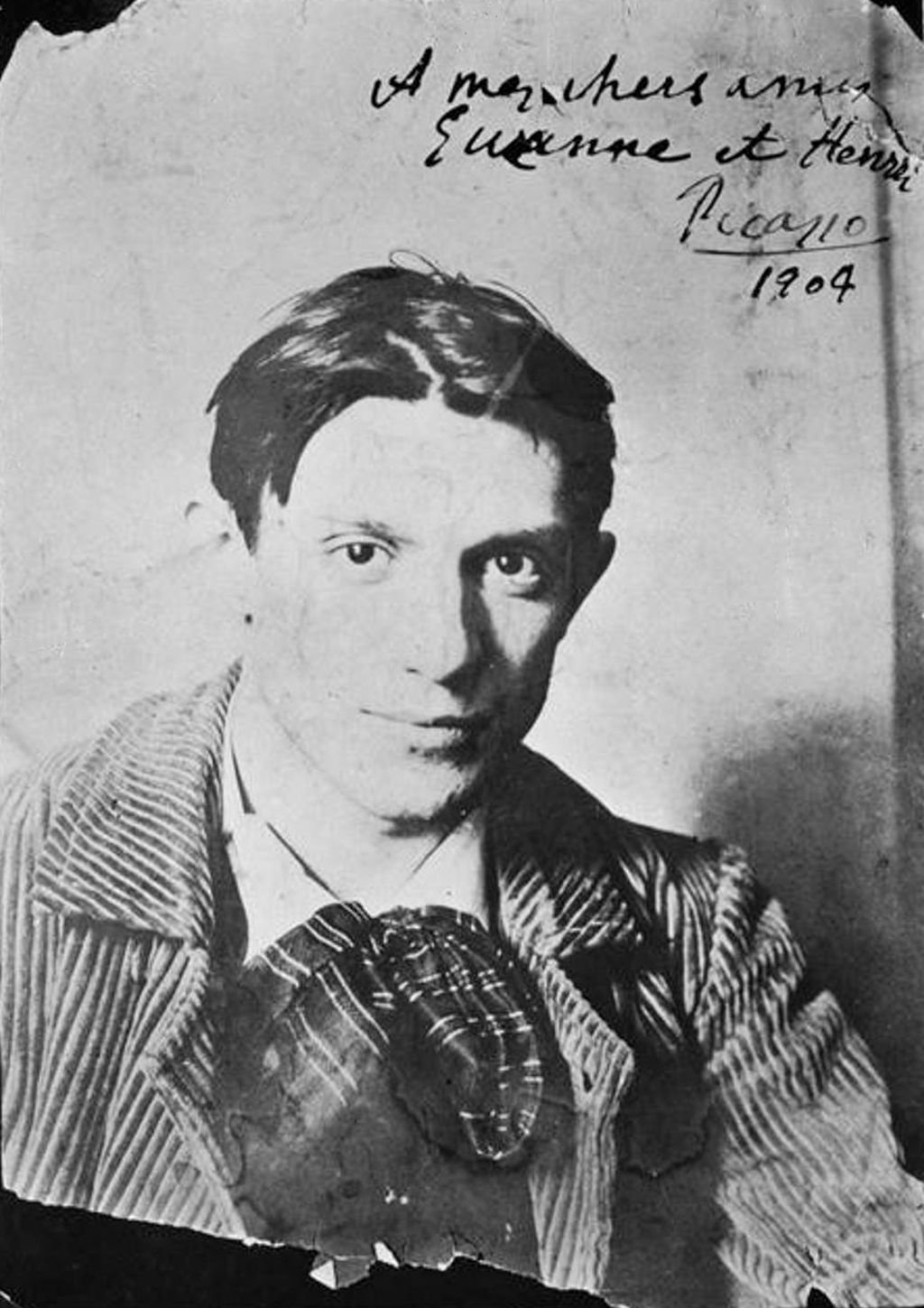
Pablo Picasso's paintings resist a simple tour from one style to the next. He learned to construct a large, legible scene through academic training, reduced a figure almost to colour and posture, fractured a tabletop into shifting planes, and later returned to older painters to remake their compositions. Those changes did not erase earlier interests. People, instruments, rooms and the act of making art recur across paintings that look unlike one another.[1][2][3]
The useful question is not “Which period is this?” alone. It is also: what problem is the painting asking us to see? A tightly modelled figure and a face assembled from incompatible views may both be portraits. A sombre blue surface and a brightly patterned mirror scene may both make closeness between people difficult to judge. The works below offer a path through Picasso's paintings by considering subject, space, colour, revision and the lives of the paintings after they left his studio. Drawings, prints and sculpture enter only when they clarify a choice made in paint.[2][3]
At a Glance
- Scope: From academic student pictures to late variations
- Recurring subjects: People, instruments, rooms and other artists’ compositions
- Ways to look: Subject, colour, space, revision and material history
Browse Picasso’s paintings
Explore every individually researched painting in this launch cluster. The links are presented without reproducing Picasso’s artwork images.
- First Communion1896
- Science and Charity1897
- Child with a Dove1901
- Self-Portrait (1901)1901
- The Blue Room1901
- La Vie1903
- The Tragedy1903
- The Old Guitarist1903–04
- La Celestina1904
- Woman Ironing1904
- Family of Saltimbanques1905
- Garçon à la Pipe1905
- Les Noces de Pierrette1905
- Boy Leading a Horse1905–06
- Portrait of Gertrude Stein1905–06
- Les Demoiselles d'Avignon1907
- The Reservoir, Horta de Ebro1909
- Girl with a Mandolin1910
- Portrait of Daniel-Henry Kahnweiler1910
- Ma Jolie1911–12
- Portrait of Olga in the Armchair1918
- Three Musicians1921
- Women Running on the Beach1922
- Pipes of Pan1923
- The Three Dancers1925
- The Dream (Le Rêve)1932
- Girl Before a Mirror1932
- Rest1932
- Guernica1937
- Weeping Woman1937
- Maya with Doll1938
- Night Fishing at Antibes1939
- Dora Maar au Chat1941
- The Charnel House1944–45
- Joie de Vivre1946
- Massacre in Korea1951
- Mediterranean Landscape1952
- War and Peace1952
The separate Blue Nude study examines a title and identification question rather than one securely identified painting.
Contents
- Before the famous periods
- Blue and rose are useful names, not explanations
- The painted body and the invention of Cubism
- More than one kind of painting at once
- A mirror, a political painting and the limits of interpretation
- Repainting the history of painting
- What a painting can tell us and what a record can add
- Where to start with Picasso's paintings
- Explore individual paintings
Before the famous periods
In Science and Charity (1897), the teenage Picasso painted a large scene of a sick woman attended by a doctor and a nun. The doctor is based on his father, José Ruiz, who helped choose the subject. The format, careful arrangement and concern with a socially legible story show Picasso working within late nineteenth-century expectations rather than somehow beginning as a Cubist. The Museu Picasso Barcelona holds the picture and several studies. Its account identifies changes made during painting, as well as the honourable mention it received at Madrid's General Fine Arts Exposition—not a mythical first prize.[1]
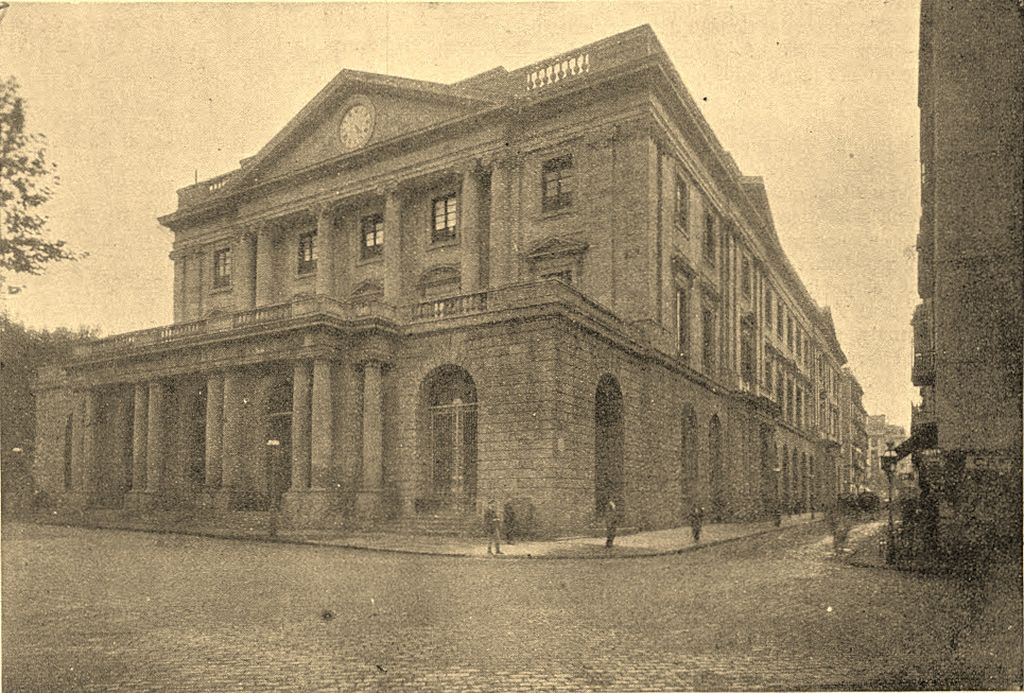
That early picture is worth looking at beside later ones because it establishes a capacity Picasso could choose to use, alter or resist. A bed, wall, bodies and gestures organise attention around a narrative. Preparatory studies and technical research also show that such apparent fluency was made through decisions. The break from academic painting was not a break from skill or from sustained work. It was a change in what he wanted a painted surface to do.[1][4]
In the years around 1900 Picasso worked between Barcelona and Paris, absorbing art and social life in both cities. The paintings began to move away from the polished finish expected of a student exhibition canvas. A smaller scale, a sharper contour or an emptied background could make a person seem more immediate—or more isolated. This is one reason a chronological list of titles misses something important: the change involved the relation between figure and surrounding space, not only the date or subject.[2][5]
Blue and rose are useful names, not explanations
“Blue Period” names a strong tendency from about 1901 into 1904, not a promise that every canvas was blue. In works such as The Tragedy (1903), colour narrows the range of a scene while posture carries much of its emotional weight. The National Gallery of Art's three figures stand close together on a shore, yet the spaces between their bodies are conspicuous. The painting does not supply a named event or an identified family. Its effect can be described without claiming to know precisely what Picasso intended—or treating a palette as a diagnosis of his mental health.[6][7]
Some subjects are recognisably precarious: people at work, people with little money, mothers and children, performers on the edge of ordinary social life. They are not interchangeable symbols of poverty. Woman Ironing (1904), for example, invites attention to a particular labouring body and the force of its downward movement. Conservation at the Guggenheim revealed a portrait beneath that painting. That physical evidence complicates any story in which a finished Blue Period image is simply a transparent outpouring of feeling; materials and earlier work remained available for Picasso to transform.[8]
The warmer colours and circus subjects commonly grouped as the Rose Period emerged gradually. A performer in pink need not be joyful. Harlequins and acrobats could be pictured in moments of waiting rather than spectacle, and shifts of colour did not end Picasso's interest in solitude or human vulnerability. The French exhibition research of the Musée d'Orsay places blue and rose across Paris and Barcelona and treats them as changing artistic choices, not two sealed moods attached to two chapters of a life.[5]
For a viewer, the strongest comparison is often formal. How much does a body weigh in the picture? Is a face specific, masked, downcast or withheld? Does colour join figures together or make the gap between them more palpable? These questions can be asked of a blue painting and a rose one without assuming that either period label supplies its meaning.[5][7][8]
Watch: Pablo Picasso
Explore Picasso through five videos from museums, broadcasters and art educators.
Picasso’s Guernica: Great Art Explained
Explore the composition and historical setting of Picasso’s best-known response to war.
Watch on YouTubeThe painted body and the invention of Cubism
Les Demoiselles d'Avignon (1907) places five women in a shallow, fractured setting. Their faces, bodies and ways of meeting the viewer are not governed by one naturalistic system. The painting was made after many preparatory studies and changed as Picasso worked. It did not enter public exhibition until 1916; the familiar title belongs to that later public history. Calling it an overnight announcement of Cubism therefore obscures both its making and its reception.[9]
It is also a picture of sex workers, not merely a laboratory for angles. Its visual sources range across European painting and Iberian, African and Oceanic works. The Museum of Modern Art notes that many non-European objects reached French collections through colonial channels. Their makers and histories cannot be reduced to raw material for a European innovation. Scholars continue to debate whether Les Demoiselles is itself a Cubist painting or a decisive work immediately before the fuller development of Cubism. That debate is more illuminating than fixing a single birthday for the movement.[9]
Picasso developed Cubism in close exchange with Georges Braque. In paintings made from about 1908, a table, bottle, guitar or face may no longer sit securely within one perspective. Edges continue across objects; planes tilt; a familiar feature appears as a clue to something the viewer must piece together. The restrained colours of many Analytic Cubist works make small differences of tone and contour matter. The painting is not necessarily an image of an object seen at exactly one instant from exactly one place.[3][10]
This does not mean Picasso and Braque abandoned recognisable subjects. A guitar's neck, a glass's rim, letters or the curve of a face can orient the viewer within a complicated field. Nor does a Cubist painting literally contain every viewpoint at once. Such a formula is too neat for the varied solutions in individual works. The more useful observation is that the painting exposes the work of recognition: how little of an object do we need before we think we know it?[3][10]
Around 1912, cut paper, printed matter and ordinary materials began to enter related works. A painted form could sit beside a fragment from the world outside the studio; an imitation could masquerade as a real texture. That shift matters to the paintings as well as to collage. It changes what a painted sign has to compete with and how we distinguish an image of a thing from an actual piece of material. Picasso's paintings and other media repeatedly pressed on one another, even though they were not the same kinds of objects.[3][10]
More than one kind of painting at once
It is tempting to describe the years after the First World War as Picasso's return from Cubism to classical figuration. The paintings themselves resist that sequence. In 1921 he made Three Musicians, an oil painting whose broad, interlocking shapes recall the logic of cut and pasted paper. The performers and instruments are visible, but their bodies share edges with costume, shadow and ground. MoMA documents that, during the same summer in Fontainebleau, Picasso made monumental versions of Three Women at the Spring in a much more classicising mode.[11][20]
Reading the Letter in 1921
Another 1921 painting makes that simultaneous range tangible. Musée national Picasso-Paris catalogues La Lecture de la lettre (Reading the Letter) as an oil on canvas made in Paris, measuring 184 by 105 centimetres, inventory MP72. Its two seated young men lean over a sheet of paper. One rests his head against his hand; their bodies and clothing form a close group within a spare setting. The old pablopicasso.net image depicts this composition, but the match does not establish permission to republish its JPEG. Readers can see the copyrighted work through the museum's object record.[24]
The GrandPalaisRmn analysis draws attention to the men's city clothes against the rocky ground, their proximity and the book lying beside them. It offers a possible evocation of Picasso's friendship with the poet Guillaume Apollinaire, who died in 1918, while explicitly noting that the figures are not portraits of the two men. An interpretation of friendship or literary memory should therefore remain a possibility, not a sitter identification or a decoded message. Nothing in the object record establishes whether the letter brings good or bad news, whether the readers are brothers, or whether either is comforting the other after a death, as the former article speculated.[24][25]
The painting's substantial scale and rounded, weighty figures provide a useful contrast with the interlocking planes of Three Musicians, also dated 1921. That comparison belongs in a discussion of Picasso's overlapping pictorial choices, not a claim that he left Cubism behind. The Neoclassicism guide explores this coexistence. Reading the Letter is also distinct from the 1932 paintings called La Lecture, discussed in the portraits guide: a shared word for reading is not an artwork identity.[11][20][24]
The point is not that one mode was sincere and the other a disguise. Painting offered different ways to stage a figure. A solid, monumental body can assert weight; a masklike performer can make identity seem assembled and unstable. A scene can be built from smooth transitions or from exposed joins. Picasso continued to move among such options, sometimes within the same period and sometimes within closely related subjects. Period labels should help a reader locate a work, not prevent that comparison.[2][11]
The 1920s and 1930s also brought more violent distortions, changing treatments of the human face and recurring attention to the relation between a person and an image of that person. These paintings are often discussed alongside Surrealism, but the label should not make every distortion a dream symbol. The work in front of us still has a date, material, composition and particular subject that must be examined before we attach a general movement to it.[2][12]
Bather with Beach Ball at Boisgeloup
MoMA catalogues Bather with Beach Ball as an oil on canvas made at Boisgeloup on 30 August 1932, measuring 146.2 by 114.6 centimetres (object 689.1980). The former pablopicasso.net page reproduces this composition: a pale grey figure seems to float diagonally across the canvas, with rounded limbs, a dark fan-like form behind the head and a magenta suit broken by sharp yellow triangles. A small ball rises near the upper right. The flat orange and blue surroundings give the moving body a stage, but no ordinary horizon or beach scene. This visual match identifies the design, not the old JPEG's provenance or permission to republish it.[21]
The picture rewards slower looking than the old page's label “Cubist artwork with elements of Surrealism” allows. A sweeping contour suggests motion while the body is both stretched and folded; the triangle pattern makes the costume appear to rotate around it. MoMA's record establishes the precise object, medium and date. It does not, by itself, establish the sitter's identity, Picasso's intention, or the legacy site's claimed French title. The old article's comparisons with later Pop art and its account of preparatory studies should not be repeated as facts without work-specific evidence. The Girl before a Mirror page offers another 1932 investigation of a transformed body, but the two paintings ask viewers to follow different kinds of movement.[21]
“Bather with a ball” is also a family of subjects, not a unique catalogue identifier. Musée national Picasso-Paris holds Baigneuses au ballon, MP143, an oil on canvas dated 4 December 1932 in Paris; it is a different painting with different dimensions. The Paris museum also describes a separate 1928 Dinard painting of bathers playing with a ball. Neither should inherit MoMA's 30 August date or its image. A visitor following an older link for this bather should be directed to the MoMA object record when they need to see the copyrighted canvas, and use this section to distinguish it from the similarly titled works.[21][22][23]
A mirror, a political painting and the limits of interpretation
In Girl before a Mirror (1932), a woman reaches toward her reflection. Picasso sets profile beside frontal view and gives the figure and the reflected body differing patterns and colours. The painting has often invited readings about youth and age, desire, doubling or mortality. MoMA's account presents it as multivalent rather than a puzzle with one correct key. Its symmetrical structure holds together parts that refuse to become one stable likeness.[12]
An X-ray discussed by MoMA showed a more naturalistic earlier treatment of the figure's body. That finding does not reveal exactly what Picasso thought as he changed it. It does show that the striking geometry of the finished woman was worked toward, not simply present from the first mark. Technical evidence is especially useful when a familiar image has become so famous that its process disappears behind its final look.[13]
The conditions of making Guernica (1937) were very different. The Spanish Republic commissioned a painting for its pavilion at the Paris International Exposition. After the bombing of the Basque town of Gernika, Picasso made the monumental canvas that bears its Spanish name. It draws figures, animals, broken space and a light source into a scene of suffering. It is a political work, but not a literal illustration in which each figure has a single agreed translation. Reina Sofía's collection record and its Repensar Guernica archive provide a documentary basis for the commission, composition, later travel and reception.[14][15]
Dora Maar photographed stages of the painting's development. Her images offer a rare way to follow visible changes to a major canvas and recognise her own role in its historical record. They do not turn a set of photographs into a transcript of Picasso's intentions. This is a useful distinction for any Picasso painting: evidence of alteration is evidence of alteration; it is not automatic proof of what every motif “means.”[15]
These two 1930s paintings test different capacities of paint. Girl before a Mirror makes a person and her image confront one another inside a strongly organised colour field. Guernica asks a large public picture to address contemporary violence without rendering the event as a conventional battle scene. One should not be used to explain the other by a single biographical story. Comparing them shows how pictorial space, scale and audience can change the problem a painter is trying to solve.[12][14]
Repainting the history of painting
Picasso kept working with earlier art, not only in his student exercises but through sustained later series. In 1957 he reinterpreted Velázquez's Las Meninas in paintings now held by the Museu Picasso Barcelona. The first large group scene makes the painter unusually prominent and changes the original's format. Across the series, figures, rooms and colours are revised again and again. The task is not to find one canvas that “corrects” Velázquez. It is to watch how variation changes our sense of the original picture and of the space within Picasso's own versions.[16][17]
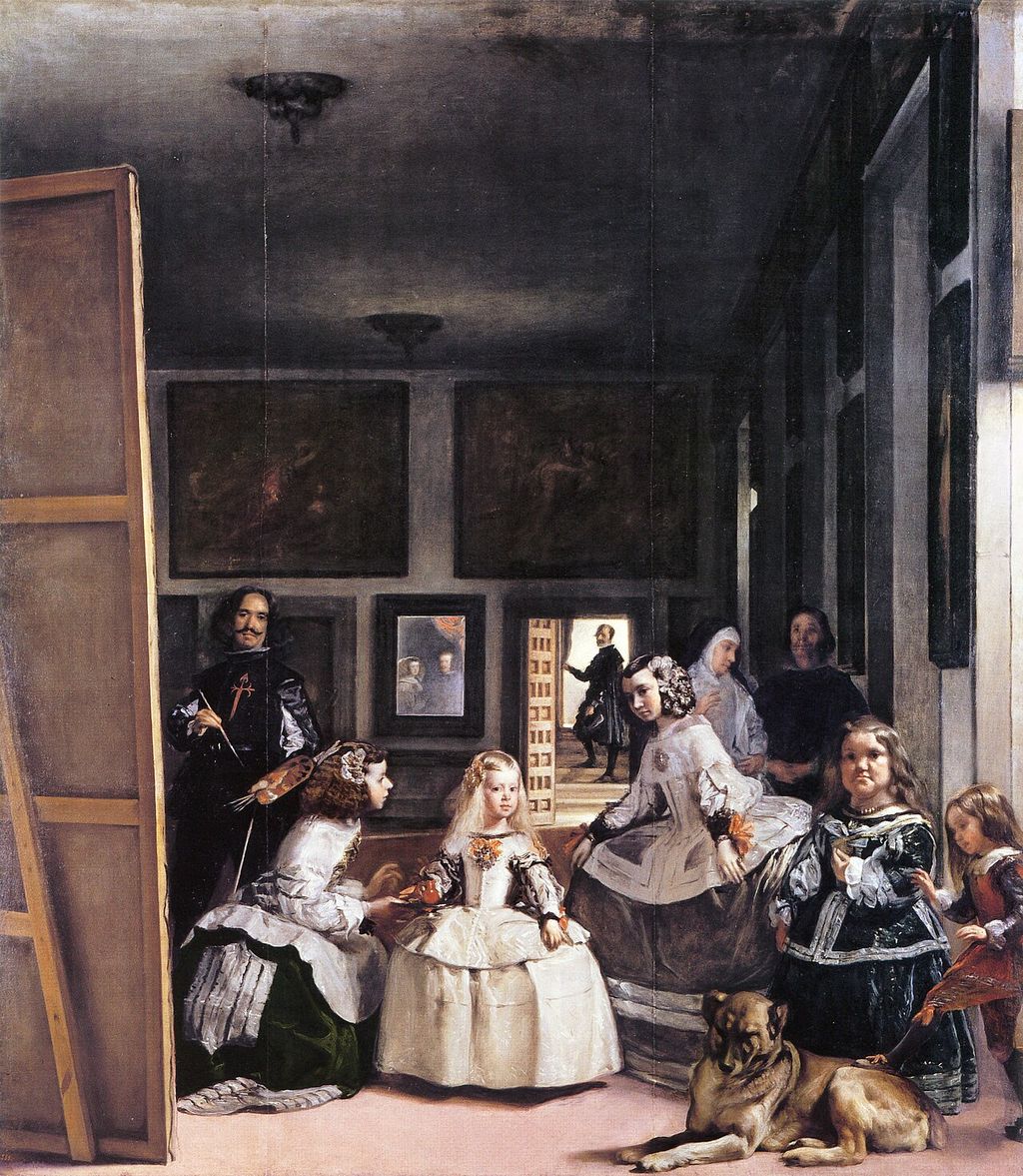
The Las Meninas paintings demonstrate a different kind of originality from the image of a lone breakthrough. Picasso could begin with a well-known composition and make the act of reworking it visible. Repetition is not mere duplication: a shift in scale, position or colour changes the relation between figures and the viewer. Looking across several versions is therefore more informative than lifting one out as a single masterpiece.[16][17]
Painting remained central late in Picasso's life. The Musée national Picasso-Paris records Le Jeune Peintre, made in Mougins in April 1972, as a loosely handled image of a youthful painter with the familiar tools of his trade. The museum cautiously discusses its relation to self-portraiture. Another late work, Mousquetaire et enfant (May 1972), returns to the historical costume and theatrical figures that recur in these years. Neither should be made into a universal summary of Picasso's final art. Together they show his continued interest in the painter's role, the performed identity and the visible stroke.[18][19]
Calling all the late canvases “Neo-Expressionist” would flatten their differences and import a later label as though Picasso had joined a single movement. A better approach is to identify the individual object, observe the way its paint is handled and ask what earlier images or roles it revisits. A swift-looking brushstroke is not proof that a painting required no decisions.[18][19]
What a painting can tell us and what a record can add
A painting gives a viewer much to work with: its size, colour, surface, figures and the relations among them. It does not always give a secure date, the sitter's name, the full sequence of alterations or the path by which the object reached its present collection. An institutional record can help with those questions. The museum holding Science and Charity publishes its studies and exhibition history; MoMA documents Les Demoiselles and Girl before a Mirror; Reina Sofía connects Guernica to an extensive archive. Those records do not eliminate interpretation, but they prevent a viewer's guess from masquerading as an established fact.[1][9][12][14]
Conservation can also reveal what the visible painting conceals. Earlier marks beneath Woman Ironing, an X-ray beneath Girl before a Mirror, studies for Science and Charity and the sequence of Guernica photographs are different types of evidence. Each illuminates a particular work. None licenses a claim that all Picasso paintings were made in the same way. Even apparently spontaneous results may come from repeated experiments; apparently resolved surfaces may retain traces of abandoned plans.[1][8][13][15]
This page is deliberately text-led. The presence of a Picasso image on an old website or a museum page does not mean another site may republish it. The linked museum records allow readers to inspect securely identified works in their institutional context; they are not an invitation to reuse those images. The paintings' dates, media and owners also make clear that a single title in an online list is rarely enough to establish which Picasso object is being discussed.[1][9][14][18]
Where to start with Picasso's paintings
For a first route through the paintings, try four comparisons rather than a ranked list of favourites:
- Training and revision: Place Science and Charity beside the Barcelona museum's studies. Which parts of the scene communicate its story immediately, and what did Picasso change before it settled?[1][4]
- Colour and distance: Read The Tragedy alongside Woman Ironing. Does blue create the same kind of isolation in a shoreline group and a working figure? What changes when the body bends over a task?[7][8]
- Bodies and space: Compare Les Demoiselles d'Avignon, a Cubist still life and Three Musicians. Look for the edges that tell you where one person or thing ends and another begins. Which parts remain recognisable even when the surrounding space becomes unstable?[9][10][11]
- Painting about images: Move from Girl before a Mirror to the Las Meninas series and Le Jeune Peintre. A reflected woman, a painted painter and a figure equipped to paint all make looking itself part of the subject, but in very different ways.[12][16][18]
Then return to an individual object record. The title, date, medium, dimensions, conservation history and provenance can change what you notice. A period name is a useful signpost; a painting is a set of particular decisions. Picasso's career is more legible when the two are kept in conversation.[1][2][9]
Explore individual paintings
The former paintings gallery offered a route into individual works. The following text-led index preserves that browsing purpose without republishing its Picasso artwork thumbnails. Each link opens a dedicated THOA article; the articles identify their works and point to institutional records where available. Titles alone do not guarantee that similarly named paintings are the same object.
Early work and the blue years
- First Communion and Science and Charity show the young painter working with large, legible figure compositions.
- Self-Portrait 1901, The Blue Room, The Old Guitarist and La Vie invite different questions about colour, space and the figure.
- Celestina, The Tragedy and Woman Ironing reward attention to the particular person and setting rather than a period label alone.
Performers and changing figures
- Les Noces de Pierrette, Garçon à la pipe, Family of Saltimbanques and Boy Leading a Horse lead from early Paris subjects toward the performers and figures of the Rose Period.
- Child with a Dove, Women Running on the Beach and Pipes of Pan offer other ways to compare bodies, companionship and movement.
Cubist experiments and landscape
- Les Demoiselles d'Avignon, The Reservoir, Horta de Ebro, Girl with a Mandolin, Portrait of Daniel-Henry Kahnweiler and Ma Jolie trace distinct problems in figure, object and pictorial space.
- Mediterranean Landscape and Night Fishing at Antibes show how place remains a subject beyond those early Cubist experiments.
Portraits, dreams and public violence
- Portrait of Gertrude Stein, The Three Dancers, Rest, The Dream and Girl before a Mirror lead to sharply different treatments of a person or a body.
- Dora Maar au Chat, Maya with Doll and Jacqueline Roque require particular care about sitter, date and object identity.
- Guernica, Weeping Woman, The Charnel House and Massacre in Korea invite comparison without collapsing their different historical settings.
- Joie de Vivre offers another postwar point of departure.
Several other titles once listed in that gallery are treated within the portraits, animals and theatre, ballet and circus guides. The studios guide discusses the specific 1956 Studio at La Californie, while the late-work guide distinguishes the Women of Algiers series from Version O. These thematic pages provide context where a dedicated artwork article is not part of the launch cluster.
Discussion
Use the evidence and your own close looking to explain your view. These are editorial prompts, not reader comments.
Reader Insights
Choose two paintings that look unlike one another. What subject or pictorial problem connects them?
How does a painting’s material or revision history alter your first reading?
Which period label helps you look, and which one risks closing the question too soon?
Join the Conversation
Which reading best fits the evidence?
References
- Museu Picasso Barcelona, “Science and Charity,” 1897 collection record. View source.
- Musée national Picasso-Paris, “La collection,” French institutional account. View source.
- The Metropolitan Museum of Art, “Pablo Picasso (1881–1973),” art-historical overview. View source.
- Museu Picasso Barcelona, “Restauración del techo novecentista de la sala de Ciencia y caridad,” Spanish account of the painting's technical study and preparatory work. View source.
- Musée d'Orsay, “Picasso. Bleu et rose,” French exhibition research. View source.
- Museu Picasso Barcelona, “Cronología,” Spanish account of the Barcelona–Paris years. View source.
- National Gallery of Art, “The Tragedy,” 1903 object record. View source.
- Solomon R. Guggenheim Museum, “Picasso's Woman Ironing,” conservation research. View source.
- The Museum of Modern Art, “Les Demoiselles d'Avignon,” 1907 object record and research. View source.
- Musée national Picasso-Paris, “Picasso et le cubisme,” French institutional essay. View source.
- The Museum of Modern Art, “Three Musicians,” 1921 object record. View source.
- The Museum of Modern Art, “Girl before a Mirror,” 1932 object record. View source.
- The Museum of Modern Art, “Picasso's Girl before a Mirror: The Science Behind Art History,” discussion of the painting's X-ray. View source.
- Museo Reina Sofía, “Guernica,” 1937 collection record. View source.
- Museo Reina Sofía, “Repensar Guernica,” Spanish archival research project. View source.
- Museu Picasso Barcelona, “Las Meninas,” first large 1957 version, collection record. View source.
- Museu Picasso Barcelona, “Forgetting Velázquez. Las Meninas,” exhibition research. View source.
- Musée national Picasso-Paris, “Le Jeune Peintre,” French collection record. View source.
- Musée national Picasso-Paris, “Mousquetaire et enfant,” French collection record. View source.
- The Museum of Modern Art, “Picasso in Fontainebleau,” exhibition research on the Cubist and classicising canvases made in summer 1921. View source.
- The Museum of Modern Art, “Bather with Beach Ball,” 30 August 1932 object record, 689.1980. View source.
- Musée national Picasso-Paris, “Baigneuses au ballon,” 4 December 1932 object record, MP143. View source.
- Musée national Picasso-Paris, “Baigneuses jouant au ballon,” account of the distinct 1928 Dinard painting, MP110. View source.
- Musée national Picasso-Paris, “La Lecture de la lettre,” 1921 collection record, MP72. View source.
- GrandPalaisRmn, Panorama de l'art, Isabelle Bonithon, “La Lecture de la lettre,” visual analysis published 13 October 2014. View source.
Image Credits
- Ricard Canals i Llambí, 1904. Wikimedia Commons labels the photograph public domain; its source credits RMN-Grand Palais. Resized to 1024px; no crop. Source record. Licence.
- Creator as listed on source page. Public domain. Source: Wikimedia Commons (File:Façana de la Plaça del Palau (bibliotecammb10916).jpg). 1024px proportional sRGB JPG derivative; no crop. Source record. Licence.
- Diego Velázquez. Public domain. Source: Wikimedia Commons. Resized to 1024px; no crop. Source record. Licence.

.jpg)
