


 by Tom Gurney
Tom Gurney BSc (Hons) is an art history expert with over 20 years experience
Email: tomgurney1@gmail.com / Phone: +44 7429 011000
Introduction
Two women clasp hands and surge across a pale shore beneath a deep blue sky. Their bodies fill almost the whole composition. One leans back as if lifted by the force of their shared movement; limbs extend in directions that make the group seem larger than the space it occupies. Picasso's Women Running on the Beach, also called Two Women Running on the Beach or La Course (The Race), can look like a monumental painting in a reproduction. The original is a gouache on plywood measuring only 32.5 by 41.1 centimetres.[1][2]
Picasso made it at Dinard, on the Brittany coast of France, in the summer of 1922. It is now Deux Femmes courant sur la plage (La Course), inventory MP78, in the Musée national Picasso-Paris. Two years later its design was enlarged for a stage curtain in the Ballets Russes production Le Train bleu. The small painting and the enormous curtain are related but separate objects, and the latter was painted by stage designer Prince Alexander Schervashidze after Picasso's composition.[1][2][3]
At a Glance
- Date and place: Summer 1922, Dinard
- Medium: Gouache on plywood
- Size: 32.5 × 41.1 centimetres
- Collection: Musée national Picasso-Paris, MP78
Women Running on the Beach in Picasso's career
The highlighted work is dated with the qualifications explained in the sources on this page. The other works are selective points of comparison, not the start or end of a style.
Contents
- What the two women are doing
- A small work with a large visual scale
- Dinard in the summer of 1922
- Classical figures in motion
- The painting becomes a ballet curtain
- The beach motif beyond this painting
What the two women are doing
The title announces a run, but the picture does not record an ordinary footrace. The women's joined hands rise over their heads; their arms pull the two bodies into one broad arc. Their feet and legs seem to make different kinds of contact with the ground. One figure appears briefly balanced on the ball of a foot while the other's leg swings backward. The Musée national Picasso-Paris compares these gestures to dance as much as to running. There is motion, but the painting holds two instants together rather than offering a freeze-frame of a single step.[1]
Their white draperies twist against flesh and blue. A shoulder and breast are uncovered on each body, and the garments appear to move with the figures rather than describing a neatly fixed costume. Thick hands and feet give the bodies weight. Smaller heads and unusually long arms and necks pull them away from normal proportions. Those choices make the women appear simultaneously heavy and airborne: capable of pressing against the shore and of breaking free of it.[1]
The setting is spare but not empty. A chalky, uneven strip of ground runs across the foreground. Behind it, a blue area can be read as sea, and a lighter blue sky carries scattered white clouds. The museum's catalogue leaves open whether the figures are on a sandy beach or higher ground above the water. This uncertainty changes their scale. There is no row of distant holidaymakers, boat or building to tell us exactly how large they are. The low horizon and wide blue field allow two figures in a tiny picture to dominate an apparently vast coastal space.[1]
Picasso has not made the women symmetrical. One body overlaps the other; arms and legs exchange foreground and background in ways that are not easy to map as a conventional pair of posed figures. Yet the joined hands are clear. They make a bond across the image and explain why the women move together even though their strides differ. “Race” need not mean that one is trying to defeat the other. It may name the energy of their passage rather than a sporting contest with a winner.[1]
The blue is equally important. It gives the pale clothing and warm bodies their contrast, but it does not become a detailed weather report. Small clouds break up the expanse without interrupting the figures' movement. The sea and sky supply a modern outdoor setting for bodies that also recall much older art. A viewer can see a beach holiday and an ancient frieze at once; neither reading cancels the other.[1][4]
A small work with a large visual scale
The original's medium is gouache on plywood, not oil on canvas. Gouache is a water-based paint valued for comparatively opaque colour. Applied to a firm panel, it can build broad, flat areas as well as quick-looking accents. The museum record does not explain why Picasso chose plywood for this picture, so the support should not be turned into a story about improvisation or poverty. What is certain is the disparity between its modest physical size and its visual force.[1][2]
The women occupy the surface so fully that a small reproduction can conceal the actual size. Their limbs push near the composition's edges, and the strong divisions of ground, sea and sky make the panel feel like a much larger design. The picture is neither an informal sketch nor a gigantic original painting. It is a complete small work that proved capable of functioning at another scale when it was adapted for the theatre in 1924.[1][3]
The frame can also mislead. The French Ministry of Culture gives the painted panel as 32.5 by 41.1 centimetres and the framed dimensions as 46 by 56.1 centimetres. Measurements quoted without saying which object they describe may appear to disagree. A theatre curtain measured in metres belongs to a different entry altogether. Museum inventory MP78 is the reliable anchor for the 1922 gouache.[1][2]
Watch: Pablo Picasso
Explore Picasso through five videos from museums, broadcasters and art educators.
Picasso’s Guernica: Great Art Explained
Explore the composition and historical setting of Picasso’s best-known response to war.
Watch on YouTubeDinard in the summer of 1922
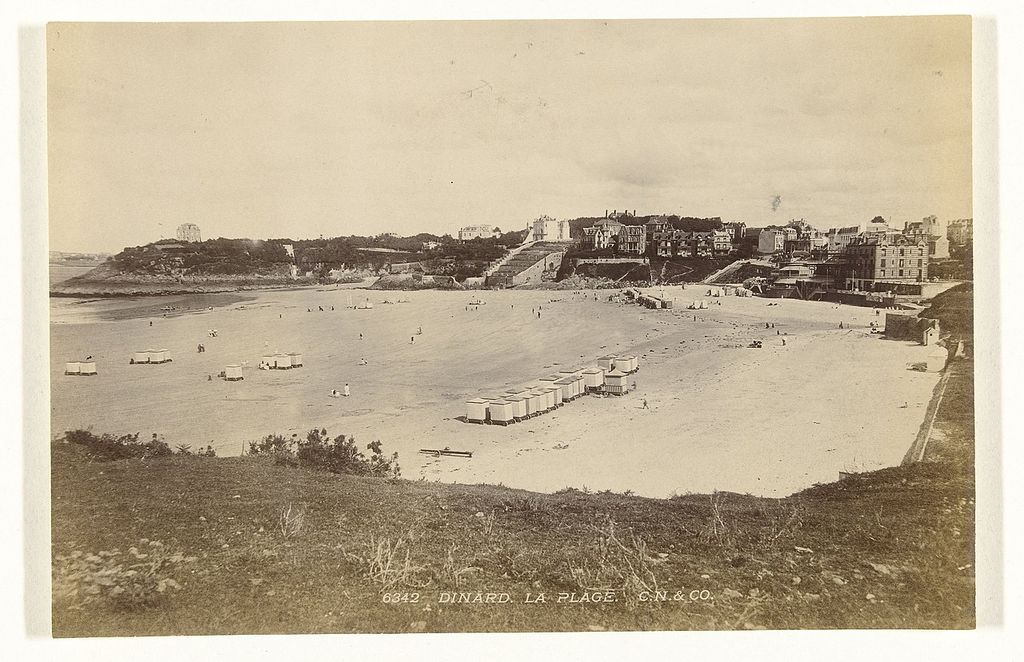
Picasso spent that summer in Dinard with his wife Olga Khokhlova and their young son Paulo. The French museum's detailed account places the family's arrival in mid-July and their stay through the middle of September. Dinard was a fashionable resort on the English Channel, with beaches, bathing and outdoor sports among its attractions. It was not a Mediterranean location, even if the intense blue of the painting can encourage that impression.[1][5]
The household matters to the picture's context, but not as a key to the women's names. Olga had been a dancer with the Ballets Russes, and Picasso knew dance through his work with the company. The Paris museum's curators consider the women's actions in light of dancers Picasso had watched. That is a meaningful comparison, especially given the later ballet adaptation. It does not establish that either figure is a portrait of Olga, nor that two particular bathers posed together on a Dinard beach.[1]
The same summer produced other works concerned with the coast. The Musée national Picasso-Paris catalogues Family by the Sea as a separate 1922 Dinard painting. A drawing now in Berlin, View of Saint-Malo, attends to the region with a few loose lines and a very different scale of human presence. Its museum interprets the view as part of Picasso's exploration of the area before the more forceful La Course. The relationship is suggestive rather than a demonstrated preparatory sequence for the two women: the Berlin sheet is a landscape, not a study in which the running figures already appear.[4][5]
The place was both a real coast and a new social setting. Early twentieth-century sea bathing had become a fashionable leisure activity, and beach clothes, sports and travel formed a public visual culture. The women in La Course are not shown in carefully catalogued 1922 swimwear. Their draperies open the image to classical associations. Nevertheless, a pair of moving female bodies beside the sea could be understood by Picasso's contemporaries in relation to the modern beach. The painting's unusual power comes partly from making those older and newer ways of seeing coexist.[1][4]
Classical figures in motion
“Neoclassical” is a useful description of one aspect of Picasso's work after the First World War: large-bodied figures, clear contours and renewed attention to traditions of European and ancient art. But Women Running on the Beach is not an academic exercise in correct anatomy. The bodies are stretched and compacted, their gestures exaggerated, their balance almost impossible if imagined as a still photograph. Picasso used a classical-looking vocabulary to make movement less predictable, not to return to a strict rulebook.[1][4]
In the preceding summer at Fontainebleau, he had developed imposing female figures in more stable arrangements. The Paris museum sees La Course as setting that weight in motion. It also compares the elongated limbs and twisted bodies to Renaissance mannerism and sees an echo of ancient maenads, women associated with the cult of Dionysus. Such comparisons help describe the image: heads tip back, drapery slips, and a run can look like a dance. They are curatorial readings of forms, not proof that Picasso copied a particular relief or assigned the figures a fixed mythological identity.[1]
The maenad reading introduces a complication to the painting's often carefree reputation. In ancient art, ecstatic movement may be celebratory, but it can also be unsettling. Picasso's figures have apparent joy and force without a clear destination. Their broad, muscular bodies are not gentle decorative beach types. The image lets liberation, exertion and strangeness occupy the same space. Calling it simply “two happy women on holiday” loses that tension.[1]
The Berlin museum's discussion of View of Saint-Malo suggests possible links to Pompeian painting and to Renaissance imagery Picasso had encountered in Italy in 1917. The Paris museum's broader research on bathers also discusses Titian, Ingres and Giulio Romano as classical and Renaissance frames for his coastal figures. Those are helpful art-historical comparisons, but a list of possible influences should not be mistaken for a verified recipe for this one gouache. What we can see directly is Picasso's own combination of sculptural weight, drapery, altered proportion and a modern sea horizon.[1][4][5]
The figures' physical freedom also requires historical care. A museum account reads the painting against postwar life and changing conventions for women's bodies at the beach. That context is plausible. But it does not tell us what each woman feels, whether Picasso intended an argument about women's emancipation, or that the painting resolves the losses of the war. Its bodies are represented through a male artist's choices; the painted gesture cannot speak for actual women at Dinard. A considered reading leaves room for both exhilaration and the questions the image cannot answer.[1]
The painting becomes a ballet curtain
The afterlife of La Course is unusually dramatic. Serge Diaghilev's Ballets Russes presented Le Train bleu in 1924. According to the Museo Nacional Thyssen-Bornemisza, Diaghilev encountered the existing small gouache in Picasso's studio and asked to use its image as the front curtain. Picasso's composition was therefore recruited for the ballet two years after he made it; it was not originally painted as a 1922 stage commission.[3][6]
The adaptation changed material, maker and scale. The Victoria and Albert Museum identifies its Le Train bleu front cloth, museum number S.316-1978, as a 1924 gouache-on-canvas enlargement painted by Prince Alexander Schervashidze after Picasso's design. Picasso liked the result and signed the cloth. The V&A gives dimensions of about 10.4 by 11.7 metres—an immense theatre surface compared with the 32.5-by-41.1-centimetre panel in Paris. Picasso's signature establishes his approval and involvement; it does not mean he personally painted every part of the enlargement.[1][3][7]
It is often called a “Picasso curtain,” understandably, because its composition is his. It is more precise to retain Schervashidze's role when discussing the physical cloth. Translating a compact panel into a surface that could fill a proscenium required a stage painter's labour and judgement. Changes of scale can affect the appearance of a line, a foot or a patch of sky. The curtain is an adaptation, not a photographic blow-up, and it deserves its own object history alongside that of the original.[3][7]
The production was collaborative far beyond the curtain. Jean Cocteau wrote the scenario, Darius Milhaud composed the music, Bronislava Nijinska choreographed, Henri Laurens designed the stage setting, and Gabrielle Chanel supplied sportswear-inspired costumes. These are different creative jobs. Diaghilev directed the Ballets Russes enterprise; he was not the choreographer of this ballet. Recognising Nijinska and Schervashidze prevents the familiar roll-call of Picasso, Cocteau and Chanel from swallowing the work of colleagues who shaped what audiences saw in motion.[1][6][7]
The ballet's name points to a modern journey, not to the location where Picasso painted in 1922. The “Blue Train” was the overnight train associated with travel from Paris to the Côte d'Azur, as the Thyssen catalogue explains. The production satirised fashionable seaside leisure, sport and flirtation. Its Mediterranean resort world should not be confused with Dinard on the English Channel. A composition made on a Brittany summer holiday could be reused to introduce a theatrical fiction of another coast.[6]
The curtain's survival has shaped the painting's reputation. It was large enough to overwhelm a theatre audience and later museum visitors, while the original could be held within the span of a viewer's arms. Both images can prompt the same memory of two women running, but their encounters are different: one invites close inspection of a painted panel; the other meets the audience before a performance as part of a staged collaboration. The V&A preserves the cloth and the Musée national Picasso-Paris preserves the gouache. Neither collection record makes them interchangeable.[1][3][7]
The beach motif beyond this painting
Picasso returned to bathers and beaches repeatedly. The Paris museum's research traces seaside studies from Biarritz in 1918 and works on paper in 1920, well before La Course. The 1922 Family by the Sea is a nearby but separate Dinard subject. In 1928 and 1929, new Dinard bathers acquired sharply altered proportions and often a more constrained, even disturbing, energy. It is misleading to make every seaside figure an extension of the joyous 1922 pair or to call the pair the first beach image he ever made.[4]
Those differences make the 1922 picture more specific. Its two figures still read as a single joined group; the sea is reduced to a broad setting; the bodies are enormous in effect without losing their human movement. Later bathers can look assembled from fewer and stranger signs of a body. The recurring shore offers a way to see Picasso varying his treatment of people, space and movement over time rather than repeating one successful motif unchanged.[1][4]
The picture itself also continued to travel. The French Ministry of Culture records exhibitions in Mexico in 1944, New York in 1957 and London in 1960, among many later presentations, before and after its 1979 acquisition by the French state through the Picasso dation. Such a record shows that the small panel had a public life independent of the stage curtain. Its celebrity did not depend only on the enormous version seen in the ballet.[2]
Women Running on the Beach compresses a surprising amount into a small object: two bodies joined in action, a thin coastal ground, a wide blue distance, classical echoes and modern resort life. Its subsequent transformation into a ballet curtain explains why it can seem larger than life, but the painting was already large in visual ambition. The Musée national Picasso-Paris object record[1] is the firm reference for the 1922 panel; the V&A's front-cloth record[3] identifies the different 1924 theatre object and the stage artist who painted it.[1][3]
Discussion
Use the evidence and your own close looking to explain your view. These are editorial prompts, not reader comments.
Reader Insights
How do two small figures create a sense of monumental movement?
What changes when you know the original is gouache on plywood, not a mural?
Where does the beach end and a more theatrical space begin?
Join the Conversation
Which reading best fits the evidence?
References
- Musée national Picasso-Paris, Deux Femmes courant sur la plage (La Course), MP78.
- French Ministry of Culture, POP/Joconde notice 50430000600.
- V&A East Storehouse, Le Train bleu front cloth, S.316-1978; V&A conservation article.
- Musée national Picasso-Paris, Baigneuses et rivages modernes.
- Musée national Picasso-Paris, Dinard and Fontainebleau feature; Museum Berggruen, Blick auf Saint-Malo.
- Museo Nacional Thyssen-Bornemisza, Picasso/Chanel; selected catalogue essay on Le Train bleu.
- V&A, Le Train bleu cloth size and installation.
Image Credits
- CN & Co. (photographer); Rijksmuseum (source). CC0. Source: Wikimedia Commons. Resized to 1024px; no crop. Source record. Licence.
