


 by Tom Gurney
Tom Gurney BSc (Hons) is an art history expert with over 20 years experience
Email: tomgurney1@gmail.com / Phone: +44 7429 011000
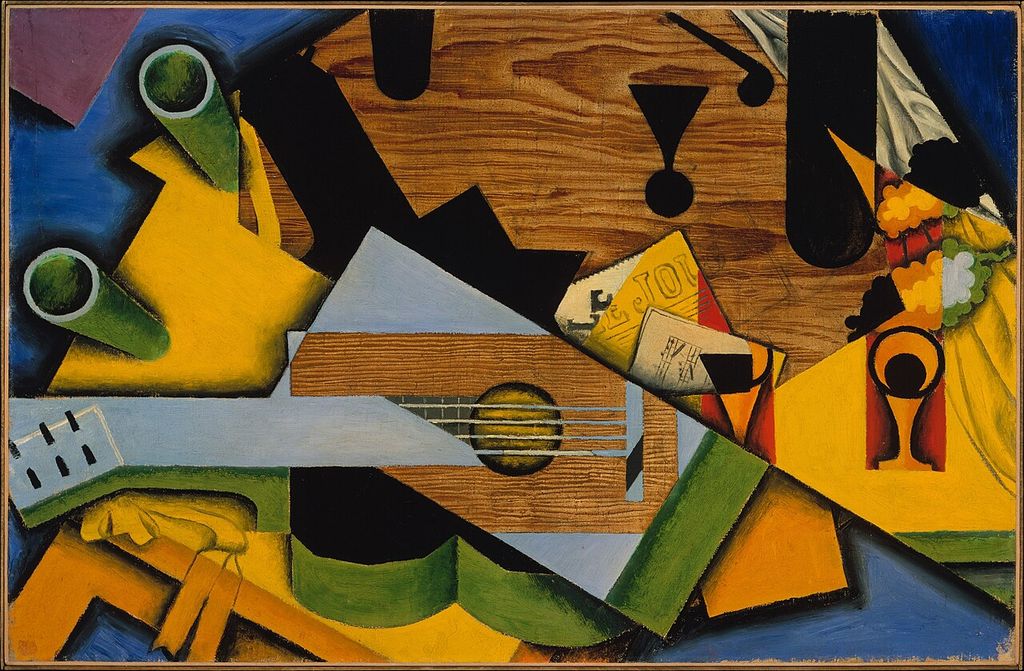
Introduction
Cubism changed how a picture could describe an object. Instead of organising a scene around one fixed viewpoint and a convincing depth behind the canvas, Picasso and Georges Braque tested how a figure, landscape or table could be rebuilt from partial views, intersecting planes and visual signs. Their close exchange in Paris from about 1908 to 1914 was central to the movement. Picasso was not its lone inventor, and the work did not stop at painting: paper, printed patterns, letters, string and constructed forms became part of the investigation.[1][2][3]
For a wider view of artists associated with the movement, browse the Cubist artists directory.
For a first look, compare three objects. In The Reservoir, Horta de Ebro (1909), architecture and hillside interlock while the viewpoint seems to shift. In Ma Jolie (1911–12), a woman and guitar nearly dissolve into small, repeated facets but remain legible through clues. In the cardboard Guitar (1912), cut and folded materials make an instrument without imitating its solid mass. Their differences explain Cubism better than the idea that Picasso simply painted things as cubes.[4][5][8]
At a Glance
- Central exchange: Picasso and Georges Braque, especially around 1908–14
- In painting: Partial views, intersecting planes and visual signs
- Beyond painting: Pasted paper, printed patterns and constructed forms
Contents
- What Cubism changed
- Picasso and Braque developed Cubism together
- Was Les Demoiselles d'Avignon the first Cubist painting?
- Landscapes and the early Cubist years
- Analytical Cubism and the fragmenting figure
- A still life across paint and print
- Collage and Synthetic Cubism
- Cubism becomes an object in space
- Public reception and the disruption of war
- How to read a Cubist work
What Cubism changed
Traditional European perspective can make a flat surface look like a window through which objects occupy stable positions in depth. Cubism does not abolish every reference to the visible world; it makes the means of representation conspicuous. An edge might define a guitar in one place and merge with a tabletop in another. A portrait can retain recognisable details while its head, clothes and surroundings share a network of angled planes. The National Gallery of Art describes Cubist images as fractured and disorienting, but not fully abstract.[3]
It is tempting to explain this as “several viewpoints at once.” That is sometimes a helpful starting point, but it can imply the artist literally walked around a sitter and pasted snapshots together. In a Cubist work, a viewpoint is constructed in paint; different spatial cues can coexist, conflict or cancel one another. The result asks the viewer to assemble a subject from evidence rather than receive a single optical description. Even a painted word can serve as a clue more direct than a rendered shape.[3][5]
Colour is part of this choice. Many analytical pictures use restrained browns, greys and ochres, bringing attention to relationships among edges and planes. The narrower palette is not a permanent Cubist rule. Later works use stronger colour and broad, flatter shapes. Nor does a geometric figure automatically make a work Cubist. The question is what the geometry does to the relationship between object, space and the actual surface on which the image is made.[1][3]
Picasso and Braque developed Cubism together
The Musée national Picasso-Paris describes Cubism as the product of Picasso's collaboration and friendship with Georges Braque. Both artists studied Paul Cézanne's attempt to give forms structural weight, and both reconsidered the conventional distinction between a subject and its surrounding space. The Museum's history places their encounter around the turn from 1907 to 1908. The Museu Picasso Barcelona identifies 1908–14 as the period in which they created and developed Cubism. These are useful historical frames, not dates when every picture suddenly adopted a common style.[1][2]
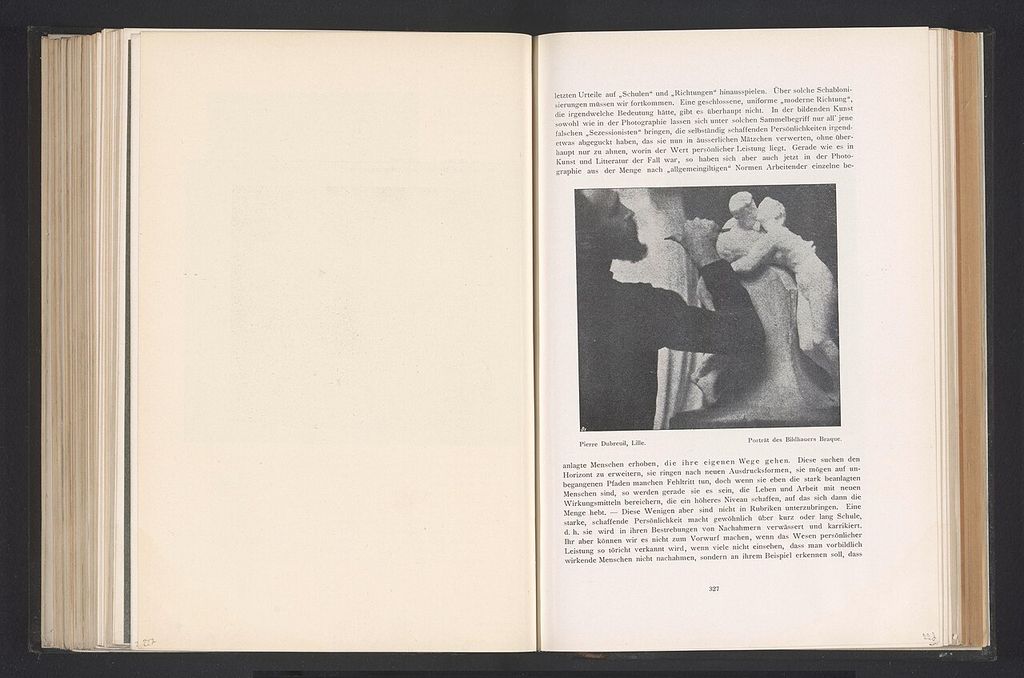
Braque's role is not a footnote to Picasso's. They exchanged ideas so closely that later historians have sometimes struggled to separate their contributions in a given stage. The Centre Pompidou, for example, points to Braque's particular leadership in parts of 1912. The movement grew from an active dialogue, with each artist testing problems the other could answer differently. Calling Picasso the sole “father of Cubism” hides the very method by which its language developed.[1]
This small working partnership must also be distinguished from the wider Cubist movement. Artists including Juan Gris, Jean Metzinger, Albert Gleizes and Fernand Léger developed related but not identical approaches, while some of them made Cubism more visible in public exhibitions. Picasso and Braque worked largely through private dealers rather than presenting every new experiment in the Paris Salons. The 1911 Salon des Indépendants and the 1912 Section d'Or exhibition therefore belong to the history of Cubism's reception, not a myth of a single Picasso premiere.[1][3]
Watch: Pablo Picasso
Explore Picasso through five videos from museums, broadcasters and art educators.
Picasso’s Guernica: Great Art Explained
Explore the composition and historical setting of Picasso’s best-known response to war.
Watch on YouTubeWas Les Demoiselles d'Avignon the first Cubist painting?
Picasso's Les Demoiselles d'Avignon was developed through the winter of 1906–07 and completed in Paris in 1907. Its compressed space, angular bodies and unlike approaches to the five women's faces pose questions that later Cubism would pursue. Yet MoMA notes a real disagreement: Picasso's dealer Daniel-Henry Kahnweiler regarded it as a beginning of Cubism, while others have argued it is not itself Cubist. Treating either verdict as unanimous would make a complex painting serve a tidy origin story.[4]
The canvas drew on several kinds of art, including Iberian and African sculpture and European pictorial traditions. The two heads at the right are often discussed in relation to African masks and Picasso's visit to the Trocadéro ethnographic museum; other figures have different sources. These encounters need their own cultural history, including the colonial channels through which many objects reached Paris. Cubism cannot be reduced to those sources, nor should a discussion of formal invention erase the makers of the works Picasso encountered.[4]
Demoiselles also was not a public manifesto in 1907. MoMA records its first public exhibition in 1916, long after Picasso and Braque had developed the Cubist language for which it is often cast as a starting point. It is best called a crucial prelude and a subject of debate. The work's full significance cannot be compressed into “first Cubist painting” or “not Cubist” without studying its revisions, figures and later reception.[4]
Landscapes and the early Cubist years
The changes become easier to trace in landscapes of 1908 and 1909. Cézanne had already made artists attentive to how volume could be built through planes of colour rather than polished outlines. Picasso and Braque tested related problems in houses, hills and trees. The term “cubes” famously stuck to the movement, but a Cubist landscape is not a pile of literal cubes. Its planes can imply several relationships between the viewer, the terrain and the painting's flat support.[1][3]
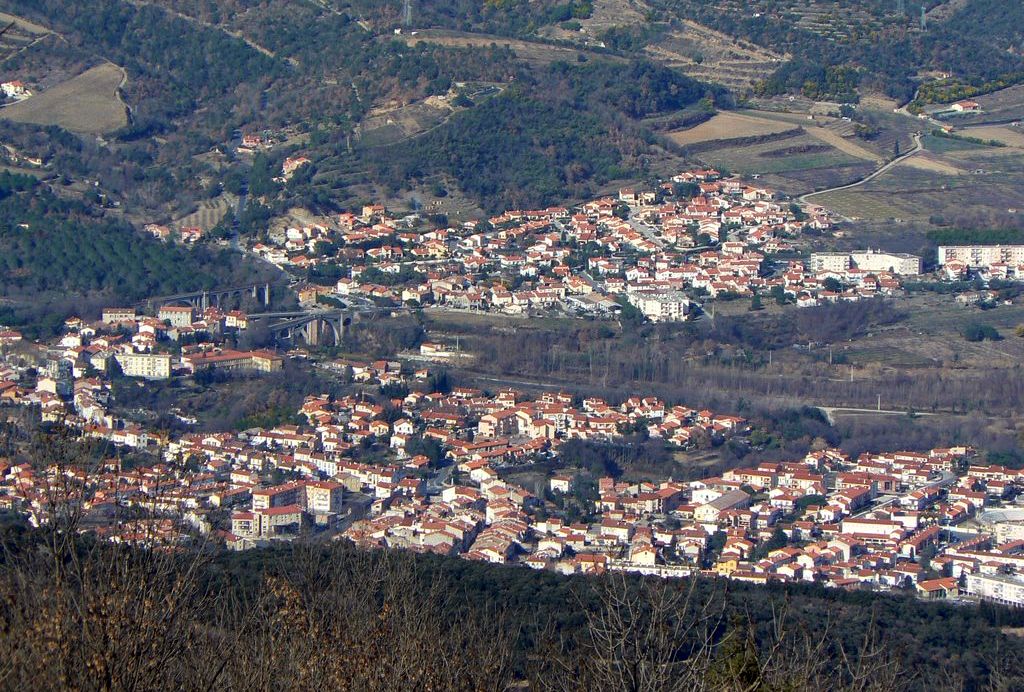
Picasso spent the summer of 1909 in Horta de Sant Joan, a Catalan village he had known earlier. MoMA's The Reservoir, Horta de Ebro names its older place label in the title while locating its making at Horta de Sant Joan. The picture uses simplified architecture and interlocking shapes to connect buildings with the rugged hillside. MoMA notes that the hillside seems seen from below while the curved reservoir at the bottom invites a look downward into water. Two spatial cues coexist, so the viewer cannot settle comfortably into one position.[2][4]
That does not make the landscape unrecognisable. A village, construction and reservoir are still present. The experiment is in how their forms meet. This is an especially useful answer to someone who thinks Cubism means that the subject has disappeared: early Cubist work may heighten attention to a real place by refusing to give it the smooth unity of a conventional view. The museum's object record supplies a specific site and date; an image alone would not tell us where Picasso worked.[4]
The 1909 Horta stay also prevents a Paris-only chronology. Picasso and Braque's dialogue unfolded across travel, studios and correspondence, while the works responded to specific settings. Barcelona's chronology follows Picasso to Horta, Cadaqués and Céret during the Cubist years. Those names matter when a particular object can be located there, but they should not become a claim that every picture from a given summer depicts its place of making.[2]
Analytical Cubism and the fragmenting figure
Art historians commonly call the increasingly dense work of about 1910–12 “Analytical Cubism.” The label describes an effect of examining and recasting a subject through small, overlapping planes. It does not mean Picasso followed a written formula or that every canvas has an exact start and end date. In some works the figure and background approach the same colour and texture, and the eye must search for a face, an instrument or a hand. The Metropolitan Museum of Art also uses “hermetic” for the hardest-to-read examples.[3]
MoMA's Girl with a Mandolin (Fanny Tellier), made in Paris in late spring 1910, is a useful early example. The singer and actor Fanny Tellier posed for Picasso. He did not eliminate her as a subject: he transformed features and body into flattened planes of grey, cream and ochre, while the instrument helps organise the picture. The title preserves the sitter's name and medium. A picture that looks almost abstract at first remains tied to a specific person and encounter.[5]
The 1910 portrait of art dealer Daniel-Henry Kahnweiler in the Art Institute of Chicago poses a related difficulty. The Institute's analysis points to details a viewer can still recognise—the head, suit, hands and watch chain—even as figure and surroundings break into small connected facets. Recognition is delayed rather than prohibited. The picture also reminds us that Cubism was not only a matter of still-life objects: the image of a named contemporary could be reconstructed through the same formal challenge.[5]
By the winter of 1911–12, Ma Jolie pushed that challenge much further. MoMA identifies a woman with a guitar, but the figure is hard to hold together visually. Six strings are one clue; another is the written phrase “MA JOLIE” and a treble clef. The words refer both to a music-hall song and to Picasso's nickname for Marcelle Humbert. The painting therefore lets language and musical notation do work that an ordinary portrait might leave to a face. It is an analytical Cubist canvas, not a collage of actual newspaper, and its personal reference does not make every facet an autobiographical symbol.[5]
The movement toward difficulty was not simply an effort to exclude viewers. A bottle, pipe, instrument or painted letter can anchor perception even when its surroundings become unstable. These recognisable signs help explain the next experiments. If the picture can contain the letters of a newspaper or the shape of a wood-grain pattern, what changes when Picasso inserts a piece of printed material itself?[1][3][5]
A still life across paint and print
The Metropolitan Museum of Art's Still Life with a Bottle of Rum (1911) puts a bottle, glass and pipe on or near a small tabletop, but none is presented through a single complete outline. Letters enter the picture as another kind of mark. The Met cautions that they could refer to Céret, where Picasso painted the canvas near Braque, or perhaps to a poster or newspaper title. They are legible signs without a settled explanation. That uncertainty is productive: a letter can be both a flat shape on the canvas and a hint of a world outside it.[9]
The same year Picasso made a drypoint print known as Still Life with Bottle of Marc, published in 1912. The Met identifies the printer Eugène Delâtre and publisher Daniel-Henry Kahnweiler alongside Picasso. The work reduces bottle, glass, playing cards and table to a scaffold of short marks and stronger lines. Its black ink and white paper sharpen a question already posed by the restrained analytical paintings: how little information can identify an object before it becomes a pattern? Printmaking was not a secondary illustration of an idea worked out in oil. It provided another surface, another line and a collaborative production process for testing it.[9]
This example also restores people who can disappear from a painter-centred history. Braque worked in close contact with Picasso at Céret; Kahnweiler commissioned related intaglio prints from both artists; Delâtre printed Picasso's plate. The visual language belongs to a broader material and social practice even when Picasso's name appears on the object record. A Cubist work may be radically innovative without having been made in isolation.[1][2][9]
Collage and Synthetic Cubism
Around 1912, Picasso and Braque took Cubism in a different direction. Rather than dividing an object into ever more facets, they could assemble an image from larger, simpler signs and actual materials. This is often called “Synthetic Cubism.” The distinction is useful, but it is not an absolute break: an analytical painting already used signs, and a synthetic work can still present difficult spatial relationships. The method makes the difference especially visible when a newspaper, wallpaper or patterned fabric appears on the support.[1][3]
Picasso's Still Life with Chair Caning, held by the Musée national Picasso-Paris and dated spring 1912, combines painted still-life fragments with a piece of oilcloth printed to imitate chair caning; rope surrounds its oval canvas. The caning is a printed illusion on an actual manufactured material. It is not a piece of woven chair seat. That double status is the point: one part of the work is a real object, another is an image of an object, and the rope can look like both frame and tabletop edge. Letters such as “JOU” invite further associations with newspaper and play. The work makes the viewer ask what, in a painting, is depicted and what is physically present.[6]
The Paris museum describes it as a pioneering collage in modern painting. That narrower claim is more useful than saying Picasso invented all collage everywhere. Its teaching material credits Braque with the first Cubist papier collé later in 1912. Both artists expanded the possibilities of attaching papers and other materials to a support. Credit matters because their related inventions were not identical, and later retellings have too often assigned every first step to Picasso alone.[1][6]
At the Centre Pompidou, Picasso's 1913 La Bouteille de vieux marc gives a particularly clear example of different kinds of sign working together. The museum explains that an actual newspaper page, patterned paper serving as a tabletop covering, and a drastically simplified bottle can coexist. Some materials were attached in ways other than glue. The work moves from literal material to visual suggestion without establishing one stable depth for everything. “Synthetic” here does not mean a less thoughtful or merely decorative version of Cubism; it names another way of making a picture from selected parts.[1]
The Met's Bottle and Wine Glass on a Table of 1912 makes Braque's role especially concrete. Its catalogue says that, after Braque pasted strips of wood-grain wallpaper to a drawing, Picasso took up cut paper in his own compositions. The Met object is charcoal, ink, graphite and pasted newspaper on paper: a papier collé, not oil on canvas. It keeps the bottle and glass identifiable without pretending that the newspaper is painted. A reader can compare it with the 1911 bottle painting to see how an actual piece of printed paper changed the terms of the problem.[9]
Cubism becomes an object in space
In the autumn of 1912 Picasso made a Guitar from paperboard, paper, thread, string, twine and wire. MoMA's object record describes cutting, folding and fastening ordinary materials into an instrument-like construction. It is three-dimensional, but it is not a carved imitation of a guitar's solid body. Open spaces, edges and the suggestion of strings do some of the work. This construction brought questions Picasso had asked on a canvas—what is a hole, what is a plane, what makes a contour legible—into the room itself.[8]
MoMA records that Picasso hung the work among drawings and collages in his studio and could present it in different arrangements. Its later photographs therefore matter to interpretation: a constructed guitar might be an independent work or one component of a larger still life. He revisited the motif in sheet metal in 1914. The shift from fragile paperboard to metal was not merely a change in durability; it tested how a constructed form could persist beyond a provisional studio arrangement.[8]
This is why the Cubist years cross media. A painting could imitate a printed surface; a collage could place real paper in a picture; a construction could turn flat sheets into a physical instrument. The distinctions among painting, drawing and sculpture became productive rather than settled. The 1912 Guitar is not a “painting with cubes” and should not be confused with later works also titled Guitar. Its date, materials and collection number identify the particular object.[6][8]
Public reception and the disruption of war
Picasso and Braque's private exchange was only one part of a larger public movement. Cubist works by other artists in the Paris Salons helped audiences recognise a style and argue over its meaning. In 1912 the Section d'Or exhibition brought together artists and a discussion of Cubism in print. Those events were not a single moment when Picasso “officially founded” the movement. They show how the label grew through exhibitions, criticism and the efforts of artists beyond the original pair.[1][3]
The First World War changed that network. Braque was mobilised in 1914; Picasso, a Spanish citizen, was not. The Musée national Picasso-Paris describes a break in their close collaboration and a gradual reorientation in Picasso's work. The war does not supply a simple stylistic line after which nobody made Cubist art. Other artists and Picasso himself could continue or revisit Cubist devices, while the original pre-war conversation could no longer proceed under the same conditions.[1][2]
Picasso's Three Musicians, painted at Fontainebleau in 1921, makes this distinction vivid. MoMA describes it as a later return to Synthetic Cubism, not an early example of the analytical mode. Flat, interlocking colour areas present Pierrot, Harlequin and a monk with instruments and sheet music; the painting recalls the look of cut and pasted paper while remaining oil on canvas. Its theatrical figures also reach back to subjects Picasso had used before Cubism. That later combination should not be forced into a story that Cubism rose in 1907 and simply died in 1914. The Centre Pompidou's 1907–14 chronology dates a founding phase, not the expiry of every idea the artists explored.[7][8]
How to read a Cubist work
Begin with what the holding institution securely identifies: title, date, medium, maker and any named sitter or location. For The Reservoir, Horta de Ebro[4], follow where walls, hillside and pool seem to meet; ask whether you are looking up or down. For Girl with a Mandolin[5] and Ma Jolie[5], look for a person and an instrument before trying to name every plane. A small clue such as strings or letters can orient the entire picture.[4][5]
Next ask what is paint and what is actual material. In Still Life with Chair Caning[6], the oilcloth is real but the caning pattern is printed; the rope is a physical edge with a pictorial role. In MoMA's Guitar[8], folded paperboard occupies space, while openings help describe a body that is not solid. These comparisons show why one word, “Cubism,” covers several related experiments rather than one look repeated for years.[6][8]
Finally, read Picasso with Braque and with the wider group, not in isolation. Cubism was a shared argument about how art could represent the world and acknowledge its own materials. Picasso's best works in that argument did not abandon the real: they asked how a real person, place, instrument or scrap of printed paper could be known through an image that refuses to pretend it is only a window.[1][2][3]
Discussion
Use the evidence and your own close looking to explain your view. These are editorial prompts, not reader comments.
Reader Insights
How does one Cubist work make you assemble its subject from partial views?
Which material is literally present, and which is only represented?
What changes when Braque and other contributors are restored to the story?
Join the Conversation
Which reading best fits the evidence?
References
- Musée national Picasso-Paris, Picasso and Cubism; Centre Pompidou, Braque and Picasso collaboration; Centre Pompidou, La Bouteille de vieux marc.
- Museu Picasso Barcelona, Catalan chronology; Spanish chronology.
- National Gallery of Art, Cubism; Metropolitan Museum of Art, Cubism.
- Museum of Modern Art, Les Demoiselles d'Avignon; The Reservoir, Horta de Ebro.
- Museum of Modern Art, Girl with a Mandolin (Fanny Tellier); Ma Jolie; Art Institute of Chicago, Daniel-Henry Kahnweiler.
- Musée national Picasso-Paris, Still Life with Chair Caning; interpretive essay; teaching sheet on collage and papier collé.
- Centre Pompidou, 1907–14 chronology.
- Museum of Modern Art, paperboard Guitar; 1912–14 Guitars exhibition; Three Musicians.
- Metropolitan Museum of Art, Still Life with a Bottle of Rum; Still Life with Bottle of Marc; Bottle and Wine Glass on a Table.
Image Credits
- Juan Gris. CC0. Source: Wikimedia Commons. Resized proportionally to 1024px wide; no crop. Source record. Licence.
- Pierre Dubreuil (original photograph); Rijksmuseum (digitisation). CC0. Source: Wikimedia Commons. Resized to 1024px; no crop. Source record. Licence.
- Reichter66. CC BY-SA 3.0. Source: Wikimedia Commons. Resized to 1024px; no crop. Source record. Licence.

,_RP-F-2001-7-1184B-228.jpg)
