


 by Tom Gurney
Tom Gurney BSc (Hons) is an art history expert with over 20 years experience
Email: tomgurney1@gmail.com / Phone: +44 7429 011000
Introduction
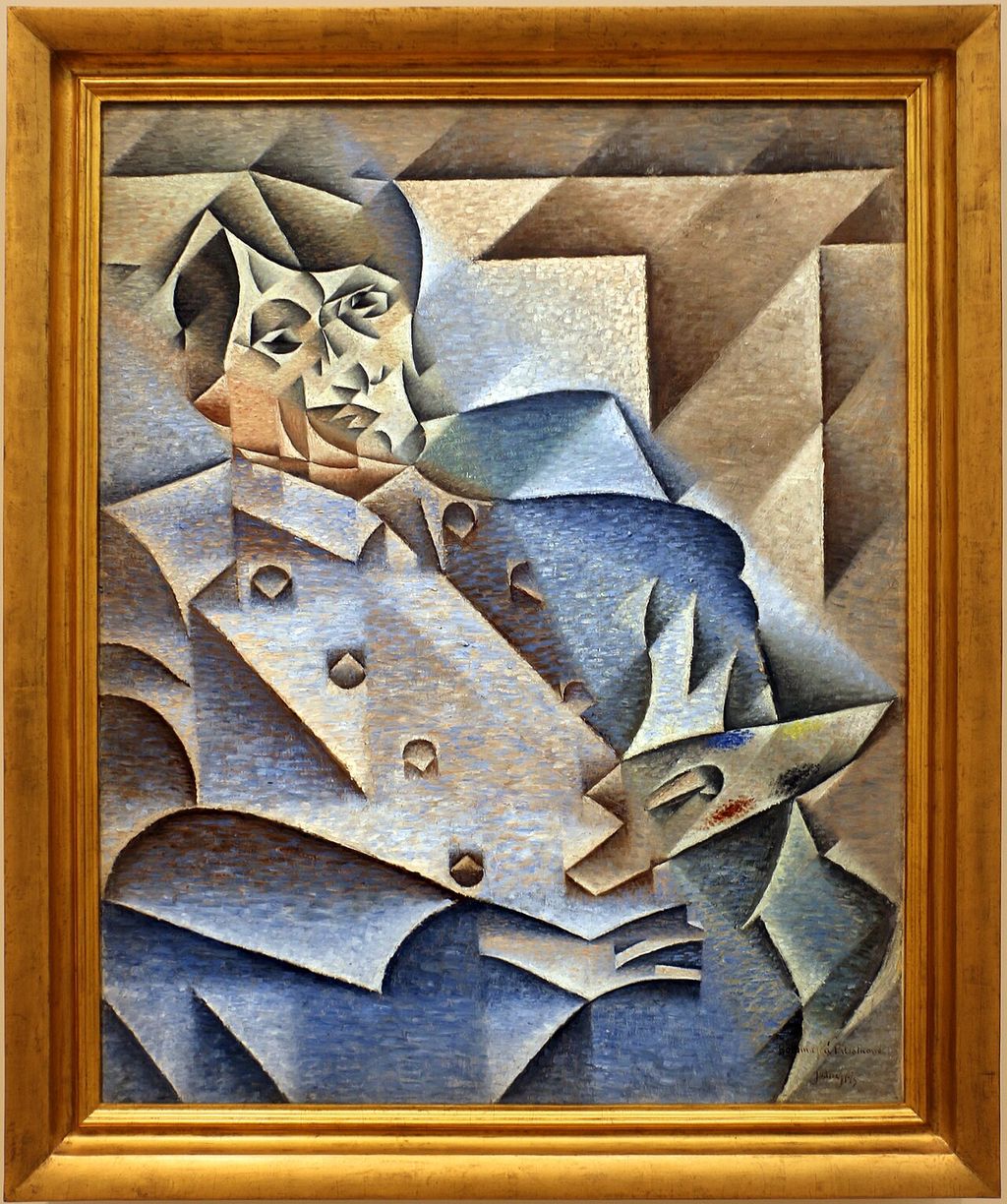
Pablo Picasso's Portrait of Daniel-Henry Kahnweiler is a picture of a particular man that makes us work unusually hard to see him. Picasso painted the oil on canvas in Paris in autumn 1910. It measures 100.4 × 72.4 centimetres and belongs to the Art Institute of Chicago, where it is catalogued simply as Daniel-Henry Kahnweiler, accession 1948.561. The sitter was the dealer who promoted Picasso and other Cubist artists. His hair, tie, watch chain and folded hands gradually emerge from a close mesh of brown, grey, black and pale planes. Those clues preserve the portrait's human subject even as the boundary between his body and the surrounding room seems to disappear. [1][2]
The painting is a major example of Analytic Cubism, the phase in which Picasso and Georges Braque tested how a picture could describe objects and space without using a single stable view. Our Cubism guide follows that wider experiment. This work is not a photograph-like record of Kahnweiler's face, nor is it a nonrepresentational pattern with a name added afterwards. Picasso kept a recognisable seated person at the centre of a radical experiment in how we recognise someone. That tension makes the work a portrait rather than merely an illustration of a style. [1][3]
At a Glance
- Made: Paris, autumn 1910
- Medium and size: Oil on canvas, 100.4 × 72.4 centimetres
- Collection: Art Institute of Chicago, 1948.561; gift in 1948
- Recognition clues: Hair, tie, watch chain and clasped hands emerge from the facets
Portrait of Daniel-Henry Kahnweiler in Picasso's career
The highlighted work is dated with the qualifications explained in the sources on this page. The other works are selective points of comparison, not the start or end of a style.
Contents
- Who was Daniel-Henry Kahnweiler?
- How can you find Kahnweiler in the painting?
- What makes the portrait Analytic Cubist?
- How does this portrait relate to Picasso's other Cubist work?
- What does the 1910 studio photograph show?
- How did the painting reach Chicago?
- Why does the portrait still matter?
Who was Daniel-Henry Kahnweiler?
Kahnweiler was born in Mannheim in 1884 and opened a Paris gallery in 1907. He became a dealer, publisher and writer closely associated with the artists later called Cubists. The Art Institute describes him as beginning to represent Picasso in 1908, purchasing many of his paintings over the following years. His gallery helped give an audience and a market to the difficult new work of Picasso, Braque, Juan Gris and others. He was not simply a customer who happened to sit for a picture: he helped make the artistic experiment viable and legible to collectors. [1][4]
The relationship should not be reduced to a simple story that Picasso painted Kahnweiler and was then rewarded with a contract. A researched Museu Picasso Barcelona exhibition dates Picasso's contractual connection to 1912, two years after the canvas. “Representing” an artist, buying paintings and making a later formal agreement are related but not identical events. The portrait records a relationship already under way in 1910; it does not establish the date or terms of every business arrangement. [1][4]
Kahnweiler's contribution also extended beyond sales. He published illustrated books and developed an account of Cubism in writing. His German-language Der Weg zum Kubismus, later known in English as The Rise of Cubism, appeared in 1920. It belongs to the later history of how Cubism was explained; it was not a set of instructions that Picasso followed while painting the portrait ten years earlier. Kahnweiler was both a participant in the prewar artistic circle and, later, one of its influential interpreters. [1][4][5]
How can you find Kahnweiler in the painting?
Begin near the upper centre. Curving dark strokes suggest a wave of hair over a forehead. Angular light and dark passages propose a nose, eyes and mouth without outlining a conventional face. Below them, lighter forms imply a collar and the knot of a tie. Further down, two bright curving lines point to the watch chain across a dark suit. At the lower centre, his hands are clasped in his lap. Once those marks connect, a seated figure becomes easier to hold in view; when the eye wanders into the surrounding facets, he seems to dissolve again. [1][2][3]
The watch chain and hands are especially helpful because they do not require a clear facial likeness. They indicate an ordinary pose and the social identity of a carefully dressed man. The Museu Picasso Barcelona has drawn attention to these details in the context of Kahnweiler's punctuality and patient sittings. That observation is an interpretation of the painting and the sitter's character, not proof that every brushstroke encodes a personal trait. It explains why the small recognisable signs matter within a picture that otherwise seems to resist easy description. [2]
Picasso did not abandon the portrait convention altogether. Kahnweiler occupies the central vertical part of a narrow canvas, facing the viewer as a seated half-length figure. There is a head, a torso and hands, the familiar architecture of a formal portrait. What changes is the way the figure is made. The face is not the only place where identity resides, and the body is not sealed off from its setting by a single outline. The picture asks us to construct the sitter from relationships among marks rather than recognise him in one glance. The Picasso portraits guide offers comparisons across his other approaches to likeness. [1][3]
The Art Institute says Kahnweiler sat for Picasso as many as thirty times. That approximate count matters because the final canvas can look spontaneous or impossibly fragmented, yet the museum describes an extended process of looking and reworking. It does not mean thirty complete portraits were painted or that we can assign a particular facet to a particular sitting. The finished surface gives us the outcome of sustained attention, not a diary of each session. [1]
Watch: Pablo Picasso
Explore Picasso through five videos from museums, broadcasters and art educators.
Picasso’s Guernica: Great Art Explained
Explore the composition and historical setting of Picasso’s best-known response to war.
Watch on YouTubeWhat makes the portrait Analytic Cubist?
The word analytic does not mean Picasso scientifically dissected Kahnweiler or that the result can be solved like a coded diagram. It names a historical phase of Cubism in which artists broke familiar forms into interacting planes and tested the space between the object and its surroundings. Here a dark suit can become part of a dark background; pale planes may suggest face, shirt or reflected light. Some edges move forward and others recede, but the canvas does not offer one fixed perspective from which all the pieces lock into place. [1][3][6]
The restricted palette helps produce that effect. Rich descriptive colour could separate a face from its room, as in many older portraits. Picasso instead works predominantly with browns, greys, blacks and whites. Small changes of tone, direction and transparency become unusually important. The Art Institute describes shimmering, semitransparent surfaces that merge Kahnweiler with the atmosphere around him. Looking slowly, one can feel the eye alternating between a coherent sitter and a nearly continuous pattern of facets. [1]
This does not make the sitter unreal or hidden behind an optical trick. We recognise him by combining a few features that persist—hair, tie, chain, hands—with our expectation that these features belong to one seated body. The painter gives enough information to invite that reconstruction, then prevents it from becoming effortless. Dr Charles Cramer and Dr Kim Grant's art-historical account observes that the central half-length pose remains traditional even while the painted space refuses a stable division between figure and background. The old convention and the new method coexist. [1][3]
The painting has more in it than its sitter. On the lower left, scholars identify a small tabletop still life, including a bottle-like form. They have also proposed readings of difficult passages toward the upper edges as a mask and an Oceanic sculpture. These are art-historical identifications of ambiguous painted forms, not details as immediately secure as the watch chain. A 1910 photograph of Kahnweiler in Picasso's studio, preserved by the Musée national Picasso-Paris, separately documents a Punu Mukuyi mask among the objects there. The photograph establishes the presence of that particular object in the atelier; it does not by itself prove that every mask-like mark in the oil copies it exactly. [3][7]
Such objects also call for care in interpretation. African and Oceanic works are not interchangeable “primitive” props, and their makers' cultures should not vanish into a story only about European invention. The studio record can help us understand what Picasso encountered, while the painting still has to be read on its own terms and the precise relationship between an object and a painted passage remains a question for scholarship. [3][7]
How does this portrait relate to Picasso's other Cubist work?
Picasso and Braque's experiments changed rapidly in the years around 1910. A work from the previous year could still give a head or landscape a blocky, sculptural weight. By the time of Portrait of Daniel-Henry Kahnweiler, the figure seems less like a solid construction set against a background and more like one part of a field of intersecting planes. Cramer and Grant compare the portrait with Picasso's Woman with Pears of 1909 and his portrait of another dealer, Ambroise Vollard, painted earlier in 1910. Their comparison helps describe a developing pictorial problem, not a march toward inevitable abstraction. [3]
There is a crucial difference between analysing a form and abandoning subject matter. In this picture, the fragments still refer to a named person, his clothes and his pose. The narrow portrait format still matters. So does the experience of losing and refinding the sitter. A viewer can start with the hands, trace upward to the chain and tie, and then return to the face with a better sense of where to look. Picasso has not provided a single authoritative route through the surface; our repeated attempts become part of the encounter. [1][3]
The canvas also predates the pasted-paper experiments usually associated with Synthetic Cubism. The Centre Pompidou places the Kahnweiler portrait within the more hermetic Analytic work of roughly 1910–12, before the later collages and constructions. Although the many planes can resemble pieces assembled together, this object is catalogued as oil on canvas, not a collage. Keeping those phases distinct makes its particular achievement clearer: Picasso produced extraordinary instability using paint alone. [1][6]
Nor should the portrait be treated as the style of everything Picasso painted afterwards. His 1937 Guernica, for example, belongs to another historical moment, purpose and visual language. Linking the two as though they were interchangeable Cubist portraits would tell us little about either. In 1910 Picasso was testing how to represent a living sitter and the space around him; that is the problem this page is about. [1][6]
What does the 1910 studio photograph show?
The Musée national Picasso-Paris catalogues a glass-plate negative made by Picasso showing Kahnweiler in the studio at 11 boulevard de Clichy, Paris, in autumn 1910. It records a real encounter between painter and sitter in a room containing other paintings and objects. The museum identifies a Punu mask in the photograph, along with works involving female figures and a Horta picture by Manuel Pallarès. Because it is an archival photograph rather than a painted diagram, it offers a different kind of evidence from the canvas. [7]
Its importance is not that it solves the portrait by revealing one correct photograph-like view of Kahnweiler. The painting departs deliberately from such a view. The photograph situates the work in Picasso's actual studio and shows that the sitter and objects existed together in a lived working environment. It can sharpen questions about what Picasso saw and chose to transform, but it cannot tell us when each painted plane was added or prove a single intended meaning for the mask-like forms. [1][3][7]
The contrast is instructive. In the photograph, a lens fixes one arrangement of objects at one moment. In the oil, Picasso makes the sitter and setting difficult to separate, returning our attention to the act of recognition itself. Calling the painting a failed likeness because it does not behave like the photograph misses the experiment. Calling it purely abstract would miss Kahnweiler. The two records illuminate one another precisely because they are not doing the same job. [1][3][7]
How did the painting reach Chicago?
Kahnweiler acquired the painting directly from Picasso. Its route to Chicago then passed through a painful chapter in his business history. When the First World War began, the French state seized the German-born dealer's gallery stock as enemy property. The Museu Picasso Barcelona records four state auctions of those holdings between 1921 and 1923, despite Kahnweiler's efforts to stop them. The Art Institute's object provenance places this particular portrait at the first sequestration sale, held at the Hôtel Drouot in Paris on 13–14 June 1921, as lot 84. [1][4][8]
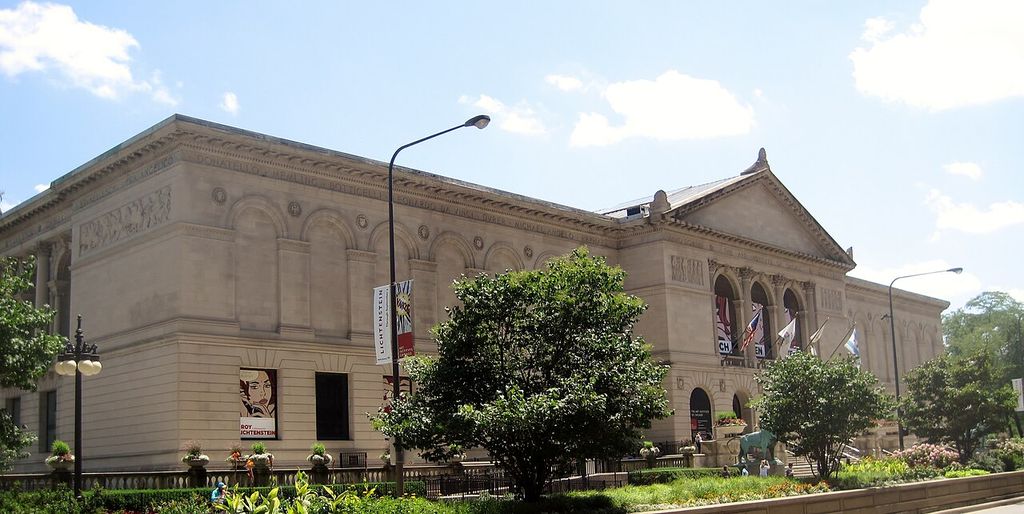
The buyer was Isaac Grünewald, whose possession the Art Institute traces to at least 1925. By about 1929–30 the portrait belonged to Earl Horter in Philadelphia. It was sold in 1934 to Elizabeth Fuller Goodspeed, later Mrs Gilbert W. Chapman. She gave it to the Art Institute of Chicago on 14 December 1948 in memory of Charles B. Goodspeed. This sequence explains how a picture originally owned by its sitter became a Chicago museum work. It should not be shortened to “Kahnweiler sold it to Chicago”: the forced 1921 sale and the intervening owners matter. [1]
Kahnweiler's life suffered another dispossession during the Second World War because he was Jewish, as Barcelona's exhibition explains. That later event is historically important, but it is not the reason this specific painting left his possession in 1921. Keeping the two episodes separate respects both the chronology of the object and the distinct circumstances of the dealer's life. [1][4]
The painting remains part of the Art Institute's collection. Gallery displays, loans and conservation needs can change, so its current on-view status should be checked with the museum before a visit. A photograph of it on another institution's website or in an exhibition notice is not evidence that the work permanently belongs there. The Chicago object record is the reliable reference for its identity and collection history. [1]
Why does the portrait still matter?
Picasso chose as his sitter someone intimately involved in the public life of the new painting. Kahnweiler had helped show, buy and explain work that many early viewers found difficult. The portrait makes a related demand of its own audience: it asks us to look beyond quick likeness without surrendering the specific person in front of us. The dealer's hands, chain and tie are modest anchors for a radical pictorial structure. [1][2][4]
Its later history adds another layer. The portrait was not only a studio experiment; it was an object bought by its subject, taken into a wartime seizure, sold, collected and eventually given to a museum. Those events do not tell us what Picasso meant by every plane, but they explain why a portrait made in one Parisian room can now be encountered in Chicago. The work holds together an individual likeness, a changing language of painting and a difficult history of how modern art moved through the world. [1][4][7]
Discussion
Use the evidence and your own close looking to explain your view. These are editorial prompts, not reader comments.
Reader Insights
Which clues let you recover Kahnweiler’s face, tie and hands?
What can the 1910 studio photograph establish about the setting?
How does the portrait retain a sitter while destabilising figure and ground?
Join the Conversation
Which reading best fits the evidence?
References
Art Institute of Chicago, Daniel-Henry Kahnweiler, object 1948.561 and current collection-data record.
Museu Picasso Barcelona, Spanish portrait entry for Daniel-Henry Kahnweiler.
Dr Charles Cramer and Dr Kim Grant, “Pablo Picasso, Portrait of Daniel-Henry Kahnweiler”, Smarthistory, 2020; accessible authorised reprint.
Museu Picasso Barcelona, Daniel-Henry Kahnweiler: dealer and publisher, Catalan exhibition research, 2022–23.
Bibliothèque nationale de France, catalogue record for Der Weg zum Kubismus, Munich, 1920.
Centre Pompidou, Le cubisme exhibition account, 2018–19.
Musée national Picasso-Paris, Kahnweiler in Picasso's studio, photograph APPH17382, 1910.
Metropolitan Museum of Art, research on the Kahnweiler sequestration sales.
Image Credits
- Sailko (photograph); Juan Gris (painting). CC BY 3.0. Source: Wikimedia Commons. Resized to 1024px; no crop. Source record. Licence.
- Teemu008, Art Institute of Chicago, 20 June 2012. Flickr / Wikimedia Commons, CC BY-SA 2.0. Proportional resize only; derivative retains CC BY-SA 2.0. Source record. Licence.

.jpg)