


 by Tom Gurney
Tom Gurney BSc (Hons) is an art history expert with over 20 years experience
Email: tomgurney1@gmail.com / Phone: +44 7429 011000
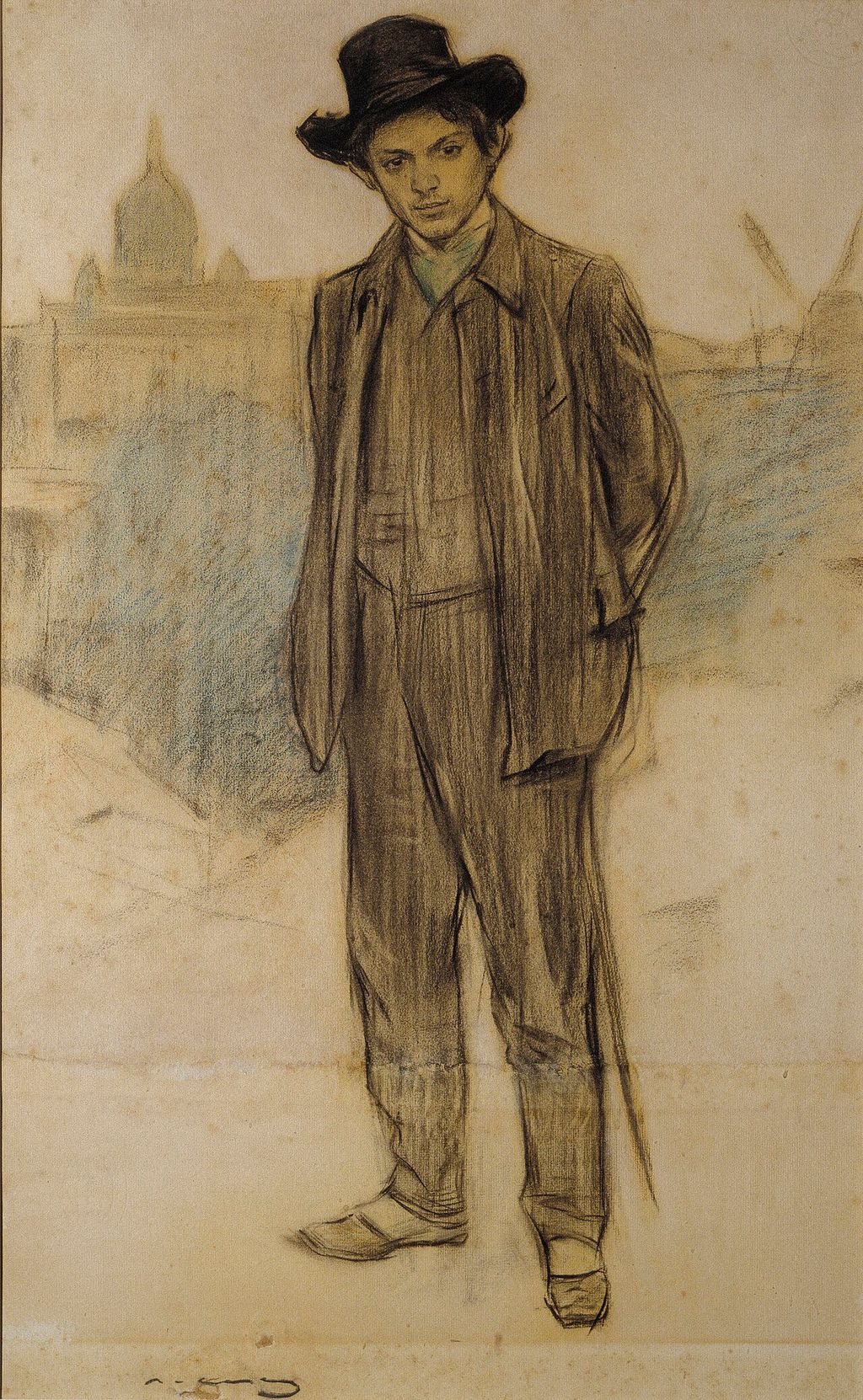
Introduction
Picasso's drawings are more than a set of quick preparations for famous paintings. A notebook page can record something seen in the street; a study can test the position of a body; a portrait can stand as a finished work; a line can make an object recognisable while leaving most of the paper untouched. These purposes overlap, but they should not be confused. To understand Picasso as a draughtsman is to look at what each sheet does, how it was made and whether it belongs to a longer sequence.[1][2]
Drawing remained active throughout his career. The Centre Pompidou's exhibition Picasso. Endlessly drawing placed youthful studies, later works, notebooks and prints in conversation rather than telling a story in which one early kind of line gave way permanently to another. The material range matters: graphite, ink, charcoal, coloured pencil, gouache and other marks on paper can create very different kinds of presence. A drawing may be searching, exact, dense, spare, private, exhibited, or several of these at once.[2][3]
At a Glance
- Scope: Studies, notebooks, portraits and finished sheets
- Materials: Graphite, ink, charcoal, coloured pencil and gouache, among others
- Key distinction: A drawing need not be a preparation for a painting
Contents
- Learning to look and learning to draw
- What a sketchbook preserves
- Studies can change the subject
- Lines that build or unsettle an object
- Drawing political and personal subjects
- A drawing is not a print
- How to look at a Picasso drawing
Learning to look and learning to draw
Picasso's early notebooks challenge the tale of effortless genius. In A Coruña, Barcelona and Madrid he practised figures, copying and the conventions of academic drawing. The Museu Picasso Barcelona's research also shows him recording streets, people, interiors and landscapes. Copying Velázquez or Goya and observing a passer-by were not identical exercises. One helped him learn from a predecessor's solution; the other asked him to select quickly from a scene unfolding before him.[1][4]
The 1899 pen-and-ink sheet The Artist's Hands Drawing His Sister Lola makes this double attention unusually clear. Picasso depicted his sister, but also the hands making her image. It is both a family portrait and a small picture about the act of drawing. The Barcelona museum records its medium as pen and ink on paper. The line does not only trace a person; it stages a relationship between subject, maker and sheet.[5]
Early drawings can be examined for their distinct tasks. An academic figure may show how the body's proportions are established. A sketch from the street may depend on selecting one posture before it changes. A notebook can hold several alternatives, annotations and subjects that were never meant to be turned into paintings. The Barcelona notebooks reveal both discipline and curiosity, but not every surviving sketch should be read as a first step toward a later masterpiece.[1][4]
In Madrid Picasso also studied older Spanish art at the Prado. His notebook copies and observations belong to a young artist's education, not to an empty period before “real” invention began. Later returns to earlier painters make more sense when we see that the habit of looking at, and working through, existing art began early. Drawing was one of the ways he learned to make that exchange visible.[1]
What a sketchbook preserves
A sketchbook is not a miniature museum of finished compositions. Its pages can preserve repetitions, false starts, abrupt changes of subject and marks made at different times. One page may test a head, the next may record a building or move toward a painting. The order matters, but a reader should not assume that every turn of the page records a linear progress from rough idea to final answer.[1][4]
The Barcelona museum's account of the notebooks follows Picasso through Madrid, Horta de Sant Joan and Gósol. It describes landscape, people at work and studies connected with larger compositions. That movement among things seen and things imagined is important. A drawing made during a stay in a village is not automatically a documentary record of one identified person, yet it can preserve details of a place, a gesture or an encounter that later become useful to the artist.[1]
Picasso kept notebooks across many years. The point is not to turn their number into a measure of greatness. It is to recognise a working surface on which alternatives could coexist. A notebook page can contain knowledge unavailable from the completed canvas: a figure considered and removed, a posture tried more than once, a detail isolated from its future setting. Conversely, the finished painting may change substantially after the notebook has been closed. The drawings and the painting are evidence of a process, not a full record of Picasso's thoughts.[1][6]
This makes museum cataloguing valuable. A book has a physical order and individual leaves have recto and verso sides; the date of a notebook may cover months or years rather than one day. If a gallery reproduces a single attractive sheet without its place in the book, the viewer loses some of the sequence. A collection record can tell us whether we are seeing a loose drawing, a leaf from a bound notebook or a later print of a drawing.[1][3]
Watch: Pablo Picasso
Explore Picasso through five videos from museums, broadcasters and art educators.
Picasso’s Guernica: Great Art Explained
Explore the composition and historical setting of Picasso’s best-known response to war.
Watch on YouTubeStudies can change the subject
Study for Two Sisters (circa 1902)
The pencil sheet illustrated on the former pablopicasso.net “Study to Two Sisters” page matches the Deux soeurs drawing catalogued by Christie's, not the different Barcelona museum drawing with a similar title. Christie's dates its sheet to Barcelona around 1902 and measures it at 62 × 46.6 cm. Two clothed figures incline toward one another, their heads touching above a nearly empty lower half of paper. The sparse setting makes the bowed heads and meeting hands carry the encounter. This is a work on paper related to the Blue Period painting L'Entrevue (Les deux soeurs), not a reproduction of that painting.[20]
Christie's identifies this as one of six related drawings and cites a July 1902 letter to Max Jacob in which Picasso described a woman from the Saint-Lazare institution and a religious sister. That evidence helps identify the subject Picasso was developing; it does not name the people who modelled for this particular sheet. Museu Picasso Barcelona holds another 1902 Study for “Two Sisters” (MPB 110.540), made in pen, ink and wash on graph paper. Its composition is markedly different. Similar titles therefore cannot be treated as interchangeable object identities, and neither drawing should be described as the finished blue oil painting.[20][21]
The preparatory work for Les Demoiselles d'Avignon shows why a study is not merely a smaller version of a finished painting. MoMA records hundreds of drawings and sketches from 1906–07. In an early oil study, two men—a sailor and a medical student—stand with five women. The men do not appear in the large canvas. Removing them helped change the relation of the women to the viewer: rather than interacting with those two figures, they confront us more directly. That is a compositional and dramatic change, not just a correction of anatomy.[6][7]
The small oil study is itself a useful warning about labels. MoMA calls it a “Study,” but its medium is oil on canvas. A study can be a painting, watercolour or drawing. The noun says something about its role in a process; the medium field tells us what kind of object it is. The museum's technical account also discusses a watercolour and the final canvas. Looking across them can clarify what changed, but it cannot assign a neat reason to every change.[6][7]
A Berlin drawing associated with the same project, Kopf einer Frau or Head of a Woman, shows a different kind of investigation. The Museum Berggruen dates it to 1906–07 and records tempera and black ink on paper. Its curator points to sparse colour, the unpainted paper and the tension between a delicate face and angular shoulders. This is not just an outline waiting to be filled. The untouched support and the distribution of marks help create the figure. The museum connects the sheet with studies for Les Demoiselles, but it remains a work with its own visual decisions.[8]
That object also has a history beyond the studio. Berlin's record traces its seizure from collector Alphonse Kann in 1940 and restitution in 1947 before later ownership. Provenance is not a reason to read those later events back into the drawing's 1906–07 imagery. It is a reason to treat an artwork as a physical object that has travelled, been owned and sometimes been wrongfully taken. An online title or cropped reproduction would not tell this history.[8]
Not every Picasso study concerns a painting. He drew for sculpture, theatre and printmaking, and sometimes explored a motif across media. For the drawings page, the important distinction is that a drawn proposal may have one purpose while the resulting stage design, sculpture or print is another object. The drawing deserves attention for its marks and choices, even where it points beyond the paper.[2][3]
Lines that build or unsettle an object
Picasso's Cubist drawings can be difficult because a line may perform more than one job. It might bound an object, divide a plane, suggest a shadow or become part of a sign such as a letter. A guitar or bottle may be indicated by fragments rather than enclosed in a single contour. The pleasure of looking lies partly in assembling those clues and seeing where they refuse to settle into a conventional view.[3][9]
The change was not a permanent move from exact drawing to abstraction. Picasso could return to closely modelled bodies while also testing whether a few marks were enough to name a thing. Barcelona's research on his 1920s sketchbooks describes series of still-life variations made with points and lines, sometimes approaching the boundary between recognisable objects and abstract patterns. Repetition allows one mark to be tested against another arrangement. The viewer can ask when a group of lines begins to read as a bottle, instrument or figure—and when it stops.[10]
The material should be named before style. Graphite may be rubbed or erased; ink can produce a decisive-looking contour or a mass of dark hatching; charcoal can give a soft edge and broad tone; coloured pencil or gouache changes the balance between line and area. These are possibilities, not a rulebook for dating Picasso. The French Musée Picasso-Paris record for a 1919 sheet lists gouache and graphite together, while later portrait records name charcoal and several pencils on one sheet. “Picasso line drawing” is too narrow a description for this range.[3][11][12]
Nor is spareness evidence that a drawing took no thought. The pressure of a stroke, the blankness left around it and the decision to stop can be as consequential as dense shading. Some sheets look swift because they are. Others condense a subject worked over many times. Without a reliable sequence of dated states, a viewer should describe the appearance rather than claim to know the time it took or the artist's degree of effort.[2][8]
Drawing political and personal subjects
In May 1937 Picasso drew studies for Guernica, the large painting made for the Spanish Republic's pavilion in Paris. Reina Sofía identifies Estudio de composición (VI) as a preparatory drawing dated 8 May. Other sheets separately investigate figures and relations within the developing composition. The drawings allow us to follow alternatives at a smaller scale before the canvas was resolved. They are not miniature copies of the finished political image.[13]
Dora Maar's photographs of the painting in progress provide another kind of sequence. A drawing made before a painted passage and a photograph of a later canvas state answer different questions. One may show an option Picasso was testing; the other records what was visibly on the canvas at a moment in its making. Together they are powerful evidence of revision, but neither tells us exactly what the bull, horse or lamp meant to every viewer or to Picasso at every stage.[13][14]
Portrait drawing poses a different evidential challenge. A name in an institutional record can securely identify a sitter; it should not be inferred from a vague resemblance. The Musée national Picasso-Paris records Portrait de Françoise as a Paris drawing of 20 May 1946 made with graphite, three-colour pencil and charcoal. The materials matter because the portrait is not simply the product of one black line. Françoise Gilot was herself an artist and writer; treating her only as a model would narrow the history of the encounter.[12][17]
The same museum records Portrait de Sylvette of 21 April 1954 as graphite on paper. Its title and catalogue establish the sitter's name, while the recorded material tells us what is on the sheet. A portrait of Lydia Corbett, then known as Sylvette David, may belong to a group of related images, but each sheet still needs its own date, medium and inventory identity. Drawings of named people are not generic examples of a “muse” theme; both the person represented and the physical work deserve specificity.[15]
Across these subjects, drawing is neither automatically more intimate nor more truthful than painting. A notebook may be private; a portrait may be intended to circulate; a political study may be linked to a public commission. The surface can be spare or heavily worked. What drawing offers is a way to inspect how line, tone, space and revision operate with unusual visibility.[2][3][13]
Man with Lamb, Man Eating Watermelon and Flutist (1967)
This late drawing is a useful test of what an online title cannot tell us. Sotheby's catalogues the pictured sheet as Homme au mouton, mangeur de pastèque et flutiste, signed Picasso and marked “20.1.67. V” at upper left. It records wax crayon on paper, 49.5 × 64.4 cm, and cites its earlier appearance in Feld, Zervos and the Picasso Project catalogues. The old pablopicasso.net photograph shows the same arrangement: a flute player at centre, a seated watermelon eater at lower left and a lamb held at right. It should be described as a drawing, not as a “three-in-one painting.”[18]
The numeral matters. Christie's catalogues another sheet of the same subject and date marked “20.1.67.IV”; in that version the positions and gestures differ. The two are related works, not interchangeable copies of one object. On the Sotheby's sheet, Picasso lets the flute cross the upper part of the composition while the eater curls into the lower corner and the standing figure and lamb fill the right edge. The open paper and shifting density of the crayon make the scene legible without a painted setting. Sotheby's proposes a pastoral reading, but that is a catalogue interpretation, not evidence that Picasso meant each figure to carry one fixed symbol.[18][19]
A drawing is not a print
The difference matters particularly online, where a monochrome image may be labelled a “sketch” regardless of how it was made. A drawing is marks made on a support such as paper. A print is an impression transferred from a prepared matrix such as a plate, stone or block. A lithograph can begin with a drawing on a stone; an etching can preserve a drawn-looking line. Neither is therefore the same physical object as a pencil or ink sheet. The British Museum explains Picasso's etchings, lithographs and linocuts by their distinct processes.[16]
The word “print” also describes a modern reproduction sold after an artwork, which is different again from an original etching or lithograph made through Picasso's printmaking practice. A shop title cannot settle the distinction. An institution's record will normally identify the object as drawing, print or painting and give its technique, dimensions and, for prints, edition or state information where known. That is a stronger starting point than the apparent simplicity of the image.[3][16]
The same caution applies to popular animal images. Picasso drew and printed animals, but an owl, dog or dove found online is not automatically an original drawing from a securely identified series. A one-word title may refer to multiple objects, a later reproduction or an image incorrectly attached to his name. Look for a holding institution, inventory number, medium and date before using any image as evidence for his drawing practice.[3][16]
How to look at a Picasso drawing
Begin with four questions. First, what is the support and what marks are recorded—graphite, ink, charcoal, colour or a mixture? Second, is this a loose sheet, a notebook page, a study for another work or a drawing that stands on its own? Third, what is visible on the page itself: contour, shading, untouched paper, corrections or several versions of a figure? Fourth, what does the institution actually know about the date, subject and ownership? These questions make an unfamiliar sheet more accessible without forcing it into a period label.[1][3][8]
To see different uses of drawing, start with the early image of Picasso drawing Lola, then compare a study associated with Les Demoiselles, the 1937 Guernica composition study and a documented later portrait such as Portrait de Françoise. The first draws attention to the act of making; the second tests a body and a new pictorial space; the third contributes to a public political commission; the fourth is a named portrait in several materials. None is an inferior version of a painting.[5][8][12][13]
Museums' object pages and catalogues let readers inspect these works in context. Their displayed images are not automatically licensed for republication elsewhere, and the drawings can be discussed without copying them. The real gain from a secure record is not just an image. It is the ability to connect a line on paper with an identified object, a material process and a history that can be checked.[3][8][15]
Discussion
Use the evidence and your own close looking to explain your view. These are editorial prompts, not reader comments.
Reader Insights
What does the sheet’s line, pressure or untouched paper contribute to the image?
Is this drawing a study, a finished work, or something that resists that division?
What can a sequence of notebook pages reveal that one isolated reproduction cannot?
Join the Conversation
Which reading best fits the evidence?
References
- Museu Picasso Barcelona, “Picasso. Los Cuadernos,” Spanish exhibition research on notebooks and early training. View source.
- Centre Pompidou, “Picasso. Endlessly drawing,” exhibition overview, 2023–24. View source.
- Musée national Picasso-Paris, “La collection,” French account of its holdings in different media. View source.
- Museu Picasso Barcelona, “Picasso. The sketchbooks,” English exhibition overview. View source.
- Museu Picasso Barcelona, “The Artist's Hands Drawing His Sister Lola,” 1899 object record. View source.
- The Museum of Modern Art, “Les Demoiselles d'Avignon: Studies,” conservation research. View source.
- The Museum of Modern Art, “Study for Les Demoiselles D'Avignon,” early 1907 oil study object record. View source.
- Staatliche Museen zu Berlin, Museum Berggruen, “Kopf einer Frau,” German object record and provenance. View source.
- Musée national Picasso-Paris, “Picasso et le cubisme,” French institutional account. View source.
- Museu Picasso Barcelona, “Objetos vivos. Figura y naturaleza muerta en Picasso,” Spanish research on still-life sketches and series. View source.
- Musée national Picasso-Paris, “Études: nature morte et main,” 1919 object record. View source.
- Musée national Picasso-Paris, “Portrait de Françoise,” 1946 object record. View source.
- Museo Reina Sofía, “Estudio de composición (VI). Dibujo preparatorio para Guernica,” 8 May 1937 archival record. View source.
- Museo Reina Sofía, “Reportaje de Dora Maar sobre la evolución de Guernica,” archival record. View source.
- Musée national Picasso-Paris, “Portrait de Sylvette,” 1954 object record. View source.
- British Museum, “Picasso: printmaker,” large-print guide explaining print techniques and object categories. View source.
- Musée national Picasso-Paris, “Françoise Gilot,” French biographical record identifying her artistic and literary work. View source.
- Sotheby's, Homme au mouton, mangeur de pastèque et flutiste, lot 207, Impressionist & Modern Works on Paper, 2008; catalogue record for the sheet marked “20.1.67. V”. View source.
- Christie's, Homme à l'agneau, mangeur de pastèque et flûtiste, lot 1011, 2015; catalogue record for the distinct sheet marked “20.1.67.IV”. View source.
- Christie's, Deux soeurs, lot 1076, 2016; catalogue record for the circa 1902 Barcelona pencil drawing, with exhibition and related-work history. View source.
- Museu Picasso Barcelona, Study for “Two Sisters”, 1902; object record for the distinct pen-and-ink-and-wash sheet MPB 110.540. View source.
Image Credits
- Ramon Casas. Public domain. Source: Wikimedia Commons. Resized to 1024px; no crop. Source record. Licence.
- Creator as listed on source page. Public domain. Source: Wikimedia Commons (File:Façana de la Plaça del Palau (bibliotecammb10916).jpg). 1024px proportional sRGB JPG derivative; no crop. Source record. Licence.

.jpg)