


 by Tom Gurney
Tom Gurney BSc (Hons) is an art history expert with over 20 years experience
Email: tomgurney1@gmail.com / Phone: +44 7429 011000
Introduction
Picasso's career did not move neatly from one style to the next. While he was making Cubist pictures, he could also draw a figure in a more classical manner; while painting, he worked in print, sculpture, theatre design and ceramics. A timeline makes the changes easier to follow, provided its dates are treated as points in a continuing practice rather than doors closing on one period and opening on another.[1][2]
This chronology follows the places, people, works and public events that shaped that practice. It is selective: it gives greater space to turning points than to every exhibition or move. Dates for a particular painting describe when it was made, not necessarily when it was first shown. That distinction matters especially for Les Demoiselles d'Avignon, painted in 1907 but first exhibited publicly in 1916.[3]
At a Glance
- Years: 1881–1973
- Tracks: Places, people, works and public events
- How to use it: A selective chronology, not a set of sealed style periods
Contents
- 1881–1900: Málaga, A Coruña and Barcelona
- 1901–1905: Paris, Barcelona and the blue-to-rose transition
- 1906–1914: Toward Cubism and beyond the painted surface
- 1915–1925: Theatre, classicism and concurrent styles
- 1926–1935: Sculpture, major exhibitions and changing relationships
- 1936–1945: Civil War, Guernica and occupied Paris
- 1946–1962: The Mediterranean and many kinds of work
- 1963–1973: The museum, donations and late work
- How to read the dates
1881–1900: Málaga, A Coruña and Barcelona
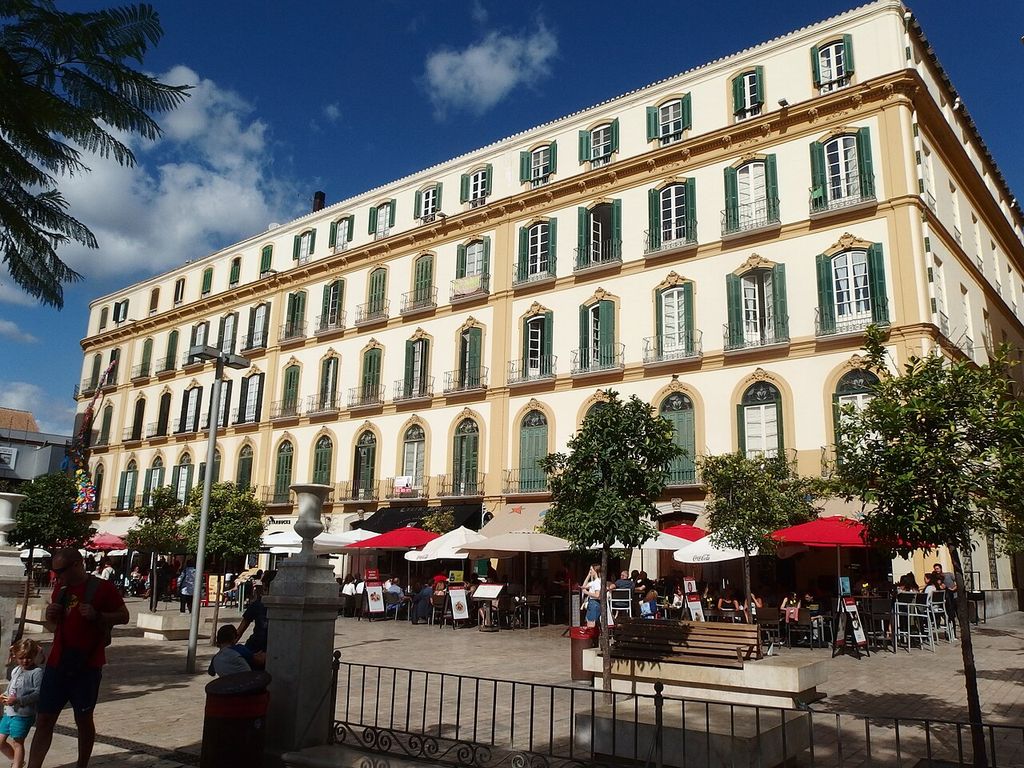
1881 — Birth in Málaga. Pablo Ruiz Picasso was born on 25 October to José Ruiz Blasco, a painter and art teacher, and María Picasso López. The family and educational settings of his childhood help explain the strength of his early draughtsmanship. They do not, on their own, foretell the radical forms of his later work.[1][2]
1891–1895 — Training and family moves. The family settled in A Coruña in 1891, where Picasso studied at the school at which his father taught. His younger sister Conchita died in January 1895. Later that year the family moved to Barcelona, and Picasso entered the art school known as La Llotja. His subsequent story is often told as a young artist escaping academic rules, but the surviving work shows how thoroughly he first learned them.[1][2]
1896–1897 — Ambitious student paintings. First Communion (1896) and Science and Charity (1897) show Picasso working on a large scale within academic conventions. For Science and Charity, he staged a scene of medical care around a sick woman and entered it in exhibitions. These paintings matter not because they already look like Cubism, but because they show a teenager able to organise figures, light and narrative for public display.[1][2]
1897–1898 — Madrid and Horta de Sant Joan. Picasso went to Madrid to study at the Real Academia de Bellas Artes de San Fernando and spent time looking at the Prado's older Spanish paintings. He then stayed at Horta de Sant Joan with his friend Manuel Pallarès. These experiences widened his visual education beyond the classroom. Horta would remain a place to which he returned in his work and travels.[1][2]
1899–1900 — A Barcelona circle, then Paris. Picasso became part of the artistic world around Els Quatre Gats, the Barcelona café and exhibition venue. There he encountered writers, artists and future supporters, including Carles Casagemas and Jaume Sabartés. In 1900 he held a solo display at Els Quatre Gats and travelled to Paris with Casagemas for the Exposition Universelle. The journey began a pattern of movement between the two cities, not an immediate abandonment of Barcelona.[1]
1901–1905: Paris, Barcelona and the blue-to-rose transition
1901 — Loss, exhibition and a changing palette. Casagemas died by suicide in Paris on 17 February while Picasso was in Spain. Picasso returned to Paris later that year. A joint exhibition with Francisco Iturrino opened at Ambroise Vollard's gallery in June, before the sombre blue-dominated pictures for which the Blue Period is now known had fully taken shape. From the autumn, images of Casagemas and other figures show a growing turn toward blue. It is too simple to claim that one death instantly produced a finished style.[1][2][4]
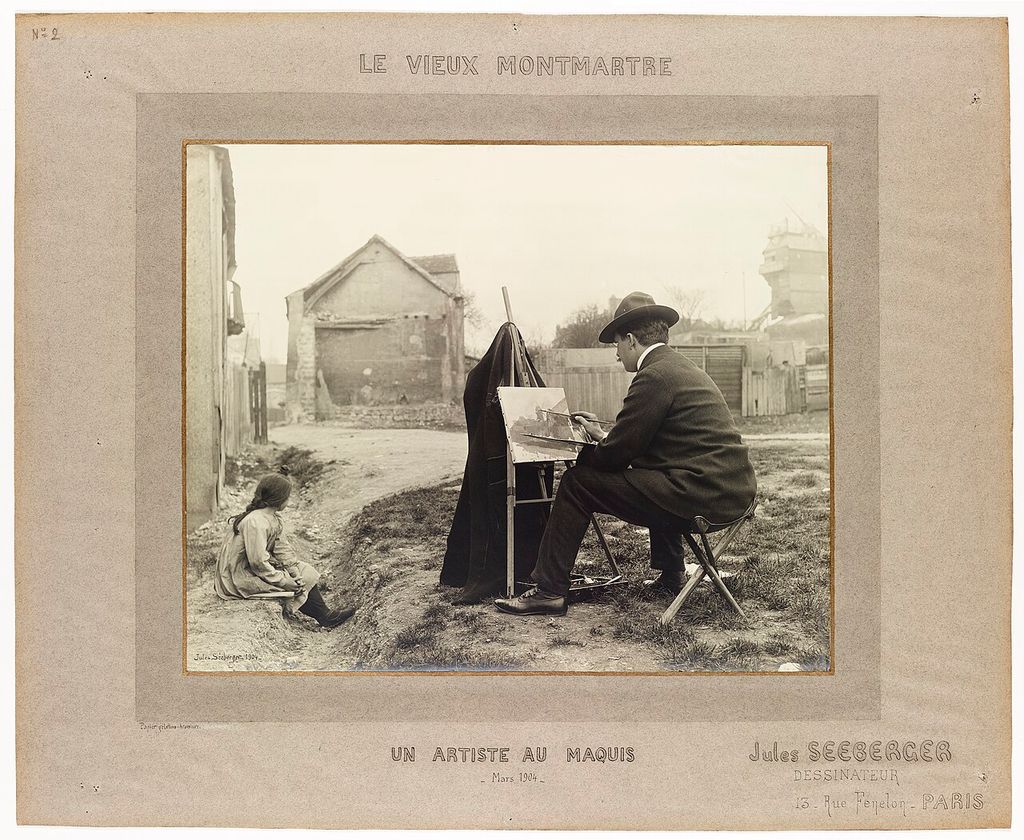
1902–1903 — Working across two cities. Picasso spent long periods in Barcelona while maintaining connections to Paris. His subjects included people in poverty, mothers and children, workers, prisoners and solitary figures. La Vie, painted in Barcelona in 1903, is among the most complex works of these years. Its meaning is debated; a date in a timeline should locate it in a developing practice, not convert it into a single biographical confession. The Paris and Barcelona strands of the Blue Period belong together.[1][4]
1904 — A more lasting move to Paris. Picasso settled at the Bateau-Lavoir in Montmartre. He made The Frugal Repast, an etching of two people at a sparse table, and continued to paint figures whose emotional force depended on posture and colour. Fernande Olivier became an important figure in his life and in accounts of the Parisian circle. The move did not end blue imagery overnight.[1][2][4]
1905 — Circus performers and a warmer range. Harlequins, acrobats and other itinerant performers became prominent in work often called the Rose Period. Warmer pinks and ochres appeared, but vulnerability and distance did not vanish. Picasso also entered Gertrude and Leo Stein's circle. A useful chronology shows this as an overlap and redirection, rather than a miraculous change from sadness to happiness.[2][4]
Watch: Pablo Picasso
Explore Picasso through five videos from museums, broadcasters and art educators.
Picasso’s Guernica: Great Art Explained
Explore the composition and historical setting of Picasso’s best-known response to war.
Watch on YouTube1906–1914: Toward Cubism and beyond the painted surface
1906 — Gósol and Gertrude Stein. Picasso and Fernande Olivier spent part of the year in Gósol, in the Catalan Pyrenees. His portrait of Gertrude Stein belongs to a period of forceful simplification of faces and bodies. Encounters with Iberian sculpture and with art seen in Paris formed part of a wider search for new ways to construct the figure. The sources of that search should be named specifically; a vague label such as “primitive influence” obscures different objects, cultures and conditions of access.[2][5]
1907 — Les Demoiselles d'Avignon. Picasso completed this large Paris painting in June–July after months of preparation. Its five figures and compressed, fractured space broke with familiar ways of depicting bodies and depth. The title now in use was attached around its first public showing in 1916; it refers to the Barcelona street associated with the picture's sex-worker subject. Georges Braque and the dealer Daniel-Henry Kahnweiler entered Picasso's artistic network around this time. The painting was a turning point, but Cubism was not the work of one artist or one canvas alone.[2][3][5]
1908–1909 — A dialogue with Braque. Picasso and Braque developed an unusually close exchange about how objects could be seen and represented. Still lifes, figures and landscapes became increasingly structured through facets and shifting viewpoints. Picasso returned to Horta de Sant Joan in 1909, painting buildings and landscape in forms that helped push their experiments forward. Their dialogue belongs within a wider field of artists and critics, even when the two painters' collaboration is central to the story.[1][2][5]
1910–1911 — Analytic Cubism. Portraits and still lifes became denser and more restrained in colour. An object might no longer sit behind a single illusionistic window; its parts could be distributed across a surface that asked the viewer to assemble relations. Picasso's 1910 portrait of Kahnweiler is one example of the demands such pictures place on recognition. The work of these years was shown and discussed within a growing Cubist movement, not created in isolation.[2][5]
1912 — Collage changes the question. In Still Life with Chair Caning, Picasso combined painted signs with oilcloth printed to imitate chair cane and a rope border. Instead of merely painting an imitation of material, he placed a manufactured material into the work. Papier collé and constructed objects soon extended this challenge to what a picture or sculpture could be. This is one reason Cubism mattered beyond a new way of drawing a guitar or a face.[2][5][6]
1914 — War interrupts a partnership. The First World War broke the immediate circumstances in which Picasso and Braque had worked. Braque was called to military service and wounded; Picasso, a Spanish national living in France, was not mobilised into the French army. He did not stop making art. The change was in the artistic and social world around him, as well as in the range of visual languages he would use.[5]
1915–1925: Theatre, classicism and concurrent styles
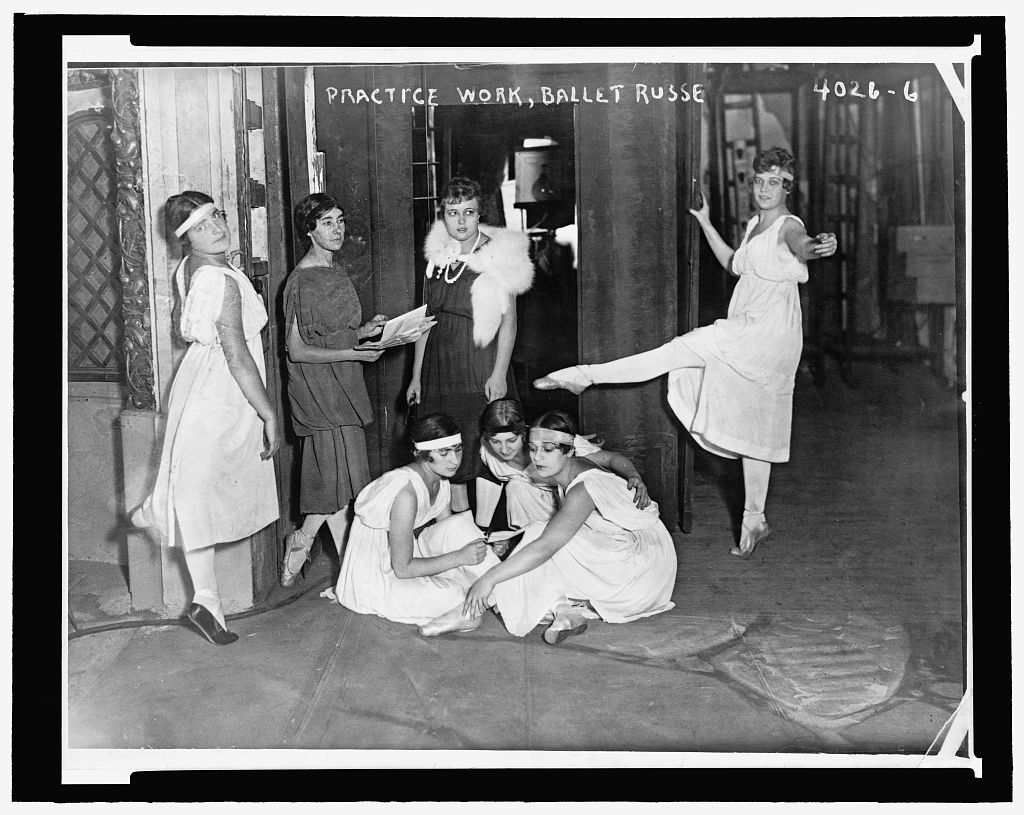
1915–1918 — Loss and Parade. Eva Gouel, Picasso's partner after Fernande Olivier, died in 1915. In 1917 he worked with Jean Cocteau and the Ballets Russes on Parade, designing scenery and costumes. The project took him to Italy, including Rome and Naples, and brought him into contact with the dancer Olga Khokhlova. They married in 1918. A timeline focused only on canvases would miss how stage design enlarged the scale and public setting of his experiments.[1][2]
1921 — Paulo and Fontainebleau. Picasso and Olga's son Paulo was born in February. During a summer in Fontainebleau, Picasso made large classicising figures and two versions of Three Musicians. The MoMA painting revisits the flat planes and cut-paper logic of Synthetic Cubism, while the Three Women at the Spring works explore weight and monumental form. Their coexistence makes the point vividly: “classical period” does not mean Cubism had been discarded.[2][7][8]
1924–1925 — Theatre and a harsher energy. Picasso designed for the ballet Mercure in 1924. The Dance of 1925, now at Tate, marks a more unsettling treatment of bodies and emotional tension. Surrealist artists and writers took an interest in Picasso, but his work was not simply absorbed into a movement he did not formally join. The mid-1920s brought another change of pressure in his images rather than a single new rule for them.[2]
1926–1935: Sculpture, major exhibitions and changing relationships
1927–1931 — Marie-Thérèse Walter and sculpture. Picasso met Marie-Thérèse Walter in 1927. She appears in many later works, but should not be described only as the source of their forms. At the same time, Picasso worked with the Catalan sculptor Julio González on experiments in welded iron. After buying the château at Boisgeloup in 1930, he had room for larger sculpture. These developments broadened the material history of his art beyond painting.[1][2]
1932 — A retrospective and a year of prolific work. A major exhibition at the Galerie Georges Petit in Paris surveyed Picasso's career. Christian Zervos began publishing the catalogue raisonné of his work. The year also produced many paintings, drawings and sculptures that now anchor accounts of Marie-Thérèse and of Picasso's public standing. Retrospective recognition did not turn him into a finished historical figure; he kept changing what his work could look like.[2]
1934–1935 — Last Spanish trip and Maya's birth. Picasso's visit to Spain in 1934 proved to be his last. In 1935 he separated from Olga, though they did not divorce, and Marie-Thérèse gave birth to their daughter Maya. He also spent time writing poetry. These family events belong in the record, but should not be made into automatic explanations for every formal decision in the studio.[1][2]
1936–1945: Civil War, Guernica and occupied Paris
1936 — Spain at war. After the military uprising in July, Picasso supported the Spanish Republic. In September he was appointed director of the Prado by the Republican government. The appointment is an important political and symbolic fact; it should not be mistaken for evidence that he moved to Madrid to run the museum day to day. Dora Maar, an artist and photographer in her own right, had become part of his life during these years.[1][2]
1937 — Guernica. The Republic commissioned a large work for its pavilion at the Paris International Exposition. Following the bombing of Gernika on 26 April, Picasso began studies on 1 May and worked on the mural through early June in his Paris studio on rue des Grands-Augustins. Maar photographed stages of the painting's making. Her record is now a crucial source for understanding revisions; it is not merely a set of pictures of the artist at work. Guernica entered a public argument about violence, fascism and the fate of Spain, while retaining a visual language that resists a one-line decoding.[1][2][9][10]
1939–1940 — War and an American retrospective. The Second World War began in Europe in September 1939. MoMA opened Picasso: Forty Years of His Art on 15 November that year; it ran into January 1940 and included Guernica. This is the documented exhibition title and date, distinct from later or garbled references to a “fifty years” show. Picasso spent the occupation principally in France, including Paris and the studio on rue des Grands-Augustins.[2][11]
1944–1945 — Political commitment and the war's end. Picasso joined the French Communist Party in 1944 and had a major exhibition at the Salon d'Automne. His wartime life also brought him into contact with the painter Françoise Gilot; institutional chronologies disagree over the exact year of their first meeting. The conflict is a reason to avoid a precise date here, not to omit Gilot as an artist with her own career. The war ended in 1945, but the political questions behind pictures such as Guernica did not.[1][2]
1946–1962: The Mediterranean and many kinds of work
1946–1949 — Antibes, Vallauris and clay. Picasso worked in Antibes and encountered the Madoura pottery workshop in Vallauris, run by Suzanne and Georges Ramié. He returned in 1947 and began sustained work with ceramics, using vessels and clay forms as surfaces and bodies to transform. He and Gilot had two children, Claude in 1947 and Paloma in 1949. The move south should not be framed as a retreat from experiment: material, scale and collaborators all changed.[1][2][12]
1949–1953 — Public symbols and private changes. Picasso's dove became widely associated with the post-war peace movement. Political subjects remained visible in his art, while he continued making prints, paintings and ceramics. Gilot left their shared household in 1953. She went on working and writing independently; the chronology of Picasso's production should not absorb her life into his.[1][2]
1954–1955 — New relationship, older paintings revisited. Jacqueline Roque became Picasso's companion and later his wife. During the 1950s he increasingly made serial responses to paintings by earlier masters, including Delacroix's Women of Algiers. These were not exercises in faithful copying. By varying a composition across many works, Picasso could test what remained recognisable and what could be transformed.[2]
1957 — Las Meninas as a series. From August to December, Picasso made fifty-eight canvases in dialogue with Velázquez's Las Meninas at La Californie in Cannes. The series includes repeated studies of figures from the older painting, but also pigeons, landscapes and a portrait of Jacqueline. The late-work guide places this series among Picasso's other responses to earlier masters. It is a particularly clear example of an artist using a historical work as a generative problem rather than a fixed model.[1][13]
1961–1962 — Mougins and Barcelona connections. Picasso and Jacqueline married in 1961 and settled at Notre-Dame-de-Vie in Mougins. His connection to Barcelona remained active through friends, publishing and the emerging museum project, even though he had not returned to Spain since 1934. A life spent largely in France did not sever the institutional and personal ties through which his early work would be preserved.[1][2]
1963–1973: The museum, donations and late work
1963 — A Picasso museum opens in Barcelona. The Museu Picasso opened in March, initially under the name Colección Sabartés. Jaume Sabartés, Picasso's longtime friend and secretary, played a central part in its founding through his collection and advocacy, alongside the city and other donors. Its emphasis on early work made Barcelona indispensable to understanding how Picasso developed before Paris became his principal base.[1][14]
1968–1970 — Gifts reshape the collection. After Sabartés died in 1968, Picasso donated the fifty-eight Las Meninas canvases and a 1901 portrait of his friend to the Barcelona museum. In 1970 he donated a large body of work that his family had kept in Barcelona, including paintings, drawings and notebooks from his youth. These acts materially changed what the public could study; they also linked the late artist to the city of his formation.[1][14]
1965–1973 — Work continues. Picasso underwent surgery in 1965 and recovered at Mougins. His late production included paintings, drawings and hundreds of prints; vigorous changes of scale and manner continued into the early 1970s. This work has not always been received in the same way as his Cubist or Blue Period paintings. Its range resists a timeline that treats the late years as a quiet epilogue.[2][15]
1973 — Death in Mougins. Picasso died on 8 April at Notre-Dame-de-Vie. He was buried at his château of Vauvenargues. The chronology ends there, but the history of the works does not: acquisitions, exhibitions, technical research, debates about interpretation and questions of image rights continue to alter how they are seen.[1][2]
How to read the dates
The common shorthand—Blue Period, Rose Period, Cubism, classicism, late work—is useful for finding a way through a long career. It becomes misleading if each label is treated as exclusive. A 1921 Cubist Three Musicians can coexist with classicising figures; a 1957 response to Velázquez is also a contemporary experiment; a museum founded in 1963 can transform the way the 1890s are understood. Picasso's timeline is best read as a network of continuing questions about bodies, objects, materials and public life, not as a ladder of styles from “early” to “mature.”[2][7][13][14]
Discussion
Use the evidence and your own close looking to explain your view. These are editorial prompts, not reader comments.
Reader Insights
Which two media was Picasso using at the same moment?
Which date marks making, and which marks a work’s first public exhibition?
Where does the chronology resist a tidy change from one style to the next?
Join the Conversation
Which reading best fits the evidence?
References
- Museu Picasso Barcelona, “Cronología,” Spanish institutional chronology; Catalan version consulted for comparison. View Spanish source; View Catalan source.
- Musée national Picasso-Paris, “Frise chronologique,” French institutional chronology; English translation consulted. View French source; View English source.
- The Museum of Modern Art, “Les Demoiselles d'Avignon,” object record and account of its making and first public exhibition. View source.
- Musée d'Orsay, “Picasso. Bleu et rose,” French exhibition account. View source.
- Musée national Picasso-Paris, “Picasso et le cubisme,” French account; English version consulted. View French source; View English source.
- The Museum of Modern Art, The Art of Assemblage, catalogue discussion of Still Life with Chair Caning. View source.
- The Museum of Modern Art, “Three Musicians,” object record. View source.
- The Museum of Modern Art, “Picasso in Fontainebleau: An Introduction,” study of the 1921 works. View source.
- Museo Nacional Centro de Arte Reina Sofía, Repensar Guernica, archival project on the commission and painting. View source.
- Museo Nacional Centro de Arte Reina Sofía, “Dora Maar's report on Guernica's progression,” archival description. View source.
- The Museum of Modern Art, “Picasso: Forty Years of His Art,” exhibition record, 15 November 1939–7 January 1940. View source.
- Musée national Picasso-Paris, “Les années méditerranéennes,” French account of Vallauris and the Madoura collaboration. View source.
- Museu Picasso Barcelona, “Forgetting Velázquez. Las Meninas,” exhibition account of the 1957 series. View source.
- Museu Picasso Barcelona, “Historical and museographic tour of the collection,” museum and donation history. View source.
- Musée national Picasso-Paris, “Les dernières années de Picasso,” French account of the late work. View source.
Image Credits
- Palickap. CC BY-SA 4.0. Source: Wikimedia Commons. Resized to 1024px; no crop. Source record. Licence.
- Séeberger, Jules (Vienne, en 1872 - Galluis, en 1932), photographe. CC0. Source: Wikimedia Commons. Resized proportionally to 1024px wide; no crop. Source record. Licence.
- Bain News Service, circa 1916. Library of Congress, Prints & Photographs Division, George Grantham Bain Collection, LC-USZ62-63268. Rights advisory: ‘No known restrictions on publication.’ Date and title derive from the archive’s old caption data. Proportional resize only. Source record. Licence.
- Berdea, 17 September 2011. Wikimedia Commons, CC BY-SA 3.0. Proportional resize only; derivative retains CC BY-SA 3.0. Source record. Licence.


