


 by Tom Gurney
Tom Gurney BSc (Hons) is an art history expert with over 20 years experience
Email: tomgurney1@gmail.com / Phone: +44 7429 011000
Introduction
Picasso's late work is not a single look or a final style. From the mid-1950s until his death in 1973, he reworked paintings by earlier masters, revisited familiar subjects, made cut and folded sculptures, and continued to draw and print at remarkable scale. A 1957 series after Velázquez can seem methodical and expansive; a 1972 musketeer can be rapidly brushed and theatrical. Both belong to the same late practice of trying an image again, changing its terms and testing what painting or another medium could still do.[1][2][3]
Where to begin the period is a curatorial choice. Museum Berggruen treats the 1954–55 Women of Algiers series as its opening; a Centre Pompidou exhibition began with 1953; the Musée national Picasso-Paris calls 1965–73 the final years. These are not contradictory dates for one event. The broader “late work” is useful here for about 1954–73, while “final years” refers more narrowly to the last decade and especially the intense production around 1969–72. The page asks what changed across those years without assuming that old age itself explains the pictures.[1][2][4]
At a Glance
- Approximate span: Mid-1950s to 1973
- Recurring practice: Series and variations after earlier paintings
- Media: Painting, drawing, printmaking and cut or folded sculpture
Contents
- Reworking other artists was a way to make new art
- Las Meninas: a series, not one remake
- Manet across painting, drawing and sculpture
- La Californie, Mougins and Jacqueline Roque
- Painting was only one part of late practice
- Musketeers, couples and the painter at work
- Avignon and the changing reception
- The last images and the danger of a “last painting”
Reworking other artists was a way to make new art
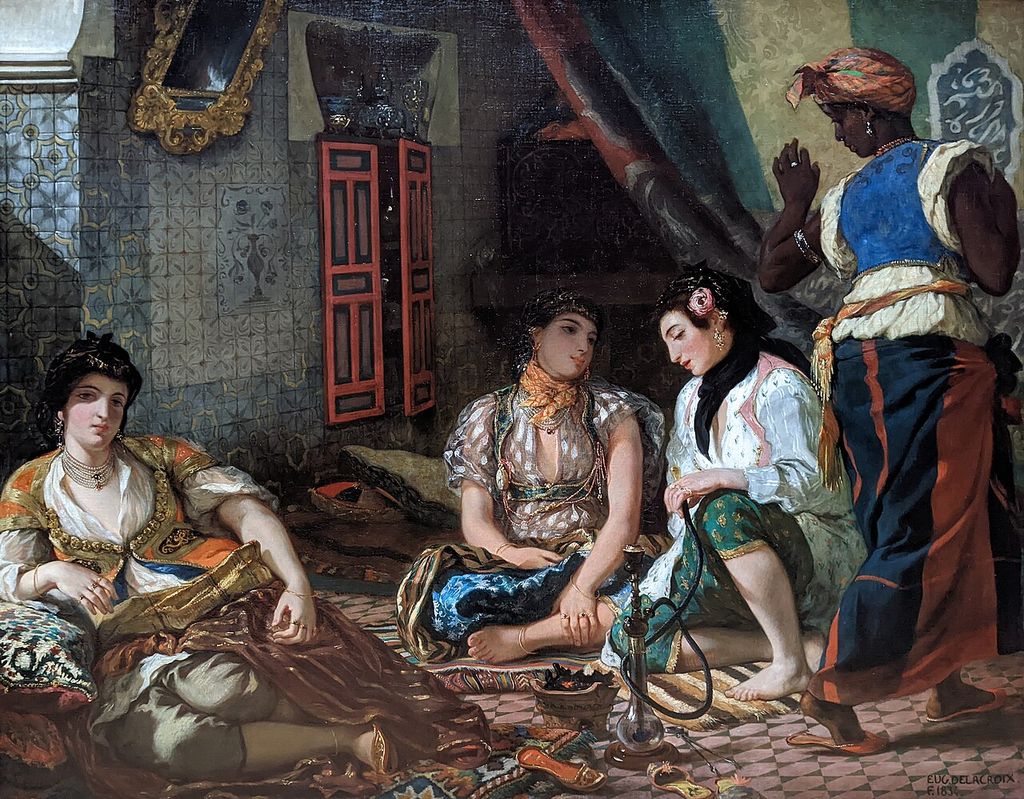
Picasso had looked closely at older art throughout his career. In the 1950s, sustained series after famous paintings became especially important. He took up Delacroix's Women of Algiers in 1954–55, Velázquez's Las Meninas in 1957 and Manet's Le Déjeuner sur l'herbe from 1959. These were not attempts to produce museum copies. A recognised composition gave him a structure he could alter: a face could change position, a figure could grow, a room could flatten, or colour could overturn the balance of the original.[1][2][5]
Museum Berggruen's German-language account identifies fifteen Women of Algiers paintings made in the winter of 1954–55 and designated A through O. Picasso also made preparatory works and prints. The lettered sequence makes variation visible. One canvas is not the definitive “Picasso version” that renders the others failed trials; each tests a relation among Delacroix's figures, the room and Picasso's own pictorial language. The subject is also a reminder that historical paintings can carry the period's ways of looking at women and North Africa. Formal innovation does not remove the need to ask whose bodies are depicted and how.[1]
The Women of Algiers series and Version O
Women of Algiers can name the whole sequence or a particular painting in it. The canvas auctioned in 2015 was Les femmes d'Alger (Version O), not every work in the group. Christie's catalogues Version O as an oil on canvas dated 14 February 1955, 114 by 146.4 centimetres, and records its earlier 1997 sale from the Ganz collection. The sequence contains fifteen lettered paintings. A reader interested in the particular canvas can use Christie's object record[15] to see the securely identified work and its sale history.[1][15]
His dialogue with old masters was therefore competitive, admiring and questioning at once. It was not proof that he had ceased to invent, nor a surrender to tradition. A work after Delacroix is legible because the earlier picture remains a point of reference; it becomes Picasso's because the spaces, contours and colour relationships are re-made. The same method extends to Velázquez and Manet, but the three series are not interchangeable. Each precursor offers a different pictorial problem and a different historical context.[1][2][5]
Las Meninas: a series, not one remake
At La Californie near Cannes, Picasso worked on his Las Meninas series from August to December 1957. The Museu Picasso Barcelona preserves the group and its chronology. It comprises 58 works, including interpretations of Velázquez's court painting, views involving pigeons, landscapes and a portrait of Jacqueline Roque. A separate sketch, donated later, helps explain the process but is not part of the 58-work series. The first large canvas followed a sketch made on 16 August; the museum documents revisions and further works through late December.[3]
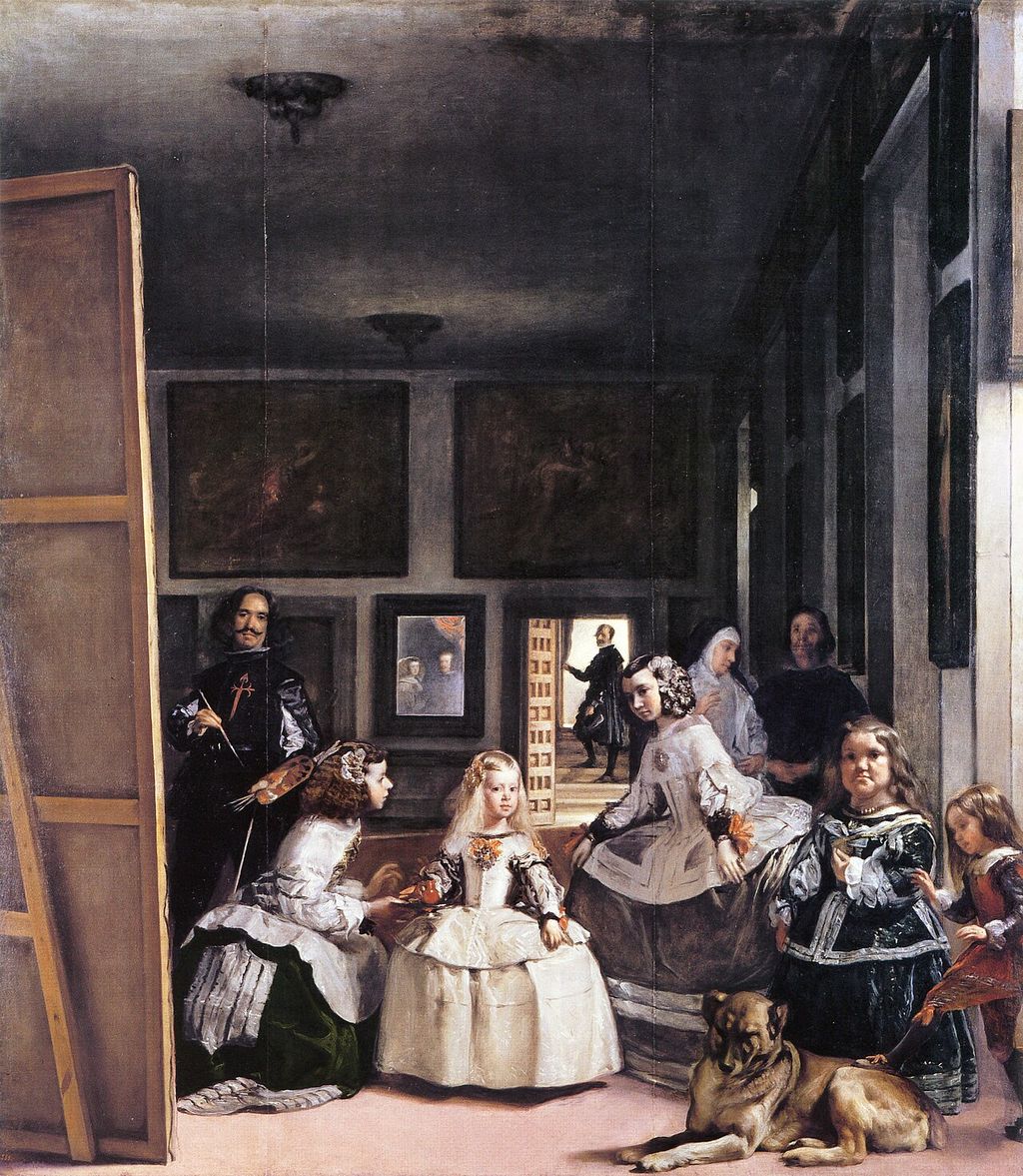
Picasso could isolate a head or figure, reconsider the whole room, shift the relative prominence of the figures, and move between crowded and sparse arrangements. The pigeon paintings were made from the surroundings of the La Californie studio and sit within the preserved sequence. They are not irrelevant interruptions in a tribute to Velázquez: the Barcelona museum suggests relationships between the studio views and the geometry of the reimagined royal chamber. The sequence moves between a famous seventeenth-century interior and the place where a twentieth-century painter was actually working.[3]
The collection history matters too. Picasso donated the complete group to Barcelona in 1968 in memory of his friend and secretary Jaume Sabartés, who had died that year. The gift helped keep the series together for viewers, making its variations easier to compare than if they had been scattered. It is tempting to describe all 58 paintings simply as “copies of Las Meninas.” That would conceal both the other subjects and the museum's evidence of a sustained, serial method.[3]
Watch: Pablo Picasso
Explore Picasso through five videos from museums, broadcasters and art educators.
Picasso’s Guernica: Great Art Explained
Explore the composition and historical setting of Picasso’s best-known response to war.
Watch on YouTubeManet across painting, drawing and sculpture
Picasso began an extended engagement with Manet's Le Déjeuner sur l'herbe in 1959 and continued it into 1961. The Musée national Picasso-Paris documents 27 paintings, many drawings and linocuts, and cardboard studies for sculptural forms. The work crossed the studios at Vauvenargues, Cannes and Mougins. It also crossed mediums: an arrangement of people in Manet's painting could become an oil, a printed image or a model for a figure in space.[5]
This is not a footnote to a painting career. The changes that occur when a body moves from a canvas to a cut or folded model are substantial. A contour that merely described a figure can become the edge of a real material. Some of Picasso's designs were enlarged as concrete works through the technical collaboration of the Norwegian artist Carl Nesjar. Crediting only Picasso would obscure the making of those public-scale translations. The extended Déjeuner cycle shows late Picasso working through a problem from several directions, not repeating an old painting because he had run out of subjects.[5][6]
Manet's original itself had shocked nineteenth-century audiences through its combination of a nude woman and clothed men in a modern outdoor scene. Picasso's variations inherit that charged structure and alter it. A reader should not call the women simply “models” and move on. The series is a dialogue about painting, but it is also a sequence of representations of bodies, looking and power. The art-historical source makes the question more, not less, relevant.[5]
La Californie, Mougins and Jacqueline Roque
Picasso moved to La Californie at Cannes in 1955 with Jacqueline Roque. The villa's rooms and objects appear in his studio paintings; it was not merely a picturesque backdrop. The Musée national Picasso-Paris describes the living space and working space intermingling, with doors, windows and furnishings entering the paintings. These canvases can make the studio itself a subject, while the paintings and models inside it change from one version to another.[4]
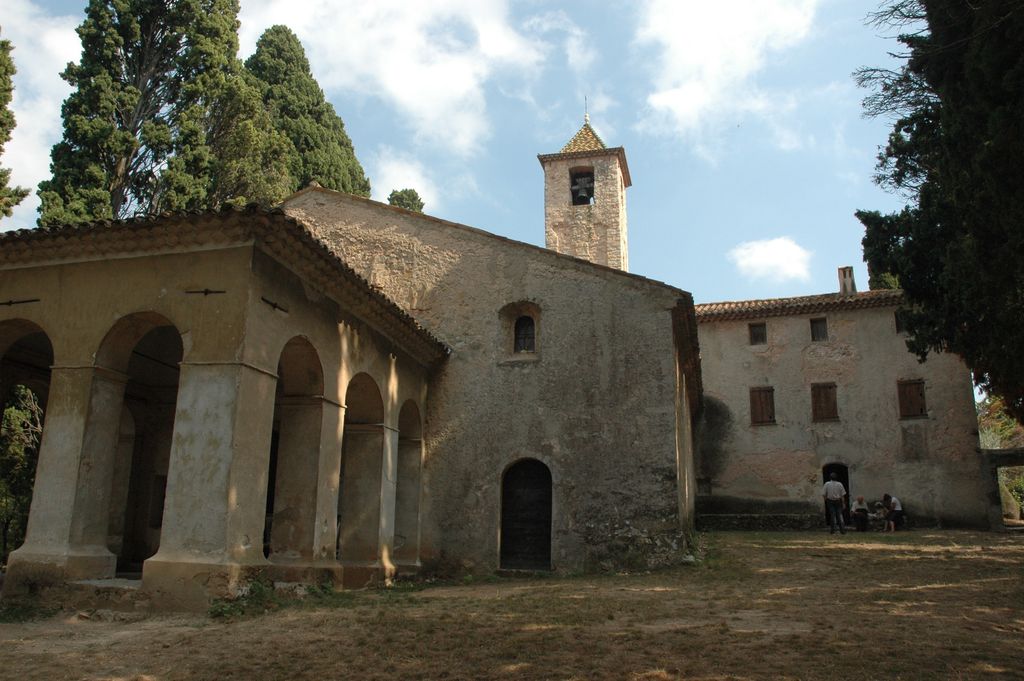
Picasso and Jacqueline married in 1961. Notre-Dame-de-Vie at Mougins became his final residence and principal studio. Jacqueline appears in many portraits, drawings and sculptures across these decades. She was also part of the artist's working and domestic world; calling her only a “muse” leaves too little room for her as a person. When a work is identified as a portrait of her, a holding institution's record can support that identity. A schematic female form should not be named Jacqueline simply because it was made during their life together.[4][7]
The shift of location did not divide Picasso's art into two sealed periods. The Déjeuner cycle ran across several studios. Subjects introduced at La Californie could continue at Mougins, while older motifs from decades earlier returned in new form. A late painting of a bather, for instance, can pose a question about flat space and bodily movement that Picasso had already addressed in Cubist works and in his 1930s swimmers. Places help locate an object; they should not be mistaken for independent causes of a style.[5][8]
The southern years also had a workshop history that began before La Californie. At Vallauris, Picasso had worked with Suzanne and Georges Ramié at the Madoura pottery from the later 1940s. His involvement with ceramics continued after he moved to Cannes and extended into the 1960s. A plate, jug or tile could combine practical vessel, painted surface and sculptural shape; a faun, bull or bird might be modelled as well as drawn. These objects make it especially misleading to write as though the late work consisted only of large paintings made alone in Mougins. The pottery's makers and facilities were part of the work's material conditions.[4][14]
Painting was only one part of late practice
The late work includes sculpture and printmaking alongside oil paintings. In the early 1960s Picasso cut and folded sheet metal into figures, sometimes allowing one view to suggest a profile and another a frontal body. The Museo Picasso Málaga's record of a 1961 cut-metal Woman identifies Jacqueline Roque as the associated figure and stresses the openness produced by cut-out forms. The sheet is both material and image: a gap can define a face, and a fold can give a flat silhouette volume.[7]
These experiments continue questions from Picasso's Cubist constructions rather than appearing out of nowhere in his eighties. Yet the material consequences are different from a painting. A metal figure can occupy a room and change with the viewer's position. A public enlargement in concrete has further technical and spatial consequences. The collaboration with Carl Nesjar was central to several enlarged designs. “Picasso made it” is an incomplete account when the object is a technically realised work beyond his own hand.[6][7]
Printmaking offered another kind of repetition and difference. Picasso worked closely with master printers Aldo and Piero Crommelynck, whose presses were moved near his Mougins studio. The 1968 Suite 347 is a large group of prints made through combinations of intaglio techniques. Museo Picasso Málaga's Suite 347 no. 138, dated 2 June 1968, uses sugar-lift aquatint and drypoint. The first can create dark, granular passages; the second incises lines directly into the plate. Such differences matter when an image that looks spontaneous is examined as a made print with technical stages and collaborators.[9]
This was not Picasso's only late graphic language. Linocuts formed part of his reworking of Manet, while the Crommelynck collaboration brought fresh momentum to etching and related intaglio methods. A printed impression can record a decision about black against white, dry line against dense tone, and one state of a plate against another. It can also reach viewers through editions in a way a unique studio canvas cannot. Describing a print as merely a reproduction of Picasso's image would miss both the direct work on the plate and the printer's craft.[5][9]
The suite gathers musketeers, bullfighters, circus performers, artists and models, and characters from Spanish literature. It also includes explicitly erotic and ethically difficult scenes, some involving sexualised young figures. A responsible account should neither treat these as harmless evidence of “vitality” nor sensationalise them for attention. Their content is part of the late work, and so is the fact that the images were produced in a collaborative print workshop and circulated as impressions rather than single canvases.[9]
Musketeers, couples and the painter at work
From the later 1960s, musketeers and other costumed men multiplied in Picasso's paintings, drawings, ceramics and prints. Museo Picasso Málaga traces the motif from 1966 and relates it to seventeenth-century painting and literature. A 1969 musketeer painted across ceramic tiles, for example, does not simply imitate Velázquez. Its shorthand features and unusual support make the figure partly comic, partly imposing. The museum notes that Picasso imagined a composite artist's signature on a related 1967 painting, bringing several admired older painters into one invented persona. That is strong evidence for the play with artistic ancestry; it is not evidence that any one musketeer must be a literal self-portrait.[10]
The Museo Picasso Málaga's Musketeer with Sword, painted on 28 January 1972, has a bright, rapid-looking surface and eyes weighted with dark paint. Its sword, costume and face evoke Spanish Golden Age and theatrical figures. The museum treats autobiographical interpretation as plausible rather than certain. A brushstroke that looks quick need not be careless: the relation between long strokes, dots, dark eyes and the painted body's contour gives the figure its presence. Picasso could honor older painters and caricature their authority in the same picture.[10]
Other recurrent subjects were the couple, the kiss, the reclining nude, the studio and the painter with a model. The Musée national Picasso-Paris records Le Baiser as made at Mougins on 26 October 1969. A title such as “The Kiss” names an action, not the identities of two actual sitters. These works can be intimate, theatrical, aggressive or comic. They should not all be turned into confessions about Picasso's marriage, nor praised without attending to the unequal positions of looking and being looked at that some of them stage.[11]
The painter-and-model subject deserves special care. In works made around 1963–64 and revisited later, Picasso pictured the act of looking and making as part of the scene. The canvas within the canvas, the model's pose and the artist's position can make the old-master tradition visible as a social arrangement, not just a source of compositional ideas. The subject also risks giving a painted woman no identity beyond being observed. A close reading should ask who acts, who watches and what the picture itself makes uncertain, rather than treating the model as a neutral studio prop.[2][4]
The Museo Picasso Málaga's Bather of 5 July 1971 offers a less obvious continuity. The museum compares its flattened space and extended body with earlier swimmers and with Cubist questions about how to create volume on a flat plane. The old motif had changed, but it was still available to Picasso as a way to investigate space. “Late” does not mean every idea in the painting originated late; it means that old questions were being tested in a new arrangement.[8]
Avignon and the changing reception
The 1970 exhibition at the Palais des Papes in Avignon presented recent paintings and drawings on a large scale. The Musée national Picasso-Paris records that the displays provoked strong reactions to their colour, erotic subjects and size. A second Avignon exhibition opened in 1973, after Picasso's death, with work from 1970–72. It is important not to merge the two into one show or describe Picasso as personally attending an exhibition that opened after April 1973.[2][4][10]
Reception was mixed, not uniformly hostile. The Centre Pompidou's later account records harsh criticism but also enthusiasm and indifference. Subsequent exhibitions in the late 1970s and 1980s offered different ways of seeing the paintings, at a moment when younger artists and critics were reconsidering expressive figuration. Museo Picasso Málaga likewise notes a shift from lifetime dismissal to later interest. Neither a negative contemporary review nor a later celebration settles every question about an individual work. Both are part of its history.[2][12]
The word “unfinished” has often been applied loosely to Picasso's late surfaces. Visible revisions, open ground, abrupt contours and rapid strokes may be intended formal choices; they may also vary from picture to picture. Their effect has to be judged by looking at a particular object. Age alone cannot make a line either weak or masterful. The range documented by museums—large canvases, small prints, careful series and brashly painted heads—defeats a single story of decline or triumph.[2][12]
That range explains why the chronology of criticism matters. A viewer at Avignon in 1970 faced new work displayed in a medieval palace, with scale and colour that many found confrontational. A visitor to a later museum exhibition could see the same decade of work beside preparatory sheets, prints and earlier cycles. The context of display changes what can be compared. Later praise is not automatically truer than the first shock, but it can correct the assumption that an elderly artist's repeated figures must be evidence of exhaustion.[2][4][12]
The last images and the danger of a “last painting”
In 1972 Picasso made drawn self-portraits and heads whose eyes and masklike features invite reflection on age and mortality. The Paris museum identifies these as a series, not one definitive image. Its collection record for The Young Painter, dated 14 April 1972, describes a smiling youthful figure with palette and brush. A reading of it as Picasso remaking himself as a young artist is possible, but the museum also cautions against treating a picture's title as proof of an exact autobiographical identity.[4][13]
Picasso's work did not culminate in one universally agreed “last painting.” He continued to make paintings and drawings across the final years, with multiple subjects and dates. A claimed final image can be seductive because it promises a closing statement from a long career. The historical record is less tidy. The task is to study securely identified objects and their dates, not turn whichever image is most dramatic into a deathbed confession. Picasso died at Mougins on 8 April 1973.[4][13]
Even the label “self-portrait” needs testing. A young painter with palette, a costumed musketeer and a drawn face from 1972 may all invite comparison with Picasso, but they make different kinds of claim on the viewer. The museum record for a specific object can establish its date and material; a resemblance or possible alter ego remains an interpretation. Keeping those levels separate lets the images stay open without making their history vague.[10][13]
To approach this late work, compare a series and a single object. The 1957 Las Meninas group[3] shows how a recognised painting could generate dozens of alternatives. The 1961 cut-metal Woman[7] asks what a contour can do in space. Suite 347 no. 138[9] reveals the technical and collaborative making of a print. Musketeer with Sword[10] turns historical costume into brisk pictorial theatre. Their differences are the argument: late Picasso did not perfect one formula. He kept remaking the relations among older art, his own earlier work, the people and stories around him, and the materials in his hands.[3][7][9][10]
Discussion
Use the evidence and your own close looking to explain your view. These are editorial prompts, not reader comments.
Reader Insights
What changes across two versions in one of Picasso’s late series?
How does a late work reuse an older painter without simply copying?
What evidence challenges the idea of one final Picasso style?
Join the Conversation
Which reading best fits the evidence?
References
- Museum Berggruen, Picasso & Les Femmes d'Alger press release and German exhibition texts.
- Centre Pompidou, Le Dernier Picasso 1953–1973 exhibition dossier; Musée national Picasso-Paris chronology.
- Museu Picasso Barcelona, Catalan chronology of Las Meninas; series presentation; collection and donation.
- Musée national Picasso-Paris, Mediterranean years; final years.
- Musée national Picasso-Paris, Le Déjeuner sur l'herbe d'après Manet; museum teaching sheet.
- Musée national Picasso-Paris, sculptures and Carl Nesjar.
- Museo Picasso Málaga, 1961 cut-metal Woman, Spanish.
- Museo Picasso Málaga, Bather.
- Museo Picasso Málaga, Suite 347 no. 138, Spanish; English catalogue.
- Museo Picasso Málaga, Musketeer, Spanish; Musketeer with Sword.
- Musée national Picasso-Paris, Le Baiser, MP220.
- Museo Picasso Málaga, The Many Faces of Picasso's Late Work; Musée national Picasso-Paris, 2023 late-work dossier.
- Musée national Picasso-Paris, Le Jeune Peintre, MP228.
- Musée national Picasso-Paris, Vallauris and Madoura; museum dossier on ceramics, 1946–71.
- Christie's, Les femmes d'Alger (Version O), 14 February 1955, lot record.
Image Credits
- Eugène Delacroix. Public domain. Source: Wikimedia Commons. Resized to 1024px; no crop. Source record. Licence.
- Diego Velázquez. Public domain. Source: Wikimedia Commons. Resized to 1024px; no crop. Source record. Licence.
- Berdea, 17 September 2011. Wikimedia Commons, CC BY-SA 3.0. Proportional resize only; derivative retains CC BY-SA 3.0. Source record. Licence.


