


 by Tom Gurney
Tom Gurney BSc (Hons) is an art history expert with over 20 years experience
Email: tomgurney1@gmail.com / Phone: +44 7429 011000
Introduction
On the left of Pablo Picasso's Massacre in Korea, women and children huddle together on a strip of bare ground. On the right, a row of armed men levels its weapons toward them. The space between the groups is narrow, but no one has crossed it. We see the instant before an apparent execution, with the threatened civilians exposed and the soldiers' faces and bodies turned into an almost mechanical formation. Picasso painted this confrontation in January 1951, seven months into the Korean War. The title fixes its historical urgency; the picture itself does not identify a particular village, army unit or documented episode. [1][2]
The Musée national Picasso-Paris owns the work as collection object MP203. Its detailed catalogue records that Picasso made it in Vallauris on 18 January 1951, in oil on plywood, measuring 110 × 210 centimetres. The French title is Massacre en Corée. An account of the picture has to hold two truths together: it is a pointed response to a real war, made by an artist with public political commitments, and it is not a photograph or a verified reconstruction of one named massacre. Much of its force comes from the tension between those truths. [1][3]
At a Glance
- Made: Vallauris, 18 January 1951
- Medium and size: Oil on plywood, 110 × 210 cm
- Collection: Musée national Picasso-Paris, MP203
- Subject: Civilians face armed figures; no specific massacre is identified
Massacre in Korea in Picasso's career
First Communion
1896Three Musicians
1921Guernica
1937Las Meninas series
1957The highlighted work is dated with the qualifications explained in the sources on this page. The other works are selective points of comparison, not the start or end of a style.
Contents
- What happens in the painting?
- Does it show No Gun Ri or another particular massacre?
- Why does the painting resemble Goya and Manet?
- What was Picasso's political position in 1951?
- How was it exhibited and received?
- How does it relate to Guernica and Picasso's later peace work?
- Why does Massacre in Korea still matter?
What happens in the painting?
Picasso divides the long horizontal surface into two opposed groups. The women and children at left are unclothed. Some cling to one another, while a child reaches toward or stands near an adult. One rounded abdomen suggests pregnancy. Bodies overlap so closely that individual outlines sometimes become difficult to separate. The figures are vulnerable, but they are not passive marks on the ground: their gestures and faces give the threatened group a shared presence. Behind them the landscape is sparse, with little to tell us exactly where they are. [2][3]
Across the gap stands a formation of armed men. Their legs, helmets and weapons make sharp, repetitive shapes. Some guns resemble modern firearms; other details recall older armour or swords. The Musée Picasso compares the soldiers to beings part medieval knight and part machine. They are not rendered as a clearly identifiable national force. Their bodies look engineered for the act of aiming, while the people opposite them remain physically exposed. [2][3]
The palette is restrained rather than purely black and white. Greys and brownish tones dominate, interrupted by muted green and other colour. The difference between the more supple human group and the angular, armoured group matters more than a strict colour code. The ground or water-like division at the centre stops the opposing masses from merging. Picasso leaves the threatened killing imminent: the picture does not show a specific victim struck by a bullet. That suspended moment asks viewers to imagine the consequence of the weapons without letting us turn away from the people in their path. [1][3]
This is not a scene to read as a detailed military diagram. No insignia identifies a regiment, and no building, sign or Korean landmark fixes the site. The Musée Picasso's later bilingual commentary observes that almost nothing visible in the landscape or figures points specifically to Korea. The title and date supply the connection to the ongoing war. That choice makes the civilians representative of more than one place, though it also raises a difficult question: what is gained, and what may be lost, when a painting about Korean suffering gives its victims no recognisably Korean setting? [3]
Does it show No Gun Ri or another particular massacre?
Some accounts identify the picture with the killing of South Korean refugees at No Gun Ri in July 1950. The Musée Picasso's brief biographical page makes that association explicitly. Yet the museum's more detailed bilingual account describes a response to reports of the Korean War and says the painting itself contains no specific Korean place or military uniform. Korean and other scholars have also questioned whether Picasso had reliable knowledge of No Gun Ri by the time he completed the work in January 1951. The massacre happened; the unresolved question is whether this canvas was conceived as a depiction of that particular event. [3][4][5]
No contemporary record reviewed here establishes that Picasso received a detailed No Gun Ri report, selected its exact location or portrayed its actual participants. Another specific-event reading names Sinchon, a different episode and a very different historical claim. The painting does not settle that dispute visually. It is therefore more accurate to say that Picasso responded to news and political representations of atrocities in the Korean War, while keeping the executioners anonymous. The title names the conflict; the image does not name the unit, the victims or the site. [3][5][6]
This distinction is not a way of minimising civilian deaths in Korea. The war brought immense suffering to non-combatants, including massacres carried out under different authorities and in different places. It is instead a matter of respecting both the historical record and the art object. If we label every soldier in the picture as a member of a particular army, we claim a level of documentation that its forms, Picasso's later remarks and the available evidence do not provide. If we call the work merely “universal,” we risk losing the fact that Picasso chose to name Korea, during the war itself, and to put endangered civilians at its centre. [3][5][7]
Watch: Pablo Picasso
Explore Picasso through five videos from museums, broadcasters and art educators.
Picasso’s Guernica: Great Art Explained
Explore the composition and historical setting of Picasso’s best-known response to war.
Watch on YouTubeWhy does the painting resemble Goya and Manet?
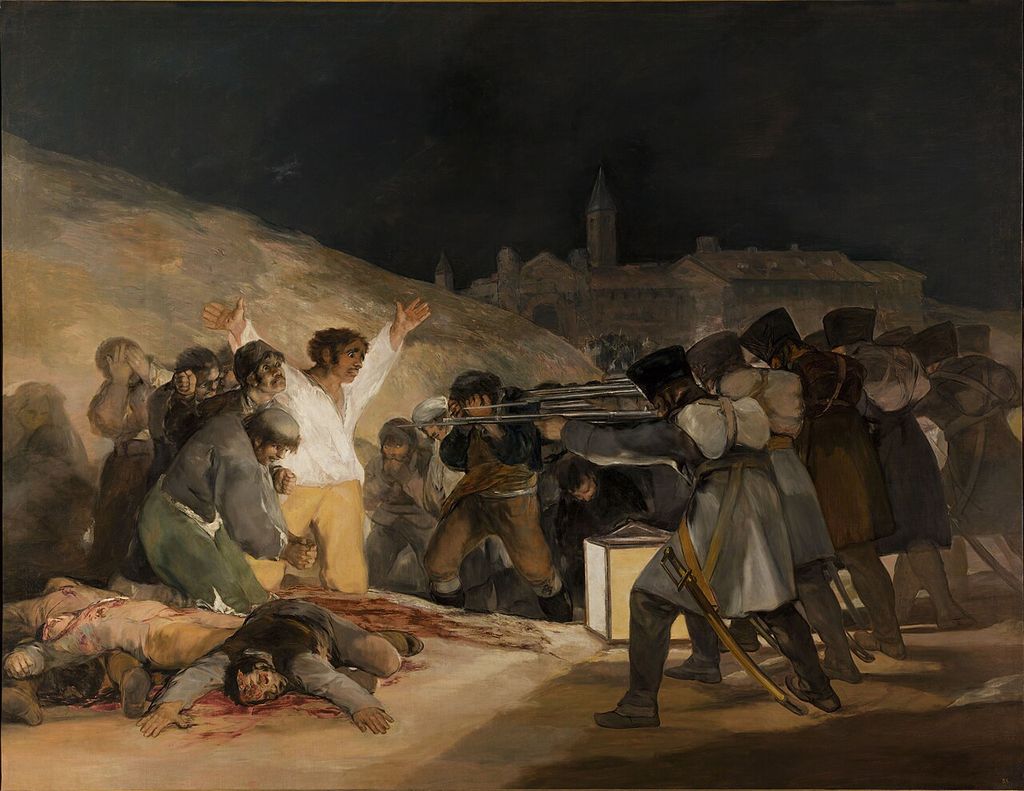
Picasso had a powerful model for representing an execution without turning it into a heroic battle scene. Francisco de Goya's The Third of May 1808, painted in 1814, places a firing squad opposite people about to be shot. At the Prado in Madrid, the soldiers form a tightly aligned, largely faceless mass, while the threatened people show fear, resistance and shock. Goya's painting addresses repression after the French occupation of Madrid, not the Korean War. The structural comparison lies in its terrible imbalance: armed order facing exposed human life. [2][8]
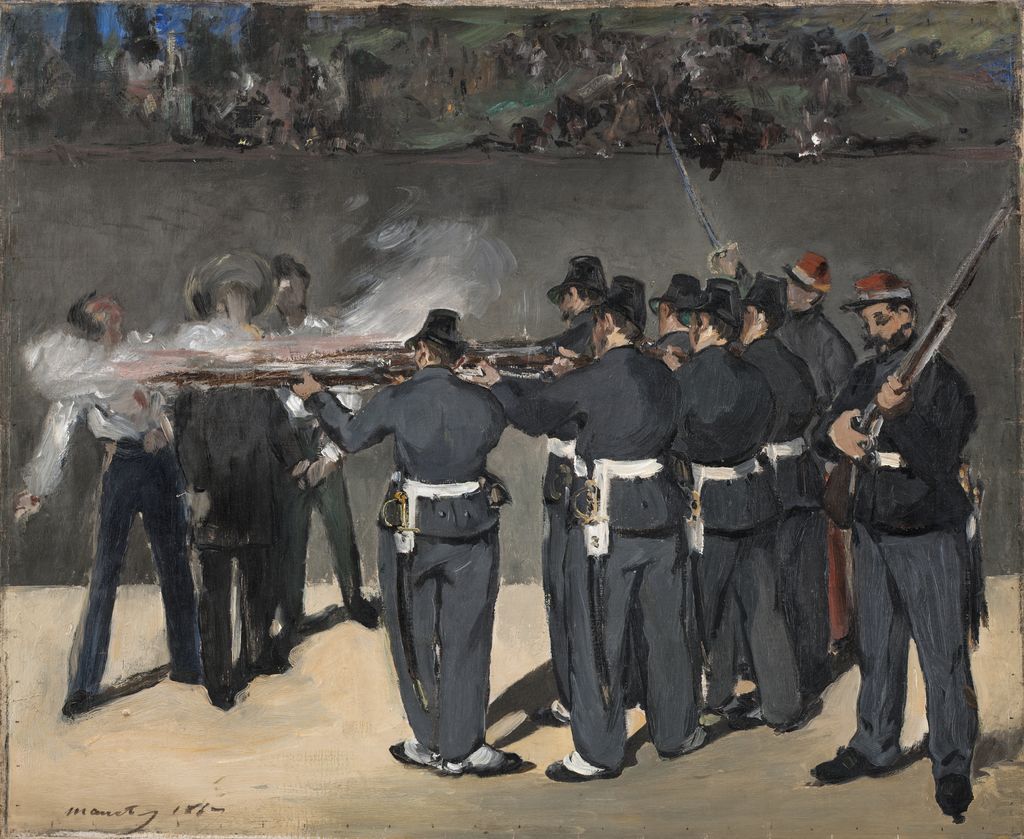
Édouard Manet's The Execution of Emperor Maximilian offered another nineteenth-century example of painting a political killing from recent history. Manet worked on several versions after Maximilian and two generals were executed in Mexico in 1867. His final version, dated 1868–69, belongs to the Kunsthalle Mannheim. Picasso's museum names both Goya and Manet as important precedents for Massacre in Korea. The paintings do not share the same victims, circumstances or political positions. They belong together because each makes a contemporary execution into a large public image rather than illustrating a distant classical or biblical story. [2][9][10]
Picasso changes the inherited formula. Goya gives the central victim a stark white shirt and a dramatic gesture. Manet's figures refer to named political actors in a known incident. Picasso presents neither a singled-out hero nor an identifiable commander. His civilians are women and children held together as a group; his armed men verge on caricatures of technology and force. The opposition is easy to grasp, yet the absence of a precise uniform or landmark stops the scene from serving as a literal battlefield report. That combination of immediacy and ambiguity is central to its political effect. [2][3][8]
What was Picasso's political position in 1951?
Picasso had joined the French Communist Party in 1944. By 1951 he was also internationally associated with peace campaigns, including his dove imagery. Those commitments are part of the painting's setting. The Korean War began in June 1950 when North Korea invaded South Korea; outside powers then entered a widening conflict. In France, interpretations of the war were sharply polarised by Cold War politics. A painting showing soldiers threatening women and children, titled Massacre in Korea, could hardly be seen apart from those arguments. [2][11][13]
But a party membership card does not tell us every visual decision Picasso made. The Musée Picasso notes that the picture's hybrid, distorted soldiers do not conform neatly to socialist-realist expectations, even while the painting is politically committed. The artist's later explanation, preserved in a museum brochure, rejected the idea that he had designed the executioners as a literal American—or any other national—uniform. We should not force the work into either an apolitical “war is bad” slogan or a transparent party poster with a fully specified enemy. It directs anger at organised killing while leaving the identities of the painted soldiers open. [2][3]
Korean art historian Jeong Yeong-mok has described the soldiers as depersonalised agents of violence and has studied the painting's divided Cold War reception. His published abstract notes criticism from both communist circles and American commentators. That opposition makes sense of a visual paradox: the picture seems unmistakably accusatory, but those who wanted a clear image of a named perpetrator could find its anonymity unsatisfactory. Viewers hostile to Picasso's politics could, meanwhile, read the same picture as an accusation against the United States. These are documented receptions, not proof that either interpretation exhausts the painting. [6]
How was it exhibited and received?
Picasso completed the work in January 1951. The Musée Picasso's exhibition record places it in the seventh Salon de Mai in Paris from 8 to 31 May 1951. Its public debut therefore came while the Korean War was still underway. The painting could enter immediate political argument, unlike a retrospective image made decades after the fighting. That contemporary setting is part of why its exact target has been debated so intensely. [1]
The work remained connected to Picasso's own collection for many years. It entered the French national collection through the 1979 dation, the settlement of estate tax with artworks. Today it belongs to the Musée national Picasso-Paris, though a permanent on-view location should not be assumed from ownership alone. Its museum record documents many later exhibitions, including one in Seoul in 2021, the first presentation of the original painting in South Korea. [1][12]
That Korean showing mattered because the title names Korea yet Korean audiences had long encountered the picture mainly through reproduction, discussion and political controversy. The Seoul exhibition's curator described it as an antiwar work; contemporary Korean reporting also recorded strong disagreement about its politics. Some retellings claim a seventy-year legal ban on display in South Korea. The sources reviewed here establish a first Korean exhibition in 2021 and a history of sensitivity, but they do not establish a specific law or decree that banned the painting for all those years. “First exhibited in Korea in 2021” is a stronger, verifiable statement than an unsupported story of an official blanket ban. [1][12]
How does it relate to Guernica and Picasso's later peace work?
Picasso had made Guernica in 1937, amid the Spanish Civil War. Both paintings condemn violence against people who cannot defend themselves, and both use disrupted bodies rather than an academic battle narrative. But their forms are different. Guernica pulls figures and animals into a crowded, fractured interior. Massacre in Korea stages a stark encounter between two facing groups. One is a scene of devastation already underway; the other suspends us before a threatened execution. Calling the Korean picture a “second Guernica” risks hiding those differences and the separate politics of the Korean War. [2][3]
The Musée Picasso also places Massacre beside The Charnel House, made after the Second World War, and the War and Peace murals Picasso painted in Vallauris in 1952. Together these works show his continuing desire to make public images about war and the fate of civilians. That continuity is not a claim that they all have the same subject or the same degree of historical specificity. The 1951 painting is distinctive for making a named contemporary war the setting of an old execution-picture structure, while leaving its actual soldiers without a national face. [2][3]
Why does Massacre in Korea still matter?
Its composition can be read in seconds: people without weapons face a line of men who have them. Yet the longer one looks, the more the picture resists easy closure. The women and children are individual enough to provoke concern but not documented portraits. The armed men are recognisably threatening but not securely assignable to a unit. The landscape is sparse, while the title is precise. Picasso uses those choices to make organised violence visible, but they also make the work a contested historical object rather than a simple illustration. [2][3]
The most responsible reading does not erase either side of that tension. The Korean War was real, and the painting was made in response to it while people were being killed. Its Goya-like firing squad, robot-like weapons and vulnerable civilians place the threat of massacre before us. At the same time, neither the visible scene nor the best documented sources make it a verified picture of No Gun Ri, Sinchon or any other exact episode. Its enduring value lies partly in demanding that we distinguish a powerful moral image from a documentary claim—and then ask why both have been so urgently wanted of it. [1][3][5][6]
Discussion
Use the evidence and your own close looking to explain your view. These are editorial prompts, not reader comments.
Reader Insights
How does the gap between civilians and soldiers create the scene’s threat?
What does the January 1951 date establish about its political setting?
Where would an exact identification of victims exceed the record?
Join the Conversation
Which reading best fits the evidence?
References
Musée national Picasso-Paris, collection record for Massacre en Corée, MP203.
Musée national Picasso-Paris, French collection essay on Massacre en Corée.
Musée national Picasso-Paris, bilingual foundation brochure, pp. 24–25.
Musée national Picasso-Paris, French account of the Mediterranean years.
The Review of Korean Studies, study of European social knowledge of the Korean War and later No Gun Ri attribution.
Jeong Yeong-mok (정영목), “Picasso and the Korean War” (피카소와 한국전쟁), Journal of the Association of Western Art History 8 (1996); abstract consulted.
Cambridge University Press, After the Korean War, chapter “Massacres in Korea”.
Museo Nacional del Prado, El 3 de mayo en Madrid, 1814 and account of the firing squad.
Kunsthalle Mannheim, Manet's The Execution of Emperor Maximilian.
National Gallery, London, account of Manet's The Execution of Maximilian and its versions.
Musée national Picasso-Paris, Picasso chronology.
Musée Picasso exhibition record and 2021 reporting with Seoul exhibition organisers and curator.
United Nations Security Council, historical account of the Korean War and the 25 June 1950 invasion.
Image Credits
- El_Tres_de_Mayo,_by_Francisco_de_Goya,_from_Prado_in_Google_Earth.jpg : Francisco de Goya derivative work: Papa Lima Whiskey 2. Public domain. Source: Wikimedia Commons. Resized to 1024px; no crop. Source record. Licence.
- Édouard Manet, The Execution of Emperor Maximilian, 1867, KMS3270. Statens Museum for Kunst, Copenhagen, SMK Open; public domain / CC0 reproduction. Proportional resize only. Source record. Licence.
- US Army. Public domain. Source: Wikimedia Commons (File:Refugees crossing Taedong river 1950-12-03.jpg). 1024px proportional sRGB JPG derivative; no crop. Source record. Licence.

