


 by Tom Gurney
Tom Gurney BSc (Hons) is an art history expert with over 20 years experience
Email: tomgurney1@gmail.com / Phone: +44 7429 011000
Introduction
Pablo Picasso's The Charnel House (Le Charnier) shows a man, a woman and a child tangled beneath a table. Above them are the outlines of a pitcher and a cooking vessel: signs of an ordinary meal suspended over a scene of violence. Picasso worked on this large canvas in Paris across 1944–45. The Museum of Modern Art in New York, which owns it, catalogues the work as oil and charcoal on canvas, 199.8 × 250.1 centimetres. Black, white and grey dominate, with unpainted ground and visible charcoal still part of the image. Its subject is unmistakably wartime death; the precise path from the news and images Picasso saw to the painting he made is more complicated than a single-source story. [1][2]
The title suggests a place where human remains accumulate, yet the picture is not a view of an identifiable mortuary. It brings atrocity into a domestic space. A table normally holds food, but here the bodies below it are the terrible centre of attention. The painting's startling force comes partly from that collision between the commonplace and the almost unbearable. It also comes from its unsettled surface: Picasso let parts of the scene remain drawn or apparently open while working intensely over others. [1][2]
At a Glance
- Made: Paris, 1944–45
- Medium: Oil and charcoal on canvas
- Dimensions: 199.8 × 250.1 cm
- Collection: The Museum of Modern Art, New York, 93.1971
The Charnel House in Picasso's career
First Communion
1896Three Musicians
1921Guernica
1937The Charnel House
1944–45Las Meninas series
1957The highlighted work is dated with the qualifications explained in the sources on this page. The other works are selective points of comparison, not the start or end of a style.
Contents
- What is shown beneath the table?
- When and how did Picasso make it?
- Was it inspired by the Nazi camps or the Spanish Civil War?
- How does it relate to Guernica?
- Why are the charcoal and blank spaces important?
- Where was it first shown and how did it reach MoMA?
What is shown beneath the table?
The people do not lie in a calm, orderly group. Their bodies cross, turn and partly merge, so the eye has to disentangle a man, a woman and a child. The man stretches across the scene with his wrists bound behind him and one arm thrust upwards. The woman turns in the opposite direction. A child lies between or across them, close to the woman's wounded body. At the top left, a lightly drawn pitcher and casserole occupy the table. Museum descriptions call the three figures a murdered family. The precise relationship between the individuals is read from their grouping rather than supplied by names or an inscription. [1][2]
Picasso does not show the people who killed them, a specific weapon or an identified street. Their vulnerability is the visible event. The bound wrists are a concrete sign of coercion, but the picture does not provide a caption explaining who tied them or why. William Rubin, the MoMA curator who studied the painting's successive states in detail, draws out other possibilities in the gestures and wounds. His close reading is valuable, but these smaller identifications should be understood as interpretation of a difficult image, not forensic evidence for one documented massacre. [2]
The table changes how we understand the scene. A pitcher and casserole belong to the rhythms of shelter and eating; beneath them are bodies reduced to a heap. The simple vessels do not make the event easier to explain. Their pale, unfinished appearance can make them seem almost like a memory of ordinary life. Picasso had painted a separate still life with comparable vessels in February 1945, and Centre Pompidou research notes that the pitcher and casserole entered The Charnel House in a later stage, around May. They are part of the final composition even though they remain largely drawn rather than filled with the still life's strong colour. [2][3]
When and how did Picasso make it?
MoMA dates the work 1944–45, and Rubin's study of progressive photographs gives that span substance. He places the start in the last months of 1944. Christian Zervos photographed an already worked-over charcoal composition in February 1945. Further photographs in April and May record changes to the people and the space around them. The table and its vessels appear in the May view. This is stronger evidence for the sequence than a later shorthand date of “summer 1945”: the canvas demonstrably existed earlier. [1][2]
The revisions were not minor finishing touches. Rubin describes changes to the man's head, the child's contours and the position of the woman's foot. A bird-like form that appeared in an early upper passage was enlarged and then removed. The post supporting the man's tied wrists also disappeared. The painter was testing what to show and what to take away while keeping the scene's stark human core. The successive photographs are especially useful because they document visible decisions without requiring us to invent a private motive for each one. [2]
The changing bird is a good example of what the photographs can and cannot prove. We can see that Picasso tried a form resembling a cockerel and removed it. Rubin suggests that such a bird might have conveyed resurrection or defiance, but neither the painting nor the photographs give us a statement from Picasso confirming that symbolism. Its removal matters because it altered the balance between possible signs of survival and the final scene's weight of loss. The documented act of revision is firmer than any one explanation for it. [2]
At first Picasso worked in charcoal. Rubin argues that he probably began strengthening lines and filling areas with black and grey paint around July 1945; some pale blue-grey passages were added later, at an uncertain date. MoMA's present medium entry appropriately names both oil and charcoal. A later photograph or catalogue entry cannot be assumed to record the first moment of painting, and the exact final day of work is not established by the evidence reviewed. [1][2]
The work is often called unfinished. That description is understandable: charcoal marks, changes of mind and portions of unpainted or lightly worked canvas remain visible. But “unfinished” should not imply that Picasso accidentally left it behind or that we know he intended to fill every blank area. Rubin argues that Picasso retained the canvas, eventually signed and released it, while leaving those differences of finish in place. We can describe its visible state securely; any claim that he stopped because painting could not express the Holocaust, or because he wished to symbolise a bound artist, is a further interpretation, not a documented explanation from Picasso. [1][2]
Watch: Pablo Picasso
Explore Picasso through five videos from museums, broadcasters and art educators.
Picasso’s Guernica: Great Art Explained
Explore the composition and historical setting of Picasso’s best-known response to war.
Watch on YouTubeWas it inspired by the Nazi camps or the Spanish Civil War?
There is no responsible reason to choose one simple origin and erase the other testimony. MoMA's current gallery account relates The Charnel House to newspaper photographs of corpses in liberated Nazi concentration camps. Museo Reina Sofía's Repensar Guernica project says Picasso later described it as a response to the first publicised images of piled bodies. Those accounts matter for the painting's historical meaning and reception. They do not, by themselves, establish that every element was conceived only after all such photographs appeared. [1][4]
The problem is chronological. Zervos's February 1945 photograph shows that Picasso was already working on the composition before the widely circulated images of camps liberated in the spring. Photographs and reports emerging later could have deepened or changed a work in progress, and Picasso continued to revise the canvas. What they cannot explain without qualification is its entire beginning. Even MoMA's earlier publications used different shorthand dates, which is why the dated progress images carry particular weight. [2]
An especially revealing example is a 1955 MoMA announcement, which described the canvas as begun in summer 1945 in reaction to camp photographs. That was a museum account written while the work was on loan, not a dated studio notebook. Rubin's later catalogue brought the February, April and May photographs into a sustained examination and placed the start earlier. A later source does not win merely by being newer; here it supplies material evidence that the older, simpler origin sentence could not accommodate. We can retain the importance of camp imagery while correcting the claim that Picasso began this already-photographed canvas only after its spring circulation. [2][9]
A different account comes from Dora Maar, the photographer and artist who knew Picasso intimately during these years. As reported by the writer James Lord and discussed in the Musée national Picasso-Paris's research for its Guernica exhibition, Maar remembered going with Picasso to a film concerning Spain, perhaps in January 1945. She recalled a scene of a murdered family in a kitchen before a table and believed it prompted the painting. Her recollection connects the picture to Picasso's enduring response to the Spanish Civil War. It is testimony reported later, not a surviving production record identifying the film beyond doubt. The month she suggested is also not enough to settle whether the canvas had already begun. [5]
The two accounts need not describe mutually exclusive experiences. Picasso could have begun the canvas, responded to a film or other images as it took shape, and then faced further evidence of Nazi mass murder while continuing to revise it. Equally, a later claim about camp photographs may describe the meaning the work acquired for him or its audience rather than the first spark of its layout. The secure conclusion is narrower and more useful: The Charnel House was developed across the end of the war; its photographed stages and layered recollections rule out a confidently proven single source. The Spanish Civil War and the Nazi camps are different histories, and the painting should not be made into a documentary picture of one named event without evidence. [1][2][4][5]
How does it relate to Guernica?
Picasso's Guernica responded in 1937 to the bombing of the Basque town during the Spanish Civil War. The Charnel House came around eight years later, in the aftermath of Paris's German occupation and as the Second World War drew to a close. Both are monumental grey, black and white images of civilian suffering; neither makes violence into a triumphal battle scene. Their compressed, distorted bodies ask viewers to confront harm rather than admire its perpetrators. This kinship is strong enough that museums frequently discuss the paintings together. [1][2][6]
Yet the works are not interchangeable. Guernica spreads its figures, animal and architecture across an immense public mural. The Charnel House pulls three people into a smaller, domestic field beneath a table. MoMA's 1972 analysis traces formal echoes of the dead soldier and anguished horse in Guernica in the later painting's raised bound arm and contorted body. Those are art-historical comparisons, not proof that the figures carry exactly the same allegorical identities. The later picture is more restrained in cast and, in some places, more visibly open in its making. [2]
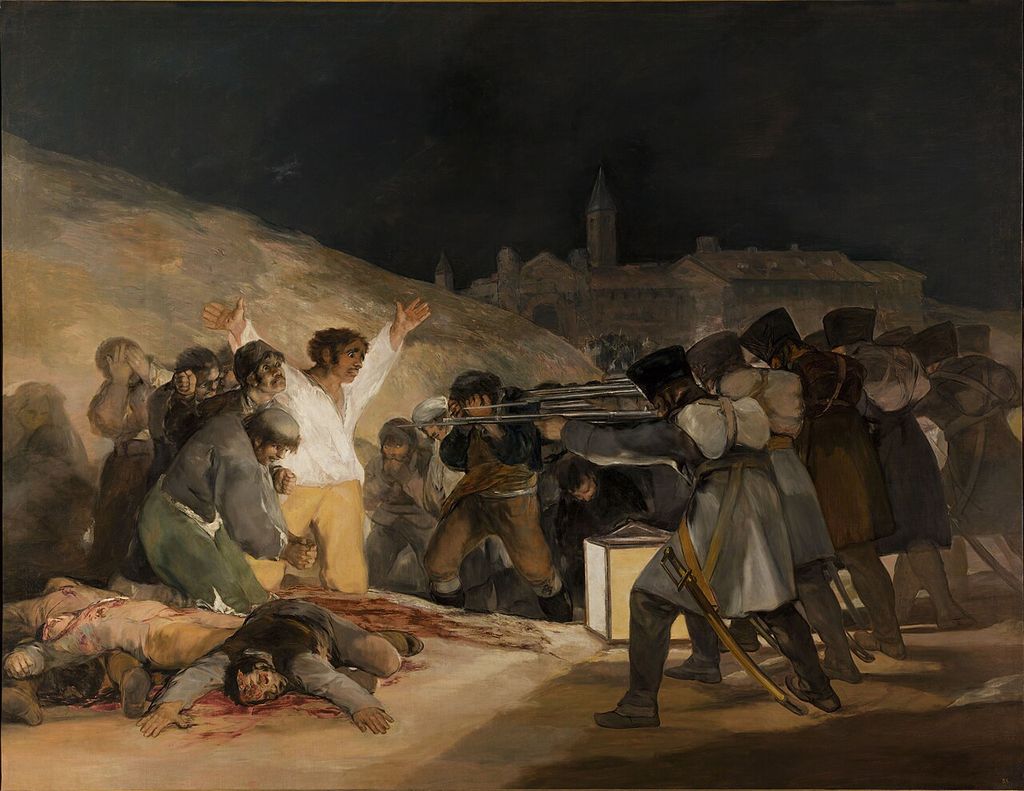
Rubin also points to Francisco Goya's Disasters of War as a possible visual kinship: dead bodies and remnants of ordinary surroundings appear together in that earlier series. The comparison puts Picasso in a longer tradition of artists confronting violence without turning it into heroic spectacle. It is not evidence that Picasso copied one specific Goya print while making this canvas. As with Guernica, the relation is strongest when it sharpens what we can see—the bodies pressed into a room and the refusal of triumph—without replacing the work's own documented history. [2]
The two paintings also occupy different political and visual moments. In 1944 Picasso joined the French Communist Party, and the Paris museum's chronology places Le Charnier in the following year. The German Kunstsammlung Nordrhein-Westfalen's account of Picasso's wartime work shows how still lifes, portraits and bodies could respond indirectly to occupation and fear, even when they did not depict a named news event. Party affiliation forms part of the context, but it is not a substitute for looking closely at the canvas or for tracing its actual stages. [6][7]
French museum scholarship also groups The Charnel House with Guernica and the later Massacre in Korea as Picasso's paintings of contemporary history. That grouping helps explain why a picture of anonymous people can be a history painting: it confronts violence of its own time rather than illustrating a remote myth or military victory. It should not flatten the different wars, sources and compositional choices behind the three works. [6]
Why are the charcoal and blank spaces important?
The painting's visible process is not merely a curiosity for conservators. Black lines sometimes hold a form in place, then slip into another contour. Grey planes make bodies seem at once heavy and spectral. White ground interrupts the darker cluster, especially around the upper table. The viewer alternates between reading a human scene and noticing the painterly work needed to make that scene. MoMA's current label describes this as a shifting, difficult vision and asks whether painting can represent the violence of war. The question is a curatorial reading of what the work does, not a quotation of a stated Picasso programme. [1][2]
The contrast between the drawn table and the worked bodies can be read as a contrast between normal life and its destruction. It can also make the vessels feel suspended, fragile or hard to grasp. None of these responses requires us to declare that Picasso left the upper area open to encode a single secret message. The photograph series shows that the table was an intentional later addition, and the final canvas preserves its spare treatment. That evidence is enough to make the difference in finish meaningful without pretending to know every reason behind it. [2][3]
Rubin also relates the painting's forms to other works Picasso made during the occupation, including images of bound animals and still lifes with ordinary vessels. This wider practice helps explain why a casserole or a raised arm could carry emotional force within Picasso's visual language. But a symbolic resemblance is not a record of a specific dead person, and the man, woman and child should not be identified as Picasso's own family. Their anonymity is part of the picture's reach and part of the limit of what the sources can tell us. [2]
Where was it first shown and how did it reach MoMA?
The Charnel House appeared in the 1946 Art et Résistance exhibition at the Musée national d'Art moderne in Paris. That public setting placed the work amid responses to occupation, resistance and the recent war. It did not make the canvas an illustration of one official political line: its disturbing bodies and unresolved surface continued to invite different readings. Later exhibitions brought it into dialogue with Picasso's other works and with a broader history of modern art. [2][8]
By 1953, a Milan Picasso retrospective presented Le Charnier alongside Guernica, Massacre in Korea and the War and Peace panels, according to Musée national Picasso-Paris research. In 1955, MoMA's exhibition of paintings from private collections showed the work in the United States while it still belonged to Chrysler. Those presentations helped shape the familiar sequence of Picasso's antiwar pictures, even though the paintings arose from different conflicts and were made for different circumstances. Exhibitions are part of a work's history of interpretation, not evidence that Picasso planned an original trilogy. [1][5][9]
Picasso kept the painting until 1954, when Walter P. Chrysler Jr. bought it from him, according to MoMA's current provenance record. In 1971, MoMA acquired it from Chrysler through an exchange and purchase. Those are the recorded ownership steps; the painting had already been shown before joining the museum permanently. MoMA's object number is 93.1971. Display arrangements change, so its collection page should be checked before visiting in person. [1]
Seen now, the work resists an easy finish to the story of war. The Nazi camps' images, Maar's memory of a Spanish film and the painting's own photographed changes point to a dense historical moment rather than one tidy source. The man, woman and child are vulnerable under objects made for daily life. Some passages are sharply defined; others remain little more than marks or pale space. The canvas does not identify the victims for us, but it refuses to let them become a simple emblem or statistic. Picasso made a history painting in which the difficulty of seeing and representing violence stays visible. For a wider view of his responses to conflict, continue with Picasso's art of war and peace. [1][2][5]
Discussion
Use the evidence and your own close looking to explain your view. These are editorial prompts, not reader comments.
Reader Insights
What do the vessels above the family add to the scene below?
How do charcoal, exposed ground and unfinished areas affect its force?
Which wartime connection is documented, and which remains an interpretation?
Join the Conversation
Which reading best fits the evidence?
References
The Museum of Modern Art, The Charnel House, object 93.1971, current object, 2019 gallery label, provenance and rights information.
William Rubin, Picasso in the Collection of The Museum of Modern Art, MoMA, 1972, pp. 166–69 and progressive photographs pp. 240–41.
Centre Pompidou, La Casserole émaillée object study, describing the still-life objects' appearance in Le Charnier in May 1945.
Museo Reina Sofía, El osario (The Charnel House), Repensar Guernica project.
Musée national Picasso-Paris, Guernica exhibition research and press kit, 2018, pp. 19–20, discussing Dora Maar's account as reported by James Lord.
Musée national Picasso-Paris, Massacre en Corée study and Picasso chronology.
Kunstsammlung Nordrhein-Westfalen, Pablo Picasso: Kriegsjahre 1939 bis 1945.
Musée national Picasso-Paris, chronology of the 1946 Art et Résistance exhibition; Rubin, source [2].
MoMA, 1955 press notice for Paintings from Private Collections and 1955 exhibition catalogue, to be read against the dated progress photographs in Rubin, source [2].
Image Credits
- El_Tres_de_Mayo,_by_Francisco_de_Goya,_from_Prado_in_Google_Earth.jpg : Francisco de Goya derivative work: Papa Lima Whiskey 2. Public domain. Source: Wikimedia Commons. Resized to 1024px; no crop. Source record. Licence.
