


 by Tom Gurney
Tom Gurney BSc (Hons) is an art history expert with over 20 years experience
Email: tomgurney1@gmail.com / Phone: +44 7429 011000
Introduction
Six figures have come together, yet almost nobody seems to look at anyone else. A harlequin holds a girl's hand. A red-clad jester faces them, two young acrobats stand nearby, and a woman sits apart on the right. There is no circus ring, audience or visible act. Pablo Picasso's Family of Saltimbanques turns people associated with movement and spectacle into a remarkably still group. Their costumes tell us who they might be; the space between them makes their relationships difficult to know. [1]
Picasso painted the large oil on canvas in 1905. It is now in the National Gallery of Art, Washington, in the Chester Dale Collection, and measures 212.8 × 229.6 centimetres. It belongs to the years often called his Rose Period, when circus people and travelling entertainers repeatedly entered his paintings, drawings and prints. But this canvas is not simply a picture of a circus. It is a painting about what remains when a performance is suspended: bodies, gestures, clothing and a shared yet uncertain place in the world. [1][2]
At a Glance
- Made: 1905
- Figures: Six itinerant performers in a largely bare landscape
- Visual question: Why does a group of entertainers seem so still and separate?
Family of Saltimbanques in Picasso's career
The highlighted work is dated with the qualifications explained in the sources on this page. The other works are selective points of comparison, not the start or end of a style.
Contents
- What do we see in Family of Saltimbanques?
- What is a saltimbanque, and why did Picasso paint them?
- Is the harlequin Picasso? Who are the others?
- What did Picasso paint beneath the visible scene?
- Why is the landscape so empty?
- How did the painting travel from Paris to Washington?
- Where is Family of Saltimbanques now, and why does it matter?
What do we see in Family of Saltimbanques?
Most of the group stands on the left half of the picture. The tallest figure, seen mainly from behind, wears a diamond-patterned harlequin costume. He holds the hand of a small girl in a pink skirt, whose other hand rests on a basket. Near them is the bulky jester in red, his pointed hat rising above his rounded shoulders. To his right, a slimmer young man shoulders a barrel, a piece of equipment that hints at acrobatic practice. A smaller boy in blue and red stands between this cluster and the seated woman. She is not dressed in an obvious performer's costume; her red skirt and pale shawl set her off from the standing figures. [1]
Picasso gives the figures almost no setting. The low, rolling ground is barren and difficult to locate. A pale sky passes behind the group, but there is no tent, street, building or town to name. The vastness of the landscape might suggest that the performers are travelling; it does not establish that they have stopped at a particular place in Spain or outside Paris. Indeed, the lack of a recognisable location is part of the experience of looking. The figures are near one another but do not seem securely settled on the earth. [1][2]
The title promises a “family,” yet the painting gives us no reliable family tree. The harlequin and girl touch, while the woman sits well away from them. The boy appears turned towards her, although his gaze is difficult to fix. The jester's hands rise, but we cannot hear what he might be saying. The National Gallery notes the heavily shadowed eyes and the weak, partial linkages among the people. The painting's emotional force comes partly from those incomplete connections: it asks us to notice how little contact there is within a group we instinctively want to make into a story. [1][2]
What is a saltimbanque, and why did Picasso paint them?
A saltimbanque is an itinerant acrobat or street performer. The word comes through French from an Italian expression about leaping onto a bench or platform. In Picasso's Paris, such entertainers overlapped in imagery with circus performers and characters inherited from the Italian commedia dell'arte, including Harlequin. That history explains why the picture contains different costumes rather than the uniform dress of a literal household. The word points to a kind of working life, not to one troupe whose members can all be named. [1][3]
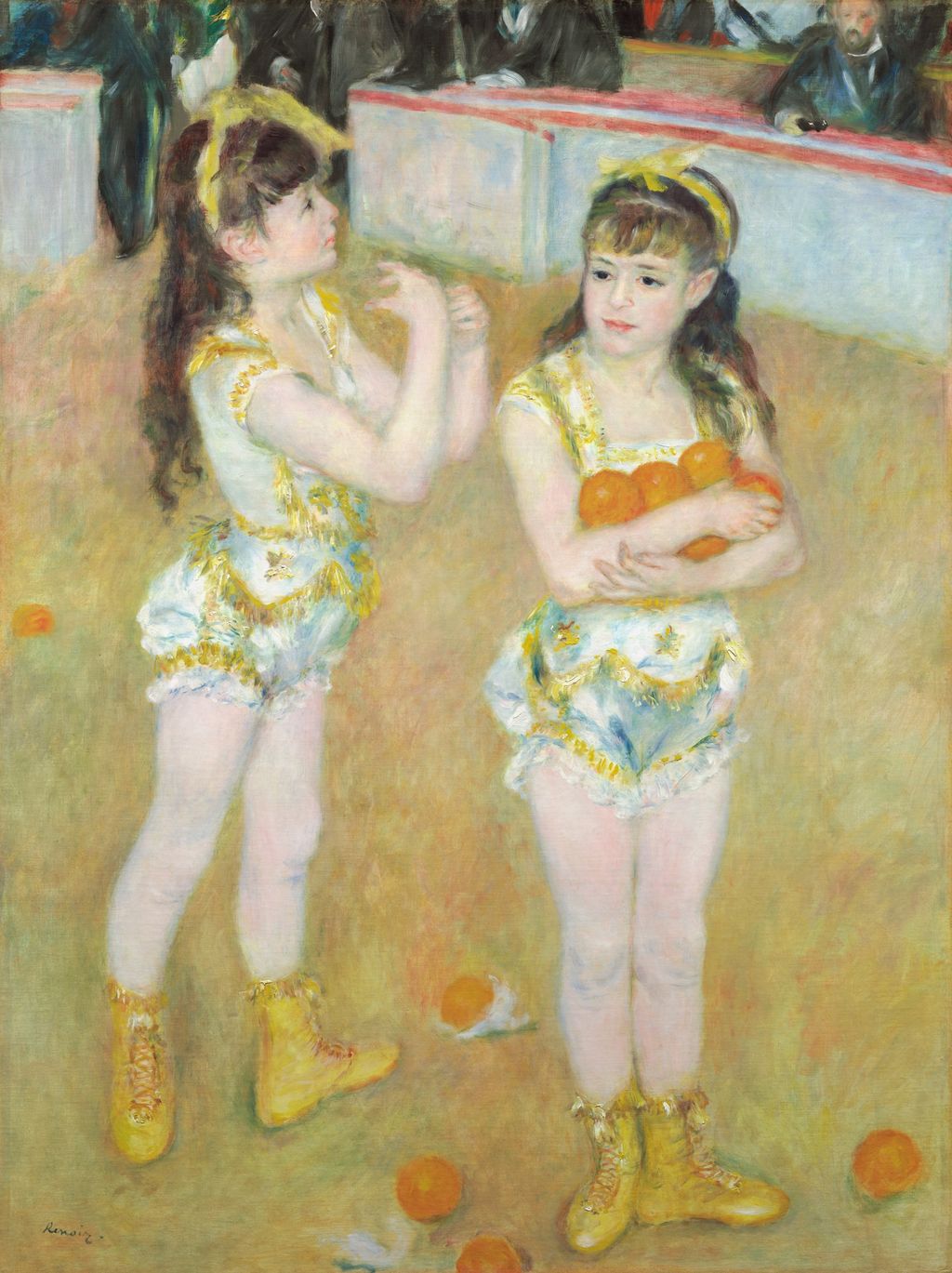
Picasso had moved to Paris permanently in 1904. The Cirque Médrano in Montmartre gave him a nearby world of acrobats, jugglers and clowns to observe, and he returned to these performers across paintings, drawings and prints in 1904–06. The figures could appeal as subjects of skill and spectacle, but also as people who worked precariously and often lived outside settled bourgeois society. The National Gallery reads the group's isolation as a possible reflection of the young immigrant artist's own uncertain place in Paris. That is a thoughtful interpretation, not a diary entry proving that Picasso assigned every painted person a private autobiographical role. [1][2][4]
“Rose Period” can be a useful label here, provided it remains a label rather than a colour test. The painting has pale pinks and warm earth tones, but also blue, grey and a dull, atmospheric sky. Its figures are less theatrically animated than some of Picasso's nearby circus works. The performers do not juggle, leap or entertain us; their clothing has become a clue to identity while their gestures remain restrained. The result is more searching than a cheerful illustration of circus life. [1][2]
Watch: Pablo Picasso
Explore Picasso through five videos from museums, broadcasters and art educators.
Picasso’s Guernica: Great Art Explained
Explore the composition and historical setting of Picasso’s best-known response to war.
Watch on YouTubeIs the harlequin Picasso? Who are the others?
The harlequin on the left is widely read as a Picasso-like self-portrait. His profile resembles the artist's, and Picasso had represented himself as Harlequin in other work of the period. The National Gallery makes that identification in its account, while also treating the picture as a composition of performers, not a photograph of Picasso and his companions standing outdoors. It is sensible to say that the painter put something of himself into the harlequin; it is too strong to say that every person therefore has a certain one-to-one real-life name. [1][2][3]
The red jester has been identified in recent scholarship as El Tío Pepe, a performer associated with the Cirque Médrano. Earlier writers also proposed resemblances to Picasso's poet friends. Those readings arise from faces, costumes and biographical parallels; they are not the same kind of evidence as a sitter's signed name or a documented posing session. The painting lets us consider the people Picasso knew and watched without turning a variable, repainted group into a fixed portrait roster. [2][3]
The seated woman's identity is unknown. An older interpretation described her as Fernande Olivier, Picasso's partner, and used that assumption to build a detailed personal story about the group. The National Gallery's more recent account explicitly says the Olivier identification has been disproved. She remains important in the painting even without a name: she occupies an open space on the right, dressed differently from most of the standing figures, and directs her attention away from the group. Her separation is a visible fact; its cause is not. [2][3]
The girl's identity is also unproved. She has sometimes been tied to an account of a child briefly cared for by Picasso and Olivier. The old claim that she is Picasso's younger sister Conchita cannot be sustained as a sitter identification: Conchita died in 1895, a decade before the canvas was completed. Picasso could, in principle, have painted a remembered child, but no evidence establishes that this is what he did here. We gain more by looking at the child's place in the composition—her hand in the harlequin's, her basket, her back partly turned—than by treating a contested biography as the picture's solution. [3]
The young acrobats, too, have been matched with members of Picasso's circle in older scholarship. Their garments and poses, however, were revised during the painting's making. A figure that looked like a travelling gentleman in one study became the harlequin in the final canvas; the smaller acrobat's costume changed. Those alterations caution against reading the visible figures as if six models had stood still for one group portrait. Picasso assembled, substituted and adjusted them over time. [3]
What did Picasso paint beneath the visible scene?
The stillness of the final picture conceals an unusually active history. In a major National Gallery conservation study, researchers used x-radiography, infrared examination, microscopy and samples from paint layers to investigate the canvas. They found evidence for an earlier circus composition: performers at work or rest, a child balancing on a ball, and other figures and equipment. A separate Circus Family study at the Baltimore Museum of Art helps reconstruct this stage. The Baltimore work is an independent sheet, not an object physically hidden inside the Washington oil; its design corresponds to forms detected below the present image. [3][5]
This matters because the final painting does not merely leave out a few accessories. In its first proposed state, action and practical activity organised the group. The balancing child made the circus unmistakable. When Picasso painted over that scene, the large canvas did not become empty by chance. He removed much of what explained the performers' occupation in order to develop a quieter and less descriptive gathering. The National Gallery's recent interactive account lets viewers compare the visible image with the earlier ball-balancer revealed by technical study. [2][3]
The researchers proposed another, less securely established intermediate state built around two acrobats. Subsequent stages brought in the jester, the young men and the girl. In later revisions, the tall figure gained his patterned harlequin suit, the girl's dog in a study gave way to a basket, and the seated woman appeared at the right. Not every step can be ordered with certainty. The conservators themselves distinguish strong material evidence—such as x-rayed underfigures and paint-layer relationships—from reconstructions based on drawings, surface traces and art-historical reasoning. A possible dog under the final basket, for example, is more tentative than the documented ball-balancer. [3]
Another preparatory study showed a horse race behind the performers. The technical team could not find evidence of that racecourse beneath the final barren landscape. A study can record an idea Picasso considered without proving that he painted it on the large canvas. This difference between a drawing and the physical layers of the oil prevents a seductive but false story in which every proposed setting is said to lie under the present surface. What we can see is that Picasso experimented with a more active, locatable background and ultimately made the place far harder to identify. [3]
Even the size of the visible painted field has a later history. The National Gallery study found that, after the canvas left Picasso's hands, its edges were folded around a smaller stretcher. The present dimensions are slightly less than those recorded at the 1914 sale. The authors thought this probably happened around or after Chester Dale's 1931 acquisition, but did not have a conservation record that would prove the date. The picture was therefore altered physically after Picasso, as well as repeatedly revised by him; neither change should be confused with the other. [1][3]
Why is the landscape so empty?
The unmarked ground makes the group difficult to place socially and geographically. It might stand for the outskirts of a growing city, as the National Gallery suggests, or for a space of theatrical imagination rather than a real campsite. Picasso did not paint a road, a ticket booth or a recognisable skyline that would settle the question. The people seem to have stopped between places and between acts. Their costumes belong to performance, but their bodies are temporarily at rest. [1][2]
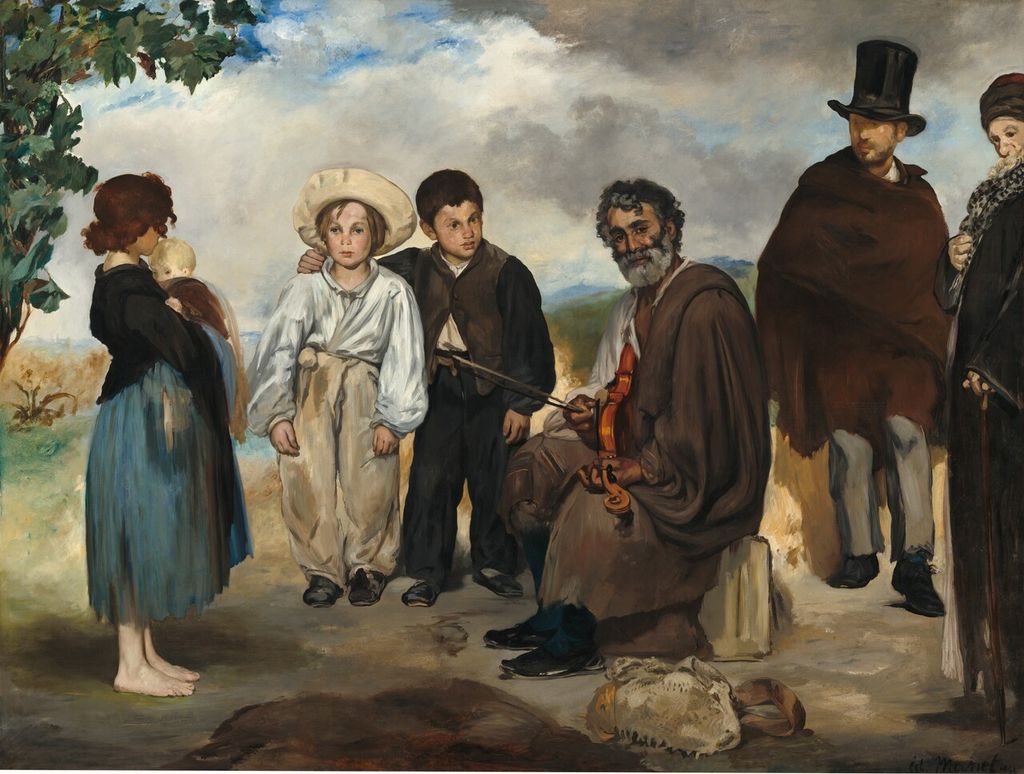
Earlier circus artists offered several ways of making performers visible outside the ring. The National Gallery's 1980 study traces the theme through Watteau's figures from the commedia dell'arte, Daumier's wandering entertainers and Édouard Manet's The Old Musician. Manet's 1862 painting, also in Washington, is a particularly suggestive comparison: a loose company of figures occupies an open landscape while their relationships remain uncertain. The public-domain Manet painting reproduced above lets readers test that visual relationship without using Picasso's protected canvas. The comparison is about a shared pictorial problem and a possible influence, not evidence that Picasso copied a particular Manet composition at a documented sitting. [3]
The historical comparison helps explain why the final Family of Saltimbanques can feel more monumental than anecdotal. Picasso does not give us an episode—“the troupe prepares for a show,” for example—that can be summarised in one sentence. He makes each figure distinct through costume and silhouette, then allows broad intervals of earth and sky to separate them. The barrel and basket retain traces of everyday use, but neither prop tells a complete story. Formal distance and human distance reinforce each other.
The emptiness does not mean the picture is devoid of relationships. The child's hand is still held. The barrel-carrier occupies a space between the standing group and the small boy. The boy's presence leads our eye toward the woman even if it does not connect them decisively. The same ground runs beneath them all. Looking at these small links without exaggerating them is the painting's challenge. To declare the company perfectly united would ignore its gaps; to call everyone wholly alone would ignore its gestures. [1][2]
How did the painting travel from Paris to Washington?
The painting's first documented owner after Picasso was André Level, who acquired it for the French collecting group La Peau de l'Ours in 1908, according to the National Gallery's current provenance record. A 1905 drawing now in the Musée national Picasso-Paris carries Picasso's later dedication to Level and calls the large canvas his painting of that year. The drawing is a separate work, but its inscription gives the painter's own link between this image, its date and an early collector. [1][6]
La Peau de l'Ours sold its collection at the Hôtel Drouot in Paris on 2 March 1914. The catalogue called Picasso's picture Les bateleurs, a related term for entertainers rather than the now-familiar English title. The dealer Heinrich Thannhauser bought it for 11,500 francs, a striking price that made the sale a much-discussed moment in Picasso's early market history. It then passed to Hertha Koenig in Munich, and by 1931 to the New York collector Chester Dale. Dale's bequest brought it to the National Gallery of Art in 1963. The detailed sequence matters more than an easy story of a painting moving directly from Picasso to an American museum. [1][3][7]
Koenig's ownership also gives the painting a literary afterlife. The German poet Rainer Maria Rilke encountered it in her apartment in 1915. His Fifth Duino Elegy, dedicated to Koenig, addresses travelling performers. The connection between poem, owner and painting is documented, but the poem is not a written key to the exact identities of the six painted people. It records how deeply the work entered another artist's imagination, and how its unsettled group could be rethought in a different medium. [1][3][8]
Where is Family of Saltimbanques now, and why does it matter?
The National Gallery of Art in Washington owns and displays the painting, though a current room listing should be checked before a visit. Its collection entry identifies the work as Picasso Estate/Artists Rights Society copyright and says the media is not available for download. The online record is an excellent place to study the picture and its provenance; it is not a general licence for publishers to reproduce its image. [1]
Family of Saltimbanques matters because its final quietness is an achievement, not a lack of action. Beneath it lies a performance scene. Around it are studies, changed costumes, revised faces and abandoned settings. In front of us, six figures occupy the same broad landscape without becoming a single legible household. The painting holds together work and pause, companionship and separation, theatrical identity and individual uncertainty. Picasso's later innovations do not need to be invoked to make it significant. In 1905 he had already found a way to turn an ensemble of entertainers into a sustained question about how people stand together—and apart. [1][2][3]
Discussion
Use the evidence and your own close looking to explain your view. These are editorial prompts, not reader comments.
Reader Insights
Who looks toward whom among the six performers?
How does the empty landscape change the sense of a circus family?
Which links to named friends are documented, and which are speculation?
Join the Conversation
Which reading best fits the evidence?
References
National Gallery of Art, Family of Saltimbanques, accession 1963.10.190, object and provenance record.
National Gallery of Art, “Isolation in Pablo Picasso's Family of Saltimbanques”, 17 March 2025.
E. A. Carmean Jr., Ann Hoenigswald and Barbara Miller, Picasso: The Saltimbanques, National Gallery of Art, 1980, especially pp. 17–59, 65–84. Technical findings and older iconographic proposals are distinguished in the text above.
Museo Picasso Málaga, Spanish chronology of the Harlequin figure.
Baltimore Museum of Art, “A Circus Family: Picasso to Léger” exhibition research, 2009.
Musée national Picasso-Paris, Étude pour les Bateleurs avec dédicace, MP2010-1; compare the distinct Famille de saltimbanques drawing, MP500.
Musée national Picasso-Paris, French collection-library account of André Level; Museo Picasso Málaga, Spanish 1914 chronology entry.
Rainer Maria Rilke, German text of the Fifth Duino Elegy; Koenig ownership and Rilke's 1915 letters documented in NGA provenance notes.
Image Credits
- Édouard Manet. Public domain. Source: National Gallery of Art (The Old Musician). 1024px proportional sRGB JPG derivative; no crop. Source record. Licence.
- Pierre-Auguste Renoir. CC0. Source: Art Institute of Chicago (Acrobats at the Cirque Fernando (Francisca and Angelina Wartenberg)). 1024px proportional sRGB JPG derivative; no crop. Source record. Licence.
