


 by Tom Gurney
Tom Gurney BSc (Hons) is an art history expert with over 20 years experience
Email: tomgurney1@gmail.com / Phone: +44 7429 011000
Introduction
A young person in a blue work garment sits before a warm, reddish wall, holding a small pipe without raising it to the mouth. Flowers crown the head, and two broad clusters of blooms flank the figure. The pipe suggests an ordinary moment in a Paris studio; the wreath and floral setting make that moment strangely ceremonial. In Garçon à la pipe, Picasso brings an everyday sitter into an image that resists being only a likeness or a story.
The painting, also called Boy with a Pipe, was made in Paris in 1905. It is an oil on canvas, 99.7 × 81.3 centimetres, signed “Picasso” at the lower left. These details come from the Sotheby's catalogue for the painting's 2004 sale[1], the most detailed public object record available for this privately owned work. Its French title means “Boy with a Pipe.” The exact identity of the boy remains less certain than the title, medium and date. A good account of the picture starts with what is visible and documented, then treats the stories attached to it with the care they deserve. [1]
At a Glance
- Also known as: Boy with a Pipe
- Made: Paris, 1905
- Scene: A seated youth with a pipe and a floral wreath
Garçon à la Pipe in Picasso's career
First Communion
1896Garçon à la Pipe
1905Three Musicians
1921Las Meninas series
1957The highlighted work is dated with the qualifications explained in the sources on this page. The other works are selective points of comparison, not the start or end of a style.
Contents
- Looking at the boy, pipe and flowers
- Who was the sitter?
- Studies and the story of the wreath
- A work of Picasso's Rose Period
- What happened to the painting?
Looking at the boy, pipe and flowers
The figure occupies most of the canvas. Blue clothing spreads across shoulders, sleeves and legs, forming a strong central shape against the brown-red background. The face is pale and still, with a gaze that seems to travel slightly away from the viewer. Picasso gives it enough individual character to suggest a person he saw, but little incident or expression to anchor a particular narrative. The boy is seated, yet the vertical lift of the head and wreath gives the portrait a sense of ceremony.
The pipe is easy to miss at first. It is small, held near the body, and no smoke is shown. It does not turn the sitter into an active scene of smoking. Instead it works as a token: the figure could raise it, but does not. The hand and pipe interrupt the large blue form and provide one small, sharp point of attention. Calling the object a symbol of adulthood is a possible interpretation, especially because the sitter appears young, but Picasso left no documented explanation that fixes its meaning. Its quietness is part of the image's puzzle.
Flowers change the tone. The bright wreath rests directly on the head, while larger, less orderly bouquets or floral patches appear behind either shoulder. They do not read like a vase arranged in a conventional interior. Their floating quality can make the boy seem framed by a decorative halo, a stage set or an imagined garden. None of those comparisons is a literal identification of the place. The contrast between the working clothes and the festive crown produces much of the painting's charge. The subject looks ordinary and exceptional at once.
The background is active without becoming a detailed room. Warm colour surrounds the blue figure, and the flowers build loose, bright areas out of it. This makes the boy's dark garment feel solid, even as the setting refuses to tell us where the chair stands or why he has been crowned. The composition relies less on a long list of objects than on a few strong relationships: blue against orange-brown, pale face against flowers, small pipe against broad body. Looking closely at these relationships is more rewarding than assigning the sitter a mood from his expression alone.
There is also a tension between the picture's symmetry and its irregularities. The wreath appears roughly central, and the two masses of flowers suggest a balanced frame. Yet the blooms on either side differ in shape and colour, the sitter's shoulders and arms do not mirror one another, and the pipe pulls the eye toward a single hand. Picasso gives the viewer enough order to read the figure immediately, then enough variation to keep looking. The flowers do not flatten the boy into an emblem; the small asymmetries allow him to remain a particular presence. Conversely, the framing prevents the blue-clothed youth from being only a quick studio sketch. Portrait and decoration are doing work together.
Who was the sitter?
The boy has often been called “p'tit Louis”, or “Little Louis,” a young visitor associated with Picasso's Bateau-Lavoir studio in Montmartre. The Sotheby's catalogue[1] presents this as a likely identification, not a securely established name. Its account reaches us through later recollections of Picasso and subsequent biographies. An actor has also been proposed. Neither possibility provides a reliable full name, age, occupation or account of how the youth came to sit. [1]
The uncertainty matters because the picture's title does not name him. It describes what he holds. We can say that Picasso drew on the people and places around him in Montmartre and that a young local model is plausible. We cannot responsibly turn a possible nickname into a detailed biography, claim the boy volunteered simply because he loved the studio, or say exactly how many times he posed. The painting's human presence is real, but the archive does not let us recover the sitter's life from its surface.
Picasso had settled in Paris in 1904, living and working at the Bateau-Lavoir. The Musée national Picasso-Paris's account of the Blue and Rose years[3] situates his growing attention to acrobats, performers and other figures at the edge of ordinary bourgeois portraiture. A Montmartre youth belongs to this close social world more plausibly than to an invented royal or mythic one. Yet the flower crown demonstrates how a model drawn from everyday life could be remade as a poetic image. Picasso did not have to choose between observing a person and transforming that person in paint. [3]
That social setting should be described with proportion. The Bateau-Lavoir gathered artists, writers and visitors, but its familiarity in Picasso biography does not identify every person who entered it. A boy's presence in this painting does not tell us whether he was paid, what work he did, or whether he understood himself as a professional model. These gaps are not reasons to avoid the portrait; they are reasons to distinguish between what an artist could make visible and what a modern researcher can document. The work preserves a face and a pose while leaving the sitter's own voice largely outside the record.
Watch: Pablo Picasso
Explore Picasso through five videos from museums, broadcasters and art educators.
Picasso’s Guernica: Great Art Explained
Explore the composition and historical setting of Picasso’s best-known response to war.
Watch on YouTubeStudies and the story of the wreath
The finished canvas did not appear without preparation. Sotheby's catalogue describes drawings of a youth with a pipe in several positions: standing, seated, leaning, lighting or merely holding it. One more developed seated study places the arms differently from the oil painting. The catalogue identifies a related multi-subject study in the Baltimore Museum of Art's Cone Collection. These drawings help establish that Picasso explored the pose and the pipe as parts of a working process. They do not prove that every mark in the final picture was planned from the beginning or that every drawing was made with the same named sitter present.
The most frequently repeated story about the flowers comes from André Salmon, writing in 1912, seven years after the canvas was painted. As quoted in the Sotheby's catalogue[1], Salmon said Picasso returned to a canvas left aside for about a month and added a rose crown, transforming a simple working boy into something more extraordinary. This is valuable early testimony from someone close to Picasso's circle. It is not a dated studio journal or a technical examination of paint layers, and the precise month-long pause has not been independently verified here. [1]
Even without accepting every detail of Salmon's anecdote, the relationship between figure and flowers is visible. The studies described by Sotheby's emphasise boy and pipe; the finished painting stages him between floral masses and beneath a wreath. The difference suggests that a relatively direct portrait idea became more allusive. Whether the wreath was physically painted in one later session, as Salmon remembered, is a separate question. An interpretation of the finished canvas can stand without pretending to know the complete order of its brushstrokes.
The crown itself does not yield a single code. A wreath can evoke festivity, honour, theatre, youth or memory; it can also simply create a compelling shape around a head. Sotheby's notes possible parallels with Odilon Redon's flower-framed portraits and reports a Verlaine poem proposed by the Picasso biographer John Richardson. These are art-historical suggestions, not documented sources Picasso named for this picture. The image's ambiguity should be preserved rather than solved by a borrowed poem or a symbolic dictionary.
A work of Picasso's Rose Period
Garçon à la pipe belongs to the work usually called Picasso's Rose Period, when the blues and greys of earlier pictures were joined by warmer pinks, oranges and earth colours, and performers and young people appeared often as subjects. The label is convenient but not a claim that every painting was rosy or cheerful. This canvas contains a large blue garment, a muted reddish environment and an expression that does not advertise happiness. “Rose” names a broad phase of artistic work, not the sitter's mood.
The Museu Picasso Barcelona's 1905–06 exhibition research[4] places these years between Paris's artistic circles and the different formal experiments Picasso pursued after travelling to Gósol in 1906. For this painting, however, the exact year 1905 should be kept in view. It is not a product of that later Gósol stay. It is more useful to compare it with other works Picasso was making in the same year than to read the face as though it already belonged to every development that followed. [4]
The Barcelona museum's chronology[6] notes Picasso's February 1905 exhibition at the Serrurier gallery, including circus subjects, as well as his meeting with the poet Guillaume Apollinaire and the making of Family of Saltimbanques. These facts show an artist working across several kinds of figure painting within one year. They do not make Garçon à la pipe a disguised performer portrait or a picture of Apollinaire. The boy's flower crown may bring theatrical associations to mind, but the canvas itself neither supplies a costume nor names a role. This is one reason to resist turning a period label into an explanation of every accessory. [6]
One such comparison is the National Gallery of Art's Family of Saltimbanques[5], also from 1905; our guide to that painting explores it in more detail. Its gathering of circus figures occupies a broad, spare landscape; the boy with a pipe is alone, close to the viewer and surrounded by flowers. Both works show Picasso making more than anecdotal illustrations from the people and entertainments around Montmartre. They turn observed figures into compositions with a measured, sometimes enigmatic stillness. The comparison is contextual, not a claim that the boy is one of the people in the larger painting. [5]
The NGA also holds Lady with a Fan[5], signed and dated 1905. Sotheby's juxtaposes it with Garçon à la pipe as another isolated figure with an unusual pose and a compact relationship between person and surrounding space. It is a separate portrait, not a study for the boy. Thinking across these works shows that Picasso was testing different ways to give a single person pictorial weight—through pose, flat colour and a few striking objects—without requiring every canvas to tell an explicit story. [5]
What happened to the painting?
Unlike Family of Saltimbanques or Lady with a Fan, this oil was in private hands when its detailed 2004 auction catalogue was made. The Sotheby's provenance[1] begins with Paul von Mendelssohn-Bartholdy in Berlin, who probably acquired it around 1910. It next lists inheritance by Countess Else Mendelssohn-Bartholdy Kesselstett, a transfer to the dealer Walter Feilchenfeldt in Zurich, and acquisition by John Hay and Betsey Whitney on 13 January 1950. It was sold in 2004 as part of the Greentree Foundation's property from the Whitney collection. The published chain is useful, but a catalogue entry should not be stretched into proof of every unrecorded transaction or legal conclusion. [1]
The work appeared in exhibitions at several public museums while it belonged to private collectors, including shows associated with the Museum of Modern Art, the National Gallery of Art and the Frick Collection. Those appearances were loans, not evidence that the institutions owned the canvas. In particular, a Paris museum archive holds an Émile Delétang photograph of Garçon à la pipe[3], bearing a Kahnweiler gallery stamp. That archival photograph helps identify how the painting was documented, but it does not place the oil itself in the Paris museum's collection. [3]
On 5 May 2004, the painting sold at Sotheby's in New York for US$104,168,000, according to the auction house's record of its top lot that year[2]. Sotheby's institutional history[2] notes that the sale was the first time an artwork passed $100 million at auction. This is a historic sale result, not a current valuation, and auction records have changed many times since. The public 2004 lot record does not establish the current owner or display location; neither should be asserted without reliable, current evidence. [2]
The price made Garçon à la pipe famous to people who may never have studied its painting. Yet the sale cannot explain the work's effect: a young sitter in blue, a pipe held rather than smoked, and flowers that make an ordinary Montmartre encounter difficult to classify. The documented studies show a composition in development; the stories of “Little Louis” and a last-minute wreath leave meaningful uncertainties. Picasso's 1905 canvas is strongest when those uncertainties remain visible alongside what the picture plainly does. It lets a viewer move between portrait and invention without requiring the boy to become either a fully known person or a single, fixed symbol.
Discussion
Use the evidence and your own close looking to explain your view. These are editorial prompts, not reader comments.
Reader Insights
How do the pipe and flower wreath pull the sitter in different directions?
What does the 1905 Paris setting establish about the painting?
Which claims about the model’s identity are secure, and which are later legend?
Join the Conversation
Which reading best fits the evidence?
References
- Sotheby's, 2004 lot 7 catalogue for Garçon à la pipe.
- Sotheby's, 2004 sale result and auction-house history.
- Musée national Picasso-Paris, Delétang archival photograph of the painting and Blue and Rose Period essay.
- Museu Picasso Barcelona, 1905–06 exhibition research.
- National Gallery of Art, Family of Saltimbanques and Lady with a Fan.
- Barcelona museum's chronology. View source
Image Credits
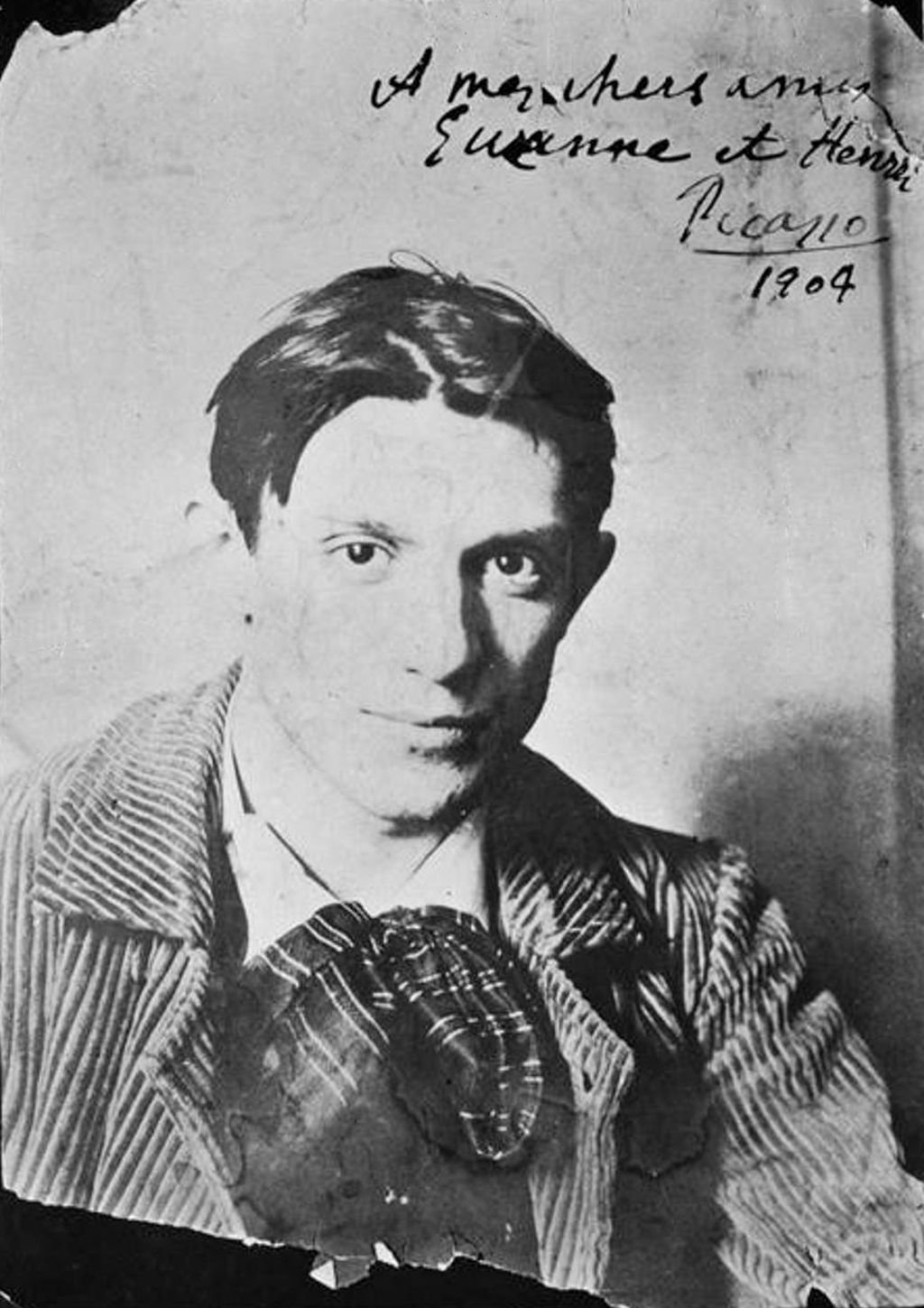
- Ricard Canals i Llambí, 1904. Wikimedia Commons labels the photograph public domain; its source credits RMN-Grand Palais. Resized to 1024px; no crop. Source record. Licence.
