


 by Tom Gurney
Tom Gurney BSc (Hons) is an art history expert with over 20 years experience
Email: tomgurney1@gmail.com / Phone: +44 7429 011000
Introduction
Picasso's Rose Period names a change in his work during the years around 1904–06. The blues and blue-greens associated with his earlier painting give way, unevenly, to pink, peach, red, ochre and warmer earth colours. Performers, Harlequins, children and young figures become especially prominent. Yet “rose” describes neither every colour nor a reliably cheerful mood. His circus people can look isolated even when they stand together, and by 1906 the spare, monumental bodies he painted and drew were moving beyond the circus altogether.[1][2][3]
The period is best understood as a sequence of experiments, not a switch flipped on a particular date. A large painting such as Family of Saltimbanques shows how Picasso developed a subject over many revisions; Boy Leading a Horse shows how little pink a Rose Period work may contain. Comparing these objects is more revealing than treating an entire two-year span as one uniform style.[3][5]
At a Glance
- Approximate years: 1904–06
- Palette: Pink, peach, red, ochre and warmer earth colours become prominent
- Recurring figures: Performers, Harlequins, children and young people
- Main places: Montmartre, Paris; Gósol, Catalonia in 1906
Contents
- When was Picasso's Rose Period?
- Performers in Montmartre
- Family of Saltimbanques: together and apart
- A café picture and the wider performer theme
- From circus figures to larger, quieter bodies
- Gósol and the ochres of 1906
- Colour, mood and the limits of a period label
- How to look at Rose Period works
When was Picasso's Rose Period?
Museums do not give identical start and end dates. Some use 1904–06; the Musée national Picasso-Paris identifies The Actor of 1904–05 as a transition and elsewhere uses 1905–06 for the period more strictly. The Museu Picasso in Barcelona marks the start around 1905. A practical chronology is a late-1904 transition, the major circus and performer works of 1905, and a 1906 shift toward the ochre and increasingly simplified figures associated with Gósol in Catalonia. These are useful boundaries, not dates on which every painting changed at once.[1][2][4][6]
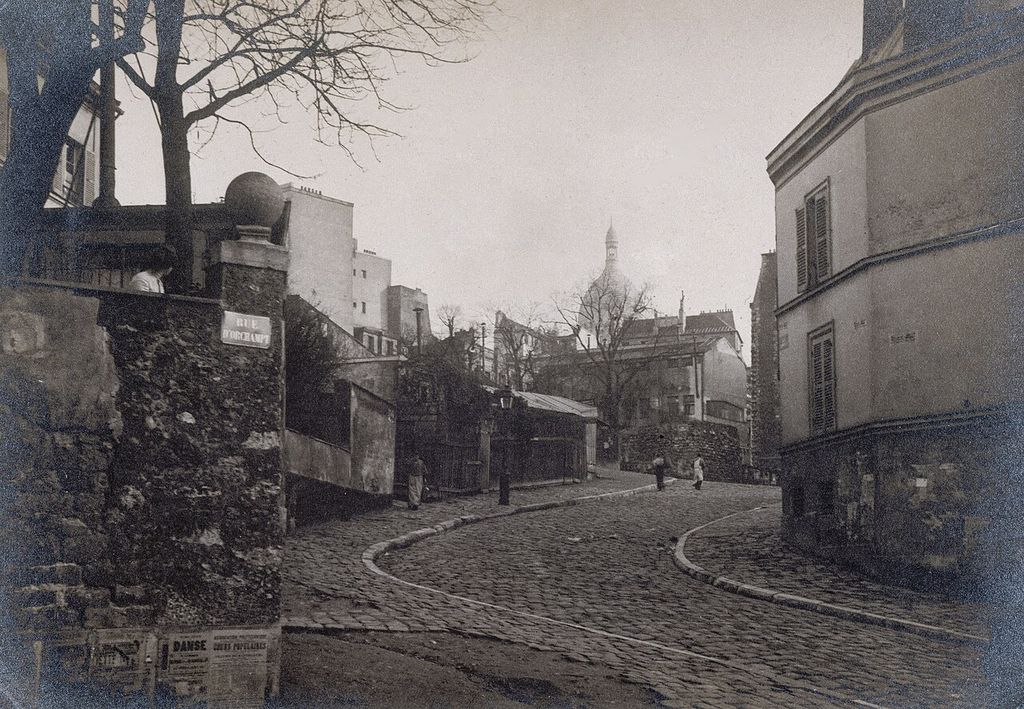
Picasso moved from Barcelona to Paris in April 1904 and took a studio in the Bateau-Lavoir, the crowded building in Montmartre where artists and writers lived and worked. That same year he met Fernande Olivier, who became his partner and a frequent subject. His social and visual surroundings now included the Cirque Médrano, theatrical troupes and the Lapin Agile cabaret. These settings help explain the new repertoire of actors, acrobats and Harlequins. They do not prove that his private feelings alone caused a new palette.[1][2]
The boundary with the Blue Period is especially porous. Blue paintings had already examined vulnerability, marginal lives and bodily expression. The early performers retain some of that emotional and formal language. The Actor, for instance, combines a theatrical subject with the elongated body and expressive hands that the Metropolitan Museum of Art relates to Picasso's earlier manner. Its date spans 1904–05. It is a bridge, rather than evidence that one period ended neatly before the next began.[4]
Performers in Montmartre
The French word saltimbanque broadly describes an itinerant entertainer, especially an acrobat or street performer. In Picasso's pictures, the term can cover a group in costume, an actor between performances or a child attached to the circus world. Harlequin comes from the Italian theatrical tradition and is recognisable by a patterned costume. A painted Harlequin need not be a documentary portrait of someone Picasso saw at a particular show.[1][3]
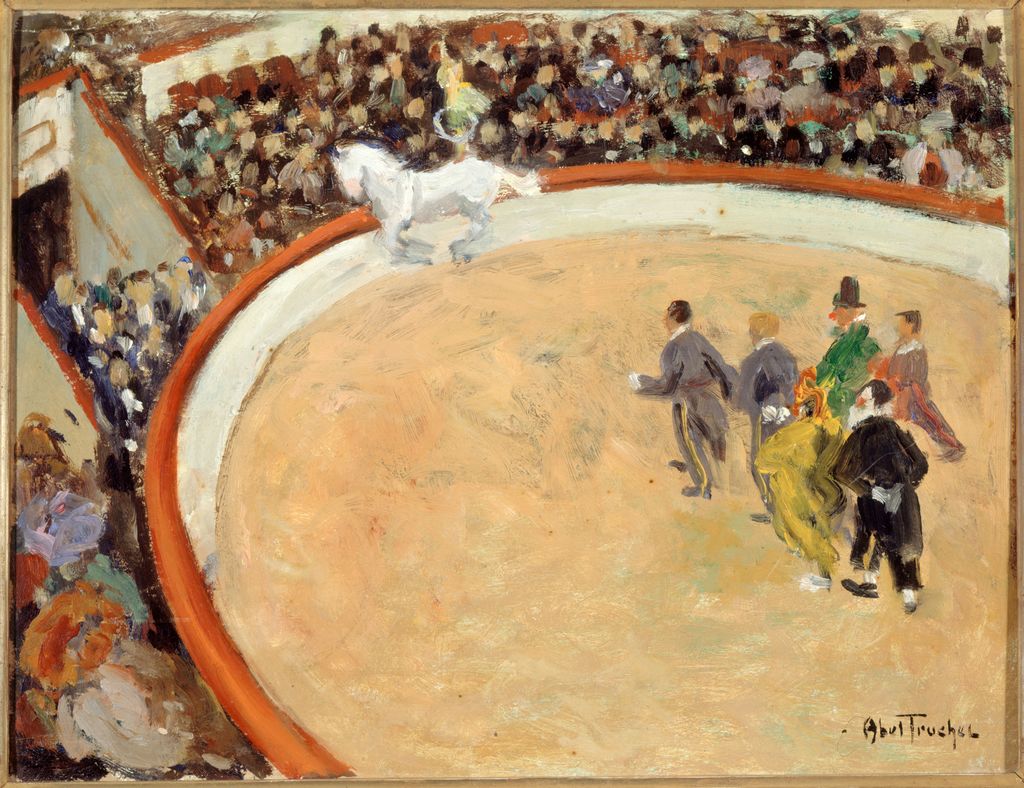
The Cirque Médrano and Parisian entertainment venues gave Picasso access to an appealing visual language: bodies balanced or folded, costumes that identify a role, and a world that lives partly in public view. Our theatre and circus guide follows that performer theme beyond this period. But these figures are often shown away from a crowd. Their poses are less about spectacular action than about waiting, resting, meeting or failing to meet one another's gaze. The pinks and oranges may feel warmer than the Blue Period's cool colour, while the human situation remains unresolved.[1][3]
Montmartre also joined visual art to a literary circle. Picasso knew André Salmon, Guillaume Apollinaire and Max Jacob, among others. Their presence matters because “the artist as outsider” was one possible interpretation of a wandering performer. It is tempting to read every acrobat as Picasso in disguise. Sometimes that has a specific basis—Picasso placed his own features on a Harlequin in Family of Saltimbanques, according to the National Gallery of Art—but the entire body of circus work cannot be reduced to autobiography. Costume makes an image of identity and performance, not a transparent diary.[1][3]
Watch: Pablo Picasso
Explore Picasso through five videos from museums, broadcasters and art educators.
Picasso’s Guernica: Great Art Explained
Explore the composition and historical setting of Picasso’s best-known response to war.
Watch on YouTubeFamily of Saltimbanques: together and apart
The National Gallery of Art's Family of Saltimbanques is dated 1905. Six figures occupy an open landscape: a Harlequin, a jester, another young performer, two children and a seated woman. Their costumes suggest a troupe, but the title should not make us assume they form a literal family. No audience watches them, and their arrangement does not resolve into a performance. They appear to share a place without sharing a single action or exchange of looks.[3]
The woman sits a little apart from the standing cluster. The Harlequin's patterned clothing gives him a vivid identity, yet he turns away. A child looks towards the woman; other faces and bodies direct attention elsewhere. Around them is an unusually spacious setting of muted rose earth and sky. The space allows each figure room, but that very room makes the gaps between them conspicuous. An interpretation of loneliness follows from these visual relationships; it is not a claim that Picasso supplied one authorised meaning for the painting.[3]
This canvas was worked out rather than delivered as a fixed conception. The National Gallery's technical study records successive compositional stages and proposes that an early “circus family” state may have begun late in 1904, before repeated repainting and probable completion in autumn 1905. That reconstruction is more specific than the object's catalogue date of 1905, and should be read as the study's argument. It also matters to interpretation: the apparent stillness of the finished painting came out of choices and revisions, not simply a quick observation of performers.[3]
The work later passed through several collections before reaching Washington through Chester Dale's bequest. Its present institutional record helps distinguish it from other similarly named Picasso works and from the many circus drawings and prints. A reader looking for the painting should use the National Gallery's object record[3], not a reproduction that lacks a collection number or reliable medium.[3]
A café picture and the wider performer theme
Picasso's 1905 At the Lapin Agile treats a different kind of stage. It was made for the Montmartre cabaret of that name and once hung there. In the Metropolitan Museum of Art's account, Picasso depicts himself as Harlequin, with Germaine Pichot beside him and the proprietor Frédé Gérard in the background. This is a painting of a social place, but its composition also plays with who is visible and who is concealed. The artist takes a conspicuous foreground role while the owner of the venue recedes.[4]
The Met records that the painting remained on public view in the café from 1905 to 1912. That history is worth distinguishing from its current collection status: a work once encountered as part of a cabaret interior is now studied in a museum. The café picture also brings back a person, Germaine, connected to the events surrounding Picasso's friend Carlos Casagemas in 1901. It therefore resists the tidy notion that the Rose Period simply banished the earlier years. The subject matter changed, but past associations did not disappear.[4]
Picasso did not investigate performers only in oil paint. The National Gallery of Art catalogues the 1905 drypoint Family of Acrobats with Macaque as part of a Saltimbanques print series. In a drypoint, lines are incised directly into a metal plate and printed on paper; it is not a small painting. The print offers a way to study how Picasso could return to a family or troupe motif through a different material process. It should not be confused with the large Washington canvas merely because both titles include performers and family.[7]
This range of media matters. A period label can make the paintings look like the complete story, yet drawings, studies, prints and sculpture were part of Picasso's thinking. His handling of a figure could move from a quick line to a more substantial body and back again. The links among works are most convincing when a museum identifies a documented study or recurring motif; apparent resemblance by itself is not proof that one sheet prepared a particular canvas.[3][6][7]
From circus figures to larger, quieter bodies
Boy Leading a Horse, painted in Paris in 1905–06 and now at MoMA, demonstrates how much the Rose Period contains beyond Harlequins. A young figure leads an unbridled horse across a sparse setting. MoMA explains that Picasso developed this central pair from an unrealised large mural project involving mounted riders and a walking figure. The final painting stands on its own even though the larger project was never completed.[5]
The boy's gesture and the horse's movement create a relationship without elaborate anecdote. Skin, animal and ground are built from subdued browns and greys rather than an obviously pink field. Picasso gives the figures size and visual weight, while removing the busy surroundings that might have located them in a particular street or circus. The object makes the term “Rose Period” useful as chronology and development, but unreliable as a colour checklist.[5]
This tendency toward broader, more sculptural form can also be seen in work associated with 1906. Cleveland's Head of a Boy, dated 1905–06, begins with a layer of pink opaque paint and uses grey and darker marks to model the face. The museum relates its closely framed head to the figures of The Two Brothers. It qualifies a possible Gósol origin for the sheet, however, and that uncertainty should stay visible. We can compare its treatment of a youthful head without pretending to know precisely where Picasso made every mark.[6]
The earlier circus figures could be slender and delicately poised; these later bodies often appear weightier and less dependent on costume. The change was not a straight line from tenderness to severity. Picasso could retain a quiet, melancholy tone while testing more simplified silhouettes. The Paris Picasso museum's account of The Two Brothers notes traces of the earlier wandering-performer world in a work connected with Gósol. This is one reason the years 1905–06 are better seen as a continuum than as two unrelated chapters.[1][6]
Gósol and the ochres of 1906
In May 1906 Picasso travelled with Fernande Olivier to Barcelona and then to Gósol, a mountain village in Catalonia. They returned to Paris in August. The Museu Picasso's detailed chronology anchors those movements; its exhibition on 1905–06 deliberately traced a path from the Rose Period to the ochre works of Gósol. Parisian performer imagery was not simply replaced by local scenery. Picasso explored bodily form, different kinds of face and a quieter, more archaic presence in his figures.[2]
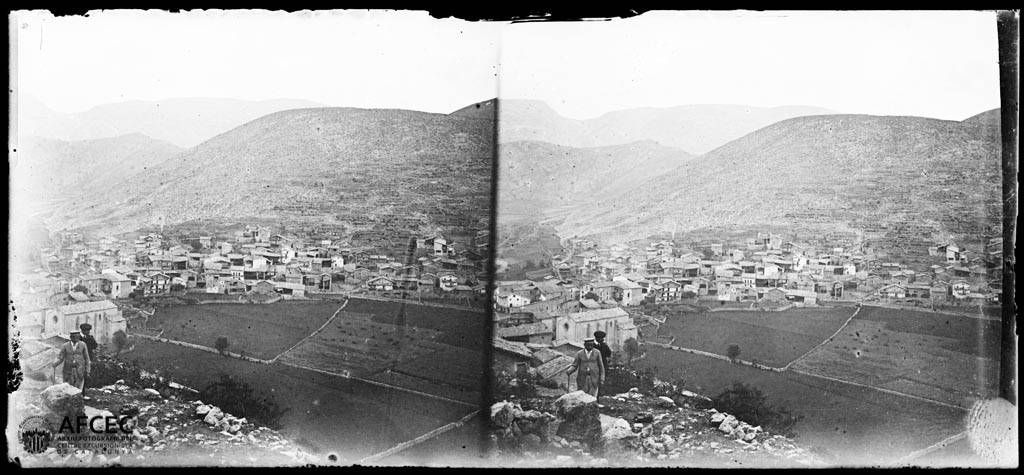
The Musée national Picasso-Paris places this journey alongside Picasso's encounter with Iberian sculpture at the Louvre. Such encounters can help explain formal experiments, but they are not a simple recipe for a new style. The village, Olivier's presence, earlier studies and objects seen in museums all belong to the context. A specific work still needs its own evidence. It would be misleading to say that every ochre picture was painted in Gósol or that every figure from 1906 records a person who lived there.[1][2]
Cleveland dates The Harem to spring–summer 1906 and links studies of Olivier bathing and dressing to its group of figures. It is a larger nude composition, with oil and graphite on canvas. The painting shows that Rose Period research was also concerned with arrangements of bodies in space, not only with the charm of circus subjects. Olivier was a model and participant in Picasso's life; her representation in a work is not evidence that her emotions or choices can be read directly from the canvas.[6]
By the end of 1906 Picasso was developing the formal questions that would become urgent in Les Demoiselles d'Avignon in 1907. That later painting is not a Rose Period work. Nor is Cubism merely an inevitable result of painting pink figures. The significance of 1906 lies in exploration: simplified features, weightier forms and relationships among figures that Picasso continued to transform. The names given to the periods help us orient ourselves, but the individual objects show the actual changes.[1][2]
Colour, mood and the limits of a period label
The most common shortcut is to pair “blue” with sadness and “rose” with happiness. There is some visible basis for the contrast: many pictures become warmer in colour, and new subjects appear. Picasso's relationship with Olivier coincided with this change, and some museum summaries note it. But colour is not a clinical record of mood, and coincidence is not proof that one person cured another's distress. Family of Saltimbanques is rose-hued yet inward and distant; Boy Leading a Horse is part of the same development but largely brown and grey.[1][3][5]
Another shortcut treats the Rose Period as a pause before “real” modernism began. That undervalues the questions these works ask about how a body occupies pictorial space, how costume shapes identity, and how simplified settings can carry complex relations among figures. The revised Family of Saltimbanques, the self-conscious Harlequin at the Lapin Agile, and the pared-down pair of boy and horse each solve a different visual problem. None exists merely to prepare the next famous painting.[3][4][5]
It is also worth keeping painterly tone separate from market stories. Dealers and collectors did become increasingly important to Picasso in these years; the Barcelona museum records Ambroise Vollard acquiring much Rose Period work in 1906, while MoMA traces Boy Leading a Horse through Leo and Gertrude Stein. These are concrete histories of ownership and circulation. They do not establish that Picasso chose a palette in order to please a buyer, or that an auction price explains what a canvas means.[2][5]
How to look at Rose Period works
Begin with an exact object rather than a generic image caption. Compare the Met's The Actor[4] with the National Gallery's Family of Saltimbanques[3]. The actor's stretched body and hands make the transition from Blue Period forms visible; the group painting turns performers into a study of distance within a shared space. Then look at the Met's At the Lapin Agile[4] to see Picasso use a recognisable Parisian place and the Harlequin's role in another way.[3][4]
Finally, compare MoMA's Boy Leading a Horse[5] and Cleveland's Head of a Boy[6]. Ask whether their colours, lines and bodies fit the shorthand “rose,” and where they exceed it. Dates, medium and collection records matter: a print, drawing and canvas are different objects, even when they belong to the same investigation. The Rose Period becomes more intelligible when it is read across these differences, with the transition to Gósol in view, rather than compressed into a story of sudden happiness.[2][5][6][7]
Discussion
Use the evidence and your own close looking to explain your view. These are editorial prompts, not reader comments.
Reader Insights
Which performer seems most distant from the people beside them?
Where does warmer colour change the mood, and where does it fail to make it cheerful?
What evidence shows the Rose Period emerging gradually rather than on one date?
Join the Conversation
Which reading best fits the evidence?
References
- Musée national Picasso-Paris, Blue and Rose periods; chronology; collection dossier on periodisation.
- Museu Picasso Barcelona, Spanish chronology; Catalan chronology; 1905–06 exhibition.
- National Gallery of Art, Family of Saltimbanques; technical and historical exhibition study.
- Metropolitan Museum of Art, The Actor; At the Lapin Agile.
- Museum of Modern Art, Boy Leading a Horse.
- Cleveland Museum of Art, Head of a Boy; The Harem; Musée national Picasso-Paris, Les Deux Frères.
- National Gallery of Art, Family of Acrobats with Macaque.
Image Credits
- La Tour, Paul de, photographe. CC0. Source: Wikimedia Commons. Resized proportionally to 1024px wide; no crop. Source record. Licence.
- Louis Abel-Truchet, Le cirque Médrano, boulevard Rochechouart, 1907, P1921. CC0 Paris Musées / Musée Carnavalet – Histoire de Paris. Public-domain painting and CC0 reproduction. Proportional resize only. Source record. Licence.
- Cèsar August Torras i Ferreri. Public domain. Source: Wikimedia Commons (File:Dos homes en primer terme i al fons el poble de Gósol des del castell.jpeg). 1024px proportional sRGB JPG derivative; no crop. Source record. Licence.

