


 by Tom Gurney
Tom Gurney BSc (Hons) is an art history expert with over 20 years experience
Email: tomgurney1@gmail.com / Phone: +44 7429 011000
Introduction
Picasso returned to performers throughout his career, but they did not always occupy the same kind of picture. A family of itinerant entertainers stands in a bare landscape in 1905. In 1917, a choreographer becomes the model for a Harlequin portrait. On the stage, Picasso's designs give dancers large, awkward structures to move inside. Decades later, a lithographed ballerina is made from a few coloured lines. These works share masks, costume and bodies in motion, yet each asks something different of the viewer.
The distinction is especially important for the Ballets Russes. A ballet was a collaboration among a producer, choreographer, composer, writer, performers and visual artist. Picasso did not create Parade or Le Tricorne alone; he made sets, curtains and costumes within productions shaped by others. His independent pictures of acrobats and dancers belong beside that work, but should not be mistaken for documents of a particular performance. Following both strands shows how the circus and stage became places to test identity, movement and the relation between a designed image and a living body.
At a Glance
- Subjects: Performers, Harlequins, circus families and dancers
- Stage work: Sets, costumes and curtain designs
- Collaboration: Ballet involved composers, choreographers, performers and producers too
Contents
- Circus performers before the ballets
- Acrobat: from the Rose period to 1930
- Parade makes the circus a modern stage
- Barcelona Harlequin: Léonide Massine in costume
- Costume Design for Ballet Tricorne
- Pulcinella, Mercure and the limits of a ballet credit
- Seven Ballerinas I: a drawing after a photograph
- Enrico Cecchetti: portrait of a ballet master
- Dancer 1954: a printed figure in motion
- How performance changed Picasso's art
Circus performers before the ballets
Picasso's 1905 Family of Saltimbanques brings together six figures in an open, almost empty landscape. The National Gallery of Art's object record[1] identifies a Harlequin, jester, young man in a leotard, boy, girl and seated woman. Their costumes suggest the circus, but there is no ring, audience or visible act. The people are near one another without forming an obvious conversation. The painting invites us to look at what performers do when they are not performing. [1]
That quietness complicates the idea that Picasso simply celebrated the liveliness of the circus. The Gallery notes that the group is not necessarily a family in the ordinary sense, and its research follows multiple stages of the painting's making. The figures form a loose arrangement rather than an illustrated story. A costume identifies a social role, while leaving the person beneath it partly inaccessible. The Harlequin's diamond pattern tells us who he plays; it does not tell us everything he thinks.
The subject spread across media. The Musée d'Orsay's account of Picasso's Blue and Rose periods[7] dates the saltimbanque cycle from late 1904 through 1905 and traces it in paintings, drawings, prints and sculpture. A 1905 bronze, The Jester in the Pinakothek collection[8], belongs to the same world of Harlequins and travelling entertainers. This is a recurring problem for Picasso rather than a single painting repeated in other materials: how can an artist portray someone whose public identity is a role? [7] [8]
Acrobat: from the Rose period to 1930
The title Acrobat can point to different moments in Picasso's work. In the Rose-period scenes, an acrobat may be one member of a troupe. In the Musée national Picasso-Paris's L'Acrobate[1] of 1930, the performer becomes a body bent into an improbable configuration. The museum identifies it as an oil on canvas and explicitly contrasts it with the acrobats of some twenty-five years earlier. It relates the renewed interest to Picasso's visits to the Cirque Médrano with his son Paulo in the late 1920s. [1]
Instead of showing a feat in a recognisable tent, the later picture isolates an elastic human form against a restrained setting. The anatomy does not give a viewer a secure route from head to torso to limbs. That difficulty is part of the picture's force: the visual question is not merely what trick the performer executes, but what a body can become when its lines and joints are rearranged. The early performers have costumes and a shared world; the 1930 acrobat is a solitary construction of movement.
Picasso also designed an acrobat costume for the stage. The Paris museum's account of the Ballets Russes[9] reproduces a 1916–17 costume project. A costume study, a Rose-period entertainer and the 1930 oil painting are three different objects. The common word acrobat should lead readers to compare them, not collapse them into one picture. [9]
Watch: Pablo Picasso
Explore Picasso through five videos from museums, broadcasters and art educators.
Picasso’s Guernica: Great Art Explained
Explore the composition and historical setting of Picasso’s best-known response to war.
Watch on YouTubeParade makes the circus a modern stage
The circus met the theatre directly in Parade[2], first performed in Paris at the Théâtre du Châtelet on 18 May 1917. Jean Cocteau supplied the idea, Erik Satie the music, Léonide Massine the choreography and Serge Diaghilev the Ballets Russes production. Picasso designed the curtain, scenery and costumes. The Centre Pompidou's curtain record[2] documents the production and its large painted threshold between auditorium and stage. [2]
The premise is a show trying to attract spectators: performers offer glimpses of their acts outside the main event. In that setting, Picasso's visual design did more than decorate. The Paris Opéra explains that he introduced the managers, whose bulky costumes functioned almost as Cubist sculptures, and a horse-costume episode recalled from circus observation. These structures changed how bodies could move. A performer in a large geometric costume cannot dance as a person in ordinary clothing does; the design becomes part of the choreography's physical problem.
The curtain and stage did not even speak the same visual language. The Opéra describes a Cubist setting set against a more neoclassical curtain. This contrast makes Parade more interesting than a tidy claim that Picasso “brought Cubism to ballet.” He used contrasting modes in the same production, while music, movement and the visual surface met in front of an audience. The stage offered a live test of whether an image could be carried, worn or moved through rather than only viewed on a wall.
Barcelona Harlequin: Léonide Massine in costume
During the Ballets Russes' 1917 journey, Picasso painted the work often called the “Barcelona Harlequin.” The Museu Picasso Barcelona[3] identifies it more precisely as Harlequin [Léonide Massine], an oil on canvas made in Barcelona in 1917. The sitter is the choreographer who worked with Picasso on Parade and later Le Tricorne. Picasso donated the painting to the city's museum in 1919. The museum's research on his Barcelona stay[10] places that visit between June and November 1917. [3] [10]
Massine is dressed in Harlequin's diamond-patterned costume, yet this is a portrait of a named colleague rather than a generic commedia dell'arte figure. The body appears poised and still. The museum points to a classical clarity of outline and restrained colours, part of Picasso's willingness to work figuratively while continuing other experiments. It is reasonable to observe the tension between theatrical dress and portrait-like stillness; it is not possible to read “stage fright” or a particular private mood from the painted face.
Barcelona also holds a separate Head of a Harlequin [Léonide Massine][11], a gouache on cardboard of the same year. Similar titles and sitter do not make the two works interchangeable. The full-length oil is the important bridge here: a collaborator from a real production becomes the subject of a painting in which performance is present as costume, even though no dance is taking place. [11]
Costume Design for Ballet Tricorne
Diaghilev again asked Picasso to design for the Ballets Russes in 1919. Le Tricorne, also called The Three-Cornered Hat or El sombrero de tres picos, used Manuel de Falla's music and Massine's choreography in a Spanish village story. The Musée national Picasso-Paris[12] records Picasso's work on scenery and costumes; a Paris costume study[3] gives the premiere as 22 July 1919 at London's Alhambra Theatre. The National Gallery of Australia's production account[13] confirms the principal production roles and warns that almost no original 1919 costumes survive. [12] [3] [13]
The Spanish setting mattered to the design. According to the Paris Opéra[2], villagers and officials were distinguished through sharply coloured dress, while the curtain evoked a bullring. Costumes made characters legible in motion and across the distance of a theatre; a drawing for one is therefore a working proposal for a dancer's appearance, not an independent portrait of the dancer. The relation between regional costume, social rank and movement is more useful to understand than a generic claim that every design is “Cubist.” The Paris museum describes this production as less insistently Cubist than Parade. [2]
The surviving records also require care with dates and media. Paris MP1719[3] is an original 1919 ink-and-gouache costume project on paper. MoMA's costume design[3] comes from a 1920 collotype-and-pochoir portfolio published by Paul Rosenberg after Picasso's designs. They are not the same physical object, and “Costume Design for Ballet Tricorne” is not a unique title. A red-and-black, crutch-using figure sometimes shown under that broad label points more specifically toward the character called le béquillard. The Paris museum catalogues a 1919 original design, MP1693[3], and separately lists a 1920 pochoir of the costume, MP3576 (25)[3]. The original is gouache, watercolour, ink and graphite on paper; the later plate is a reproduction after a design. A small reproduction with a generic caption cannot by itself establish which physical object it shows. Date and medium need to be checked against a specific catalogue record. [3]
Pulcinella, Mercure and the limits of a ballet credit
Picasso's work for the stage did not end with Le Tricorne. In Pulcinella (1920), he again designed scenery and costumes for a Massine ballet, now with Igor Stravinsky's music and characters drawn from Italian theatrical tradition. The Teatro dell'Opera di Roma's historical archive[6] names each role in its record of the Ballets Russes' Rome performance on 30 January 1921. That is a later Rome performance, not the ballet's Paris premiere. The Rome opera's Italian-language production history[14] distinguishes the 1920 Paris origin of Pulcinella from its arrival in Rome. It also makes clear that modern performances have used reconstructed sets and costumes: a current stage photograph must not be presented as a photograph of the 1920 originals. [6] [14]
In Mercure (1924), Picasso worked again with Massine and Satie, but the producer was Count Étienne de Beaumont, not Diaghilev. The Paris Opéra's account[2] describes mobile sculptural elements and “plastic poses” that drew the dancers into the design. A Paris museum study for the curtain[6] identifies Harlequin and Pierrot as musicians and records the premiere on 15 June 1924 at the Théâtre de la Cigale. The familiar theatrical types have returned, but now in a quite different kind of event from the quiet 1905 saltimbanques. [2] [6]
One more 1924 production shows why a Picasso credit needs to be specific. For Diaghilev's Le Train bleu, Picasso allowed his earlier picture of two women running on a beach to be used as the basis for a large curtain. The Opéra says his participation here was limited compared with the four intensive collaborations. The original Women Running on the Beach and the enlarged stage curtain are related, but they are not one object. The Victoria and Albert Museum identifies Prince Alexander Schervashidze as the painter[15] who enlarged Picasso's design. His painting could become part of a theatrical spectacle without every inch of its stage version being his handwork. [15]
Seven Ballerinas I: a drawing after a photograph
Picasso also looked at the dancers outside a performance. A drawing sometimes called “Seven Ballerinas I” points toward a group of seven dancers he drew in early 1919. The French national collection record[4] calls the Paris museum drawing Seven Dancers with Olga Khokhlova in the Foreground, after a Photograph by White. It is graphite over a charcoal sketch on paper, not a painting. Olga, Picasso's wife and a Ballets Russes dancer, is identified in the foreground. The Musée Picasso-Paris Olga exhibition catalogue[16] distinguishes this seven-dancer work from another drawing of three dancers after a photograph. [4] [16]
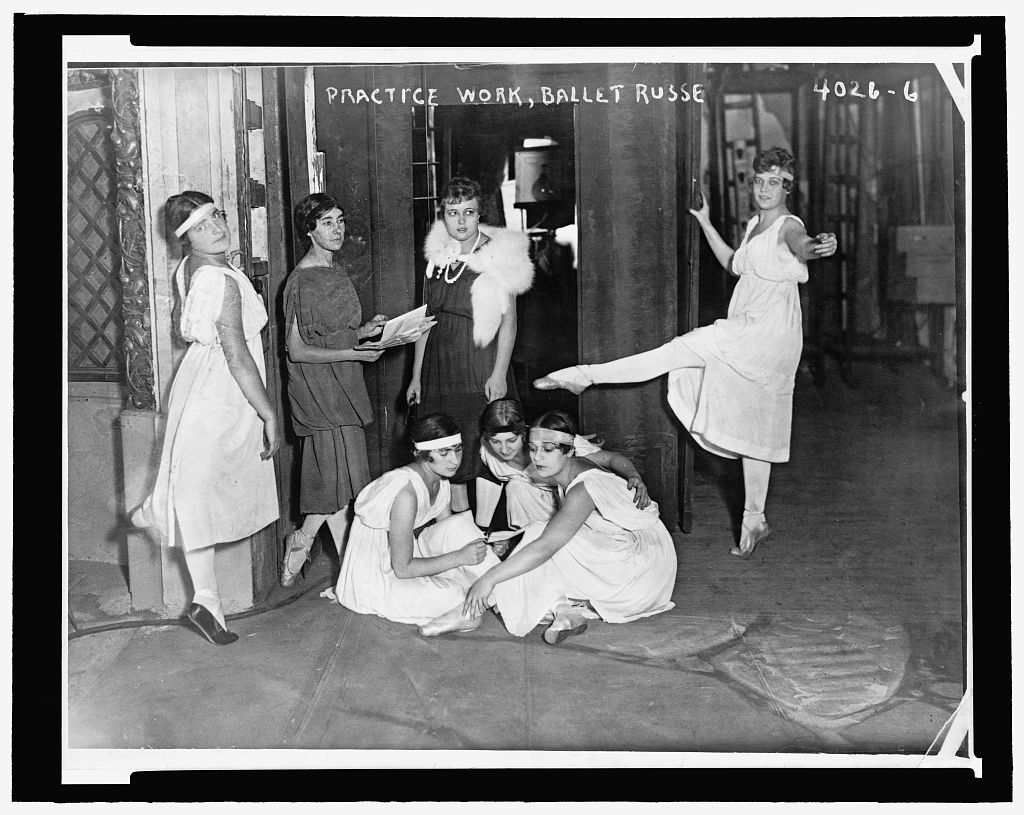
The photographic source matters. This is not a report of Picasso standing at the edge of a rehearsal and catching a split second of movement. He redrew a posed image and gave the figures a new coherence in line. The dancers are a group, but individual positions and directions remain readable. Their costume and gesture connect the picture to ballet; the transformation from photograph to drawing connects it equally to Picasso's way of looking at an existing image. The drawing invites attention to the choices he made in contour and arrangement, rather than invented stories about the dancers' feelings or his marriage.
Nor is this the same work as The Three Dancers of 1925. The later oil painting belongs to another moment and another visual problem. Linking the two pages helps a reader see how a dance title can cover radically different media and meanings. It does not make the seven-dancer drawing a preparatory study for the 1925 canvas.
Enrico Cecchetti: portrait of a ballet master
Picasso's Portrait of the Ballet Master of La Scala, Enrico Cecchetti names a person rather than a stage character. Sotheby's 2014 object record[5] identifies Cecchetti as the sitter and records the pencil drawing's lower-left signature, Monte Carlo inscription and date of 29 April 1925. The sheet measures 34 by 26 cm. Cecchetti is seated, with his hands resting over a cane or stick; the precise inscription and pose help distinguish this drawing from other portraits of performers. The record does not turn his expression into a diagnosis or establish an “expressionist” style label for the work. [5]
Cecchetti's place in this guide is specific: he was a ballet master associated with La Scala, while the portrait is an independent drawing, not a costume design or a surviving view of a Picasso-designed production. Sotheby's traces the sheet through Picasso's estate and Marina Picasso and cites its inclusion in exhibitions and catalogues on Picasso and theatre. This history helps establish which drawing is being discussed. The portrait connects the people around ballet to Picasso's work on paper without treating every dancer and theatre colleague as an interchangeable motif.
Dancer 1954: a printed figure in motion
The later work commonly titled “Dancer 1954” is another reason to name a medium carefully. The Museu Picasso Barcelona's Dancer[4] is a four-colour lithograph made in Vallauris in 1954. Lines in different colours describe a skirt, limbs and face without a painted stage or audience. Their economy makes the turning or lifted pose legible while leaving much of the paper open. It would be misleading to call the finished object simply a hand drawing, although drawing on transfer paper was part of its printmaking process. [4]
MoMA also catalogues a 1954 Ballet Dancer lithograph[17], printed by Mourlot in Paris. The institutional records have different titles, collection numbers and sheet measurements; they should not be silently collapsed into the same impression. What they establish is a continuing interest in the dancer as a figure that can be translated through print. By 1954, the body need not be costumed as a Harlequin or built into a stage structure to convey movement. A small number of coloured marks can carry the idea. [17]
How performance changed Picasso's art
Picasso's theatre work and performer pictures are best understood as related experiments, not a single style marching from the Rose period to modern ballet. The 1905 saltimbanques make a group of professionals appear strangely still. The 1930 Acrobat bends a solitary body beyond ordinary anatomy. Parade makes a costume into an obstacle and a spectacle in its own right; Le Tricorne asks a designer to make a social world readable from the stage. Massine's 1917 Harlequin portrait, the 1919 dancers after a photograph and the 1954 lithograph each bring the performer back onto a flat surface by different means.
Those differences reward close looking. Is the person acting, resting, posing or being remembered from another image? Is the artwork a painting, a design that will be made into costume, or a print? Who else helped make the performance? Answering those questions keeps Picasso's visual invention visible without erasing the people, productions and media through which it worked.
Discussion
Use the evidence and your own close looking to explain your view. These are editorial prompts, not reader comments.
Reader Insights
What changes when a performer is pictured offstage rather than in a ballet?
Which collaborator’s contribution is essential to the stage work discussed?
How does costume or movement alter the space of the picture?
Join the Conversation
Which reading best fits the evidence?
References
- National Gallery of Art, Family of Saltimbanques; Musée Picasso-Paris, L'Acrobate.
- Paris Opéra, Picasso and Dance; Centre Pompidou, Parade curtain.
- Museu Picasso Barcelona, Harlequin [Léonide Massine]; Musée Picasso-Paris, Le Tricorne costume study, original Béquillard design and 1920 portfolio; MoMA, 1920 portfolio print.
- French Ministry of Culture, seven dancers MP841; Museu Picasso Barcelona, 1954 Dancer.
- Sotheby's, 2014 lot 109, Portrait du Maître de ballet de la Scala de Milan, Enrico Cecchetti.
- Teatro dell'Opera di Roma, Pulcinella archive; Musée Picasso-Paris, Mercure curtain study.
- Musée d'Orsay's account of Picasso's Blue and Rose periods. View source
- The Jester in the Pinakothek collection. View source
- Paris museum's account of the Ballets Russes. View source
- museum's research on his Barcelona stay. View source
- Head of a Harlequin [Léonide Massine]. View source
- Musée national Picasso-Paris. View source
- National Gallery of Australia's production account. View source
- Rome opera's Italian-language production history. View source
- Victoria and Albert Museum identifies Prince Alexander Schervashidze as the painter. View source
- Musée Picasso-Paris Olga exhibition catalogue. View source
- MoMA also catalogues a 1954 Ballet Dancer lithograph. View source
Image Credits
- Andrew McMillan. Public domain. Source: Wikimedia Commons. Resized to 1024px; no crop. Source record. Licence.
- Louis Abel-Truchet, Le cirque Médrano, boulevard Rochechouart, 1907, P1921. CC0 Paris Musées / Musée Carnavalet – Histoire de Paris. Public-domain painting and CC0 reproduction. Proportional resize only. Source record. Licence.
- Jacques-Émile Blanche, 1913, P1881. CC0 Paris Musées / Musée Carnavalet – Histoire de Paris. Painting public domain (Blanche died in 1942); reproduction released CC0. Proportional resize only. Source record. Licence.
- Bain News Service, circa 1916. Library of Congress, Prints & Photographs Division, George Grantham Bain Collection, LC-USZ62-63268. Rights advisory: ‘No known restrictions on publication.’ Date and title derive from the archive’s old caption data. Proportional resize only. Source record. Licence.
