


 by Tom Gurney
Tom Gurney BSc (Hons) is an art history expert with over 20 years experience
Email: tomgurney1@gmail.com / Phone: +44 7429 011000
Introduction
A naked youth walks forward with one arm extended. Beside him, a pale horse lowers its head and seems to follow. The boy's fist closes as though it held a lead, but Pablo Picasso has painted no reins, rope or bridle. That small absence changes the encounter: is the horse responding to a command, moving with the boy of its own accord, or simply caught in the same moment of motion? Boy Leading a Horse looks direct enough to recognise at once, yet its gesture never quite settles into an ordinary story. [1]
Picasso made the large oil painting in Paris in 1905–06. It measures 220.6 × 131.2 centimetres and belongs to The Museum of Modern Art, New York, as part of the William S. Paley Collection. Often placed within Picasso's Rose Period, it grew from a much larger plan to paint several youths and horses. The solitary pair endured when the planned multi-figure work did not. Knowing that history makes the canvas more than a simple image of a boy and an animal: it shows Picasso stripping a scene back until pose, touch and scale carry nearly all its meaning. [1][2]
At a Glance
- Made: Paris, 1905–06
- Medium and size: Oil on canvas, 220.6 × 131.2 cm
- Collection: MoMA, William S. Paley Collection, 575.1964
- Key detail: No reins or bridle appear between the boy and horse
Boy Leading a Horse in Picasso's career
First Communion
1896Boy Leading a Horse
1905–06Three Musicians
1921Las Meninas series
1957The highlighted work is dated with the qualifications explained in the sources on this page. The other works are selective points of comparison, not the start or end of a style.
Contents
- What do we see in Boy Leading a Horse?
- How can he lead the horse without reins?
- Was this originally part of The Watering Place?
- Why is it called a Rose Period painting?
- Who owned the painting before MoMA?
- Where is Boy Leading a Horse now, and why does it matter?
What do we see in Boy Leading a Horse?
The horse occupies much of the left half of the tall canvas. Its head inclines toward the viewer and toward the boy, and its legs appear in front of a spare, reddish-brown landscape. The youth stands to the right, his torso upright, one hand resting at his waist while the other reaches toward the animal. His face is serious and his body is fully exposed. No stable, recognisable landmark tells us whether the pair is at a farm, a road or a mythic field. The restricted setting lets their different forms—long horse neck and legs, compact human torso and arms—supply the picture's rhythm. [1]
Picasso did not polish every part into an even surface. The contours of the two bodies are strong, but the ground and sky change in tone and texture. Grey and earth colours keep the work close to the subdued range of his late Rose Period without making it a uniformly pink painting. At this scale, the boy's relatively small hand matters enormously. It is the point where a possible act of guiding should become visible. Picasso makes the hand clear while withholding the equipment that would explain how the action works. [1][3]
The horse's shape is not just a foil for the human figure. Its head, chest and long forelegs establish a vertical line that answers the boy's standing body; the two do not form a conventional rider-and-mount silhouette. Their heads point in different directions, so our attention passes back and forth between the animal's downward gaze and the youth's more distant look. Meanwhile the background gives almost no sense of how far away the horizon lies. As Rubin observed, some passages where animal meets ground are not smoothly separated. This makes the pair feel at once solid and strangely untethered from a measurable place. [3]
The title calls him a “boy,” yet he is drawn with the bearing and proportions of an adolescent or youth. We do not know his name from the picture. Older scholarship has tried to connect him with a young figure in Picasso's earlier Paris work, but an identification remains an argument about models and motifs, not a label Picasso wrote beside the painting. The more reliable first step is to describe the posture before attaching a biography to it. [3]
How can he lead the horse without reins?
There is no visible rope between the closed fist and the horse's head. This is neither an accidental detail to be painted in by the viewer nor proof that the boy has supernatural power. MoMA's gallery account describes a youth moving determinedly forward, his grip seeming to compel the horse without tack. Art historian William Rubin read that unusual gesture as an emblem of mastery and linked it to a broader classical idea of human command over animal force. That interpretation helps explain why the picture can feel monumental despite its plain subject. It should remain an interpretation: the canvas does not contain a written key equating the horse with “passion” and the boy with “reason.” [1][3]
The relation between the two figures is not wholly one-sided. The animal's size and weight are impossible to ignore. Its lowered head is close to the boy, but its path and attention are not as easy to read as the extended arm. The boy may look assured, yet the very absence of a tether makes his apparent authority less verifiable. We see a gesture capable of suggesting guidance, trust or an imagined ideal of control. Those are possible readings of the visible encounter, not facts about the animal's response or a lesson Picasso is known to have intended. [1][3]
This openness is one reason the painting differs from a pastoral anecdote. There are no spectators, stablehands or other riders in the finished image. Nor are there tools that make the pair's practical task legible. The figure and horse stand alone in a wide, muted field, enlarged far beyond the scale of a casual sketch. Their everyday action takes on the gravity usually reserved for a public monument, without becoming a portrait of a known hero or a named episode from mythology. [1][3]
Watch: Pablo Picasso
Explore Picasso through five videos from museums, broadcasters and art educators.
Picasso’s Guernica: Great Art Explained
Explore the composition and historical setting of Picasso’s best-known response to war.
Watch on YouTubeWas this originally part of The Watering Place?
Yes. Picasso developed the boy and horse from the central motif of an ambitious composition usually called The Watering Place. The Metropolitan Museum of Art owns a 1905–06 gouache on board showing a group of nude adolescents and horses in an arid, mountainous setting. It measures only 37.8 × 58.1 centimetres, but the studies imply that Picasso considered a much larger final work. No definitive multi-figure version was completed. The MoMA painting isolates one pair from that larger imagined world; it is not a cropped fragment physically cut from a finished mural. [1][2]
The surviving studies show a process rather than a single straightforward copy. Earlier variations still connect the horse scene with circus imagery: the Met notes that the principal youth wore a performer's costume in some preliminary designs. Other sketches alter the number and placement of riders and animals. In one phase the boy turns toward and touches the horse; later he moves forward with his arm extended. The simplified final canvas therefore preserves a relationship Picasso had repeatedly tested, while removing the company that once explained it. [2][3]
The gouache and the oil should not be collapsed under a single title simply because both contain youths and horses. The Met work is horizontal and gives several figures an imagined landscape to occupy. The MoMA oil is tall and concentrates on one encounter. Picasso also made a small drypoint connected with the Watering Place theme, dated 1906 and published later in 1913. It is another related object, not an impression printed from the Paley canvas or proof that the mural was completed. Recognising these separate media—gouache, drawing, print and oil—helps explain how Picasso tested a motif before deciding what could stand alone. [1][2][9]
William Rubin's study of the Paley Collection reconstructs some of those steps in detail. He discusses a watercolour called Horse with a Youth in Blue as part of the changing motif, not as a later oil duplicate of Boy Leading a Horse. He also considers several possible reasons why Picasso did not finish the grand ensemble. None is documented as Picasso's definite explanation. Perhaps the composition did not satisfy him, or perhaps his quickly changing art made the enormous project less attractive. What we can securely say is that the large painting of the pair survived, while the planned full scene remained a proposal known through studies. [3]
The Met relates The Watering Place to Picasso's Family of Saltimbanques, made in 1905. That earlier canvas gathers circus performers in an open, nearly empty landscape. In the Met's interpretation, the later youths and horses are like performers who have stepped out of costume into an older, pastoral world. The link is illuminating but not literal: no document proves that each naked youth in the unbuilt scene is a portrait of a particular performer in Family of Saltimbanques. The change from dressed social outsiders to unclothed, idealised figures is the larger artistic story. [2][4]
Why is it called a Rose Period painting?
“Rose Period” names a loose phase of Picasso's early career, not a rule that every square inch must be rose-coloured. After the mournful blue-dominated paintings of the preceding years, Picasso's work in 1904–06 increasingly turned to circus performers, warmer earth tones and a different sense of human presence. Boy Leading a Horse belongs to that history, but its terracotta and grey palette and its sculptural figures show why period labels can conceal as much as they reveal. It is more severe than a sentimental scene of friendship with an animal. [1][3][4]
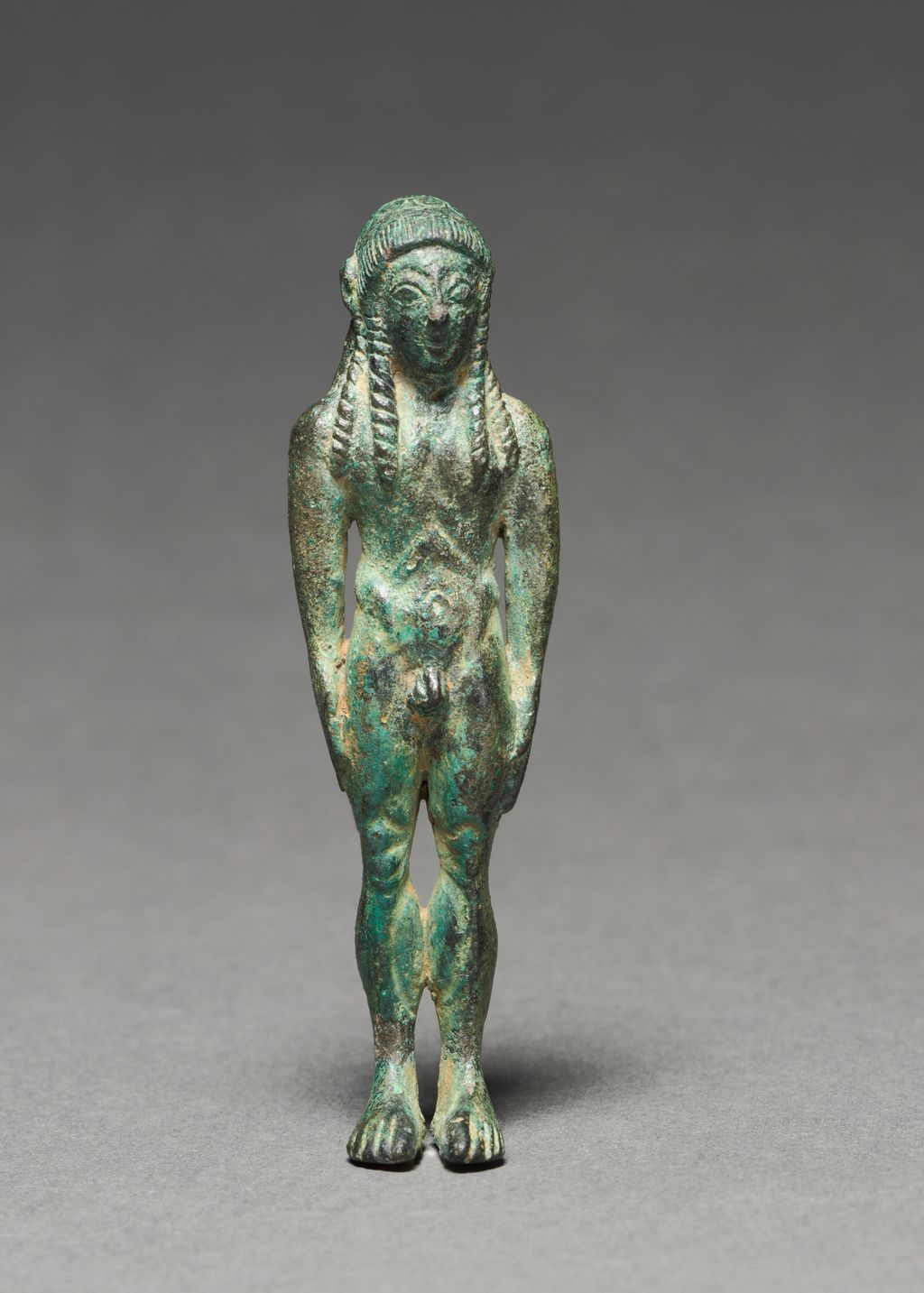
The painting's strong outline and bare setting also point toward a new interest in classical form. Rubin compared the forward-striding boy with ancient Greek statues of youths, or kouroi, and considered Picasso's engagement with Cézanne and other painters who gave figures a solid, monumental presence. These are art-historical comparisons, not evidence that a particular statue was copied line by line. In the canvas, the youth's individual features matter less than the visual force of a body set firmly against open ground. [3]
That classical reading need not turn the boy into a Greek god. A kouros comparison concerns a standing or striding nude body, its clarity of outline and its claim to occupy space. Picasso's boy, however, is not carved in stone, and the painted horse introduces an uneasy partner into the scheme. Even the seemingly firm contour changes where brushwork and muted ground meet. The work can evoke an old sculptural ideal while remaining stubbornly a modern painted image, made out of uneven tones and particular decisions about what to omit. [1][3]
French curatorial research at the Musée national Picasso-Paris identifies this nude horse-leader as a key work in the classicising direction that became clearer in Picasso's art of 1906. Its account of Les Deux Frères, a gouache made during his stay in Gósol that summer, finds a related pose in one figure. That connection helps us follow the development of his figures across works. It does not move Boy Leading a Horse to Gósol: MoMA places its making in Paris in 1905–06. [1][5]
The Spanish Museo Reina Sofía has urged a fuller view of Picasso's experiments in 1906. Rather than treating them only as a bridge to the celebrated shock of Les Demoiselles d’Avignon in 1907, its research attends to changes in the nude, the handling of bodies and Picasso's dialogue with different artistic traditions. Boy Leading a Horse is valuable within that wider enquiry. It has its own ambitious conception and its own peculiar mystery; its importance does not depend on being called an unfinished rehearsal for Cubism. [6]
Who owned the painting before MoMA?
The painting's history includes some of the influential people and difficult transactions through which early modern art entered museums. MoMA's provenance record begins with the dealer Ambroise Vollard in Paris and places the canvas in the collection of Gertrude and Leo Stein by 1906, remaining with them until 1913. The Steins' Paris rooms were a meeting place for artists and collectors, and this large early Picasso was part of the collection that helped make his work visible to visitors. It passed through Daniel-Henry Kahnweiler's Galerie Simon before appearing in the collection of the Berlin banker Paul von Mendelssohn-Bartholdy. [1]
The 1930s portion of that ownership chain is contested. MoMA records the picture in the Mendelssohn-Bartholdy family and then with the Thannhauser galleries by 1935. Descendants of Paul and Elsa von Mendelssohn-Bartholdy later argued that the transfer was forced by Nazi persecution and sought its return. The museums holding this and another Picasso disputed that claim. A US federal court allowed important parts of the heirs' case to proceed in 2009, but the parties settled before a trial resolved the underlying factual dispute. The settlement terms were confidential, and the picture remained at MoMA. It would be inaccurate either to call the 1930s transfer conclusively voluntary or to say a final judgment ordered this canvas returned. [1][7][8]
William S. Paley bought Boy Leading a Horse in 1936 and gave it to MoMA in 1964. The museum's object page still identifies it with the William S. Paley Collection and describes its provenance research as ongoing. That continuing research is part of responsible care for a major artwork. A painting's aesthetic importance does not remove the obligation to be precise about how it moved through European and American collections. [1]
Where is Boy Leading a Horse now, and why does it matter?
MoMA in New York owns the canvas. Its online record lists a current gallery location, but displays can change, so visitors should check the museum's object page before planning a trip. The same record identifies it as object 575.1964 in the William S. Paley Collection. [1]
The painting matters because it lets us see a decision. Picasso could have filled an enormous surface with riders and horses. Instead, he gave monumental scale to one boy, one animal and an almost invisible bond between them. Their relationship carries traces of the circus pictures, of a classical ideal of the human body, and of the unfinished Watering Place scheme, but it is not reduced to any one of those sources. We can read confidence in the boy's stride and still notice how little we know about where the two figures are going. The answer is not hidden in a missing rein. The missing rein is what keeps us looking. [1][2][3]
Discussion
Use the evidence and your own close looking to explain your view. These are editorial prompts, not reader comments.
Reader Insights
How does the missing rope alter your reading of the boy’s gesture?
Which features make the horse seem to follow rather than be pulled?
What can the documented object history resolve about this painting?
Join the Conversation
Which reading best fits the evidence?
References
The Museum of Modern Art, Boy Leading a Horse, collection object 575.1964.
The Metropolitan Museum of Art, The Watering Place, object 1984.433.274.
William Rubin, essay on Boy Leading a Horse in The William S. Paley Collection: A Taste for Modernism, printed pp. 98–103 (PDF pp. 17–19), MoMA, 1992.
National Gallery of Art, Washington, Family of Saltimbanques, 1905.
Musée national Picasso-Paris, French curatorial essay on Les Deux Frères and Le meneur de cheval nu.
Museo Nacional Centro de Arte Reina Sofía, Spanish Picasso 1906: La gran transformación research dossier, 2023.
United States District Court, Southern District of New York, Schoeps v. Museum of Modern Art, opinion, January 2009.
MoMA and Guggenheim's 2007 statement of their position, Mendelssohn family statement in German and contemporary report of the 2009 confidential settlement.
The Museum of Modern Art, The Watering Place (Horses Bathing), 1906 drypoint, published 1913.
Image Credits
- Creator unidentified. CC0. Source: Cleveland Museum of Art (Statuette of a Kouros). 1024px proportional sRGB JPG derivative; no crop. Source record. Licence.
