


 by Tom Gurney
Tom Gurney BSc (Hons) is an art history expert with over 20 years experience
Email: tomgurney1@gmail.com / Phone: +44 7429 011000
Introduction
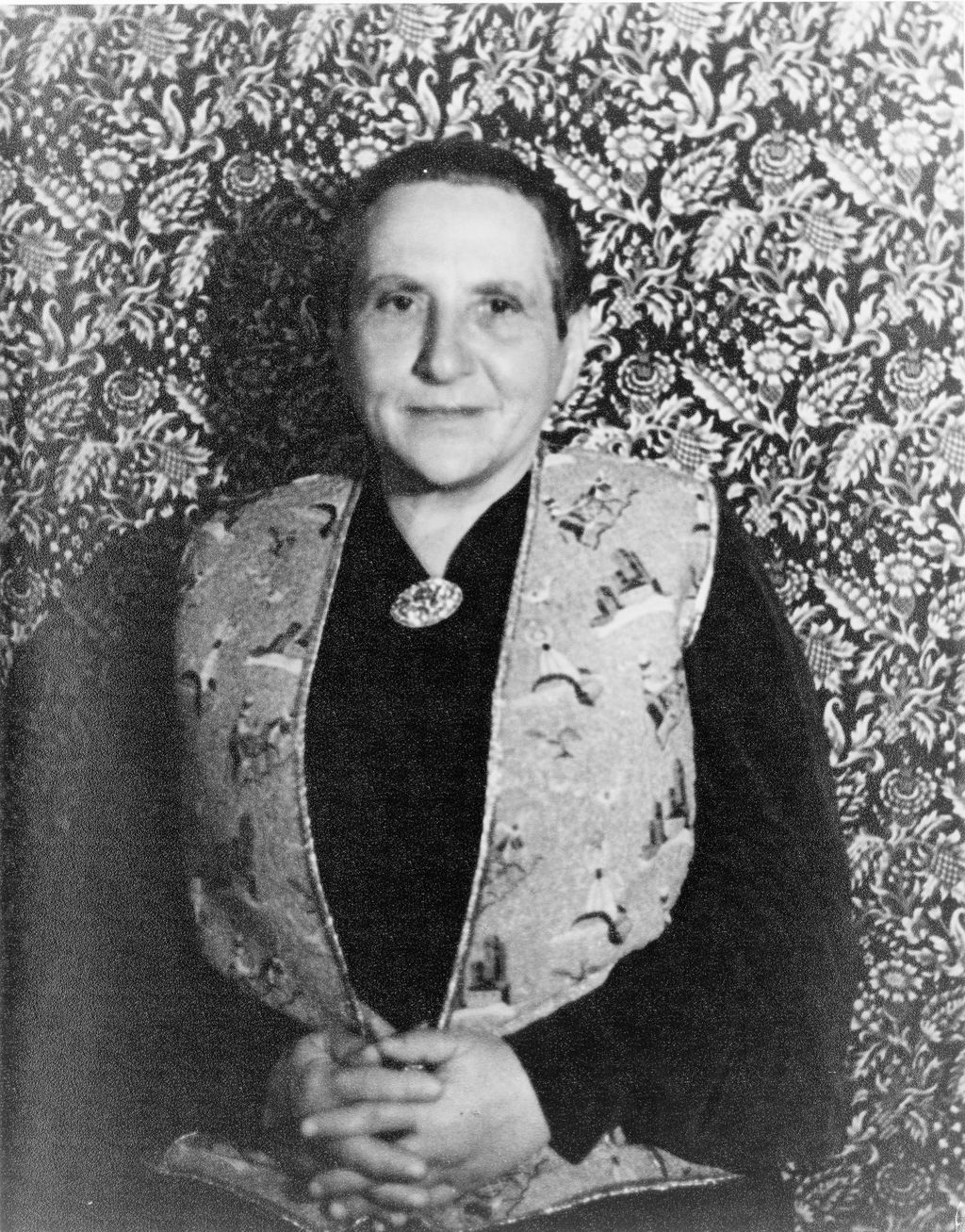
Gertrude Stein sits forward in a broad chair, her hands settling on her lap and her dark clothing gathering into large, weighty forms. The face above them seems to belong to a different pictorial rhythm. Its heavy-lidded eyes, strong outline and concentrated expression have often been described as masklike. Yet the canvas is not two unrelated pictures placed together. Picasso made the differences between face, clothing, hands and background part of the portrait's force: the viewer meets a particular woman and, at the same time, sees an artist testing what a likeness might be. [1] [2]
The painting is Pablo Picasso's Gertrude Stein, made in 1905–06. It is an oil on canvas, 100 × 81.3 centimetres, now in The Metropolitan Museum of Art, New York[1], as object 47.106. “Portrait of Gertrude Stein” is a familiar descriptive title for it. The date range matters. Picasso began painting Stein in Paris in 1905 and reworked the portrait in 1906; it was not a single inspired moment, nor does it establish the exact day Cubism began. It is a record of looking, revising and thinking through a friendship between two people who were developing new artistic languages. [1] [8]
At a Glance
- Sitter: Gertrude Stein, writer and collector
- Made: 1905–06
- Visual contrast: Weighty seated body and simplified, masklike face
Portrait of Gertrude Stein in Picasso's career
First Communion
1896Portrait of Gertrude Stein
1905–06Three Musicians
1921Las Meninas series
1957The highlighted work is dated with the qualifications explained in the sources on this page. The other works are selective points of comparison, not the start or end of a style.
Contents
- Gertrude Stein was more than Picasso's sitter
- What the painting shows
- How many times did Stein sit?
- What conservation can and cannot reveal
- What happened after Gósol?
- The portrait Stein chose to keep
Gertrude Stein was more than Picasso's sitter
Stein was an American writer living in Paris, where she and members of her family became important early collectors of avant-garde art. Her brother Leo, brother Michael and Michael's wife Sarah had their own roles and tastes; the collective story should not be flattened into the actions of one person. The Stein family's rooms brought Cézanne, Matisse and Picasso into conversation for visiting artists, writers and collectors. The 27 rue de Fleurus apartment that Gertrude shared with Leo became particularly famous as a place to see and discuss these works. [1] [7] [4]
The Met's account of its portrait[1] describes Stein's early patronage and friendship as critical to Picasso. She was not merely posing while a future genius discovered her. As a collector and host she helped put his art before people who might look closely, buy it or talk about it; as a writer she was pursuing a formal experiment of her own. During the period of the sittings she was working on the stories that became Three Lives. The Met's conservation essay[2] notes her later recollection that she composed sentences in her mind while posing. That is her account of her activity, not a licence to claim that every change in Picasso's paint was caused by a particular literary phrase. [1] [2]
This network was practical, not simply glamorous. The Baltimore Museum of Art's account of Etta Cone[5] records a collector whom Stein brought into Picasso's studio and whose purchases continued afterward. Cone's later collection preserves a material trace of how introductions could develop into sustained support. The SFMOMA exhibition on the Stein family[7] likewise treats the siblings and Sarah Stein as participants in collecting and advocacy. Gertrude's portrait emerged within that exchange of art, writing, hospitality and money. None of this means Stein commissioned every work she owned or that Picasso's choices can be reduced to pleasing a patron. It means the sitter had access, taste and influence of her own. [5] [7]
Stein's relationship to the image did not end when she stopped sitting. She kept the painting, hung it where visitors to her Paris home would see it, wrote about its significance and later chose where it would go after her death. Her image was a meeting point between her own public identity and Picasso's developing reputation. The portrait's history therefore includes what she did with it, not just what Picasso did to the canvas. [3]
What the painting shows
Stein fills the lower part of a square-ish upright composition. Her dark brown corduroy dress or coat forms broad planes across the shoulders and arms. The chair behind her has a red-brown back that pushes forward through the warm, muted background. Little in the room competes for attention. Her head, set high above the heavy clothes, appears relatively small; the eyes and mouth are restrained, while the nose and brow give the face a sharpened structure. It is a portrait built from changes in weight: broad body, compact face, long downward sleeves and hands that interrupt the dark mass near the bottom. [1] [2]
The hands do not perform a gesture with a clear story attached to it. One lies across the lap; the other rests near the edge of the chair or clothing. Their different angles help hold the figure in place and counter the frontal pull of the head. Because the body leans slightly toward us, the sitter can seem to occupy the viewer's space without returning a direct, conversational gaze. Nothing in the painting tells us that Stein was angry, unhappy, aggressively “masculine” or disappointed by the world. Such descriptions import a psychological script into a pose that can be studied more precisely as form. [1]
There are passages of quick, visible painting as well as areas of firmer contour. The dark sleeves gather colour and brushwork; the background does not create a meticulously measured interior. This matters to the viewer's experience. Stein is not isolated by a flat blank field, but neither does Picasso let surrounding objects explain her. The chair gives her a place and a frame, then the painting concentrates on how a person can emerge from a small range of browns, reddish tones, skin colour and sharply adjusted lines. [2]
The head has made the work famous, but calling it a “mask” can be too easy. It is not an anonymous prop placed where a face should be. The eyes, asymmetric contours and specific relation to the body make this Stein's portrait. The word points to Picasso's simplification and to contemporary interest in older and non-academic forms, but the Met's object account[1] more specifically mentions his encounter with Iberian sculpture. Other sources and artistic encounters may have mattered too. The face is a painted solution within one evolving work, not a label that ends the inquiry. [1]
Watch: Pablo Picasso
Explore Picasso through five videos from museums, broadcasters and art educators.
Picasso’s Guernica: Great Art Explained
Explore the composition and historical setting of Picasso’s best-known response to war.
Watch on YouTubeHow many times did Stein sit?
The best-known story says Stein sat for Picasso eighty or ninety times. Stein told it years later, most influentially in The Autobiography of Alice B. Toklas, published in 1933. Despite its title and Toklas's first-person voice, Stein wrote the book. Its portrait episode has shaped almost every retelling: long sittings, repeated failure to capture the face, Picasso covering it over, a summer in Spain and a final head painted without Stein present. This is indispensable evidence for how Stein remembered and narrated the painting. It is not a dated session diary that independently verifies a precise count. [2] [8]
The Met's fuller catalogue account in French[8] places the beginning of the sittings in autumn 1905, says Picasso painted out a face with which he was dissatisfied in spring 1906, and describes the final reworking on his return to Paris. It also considers Stein's near-ninety figure likely exaggerated in view of Picasso's rapid practice. The useful distinction is between many sittings, for which there is strong support, and an exact total, which remains unproved. The romance of a large number must not override the evidence simply because it is memorable. [8]
There is a valuable independent glimpse of the process. The Baltimore Museum of Art's research on collector Etta Cone[5] records that Stein invited Cone to a sitting in November 1905. Cone bought two works from Picasso at that visit, and later acquired more. The account anchors one visit in a wider network of women collectors and patrons. It does not turn that occasion into a complete timetable. What we can safely say is that the portrait took shape over months, and that Stein's accounts of those months were themselves part of her creative and public life. [5]
What conservation can and cannot reveal
In 2020, Met conservator Isabelle Duvernois and research scientist Silvia A. Centeno described what X-radiography and elemental imaging reveal beneath the visible Gertrude Stein[2]. Their findings make the work's revisions material, not merely anecdotal. Mapping iron in the brown earth colours shows broad, swift paint application in the coat and chair. Drips descend along the sleeves. It also exposes worked-over passages at the centre and around the hands, while one side of the background was altered far more than the other. [2]
The face preserves ghostly traces of earlier features. A thin outline suggests a previous three-quarter profile near the cheek, but it cannot be securely identified as the first sketch made in front of Stein. No photograph or written description of that initial sketch survives. Imaging can show that paint was changed, covered and shifted; it cannot give us a complete portrait at every intermediate stage, or tell us how many times Stein was present for each alteration. [2]
The hands contain a particularly vivid trace of decision-making. The Met's elemental map shows seven adjacent fingers in an underlayer where Picasso shifted one hand's position. There are not seven fingers in the finished portrait. The extra shapes are evidence of revisions under the visible surface, perhaps connected to changes in the rest of the figure. Even the celebrated face was not the only place where Picasso wrestled with the picture. The technical account turns a legend about one difficult head into a more complex account of a whole painting in motion. [2]
This evidence also corrects the idea that Picasso first completed a perfectly naturalistic body and then simply attached a new face in one swift act. The present canvas certainly makes head and body feel different. Yet the mapped adjustments to clothing, hands and background show a wider process of revision. We can describe the finished contrast and the underlayers without pretending to reconstruct a neat sequence of every brushstroke. The painting is more interesting for the questions that survive than for a tidy before-and-after myth. [2]
What happened after Gósol?
In the summer of 1906, Picasso travelled with Fernande Olivier to Gósol, a village in the Catalan Pyrenees. The portrait was not finished there in front of Stein; its head was revised after his return to Paris. The Met sees in the new face a relation to Picasso's recent encounter with Iberian sculpture and to the more simplified, archaizing forms that emerged around the Gósol period. The Musée national Picasso-Paris's Spanish account of 1906[6] understands the painting as a Paris–Gósol–Paris development, stressing continuities rather than a single abrupt revelation. [6] [8]
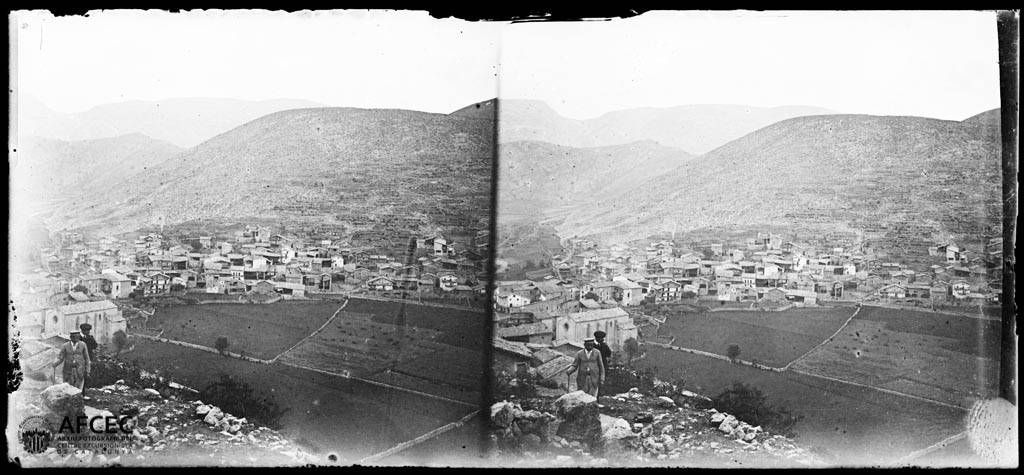
This does not settle one exclusive source for the face. Artists in Picasso's circle encountered museum objects, reproductions and one another's work, and later curators have proposed several comparisons for the forms of 1906. The Spanish exhibition essay places the portrait in a broader conversation involving Iberian art and other older visual traditions. These objects and cultures have their own histories; calling all of them simply “primitive” hides differences and repeats a dated hierarchy. It is safer to identify the source or interpretation when possible and to avoid making a particular influence certain where the evidence is comparative. [6]
The contrast between Stein's comparatively modelled body and the concentrated, simplified face is often described as a bridge from the Rose Period toward Cubism. As a way of orienting a reader, this has value: the painting shows Picasso testing a more structural account of a head and figure. But it is not yet an analytic Cubist painting in the sense of his works with Georges Braque several years later. Nor does a single portrait prove that Stein “caused” Cubism. The history is less mechanical. Picasso made choices across many works; Stein and the artistic community around her participated in the conditions in which those choices were seen, discussed and developed. [1] [6]
The portrait Stein chose to keep
Stein did not regard the finished picture as a failed likeness. She lived with it for decades. Photographs and accounts of her rue de Fleurus rooms show it as a prominent object in the space where she received visitors. The Met's archival essay on Picasso and Stein[3] describes how it became part of her own account of her modernity: she placed her literary experiment and Picasso's visual experiment in a shared story. Her 1933 memoir made the portrait's creation memorable partly because it also made Stein an active narrator of artistic change. [3]
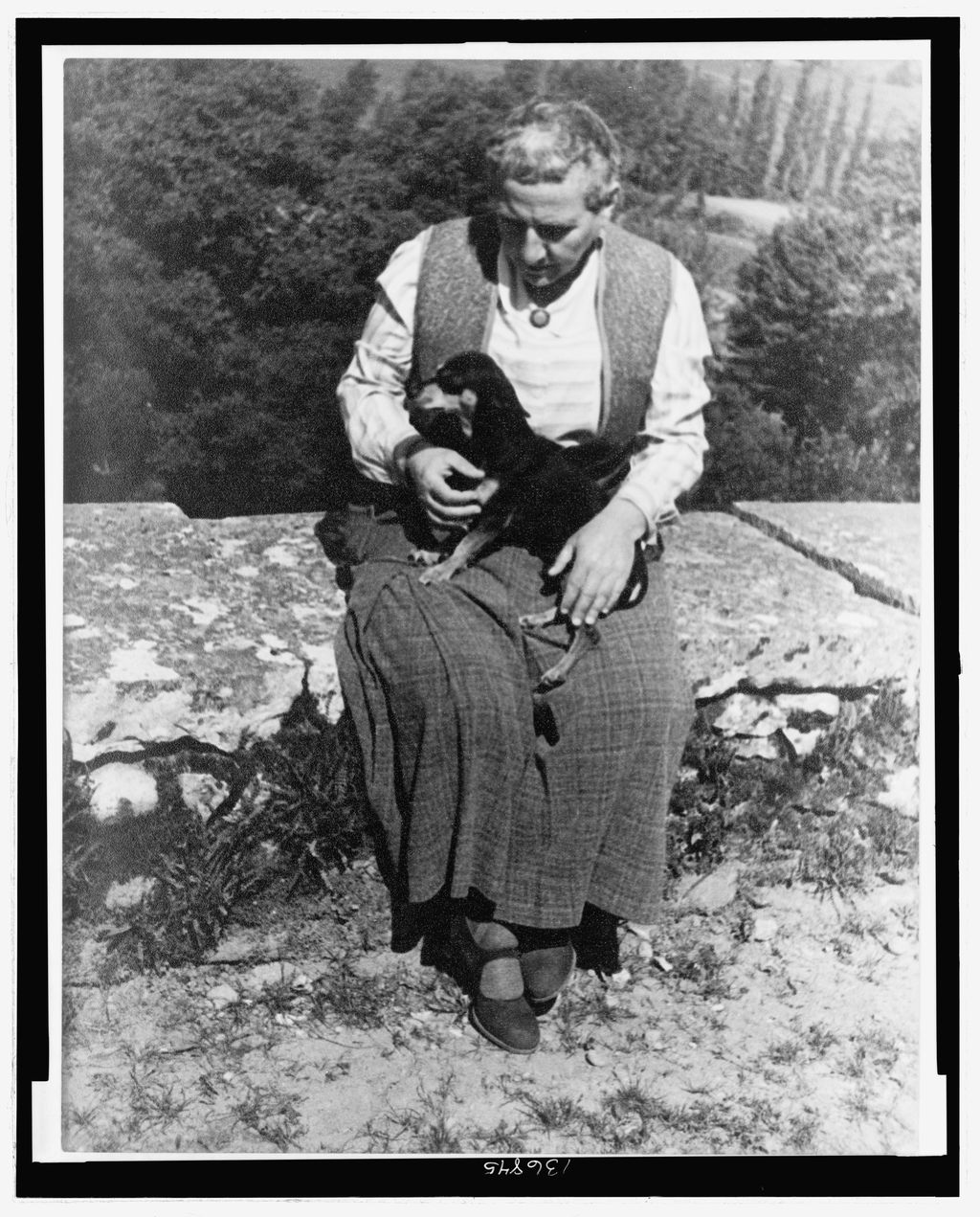
That self-presentation deserves neither unquestioning acceptance nor dismissal. Writers, like painters, select and arrange experience. Her vivid account of the sittings can preserve the pressure and duration of a relationship even if its numerical claims cannot be verified. Conversely, treating her recollections as mere vanity would erase the genuine fact that she wrote, collected, advocated and shaped the painting's public meaning. She produced literary portraits of Picasso in later years; he was her subject as well as she was his. [3]
The picture also stayed with Stein and her partner Alice B. Toklas through changes of address and the upheaval of war. The Met records that Stein made this portrait the only painting specifically named in her will for a museum bequest. She died in 1946; the canvas arrived in New York in 1947 and became the first Picasso painting to enter the Met's collection. The museum's credit line, “Bequest of Gertrude Stein, 1946,” refers to the bequest, not the date Picasso painted it. The accession number 47.106 reflects its arrival into the museum's records. Other works from Stein's collection followed different paths; this named bequest should not be merged with later sales by heirs. [1] [3]
Toklas's place in that history is easy to lose when the painting is told as a story of two famous makers. She shared Stein's life and helped manage the consequences of Stein's death, including the painting's departure for New York. The Met's archival essay describes how difficult that departure was for her. A reader need not choose between recognising Stein's deliberate bequest and recognising Toklas's care for a work that had formed part of their home for decades. The portrait had both an institutional future and a deeply domestic past. That dual life helps explain why its transfer was more than the movement of a valuable canvas from one address to another. [3]
The bequest completed a choice Stein had made long after the last sitting. Picasso's portrait was to be publicly visible, but within an institution she selected. Today its location is part of the story, not the whole story. To see the work only as Picasso's precursor to Cubism is to miss the writer and collector who helped make it consequential. To see it only as Stein's self-image is to miss the material evidence of Picasso's restless alterations. The portrait's enduring strength lies in that intersection: a face that refuses easy naturalism, a body and pair of hands worked and reworked, and a sitter who continued to speak for herself. [1] [2] [3]
Discussion
Use the evidence and your own close looking to explain your view. These are editorial prompts, not reader comments.
Reader Insights
Where do the weighty body and simplified face meet or resist each other?
What does Stein’s later account establish, and what cannot it date precisely?
How did Stein’s own collecting and writing shape the portrait’s afterlife?
Join the Conversation
Which reading best fits the evidence?
References
- The Metropolitan Museum of Art, Gertrude Stein object 47.106.
- Isabelle Duvernois and Silvia A. Centeno, Met conservation study of the portrait.
- Francesca Wade, Met archival essay on Picasso and Stein.
- The Met, Modern Art Index Project profile of Gertrude Stein.
- Baltimore Museum of Art, Etta Cone and the November 1905 sitting.
- Musée national Picasso-Paris, Spanish research on Picasso's 1906 transformation.
- SFMOMA, The Steins Collect, on the family's collecting and advocacy.
- The Metropolitan Museum of Art, French catalogue account of Gertrude Stein.
Image Credits
- Carl Van Vechten, 4 November 1934. Library of Congress, Prints & Photographs Division, Carl Van Vechten Collection, LC-USZ62-103678. The Library considers this collection public domain; donor restrictions expired in 1986. Privacy and publicity rights may apply. Uncropped and uncolourised; proportional resize only. Source record. Licence.
- Cèsar August Torras i Ferreri. Public domain. Source: Wikimedia Commons (File:Dos homes en primer terme i al fons el poble de Gósol des del castell.jpeg). 1024px proportional sRGB JPG derivative; no crop. Source record. Licence.
- Carl Van Vechten, 1934. Library of Congress, Prints & Photographs Division, Carl Van Vechten Collection, LC-USZ62-136845. The Library considers this collection public domain; donor restrictions expired in 1986. Privacy and publicity rights may apply. Uncropped and uncolourised; proportional resize only. Source record. Licence.

