


 by Tom Gurney
Tom Gurney BSc (Hons) is an art history expert with over 20 years experience
Email: tomgurney1@gmail.com / Phone: +44 7429 011000
Introduction
Picasso's Self-Portrait of late 1901 shows a young painter who has made himself look older. A pale face and short beard emerge from a dark, high-collared coat against a field of blue. The economy of the setting gives the head exceptional force, yet the image is not an unfiltered record of how Picasso looked or felt on a particular day. The Musée national Picasso-Paris, which owns the painting, reads its aged features as part of a deliberate construction of the melancholy artist. That distinction—between a recognisable person and an image made for others to see—is the starting point for understanding this Blue Period work.[1][2]
The painting's current collection title is Autoportrait (Self-Portrait). The Paris museum dates it to the end of 1901, records Paris as its place of creation, and lists it as oil on canvas measuring 81 by 60 centimetres, inventory MP4. “Blue Self-Portrait” is a useful descriptive name, and historical catalogues have used other titles, including Portrait de l'artiste and Grand Autoportrait bleu. None of these names should make it interchangeable with every Picasso self-portrait dated 1901. This page concerns MP4, the large blue painting in the Paris collection.[1]
At a Glance
- Date: Late 1901
- Form: Painted self-portrait with blue ground and dark coat
- Collection: Musée national Picasso-Paris
Self-Portrait (1901) in Picasso's career
The highlighted work is dated with the qualifications explained in the sources on this page. The other works are selective points of comparison, not the start or end of a style.
Contents
- What Picasso shows in the painting
- A self-portrait made at a turning point in 1901
- Not the only Picasso self-portrait of 1901
- Why blue is more than a mood
- Ownership and later reception
- Looking at the painting without inventing a confession
What Picasso shows in the painting
The figure stands close to the front of the picture. His shoulders and torso are taken up by a dark overcoat whose collar rises toward the face. Picasso does not provide a room, a mirror, a palette or the usual signs of a studio. The broad blue background is comparatively spare. It makes the outline of head and coat legible without telling us whether we are indoors or outdoors. A viewer sees a person seemingly exposed to scrutiny, but not the circumstances in which he was painted. The face is the concentrated area of attention: light skin, darker eye sockets, and small warm accents around the features resist the impression that the whole canvas is a single flat blue.[2][3]
The body and face are handled differently. The coat is a large, simplified mass, while the visible features offer more local variation. That contrast makes the sitter appear both present and withdrawn. It is possible to feel the coldness of the colour and the enclosure of the coat without turning either into a factual report about the temperature of a Paris room. The museum's educational study notes that the figure has beard and moustache Picasso did not actually wear. Whether or not a viewer would know that from the picture alone, the documented discrepancy shows why “self-portrait” is not synonymous with “snapshot.” He could alter his appearance to make a pictorial role.[2]
The gaze is direct enough to establish an encounter with the viewer, yet the head is not simply square to the canvas. The Guggenheim's 2023 exhibition, which brought this painting together with another 1901 Picasso self-image, drew attention to the slight turn away. That small angle matters: it complicates the familiar description of a completely frontal confession. Picasso offers his face for inspection while also controlling the distance between figure and viewer. The painted person is identifiable as the artist; what is withheld is a definitive explanation of his inner life.[5]
A self-portrait made at a turning point in 1901
Picasso's year did not begin in an all-blue world. He had moved between Barcelona, Madrid and Paris, and his work responded to the crowds and visual languages of those places. In summer 1901 the dealer Pere Mañach helped arrange Picasso's exhibition at Ambroise Vollard's Paris gallery. Musée d'Orsay's account records its opening on 25 June and describes lively Paris subjects among the works shown. The late-year Self-Portrait followed that burst of activity. Treating all of 1901 as one uniformly dark interval would obscure the changes in subject, colour and artistic ambition that occurred within the year.[4]
An event within that chronology is beyond dispute. Picasso's friend Carles Casagemas died by suicide in Paris in February 1901. Barcelona's museum identifies Casagemas as a painter, draughtsman and writer who had shared a studio with Picasso and travelled with him to Paris in 1900. The Paris museum places Casagemas's death and Picasso's memorial images near the beginning of what art historians call the Blue Period. The friendship and loss are important historical context. They do not, on their own, prove that every blue passage in MP4 expresses one specific feeling, nor do they entitle a later writer to diagnose Picasso from a painted face.[8][9]
The Blue Period is a name given to a wider group of works, generally dated from late 1901 into 1904, in which restricted blue ranges and themes of vulnerability become especially prominent. The Paris museum's English account discusses Picasso's interest in people at the margins of society and the paintings associated with Saint-Lazare. The blue Self-Portrait belongs near the beginning of this shift, but it is neither a complete explanation of those later subjects nor an illustration of a single cause. It shows the painter inserting his own image into an emerging visual language while that language was still changing.[3][9]
The same Paris collection holds La Mort de Casagemas, MP3, an oil on wood dated to summer 1901. It is a picture of Picasso's dead friend, not of Picasso himself. Its compact 27-by-35-centimetre support and named memorial subject differ sharply from the larger, upright self-portrait MP4 of late in the year. The museum's inventory numbers are adjacent, but they are collection identifiers, not an artist's day-by-day sequence. Read together, the works show two kinds of address to loss: one represents the person who died, while the other presents the artist's own constructed image. That comparison is more precise than assuming the latter is a direct translation of the former into blue.[1][10]
One of the dangers of a biography-led reading is that it makes the painting's visible decisions seem automatic. Casagemas's death may help explain why Picasso was drawn to certain themes, as the museums suggest. Yet Picasso still chose a canvas of this size, an almost empty blue ground, an imposing coat, a carefully presented face and an aged appearance. Those choices could have been different even if the circumstances of his life were the same. A painting is made, not merely suffered. Recognising its construction does not deny the reality of grief; it prevents grief from replacing analysis of the work.[2][4]
Watch: Pablo Picasso
Explore Picasso through five videos from museums, broadcasters and art educators.
Picasso’s Guernica: Great Art Explained
Explore the composition and historical setting of Picasso’s best-known response to war.
Watch on YouTubeNot the only Picasso self-portrait of 1901
The precise object matters because Picasso made several images of himself that year. MoMA owns Self Portrait (Yo), an oil on cardboard mounted on wood, much smaller than MP4. The Spanish “Yo” means “I” and is written into that painting. The Guggenheim exhibition describes its forceful gaze, visible cardboard support and lively brushwork. It also says Picasso made at least four self-portraits in 1901. That number refers to different works and media, not four versions of the same blue Paris canvas.[5][6]
Picasso also pictured himself in a top hat. Musée d'Orsay interprets that summer image in relation to Toulouse-Lautrec, cabaret culture and the young artist's public pose. By contrast, it relates the later blue picture to a different artistic model: the figure of a misunderstood painter associated with Vincent van Gogh. These are curatorial readings, not proof that Picasso consciously followed an exact programme from one image to the next. Their value is comparative. The same artist could try out an elegant social identity, an assertive “I” and an older-looking solitary figure in one year.[4]
Barcelona's Museu Picasso catalogues a further 1901 Self-Portrait drawn in pen and ink on the reverse of printed cardboard. Made in Barcelona, it is only 12.8 by 9.8 centimetres. Its support and scale are unlike the Paris oil. Even the label “1901 self-portrait” therefore needs a museum, medium or inventory number to specify its referent. A reproduction without those facts can easily be miscaptioned, especially when a search result places several very different images under the same short title.[7]
The contrasts also unsettle a tidy story of linear progress. It would be easy to make the confident Yo stand for youthful optimism and the blue painting for a sudden loss of hope. But a canvas can borrow the posture of an earlier painter, a cardboard image can make a bold signature into its subject, and a small drawing can serve a different purpose again. The works are not chapters in a diary whose meaning is known in advance. They are experiments in how Picasso might present an artist—himself—to different audiences and under different visual conditions.[4][5][7]
Why blue is more than a mood
The colour is crucial, but “blue means sadness” is too short an account of it. In MP4, a restricted range ties the figure to its surroundings while allowing the pale face to stand out. The coat appears dark against the background and yet participates in the same cool atmosphere. Warm details in the face become more noticeable because so much of the canvas is held within related tones. The result is a formal concentration: colour directs where the viewer looks and how the space feels, even before any biographical information is supplied.[2][3]
The Paris museum's study places Picasso's blues in a longer history of painting. It mentions Spanish painters of the seventeenth century, the use of coloured shadows by Impressionists, and the elongated, sometimes gaunt faces of El Greco. It also proposes Van Gogh's self-portraits as a modern comparison. These connections should not be collapsed into a single claim of imitation. A viewer can see how Picasso's picture converses with earlier ways of giving a face drama and depth, while still recognising how radically little setting he gives his own figure.[2]
Musée d'Orsay sharpens the Van Gogh comparison by locating it in a role rather than in matching brushwork. Its curators suggest that the late-1901 Picasso borrows something of the image of an artist not understood by his surroundings. The educational study similarly calls the melancholy artist a familiar theme, or topos. Neither museum says that looking at two painted beards proves two painters shared an identical psychology. The comparison becomes useful when it concerns pictorial address: how a painter invites an audience to read age, suffering and artistic seriousness in the face he has chosen to make.[2][4]
An oil lamp in Picasso's studio has also been proposed as one possible influence on the colour effects. The Paris educational sheet presents that possibility cautiously, not as the verified lighting conditions of the canvas. Nor does the painting's raised collar establish the weather on the day it was made. Those are attractive stories because they make the blue and coat feel instantly explicable. They remain hypotheses. The more secure description is that Picasso painted cool colour, a dark coat and an older-looking face, then allowed their relation to carry the image's power.[2]
Ownership and later reception
The Paris museum records MP4 among works formerly in Picasso's own studio. It entered the national collection through the Picasso estate dation in 1979. That history differs from the ownership path of MoMA's Yo, which has its own record and ongoing provenance research. Keeping the two separate prevents a frequent kind of art-history error: importing a sale, collector or museum into the biography of an object that merely shares a title and year.[1][6]
The catalogue's exhibition history shows that the blue Self-Portrait did not become important only after the Paris museum received it. The work appeared in Picasso exhibitions in Paris and Zürich in 1932 and in later retrospective contexts, including a 1980 MoMA show. These are documented appearances, not a claim that it was celebrated from the moment of painting. Indeed, the object record does not by itself establish its first public viewing, the reaction of visitors in 1901 or a precise date on which critical opinion changed. Its later display history tells us how institutions came to use the painting to represent Picasso's early work.[1]
The title has travelled too. A catalogue might say Autoportrait, another might use “Blue Self-Portrait,” and the Paris record preserves older scholarly labels. A dimension discrepancy appears even within material from the holding museum: its collection database and educational sheet give 81 by 60 centimetres, while some narrative pages give 81 by 61. The one-centimetre difference is not an artistic mystery to solve from a screen reproduction. It is a reason to state which record supplies an exact measurement and to avoid presenting all museum descriptions as if they were perfectly uniform.[1][2][3]
This care with names and measurements has a practical consequence for anyone seeking the painting. The authoritative Paris catalogue entry is MP4, not a generic image result for “Picasso self portrait 1901.” A different museum's self-portrait from that year may show another pose, support or scale and may have a separate copyright holder for its photograph. An unlabelled reproduction can be useful for orientation, but it cannot settle provenance or permission. The Paris record and the museum's study supply a more reliable path to the painting's identity than an old web caption or a shop listing.[1][2][6][7]
Looking at the painting without inventing a confession
The appeal of the work lies partly in its refusal to settle into one register. The face can seem exposed, but its beard and aged features are fashioned. The coat can seem protective, but it also gives the figure an imposing silhouette. The blue can suggest cold or isolation, but it is also a deliberate and historically informed colour choice. Each observation can support more than one interpretation. The challenge is to keep a distinction between what the painting shows, what the museums have established about it, and what a viewer infers.[2][4]
That distinction protects the human story rather than removing it. Casagemas was a real person and artist, not a device invented to explain blue paint. Picasso had known him, shared work and travel with him, and made other images in response to his death. The painting was made in a period of changes in Picasso's subjects and palette. Yet the self-portrait does not provide a transcript of private thoughts, evidence of a clinical condition or a record of literal winter chill. A thoughtful reading can hold the documented relationship and the constructed image together without making either one swallow the other.[2][8][9]
For readers interested in Picasso's wider practice, MP4 is also a useful point of comparison. It is one early version of an artist representing himself, not “the” face of Picasso for all time. Other self-portraits made in 1901 vary in scale, medium and posture; later ones change the treatment of the face again. The blue painting's particular achievement is to turn a small set of visible elements—a head, coat and field of colour—into a convincing artistic identity that can still be questioned. Its maker is present, but the painting is more than a confession by its maker.[4][5][7]
Discussion
Use the evidence and your own close looking to explain your view. These are editorial prompts, not reader comments.
Reader Insights
What choices make the young painter appear older?
How does the Paris museum distinguish construction from a record of mood?
Which Blue Period comparison sharpens the reading of this particular portrait?
Join the Conversation
Which reading best fits the evidence?
References
- Musée national Picasso-Paris, Autoportrait, MP4 collection record.
- Musée national Picasso-Paris, Autoportrait educational study.
- Musée national Picasso-Paris, Blue and Pink Periods and French artwork essay.
- Musée d'Orsay, Picasso Bleu et rose exhibition.
- Solomon R. Guggenheim Museum, Young Picasso in Paris exhibition press kit.
- MoMA, Self Portrait (Yo), 1901.
- Museu Picasso Barcelona, Self-Portrait drawing, MPB 110.438 and Yo Picasso exhibition.
- Museu Picasso Barcelona, Carles Casagemas biography.
- Musée national Picasso-Paris, chronology.
- Musée national Picasso-Paris, La Mort de Casagemas, MP3.
Image Credits
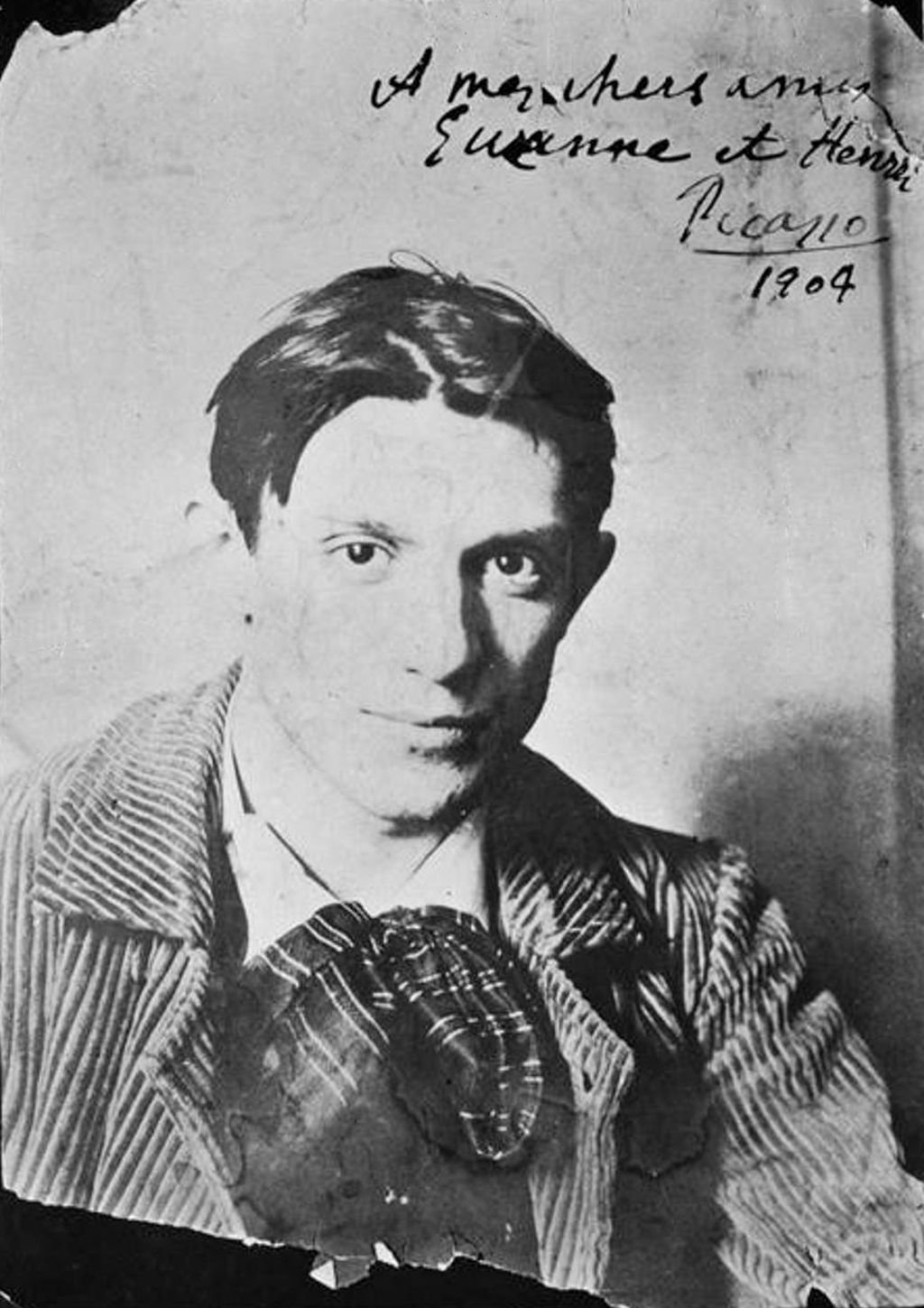
- Ricard Canals i Llambí, 1904. Wikimedia Commons labels the photograph public domain; its source credits RMN-Grand Palais. Resized to 1024px; no crop. Source record. Licence.
