


 by Tom Gurney
Tom Gurney BSc (Hons) is an art history expert with over 20 years experience
Email: tomgurney1@gmail.com / Phone: +44 7429 011000
Introduction
In Picasso's Cubist work, a piece of oilcloth can look like woven chair cane without being cane at all. A newspaper clipping may be both a patch of grey and a fragment of the day's news. Cardboard can become a guitar without forming the solid body of an instrument. These works ask a deceptively direct question: when a real material enters an artwork, does it represent something, become something else, or remain stubbornly itself?[1][2][3]
Collage and assemblage are related but not identical answers. Collage joins materials on a surface; papier collé means pasted paper; construction and assemblage can bring those materials into relief or into the room. Picasso explored all of them, especially during the Cubist years, then returned to found objects in later sculpture. This guide follows specific works and the roles of Georges Braque, printed culture, everyday materials and museum cataloguing. It treats the familiar “first collage” claim with care, because both its definition and its history are more complicated than a slogan allows.[1][4][5]
At a Glance
- Focus: Collage, papier collé and assemblage
- Key years: 1912–14 and later found-object sculpture
- Collaborator: Georges Braque
- Look for: Printed imitation, newspaper and real materials
Contents
- Collage, pasted paper and assemblage
- An 1899 pasted image before the Cubist years
- Still Life with Chair Caning and the material that imitates material
- Braque, Picasso and the arrival of papier collé
- Newspaper that is more than grey paper
- The Bottle of Vieux Marc and a ladder of meanings
- From the flat page to a cardboard guitar
- Found objects after the Cubist years
- How to look at a collage or assemblage
Collage, pasted paper and assemblage
A collage may contain drawing or paint alongside paper, fabric or another material attached to the support. The attached thing can be a ready-made image, a piece of patterned surface or just a shape cut for its colour and edge. In a papier collé, paper itself is the central pasted material: newsprint, wallpaper, packaging and coloured sheets can do jobs a painter might otherwise give to pigment. The physical source of a fragment matters because it carries its previous use into the work.[4][6]
An assemblage brings separate elements together in a more three-dimensional relation. The boundary is not always sharp. Picasso's 1912 Still Life with Chair Caning contains a real rope around an oval canvas, so it behaves like both an image and an object. A cardboard Guitar projects from the wall into space. In Bull's Head, two bicycle components become a figure without losing their identity as components. These cases are more illuminating than a rigid rule that every flat work is a collage and every joined object a sculpture. The sculpture guide follows that three-dimensional work in more detail.[2][3][7]
The crucial change was not simply that Picasso used inexpensive material. Artists had long attached, decorated and assembled things. In the Cubist works, a manufactured pattern or printed word entered a picture that was already questioning how representation works. A piece of paper might resemble wood, serve as a tabletop, remain a page of newspaper and create a flat shape at the same time. The viewer has to move between these readings rather than settle quickly on one.[4][8]
An 1899 pasted image before the Cubist years
The Museu Picasso Barcelona identifies a surprising earlier example. In March 1899, when Picasso was studying the figure at the Cercle Artístic in Barcelona, he pasted a small printed picture-card of the French actress Angeline Cavelle to his drawing Man Leaning against a Wall. The card came from a matchbox series of performers. The museum's exhibition asked whether this should count as a collage before the modern form usually dated to 1912.[1]
The distinction is worth keeping. The young artist had already encountered a city full of advertising, illustrated journals, cards and mechanically reproduced images. Cutting and pasting were not unknown gestures. Yet the 1899 drawing does not automatically have the same purpose as the Cubist still lifes of 1912–14. It puts a printed image beside a drawn figure; the later works turn the relationship between attached material, depicted thing and picture surface into a sustained artistic problem. Calling 1912 the first time Picasso ever glued an image to paper would be inaccurate. Calling the 1899 drawing fully equivalent to the later Cubist collages would flatten what changed.[1]
Barcelona's research also warns against writing the history as a lone artist discovering everyday print. Popular cards, advertisements and newspapers already circulated through ordinary life. Their subjects, typography and cheap availability made them possible artistic materials. The artist's choice and placement altered how they were read, but the materials did not emerge from nowhere. That broader visual world is part of the collage story.[1]
Watch: Pablo Picasso
Explore Picasso through five videos from museums, broadcasters and art educators.
Picasso’s Guernica: Great Art Explained
Explore the composition and historical setting of Picasso’s best-known response to war.
Watch on YouTubeStill Life with Chair Caning and the material that imitates material
Picasso made Still Life with Chair Caning in spring 1912. The Musée national Picasso-Paris catalogues it as oil and oilcloth on canvas framed with rope. The oilcloth is printed to imitate chair caning. That detail is the work's central trap: Picasso did not paste a piece of woven chair seat into the picture. He pasted an industrial imitation of it. A real material carries an unreal image of another material, while painted signs on the canvas suggest objects at a café table.[2][9]
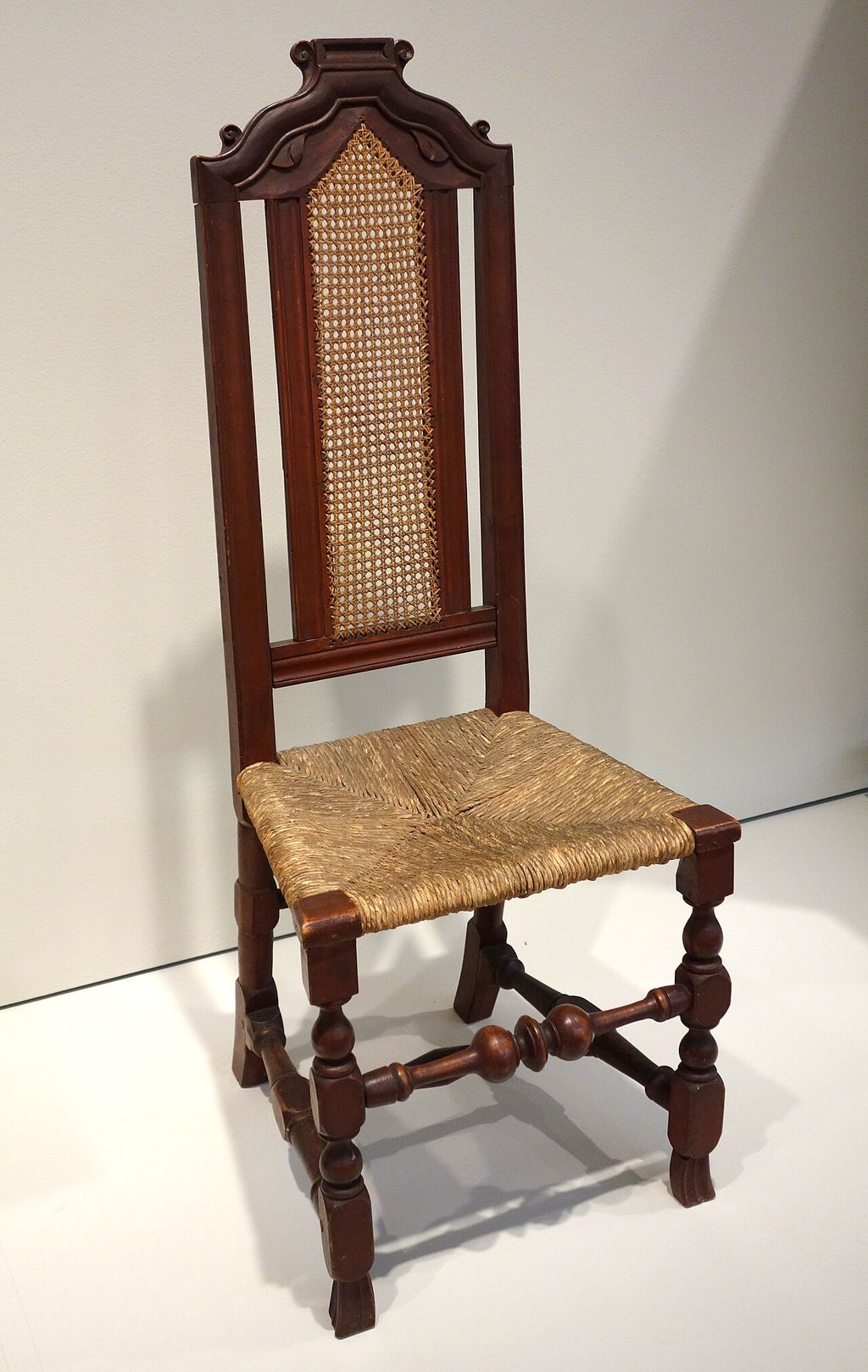
The rope complicates the familiar picture frame. It encloses the oval and belongs to the physical world, yet it can also evoke a table edge or a café furnishing. The letters “JOU” invite readings such as journal or jouer, though a fragmentary word should not be forced into a single decoding. The pipe, glass and other objects are suggested by partial marks rather than fully modelled forms. The viewer's mind completes a tabletop while noticing that its most tangible “cane” is printed on oilcloth. This is why the work cannot be described simply as a painting with a decorative scrap added.[9]
The Paris museum calls it a turning point in Cubism. Its educational research notes that it is often treated as the first recognised modern collage. That is a useful historical claim when framed as one about a particular modern artistic practice; it is less useful as an absolute claim that nobody had pasted material into art before. The Barcelona 1899 drawing already cautions against that. Moreover, “collage” here includes oilcloth and rope, whereas the subsequent history of papier collé concerns pasted paper in a more specific sense.[1][2][10]
Braque, Picasso and the arrival of papier collé
Georges Braque was Picasso's close collaborator in the development of Cubism, not a supporting character in an invention attributed wholly to Picasso. Centre Pompidou credits Braque with developing papier collé around autumn 1912, after Picasso's spring oilcloth experiment. The Metropolitan Museum of Art says Picasso followed Braque's example in September 1912 by pasting coloured or printed pieces of paper into compositions. The labels “collage” and “papier collé” refer to related procedures, but the sequence changes if they are treated as interchangeable. The responsible account names both artists and states which operation is under discussion.[4][5][11]
Picasso rapidly tested what pasted paper could do. Newsprint supplied letters and dates but also a grey tonal block. Wallpaper might stand for a wall or tablecloth while displaying its own mass-produced pattern. A tobacco packet could represent itself and simultaneously act as a colour accent. Paper could be cut to the outline of a bottle while carrying words from an unrelated article. The material was neither a mere shortcut for painting nor a neutral decoration. It brought the commercial and verbal culture of ordinary life into a picture's structure.[4]
This change is often associated with Synthetic Cubism, when larger, clearer planes and more legible signs could rebuild an object after the dense facets of earlier Cubist painting. The Cubism guide traces that wider shift across painting and construction. The label helps orient the period, but it should not imply a neat overnight switch. Some 1912–14 works remain difficult to read; others are playful or decorative. Centre Pompidou itself describes Picasso's experiments as taking several directions at once. The more precise question is how a particular fragment works in a particular composition.[4][5]
Newspaper that is more than grey paper
In Picasso's 1912 Man with a Hat and a Violin, the Met records cut and pasted pieces of Le Journal with charcoal on two joined sheets. The clippings are arranged around a schematic man and instrument. They also retain traces of news: the Balkan Wars, French mine unrest, serial fiction, advertisements and a personal tragedy appear in the paper. Those words do not vanish because the fragment has become part of an artwork.[5]
Nor is it safe to turn every visible word into a hidden message intentionally authored by Picasso. A newspaper is already a crowded, contingent object. The clipping's exact text can open a historical question about what readers saw in 1912, while its size and cut shape may explain its placement better than any supposed code. A close reading begins by noticing both: the paper's visual role and the fact that it came from a dated public medium. The Met's object record lets readers inspect this one work without generalising all Cubist newsprint into the same story.[5]
Other records make the range of materials clear. MoMA catalogues Glass, Guitar, and Bottle of early 1913 as oil, pasted newspaper, charcoal and pencil on canvas. Centre Pompidou catalogues Bottle, Newspaper and Glass on a Table of 1912 as charcoal, gouache and pasted papers on paper. Their museum departments classify one as painting and the other within drawing and papier collé. The works are not essentially different because of those administrative labels, but the labels tell us why “Picasso collage” does not designate one uniform object type.[6][12]
The Bottle of Vieux Marc and a ladder of meanings
Centre Pompidou's account of The Bottle of Vieux Marc, made in spring 1913, offers a useful way to read a papier collé. Actual newspaper remains newspaper. A real piece of wallpaper can suggest a tablecloth. The bottle is drawn in abbreviated form but identified by the words “vieux marc.” Charcoal lines suggest the table, bottle neck and glass. The work offers a range from material presence to visual allusion rather than an image in which every part belongs to one consistent illusion.[13]
The wallpaper also creates a problem of transparency. A patterned patch helps the viewer identify a glass because the same pattern seems to continue through it. Yet the “tablecloth” is itself wallpaper, not cloth. What looks like the optical evidence of a transparent vessel is built from a deliberate mismatch of physical material and pictured role. The viewer recognises the glass by accepting a small fiction while seeing the literal paper. This is a distinctive pleasure of Picasso's collage: representation does not disappear when real things are pasted down; it becomes more self-conscious.[13]
A later work in Berlin, Glass and Ace of Clubs of 1914, continues the game differently. Museum Berggruen describes pencil and pasted papers on paper, including faux-wood cardboard that forms a tabletop and a playing card connecting shapes. Its German record identifies the support, date and materials and treats the card as both object and compositional hinge. This is not a repeat of the 1912 oilcloth trick. By 1914, pasted papers could build spatial relationships from the edges and associations of several distinct fragments.[14]
From the flat page to a cardboard guitar
Picasso's cardboard Guitar of October–December 1912 sits at the border of collage and sculpture. MoMA describes paperboard, paper, string and wire cut, folded, threaded and joined. It was not a solid carved imitation of an instrument. Planes suggest the body; a projecting cylinder changes the expected sound hole; empty space becomes part of the construction. Early photographs show it both as an independent object and in a larger still-life arrangement. Its meaning and scale could shift with its setting.[3][15]
The relation to the paper collages runs both ways. Pasted planes can be read as a bottle, guitar or tabletop on a flat support. Cardboard planes can stand out into the room while still acting like drawn signs. Picasso's later sheet-metal Guitar of 1914 revisits the construction in a more durable material. It is not simply the same object made heavier. Metal holds bends and shadows differently, and the physical interval between parts becomes harder to overlook. MoMA's exhibition brought collages, constructions, drawings and photographs together precisely because a single medium category cannot explain these changes.[3]
Assemblage also need not become a completely freestanding object. The Paris museum describes Mandolin and Clarinet of autumn 1913 as a construction in relief, where wood elements and voids evoke instruments. The gap between pieces can be as active as the pieces themselves. This is different from attaching a news clipping to paper, but both methods make viewers read a thing through a selective arrangement of real materials and absences.[7]
Found objects after the Cubist years
Picasso returned to assembly in forms that did not look like paper Cubism. His Bull's Head of spring 1942 uses an actual bicycle saddle and handlebars. The Paris museum's object record names leather and metal. One can see a bull's face and horns without ceasing to see the bicycle parts. It is not merely “recycled art” in the sense of hiding waste inside a new product. Its double identity is the work's mechanism.[16]
At Vallauris in 1950, The Goat brought found things into a more composite sculptural process. The Musée national Picasso-Paris catalogues plaster with a basket, ceramic pots, palm leaf, metal, wood and cardboard. Some components remain recognisable; others are partly absorbed into the animal's body. The museum distinguishes this kind of additive sculpture from the almost immediate reorientation of two intact bicycle parts. Assemblage is therefore not one recipe. It can be a minimal joining or an extended negotiation between existing objects and modelling.[7][17]
The sculpture history has its own detail, including plaster, casting and workshop practice. Here the link back to collage is conceptual and material: selecting a fragment, keeping some of its former identity visible and asking it to work in a new whole. The cardboard guitar, the bicycle bull and the mixed-material goat are not equally “Cubist” in date or appearance. They show that the question of how ordinary matter becomes an image remained productive across different moments of Picasso's career.[3][7]
How to look at a collage or assemblage
Start by separating what is physically there from what it depicts. Is the “wood” really wood, printed woodgrain or paint? Is a visible newspaper a dated clipping, a drawn word or a blank grey plane? Does rope frame a picture or act as a represented table edge? In a construction, ask which pieces project, which spaces are empty and what changes when the object is viewed from the side. These questions make the work intelligible without pretending every ambiguity has one correct answer.[2][13][14]
Then use the museum label to identify the specific work. Still Life with Chair Caning is oil, printed oilcloth, canvas and rope; the 1912–14 papiers collés include cut newsprint and other papers; the cardboard and metal Guitars are distinct objects; Bull's Head and The Goat belong to later assemblage. Check date, material and institution rather than treating a familiar title or online reproduction as enough. The source photograph may flatten relief or hide fragile joinery, and it carries rights separate from the artwork.[2][3][12][16][17]
The museum records keep collaboration and chronology in view. Picasso did not single-handedly invent every form of cutting and pasting, and collage did not simply lead to sculpture as a final destination. From the 1899 matchbox card to the 1912 oilcloth and later bicycle parts, the recurring question is how a material's everyday identity can remain visible while it becomes part of a new image. Looking for that double role gives a reader more to work with than any claim that one artist discovered ordinary matter for art.[1][4][5][7]
Discussion
Use the evidence and your own close looking to explain your view. These are editorial prompts, not reader comments.
Reader Insights
In a collage, which part is literally present and which part is pictured?
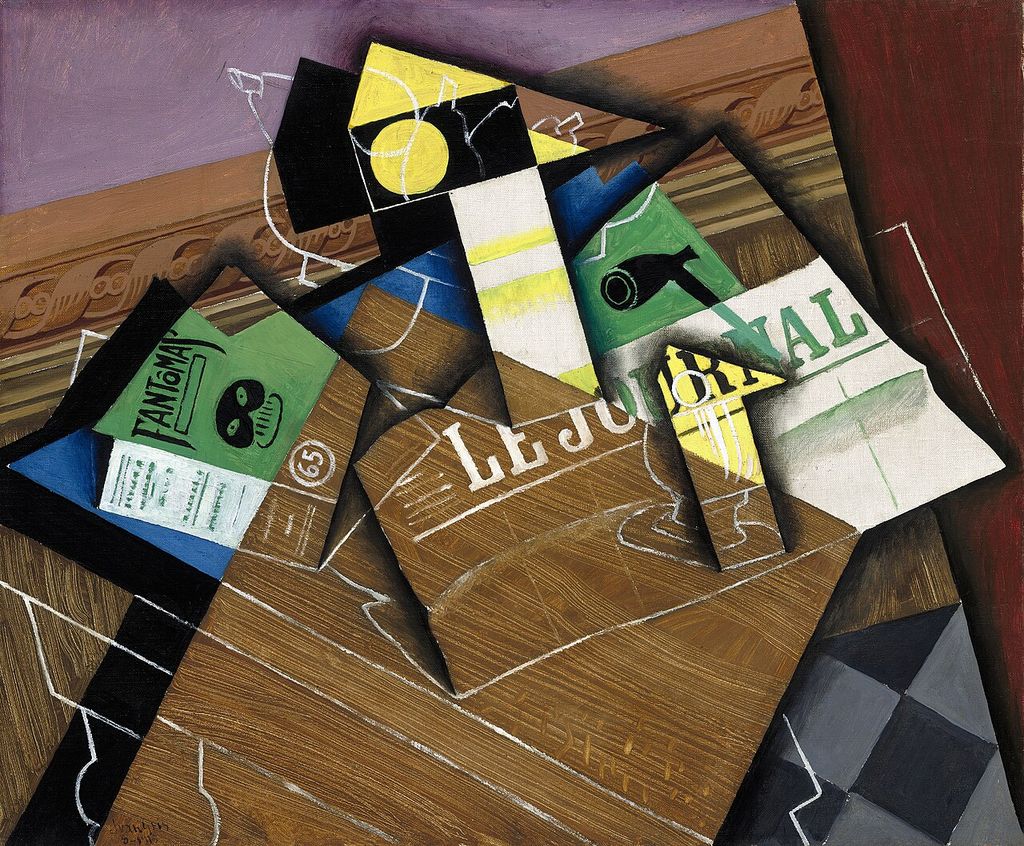
Compare Picasso's materials with Juan Gris's later Cubist collage, without treating one as the other's work.
Does the 1899 pasted card change what 'first collage' should mean?
Join the Conversation
Which reading best fits the evidence?
References
- Museu Picasso Barcelona, “A Collage Before Collage,” research on the 1899 Man Leaning against a Wall. View source.
- Musée national Picasso-Paris, “Nature morte à la chaise cannée,” MP36 object record. View source.
- The Museum of Modern Art, “Picasso: Guitars 1912–1914,” exhibition research. View source.
- Centre Pompidou, “Bouteille de Bass et carte de visite,” collection analysis of papier collé and Braque. View source.
- The Metropolitan Museum of Art, “Man with a Hat and a Violin,” 1912 object record. View source.
- Centre Pompidou, “Bouteille, journal et verre sur une table,” 1912 object record. View source.
- Musée national Picasso-Paris, “L'assemblage,” thematic collection research. View source.
- Centre Pompidou, “Bouteille de Bass et carte de visite,” analysis of pasted materials' varied meanings. View source.
- Musée national Picasso-Paris, “Nature morte à la chaise cannée,” museum essay. View source.
- Musée national Picasso-Paris, educational object sheet for Still Life with Chair Caning. View source.
- Fundación MAPFRE, “Picasso-Picabia. La pintura en cuestión,” Spanish dossier on 1912 experiments. View source.
- The Museum of Modern Art, “Glass, Guitar, and Bottle,” early 1913 object record. View source.
- Centre Pompidou, “La Bouteille de vieux marc,” educational object analysis. View source.
- Staatliche Museen zu Berlin, Museum Berggruen, “Glas und Kreuz-Ass,” 1914 German object record. View source.
- The Museum of Modern Art, “Guitar,” cardboard construction object record. View source.
- Musée national Picasso-Paris, “Tête de taureau,” MP330, original 1942 saddle-and-handlebar work. View source.
- Musée national Picasso-Paris, “La Chèvre,” MP339, original 1950 mixed-material object. View source.
Image Credits
- Juan Gris. CC0. Source: Wikimedia Commons. Resized proportionally to 1024px wide; no crop. Source record. Licence.
- Daderot. CC0. Source: Wikimedia Commons (File:Cane Chair, Boston, 1710-1720, maple - Chazen Museum of Art - DSC02595.JPG). 1024px proportional sRGB JPG derivative; no crop. Source record. Licence.
