


 by Tom Gurney
Tom Gurney BSc (Hons) is an art history expert with over 20 years experience
Email: tomgurney1@gmail.com / Phone: +44 7429 011000
Introduction
Two young men occupy nearly the full height of The Pipes of Pan. One stands with his weight shifted over a leg and looks beyond the scene; the other sits on a low ledge, raising a set of pipes to his mouth. Behind them, a band of blue sea meets a blue sky. Sandy architectural planes frame their bodies without telling us whether we are looking at a beach, a terrace, a stage or some combination of all three. The musical instrument names the painting, but the image is strikingly still.
Picasso's French title is La Flûte de Pan. The Musée national Picasso-Paris, which owns the painting[1], catalogues it as oil on canvas, 205 × 174 centimetres, inventory MP79, made in autumn 1923 in Paris. The same museum's shorter interpretive pages describe the men in relation to Picasso's summer 1923 stay at Cap d'Antibes. Those accounts need not be forced into a single moment: the summer offered people, light and coastal forms to think with, while the detailed object record gives the finished canvas an autumn Paris date. The painting itself keeps the two settings imaginatively together. [1]
At a Glance
- French title: La Flûte de Pan
- Figures: Two young men, one playing pipes, beside the sea
- Setting: The sandy architecture can suggest a beach, terrace or stage
Pipes of Pan in Picasso's career
First Communion
1896Three Musicians
1921Pipes of Pan
1923Guernica
1937Las Meninas series
1957The highlighted work is dated with the qualifications explained in the sources on this page. The other works are selective points of comparison, not the start or end of a style.
Contents
- Two men, one instrument
- Why Pan is in the title but not in the picture
- Classical form after Cubism
- Drawings, summer studies and an autumn canvas
- From Picasso's studio to the Paris collection
Two men, one instrument
The standing figure is almost frontal, but his pose is not square. One knee softens and the hips tilt, giving his body a slight counter-movement. His arms hang, and his gaze leaves the pair rather than joining the musician. The seated figure turns inward. He lifts the row of pipes with both hands so that it partly covers his face. The instrument interrupts our view of him as surely as it creates the possibility of sound. His bent leg stretches diagonally across the foreground, while the other folds back along the ledge.
Picasso has made the figures large without crowding the whole canvas with detail. Bare skin, white bathing trunks, dark hair and the broad horizontal colour of the sea do much of the descriptive work. Edges are firm but not uniformly outlined. The left man's shoulders and torso possess a sculptural weight; the right man's arms, knees and pipes form a denser arrangement of intersecting angles. Rather than showing two figures in synchronized action, Picasso gives us a contrast between a body open to the view and one nearly folded around an object.
Their hands make the contrast more exact. The standing youth's fingers hang near his thigh, free of a task. The player grips an object whose parallel reeds repeat the verticals of his fingers and of the blocks behind him. Because the pipes cover much of his mouth and lower face, he is known primarily through an action, while the other man's uncovered head is available for our scrutiny. Yet the uncovered man offers no reciprocal look. The painting withholds both the musician's full face and the standing figure's attention. That small imbalance helps give an apparently simple pairing its quiet psychological tension without needing an invented conversation between the two.
Their white trunks are a crucial modern clue. The men might at first resemble inhabitants of an ancient Mediterranean landscape, but they are dressed for a twentieth-century shore. The Paris museum's detailed essay[1] points out this double register. It sees both modern bathers and figures that recall the shepherds of classical poetry. The canvas does not ask us to choose one historical costume. It lets a contemporary swimmer's clothing appear amid architecture that could suggest ruins, modern blocks or the simplified scenery of a theatre. [1]
The space is deliberately hard to pin down. A pale slab rises at the left edge, another at the right. A step, platform or low wall supports the seated player. Beyond, the blue band marks the horizon, but the interval between these planes is too abbreviated to map as a real building. Flat, broad areas bring the men to the front. They also make the scene feel somewhat constructed, as if a few stage elements have been positioned to set off the bodies. The figures' monumentality depends partly on how little else competes with them.
Why Pan is in the title but not in the picture
Pan, in Greek myth, is a rustic god associated with shepherds and the syrinx or panpipes. Picasso does not paint the horned, goat-legged god standing beside the men. The title directs us to Pan's instrument, held by a human figure. This matters because it prevents the classical reference from becoming too literal. The holding museum explicitly says[1] that the canvas does not illustrate a particular episode from ancient mythology. [1]
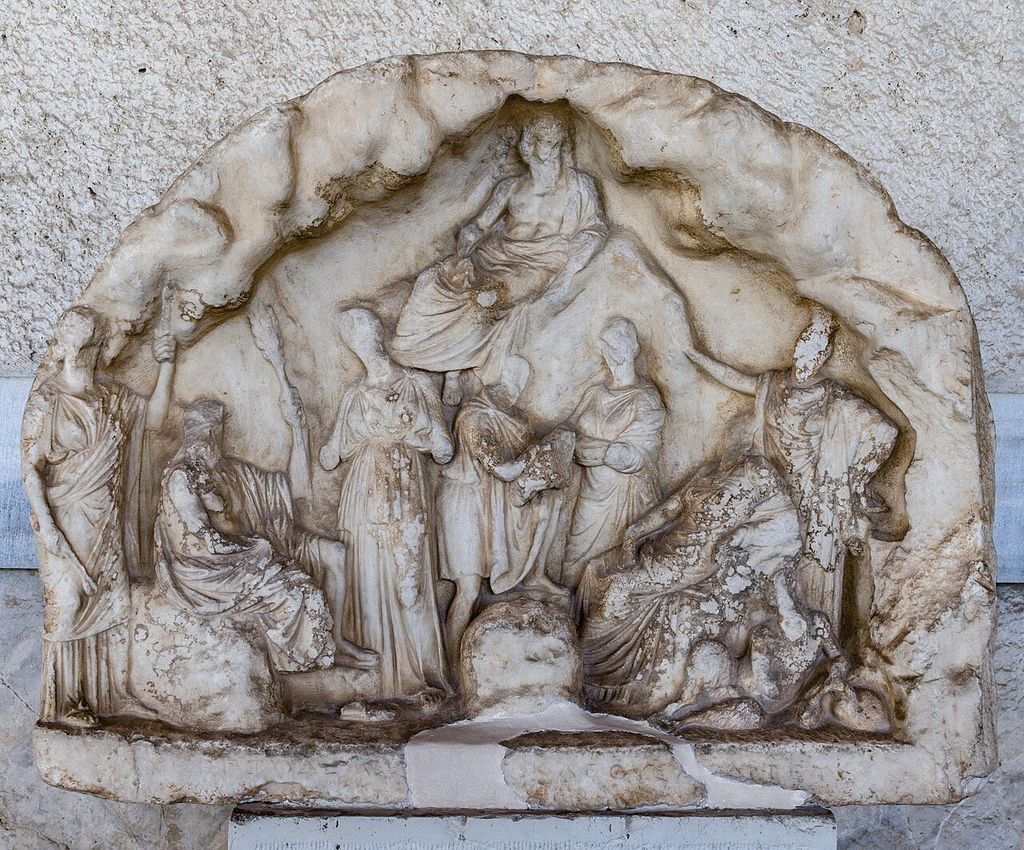
The Paris museum compares the young men with shepherds from Virgil's Eclogues and with people who might have inhabited the world of Ulysses. These comparisons describe the painting's range of associations, not a hidden script that identifies one man as a named ancient hero. The sea, instrument and simple architecture allow different Mediterranean times to overlap. A bather from 1923 can share a stage with an image of antiquity without ceasing to look modern.
It is possible to approach the two bodies through questions of youth, physical ideals or masculinity. Yet the old Picasso-site account turned those possibilities into certainty, claiming that the work directly expressed the painter's own sexuality and male confidence. No checked object record or statement by Picasso establishes that private meaning. The visible facts are more interesting than an invented confession: two solid but differently absorbed figures, one turned to an instrument and one to the distance, held in a sunlit setting whose period will not settle.
The music is similarly less straightforward than the title promises. We see lips near the pipes, but no painted notes, dancing crowd or responsive companion. The standing youth does not face the player. The Paris museum's essay calls the picture almost paradoxically silent and reads that stillness as a reflection on a lost classical world. Silence is an interpretation of an image, not something a canvas can prove was audible or inaudible in Picasso's imagination. Still, it catches an important visual effect: the pose implies playing, while the overall composition suspends the event.
Watch: Pablo Picasso
Explore Picasso through five videos from museums, broadcasters and art educators.
Picasso’s Guernica: Great Art Explained
Explore the composition and historical setting of Picasso’s best-known response to war.
Watch on YouTubeClassical form after Cubism
The Pipes of Pan belongs to the body of large, classical-looking works Picasso made after the First World War. The label “neoclassical” can be useful, provided it does not suggest that he simply abandoned everything he had learned from Cubism. The bodies are weighty and legible, yet the architecture behind them is pared down into planes; the foreground limbs are organised with severe clarity. Picasso could combine a classical figure with an experimental construction of space.
The Museo Nacional del Prado's artist account[4] draws attention to the volumetric forms, simplified drawing and affinities with ancient sculpture and fresco. It does not mean that Picasso copied a specific Roman statue for these two men. The standing figure's shifted weight belongs to a long history of contrapposto, the classical solution for giving a still body a sense of latent movement. He is static, but not rigid. The sitter's bent limbs then provide a more compressed counterweight. [4]
The Paris museum compares the painting with its own Three Women at the Fountain[1], a large classical subject of 1921. That earlier group places women around a water source with a different mixture of mass, drapery and monumentality. In The Pipes of Pan, the cast is reduced to two nearly undressed men and the setting to a few emphatic planes. The point of comparison is not to declare one painting more advanced. It is to notice how Picasso kept returning to the challenge of making a human group feel timeless while changing its scale, gender, setting and relation to water. “Classical” names a continuing inquiry, not one fixed recipe. [1]
The sea and bright trunks keep this classical vocabulary out of a museum of stone casts. The figures have lived-in colour and contemporary clothing. Their bodies are monumental, but their setting could be a holiday coast. Picasso's 1917 journey in Italy and the wider interwar interest in classical forms provide context; neither alone explains the particular beach-like encounter of 1923. The Paris museum's essay[1] stresses that “classical” here can mean seeking essential form, not reproducing the ancient world as a historical tableau. [1]
Another painting made in the same period shows the range of this approach. In the Museo Nacional Thyssen-Bornemisza's Harlequin with a Mirror[3], also dated 1923, a single performer assumes a sculptural presence while holding a mirror. His theatrical costume differs sharply from the bathing trunks of The Pipes of Pan. The Madrid museum exhibited the two works together in 1995–96 with drawings and other paintings, encouraging visitors to compare their development. That was a temporary loan of the Paris canvas, not a change of ownership. [3]
The Thyssen's object essay also presents a more personal theory associated with scholars William Rubin and Pierre Daix. They relate drawings around Harlequin with a Mirror and The Pipes of Pan to Picasso's attraction to Sara Murphy during the Antibes summer, with allegorical roles for Cupid, Venus and Pan. This is an attributed interpretation of a group of works, not a proven identification of the two men in MP79 as named people or a key to every gesture. Picasso's drawings explore combinations and allegorical possibilities that the final two-man painting does not simply repeat.
Drawings, summer studies and an autumn canvas
One dated drawing makes the longer development visible. The Paris museum owns Études: Cupidon et danse au son de la flûte de Pan, MP983[2], an ink sheet inscribed 4 February 1923. Its title refers to Cupid and dancing to Pan's flute. Because it predates the Antibes summer, it shows that the Pan-pipe theme occupied Picasso earlier in the year. It is not a small version of the finished pair, and its different cast of characters warns against treating every related drawing as a literal preparatory tracing. [2]
Other 1923 studies place classically inflected figures at the edge of the sea. The Paris museum's MP79 interpretation[1] compares them with the painting and with earlier seaside subjects such as Family by the Sea of 1922 and Two Bathers of 1921. These comparisons suggest a continuing investigation of the human figure in a stripped-down coastal setting. They do not reduce the final image to one documented source sheet or one observed afternoon. A full catalogue of those drawings would be needed to state a precise sequence of compositional changes. [1]
The difference between Cap d'Antibes and Paris deserves to remain visible. Short museum prose describes the painting as made during a summer stay in the south, where Picasso encountered the Mediterranean. The detailed MP79 collection record[1], repeated in the French culture ministry's Joconde entry[1], instead specifies autumn 1923, Paris for the finished work. Rather than pick one statement and erase the other, it is best to say that the subject and related studies belong to the 1923 Antibes context, while the most granular current object catalogue places completion in Paris that autumn. The coast remains in the picture even if the canvas was completed away from it. [1]
The museum's own public measurements likewise differ slightly. Its detailed object record and the state collection database give 205 × 174 cm; a shorter masterpiece page captions 205 × 175 cm. A one-centimetre discrepancy does not change the painting's monumental scale, but a careful record should say which measurement it is using. Here the detailed catalogue value controls. The canvas is over two metres high: a reproduction on a screen can hide how close to life-size—or larger—the young men appear in front of a visitor.
From Picasso's studio to the Paris collection
The painting remained in Picasso's studio collection and entered the French national collection through the 1979 dation made by his heirs, according to MP79[1] and the state's Joconde record[1]. A dation is a transfer of works in payment of inheritance tax; it is not an ordinary museum purchase. That provenance explains why a major 1923 canvas belongs to the Musée national Picasso-Paris today. The museum's live display status may change; ownership is the durable point. [1]
That institutional history is also useful when reading reproductions. The older English title The Pipes of Pan, the French La Flûte de Pan and the variant Pan Pipes point to the same MP79 oil, not to three paintings. But Picasso also drew and painted other flute subjects. A title search alone may turn up a February study, an image printed as a poster, or a later reproduction of this canvas. The museum inventory number, medium, dimensions and two-man composition are better identifiers than a translated title.
The work had a public life before the museum was established. The official exhibition history places it in Picasso's 1932 retrospective at Galerie Georges Petit in Paris and the Kunsthaus Zürich exhibition later that year. Those were important opportunities for audiences to encounter a painting that combined monumental classicism with a recognisably modern shore. Later loans carried it to other exhibitions, including the Thyssen's 1995–96 comparison with Harlequin with a Mirror. Being exhibited elsewhere did not transfer its ownership from Paris.
In the canvas, the musical cue remains suspended between action and silence. A modern bather raises Pan's ancient instrument while another looks beyond him, and simple blocks make a shore feel like both a real place and an arranged scene. Picasso gives them the presence of sculpture without making them statues, and gives the scene a classical resonance without telling a specific myth. Those tensions—rather than an invented private symbolism—are what make The Pipes of Pan more than a period label or a picture of two men at the beach.
Discussion
Use the evidence and your own close looking to explain your view. These are editorial prompts, not reader comments.
Reader Insights
How do the two figures divide stillness and music?
Does the background read most like a beach, terrace or stage?
Which classical association is useful without becoming a claim of direct quotation?
Join the Conversation
Which reading best fits the evidence?
References
- Musée national Picasso-Paris, detailed La Flûte de Pan record MP79 and its short masterpiece essay; French state Joconde entry.
- Musée national Picasso-Paris, Études: Cupidon et danse au son de la flûte de Pan, 4 February 1923.
- Museo Nacional Thyssen-Bornemisza, Harlequin with a Mirror and the 1995–96 two-painting exhibition.
- Museo Nacional del Prado, Picasso artist essay.
Image Credits
- Paul Cézanne. CC0. Source: Wikimedia Commons. Resized proportionally to 1024px wide; no crop. Source record. Licence.
- Jebulon. CC0. Source: Wikimedia Commons (File:Cave of Pan relief Agora Museum Athens.jpg). 1024px proportional sRGB JPG derivative; no crop. Source record. Licence.

