


 by Tom Gurney
Tom Gurney BSc (Hons) is an art history expert with over 20 years experience
Email: tomgurney1@gmail.com / Phone: +44 7429 011000
Introduction
A blue dancer rises at the centre of La Joie de vivre, arms lifted, hair spreading on either side of her head. Musicians and hybrid creatures join her near a band of dark Mediterranean blue. Pale sand, small animals, a boat and a spare horizon place the celebration at a shoreline that is both recognisable and imaginary. The French title means Joy of Life, but this is not a casual sketch of a happy afternoon. It is a large, carefully revised work made in the charged aftermath of war.
Picasso created the panel in 1946 in the Château Grimaldi at Antibes. The French state's official museum record[1] identifies it as MPA 1946.1.4, measuring 120 × 250 centimetres, and describes its materials as oil-resin paint and charcoal on fibre-cement. That hard support is an important part of its identity. The painting is not the oil-on-canvas work implied by some generic descriptions of Picasso's “pictures”; nor is it Henri Matisse's earlier painting with a similar English title. It belongs to the city of Antibes and is kept by the Musée Picasso there. [1]
At a Glance
- French title: La Joie de vivre
- Made: 1946, at the Château Grimaldi in Antibes
- Scene: Dancer, musicians and hybrid figures at an imagined Mediterranean shore
Joie de Vivre in Picasso's career
First Communion
1896Three Musicians
1921Guernica
1937Joie de Vivre
1946Las Meninas series
1957The highlighted work is dated with the qualifications explained in the sources on this page. The other works are selective points of comparison, not the start or end of a style.
Contents
- A dance built across a wide panel
- The Château Grimaldi as a working studio
- A process visible in Michel Sima's photographs
- Françoise Gilot and the central figure
- After war, without forgetting it
- Matisse and another Joy of Life
- The work's place in Antibes
A dance built across a wide panel
The unusual width gives Picasso a space closer to a frieze or mural than to a conventional upright portrait. The dancer forms a central axis, but the scene does not simply radiate evenly from her. Figures to either side strike different poses; one bends towards an instrument, another opens an arm or points across the shore. The sea's dark horizontal band holds these movements together. Above it, the light sky leaves room for the dancer's lifted hands and hair, while below it pale ground becomes a stage for feet, hooves and small animals.
The Antibes-area museum essay[2] identifies a nymph, a faun or satyr, a centaur and little goats. Such creatures make a Mediterranean pastoral rather than a record of an actual coastal gathering. Their bodies are freely transformed. A horse-like flank can coexist with a human torso; a musician is part person and part mythological presence. Picasso does not reconstruct an ancient vase scene. He takes familiar Mediterranean beings and makes them act within a distinctly modern arrangement of colour and line. [2]
The central woman holds a tambourine. This small object matters because it gives the lifted arms a purpose and sets a rhythm the other figures seem to answer. She is not still in the way a posed nude might be. One leg narrows towards the ground, the torso twists, and the hair flares sideways; her body can be read as passing through several positions at once. The departmental essay notes that this apparent rotation arises from different views of the body meeting in one figure. Rather than painting a sequence of separate dancers, Picasso compresses movement into a single, changing silhouette.
Dark passages at either end of the panel intensify the light middle. The shoreline and horizon supply long horizontal lines, while bodies, arms and angled forms pull the eye up and across. The dancer stands near the central line of a loose triangular structure, a relationship also traced in the local museum's formal analysis[2]. Those organising lines are not visible as an academic diagram when one first sees the work. They explain why its many creatures and gestures still read as one event rather than a collection of independent motifs. [2]
Picasso repeats colour across the supposed border between figure and landscape. Blue belongs to the dancer and to the sea; pale yellow and white move from ground into bodies and animals. The setting is therefore not a neutral background onto which characters have been pasted. It shares their palette and some of their contours. The small boat-like forms at the edges widen the imagined world without creating a map of a real stretch of Antibes coast. The picture invites recognition of the Mediterranean while refusing to become a topographical view.
The Château Grimaldi as a working studio
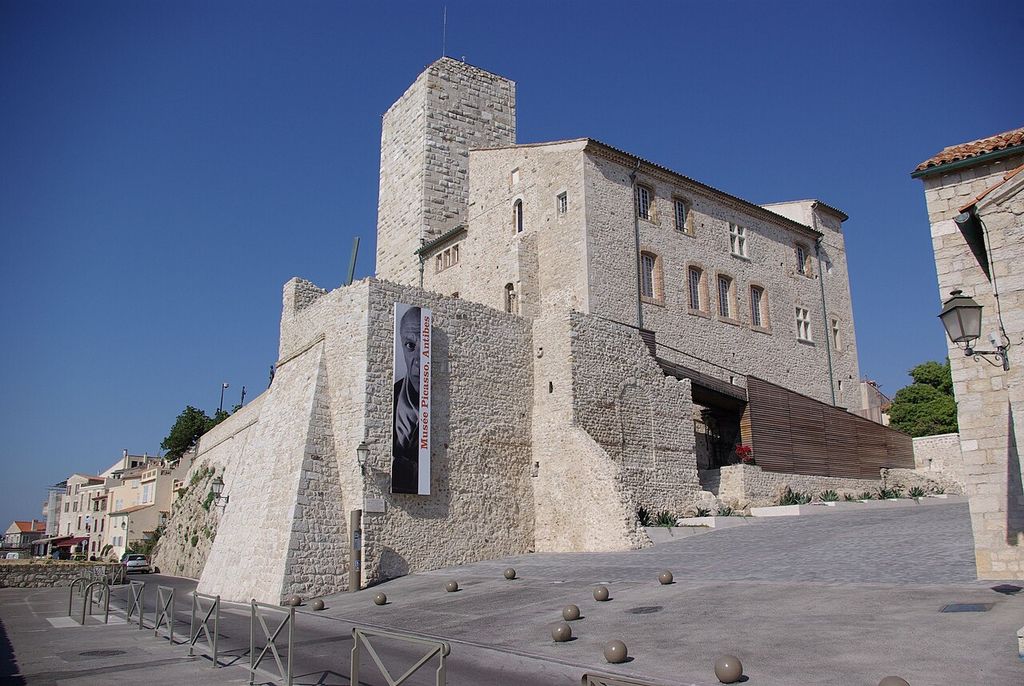
The place of creation is unusually secure. According to Antibes's own museum history[2], Picasso visited the Grimaldi museum in September 1945. Its curator Romuald Dor de la Souchère then offered him workspace in the château in 1946. The departmental account[2] places him in a second-floor studio from about mid-September to mid-November and dates the panel itself to October–November. The official object record gives the year and building rather than an exact day of completion. [2]
This setting is more than picturesque background. Picasso could work on a panel over two metres wide and revisit it as the composition developed. He made other fauns, satyrs, centaurs, marine animals and still lifes during the same Antibes stay. The Museu Picasso Barcelona's account of the Antibes collection[4] emphasises the variety of supports and paints in that group, including fibre-cement and industrial paints. The exact La Joie de vivre record specifies oil-resin paint and charcoal. A broad statement that every Antibes work is “Ripolin,” or that this one is a standard canvas, would miss the material variety of the studio. [4]
At the upper right, the official catalogue records the painted inscription “ANTIPOLIS 46” with a small faun head. Antipolis is the ancient name associated with Antibes. Its appearance is fitting in a work that blends mythic figures with a contemporary shore. The inscription ties the image to place and year, but does not turn the whole panel into a literal reconstruction of ancient Antipolis. The faun head acts almost like a small emblem beside the much larger living group.
The castle had a later history as a home for these works. The Antibes civic museum says Picasso left 23 paintings and 44 drawings with the city after his 1946 stay; its language describes the group as a deposit. The specific object record for La Joie de vivre[1] gives a 1946 gift and present municipal ownership for this panel. Those statements concern different levels of the collection's history and should not be compressed into an unsupported account of every individual transfer. The first Picasso room opened in the château on 22 September 1947; the building took the name Musée Picasso officially in 1966. The painting was not made in an institution already bearing that name. [1]
Watch: Pablo Picasso
Explore Picasso through five videos from museums, broadcasters and art educators.
Picasso’s Guernica: Great Art Explained
Explore the composition and historical setting of Picasso’s best-known response to war.
Watch on YouTubeA process visible in Michel Sima's photographs
Most paintings leave preparatory drawings or later recollections, but La Joie de vivre also has an unusually vivid photographic record. The Antibes-area museum essay says Michel Sima photographed at least nine stages as Picasso worked in the Château Grimaldi. The sequence shows substantial revisions rather than a single inspired gesture fixed at once. According to that source, the musical faun was reworked repeatedly; changes across the panel strengthened the movement and its overall spatial organisation.
There is an important limit to this evidence. The documented series lets us say that the work developed through multiple states, and that later museum researchers have compared those states. It does not justify inventing the exact order of every brushstroke without checking every photograph. Some photographs are held by the Antibes museum; a separate 1946 Sima photograph catalogued by the French state[3] shows Picasso and Françoise Gilot with the painting. This confirms their presence with the work, not that the central dancer was a posed portrait of Gilot or that she stood in the studio while each stage was painted. [3]
The photographic evidence also changes how “spontaneous joy” should be understood. The scene may feel light and unforced, but its look was worked for. Picasso adjusted figures and balances until the wide format could hold both a central dancer and activity spread towards the edges. The changes matter because they keep the work from being reduced to a simple emotional release after wartime hardship. Its appearance of ease is a formal achievement, not evidence that it required no revision.
Picasso continued the seaside world in related drawings known as the Suite Antipolis. The local museum's essay[2] places these drawings around the time he finished the panel and notes recurring figures on the shore or in the water. They show how the invented company of fauns, nymphs, centaurs and animals could keep moving beyond one large composition. They should not be treated automatically as preliminary drawings: some belong at or after the panel's completion. The same cast of characters can generate a later variation as well as an earlier plan. [2]
Françoise Gilot and the central figure
The dancer has often been linked with Françoise Gilot, Picasso's companion at the time. Gilot was herself a painter, not a “budding student” whose significance lay only in being Picasso's model. The Antibes-area museum essay[2] sees in the nymph the elongated body and flower-like hair that Picasso also gave to images associated with Gilot in 1946. It discusses the central dancer in relation to his Woman-Flower motif. This is a considered visual interpretation, not an inventory-label identification of a sitter for the panel. [2]
The distinction matters. A photograph of Gilot standing with Picasso and La Joie de vivre is a valuable historical document, but a photo beside a picture does not make every depicted figure a literal portrait. The dancer's blue, stretched body is also an allegorical and mythological construction. A Université Côte d’Azur research entry[3] conveys the range of readings: peace, happiness, a bacchante, Gilot, an exercise in representing bodily movement, and a response to older art. These are not equally proven biographical facts. They explain why a figure can suggest a known person while doing more than representing her likeness. [3]
Gilot's presence belongs in the account without being made to carry all of its meaning. She and Picasso were living together on the Riviera in 1946, and the Antibes source presents her as sharing his life and the château workspace. To describe the panel only as a measure of Picasso's private happiness would reduce both the artist Gilot and the public, postwar imagination of the scene. Equally, a reader need not deny personal connections to see a nymph dancing on a Mediterranean shore. The painting holds biography, myth and formal experiment together, but none of them cancels the others.
After war, without forgetting it
The title can sound like a declaration that wartime violence has vanished. Picasso made the panel in 1946, after the end of the Second World War, when liberation and reconstruction were immediate experiences rather than distant history. The departmental museum essay[2] reads the dancing group as an expression of renewed peace and collective energy. That is a powerful context for its musicians, shore and open movement. [2]
It is not, however, a complete account of Picasso's art about war and peace. In the preceding years he had made dark work, including The Charnel House of 1944–45[5], which takes bodies and violence as its subject. The Antibes canvas and that picture are different responses to a world marked by war. One does not prove the other was forgotten or overcome. The Riviera's light and mythic figures offer a space in which freedom might be imagined; they do not document that Picasso, Gilot or anyone else felt only joy. [5]
The contrast between a very dark horizon band and the pale, animated centre helps keep the painting from becoming a one-note festival. The sea can serve as a broad stage backdrop, while its colour also gives weight to the edge of the scene. No object record assigns it a specific political symbol. It is better to describe the visual contrast and the historical moment than to insist that every shade carries a settled allegorical meaning. The postwar reading is strongest when it remains a reading rooted in date and form.
Matisse and another Joy of Life
The title inevitably recalls Henri Matisse's Le Bonheur de vivre (The Joy of Life), painted in 1905–06[4], now at the Barnes Foundation. Matisse gathered dancers, musicians and reclining figures in a boldly coloured Arcadian landscape. Picasso's later Antibes panel likewise joins bodies, music and a world outside ordinary time. The resemblance is a good starting point for comparison, not proof that one picture is a direct parody of the other. [4]
The two compositions feel different. Matisse spreads figures through a broad landscape and tests vivid, shifting colour on a monumental canvas. Picasso compresses his mythic shore into a long band, places one dancer at its centre and works on fibre-cement. The Antibes-area museum account calls their connection part of a continuing pictorial dialogue. It also recounts an anecdote from Gilot's later memoir about Picasso and Matisse joking over how each might paint her. A remembered conversation years after the event may illuminate their relationship; it cannot establish that La Joie de vivre was painted as a joke at Matisse's expense.
Indeed, the word “parody” can mislead. It suggests a specific mockery, whereas the available museum sources support a relationship of subjects and artistic exchange without proving that intention. Both artists had reason to revisit the longstanding theme of music, bodies and imagined pleasure. Picasso could answer Matisse, echo a much older pastoral tradition and make a work tied to the Antibes studio at the same time. Comparison should enlarge the painting rather than force it into a contest with a single winner.
The work's place in Antibes
La Joie de vivre has become one of the signature works of the Antibes collection. The Museo Picasso Málaga's account of its 2006 exhibition[4] names the panel among major loans from Antibes and places it beside ceramics, sculptures, drawings, paintings and Sima's photographs. The related Barcelona exhibition[4] situated this Mediterranean group within Picasso's longer career. Those loans and publications widened access to the work, but its legal owner remained the city of Antibes. [4]
The panel rewards a return from biography and chronology to looking. Its dancer appears to pivot while the music-makers and animals fill the shore around her. Its lines are both angled and supple, its creatures ancient and newly invented, its support industrial and its subject pastoral. The title offers joy, but the work reaches that effect through selection, change and composition. Antibes provided the studio and a Mediterranean setting; Picasso made of them a scene that was never merely a sunny view from the window.
Discussion
Use the evidence and your own close looking to explain your view. These are editorial prompts, not reader comments.
Reader Insights
How does the central dancer organise the shoreline figures?
What does Antibes in 1946 add to a reading of postwar joy?
Which revisions can be documented rather than guessed from a reproduction?
Join the Conversation
Which reading best fits the evidence?
References
- French Ministry of Culture, La Joie de vivre, Antibes MPA 1946.1.4: object, materials, inscription, ownership and bibliography.
- Antibes city, history of the Musée Picasso; Alpes-Maritimes museum essay on the painting.
- French Ministry of Culture, Michel Sima's photograph of Picasso and Françoise Gilot with the work; Université Côte d’Azur, interpretations of the dancer.
- Museo Picasso Málaga, Los Picassos de Antibes; Museu Picasso Barcelona, Els Picassos d'Antibes; Barnes Foundation, Matisse's Le Bonheur de vivre.
- The Charnel House of 1944–45. View source
Image Credits
- Clemensfranz. CC BY-SA 3.0. Source: Wikimedia Commons. Resized proportionally to 1024px wide; no crop. Source record. Licence.
